


VF Corp Update
For newer readers, here’s a quick overview of the key drivers behind our thesis on VF Corp, a global apparel and footwear leader with a portfolio of iconic brands, now firmly in the growth phase of its turnaround with significant operating leverage ahead:
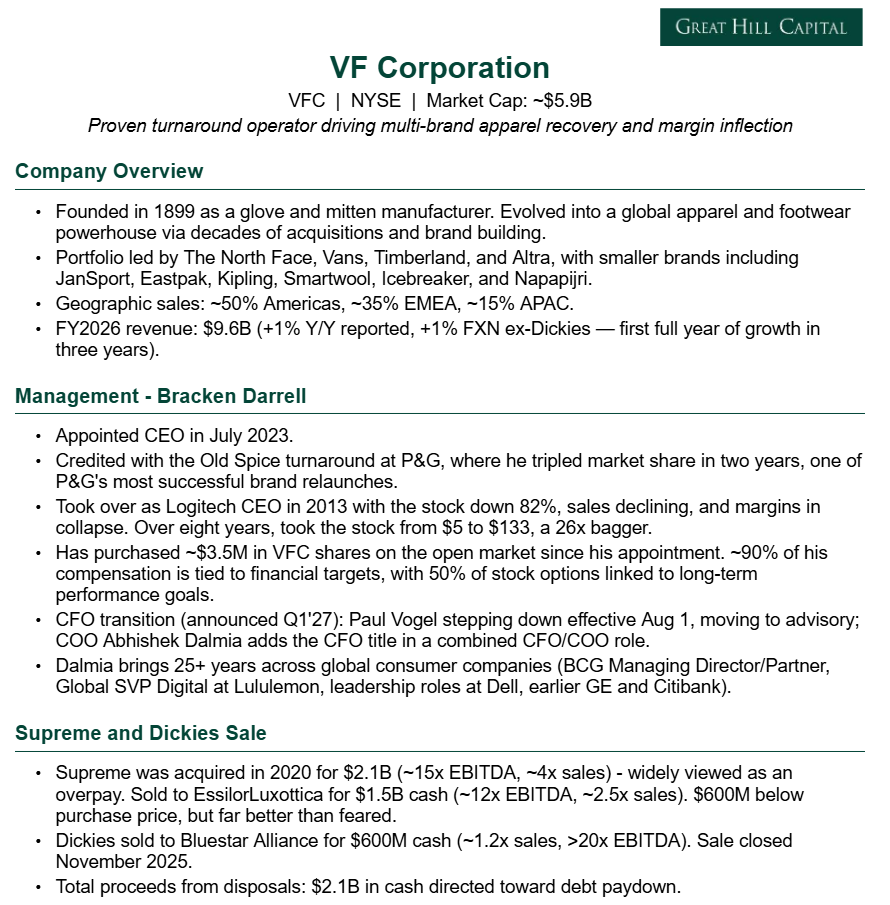
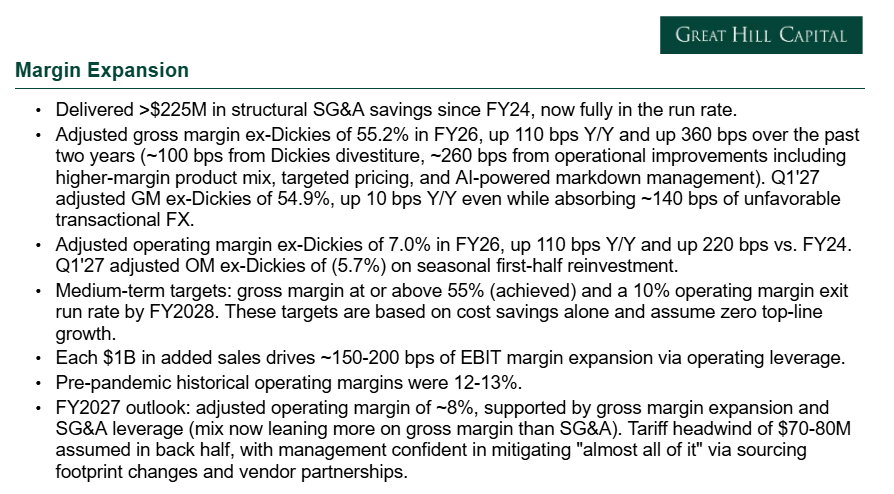
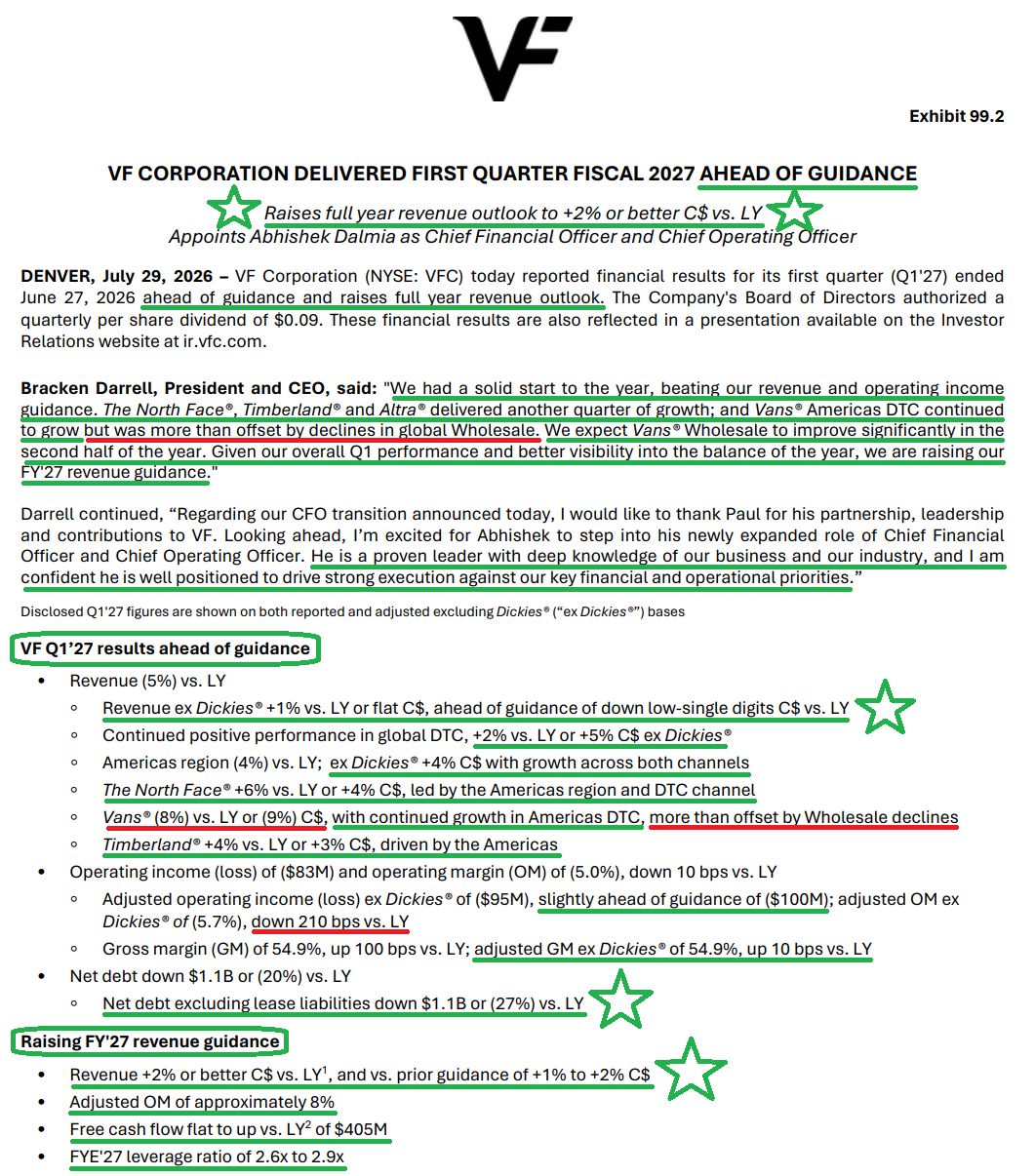
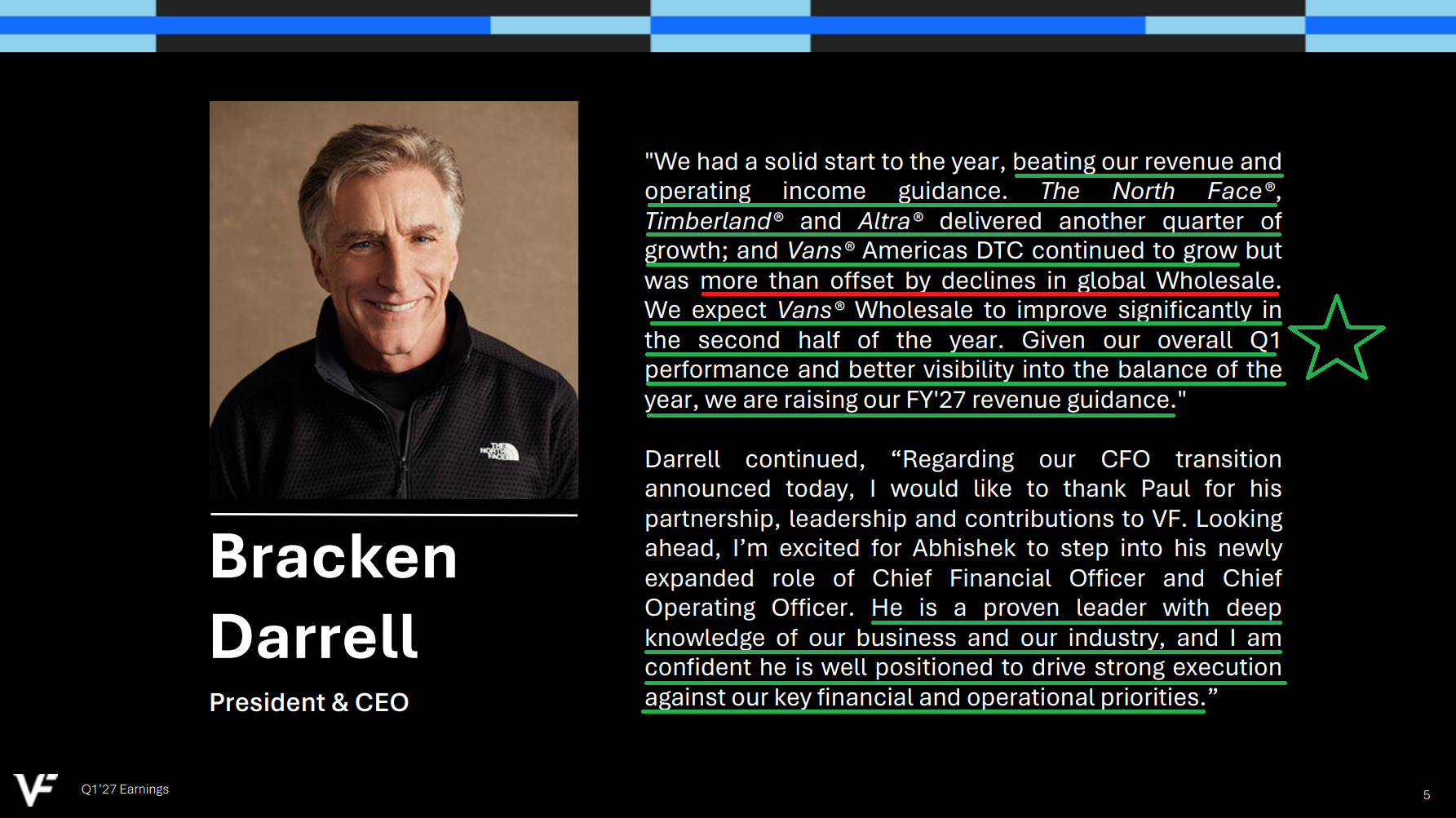
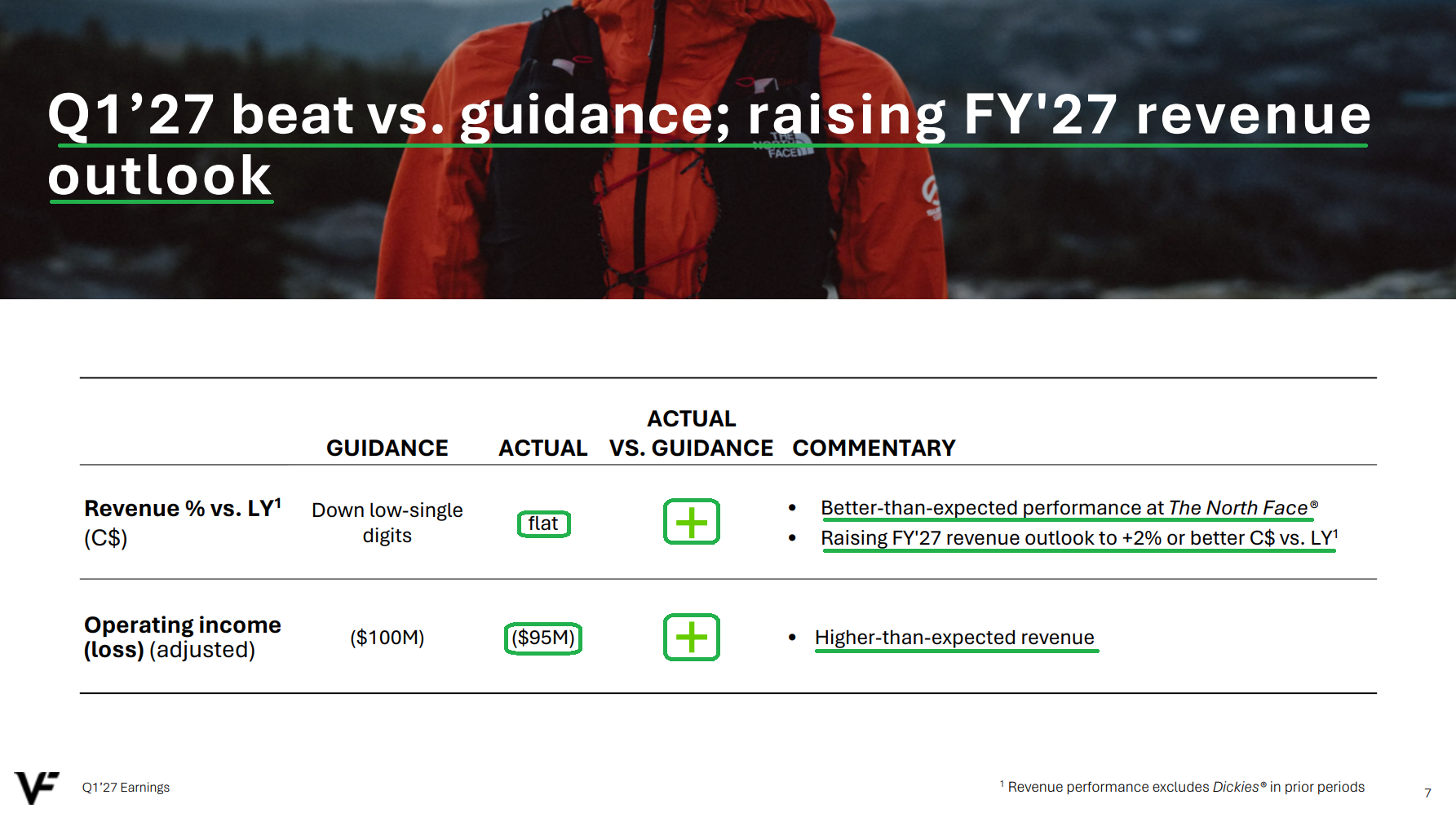
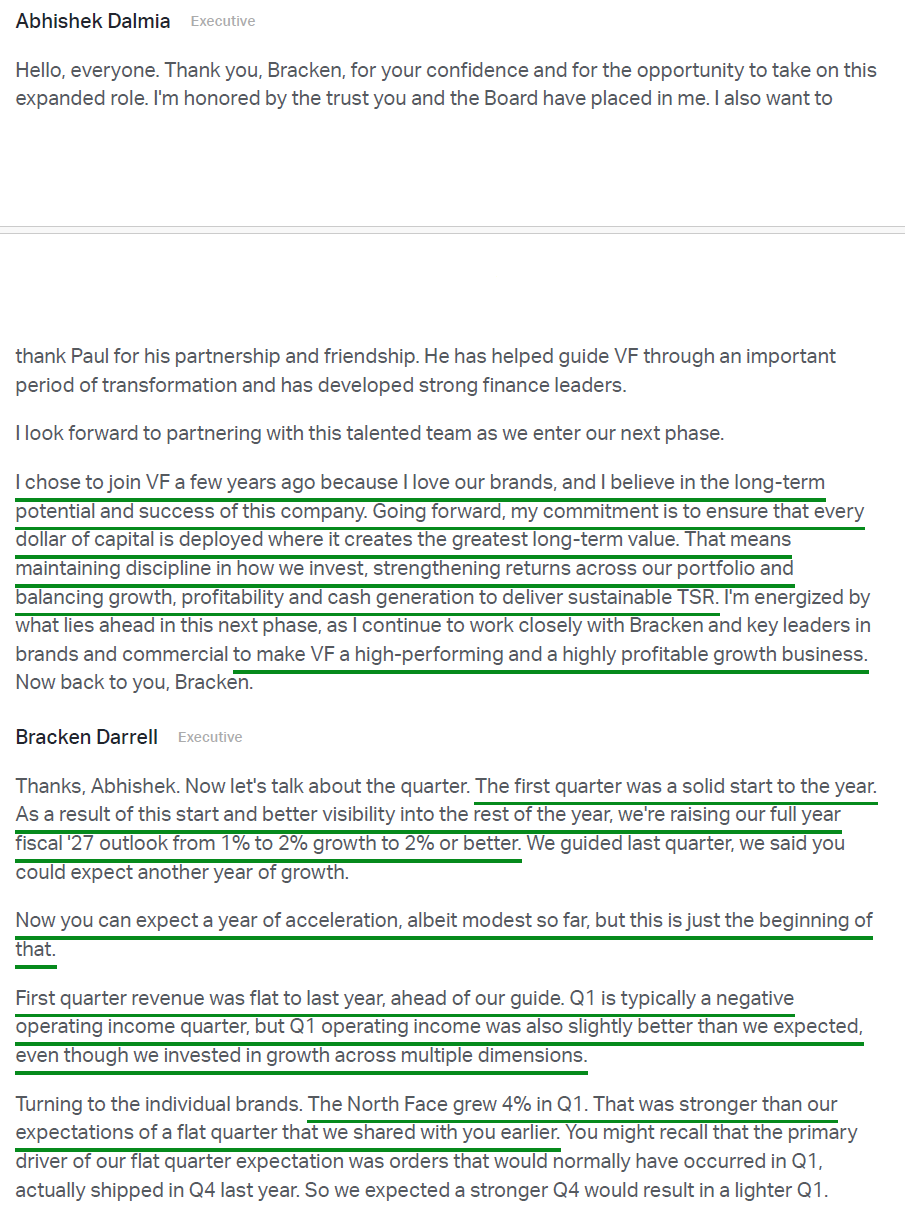
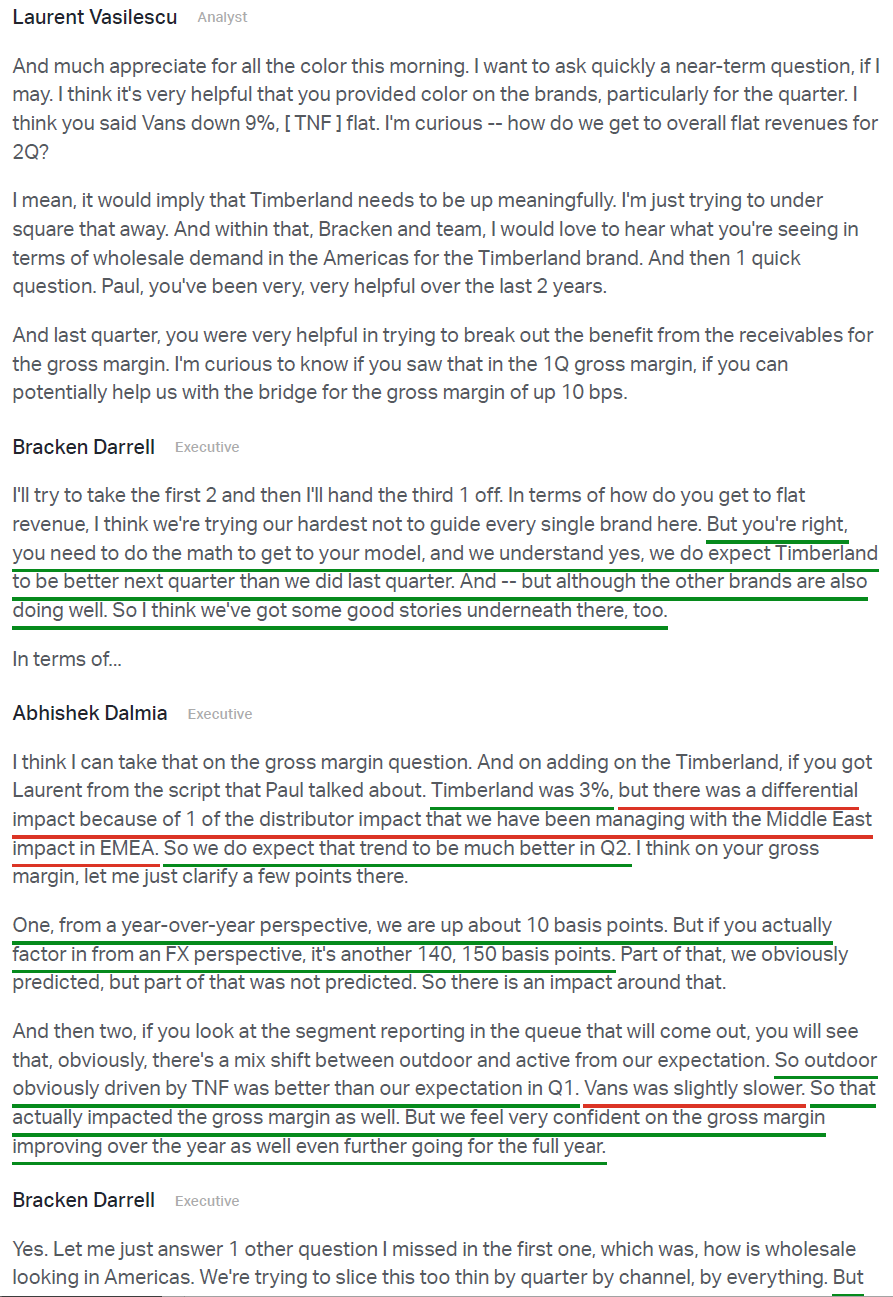
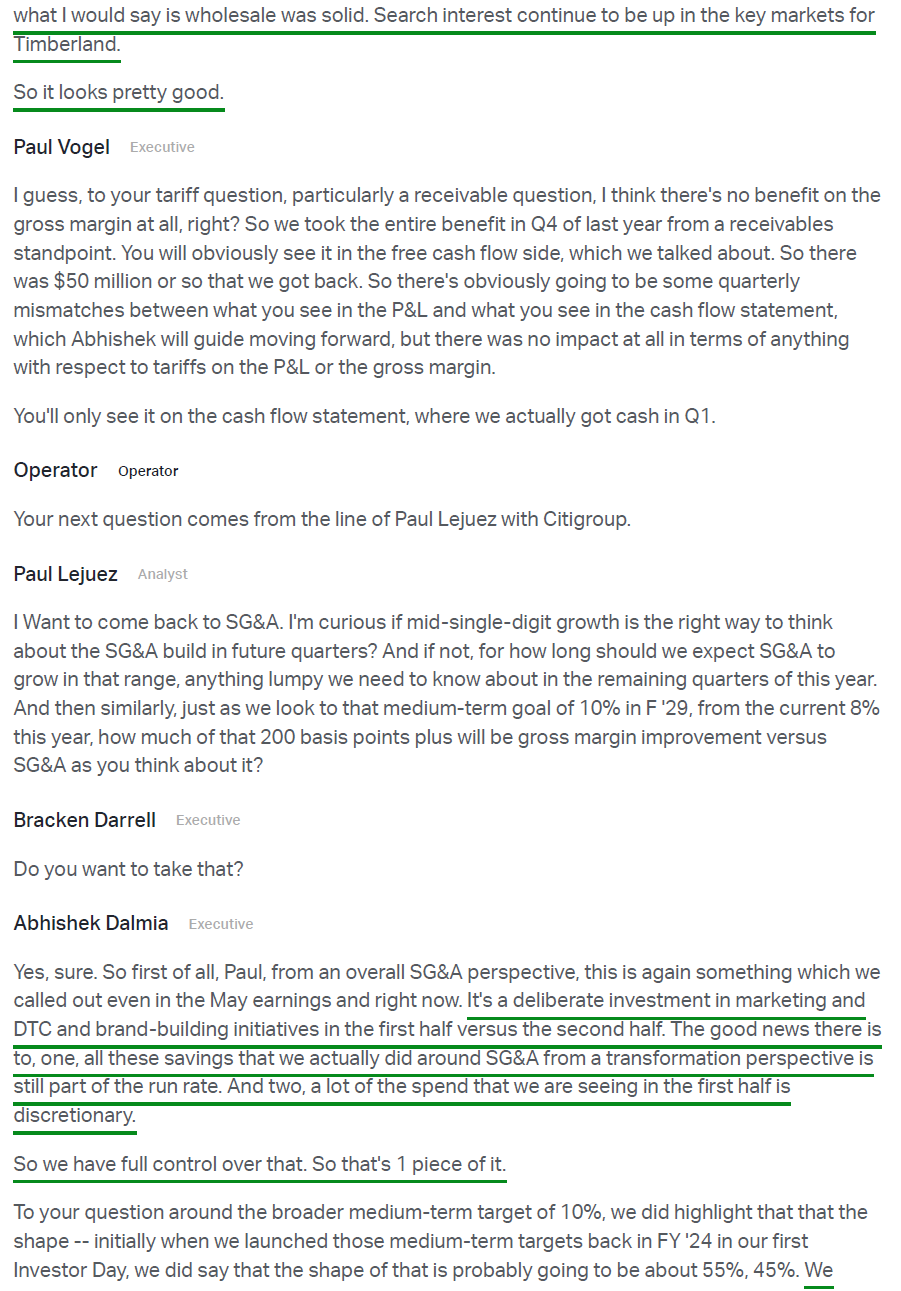
VF Corp delivered a solid start to fiscal 2027, exceeding management's guidance in what is seasonally the smallest and weakest quarter of the year. Revenue of $1.67B came in flat C$ ex-Dickies versus guidance for a low-single-digit decline, topping the Street's ~$1.64B, with the vast majority of the portfolio now full steam ahead in growth mode. The outperformance was driven by The North Face, which grew +4% C$ versus management's expectation for a flat quarter, along with +3% C$ growth from Timberland and double-digit growth from Altra across every region and channel.
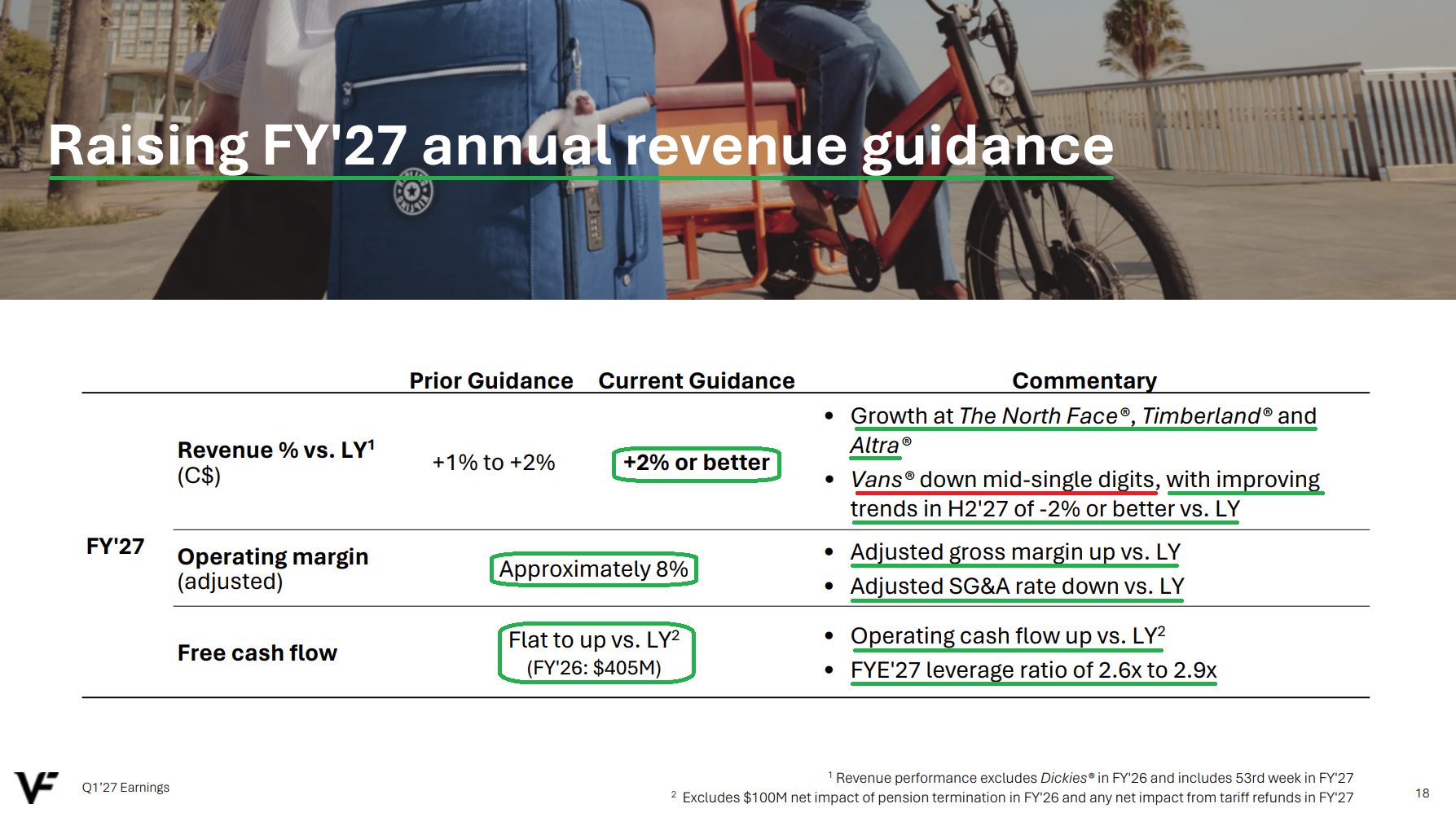
The quarter, combined with improved visibility into the back half, gave management the confidence to raise its full-year revenue guide to +2% or better C$, up from the prior range of +1% to +2%. Modest, sure, but it still represents acceleration from last year's +1% and another solid step in the right direction.
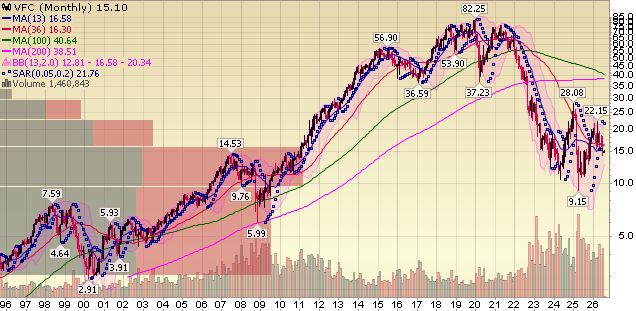
The reward for all of that? A stock that fell as much as 19% intraday, its worst intraday drop since the Liberation Day tariff tantrum.
We have seen this movie many times before. As we like to say, the market is a voting machine in the short run (driven by emotion) and a weighing machine in the long run (driven by fundamentals). Right now, the voting machine has put VF in the penalty box, growing impatient with the Vans turnaround despite management executing exactly as it said it would.
That impatience is precisely what created the opportunity for us to take advantage of an overdone selloff and add to our position at even more attractive prices. Taking advantage of other investors' short-term thinking has been one of our biggest wealth generators over time, and as you would expect when you're in business with great operators, we were not buying alone.
Two days after the print, Bracken Darrell stepped into the open market and bought nearly a half million dollars' worth of stock, pushing his cumulative open-market purchases to more than $3.5M since he walked in the door at VF. When the CEO, who knows more about the company and has a better pulse on where it is headed than anyone else, is voting with his own capital, that is a trade we want to be on the same side of.
https://www.hedgefundtips.com/insider-buying-in-v-f-corporation-vfc-9/
So why the selloff? Two things spooked the market, but neither changes the underlying long-term thesis.
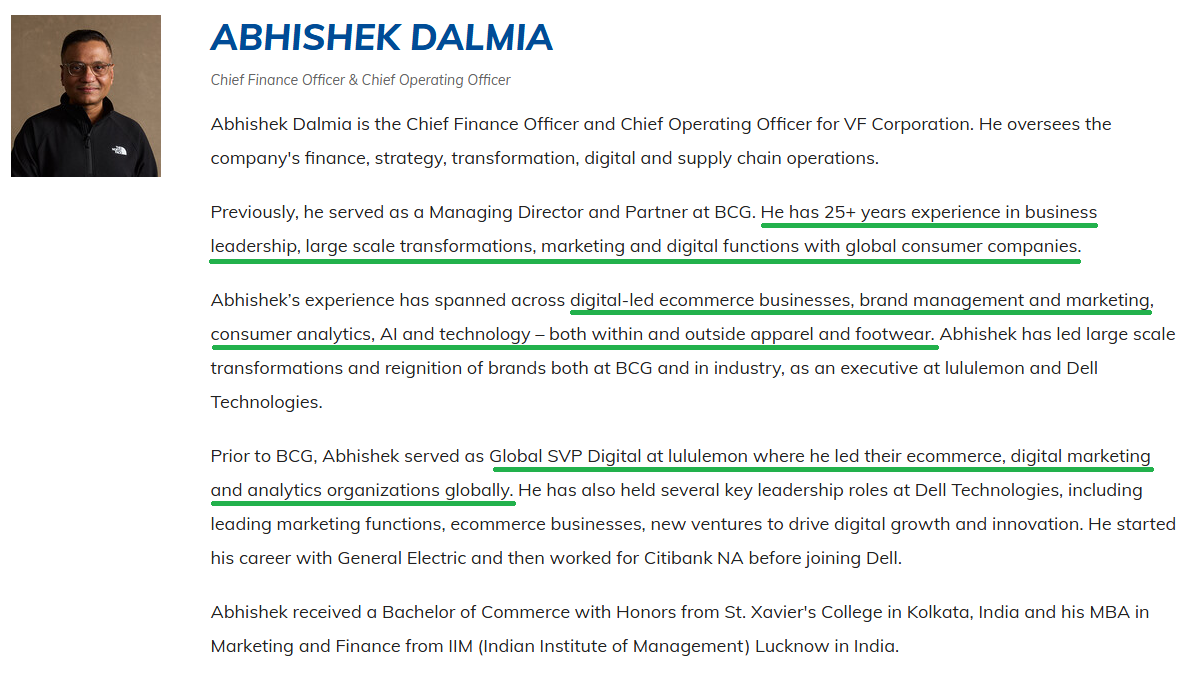
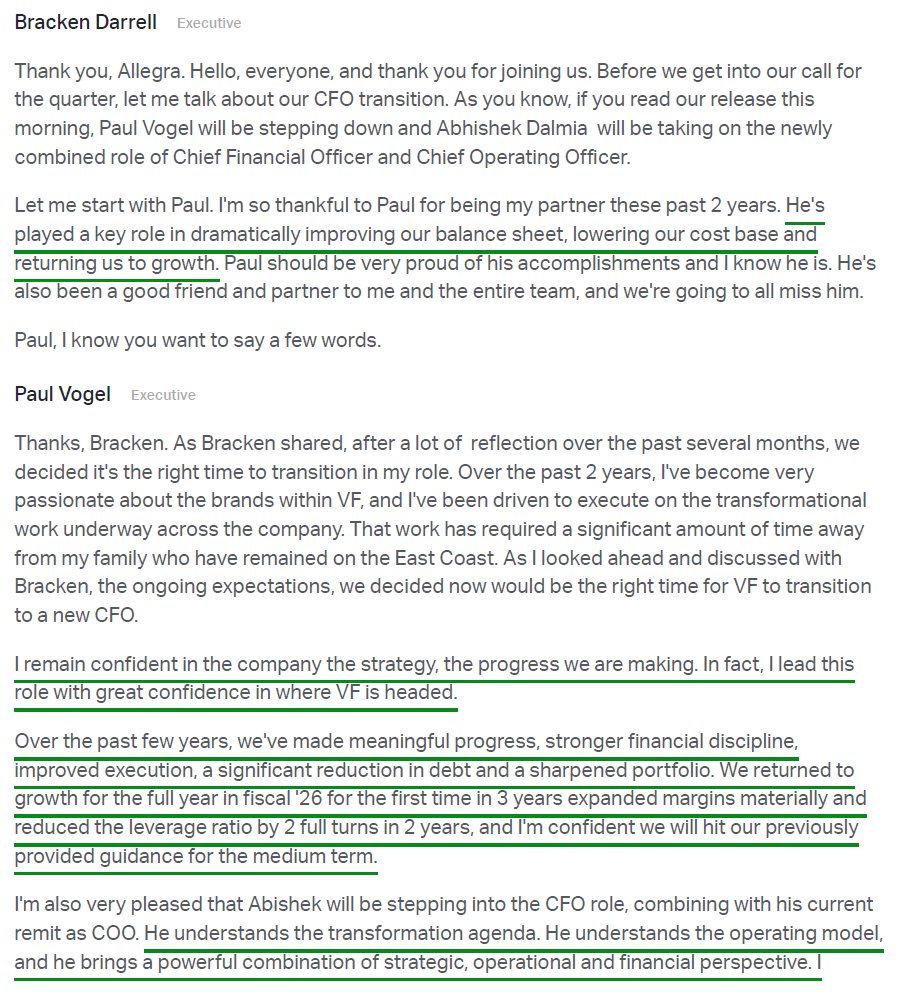
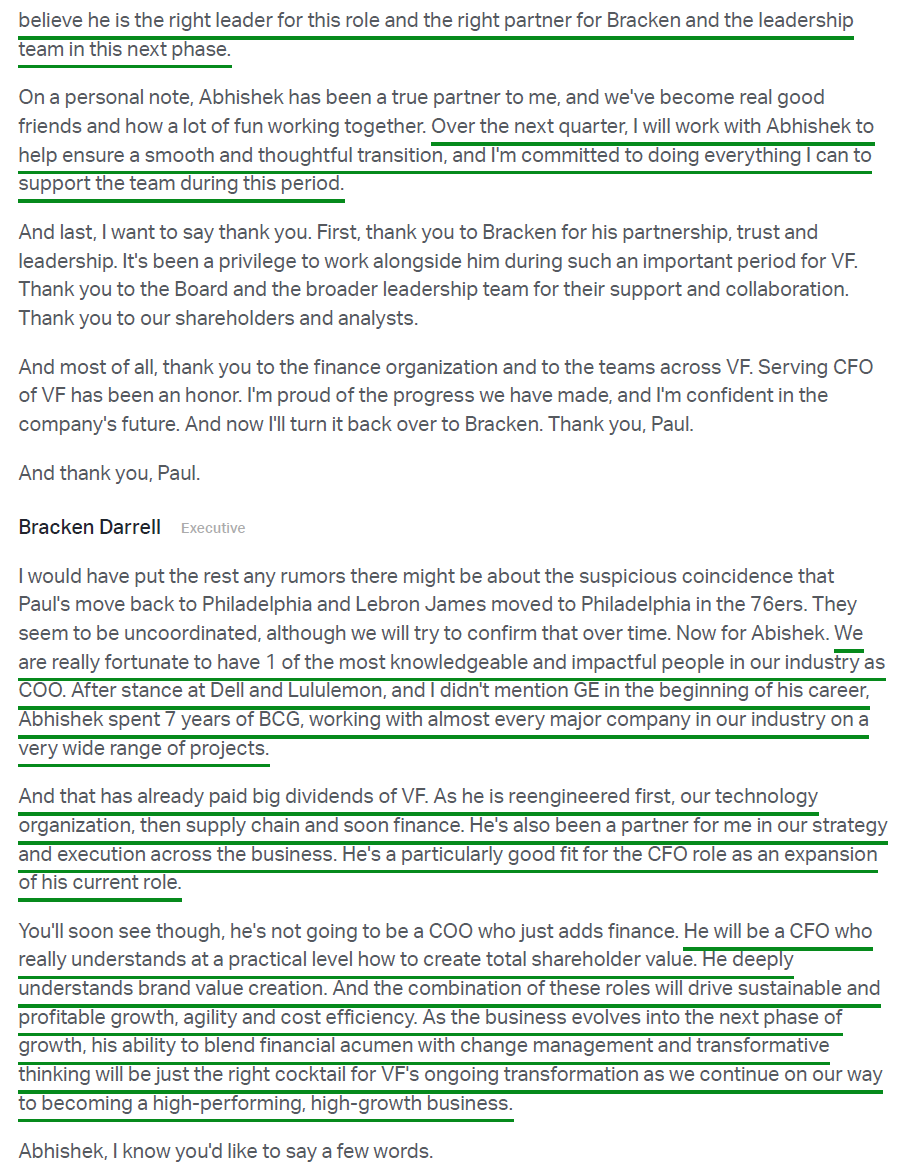
The first was a surprise CFO change, with Paul Vogel stepping down effective August 1 after just ~2 years in the seat and moving into an advisory role to assist with the transition, while COO Abhishek Dalmia assumes the combined CFO/COO role. The market chose to shoot first and ask questions later, even though the move had been somewhat telegraphed last quarter when VF had Dalmia join the Q4 earnings call to discuss the turnaround strategy. The reality of the C-suite change is far less concerning than the market's initial reaction, and we would argue it should ultimately be viewed as a positive.
This is not the first time Vogel's exit has been framed this way. When he left Spotify, Daniel Ek explained that the company was "entering a new phase and needs a CFO with a different mix of experiences." VF is now entering a similar transition. Vogel spent 20 years on Wall Street before ever stepping into a CFO seat. His career was built around capital markets, investor relations, and financial strategy, which is exactly the profile you want when the job is selling assets, paying down debt, taking out costs, and convincing a skeptical market of a turnaround. The next chapter for VF is centered on brand-led operational growth, and that calls for a true operator.
That is exactly what VF is getting. Dalmia has been with VF since early 2024. In that time, he has re-engineered VF's technology organization, then the supply chain, and now finance. Handing the combined seat to the person already running the operating engine, as VF transitions from balance sheet repair to operational growth, strikes us as an upgrade at this stage of the turnaround.
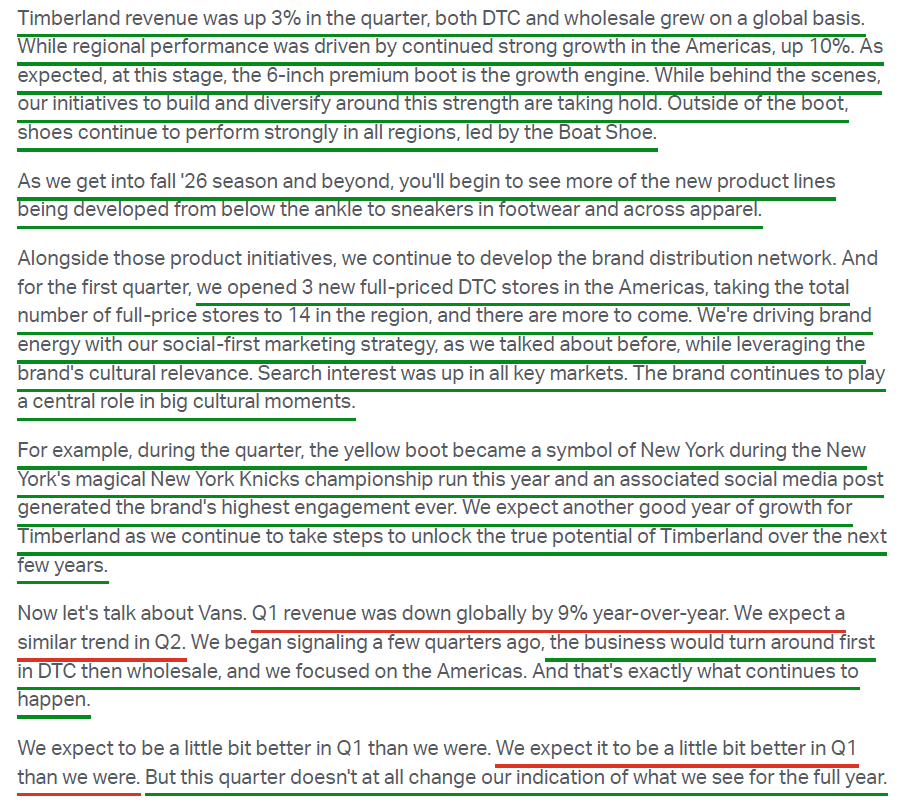
The second and far bigger source of angst is Vans, down (9%) C$ in the quarter and running below management's guidance for a rate slightly worse than Q4's (5%). Nobody wants to see that turnaround happen faster than we do. The reality, however, is that the recovery continues to follow the path management laid out, even if the pace has been uneven.
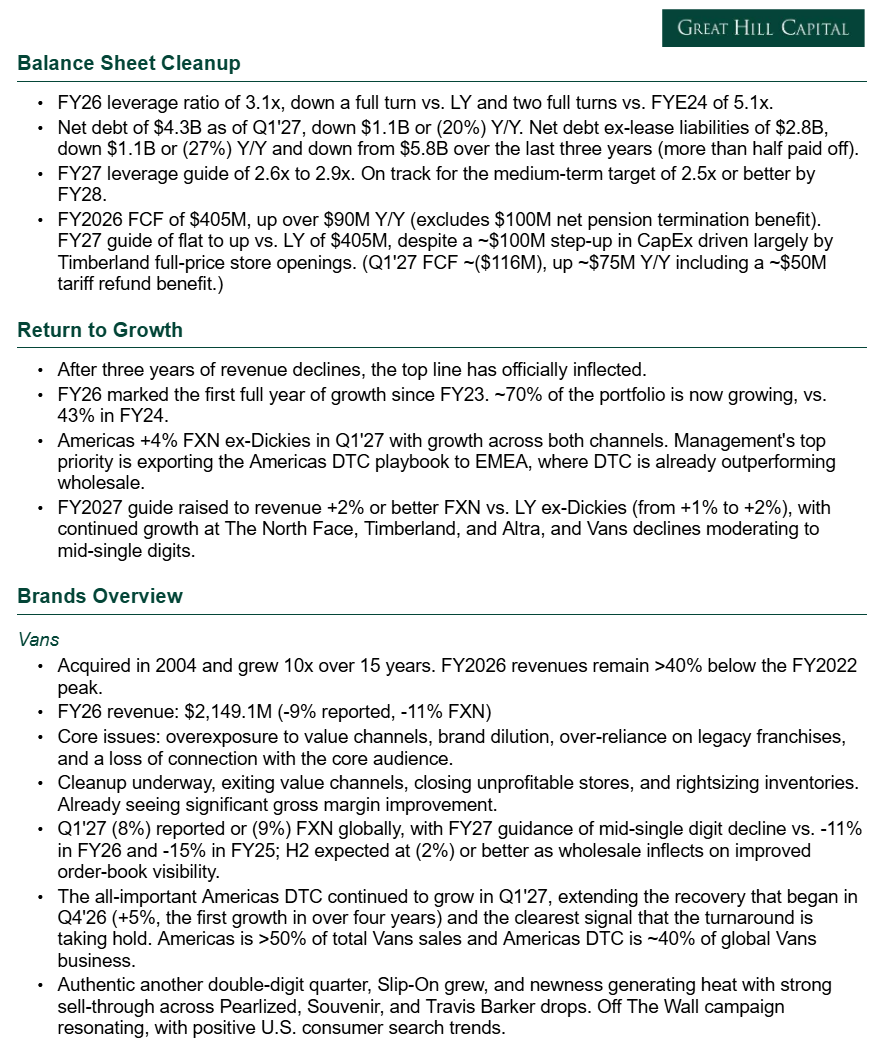
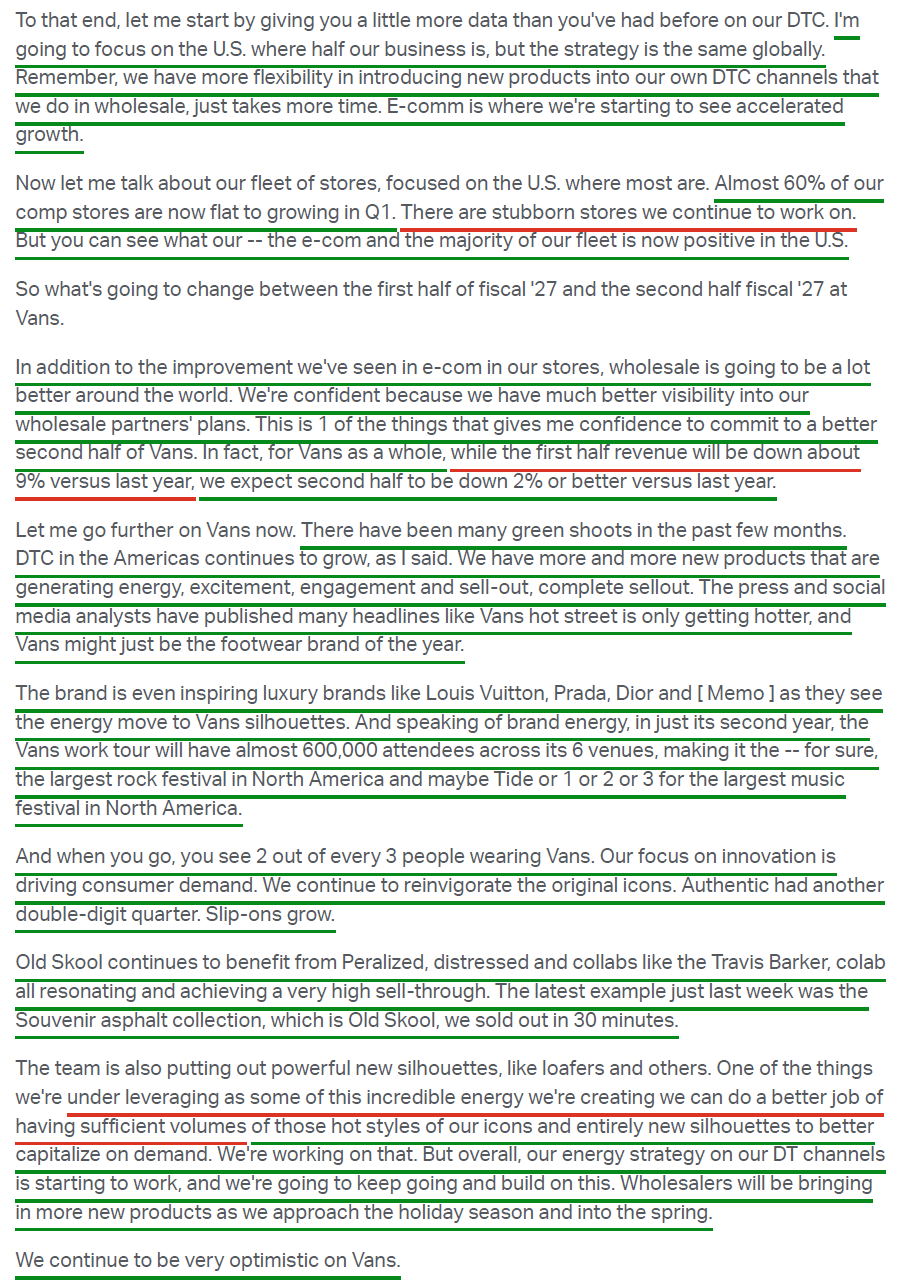
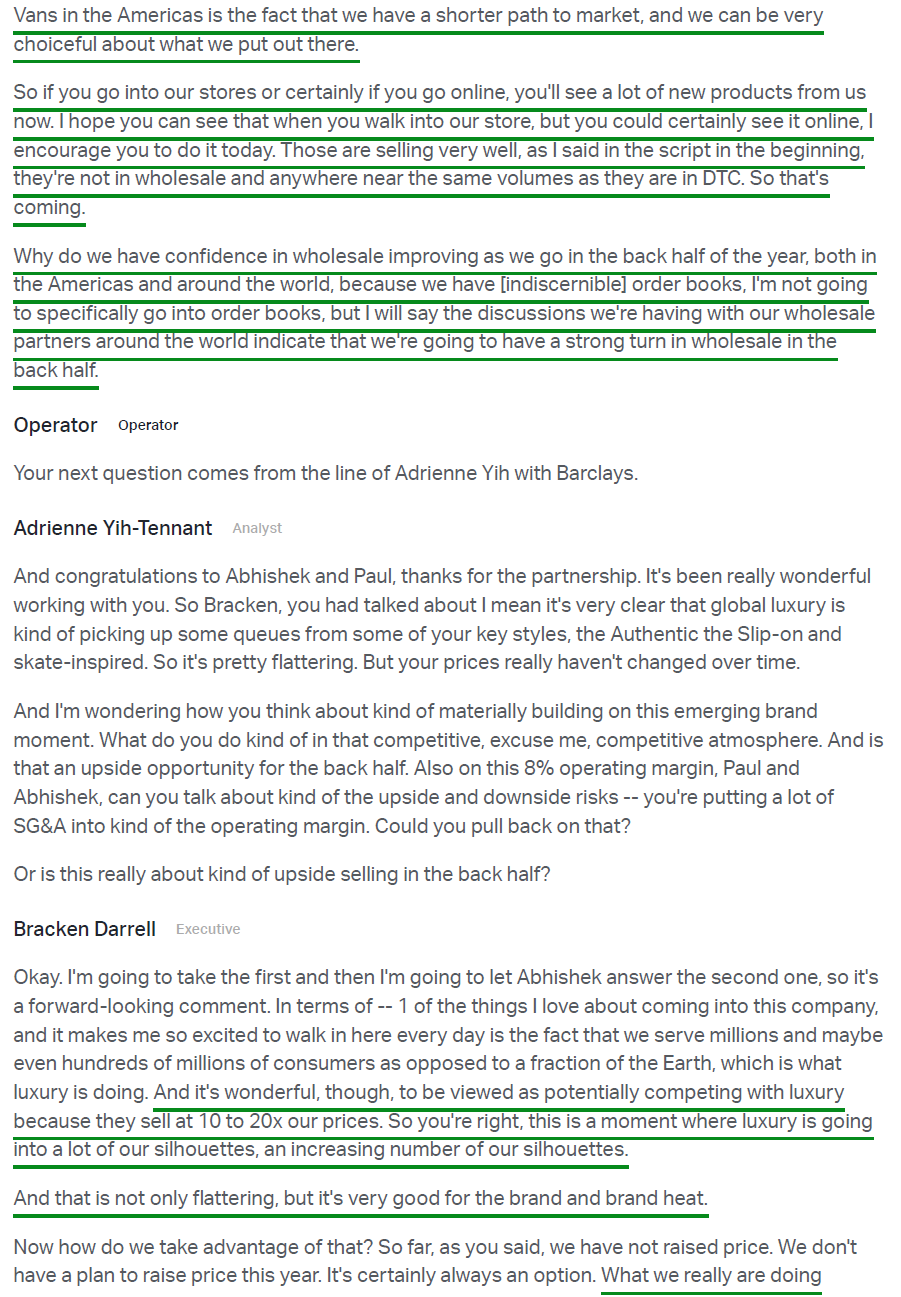
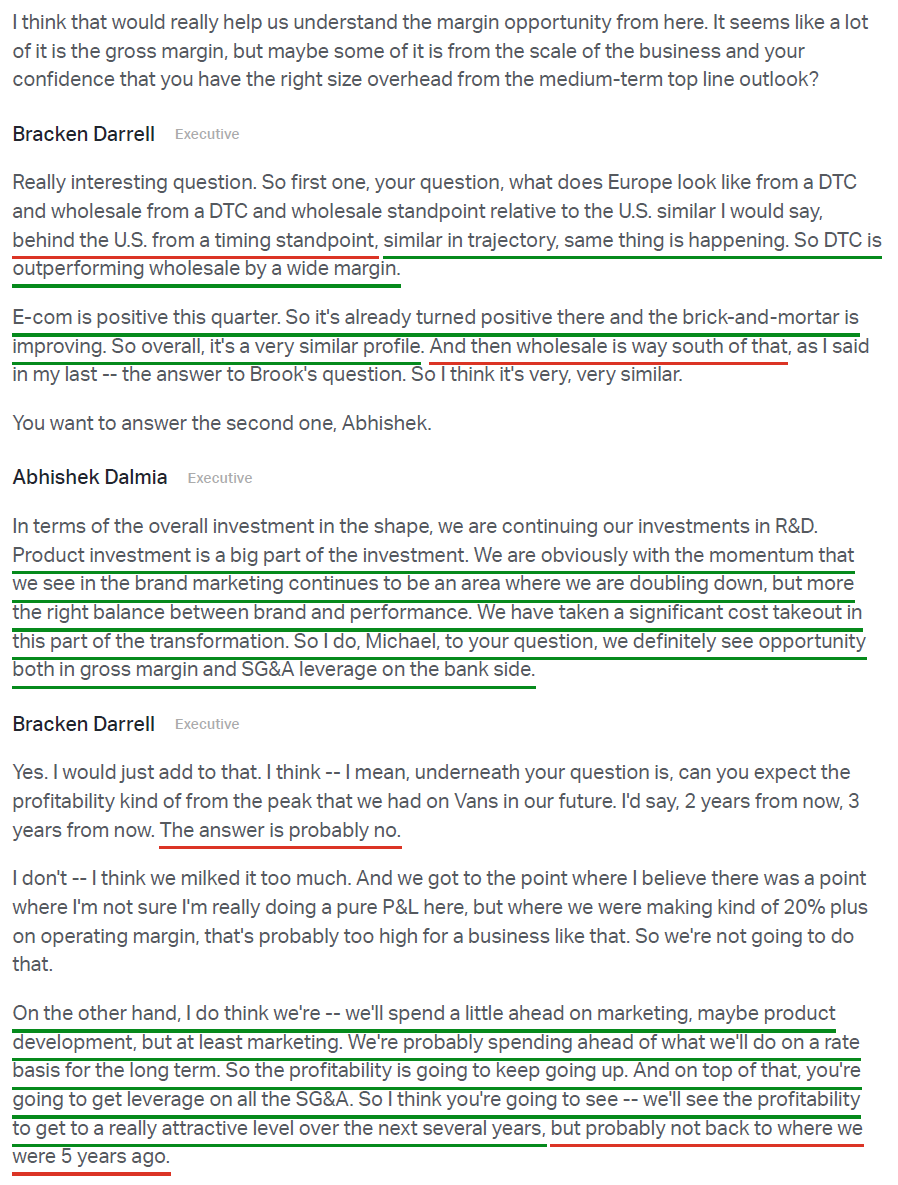
The recovery was always expected to start with the Americas, and where the Americas go, Vans goes, given the region accounts for >50% of total brand sales. Within the Americas, the turnaround was expected to flow from e-commerce, to total DTC, and eventually to wholesale. As expected, Americas e-commerce flipped positive in Q3 for the first time in over four years at +4%, followed by Americas DTC returning to growth in Q4 at +5%. This quarter, that same progression continued, with e-commerce accelerating and Americas DTC growing again, as ~60% of US comp stores are now flat-to-growing. The wholesale channel, meanwhile, remains under pressure.
Management expects that same order to play out globally. EMEA is not far behind the Americas (~two quarters behind the US), with e-commerce already positive this quarter and brick-and-mortar improving. APAC, the smallest of the three regions for the brand, follows from there.
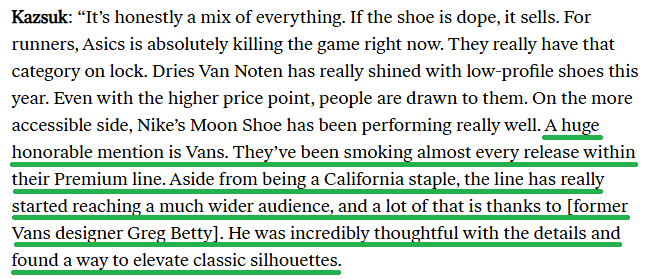
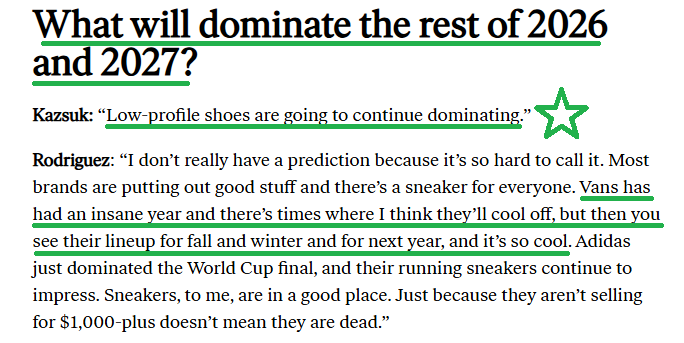
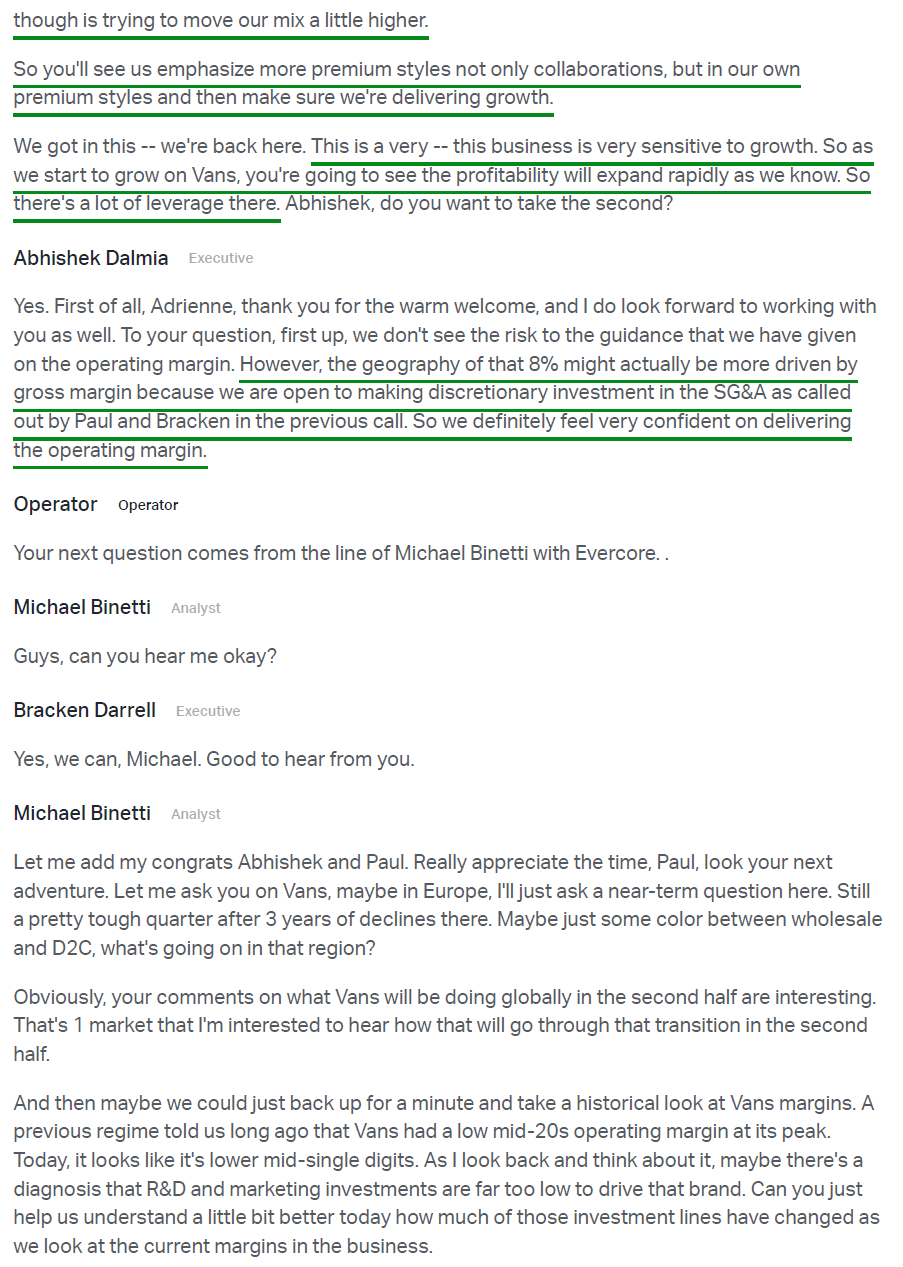
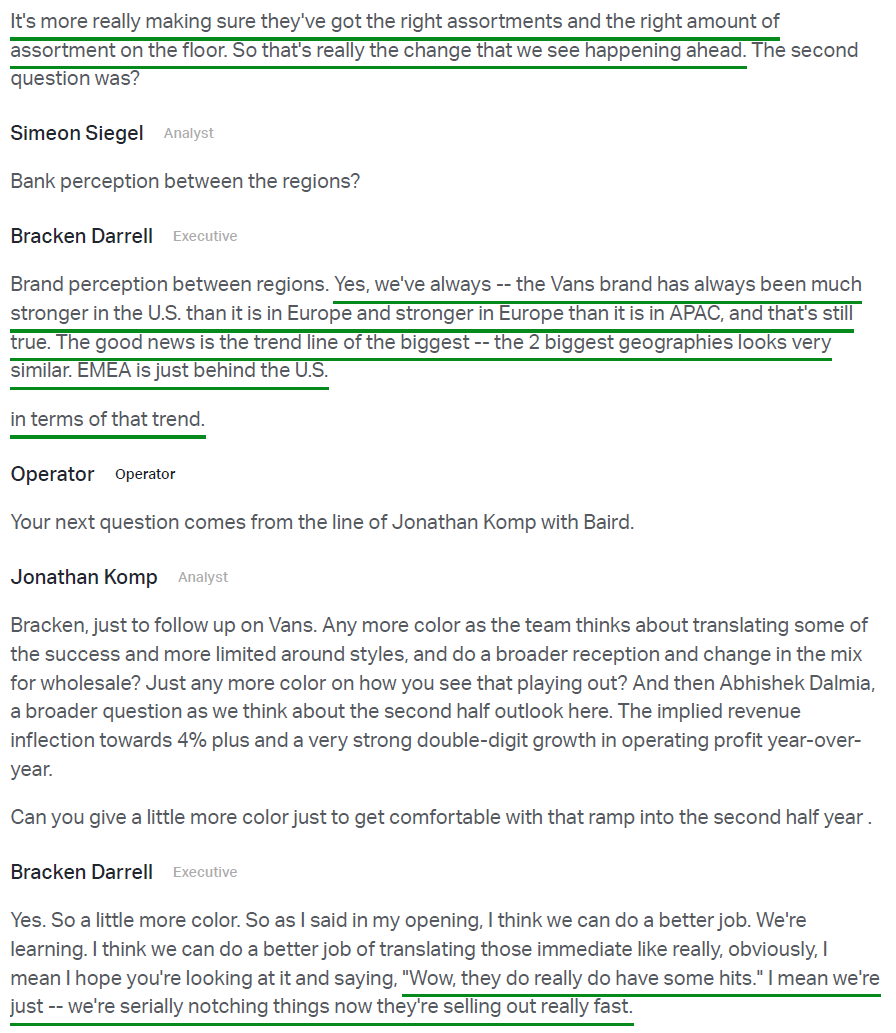
Driving the strong DTC results is brand heat that is impossible to ignore. Authentic delivered another double-digit quarter, Slip-On grew, Travis Barker and Pearlized product are seeing strong sell-through, and new drops are selling out almost immediately, with the Souvenir collection gone in ~30 minutes. Meanwhile, the Vans Warped Tour drew ~600K fans across six venues in just its second year, becoming the largest rock festival in North America. Even luxury houses have taken notice, with Louis Vuitton, Prada, Dior, and Miu Miu seemingly chasing Vans silhouettes.
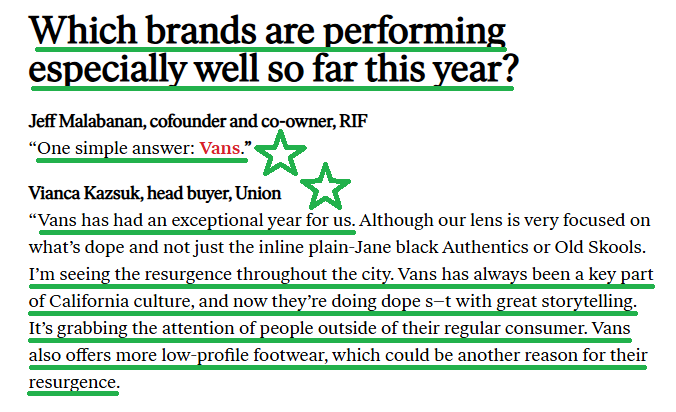
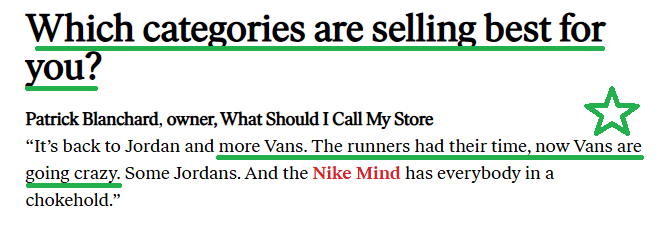
That momentum is showing up in the resale market as well, where Vans has seen a "resurgence" and looks poised to keep dominating, with a legitimate case building for Footwear Brand of the Year. The Q&A below with some of the top retail and resale insiders on Vans is worth a look:

So why isn't this momentum showing up in wholesale yet? Two words: timing lag.
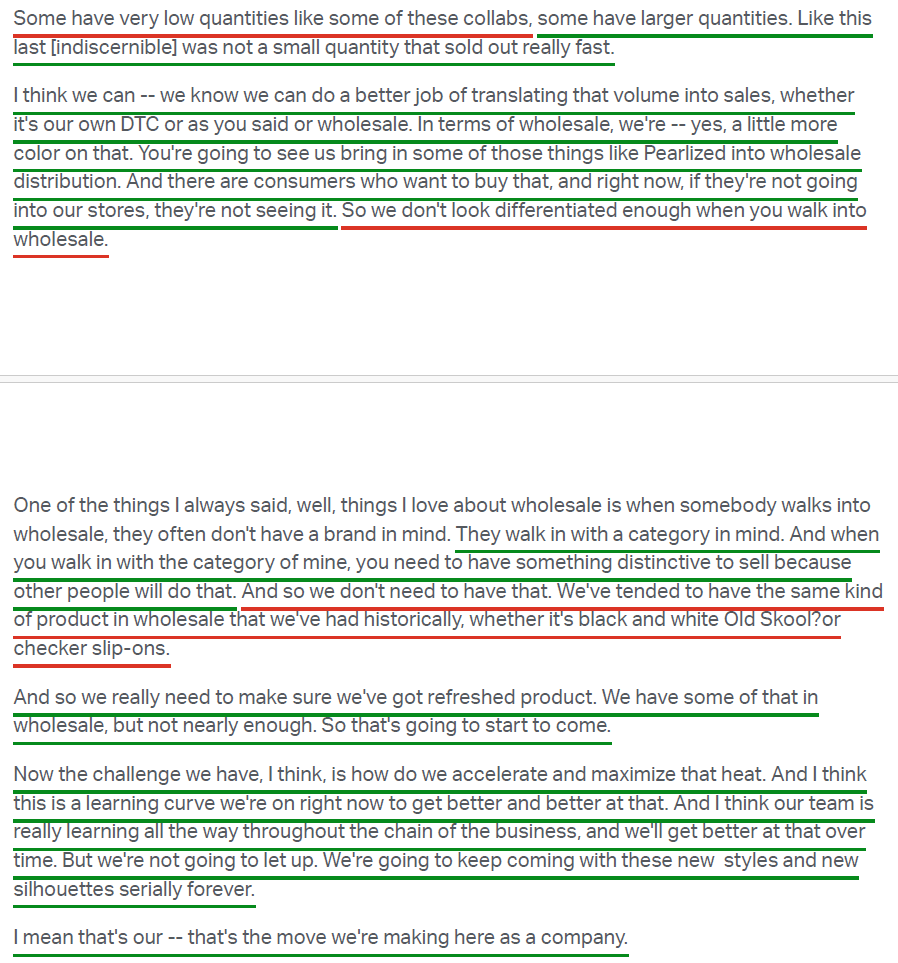
DTC demand is under management's direct control, given their ability to more immediately influence product, marketing, and the in-store experience. They have far more flexibility to introduce new product, test what works, adjust what doesn't, and manage volumes on the fly. Wholesale is the opposite. It is inherently backward-looking, with retailers buying based on recent sell-through and reordering on a delay. That means the DTC momentum built over the past few quarters flows into wholesale orders with a lag, showing up through the back half holiday season and into spring as hit product like Pearlized finally makes its way into wholesale distribution alongside other refreshed, trending styles.
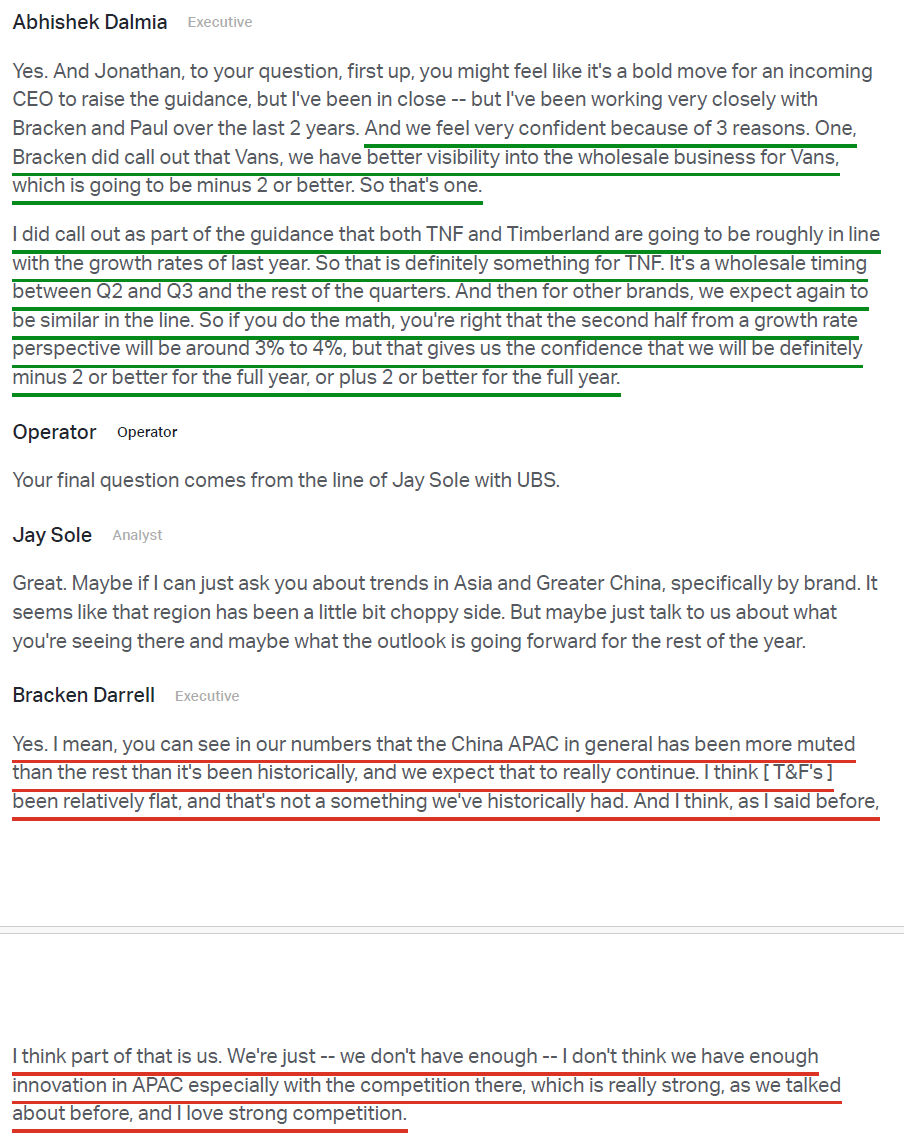
The single most important line from the entire call was Bracken addressing exactly that:
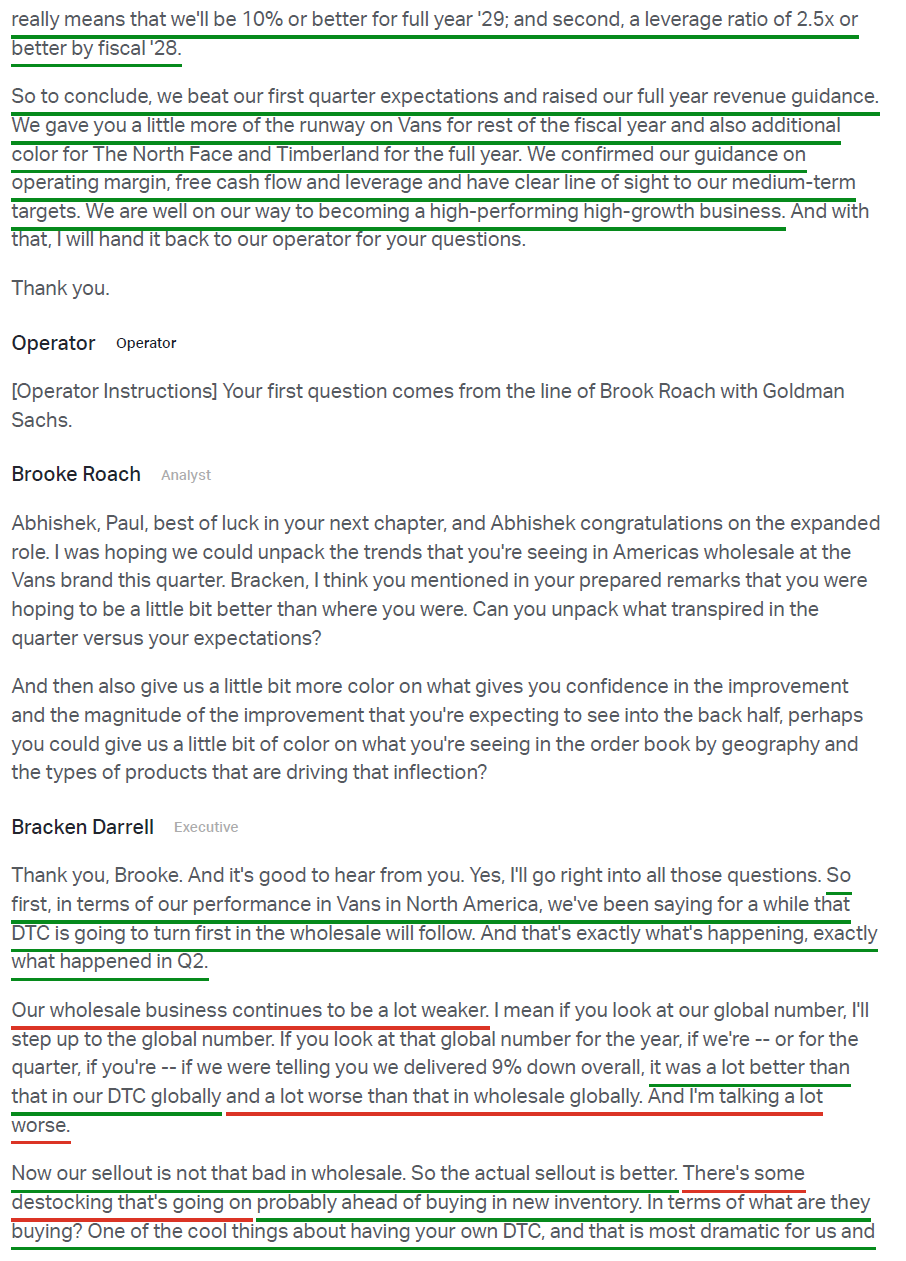
"Why do we have confidence in wholesale improving as we go into the back half of the year, both in the Americas and around the world? ... I'm not going to specifically go into order books, but I will say the discussions we're having with our wholesale partners around the world indicate that we're going to have a strong turn in wholesale in the back half."
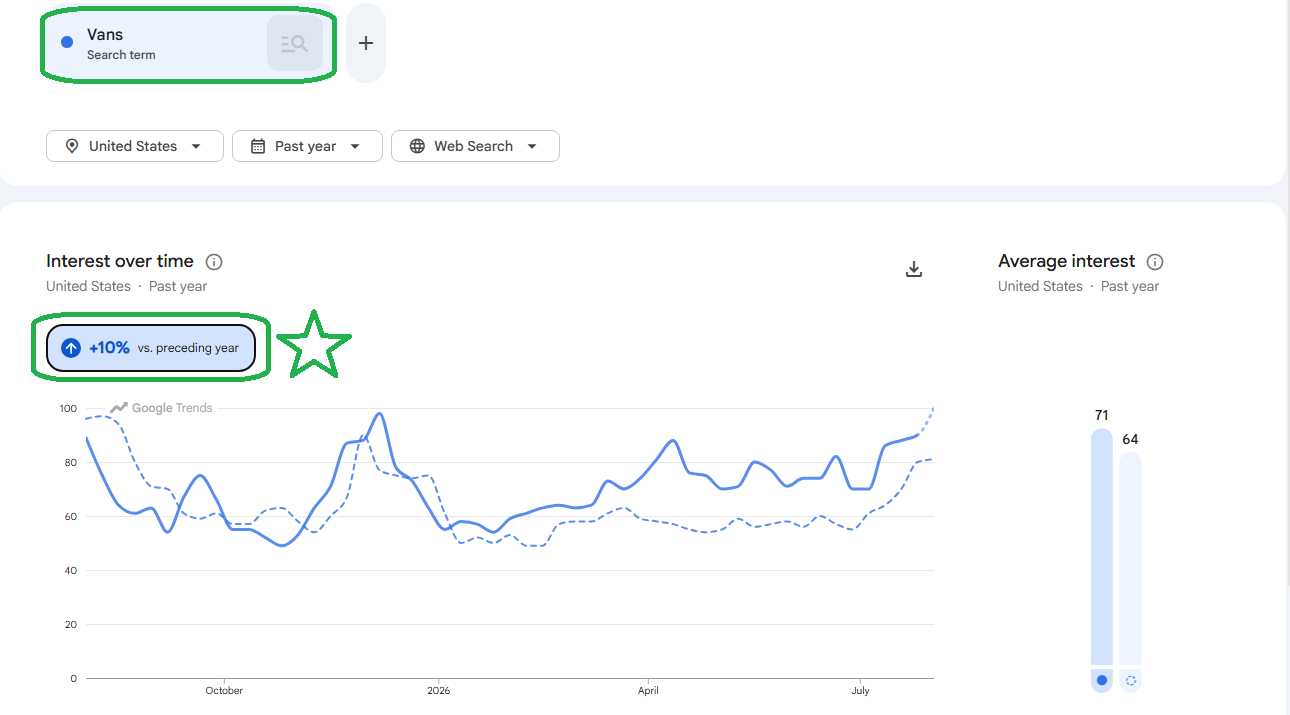
That order book visibility underwrites a guide calling for Vans down (2%) or better in the second half, landing the full year at a mid-single-digit decline versus last year's (11%). Based on the search trends and brand heat we are seeing, we believe management is likely being conservative here and would not be surprised to see Vans inflect positive and finish ahead of current expectations.
While all eyes remain fixed on Vans, the rest of the portfolio is firing on all cylinders.
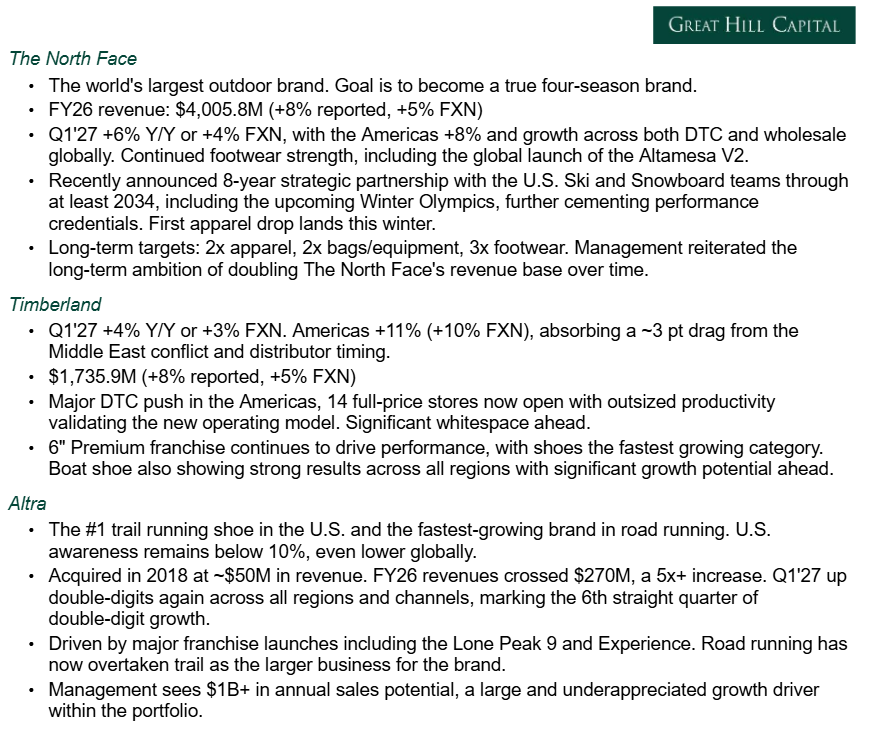
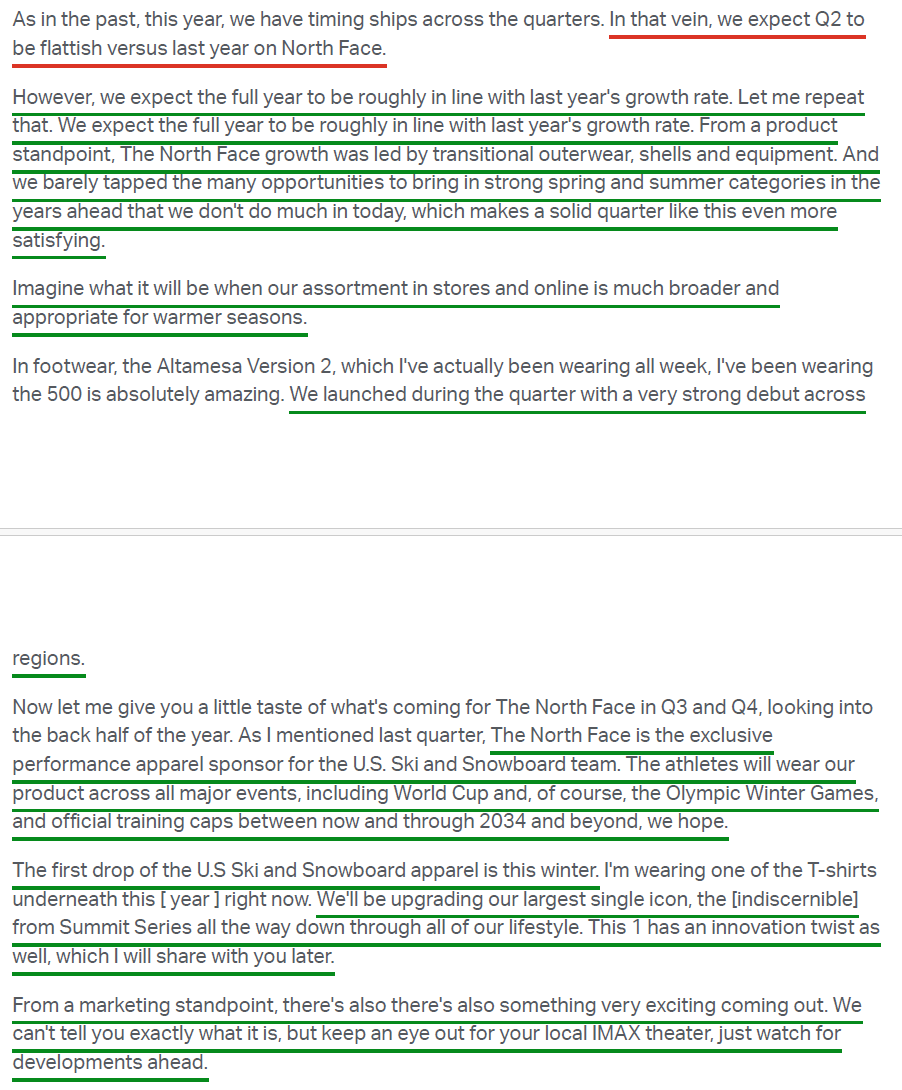
The North Face grew +4% C$, with transitional outerwear, shells, and equipment all growing as the brand continues expanding toward becoming a true four-season name and marching toward its long-term goal of 2x apparel and equipment and 3x footwear. Management expects the full year to be ~in line with last year's +5% C$ growth, with the exclusive US Ski & Snowboard partnership landing its first drop this winter ahead of the Olympic cycle.
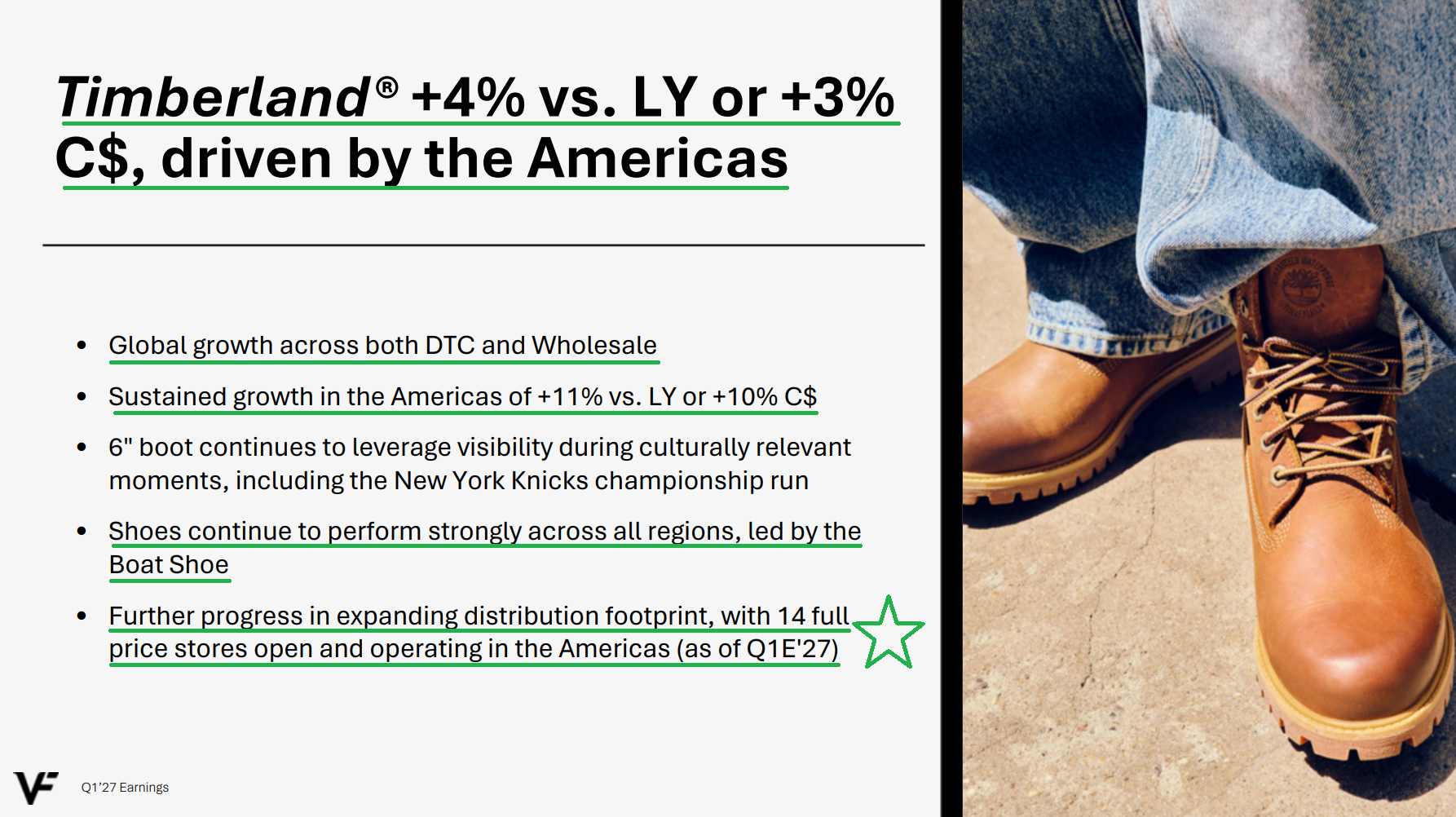
Timberland grew +3% C$, driven by the Americas at +10% C$, with the full year also expected to be ~in line with last year's ~+5% C$ pace. The accelerated DTC push continues, now at 14 full-price stores in the Americas with more coming, while this fall marks the start of the real effort to take the brand beyond the boot with a broader lineup across footwear and apparel.
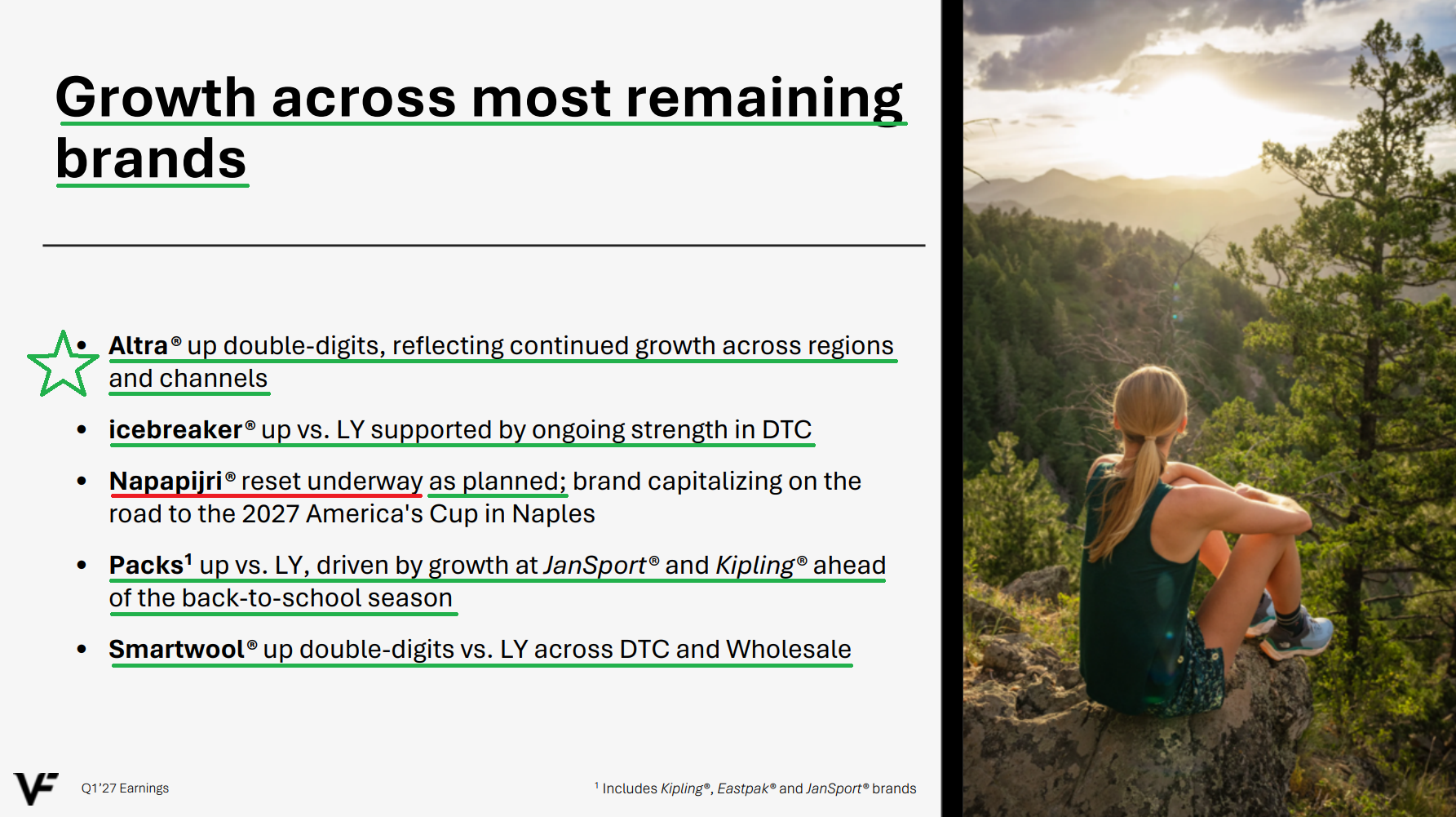
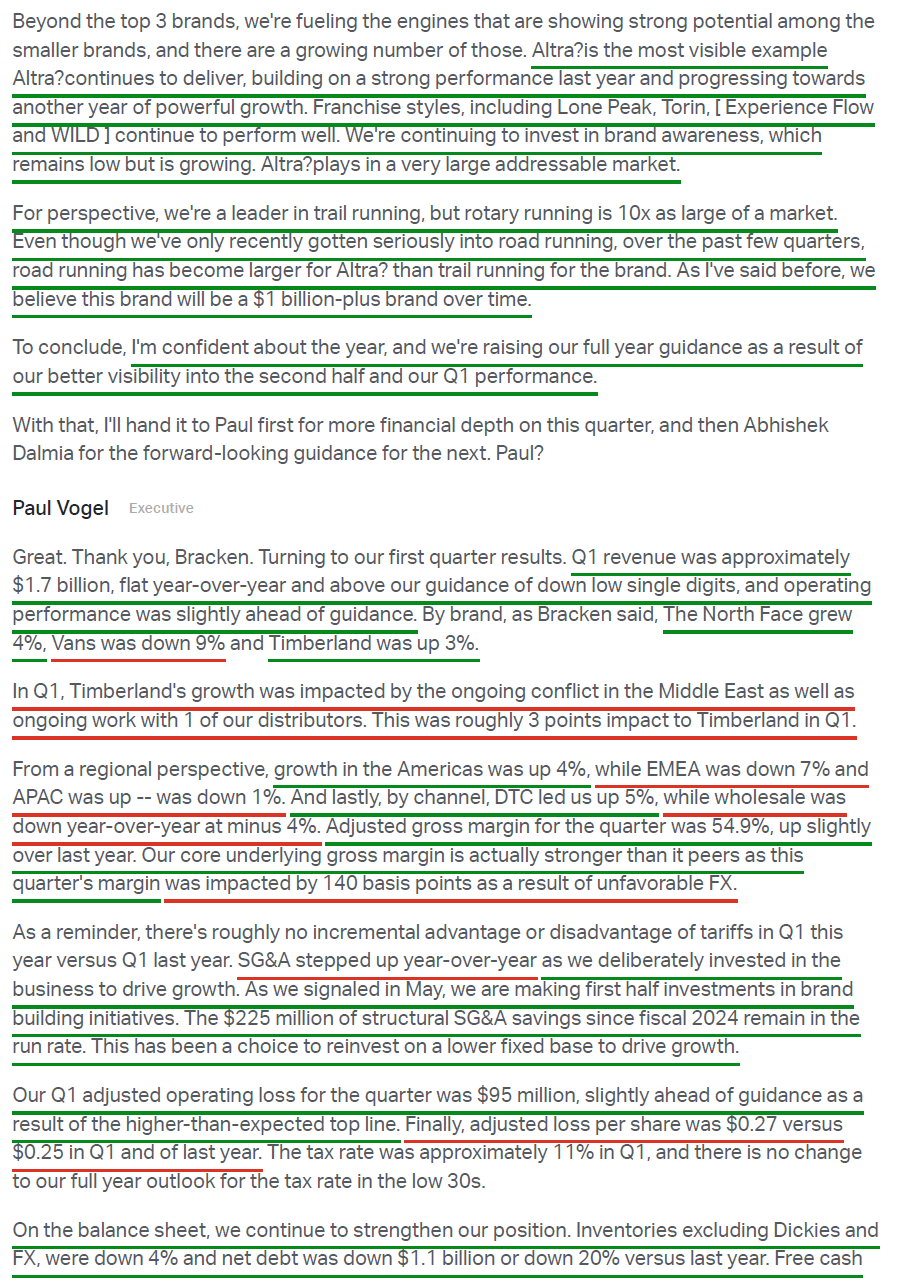
Altra continues to compound double-digit growth, now larger in road running than trail (a market ~10x the size), on its way to becoming what management believes will be a $1B+ brand.
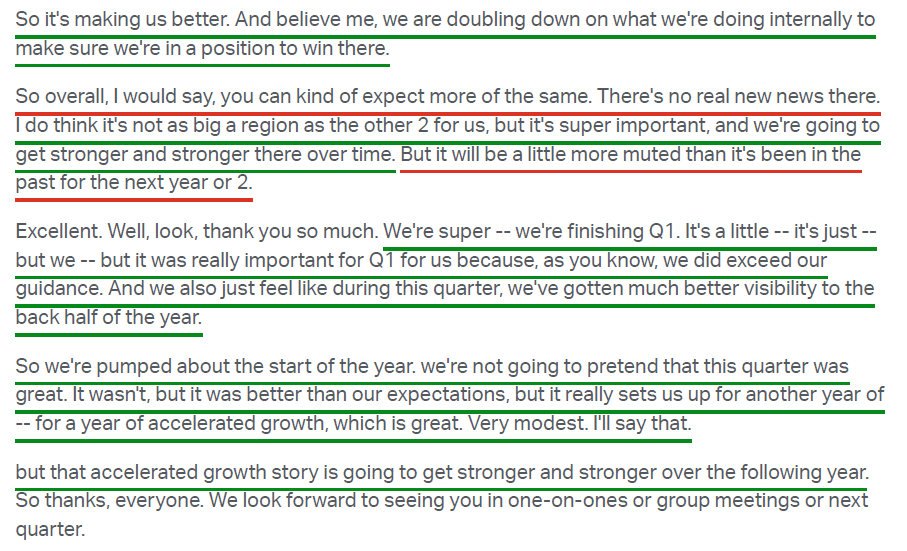
The point is this: VF is entering a different phase of the turnaround, one where growth begins to meet operating leverage. As low-single-digit growth becomes mid-single-digit growth, and higher still over time, we expect that 10% operating margin target to start looking more like a floor than a ceiling.
Until then, Growth Bracken is doing exactly what he said he would, with the market's impatience creating opportunity for those willing to look beyond the next quarter.
Q1 Earnings Breakdown
10 Key Points
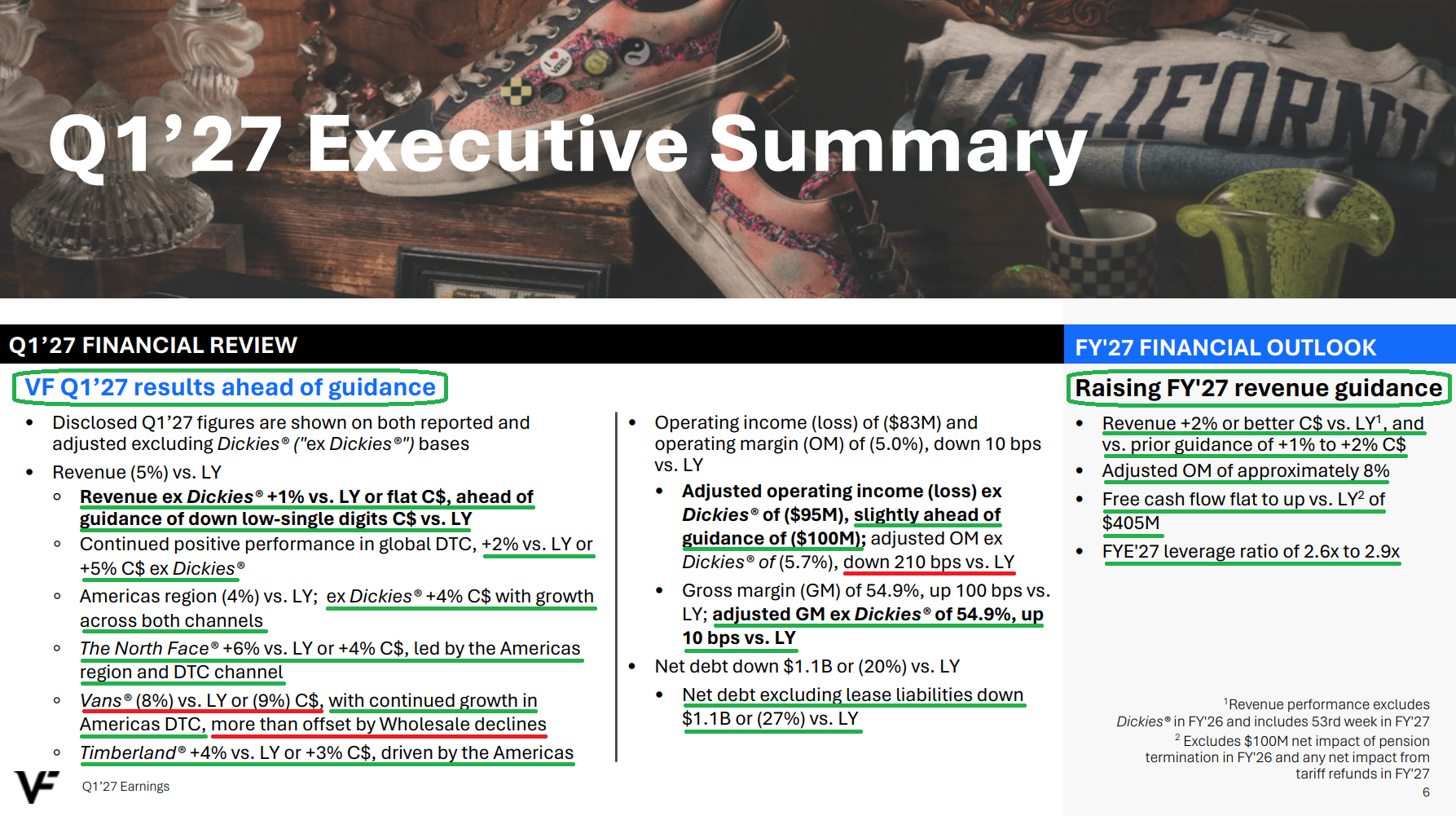
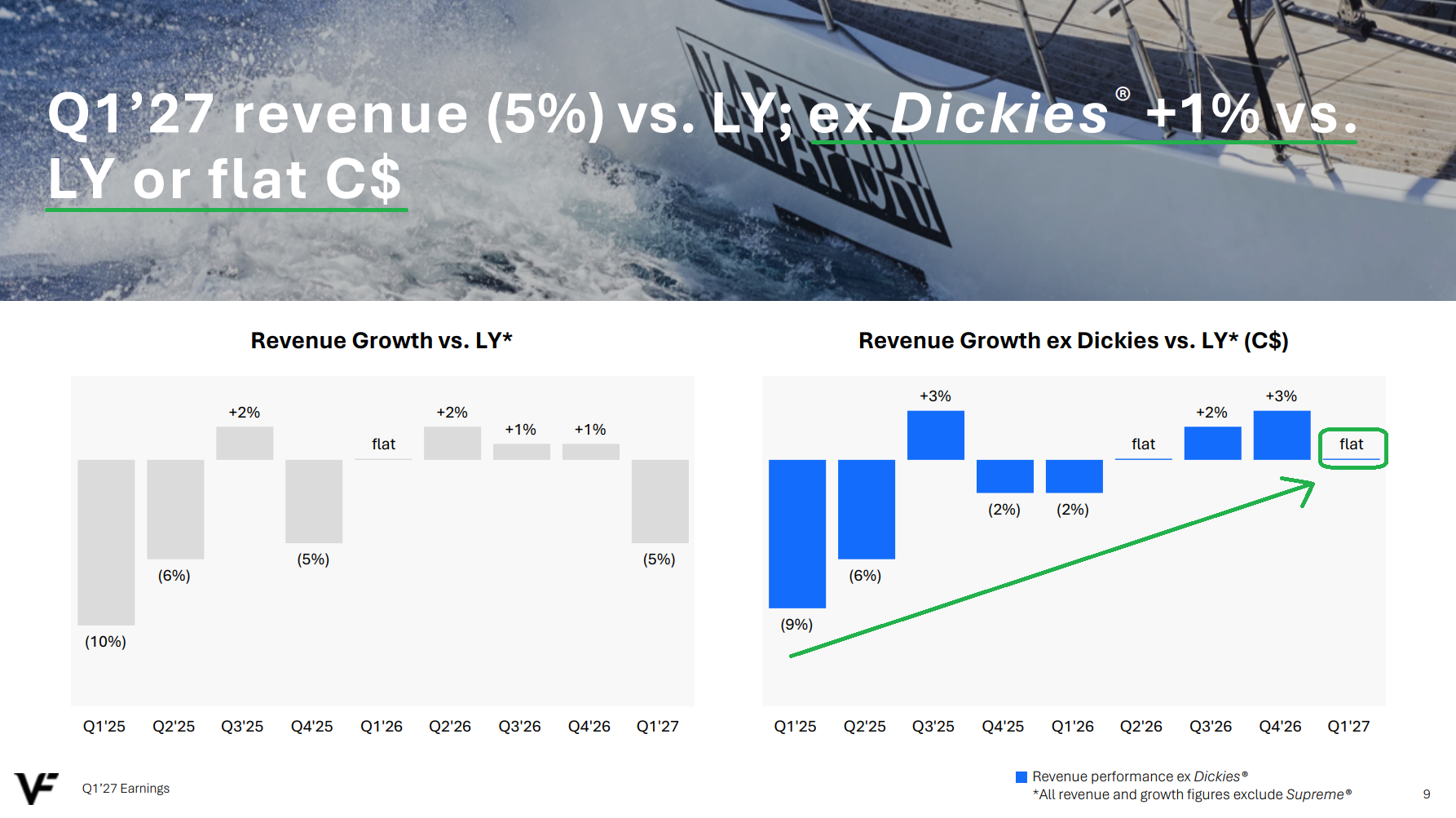
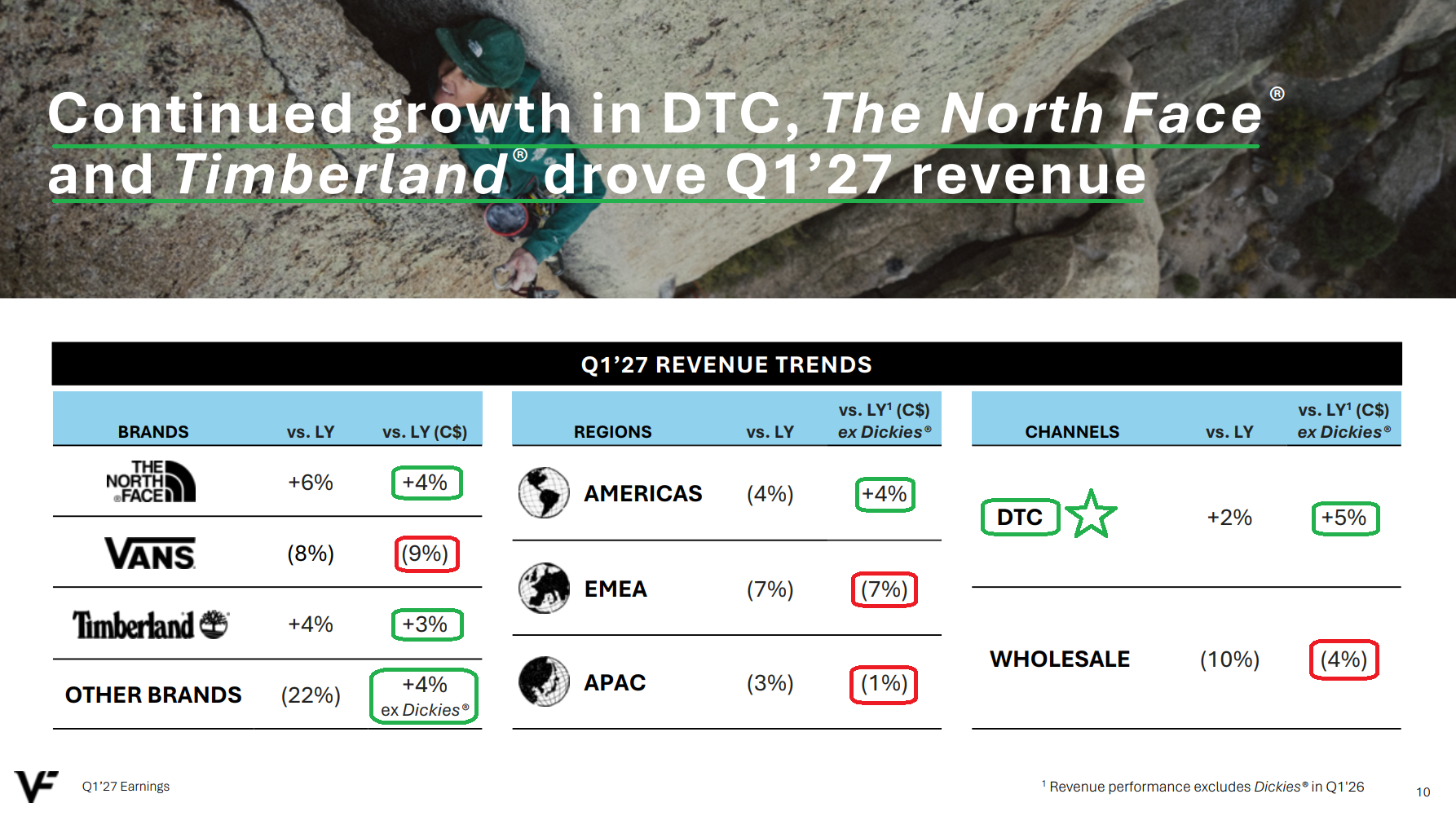
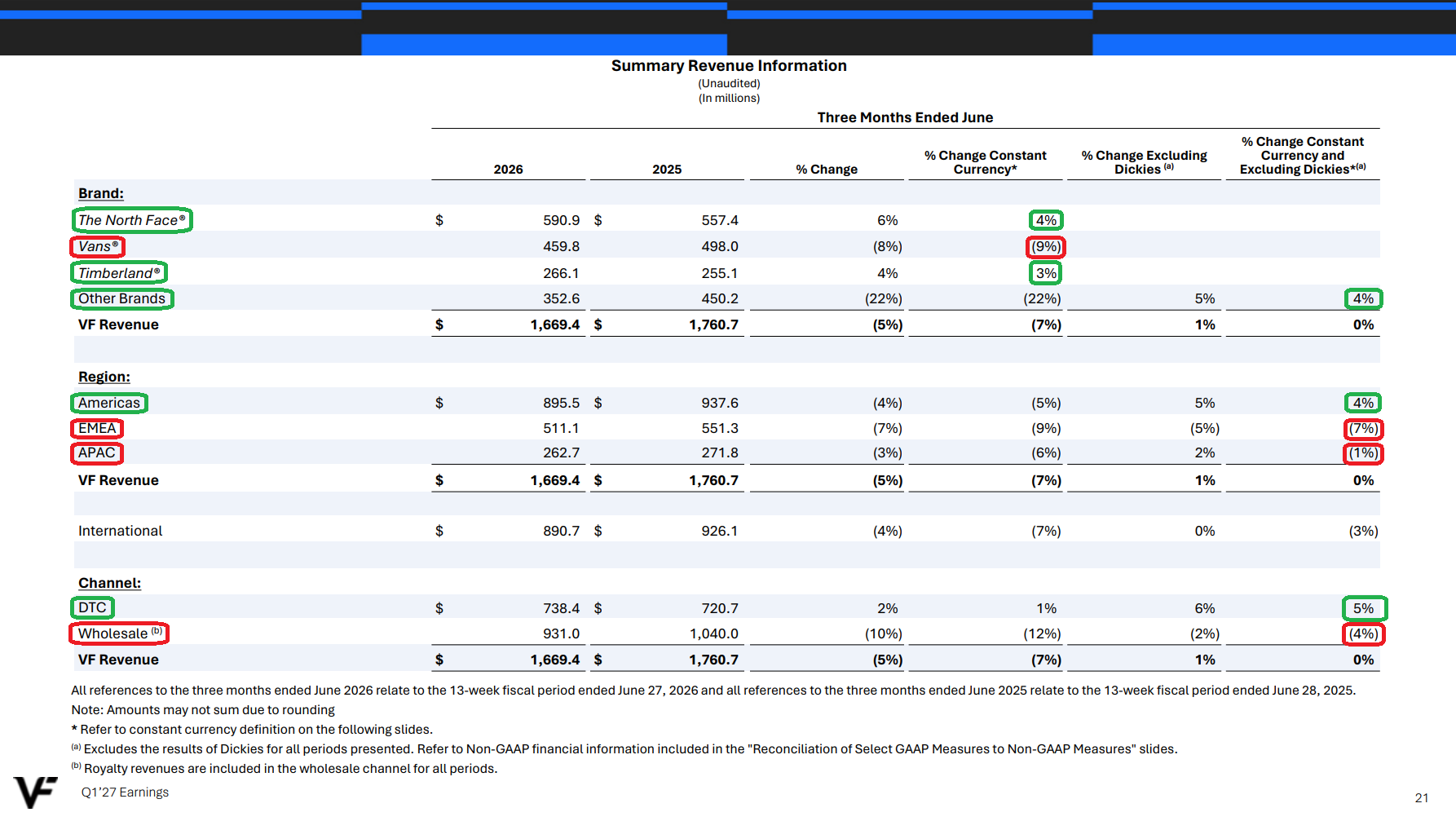
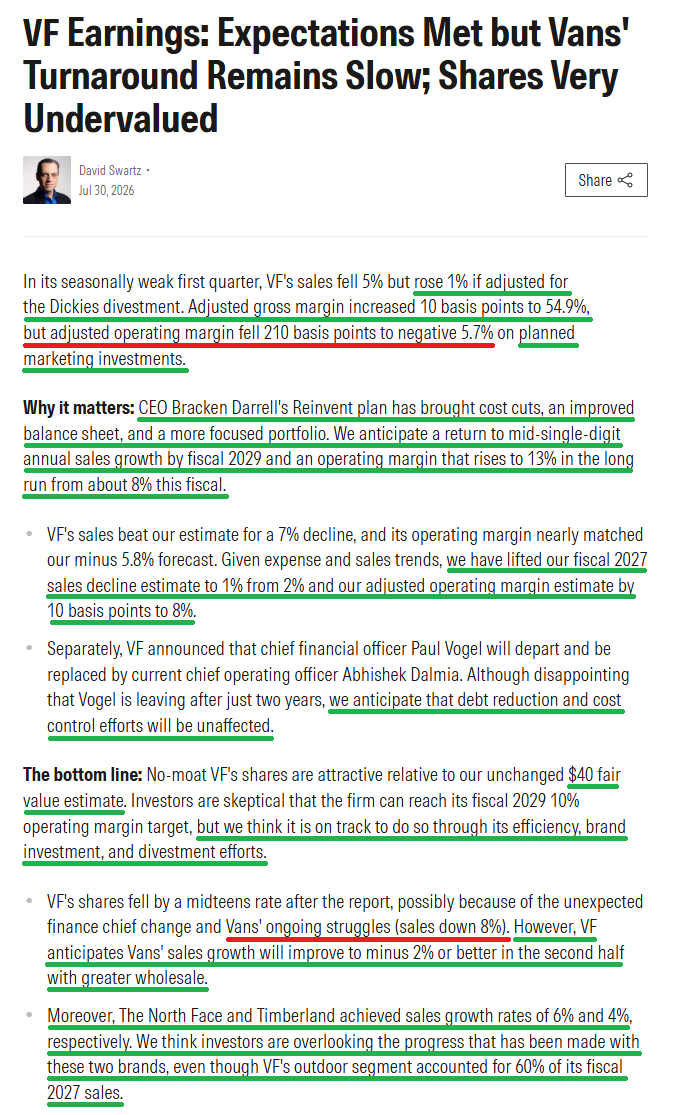
1) VF reported Q1 revenue of $1.67B, +1% Y/Y / flat C$ ex-Dickies, ahead of guidance for a low-single-digit C$ decline and topping the Street's ~$1.64B. By region, the Americas were (4%) reported or +4% C$ ex-Dickies with growth across both channels, while EMEA was (7%) reported or (7%) C$ and APAC was (3%) reported or (1%) C$. By channel, global DTC led the way at +2% reported or +5% C$ ex-Dickies, more than offsetting a Wholesale decline of (10%) reported or (4%) C$.
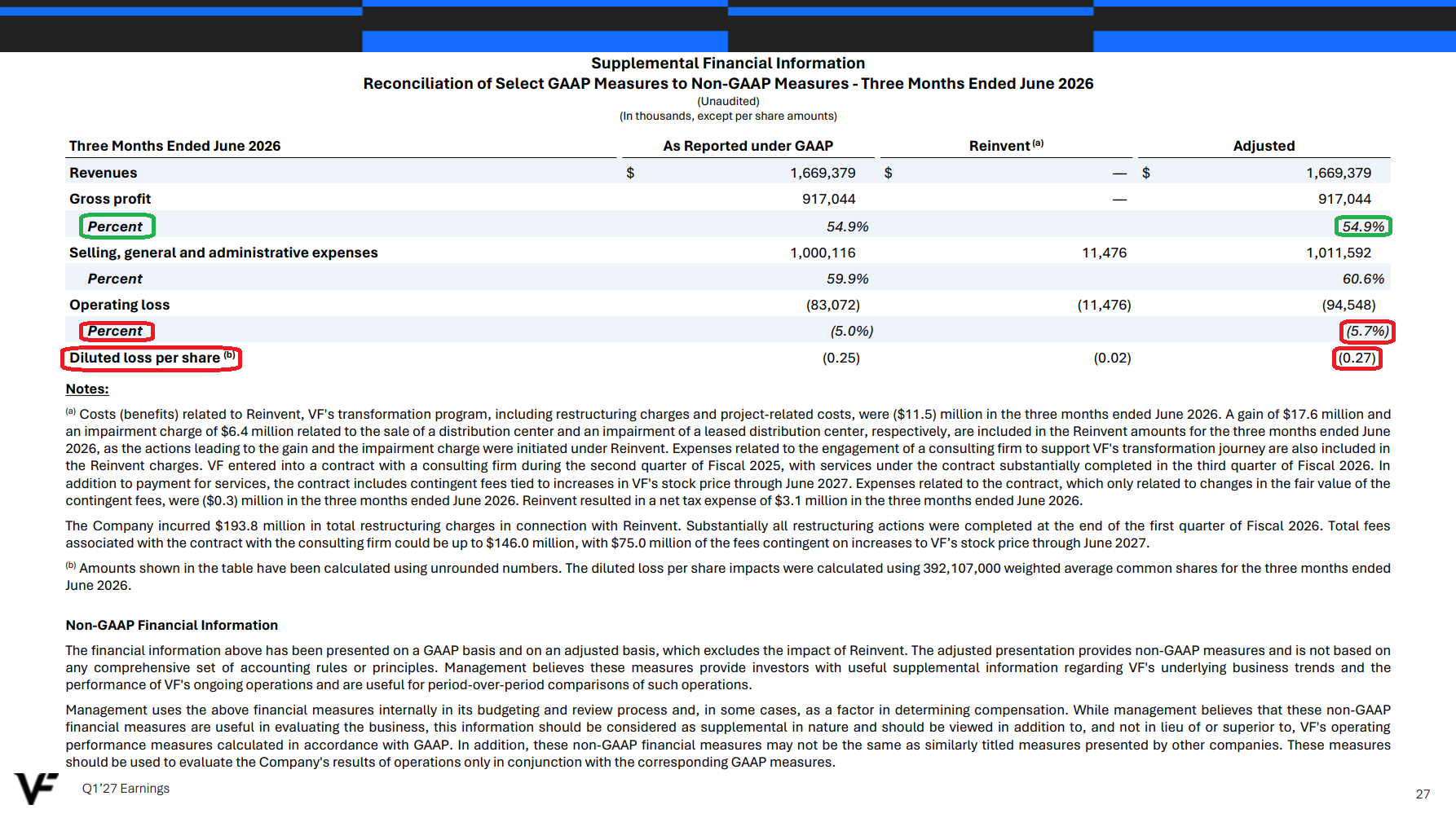
2) Adjusted gross margin ex-Dickies came in at 54.9% in Q1, up 10 bps Y/Y, though the underlying figure was stronger than the headline suggests after being weighed down by ~140 bps of unfavorable FX during the quarter, with no incremental tariff advantage or disadvantage vs. Q1 last year. Management reiterated its expectation for full-year adjusted gross margin to be up vs. FY26's 55.2%, keeping VF comfortably above its FY28 target of 55%.
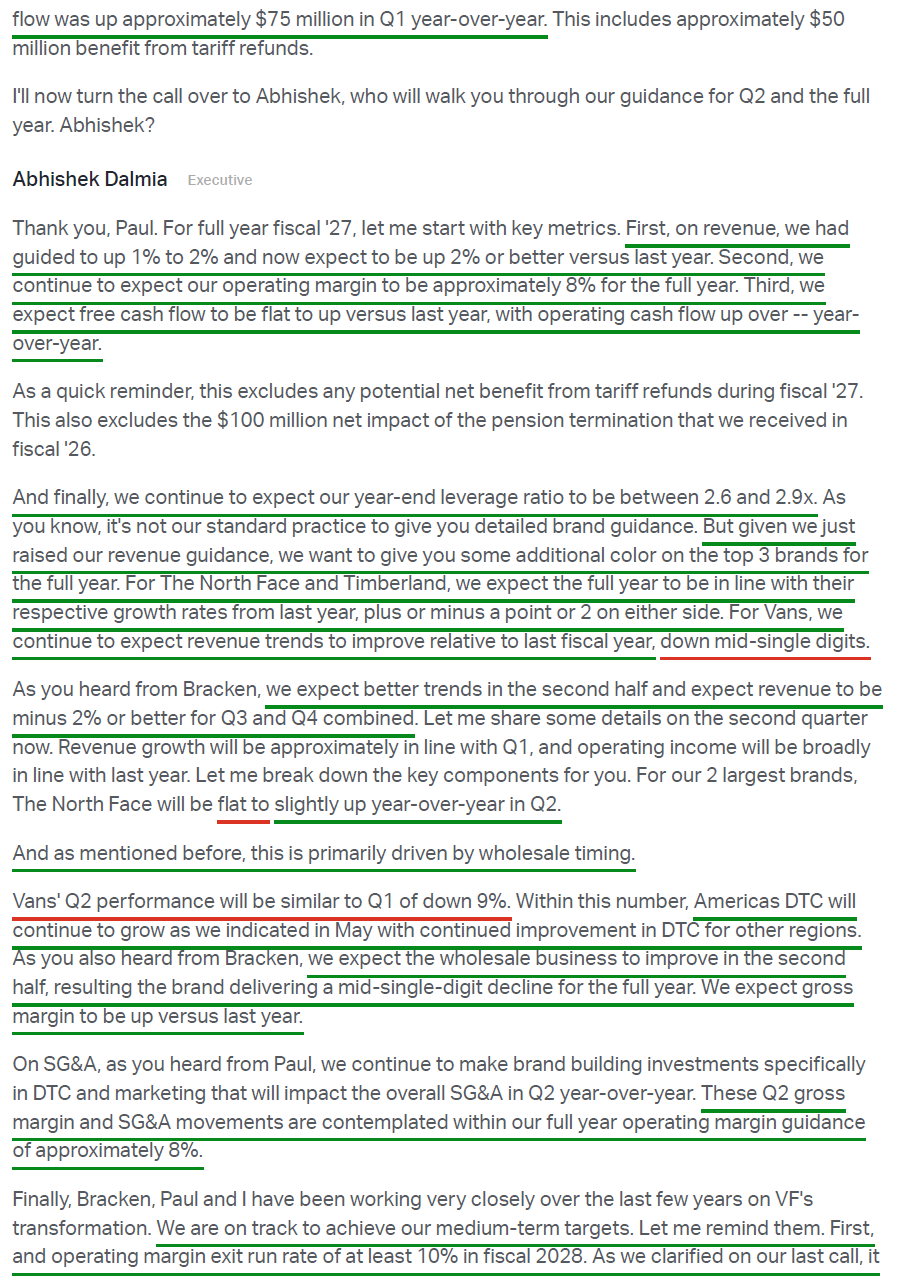
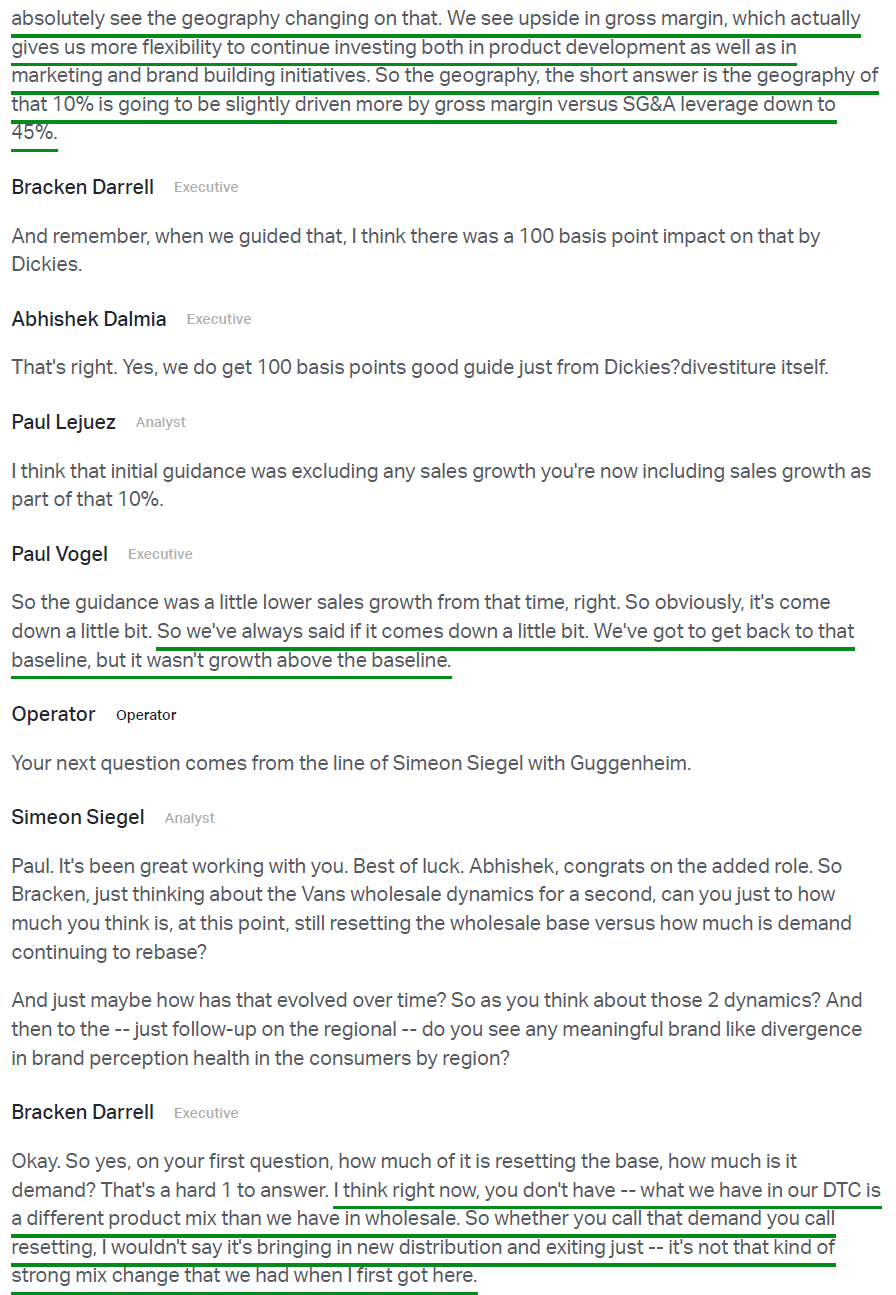
3) Adjusted operating loss ex-Dickies was ($94.5M), for an adjusted operating margin ex-Dickies of (5.7%), down 210 bps Y/Y but slightly ahead of guidance of ($100M) on the higher top line. Q1 is a loss-making quarter in line with historical seasonality, with the Y/Y step-down planned, as management deliberately front-loaded first-half SG&A into marketing, DTC, and brand building to drive growth. Most importantly, the >$225M of structural SG&A savings taken out since FY24 remain fully in the run rate. Full-year adjusted OM was held at ~8% (up from FY26's 7.0%), with management reaffirming its medium-term target of a 10% operating margin exit run rate in FY28.
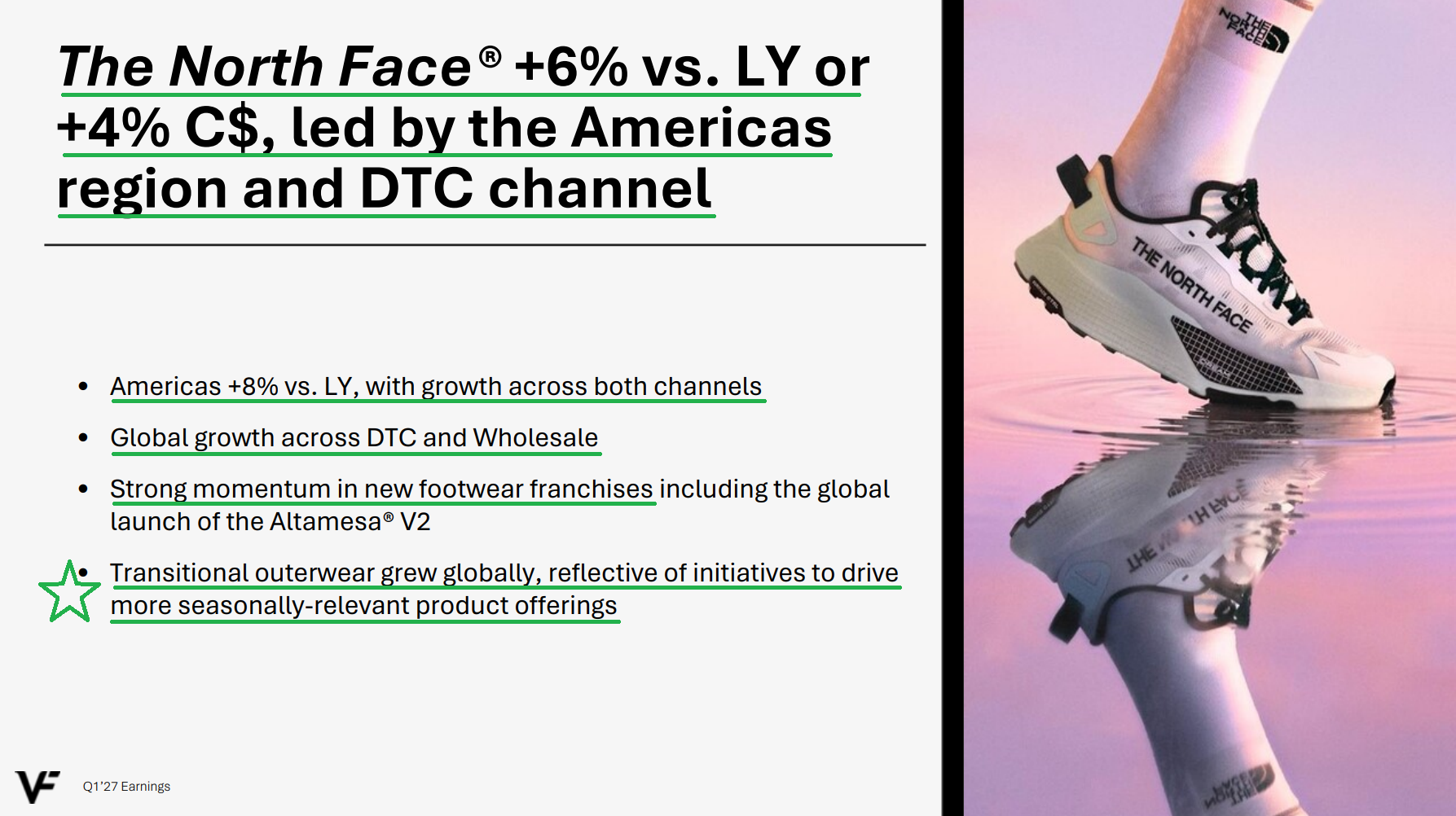
4) The North Face grew +6% Y/Y or +4% C$ to $590.9M, led by the Americas at +8% (+8% C$) with growth across both DTC and wholesale globally. Results topped management's flat expectation, which had baked in the Q4 order pull-forward, with transitional outerwear, shells, and equipment all growing as the brand pushes toward more seasonally relevant offerings, alongside continued footwear momentum behind the global launch of the Altamesa V2. Management expects Q2 to be ~flat on wholesale timing but reiterated that the full year should land in line with FY26's +5% C$ growth rate, plus or minus a point or two. Back-half catalysts include the first drop of the exclusive US Ski & Snowboard apparel this winter, part of a performance apparel partnership running through at least 2034, with a fresh marketing push still to come.
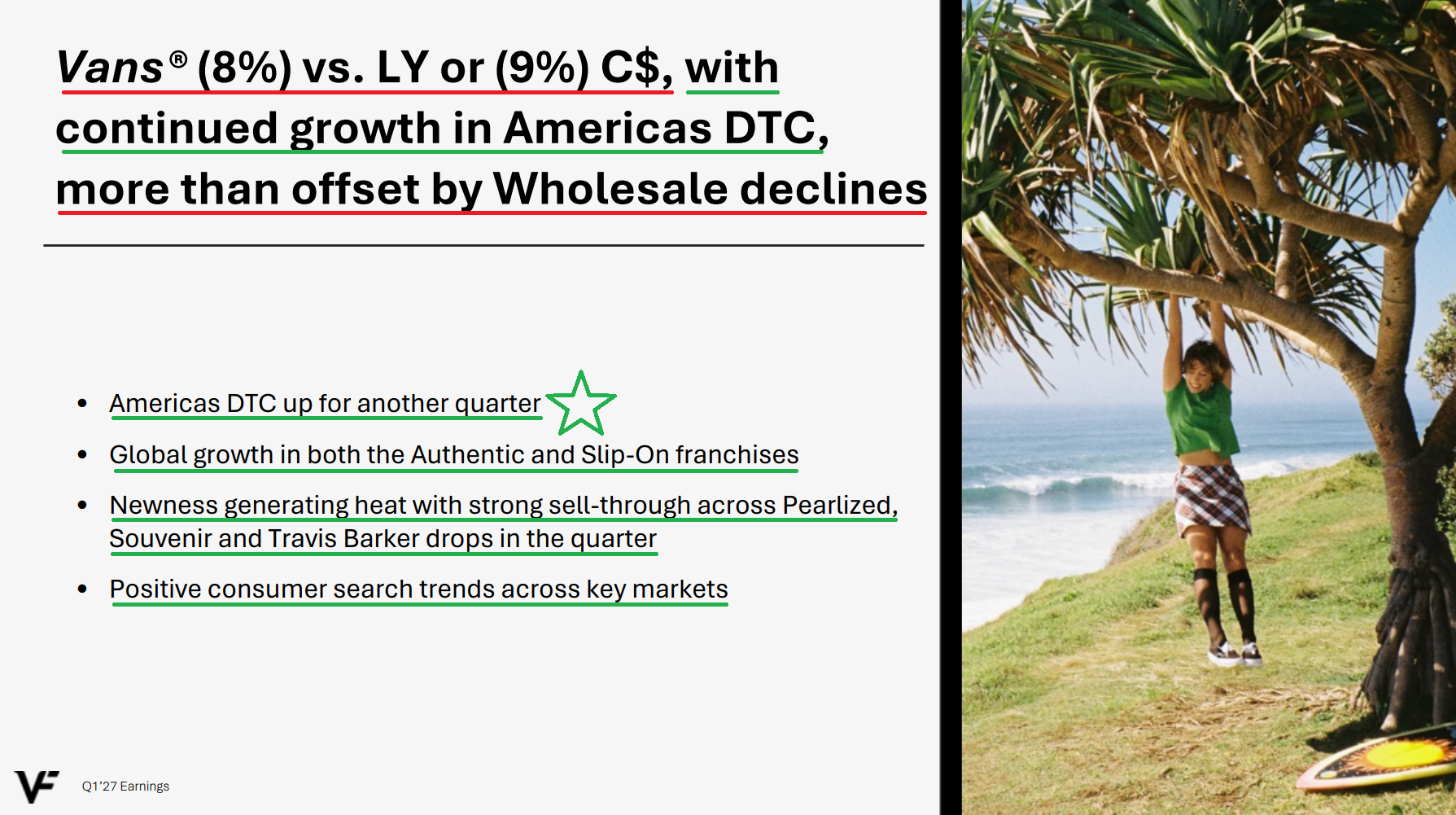
5) Vans declined (8%) Y/Y or (9%) C$ to $459.8M, with the all-important Americas DTC business up for another quarter and e-commerce accelerating, more than offset by global wholesale running well below the blended number as retailers destock ahead of refreshed assortments. ~60% of U.S. comp stores are now flat to growing, with the Authentic franchise posting another double-digit quarter while Slip-On grew and newness continued to generate heat as the Pearlized, Souvenir (sold out in ~30 minutes), and Travis Barker drops all sold through strongly. Management guided Q2 to a similar ~(9%) before an inflection to (2%) or better in H2, landing the full year at a mid-single-digit decline vs. (11%) in FY26. That H2 turn rests almost entirely on wholesale, with Bracken pointing to wholesale partner discussions that signal "a strong turn in wholesale in the back half."
6) Timberland grew +4% Y/Y or +3% C$ to $266.1M, driven by the Americas at +11% (+10% C$) with global growth across both DTC and wholesale. Growth absorbed a ~3-point drag from the ongoing Middle East conflict and timing with one of the brand's distributors, both of which management expects to moderate beginning in Q2. The 6" Premium Boot remains the engine, while the Boat Shoe led shoes higher across all regions, with search interest up across all key markets. Management opened three new full-price DTC stores in the Americas to reach 14 in the region, with more to come and a rollout of more seasonally relevant apparel and footwear beginning in fall 2026 as it broadens the lineup across categories.
7) Other Brands grew +4% C$ ex-Dickies to $352.6M, once again led by Altra, which grew double digits across all regions and channels to extend last year's momentum. Elsewhere, Packs grew behind JanSport and Kipling ahead of back-to-school, Smartwool was up double digits across DTC and wholesale, icebreaker grew on DTC strength, and the Napapijri reset stayed on track.
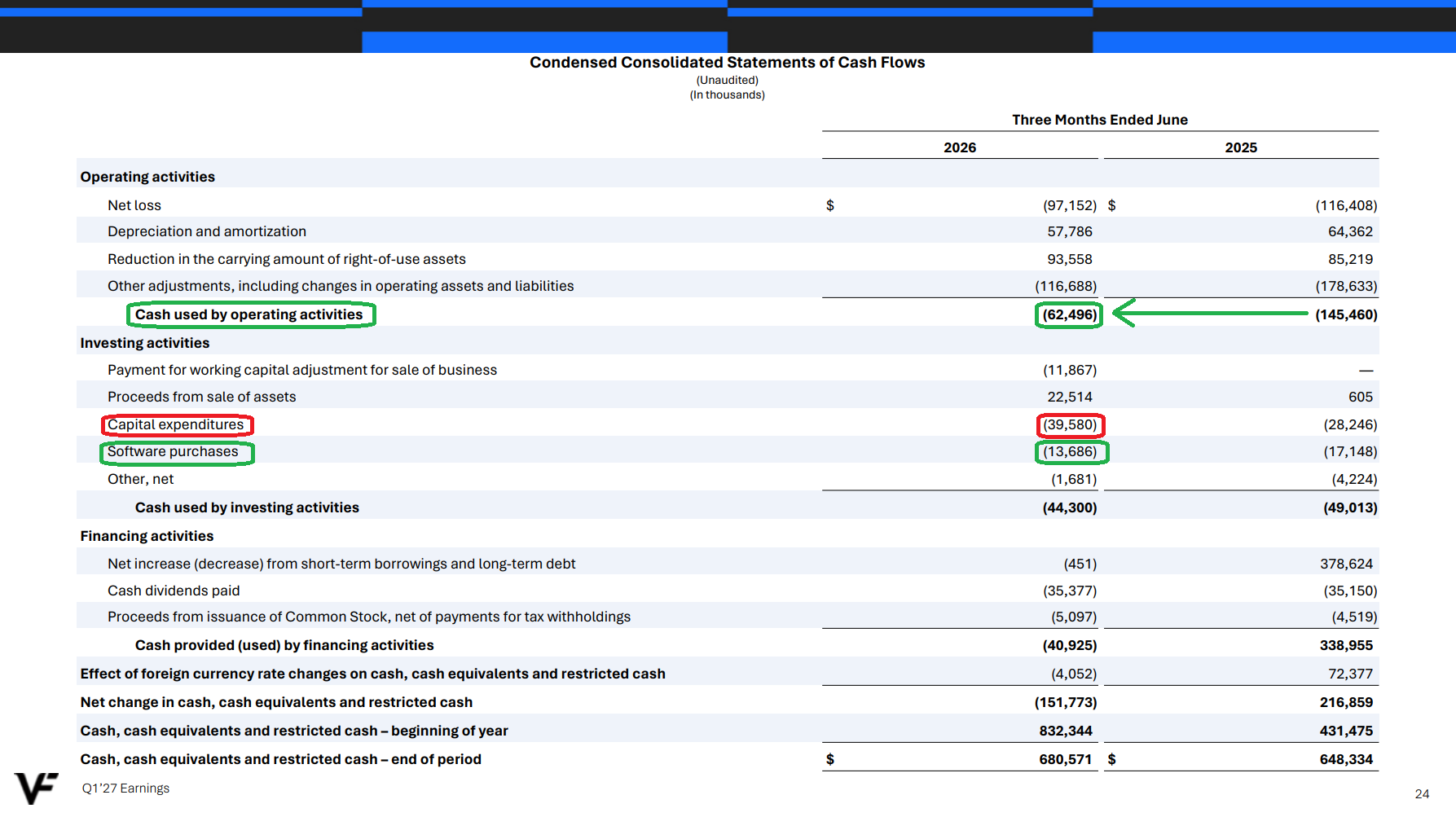
8) Free cash flow was an outflow of ~($116M) in Q1, up ~$75M Y/Y and consistent with VF's historical seasonality, helped by a ~$50M benefit from tariff refunds collected during the quarter. Management reaffirmed its FY27 guidance for free cash flow to be flat to up vs. FY26's $405M, with operating cash flow up Y/Y. Guidance excludes both the $100M net pension termination benefit booked in FY26 and any net benefit from tariff refunds in FY27, leaving room for upside.
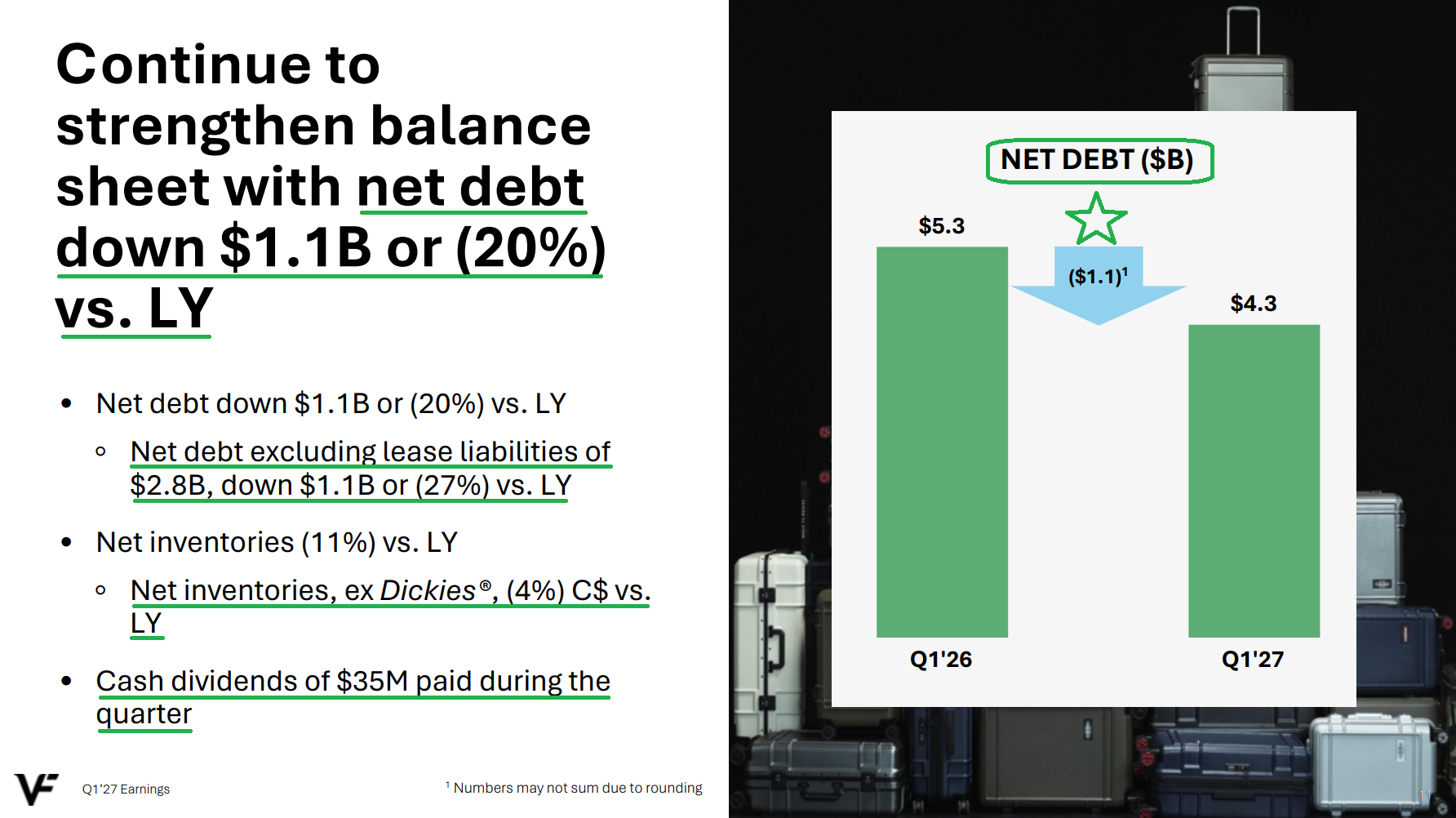
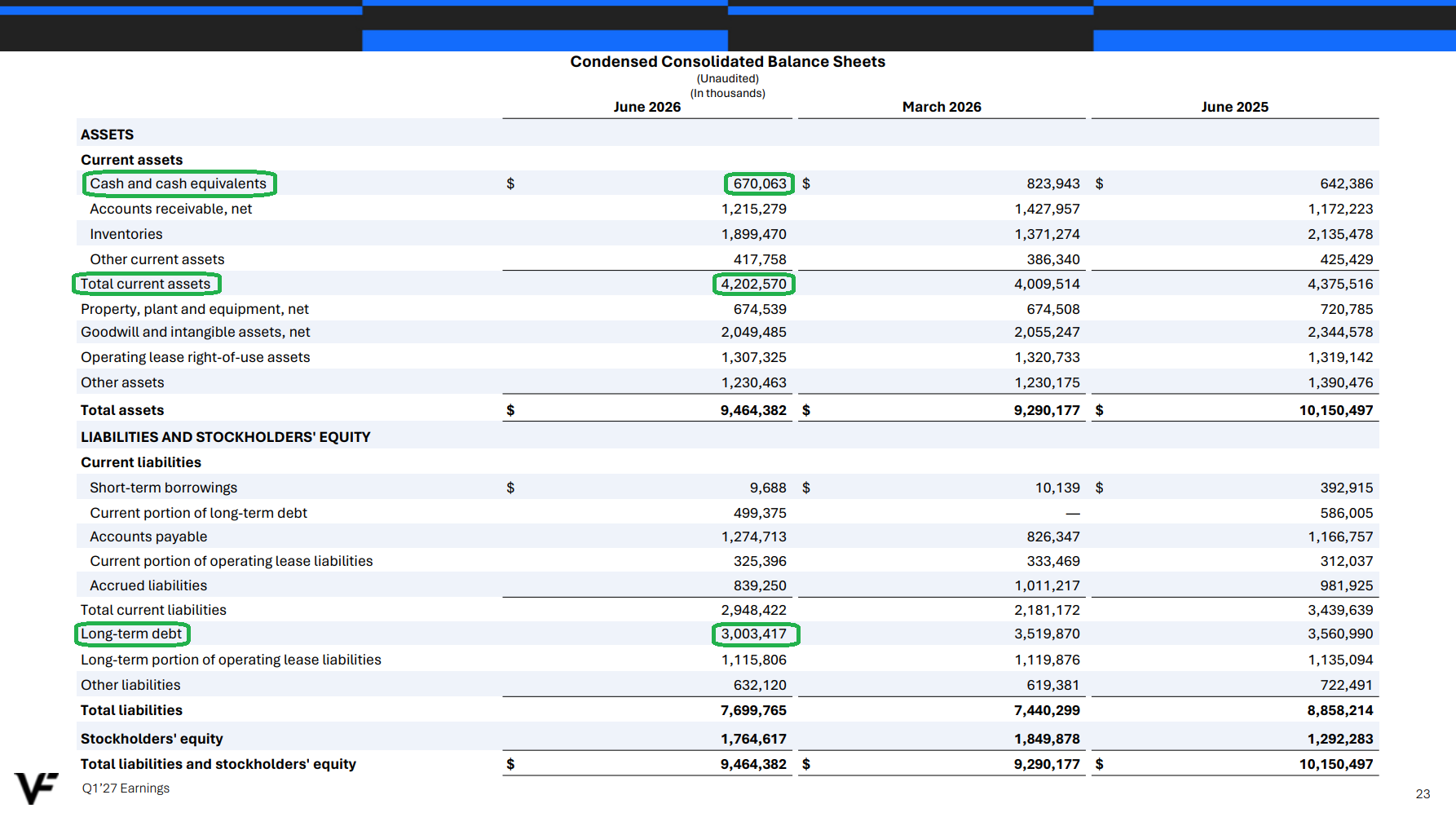
9) VF continued to strengthen its balance sheet, with net debt ending the quarter at $4.3B, down $1.1B or (20%) Y/Y, while net debt excluding lease liabilities fell to $2.8B, down $1.1B or (27%) Y/Y. Net inventories were (11%) reported or (4%) C$ ex-Dickies. Management guided to a FYE27 leverage ratio of 2.6x to 2.9x, down from 3.1x at the end of FY26 and keeping the company on track to reach its medium-term target of 2.5x or lower by FY28.
10) Management raised its FY27 revenue outlook to +2% or better C$ ex-Dickies, up from the prior +1% to +2%, with growth at The North Face, Timberland, and Altra and a Vans decline of mid-single digits (with H2 improving to (2%) or better). For Q2, management guided revenue ~in line with Q1 and operating income broadly in line with LY, with The North Face flat to slightly up on wholesale timing, strong growth at Timberland, and Vans similar to Q1 at ~(9%).
Earnings Call Highlights
Morningstar Analyst Note
Stanley Black & Decker Update
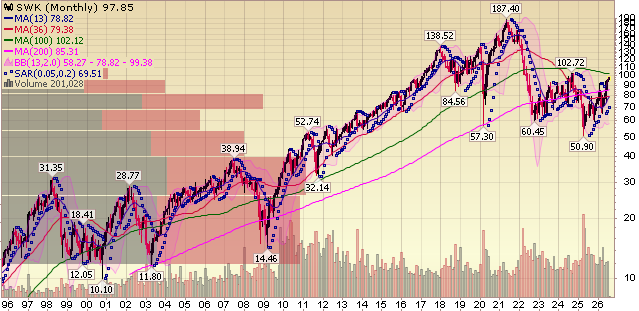
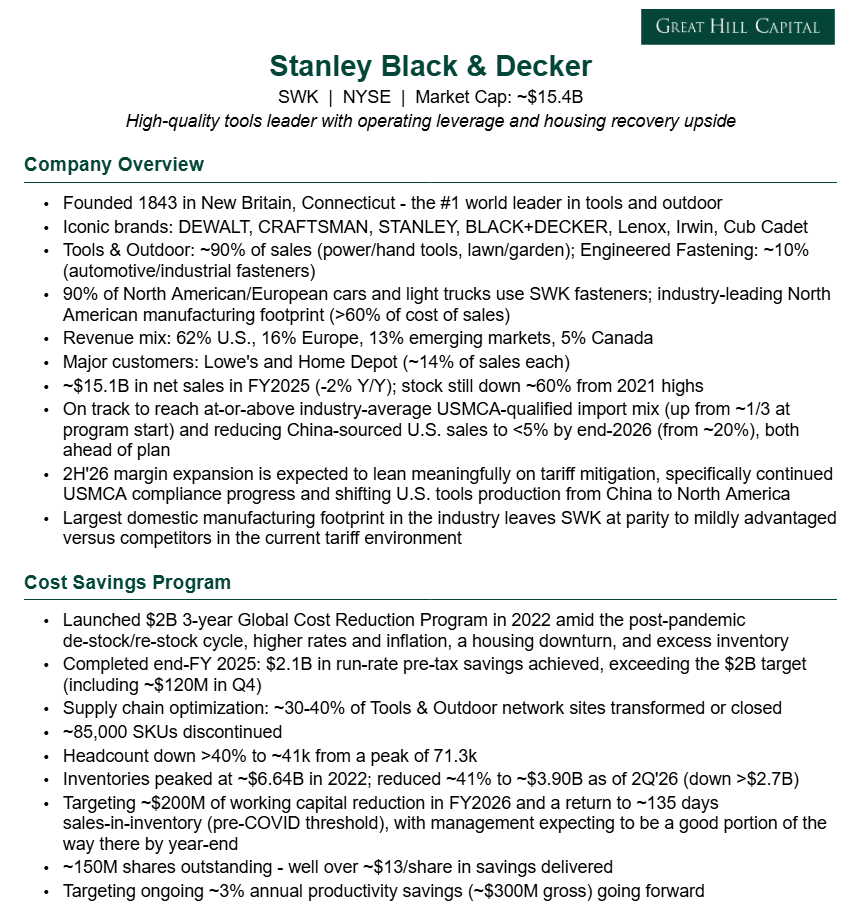
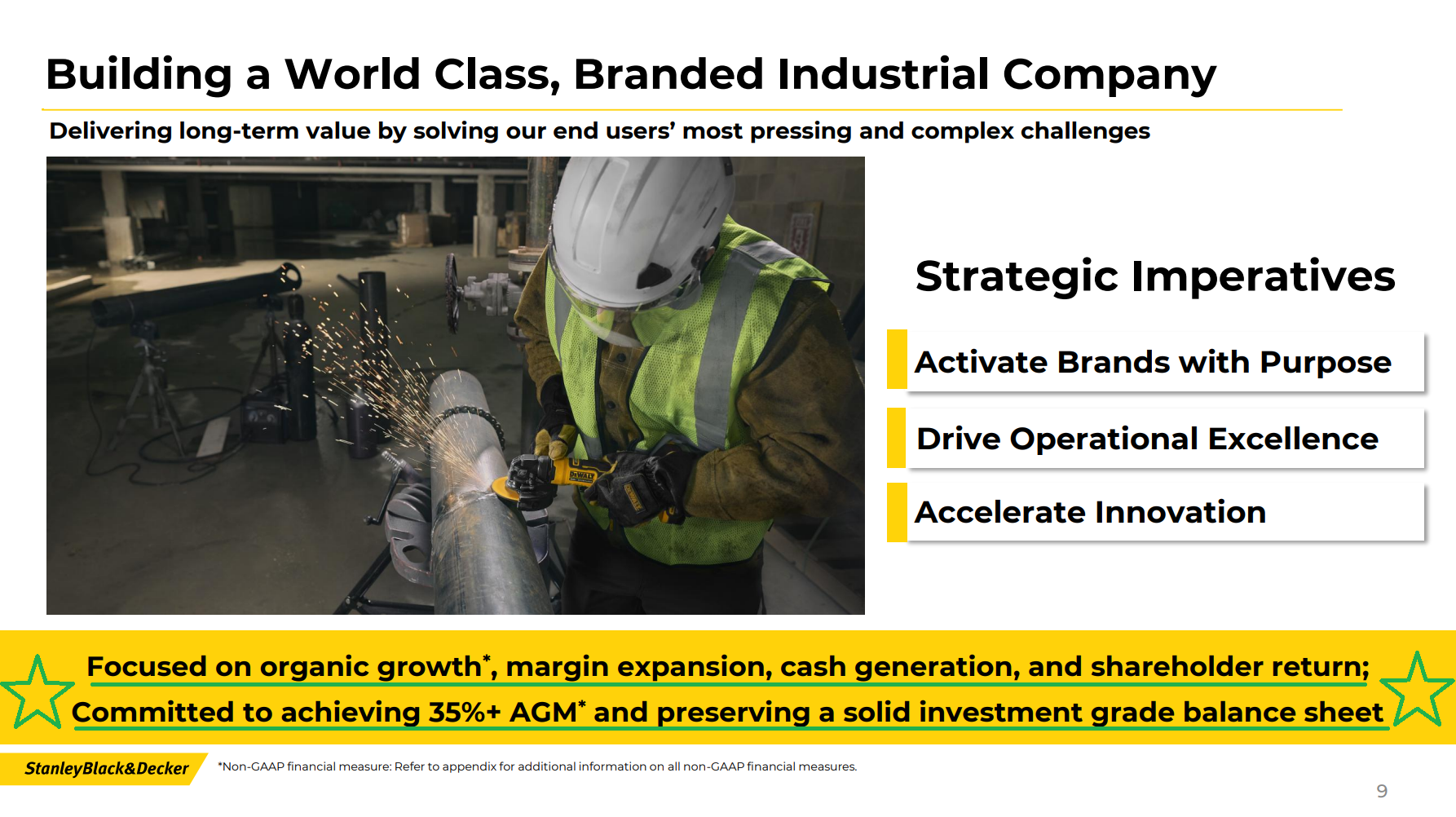
For newer readers, here’s a brief overview of the key drivers behind our Stanley Black & Decker thesis, the world’s #1 tools company turning the page on a multi-year restructuring and a levered way to play the long-awaited housing recovery:
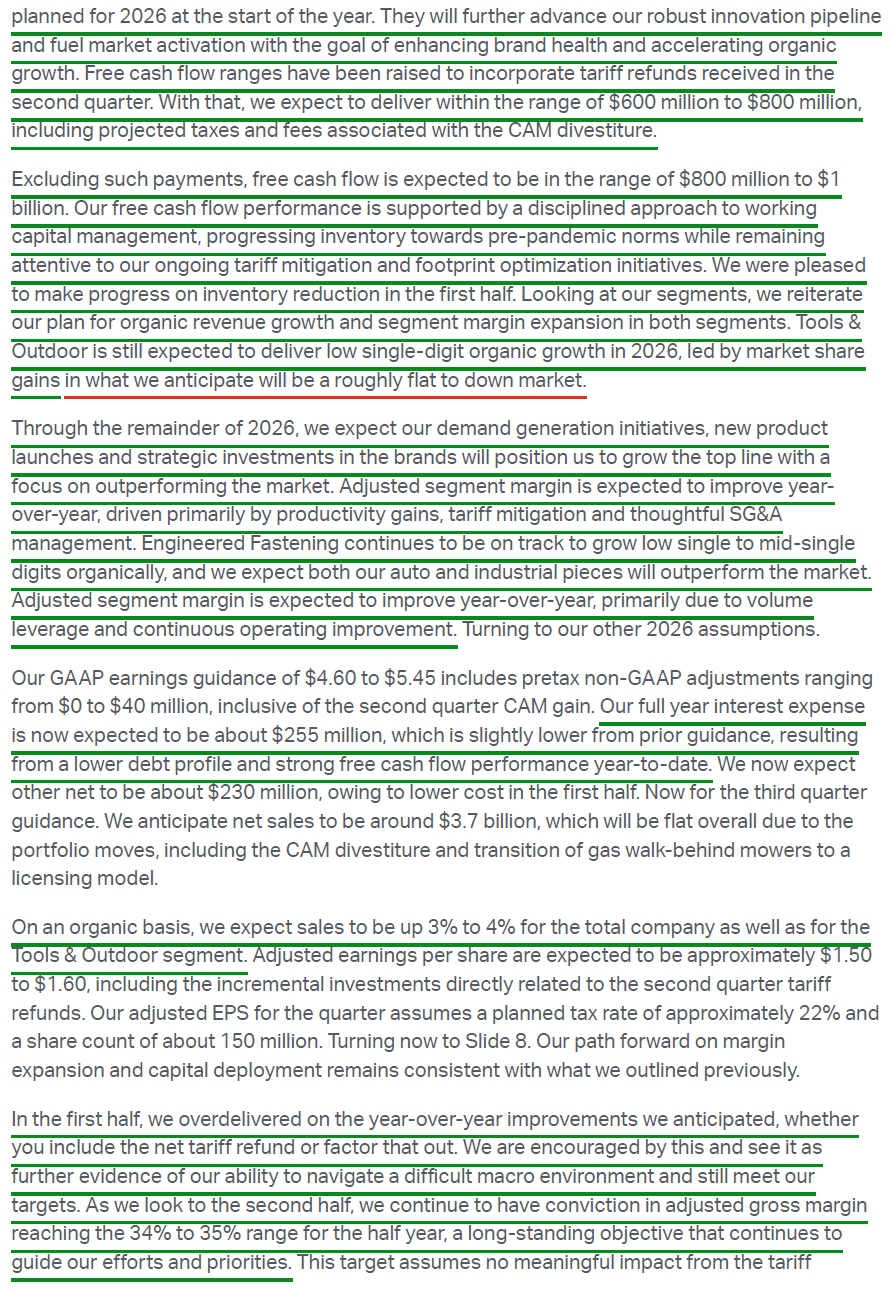
Q2 Earnings Breakdown
10 Key Points
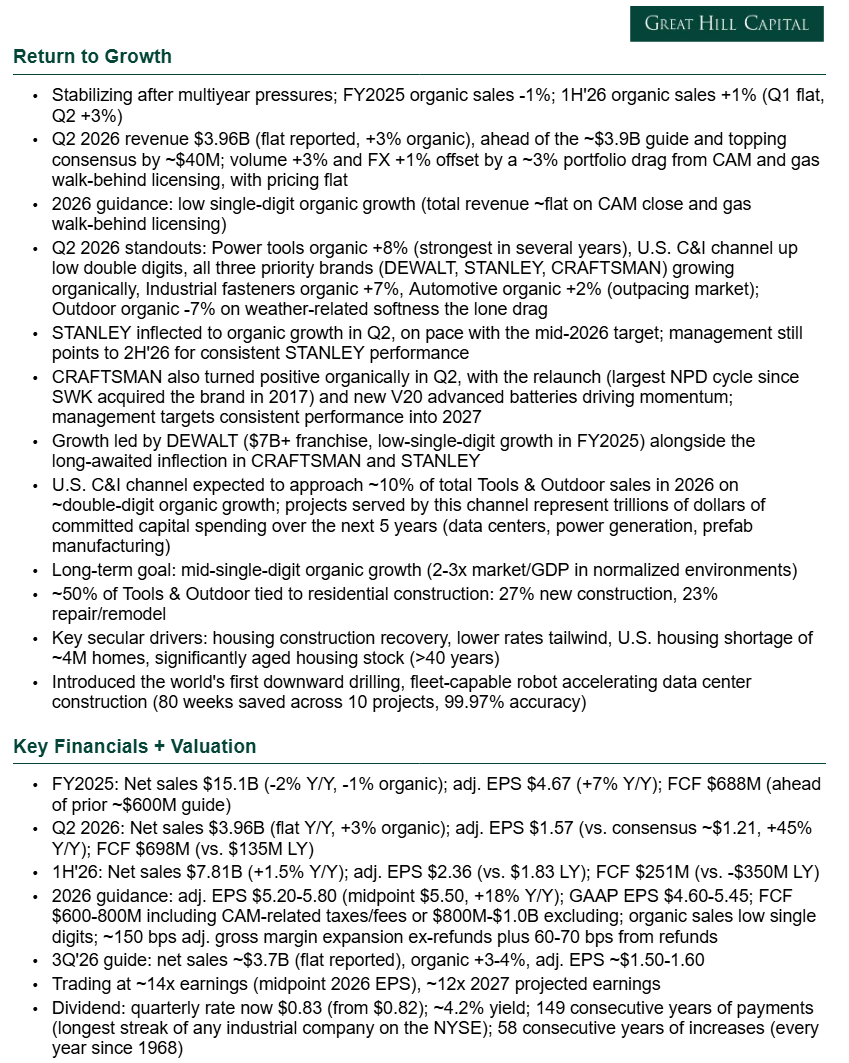
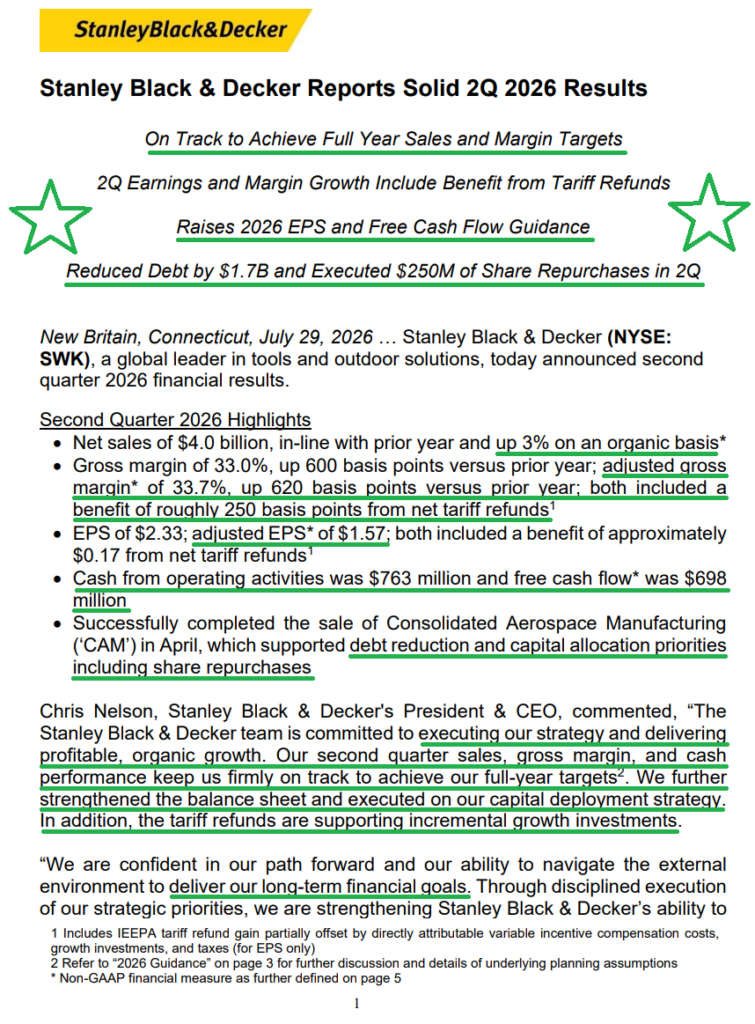
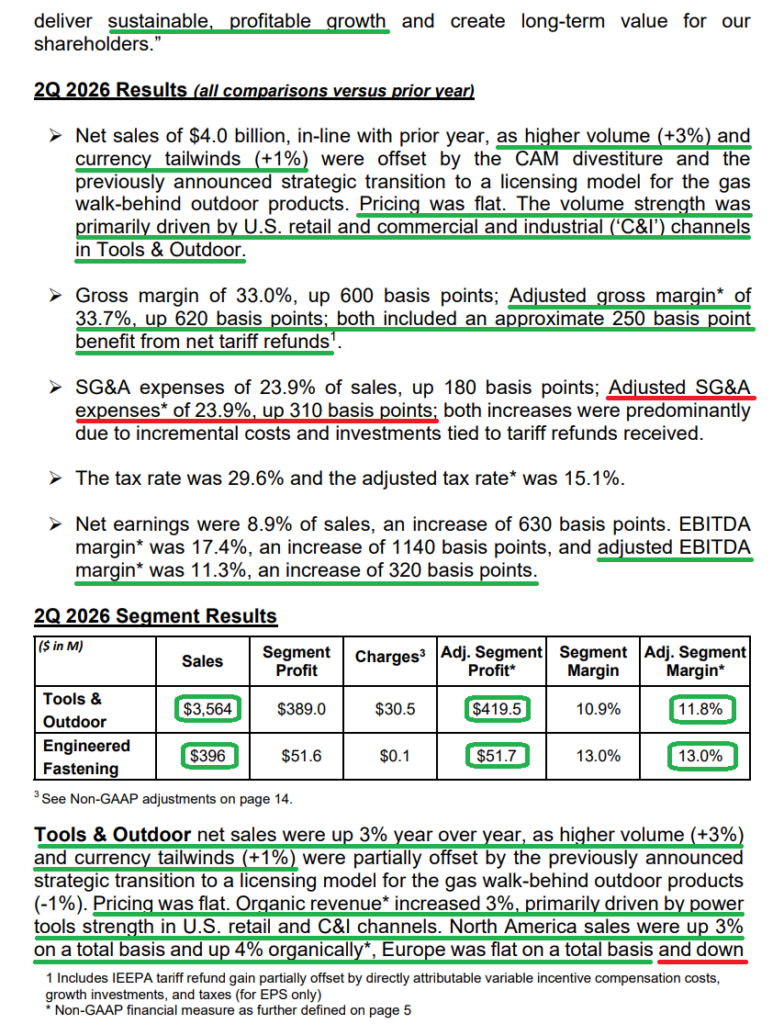
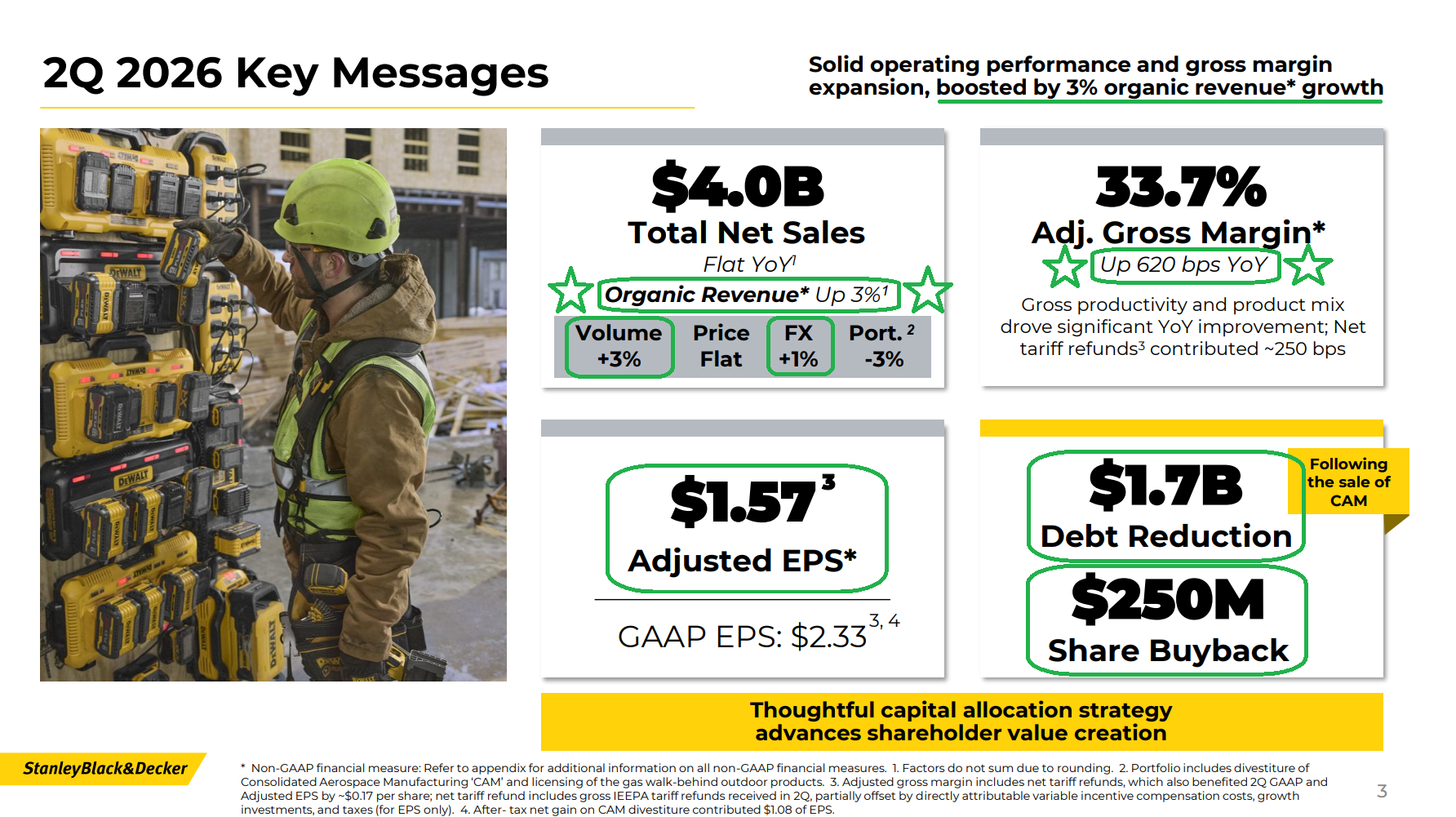
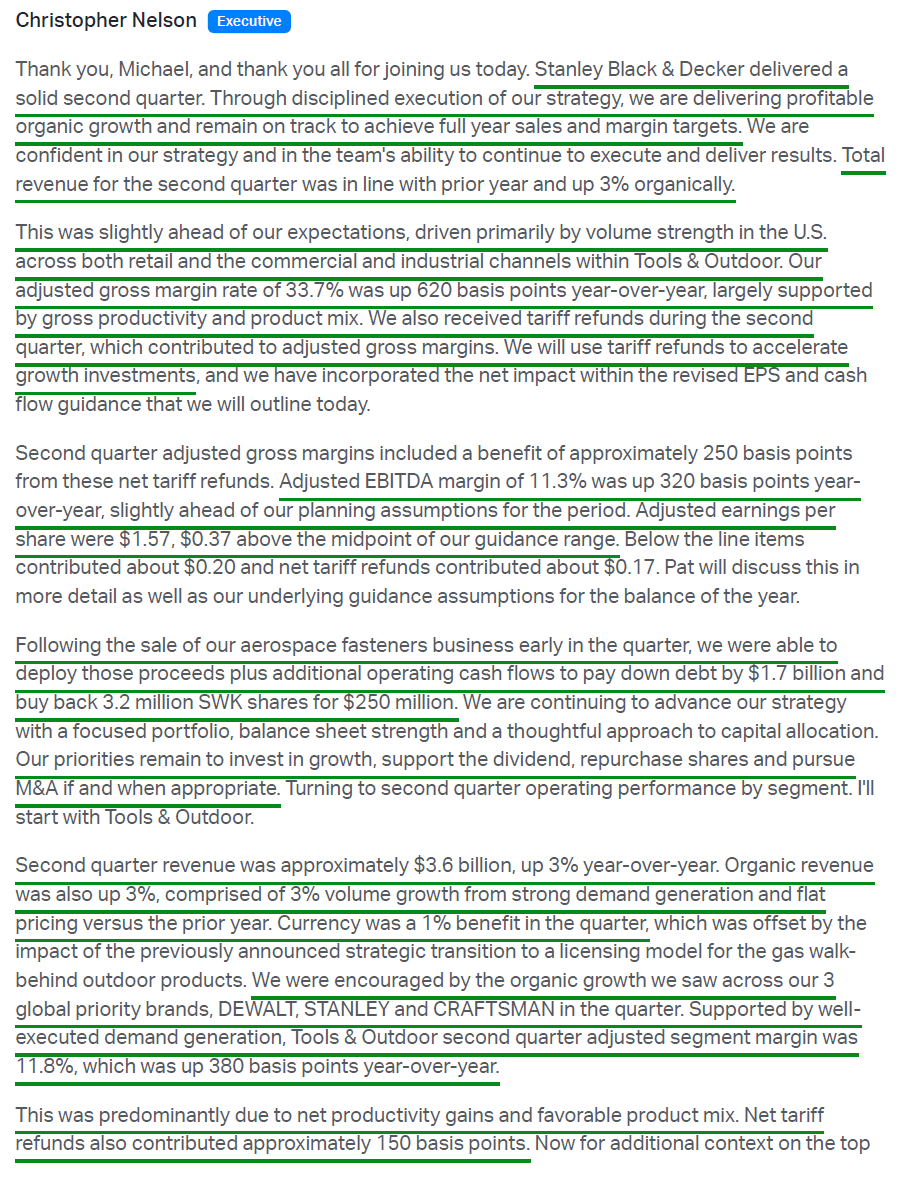
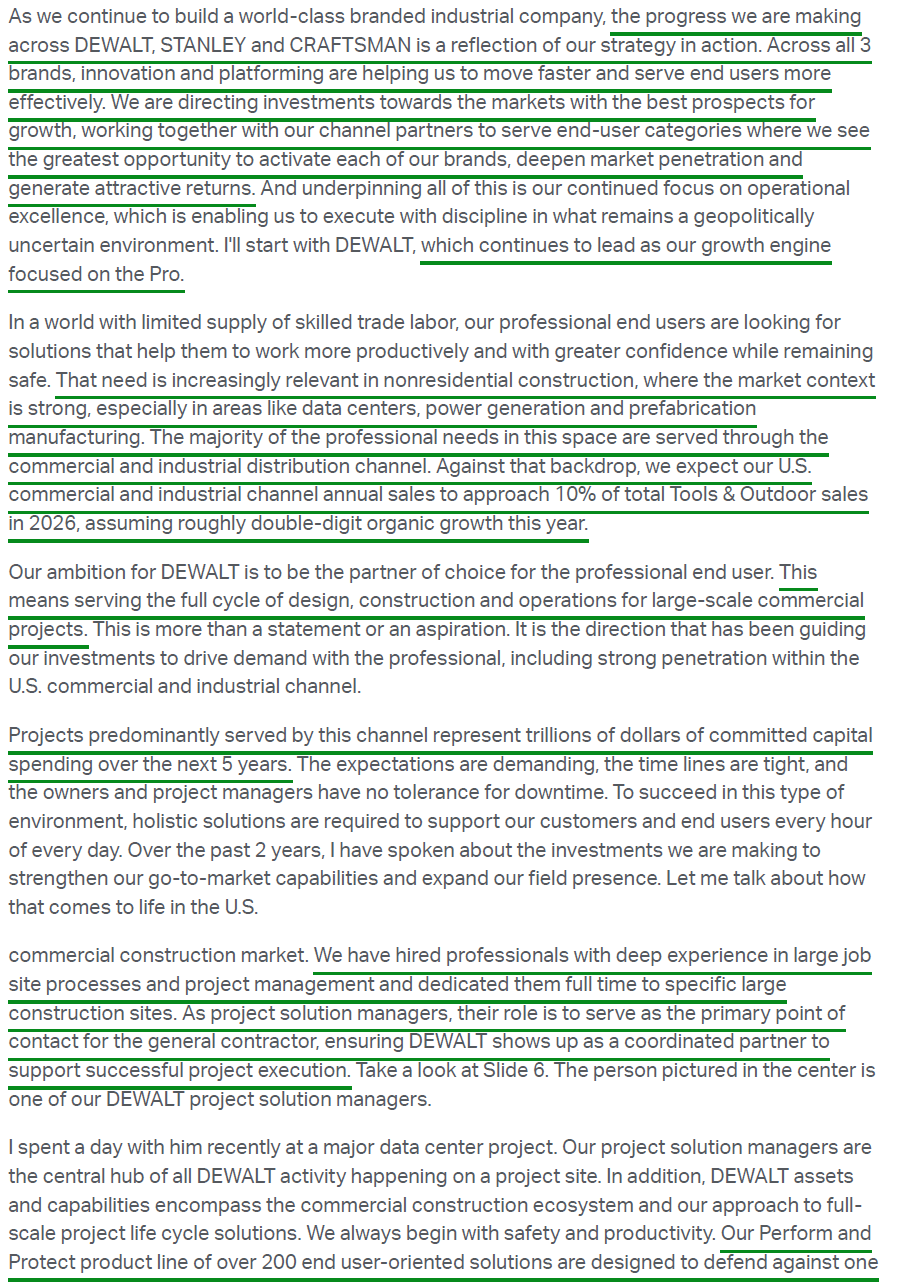
1) SWK reported Q2 revenue of $3.96B, flat Y/Y on a reported basis and up 3% organically, coming in slightly ahead of the ~$3.9B prior guide and beating consensus by ~$40M. Higher volume (+3%) and currency tailwinds (+1%) were offset by a ~3% portfolio drag from the CAM divestiture and the previously announced transition to a licensing model for gas walk-behind outdoor products, with pricing flat. Volume strength was concentrated in U.S. retail and the commercial and industrial (C&I) channels within Tools & Outdoor, bringing year-to-date organic growth to +1%.
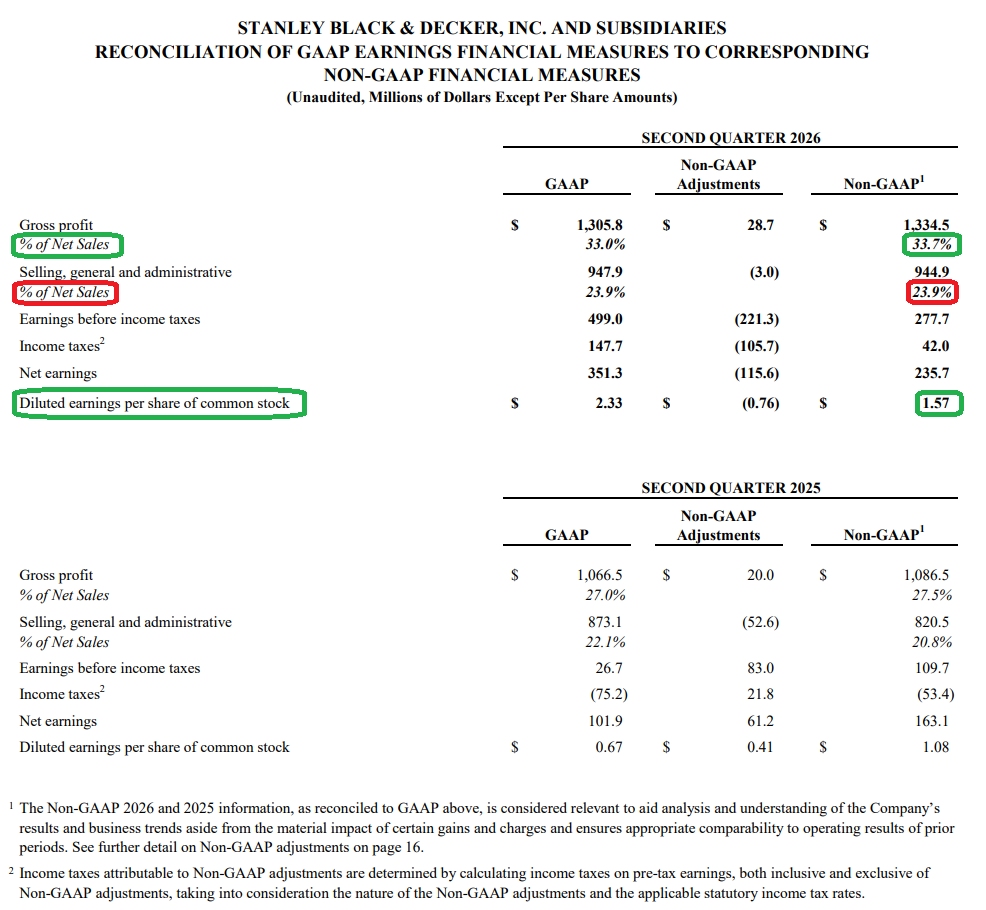
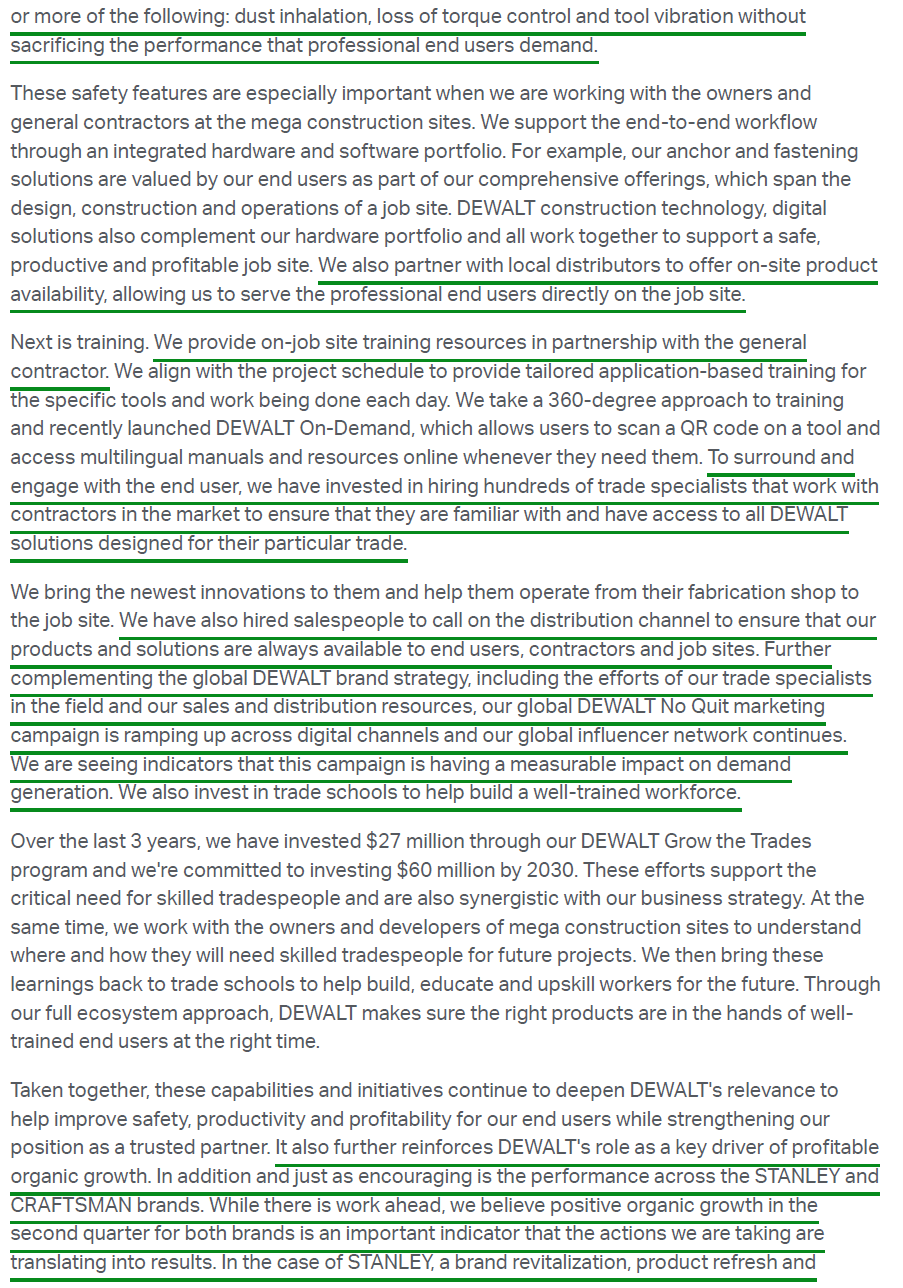
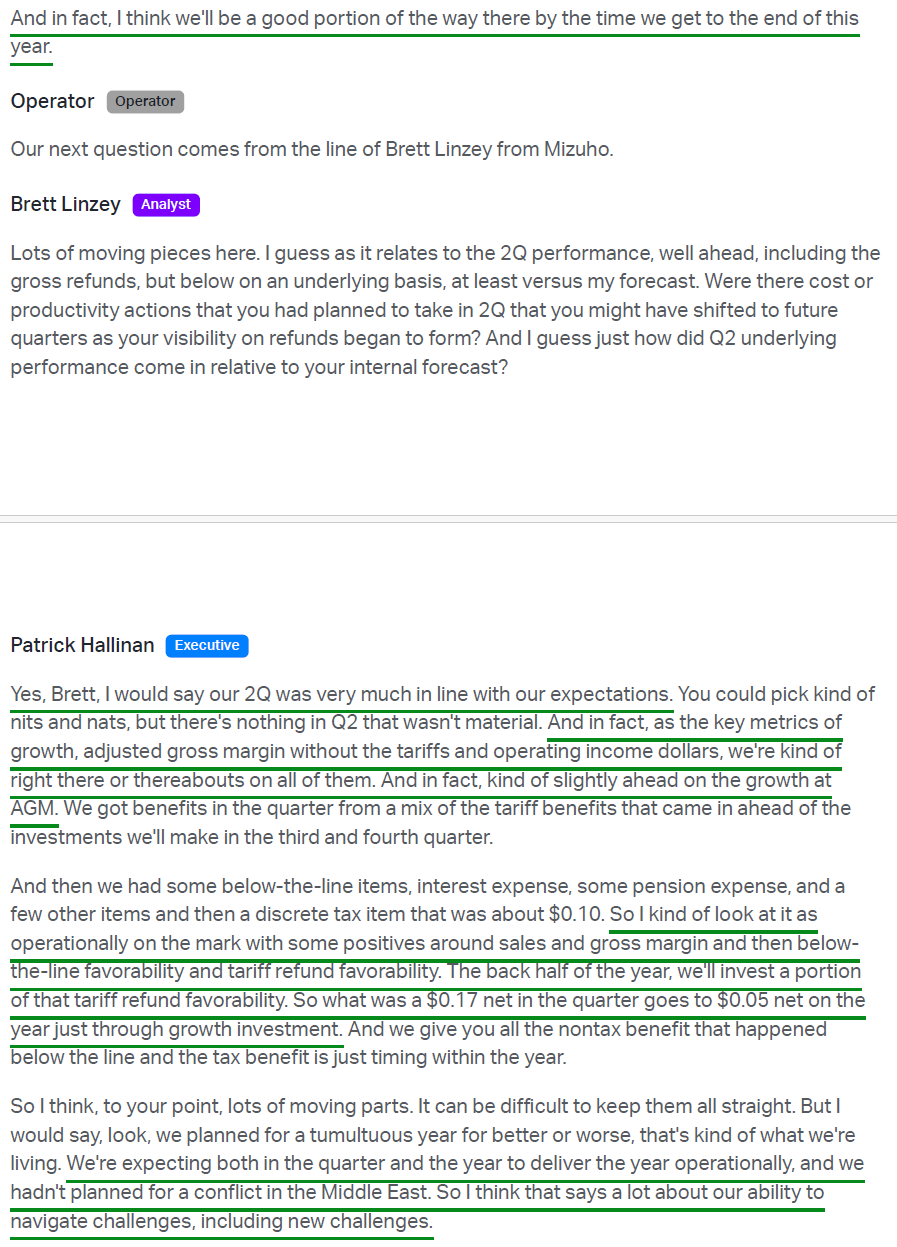
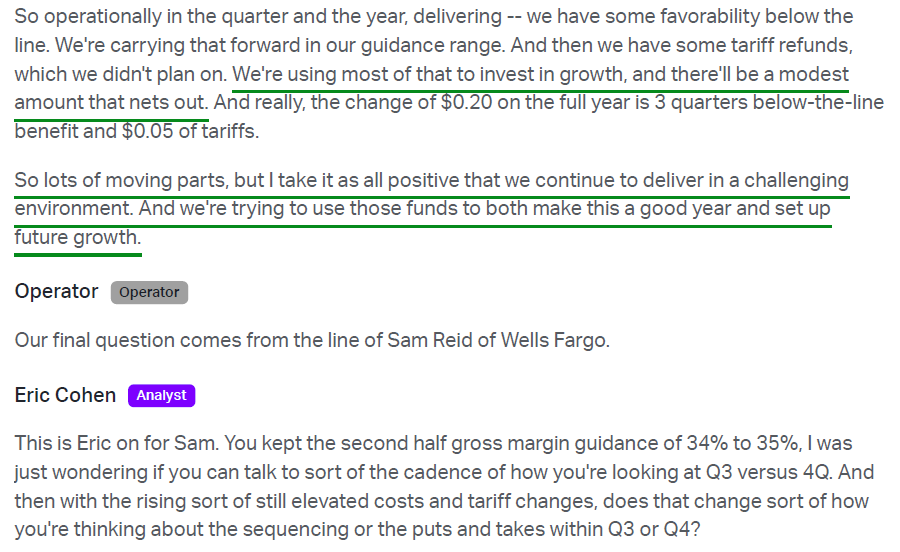
2) Adjusted EPS of $1.57 came in well ahead of consensus of ~$1.21 and $0.37 above the midpoint of April guidance, up ~45% Y/Y. Above-the-line operating performance was largely in line with internal expectations, with the outperformance driven primarily by below-the-line items (~$0.20, ~half from discrete tax timing plus lower interest expense) and net tariff refunds (~$0.17).
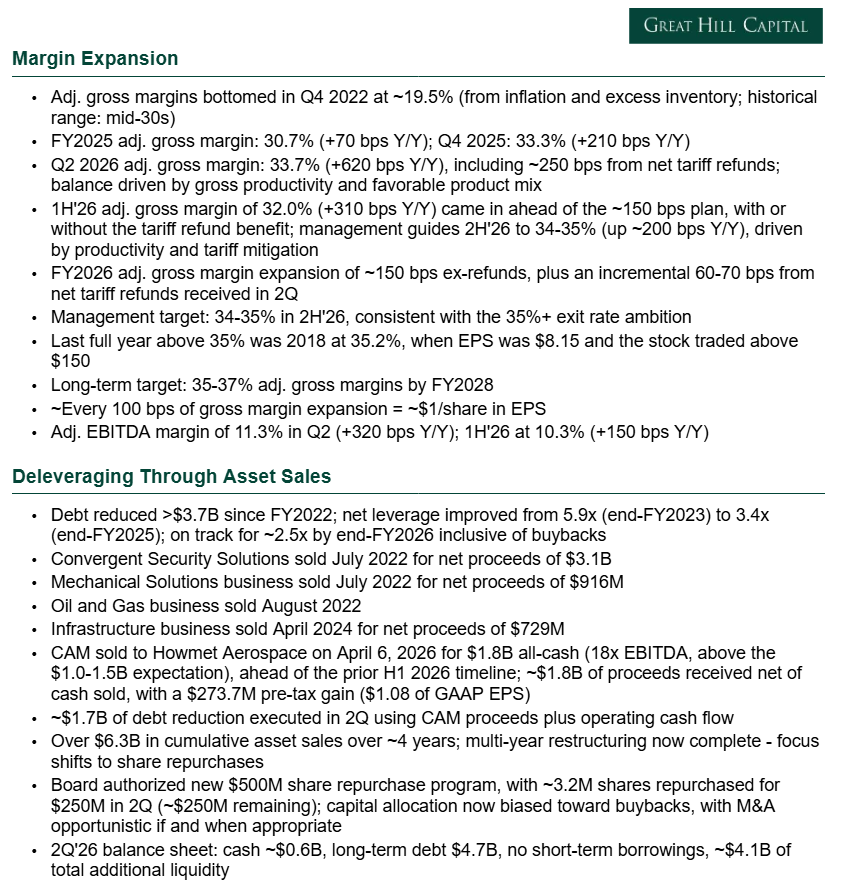
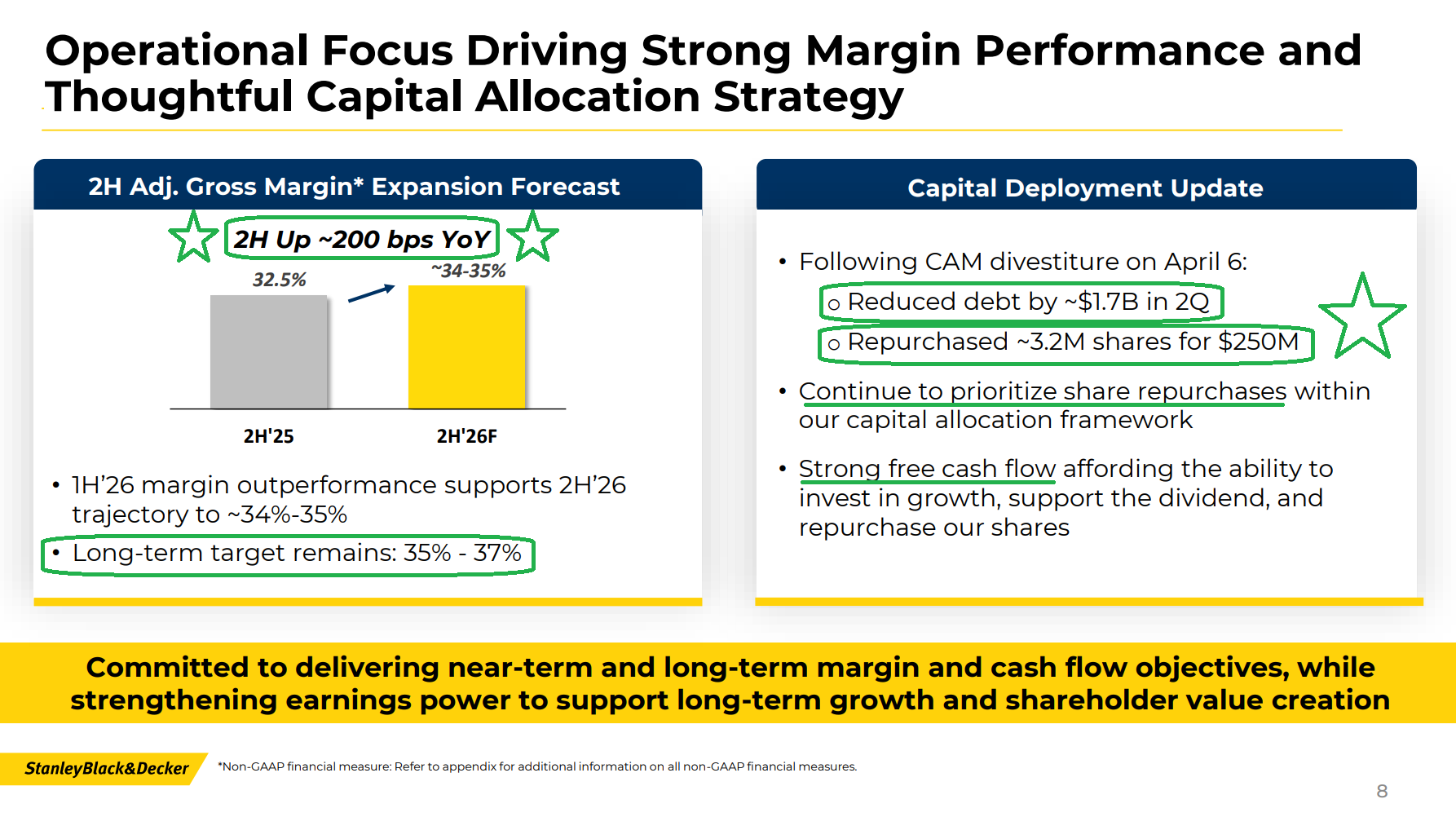
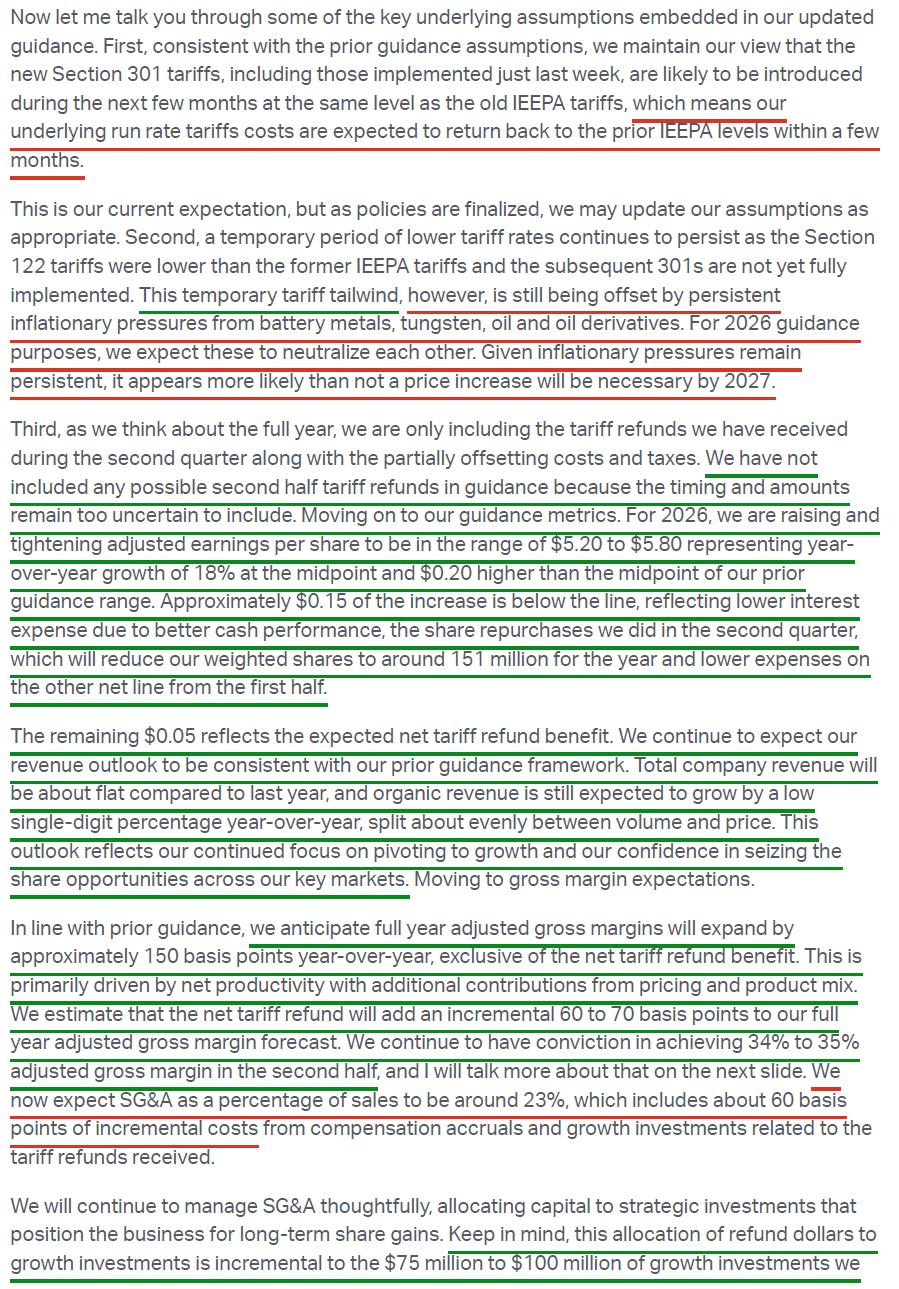
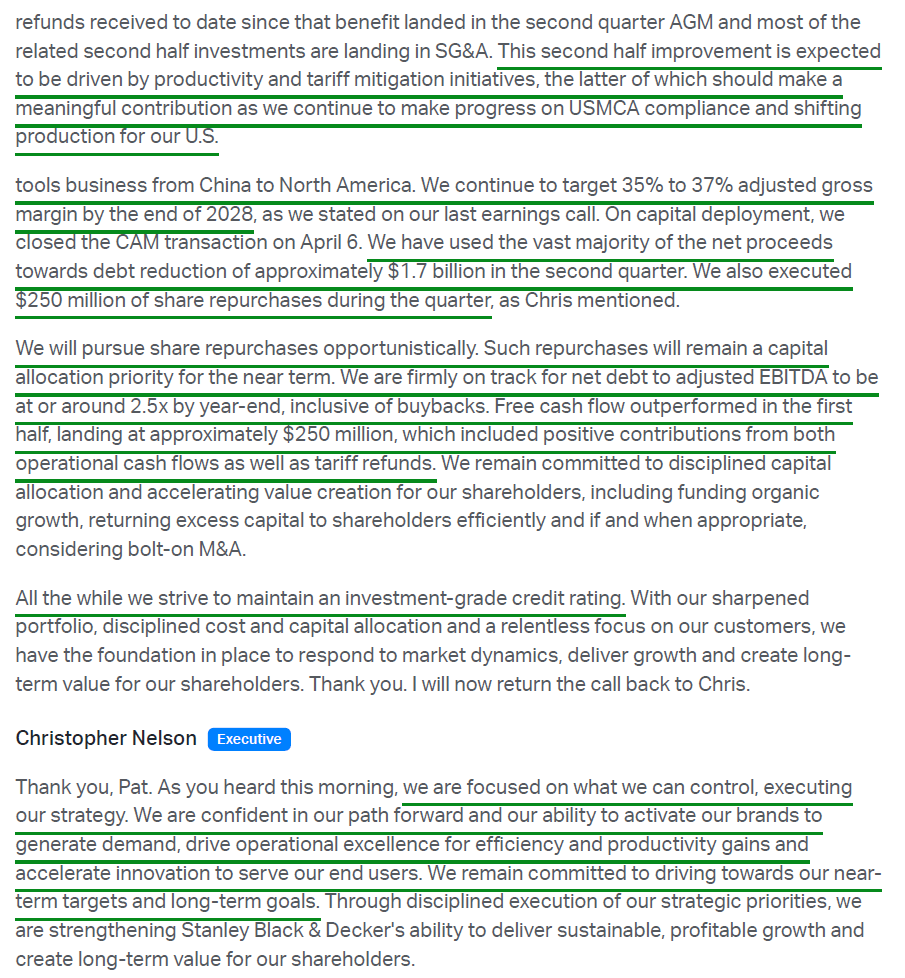
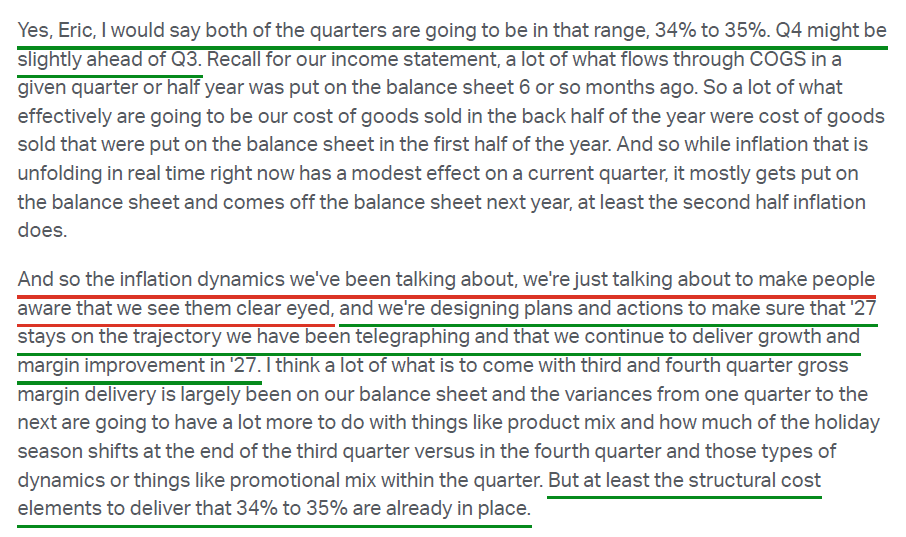
3) Adjusted gross margin (the #1 metric in the SWK turnaround) reached 33.7% in Q2, up 620 bps Y/Y, with ~250 bps coming from net tariff refunds and the balance from gross productivity and favorable product mix. For the full year, management expects ~150 bps of expansion off FY25's 30.7% excluding refunds, plus an incremental 60 to 70 bps from the refunds received. First half outperformance supports the 2H trajectory of 34% to 35% (up ~200 bps Y/Y), driven by productivity alongside tariff mitigation initiatives, including continued USMCA compliance progress and the shift of U.S. tools production from China to North America. The long-term target of 35% to 37% by the end of 2028 remains unchanged.
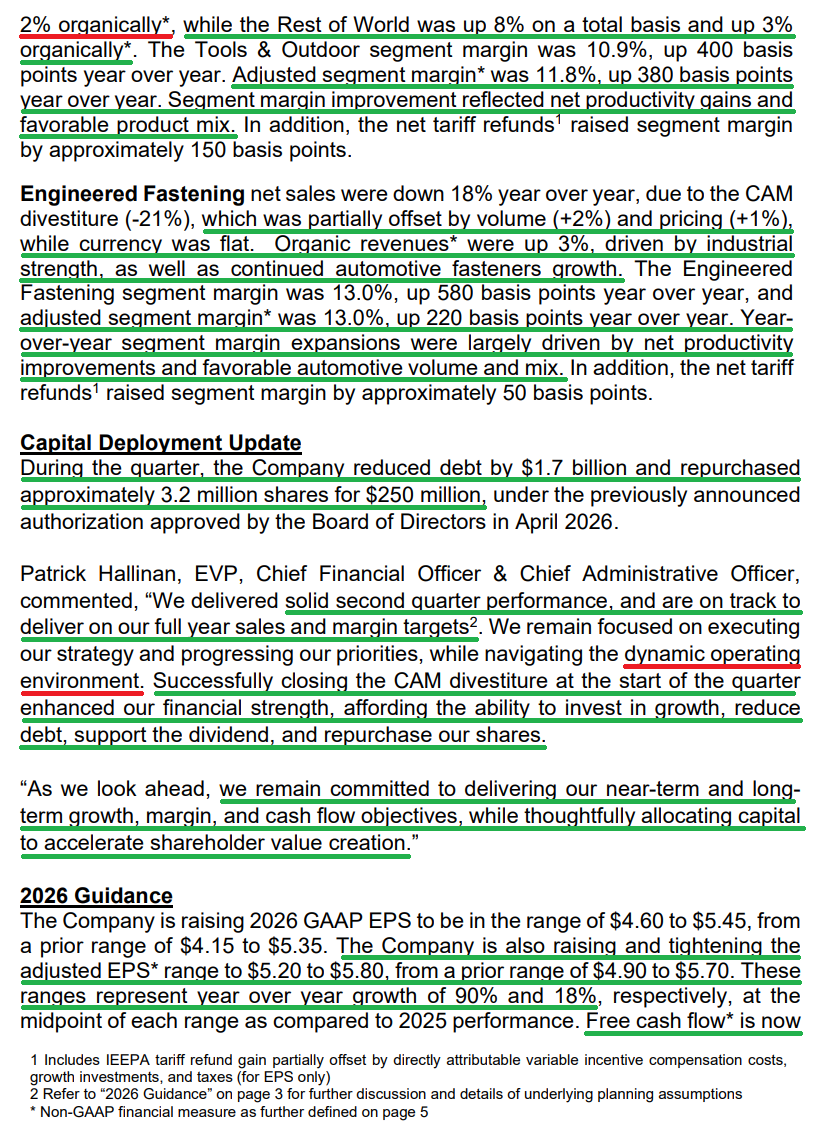
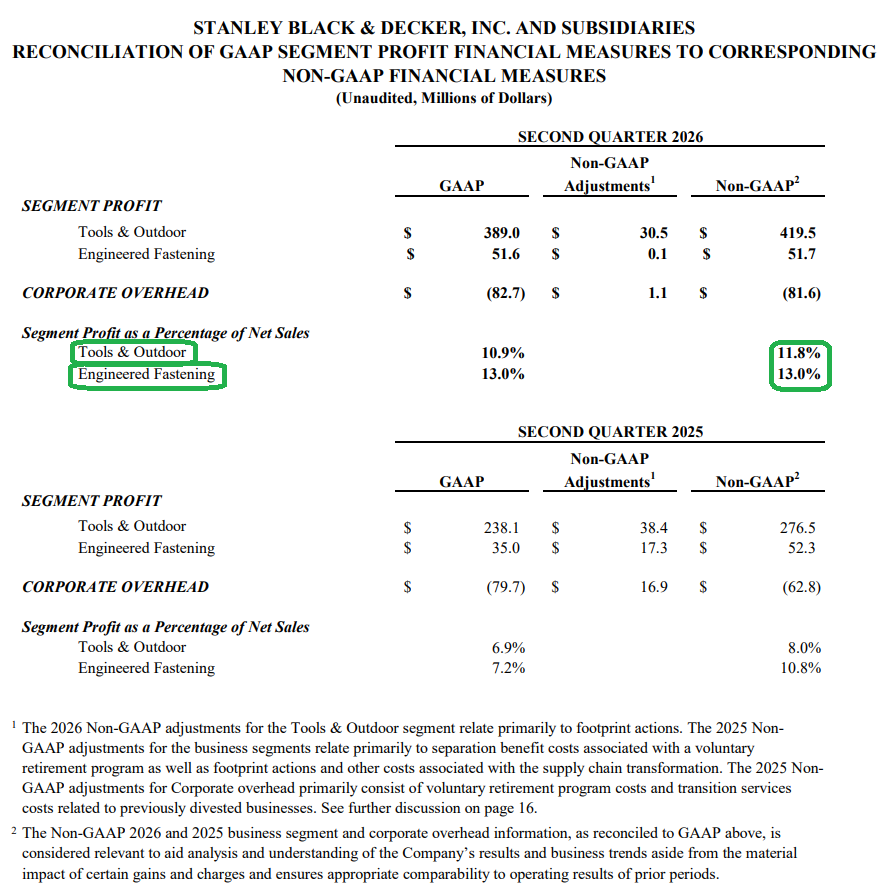
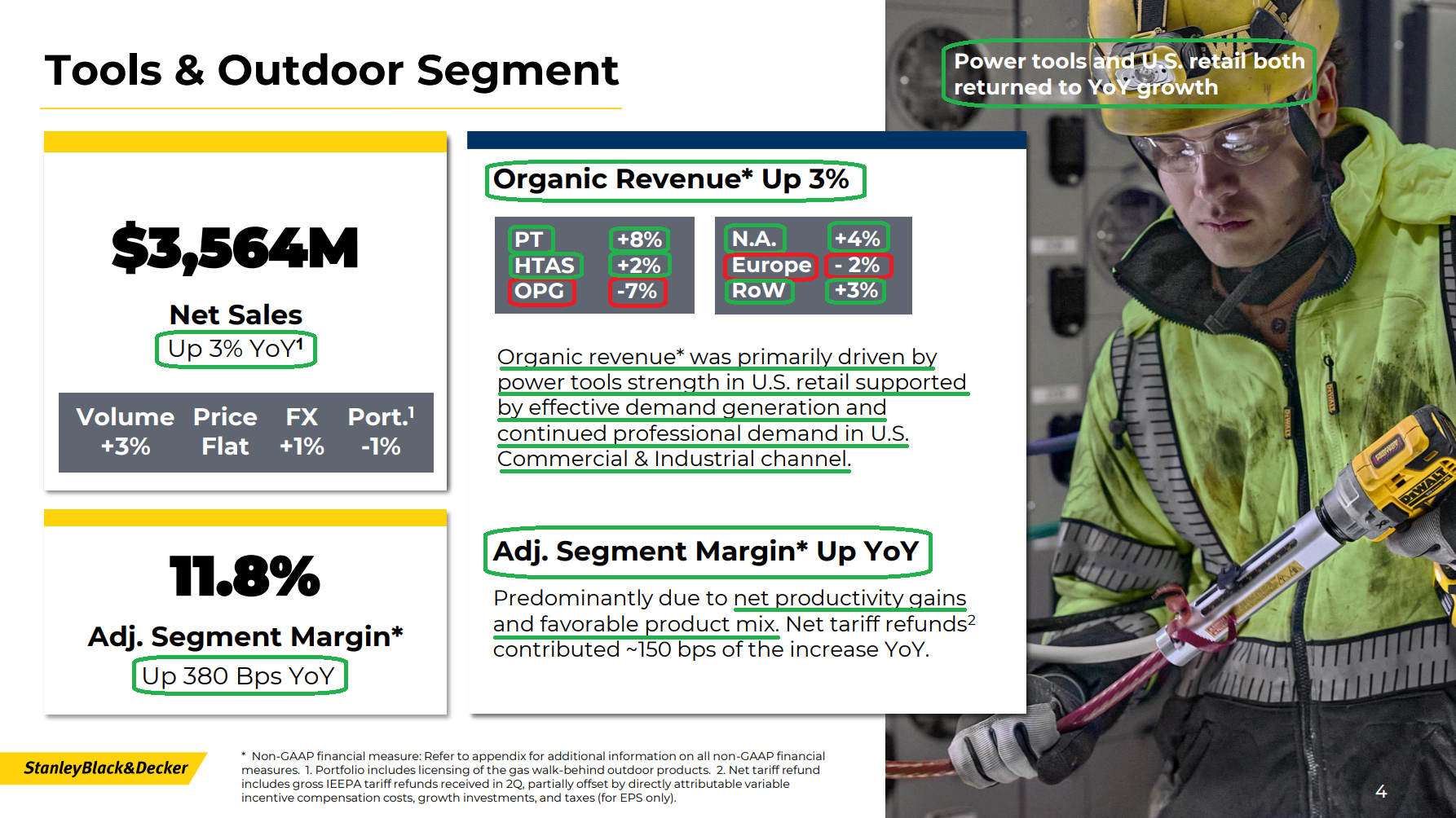
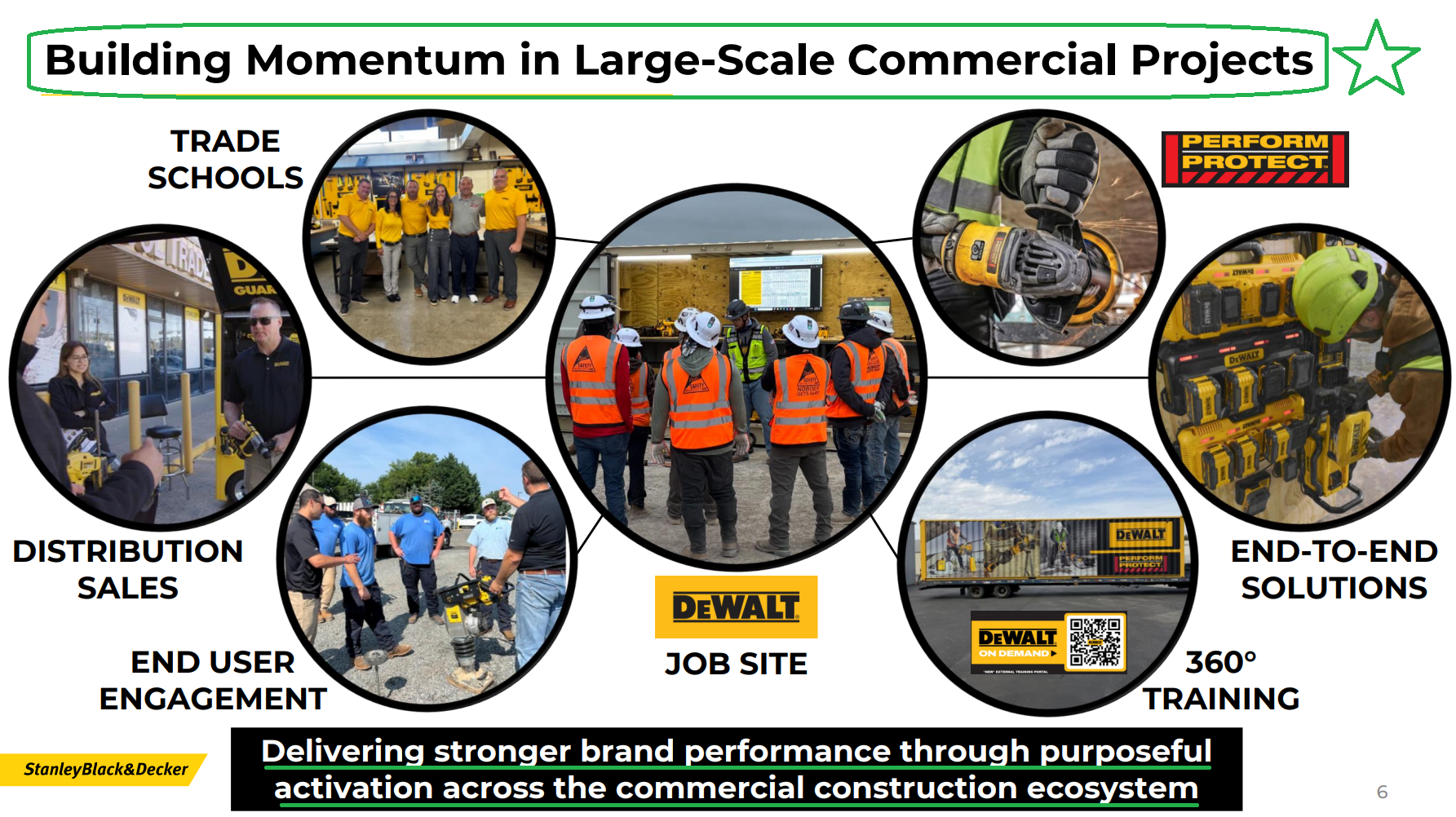
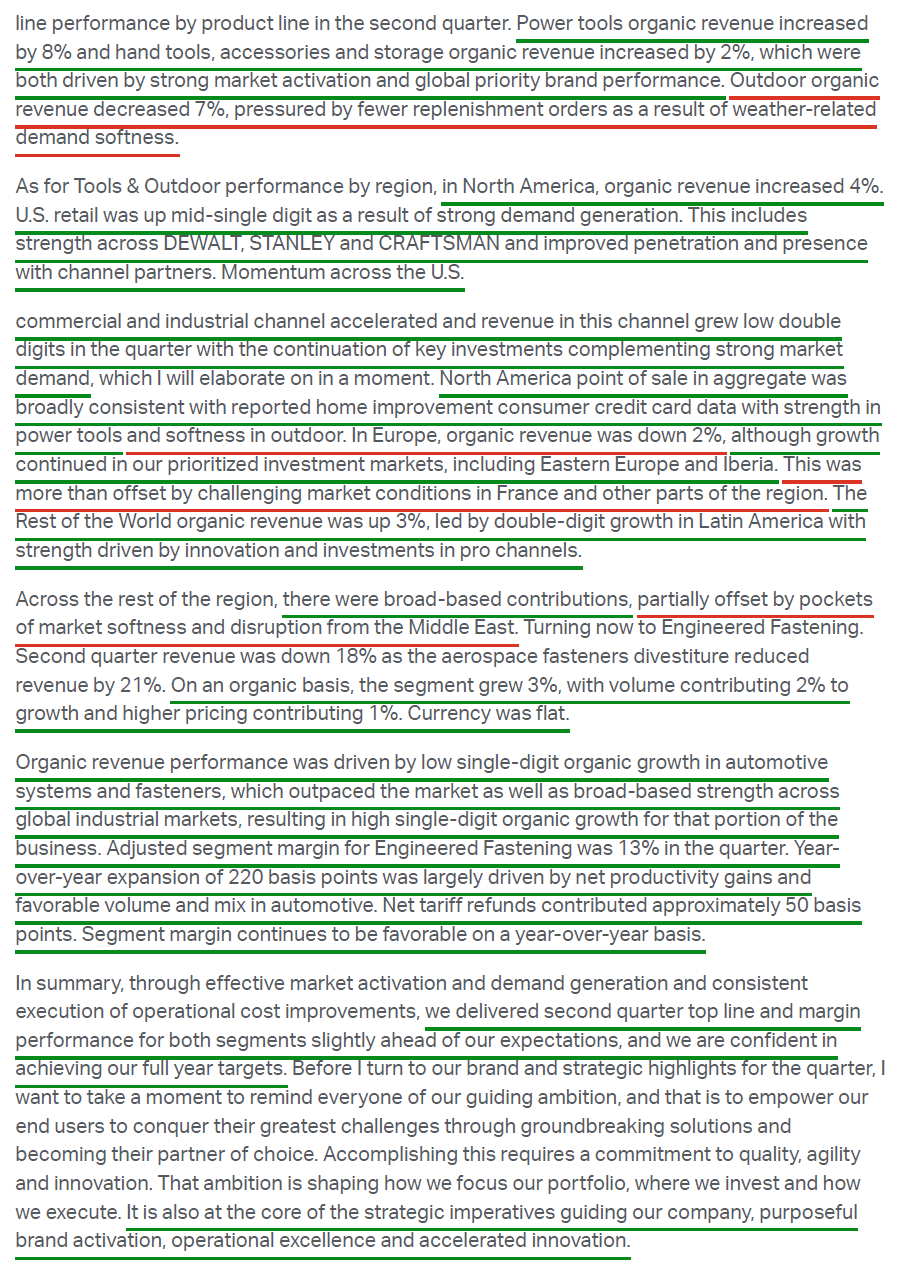
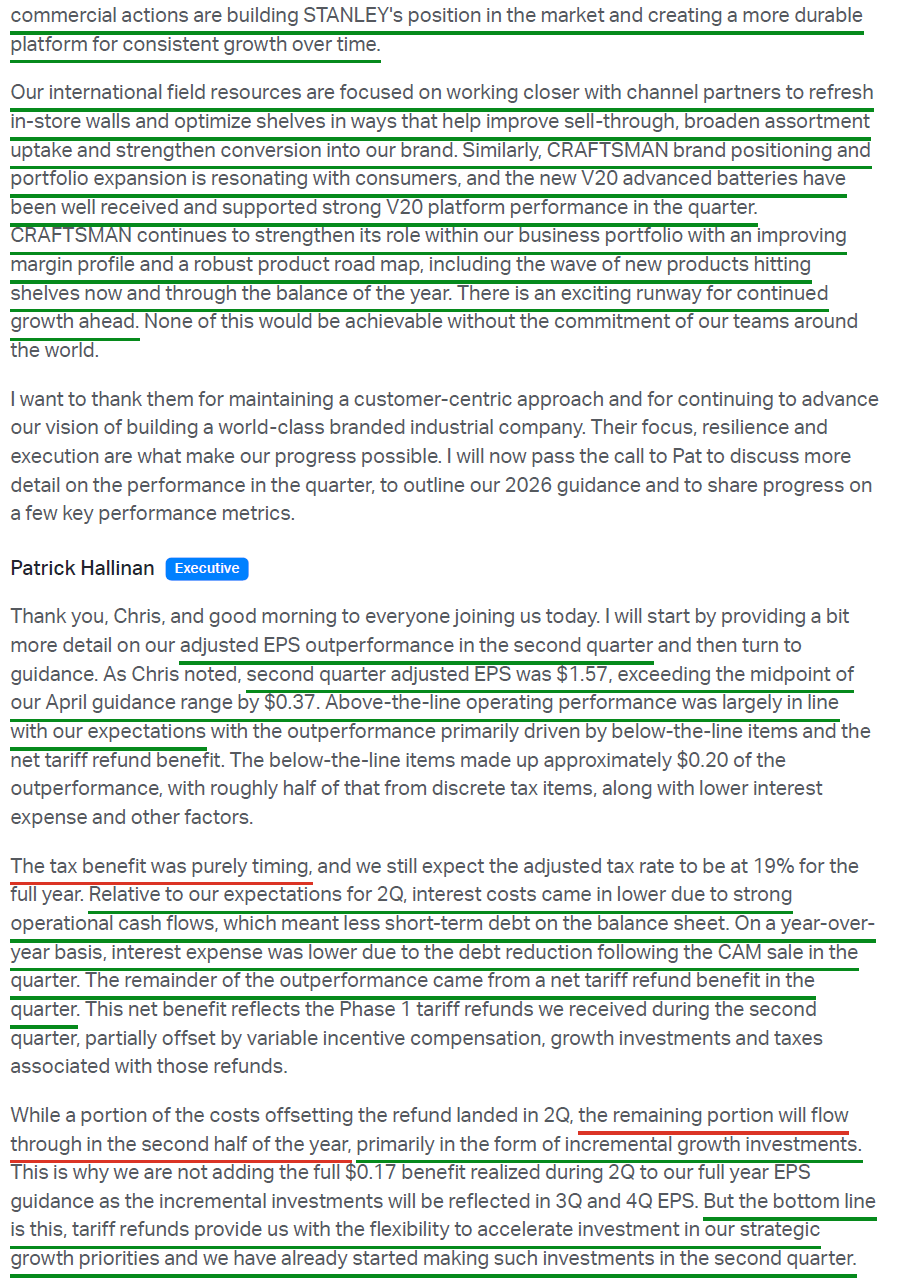
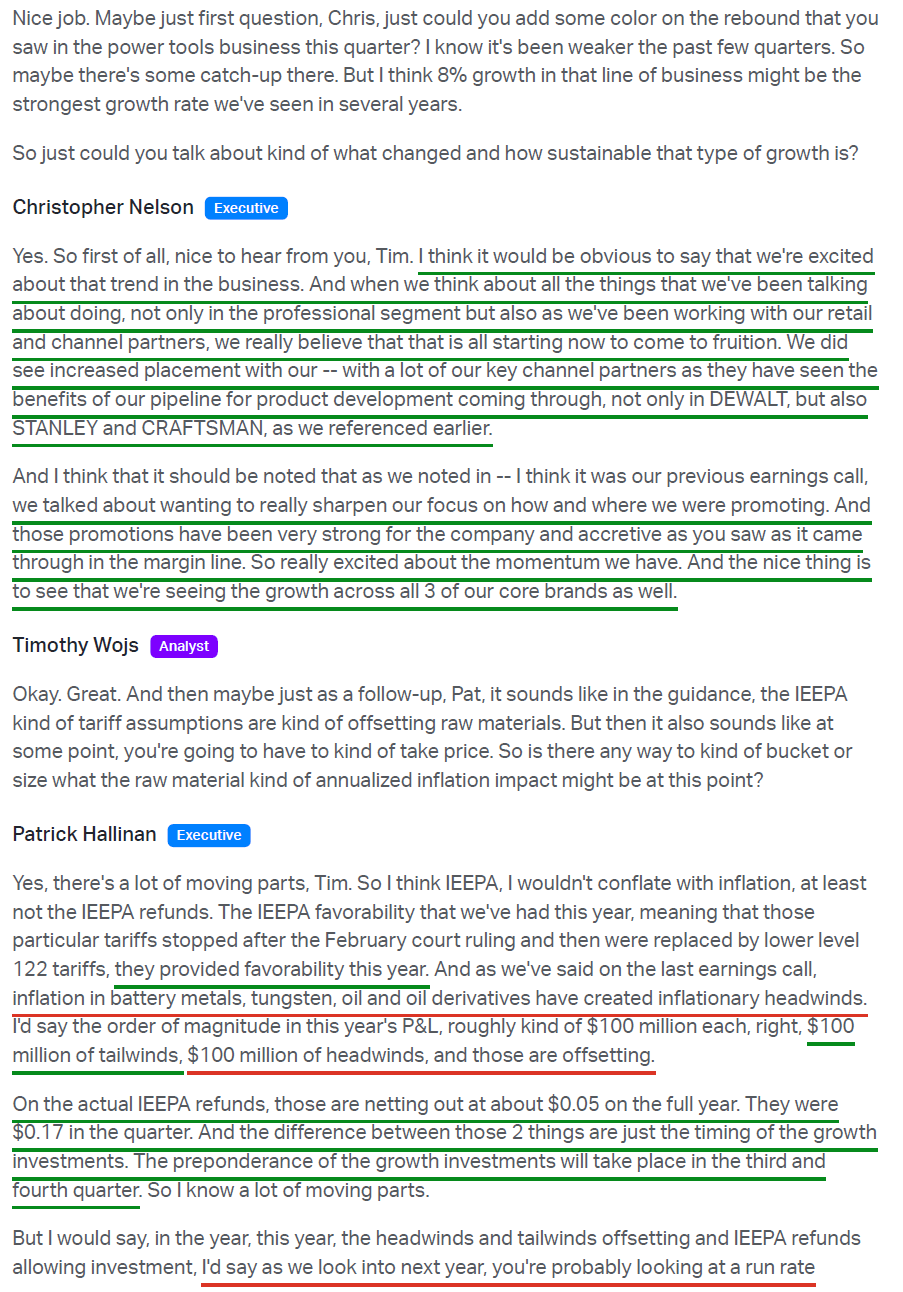
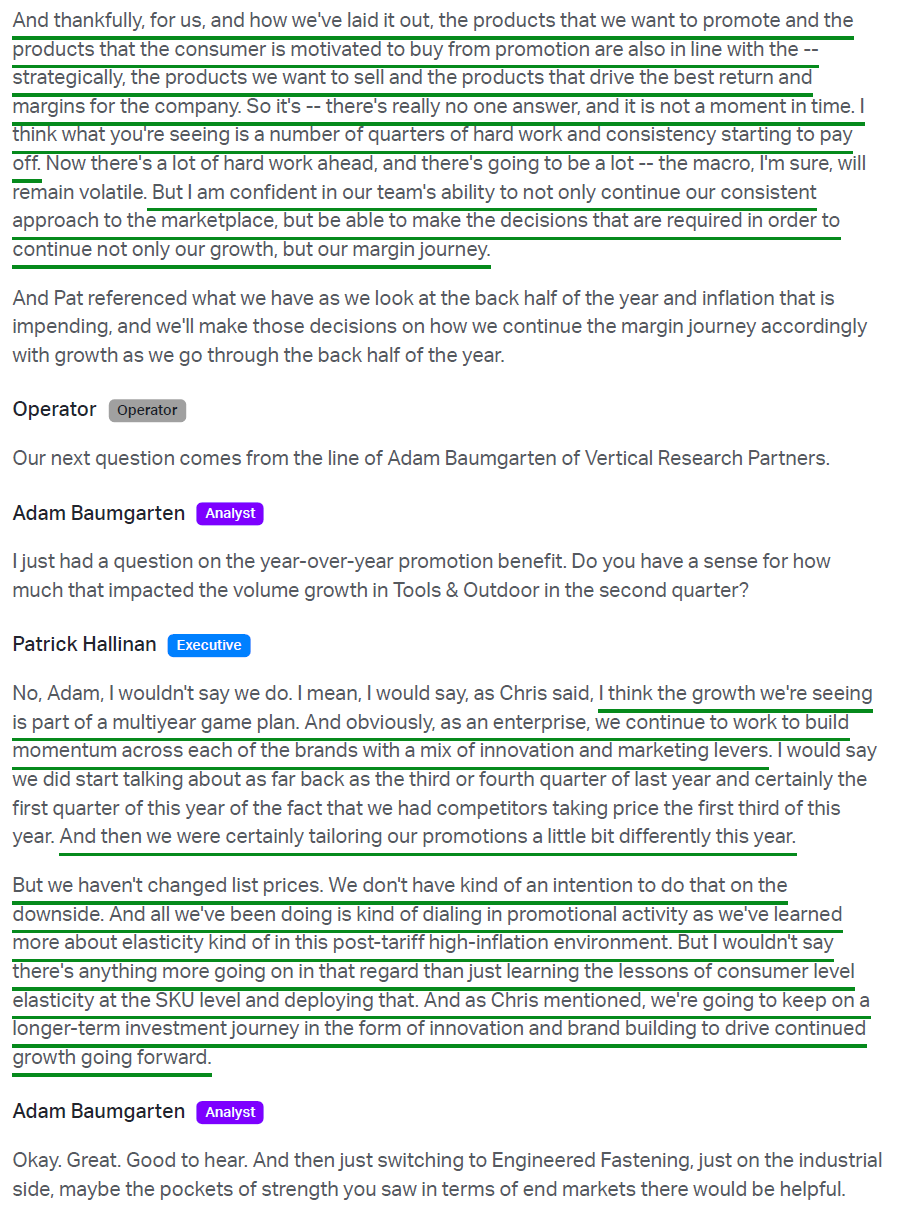
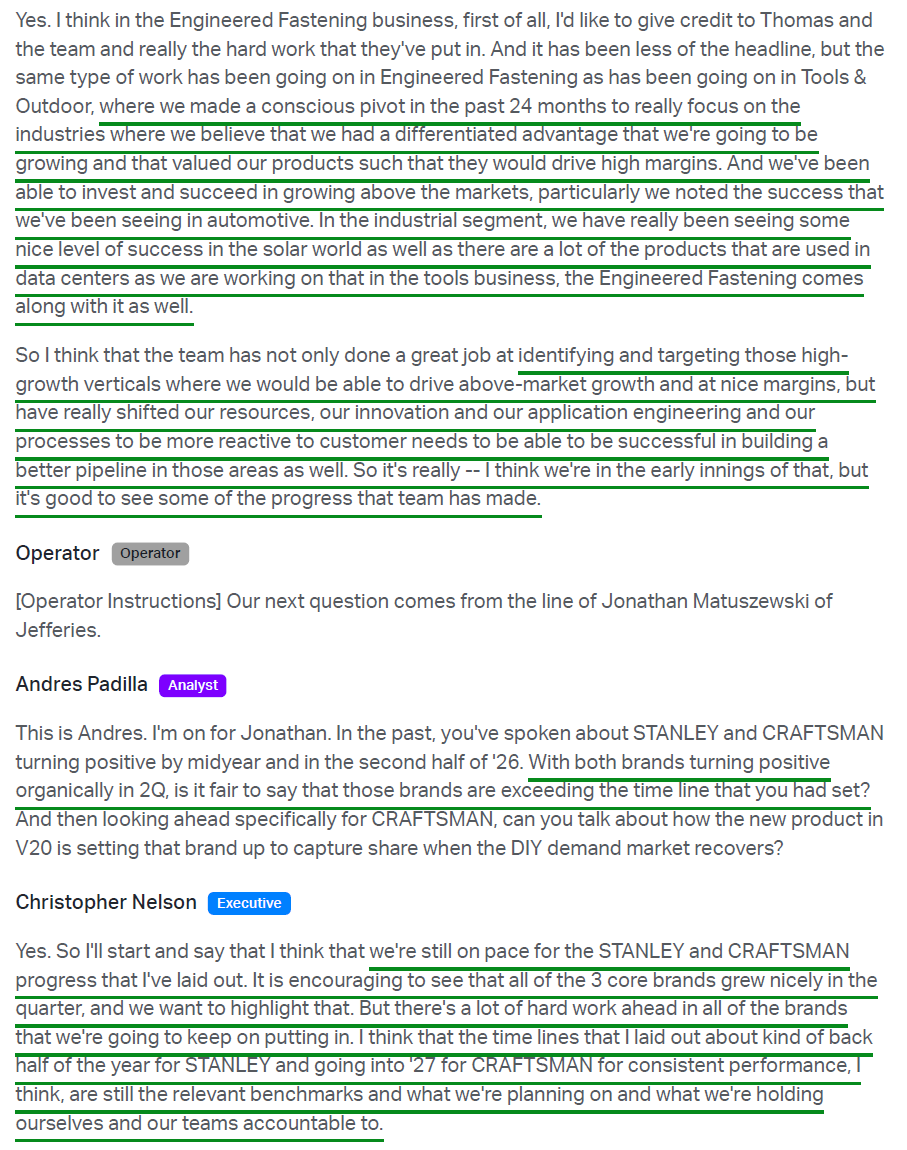
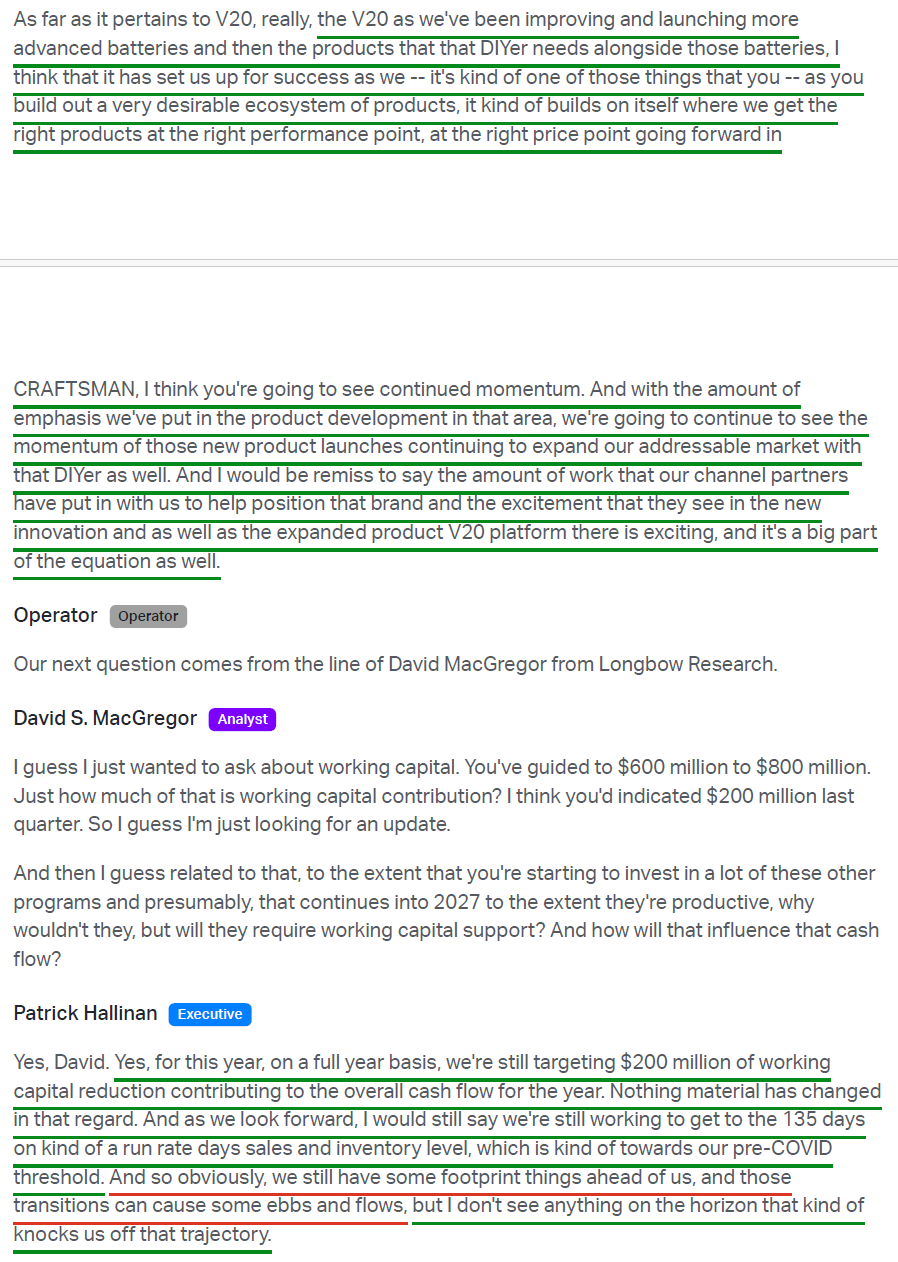
4) The Tools & Outdoor segment (~90% of total sales) posted Q2 net sales of $3.56B, up 3% on both a reported and organic basis, as higher volume (+3%) and currency (+1%) were partially offset by a 1% drag from the gas walk-behind licensing transition, with pricing flat. Power tools organic growth of +8% marked the strongest performance in several years, with hand tools, accessories, and storage up 2%, partially offset by a 7% organic decline in Outdoor due to weather-related demand softness and fewer replenishment orders. By region, North America organic growth was 4% (U.S. retail up mid-single digits, C&I channel up low double digits), Europe declined 2%, and Rest of World grew 3% on double-digit strength in Latin America. Adjusted segment margin of 11.8% expanded 380 bps Y/Y on net productivity gains and favorable mix, including ~150 bps from net tariff refunds. All three global priority brands grew organically, with DEWALT continuing to lead as the growth engine on professional demand, STANLEY inflecting on brand revitalization and product refresh, and CRAFTSMAN returning to growth behind the new V20 advanced batteries.
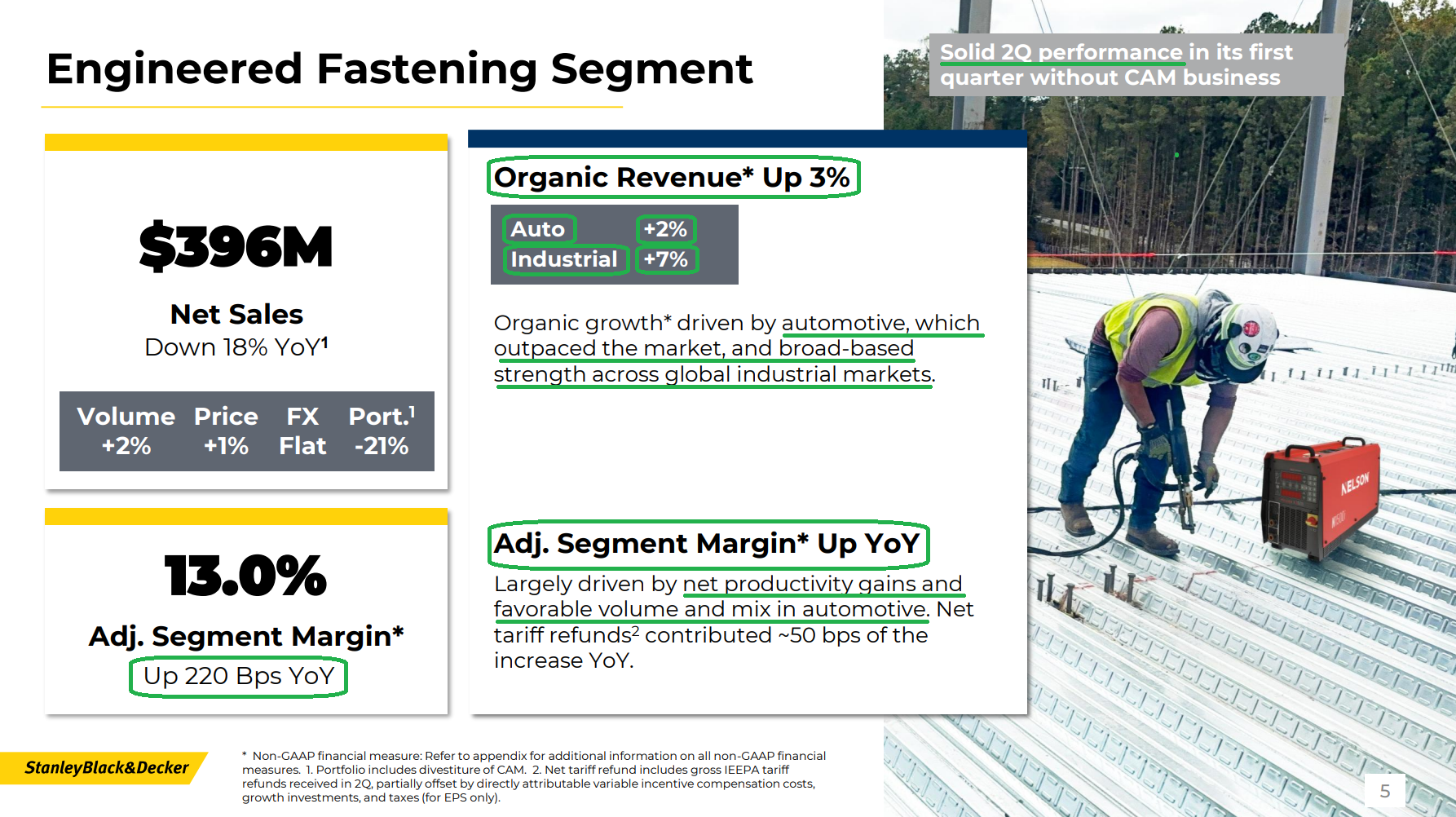
5) The Engineered Fastening segment (~10% of total sales) posted Q2 net sales of $396M, down 18% reported but up 3% organically in its first quarter without CAM, as the divestiture created a 21% headwind partially offset by volume (+2%) and pricing (+1%), with currency flat. Automotive grew 2% organically, outpacing the market, while Industrial grew 7% on broad-based global strength, including solar and data center-related demand. Adjusted segment margin of 13.0% expanded 220 bps Y/Y on net productivity improvements and favorable automotive volume and mix, including ~50 bps from net tariff refunds. Management pointed to a deliberate pivot over the past 24 months toward high-growth verticals where the business holds a differentiated, high-margin position, describing the effort as still in the early innings.
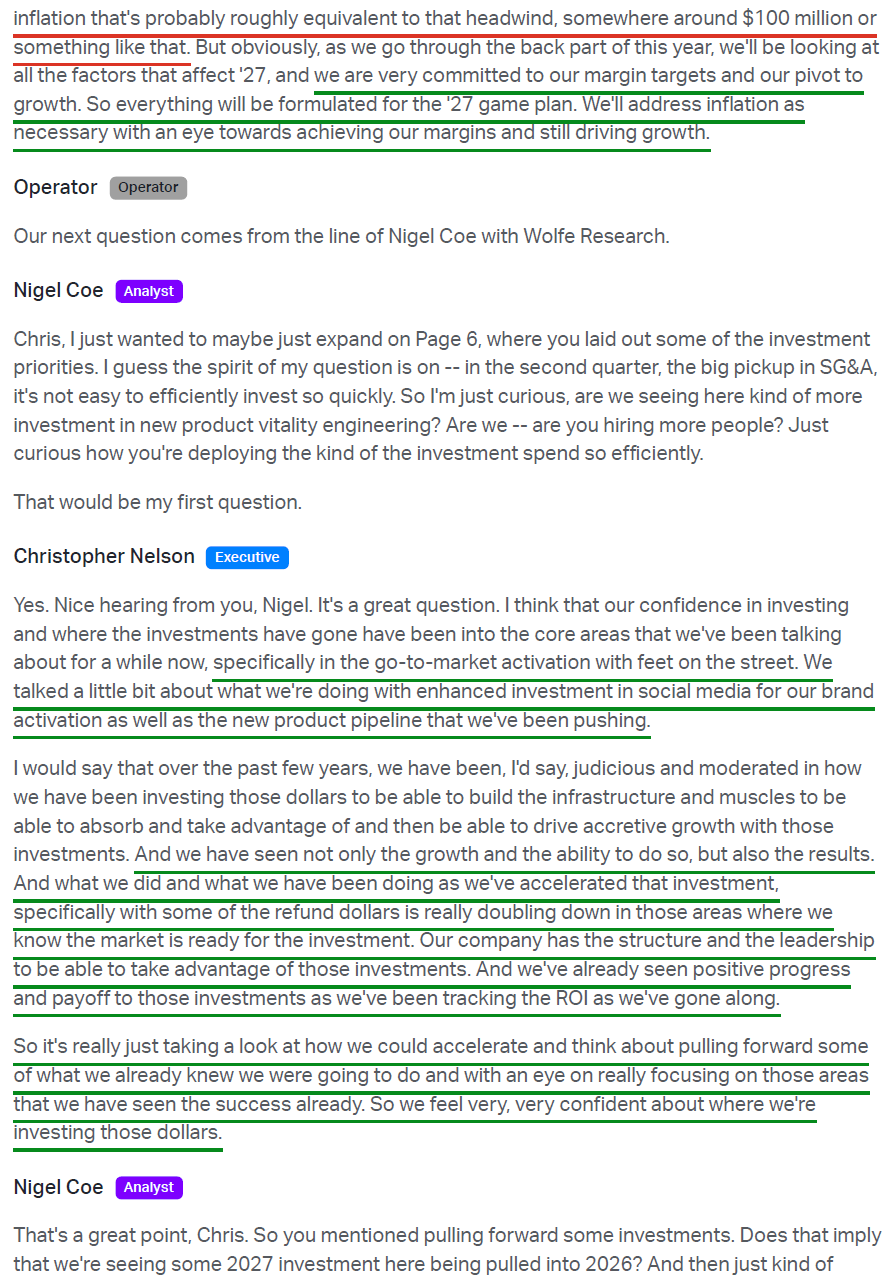
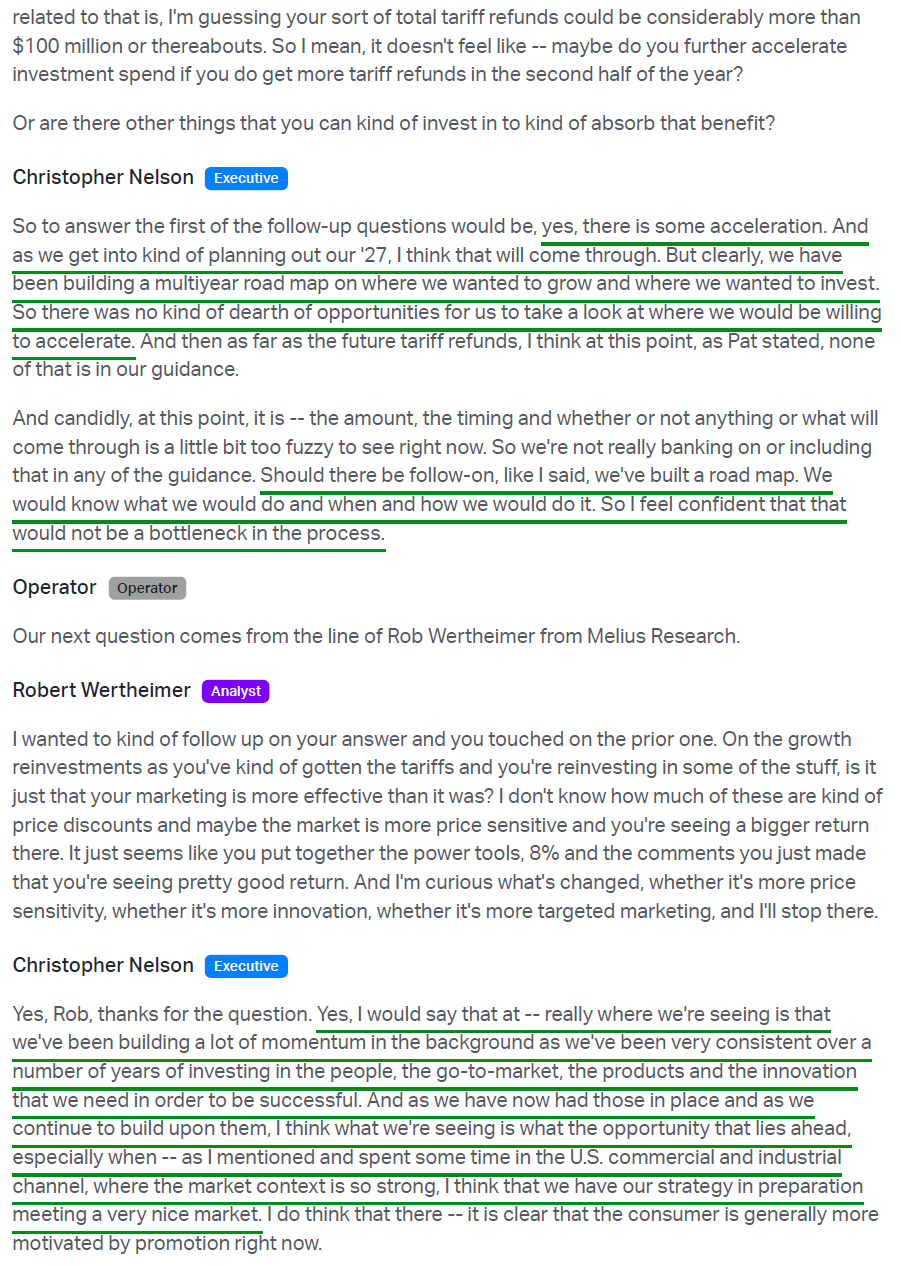
6) Management is redeploying the tariff refunds into growth investments rather than allowing them to flow through to earnings, with adjusted SG&A of 23.9% of sales (+310 bps Y/Y) predominantly reflecting those incremental costs. The spend is incremental to the $75M to $100M of growth investment planned for FY26 at the start of the year and is directed toward go-to-market activation and expanded field presence, brand activation and social media, and the new product pipeline, including the global DEWALT No Quit campaign now ramping across digital channels with measurable impact on demand generation. Management described the move as pulling forward planned investments into areas where the market is ready and ROI is already tracking well, with the bulk of the refund-funded spend landing in 3Q and 4Q.
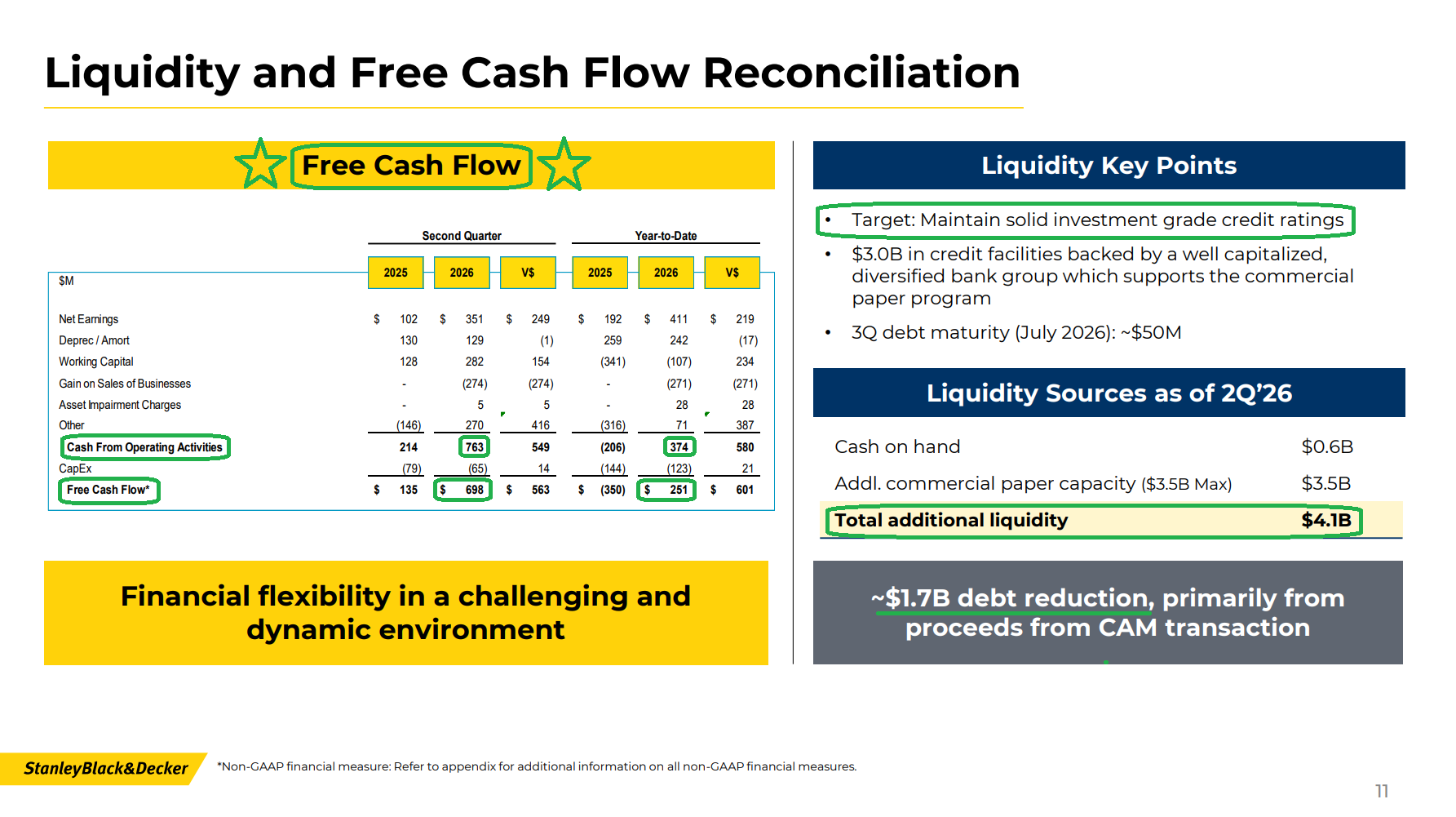
7) Cash from operating activities of $763M drove free cash flow of $698M in the quarter, up sharply from $135M last year and swinging YTD free cash flow to $251M versus an outflow of $350M a year ago. Performance was supported by disciplined working capital management alongside the tariff refunds received, with management still targeting ~$200M of working capital reduction for the full year and continued progress toward ~135 days sales-in-inventory, approaching the pre-COVID threshold.
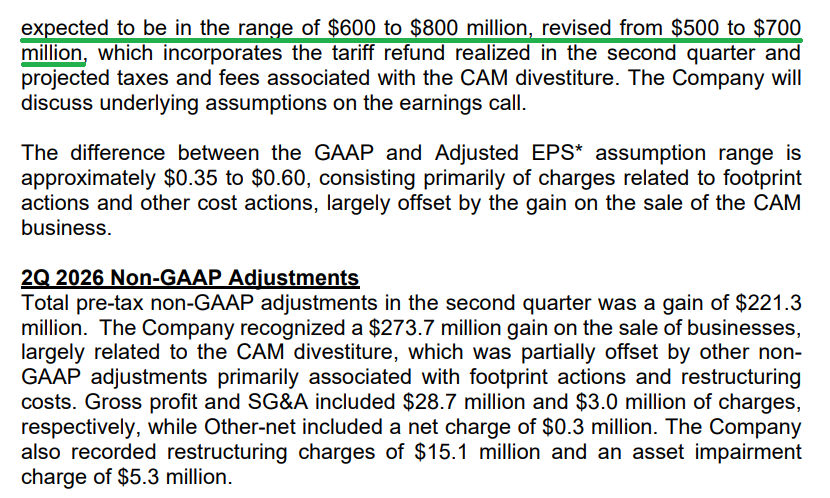
8) SWK repurchased ~3.2M shares for $250M during the quarter under the new $500M authorization, with buybacks remaining the near-term capital allocation priority alongside funding organic growth and supporting the dividend, while bolt-on M&A will be considered if and when appropriate. The Board also approved a $0.01 increase to the quarterly cash dividend to $0.84 per share, extending a streak of annual increases dating back to 1968 and representing a ~3.4% yield at current prices.
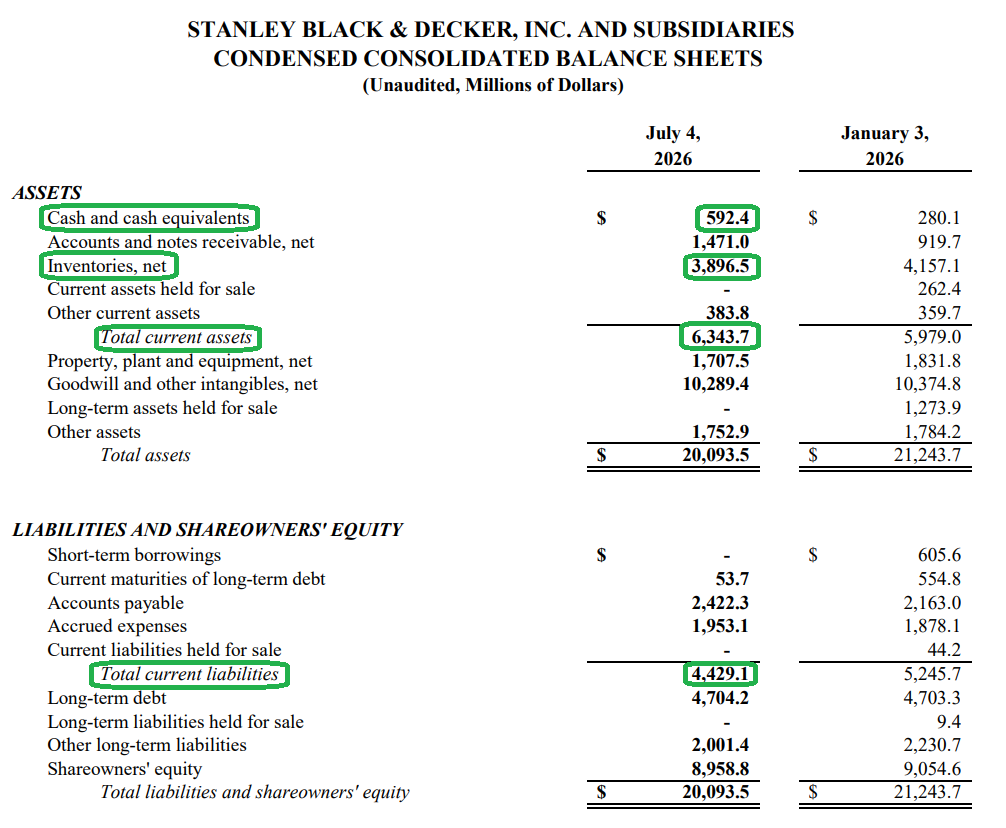
9) SWK closed the ~$1.8B sale of Consolidated Aerospace Manufacturing on April 6, deploying the proceeds plus operating cash flow to reduce debt by $1.7B during the quarter. That keeps the company firmly on track for net debt to adjusted EBITDA of ~2.5x by year-end, inclusive of buybacks, down from 5.9x at the end of 2023. SWK ended the quarter with ~$0.6B of cash, $4.7B of long-term debt, no short-term borrowings, and ~$4.1B of total additional liquidity, with maintaining a solid investment-grade credit rating remaining a stated priority.
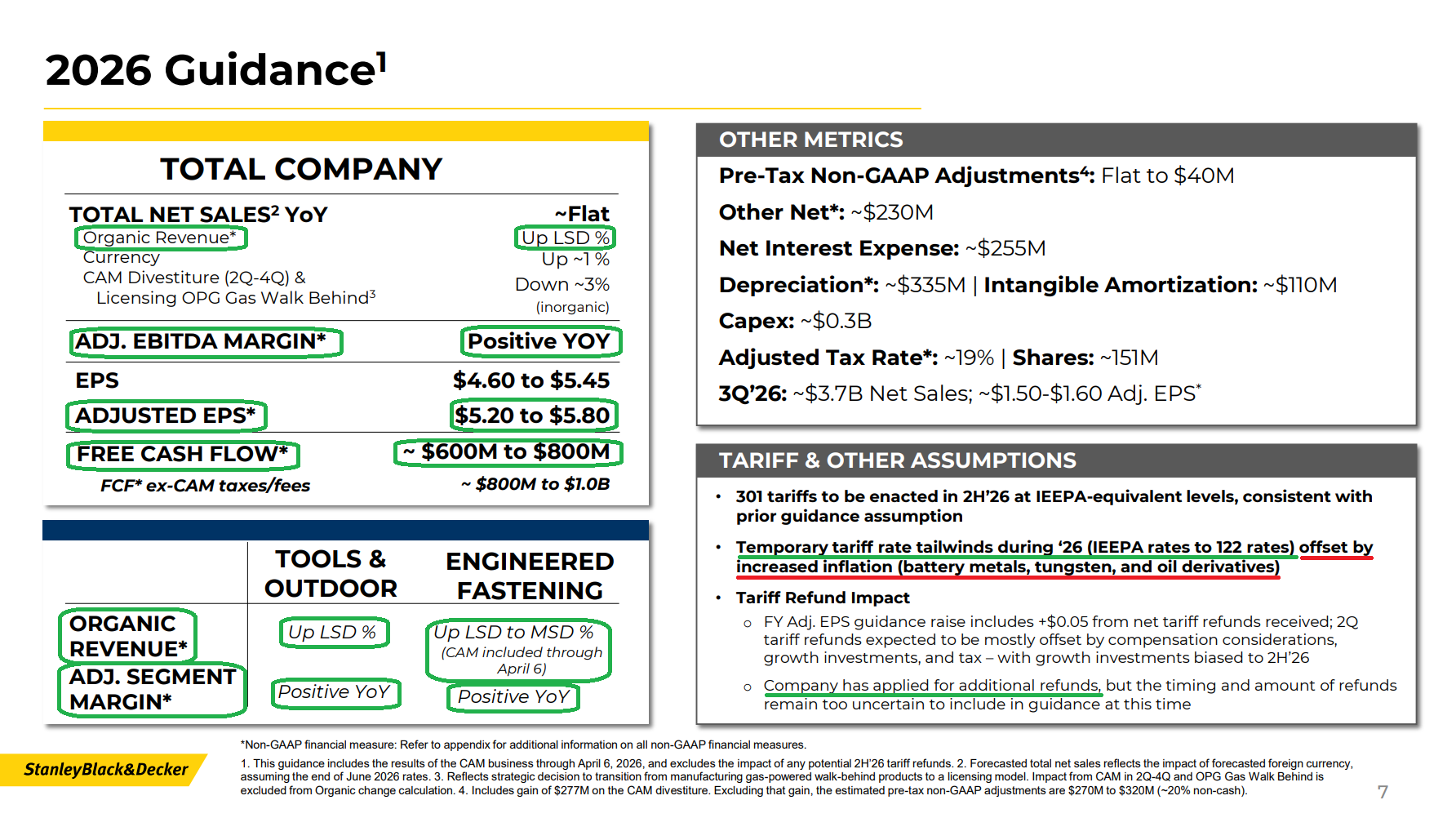
10) SWK raised and tightened FY26 adjusted EPS guidance to $5.20 to $5.80 from a prior range of $4.90 to $5.70, with the $5.50 midpoint implying +18% Y/Y growth and landing ~$0.20 above the prior midpoint versus consensus of ~$5.37. Of the raise, ~$0.15 comes from below-the-line items (lower interest expense, buybacks reducing weighted average share count to ~151M, and lower other-net), with the remaining ~$0.05 coming from the net tariff refund. Total revenue is still expected to be ~flat Y/Y with low-single-digit organic growth, split evenly between volume and price. Free cash flow guidance was lifted to $600M to $800M from $500M to $700M, or $800M to $1.0B excluding CAM-related taxes and fees. For Q3, management guided to net sales of ~$3.7B (flat reported on portfolio moves), organic growth of 3% to 4%, and adjusted EPS of ~$1.50 to $1.60.
Earnings Call Highlights
General Market
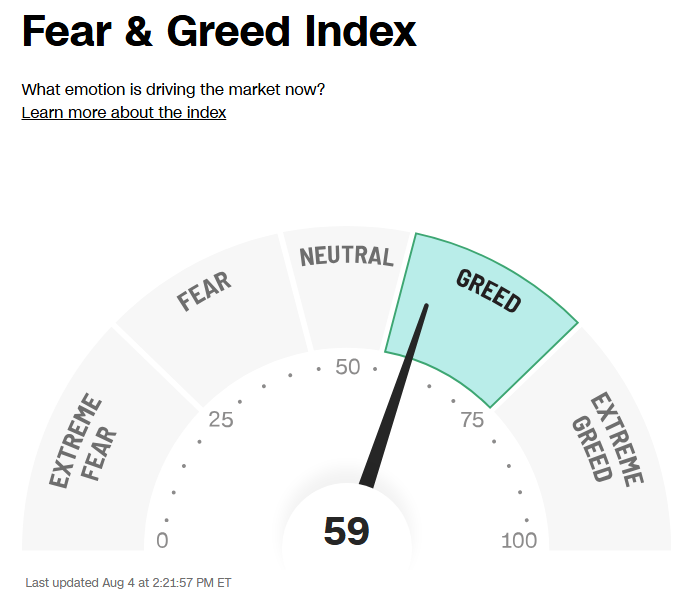
The CNN “Fear and Greed Index” ticked up to 59 this week from 37 last week. You can learn how this indicator is calculated and how it works here: (Video Explanation).
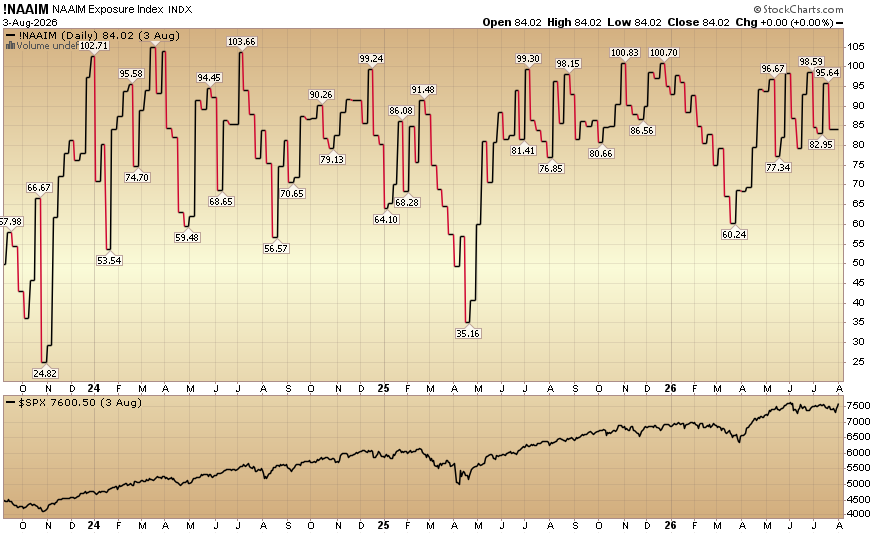
The NAAIM (National Association of Active Investment Managers Index) (Video Explanation) held steady at 84.02% equity exposure this week.
Our podcast|videocast will be out sometime today. We have a lot of great data to cover this week. Each week, we have a segment called “Ask Me Anything (AMA)” where we answer questions sent in by our audience. If you have a question for this week’s episode, please send it in at the contact form here.

Comments
Log in or sign up to join the conversation.