

Key Market Outlook(s) and Pick(s)
On Monday, I joined the amazing Liz Claman on Fox Business’ The Claman Countdown to discuss markets, the economy, outlook, breadth, bonds, the Fed, Iran, healthcare, staples, AI, Estee Lauder (EL), and more. Thanks to Liz, Brooke Haliscak, and Jake Mack for having me on.
On Tuesday, I joined the great Stuart Varney on Fox Business’ Varney & Co. to discuss markets, the economy, outlook, breadth, the Fed, yields, Iran, the consumer, AI, GXO Logistics (GXO), Comstock Resources (CRK), Meta (META), AMD (AMD), SpaceX (SPCX), Netflix (NFLX), and a lot more. Thanks to Stuart, Maggie Edwards, and Nick Palazzo for having me on.
On Monday, I joined Kristen Scholer on NYSE TV to discuss markets, the economy, outlook, breadth, bonds, the Fed, healthcare, staples, tech, AI, and more. Thanks to Kristen and Mel Montanez for having me on.
On Monday, I joined Diane King Hall on the Schwab Network to discuss markets, the economy, outlook, breadth, the Fed, Iran, oil, bonds, PayPal (PYPL) ($PYPL), Disney (DIS) ($DIS), and more. Thanks to Diane and Kaitlyn Crist for having me on.
Hormel (HRL) Update
For newer readers, here’s a brief overview of the key drivers behind our thesis on Hormel, an out-of-favor staples compounder and dividend aristocrat with a margin inflection ahead and the secular protein megatrend behind it:
Company Overview
Founded in 1891 in Austin, Minnesota. A global branded food company with ~$12B in revenue across 80+ countries.
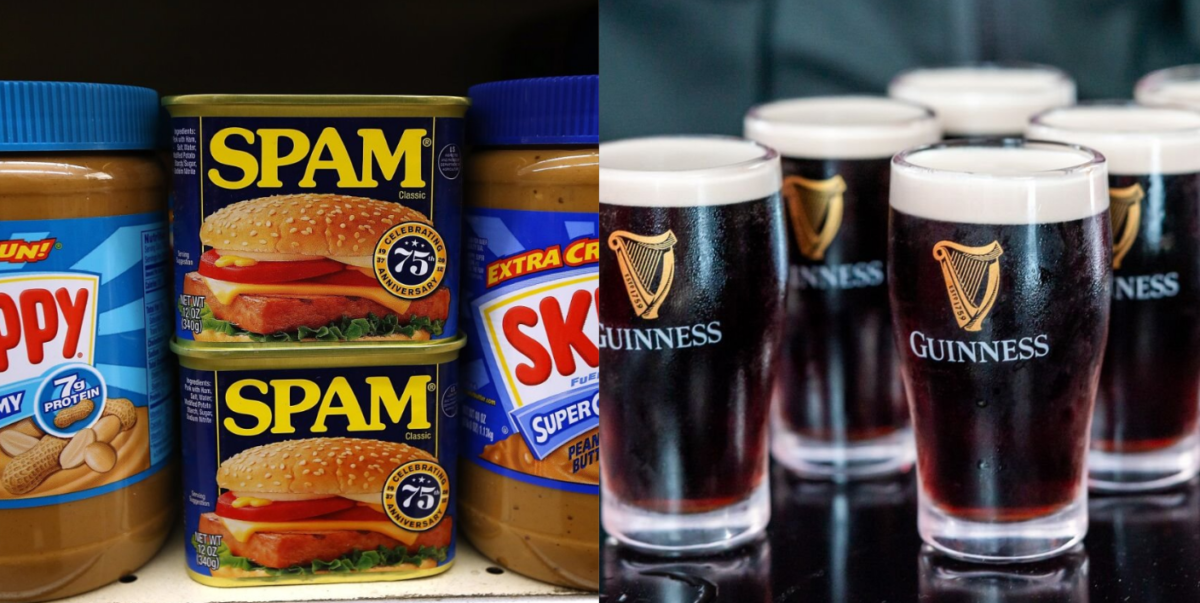
Leading brands include SPAM, Skippy, Jennie-O, Planters, and Applegate, with #1 or #2 market share in 40+ retail categories.
Protein-centric portfolio: 70%+ of sales derived from meat and protein-rich foods, directly aligned with the secular protein consumption trend.
FY2026 YTD segment mix: Retail ~60% of sales, Foodservice ~34%, International ~6%.
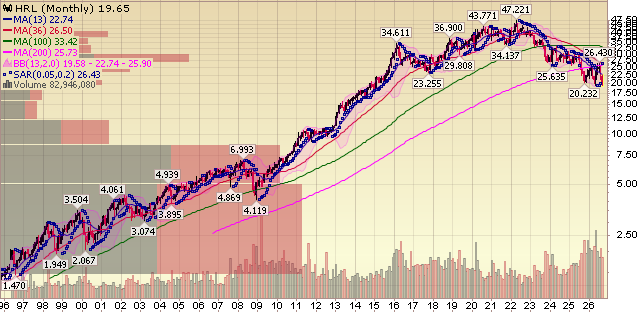
Stock down nearly 60% from 2022 highs (~$50/share) and trading at the lowest levels since 2015.
Leadership transition complete: John Ghingo named Chief Executive Officer after serving as president, with interim CEO Jeff Ettinger remaining on the Board of Directors. Ash Bhumbla joins as Chief Financial Officer, succeeding interim CFO Paul Kuehneman.
Dividend Aristocrat
Uninterrupted quarterly dividend payments since 1928 — 392 consecutive quarters and counting. 60 straight years of dividend increases with a 5-year CAGR of ~3.8%.
Current yield of ~5.9%, close to highest on record, with a record $633M returned to shareholders via dividends in FY2025. Returned $161M via dividends in Q3 FY2026 alone.
Payout ratio of 82%, backstopped by a strong balance sheet with $840M of cash on hand against ~$2.86B in total debt.
Commodity Costs & Temporary Headwinds
Heavy perishable inputs (72% of FY2025 sales) drove major margin pressure: beef near record highs, pork bellies +30%, wholesale pork +~10%, and nuts elevated, resulting in a ~400 bps margin hit.
Additional one-off headwinds in FY2025: avian flu disruptions in turkey and chicken, a ~5M lb chicken recall, and a Skippy facility fire.
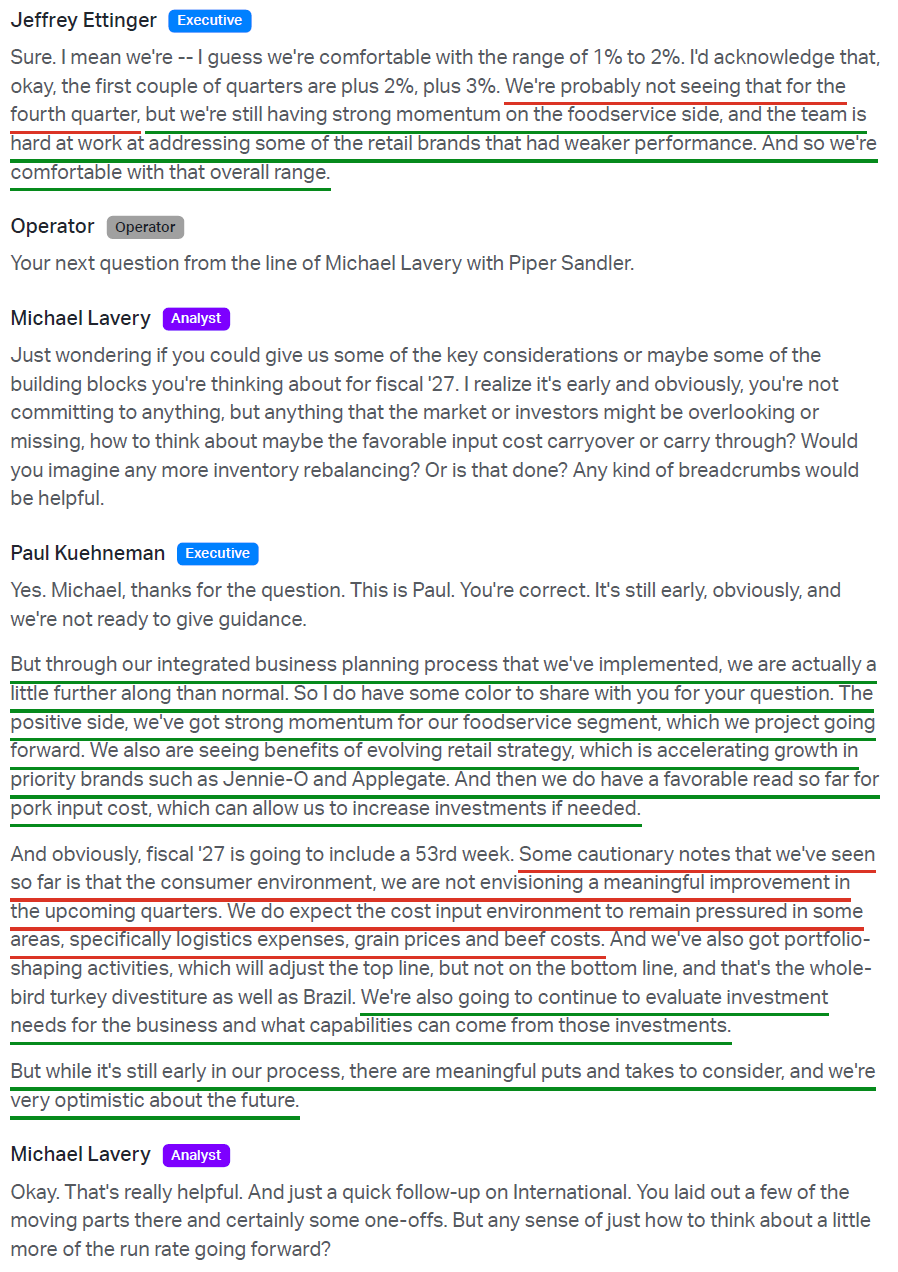
Relief is arriving but staggered: pork markets began declining partway through Q3 FY2026, with only a partial quarter of benefit recognized and the larger share expected to flow through in Q4 and into FY2027.
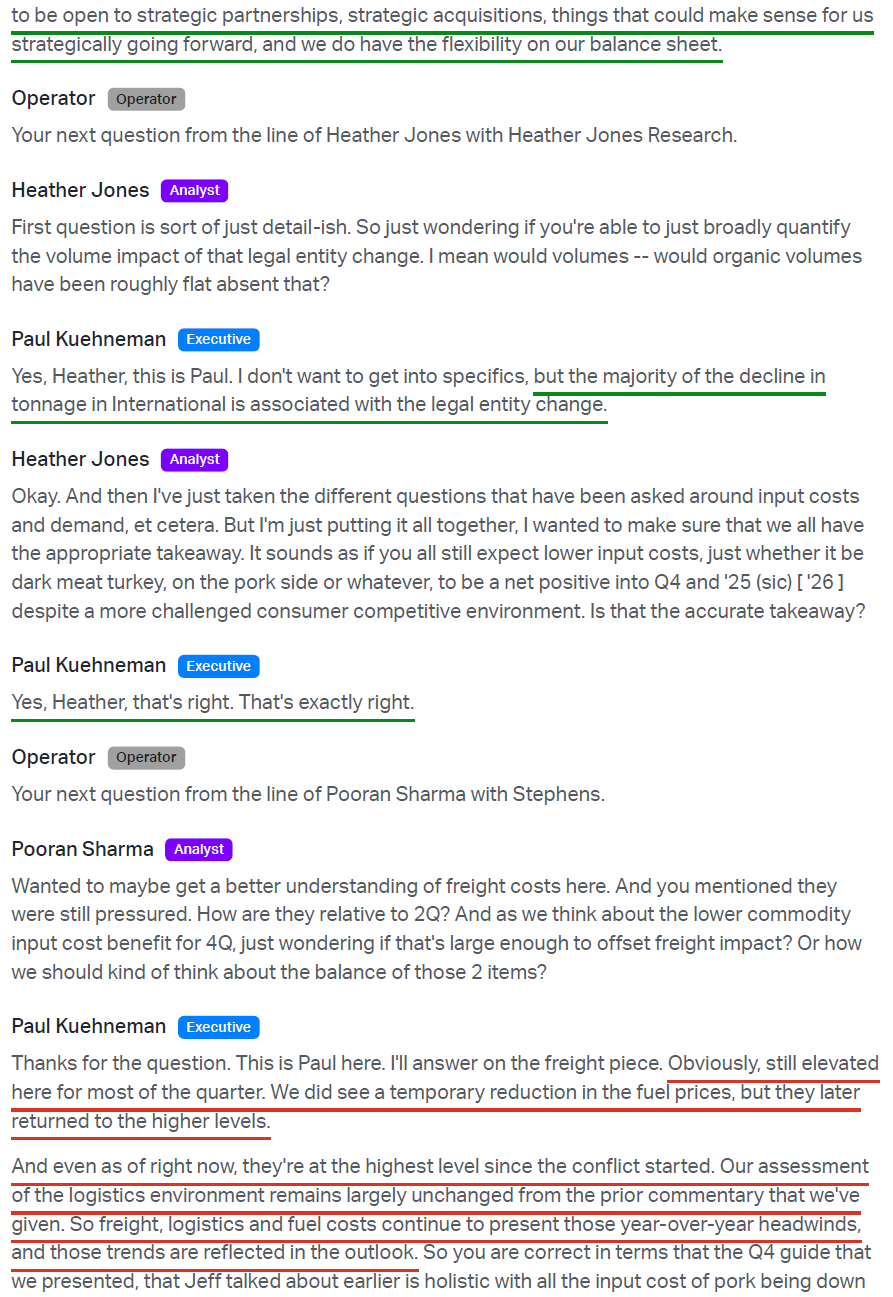
Beef remains elevated, while freight, logistics, and fuel re-emerged as a Q3 headwind with fuel back at its highest level since the geopolitical conflict began.
Two rounds of pricing actions implemented in summer and fall of 2025, fully in effect as of Q2 FY2026 with elasticities tracking in line with expectations.
Q3 gross margin was 15.9% (-14 bps Y/Y), with year-to-date gross margin at 16.3% vs. 16.2% last year. Management believes the margin profile improves from here as lower input costs work through inventory.
Targeted inventory rebalancing largely completed in Q3, with finished goods down significantly Y/Y in both dollars and pounds.
Protein Boom Driving Growth
Directly aligned with secular health and wellness trends — GLP-1 households consume ~3x more protein than the average consumer.
FY2025 organic sales +2%: Retail +1%, Foodservice +5%, International +1%.
Q3 FY2026 organic sales turned negative (-1.7%) for the first time in over a year on portfolio-shaping actions, lower commodity-based pricing, and a strained consumer, with year-to-date organic sales still +1.0%.
Q3 FY2026 segments: Retail -3.3% organic / -3.7% profit ($1.78B, ~60% of sales), Foodservice +1.8% organic / +2.7% profit ($1.00B, ~34% of sales, 12th straight quarter of organic growth), International -4.4% organic / adjusted segment profit flat ($179M, ~6% of sales).
Foodservice carries an outsized share of the earnings: ~34% of sales but ~51% of total adjusted segment profit, continuing to outperform an industry facing soft traffic and macro pressure.
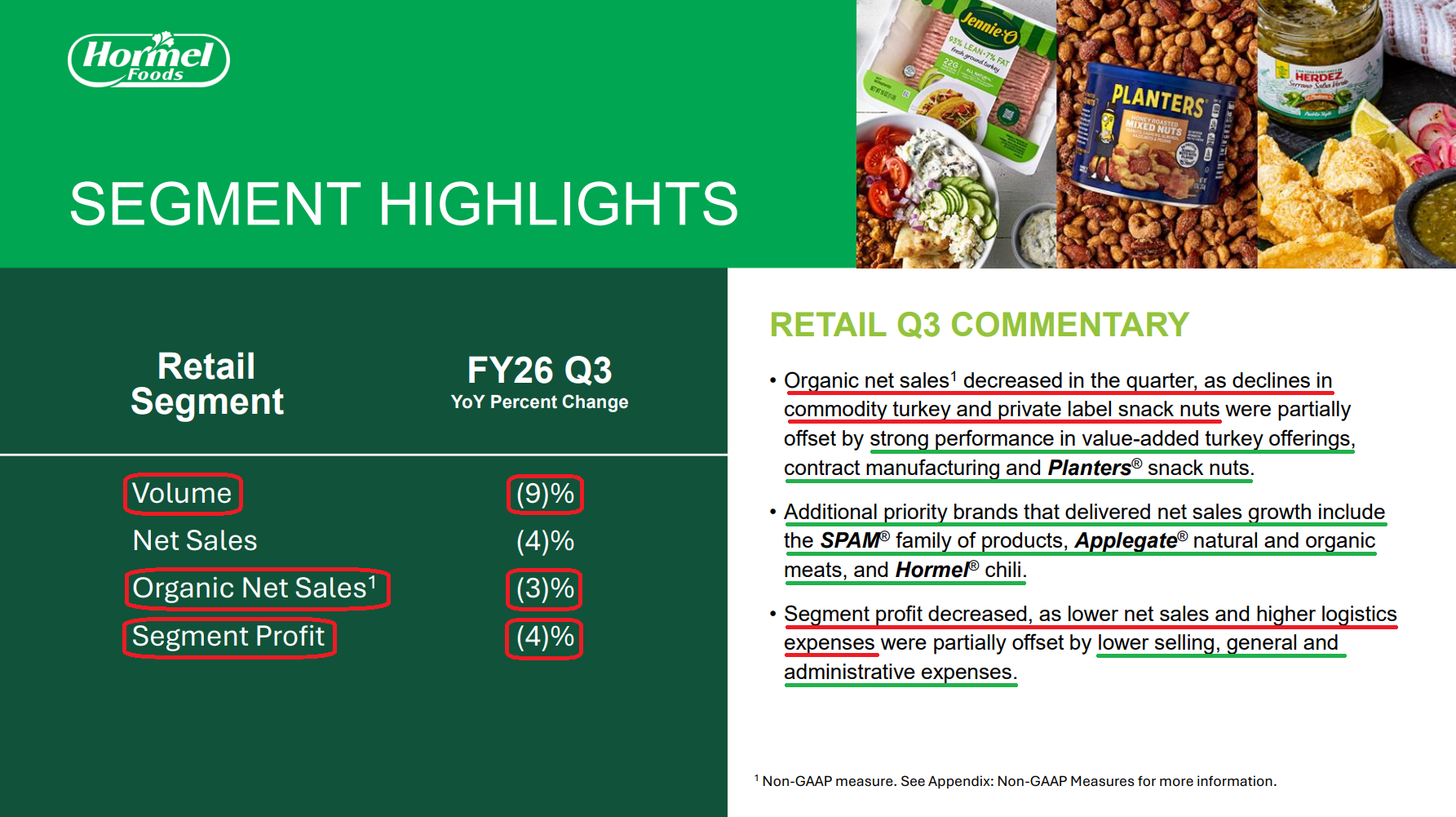
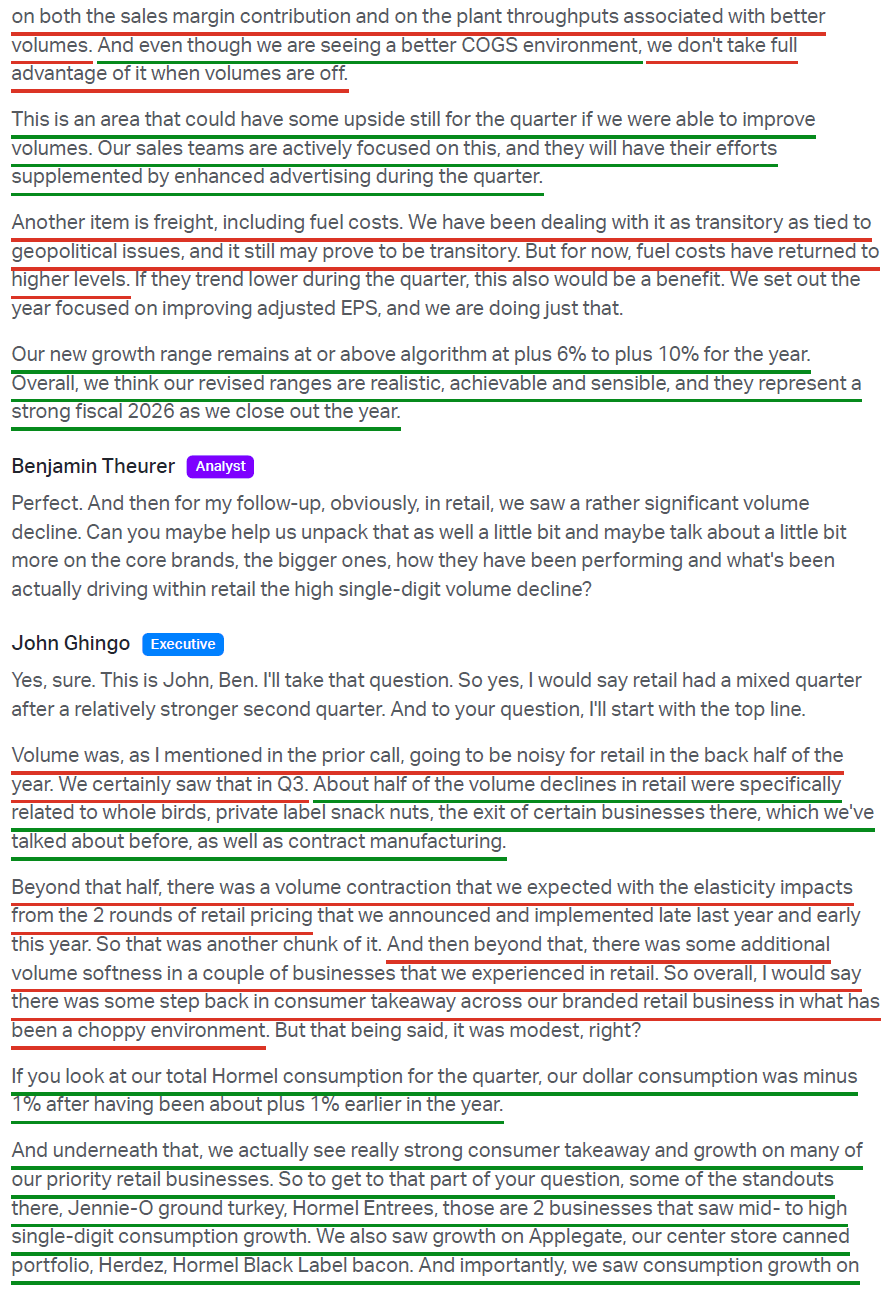
Retail volume fell 9% in Q3, with roughly half tied to the whole bird turkey divestiture, the private label snack nut exit, and contract manufacturing. The balance came from expected pricing elasticity plus incremental softness in a choppy consumer environment.
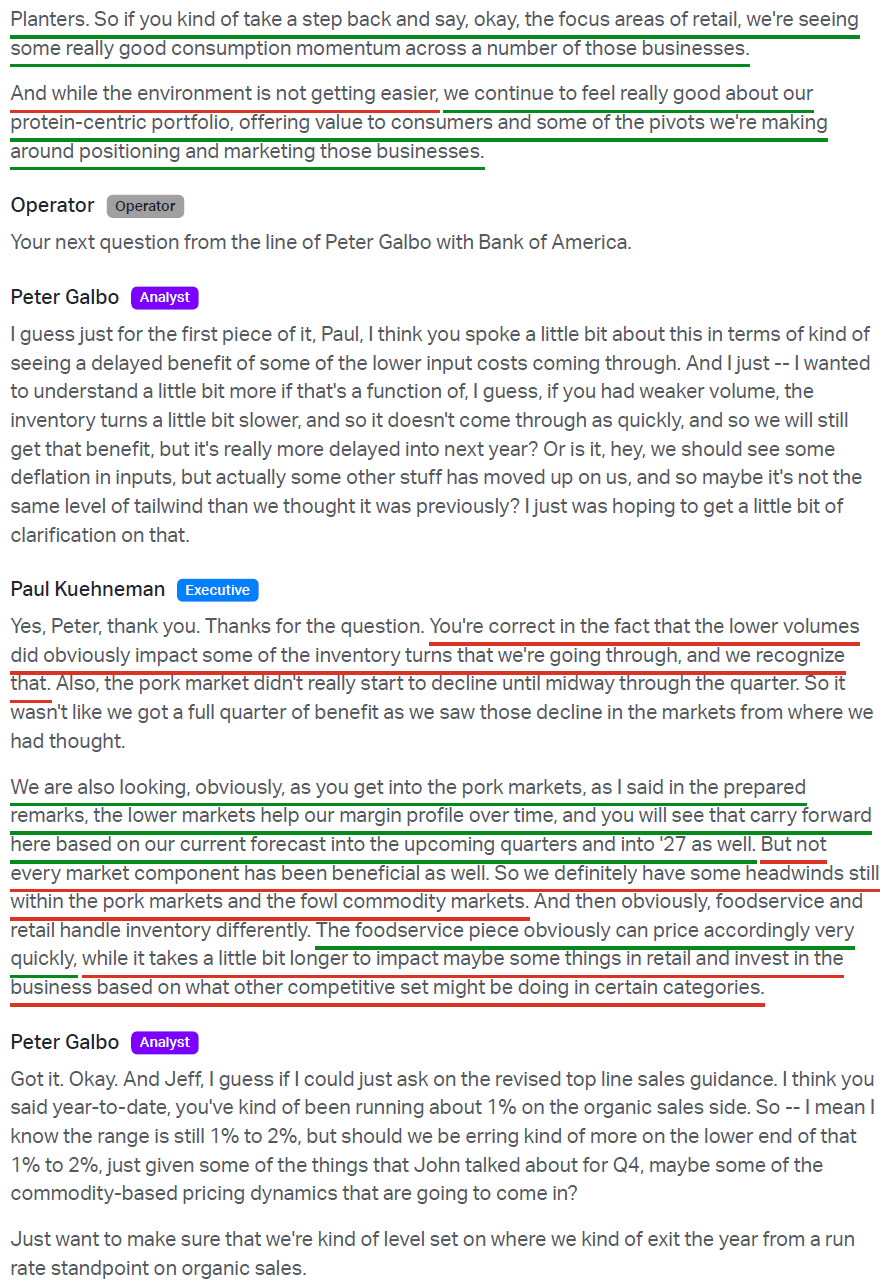
Priority brands still gaining traction: Jennie-O ground turkey and Hormel entrees posted mid- to high-single-digit consumption growth in Q3, with Applegate, Herdez, Black Label bacon, the SPAM family, Hormel chili, and Planters also growing.
Planters returned to consumption growth on in-store activations, with marketing dollars shifting toward retailer media, e-commerce, and digital channels across the Retail portfolio.
International refocusing on Asia Pacific: Brazil (Ceratti) divested.
Transform & Modernize
Multi-year T&M initiative on track: supply chain optimization, footprint consolidation, automation, and 120+ projects contributing value.
Delivered $75M in savings in FY2024 and reached the high end of the $100-150M target in FY2025.
Reduced ~250 corporate and sales roles (~9% of the workforce) for additional savings.
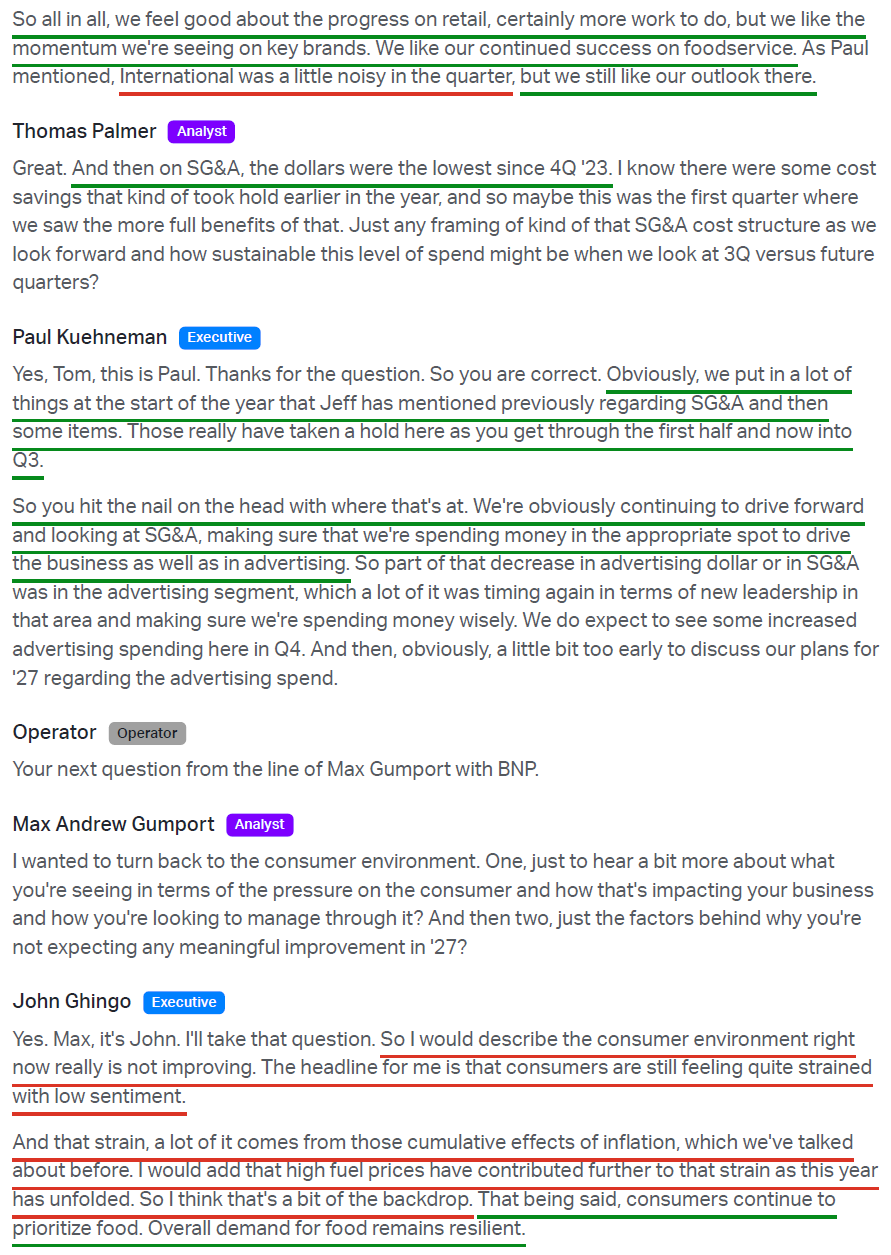
SG&A discipline showing through: adjusted SG&A fell 11.6% in Q3 FY2026 to 7.3% of net sales from 8.1%, the lowest dollar level since Q4 FY2023.
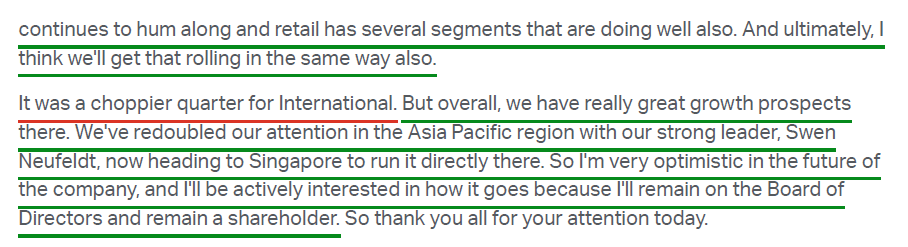
New integrated business planning process is driving better visibility, faster decision-making, and tighter coordination across a recently centralized business.
Path back to mid-cycle 10%+ operating margins, with Q3 FY2026 adjusted operating margin at 9.0% (+61 bps Y/Y) and year-to-date adjusted operating margin at 9.0% vs. 8.7% at the same point last year.
Key Financials & Valuation
FY2025: net sales ~$12B, adjusted EPS $1.37, operating cash flow $845M, capex $311M (~2.6% of sales).
Q3 FY2026: net sales $2.96B (-2.4% Y/Y), adjusted EPS $0.37 (+5.7%), adjusted operating income $266M (+4.7%), gross margin 15.9% (-14 bps Y/Y), operating cash flow $241M (+54%), capex $68M, free cash flow ~$173M.
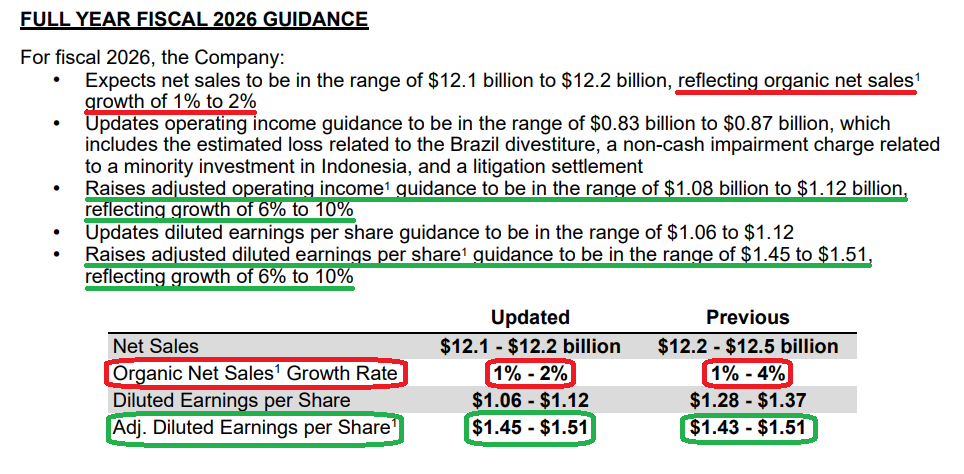
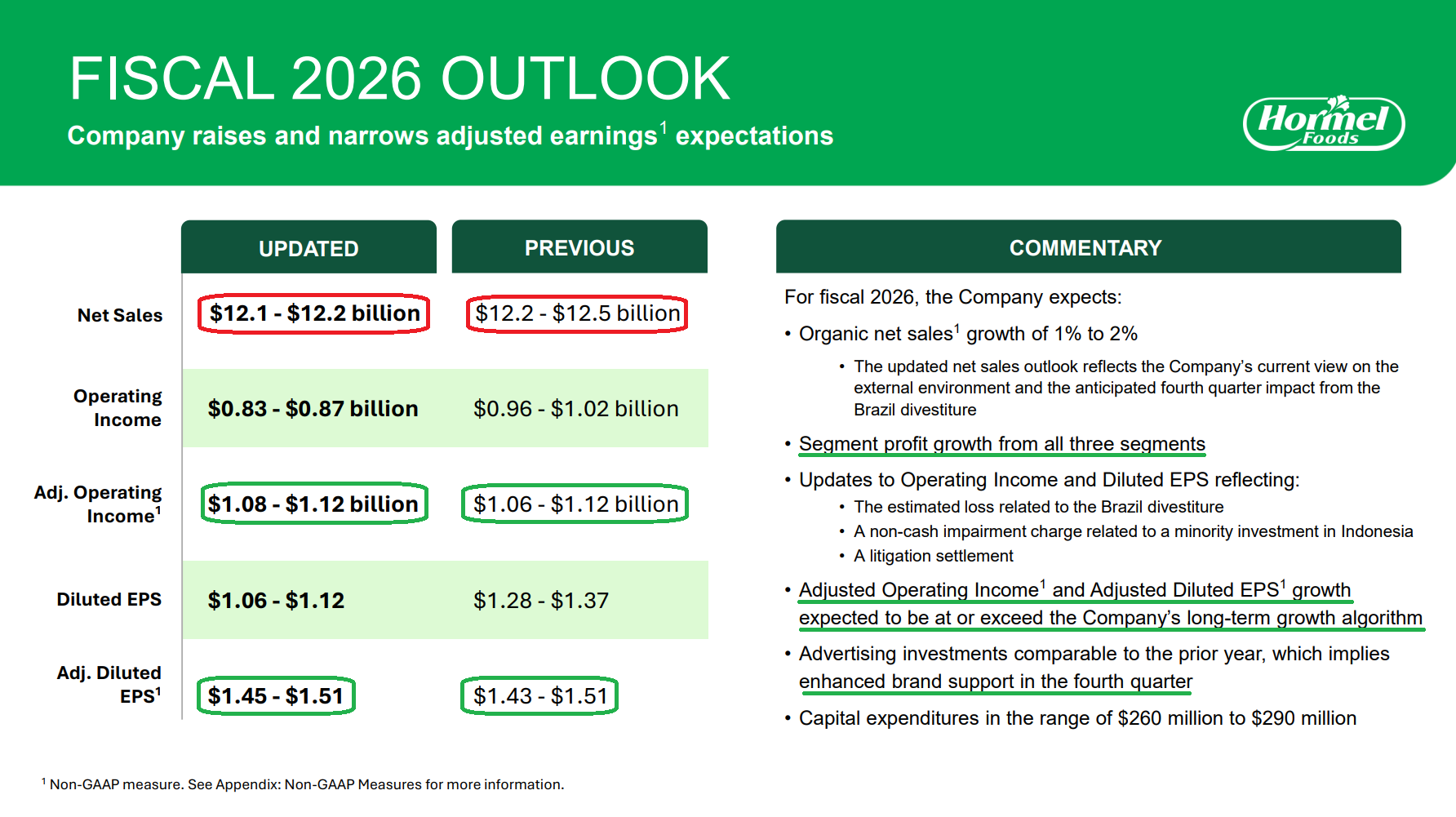
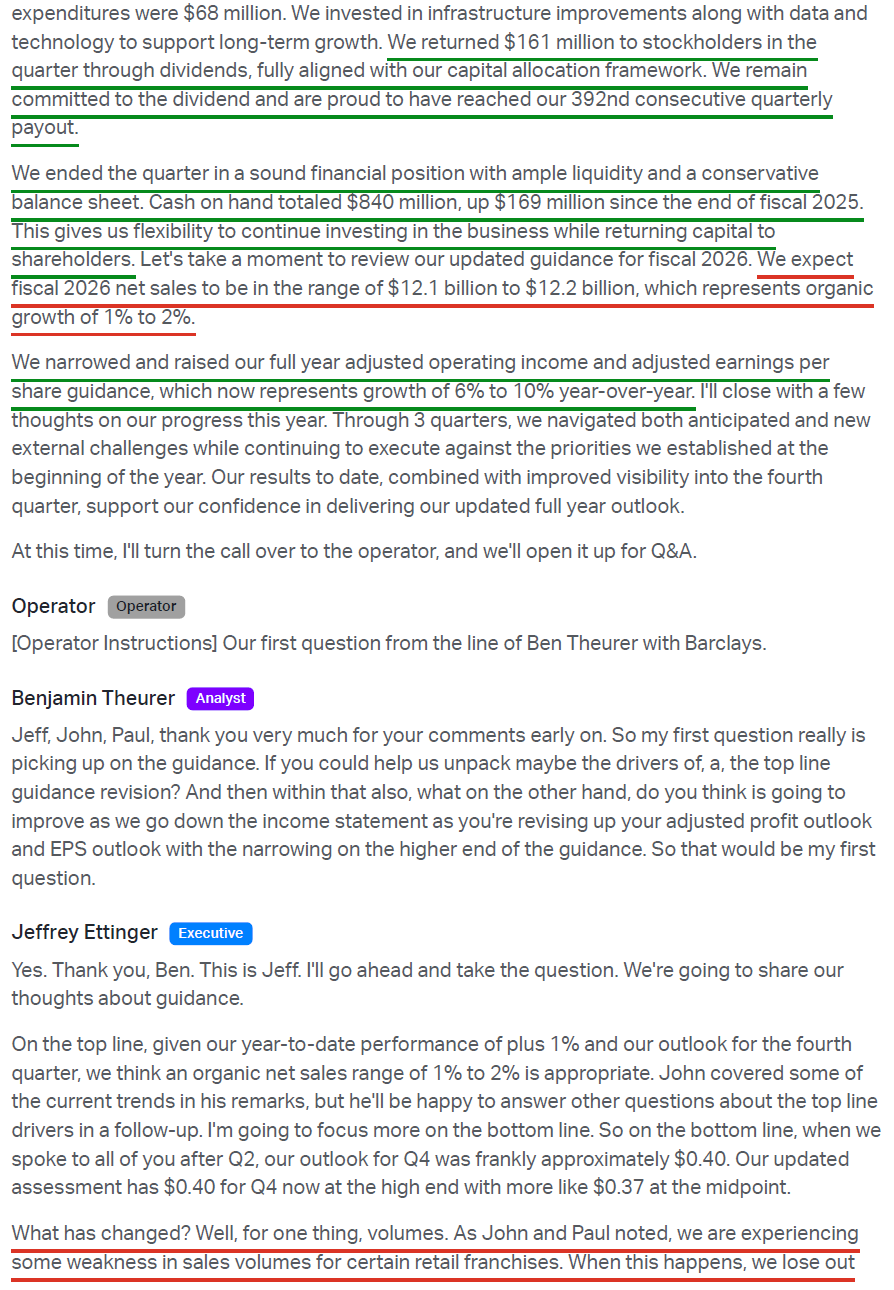
FY2026 guidance updated: net sales cut to $12.1–$12.2B (organic +1–2%, from +1–4%), adjusted operating income raised to $1.08–$1.12B (+6–10%), adjusted EPS raised and narrowed to $1.45–$1.51 (+6–10%). Segment profit growth is still expected from all three segments.
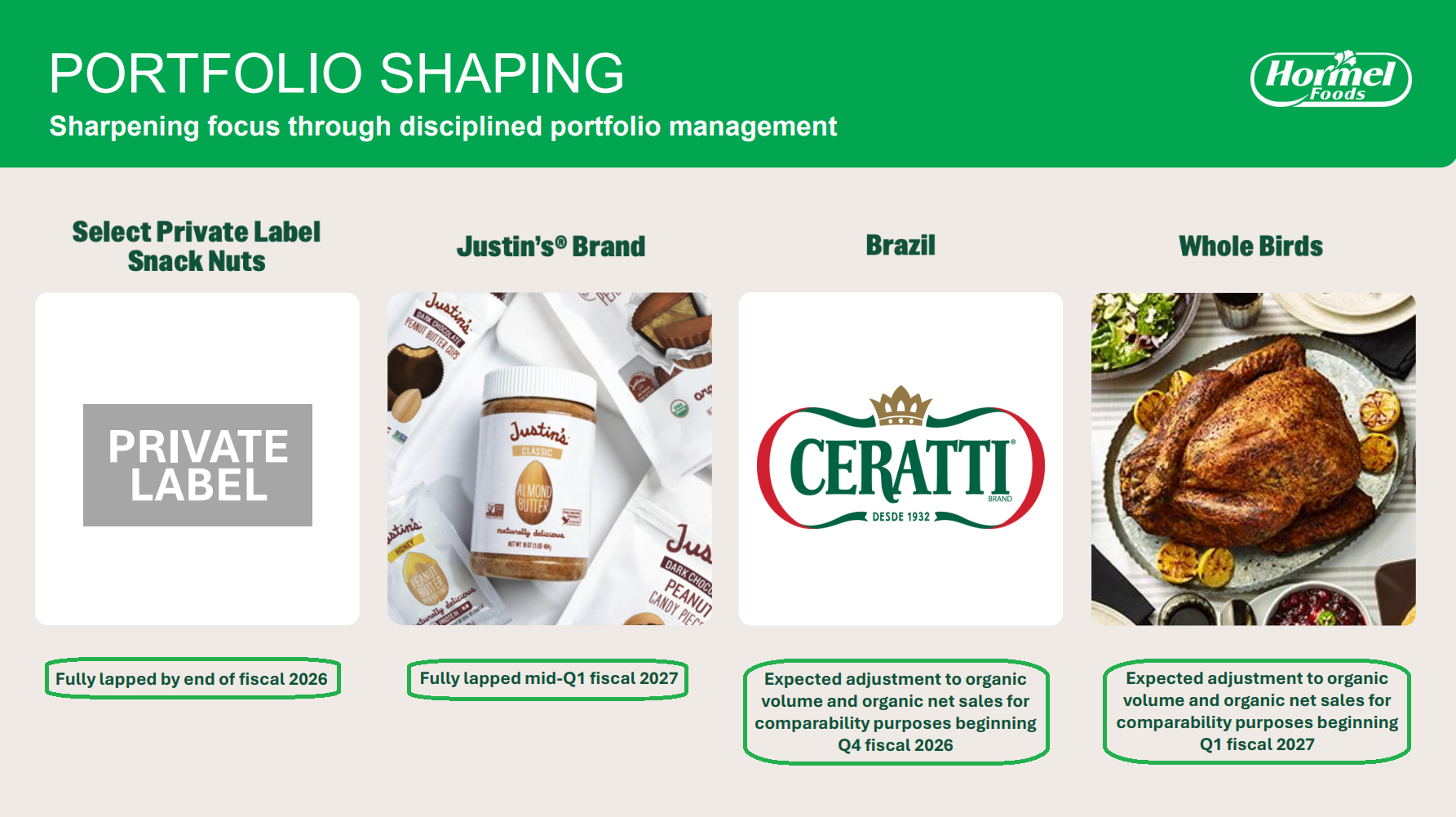
Portfolio shaping continues: whole-bird turkey completed in Q2 and excluded from Y/Y comparisons beginning Q1 FY2027, with the Brazil divestiture closing early in Q4 FY2026 and excluded beginning Q4 FY2026. Private label snack nuts fully lapped by the end of FY2026 and Justin’s by mid-Q1 FY2027.
$840M of cash on hand against ~$2.86B in total debt, with management explicitly signaling renewed openness to strategic M&A after several quiet years.
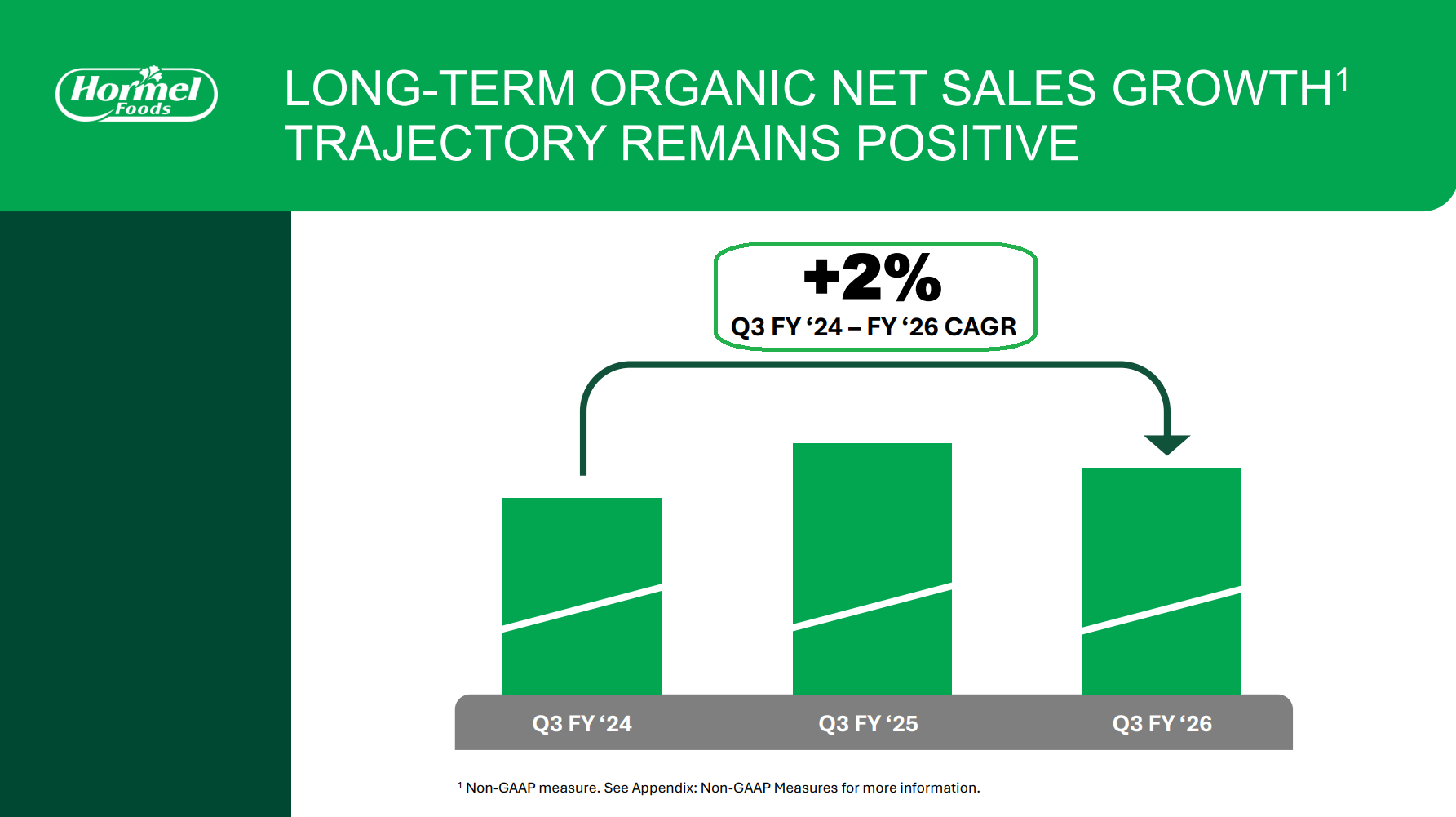
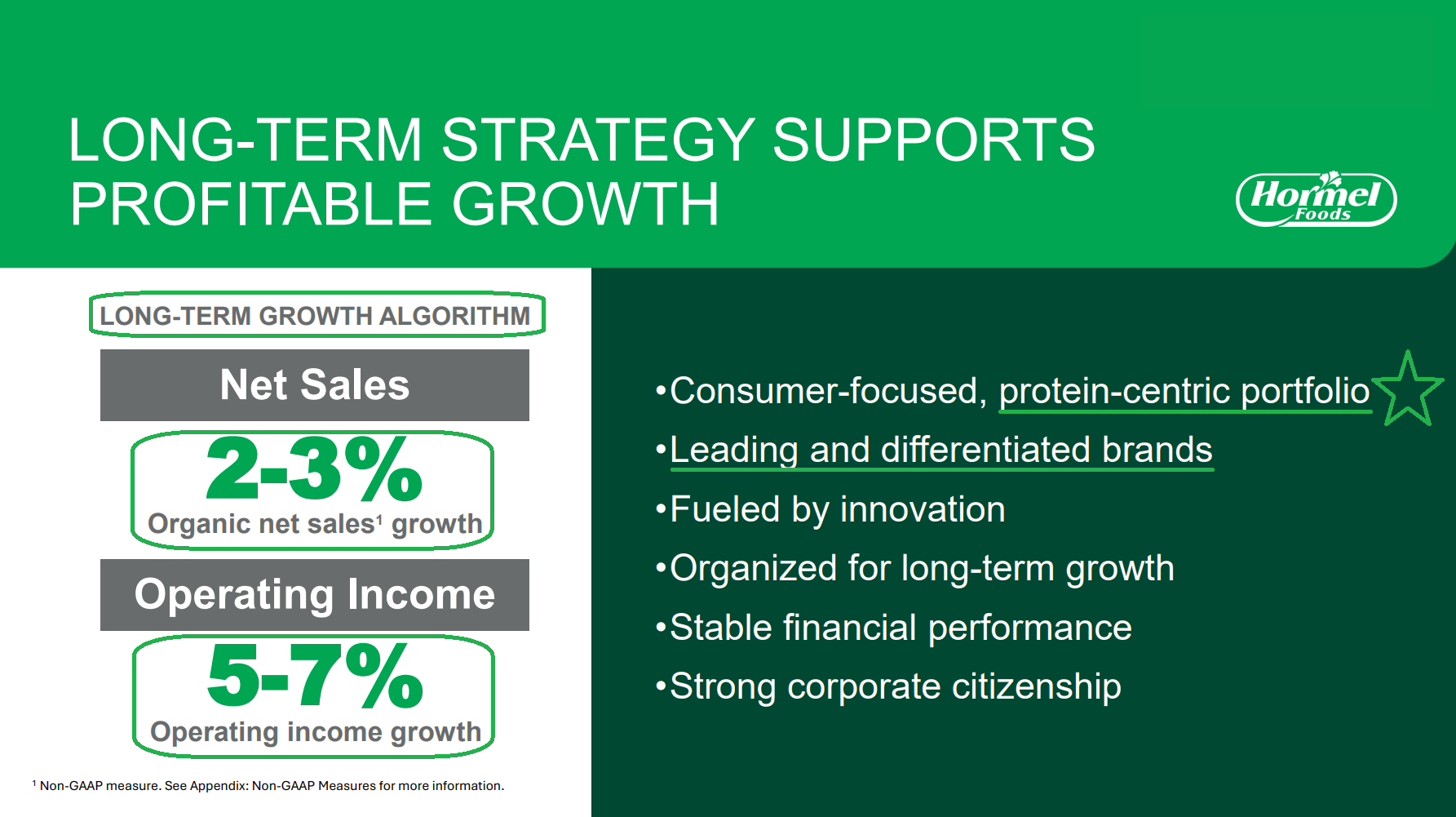
Long-term targets of 2-3% annual organic sales growth and 5-7% operating income growth.
Trading at ~12.9x forward earnings vs. a 20-year average of ~20x (lowest since GFC)
Paid to wait: a ~5.9% yield on a 135-year-old protein compounder with a margin inflection underway, cost-savings runway, and the protein megatrend at its back.
Q3 Commentary
Hormel has had a lot on its plate over the past few years, but the ingredients for a recovery are finally coming together.
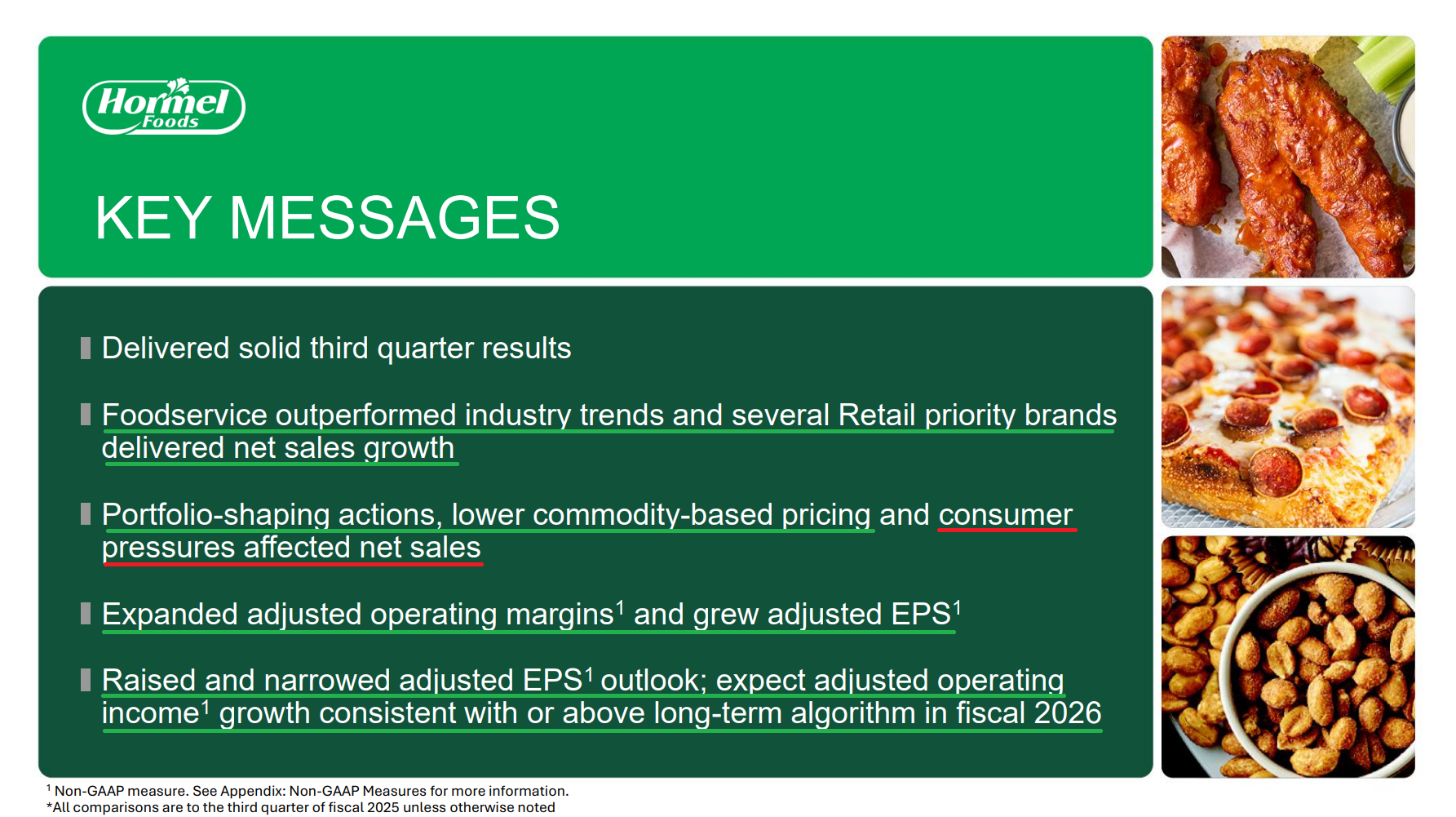
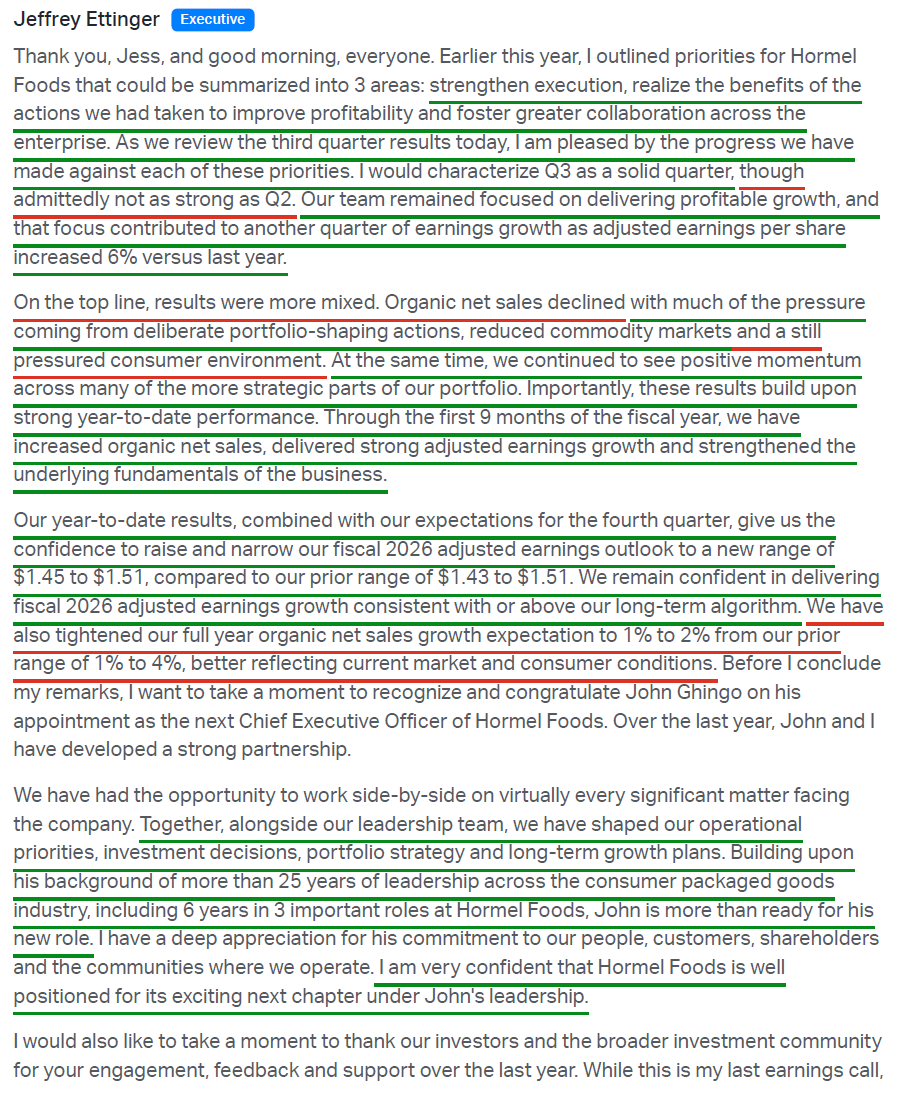
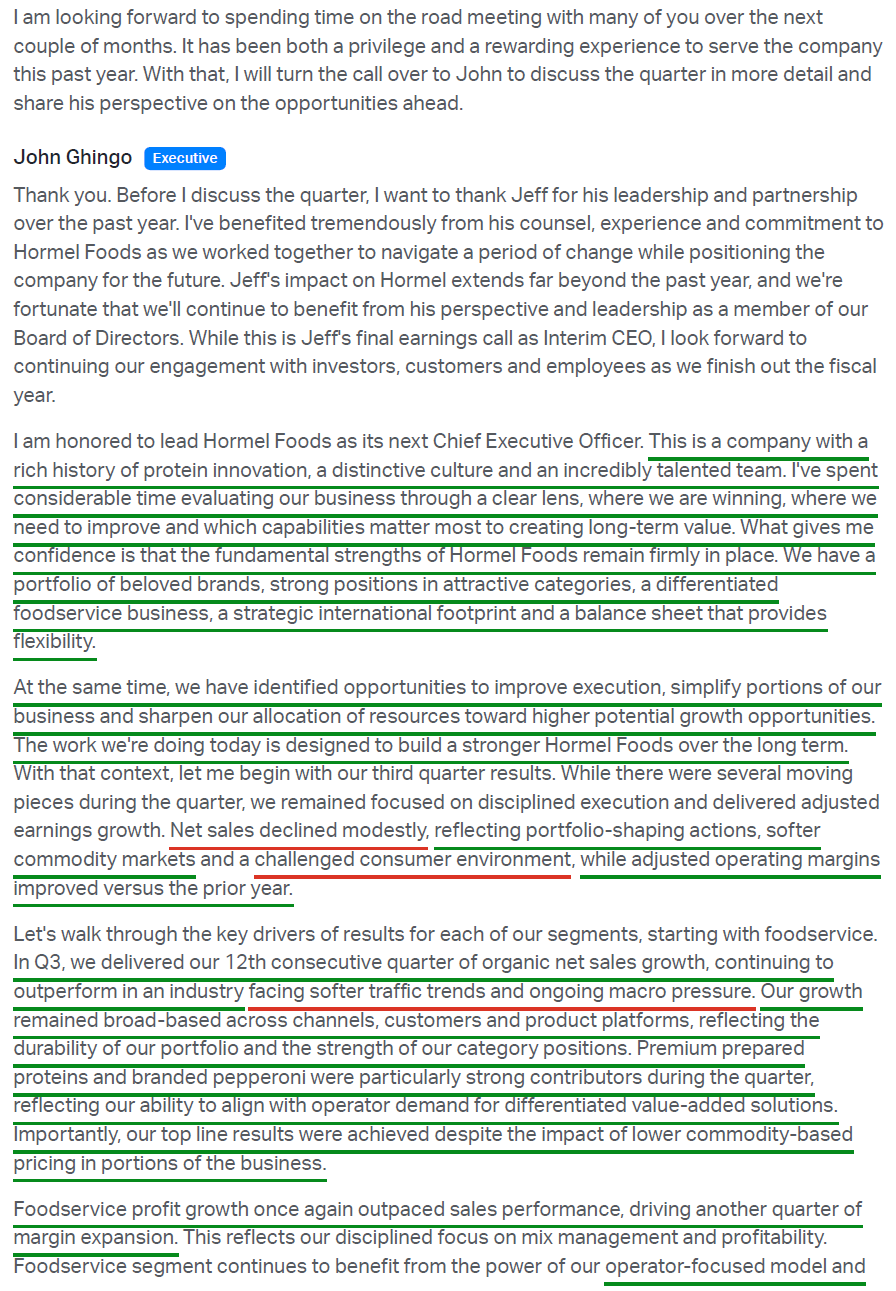
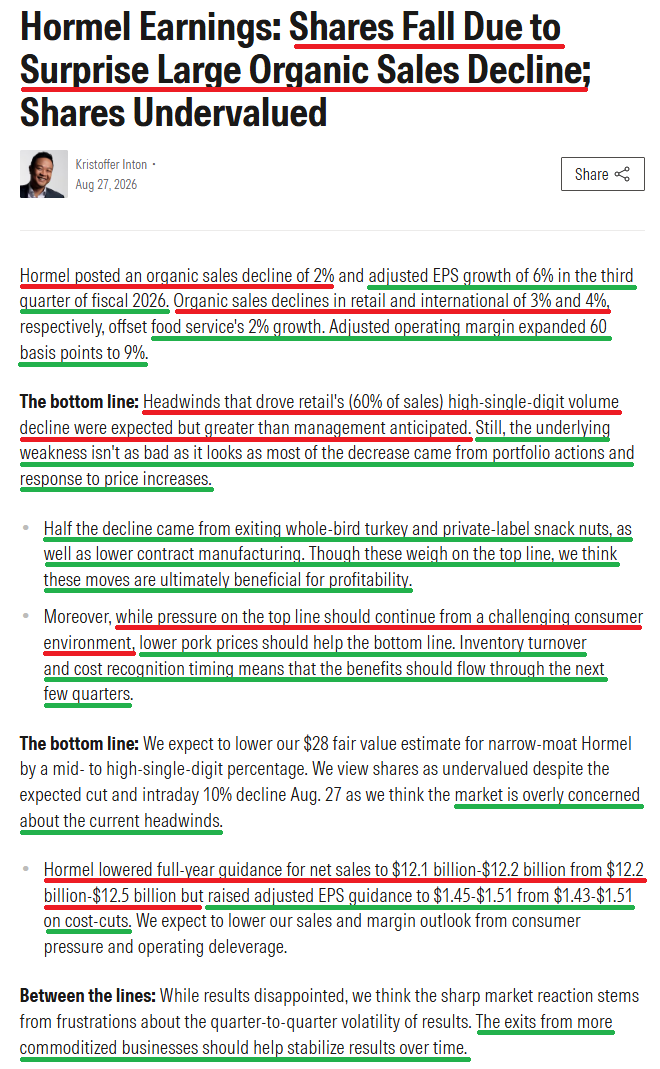
Despite a ~10% drop following third-quarter results, the underlying business looks much healthier than the headline numbers suggest. Net sales of $2.96B fell 2.4% Y/Y, with organic net sales down 1.7%, leading management to trim its full-year sales outlook to $12.1B to $12.2B from $12.2B to $12.5B and narrow organic growth to the low end of its prior range at 1% to 2%. The bottom line was far more encouraging, with adjusted EPS of $0.37, up 5.7% and ahead of expectations, allowing management to raise the low end of its adjusted EPS guidance to $1.45 to $1.51 from $1.43 to $1.51. Nearly all of the top-line pressure traces back to Retail, a segment that accounts for ~60% of sales and has spent the better part of three years in the penalty box, working through a reset that now appears to be nearing its end.
Retail’s weakness began in 2023, when organic sales fell 3%, followed by a 4.8% decline in 2024. The segment returned to 1.1% growth in 2025, only to run into steep input inflation and a strained consumer this year. Along the way, a string of one-off headwinds hit the business, as Planters worked through integration struggles before a plant shutdown in 2024, the turkey business contended with avian flu and a collapse in whole-bird turkey prices, and a fire at the SKIPPY facility added another setback last year. The result was a frustrating pattern of one step forward and two steps back, leaving investors impatient and throwing in the towel on the idea of a sustained recovery.
Management is now addressing that volatility head-on. Hormel is shedding lower-return, more commoditized businesses, including select private-label snack nuts and whole-bird turkey, a highly volatile business that drove much of the earnings swings in 2023 and 2024 while being significantly dilutive to Retail margins. Exiting those businesses shifts the segment’s focus toward higher-margin, value-added products. Those exits, together with intentionally lower contract manufacturing volume, accounted for about half of this quarter’s 9% decline in Retail volume, with most of the rest coming from expected elasticity following two rounds of price increases. Giving up that volume weighs on reported sales in the near term, but it leaves behind a higher-margin, more stable Retail business that we believe is now sitting at its trough.
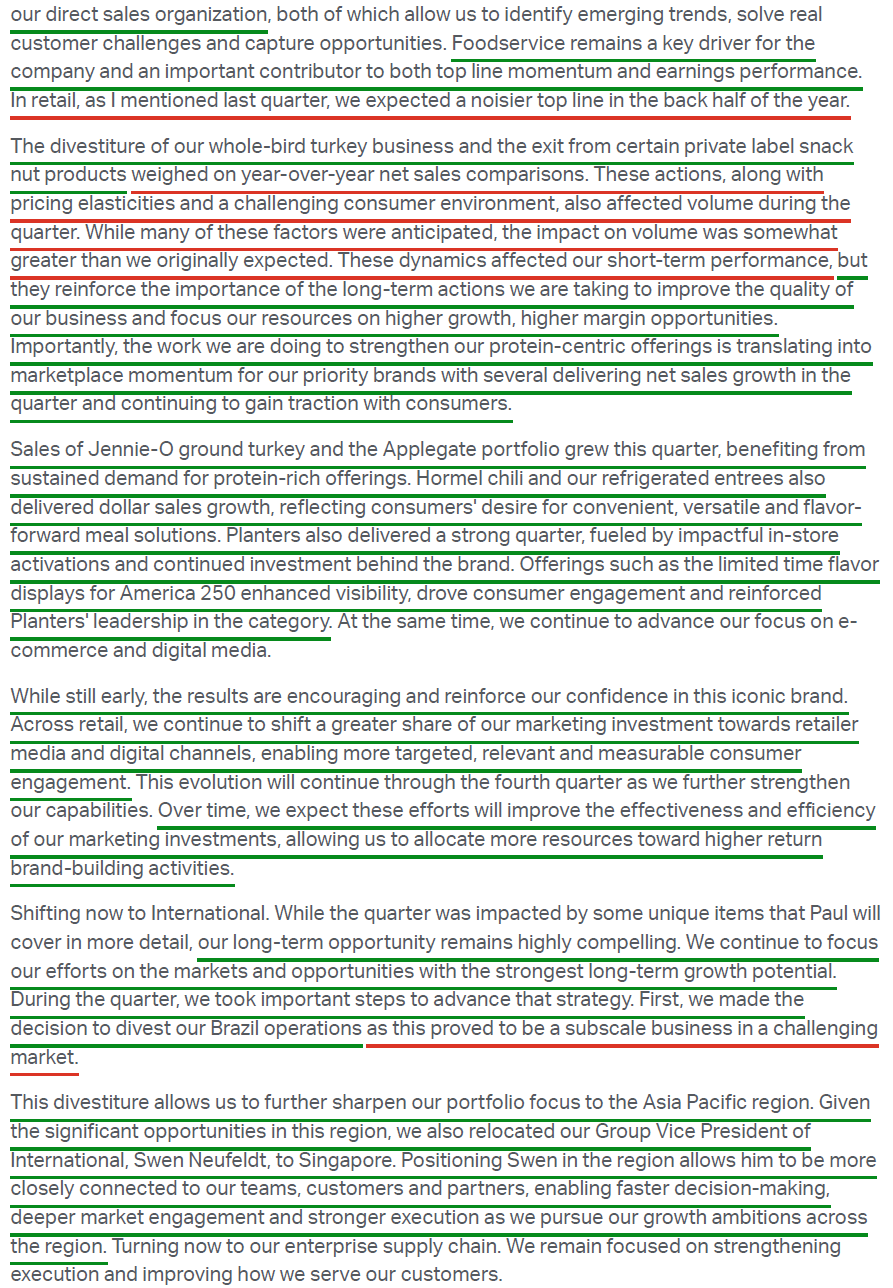
Meanwhile, the brands Hormel is prioritizing continue to grow. Jennie-O ground turkey and Hormel entrees posted mid- to high-single-digit consumption growth, while Applegate, Herdez, Black Label bacon, SPAM, and Hormel chili also grew. Planters returned to consumption growth as well, a welcome sign for a brand that has been at the center of the Retail turnaround. With the exits lapping over the coming quarters, pricing fully reflected, and input costs easing, the pieces are in place for Retail to return to profitable growth while rebuilding segment margins from the mid-6% range today toward the high single digits the business has historically earned.
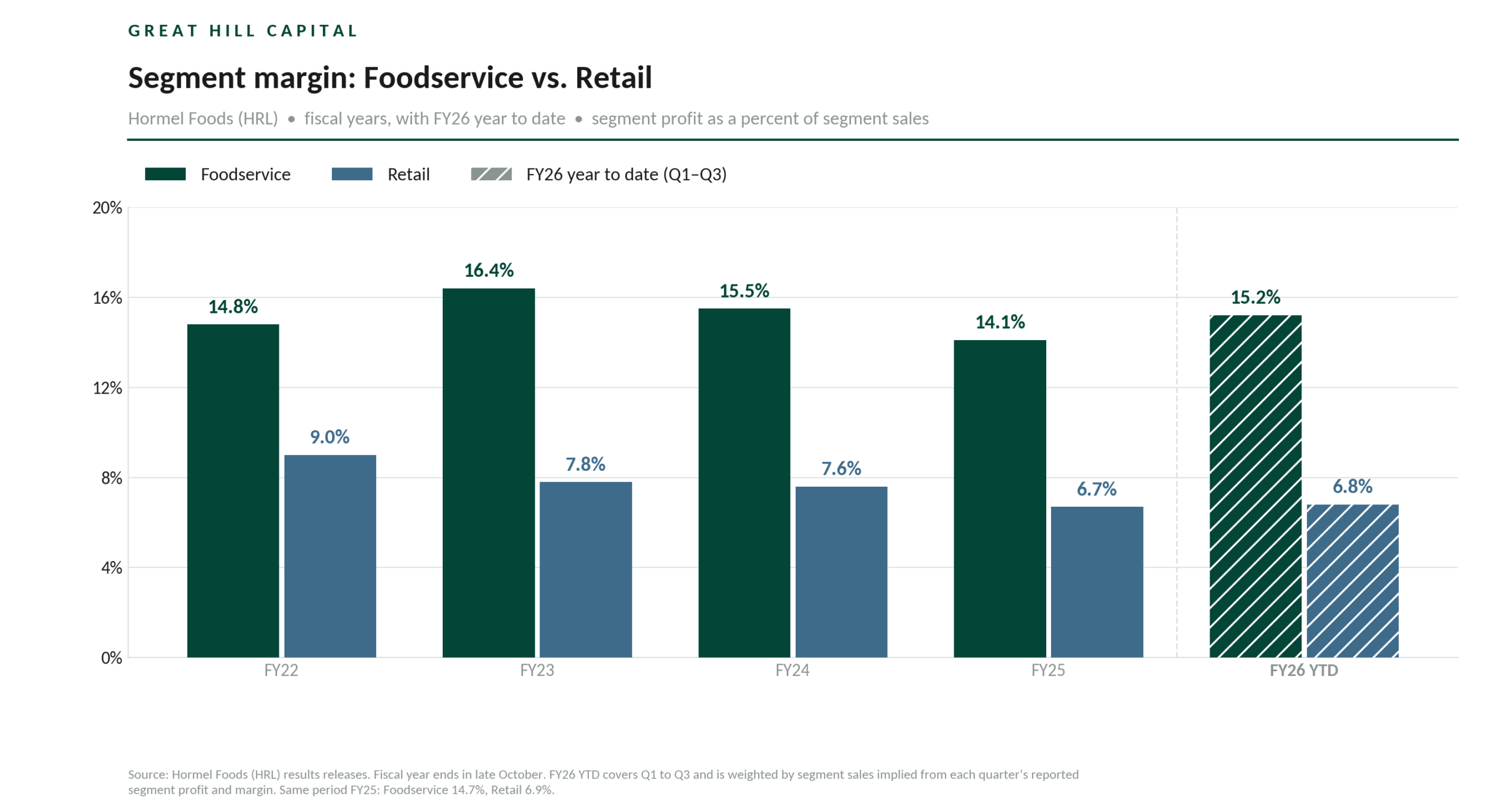
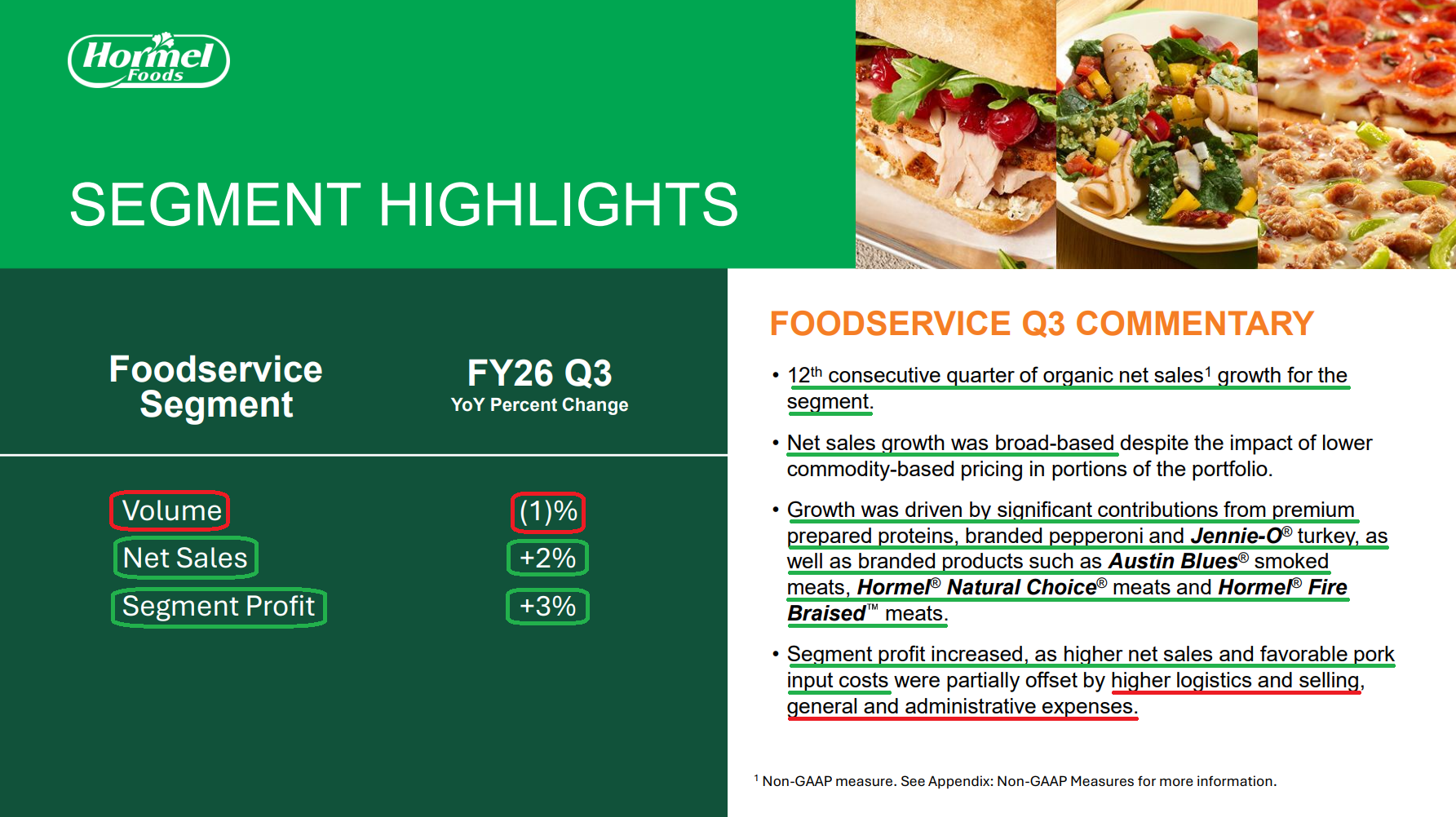
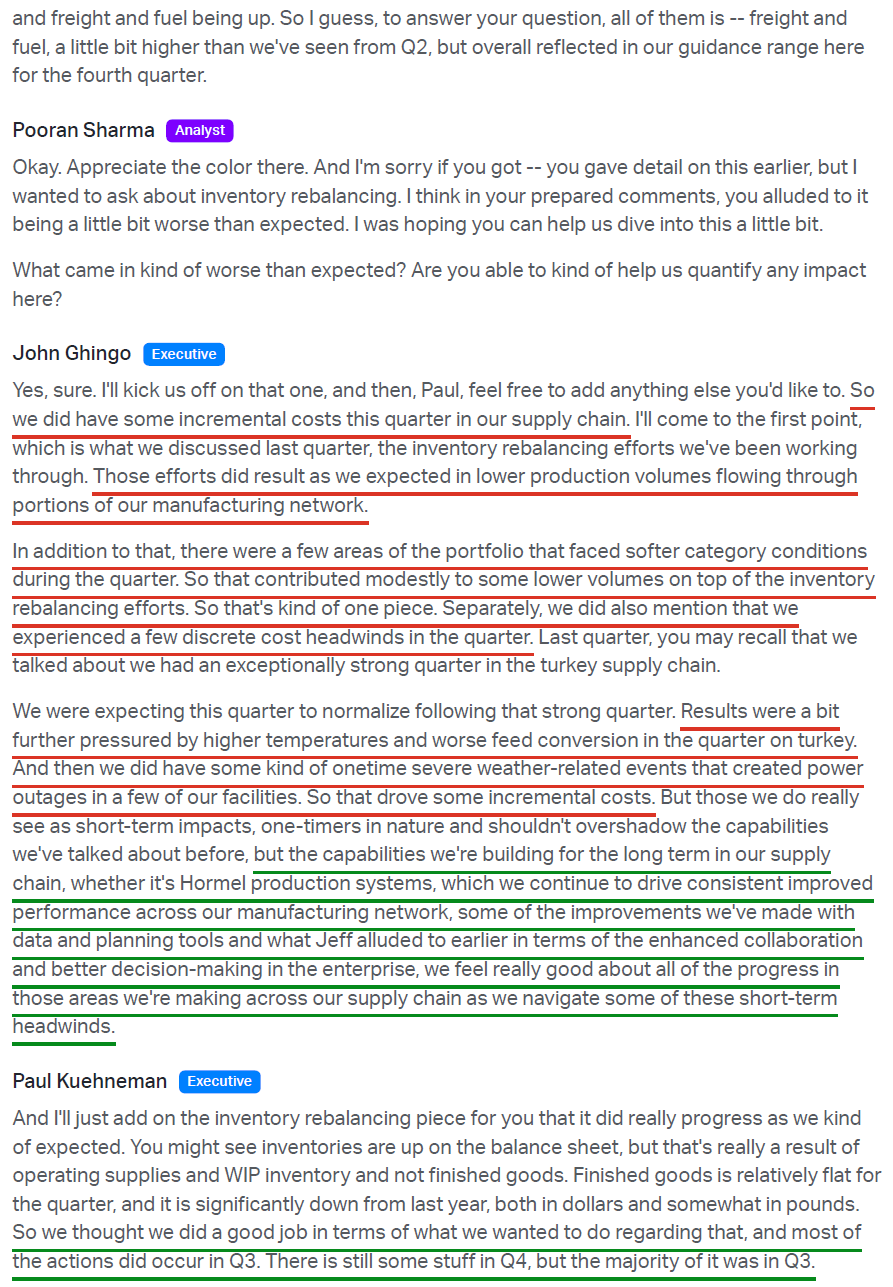
While Retail resets, Foodservice continues to do the heavy lifting, generating more than half of segment profit on about a third of company sales. Year-to-date margins of 15.2% are more than double Retail’s 6.8%, with organic sales up 5.2% against a 1.3% decline in Retail. The segment has now delivered 12 straight quarters of organic growth, led by premium prepared proteins and branded pepperoni, even as restaurant operators reported net declines in customer traffic in 17 of the last 18 months.
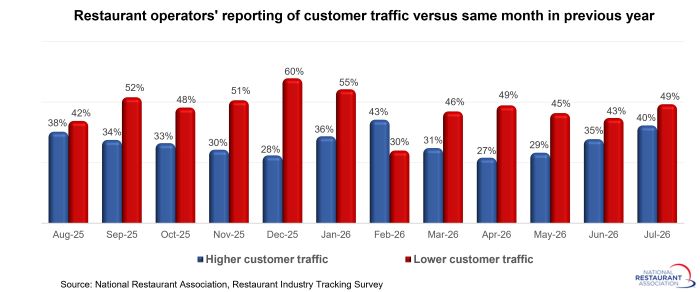
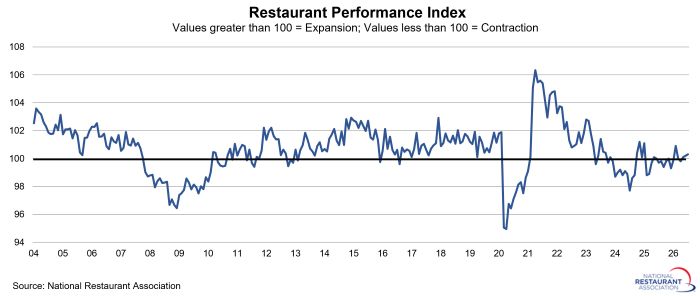
When the restaurant industry finally finds its way out of the gutter, Hormel’s steady share gains in a down market should provide an additional volume tailwind on top of the solid growth it is already generating. And restaurants are only part of the story, with exposure to hotels, schools, healthcare facilities, convenience stores, and entertainment venues providing a diversified base of demand across the cycle.
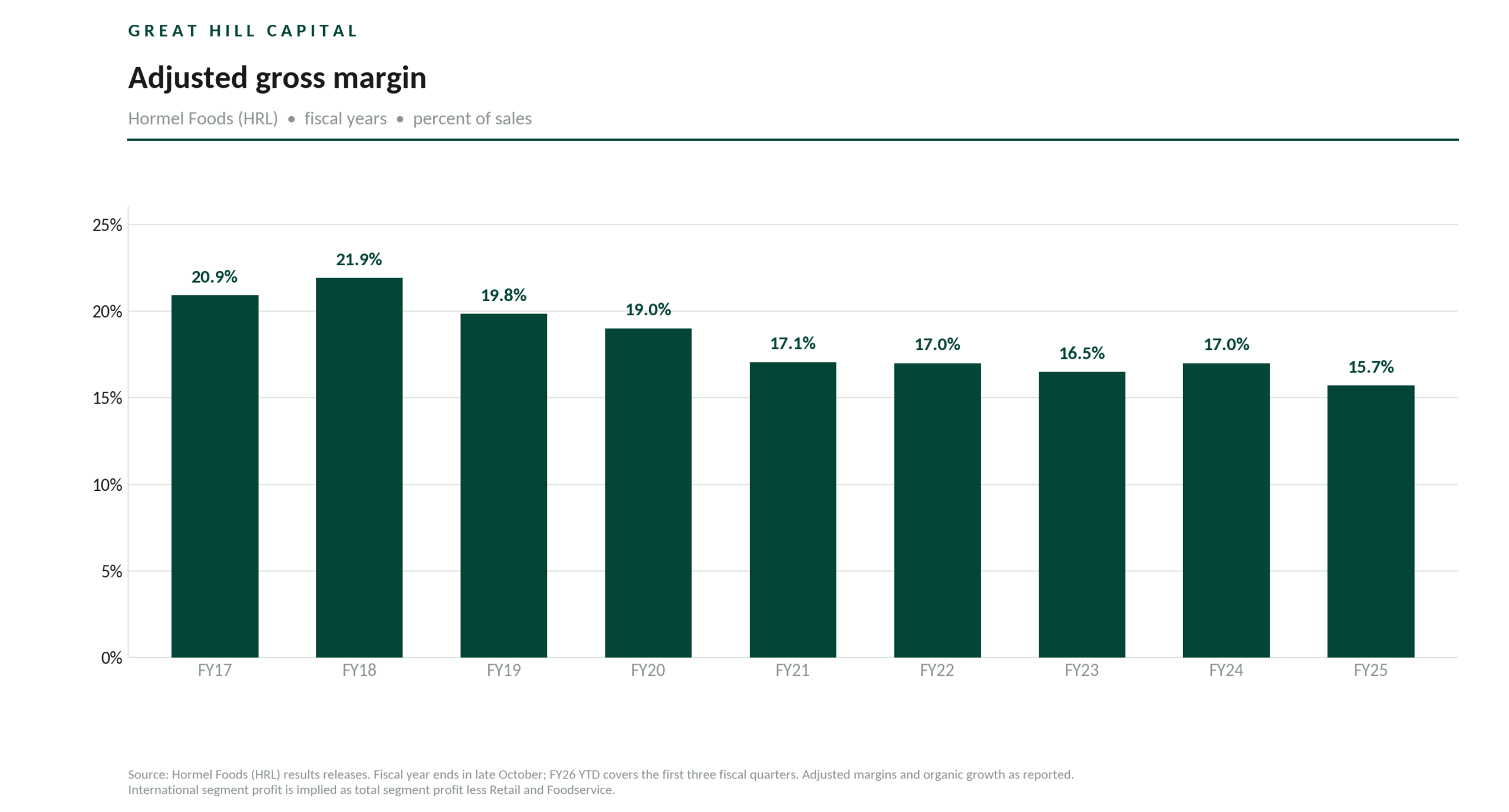
With high-margin Foodservice making up a bigger slice of the pie alongside a cleaned-up Retail business, there is a clear line of sight to margin expansion from today’s trough levels. Adjusted gross margin sat at just 15.7% in FY2025, its lowest level since 2008 and well below the high teens, and at times north of 20%, that the company earned historically.
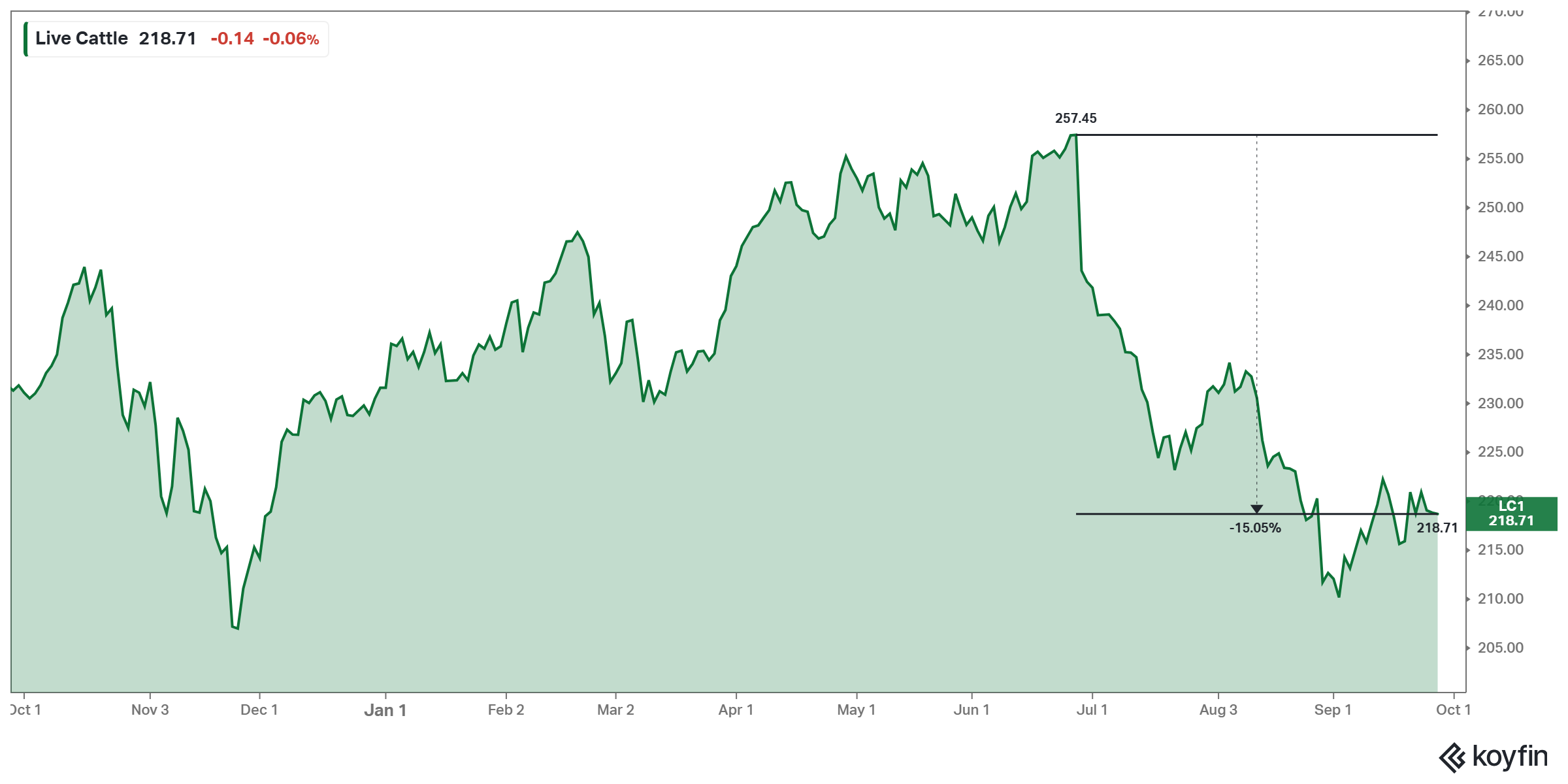
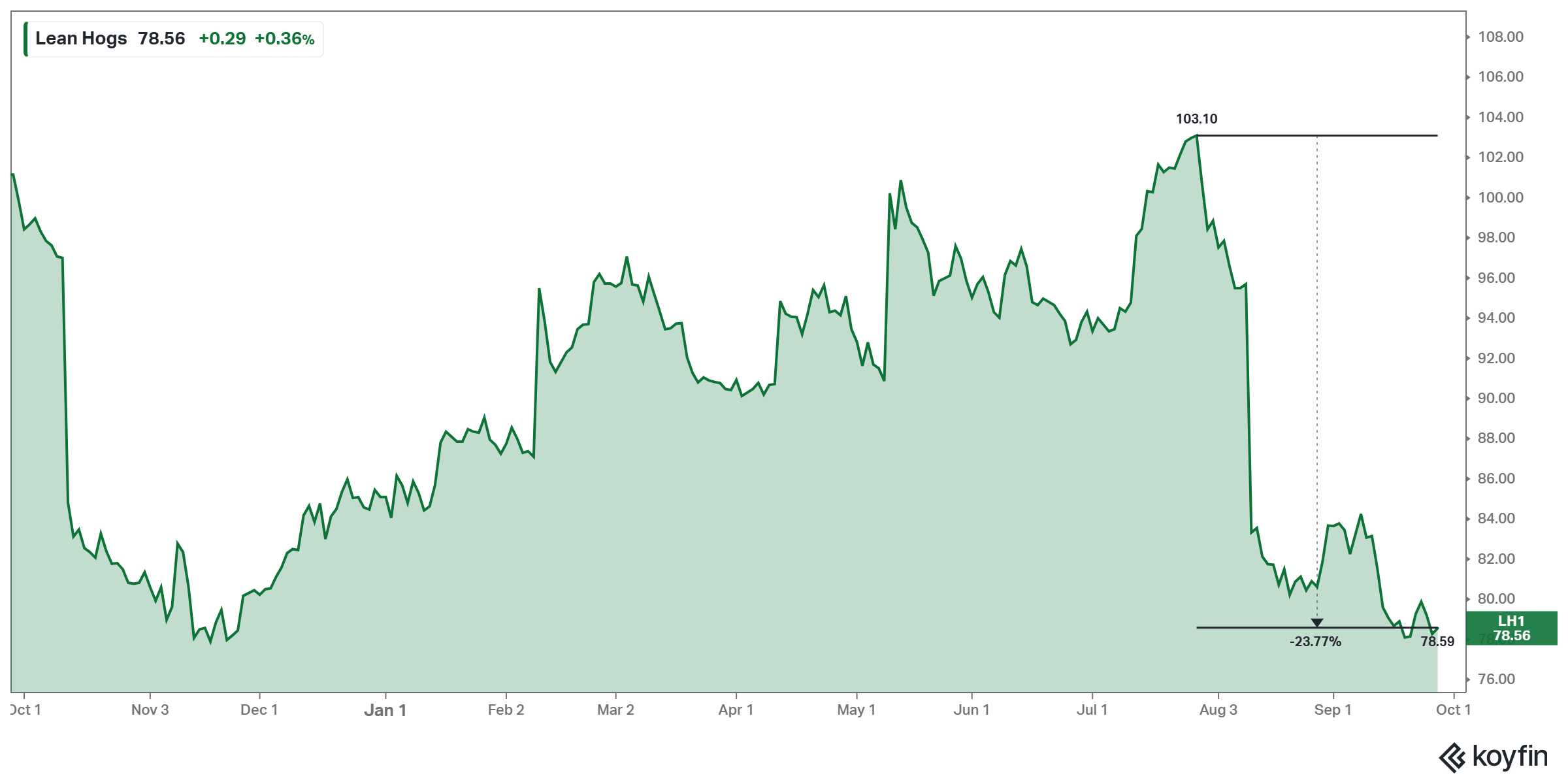
Input costs also started to roll over during the quarter, with live cattle now ~15% off their June highs and lean hogs down ~24% from recent highs.
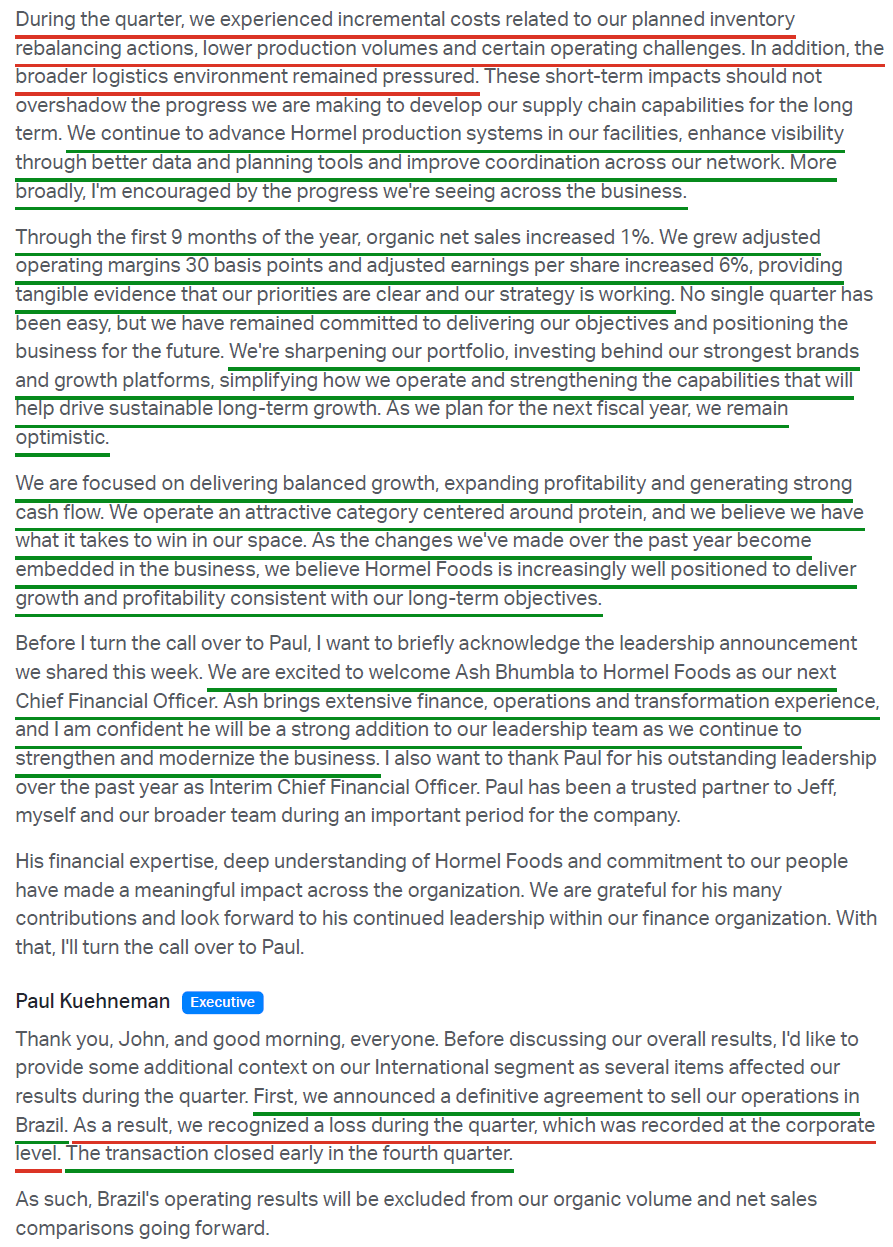
Only a partial benefit reached the P&L in Q3 as higher-cost inventory worked through, with most of the relief still to come in Q4 and FY2027. Further down the income statement, years of cost work are just starting to pay off, with adjusted SG&A falling to 7.3% of net sales from 8.1% a year ago, its lowest dollar level since Q4 FY2023. That puts FY2026 on track for Hormel’s first operating margin increase since FY2021, with guidance implying a 9.1% midpoint versus 8.4% last year and plenty of runway to work back toward a normalized 10% to 12% range.
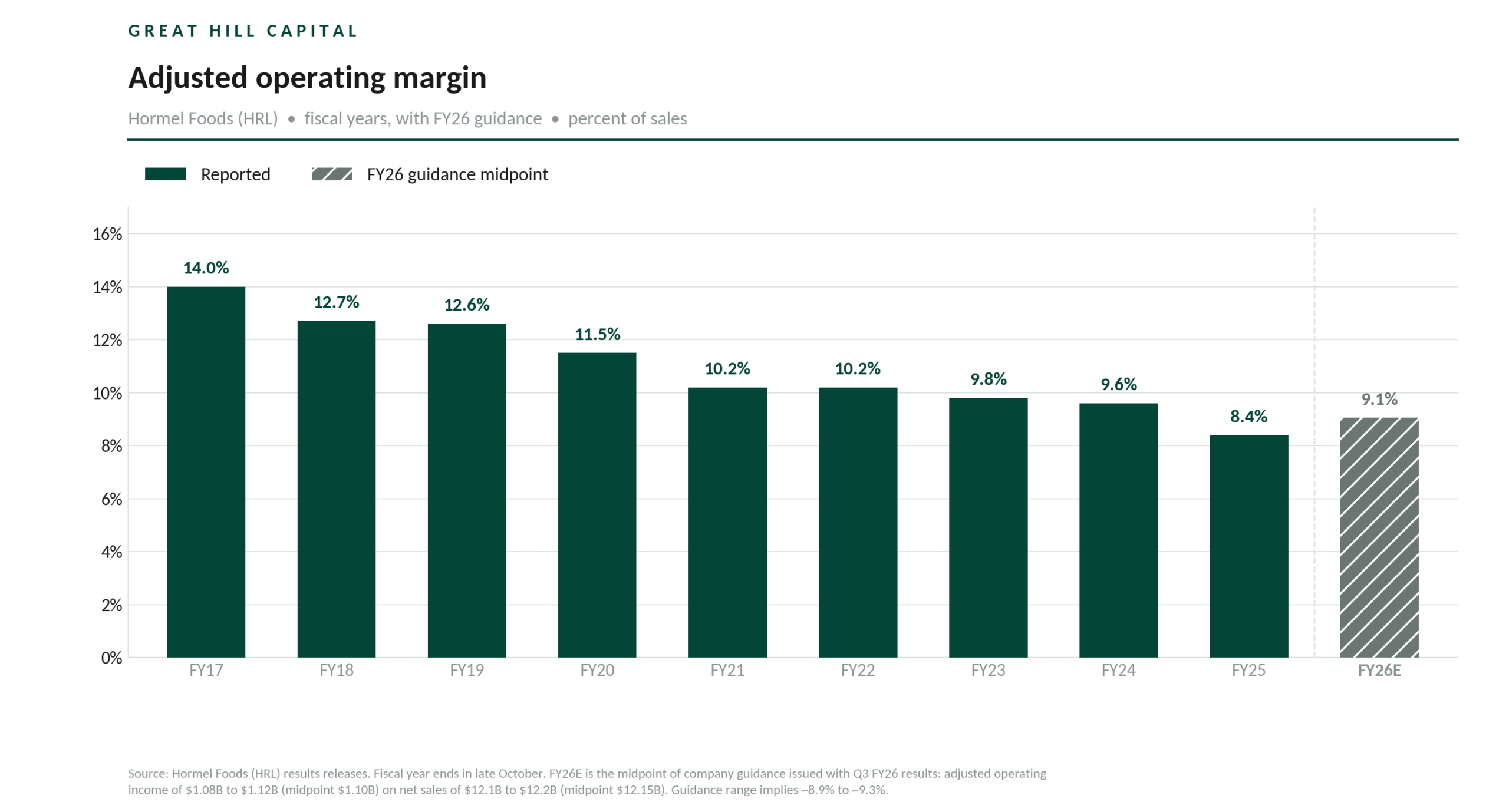
Beyond the margin opportunity, Hormel has another tailwind working in its favor: the shift toward higher-protein diets.
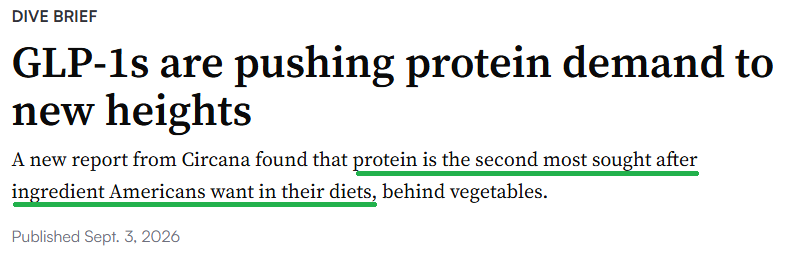
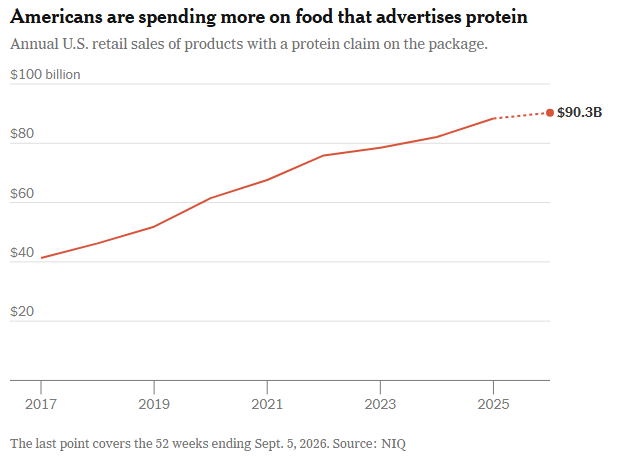
Unlike consumer staples companies built around bread, sweets, and heavy carbs that are swimming against the current of where diets are heading, Hormel is on the right side of that trend. With ~72% of annual net sales coming from meat and poultry across brands like Jennie-O, SPAM, Applegate, and Columbus, Hormel is about as direct a protein play as there is in consumer staples, at a time when nearly half of U.S. adults say they want more protein in their diets. That share climbs to 65% among GLP-1 users, while the government’s new dietary guidelines raised recommended protein levels by more than 50%. Meanwhile, U.S. retail sales of protein-labeled foods are expected to reach $90.3B this year, more than double the ~$40B generated in 2017.
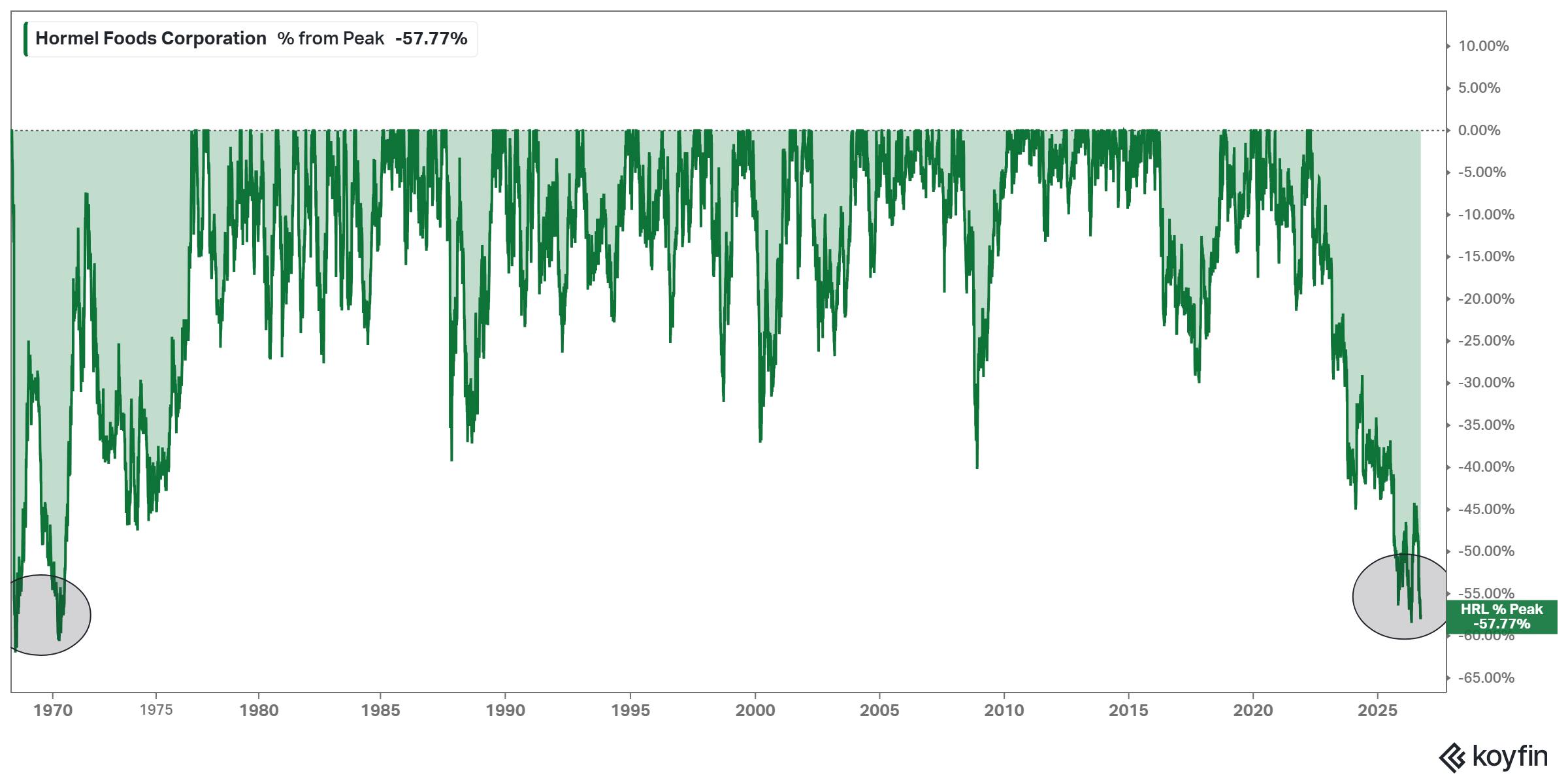
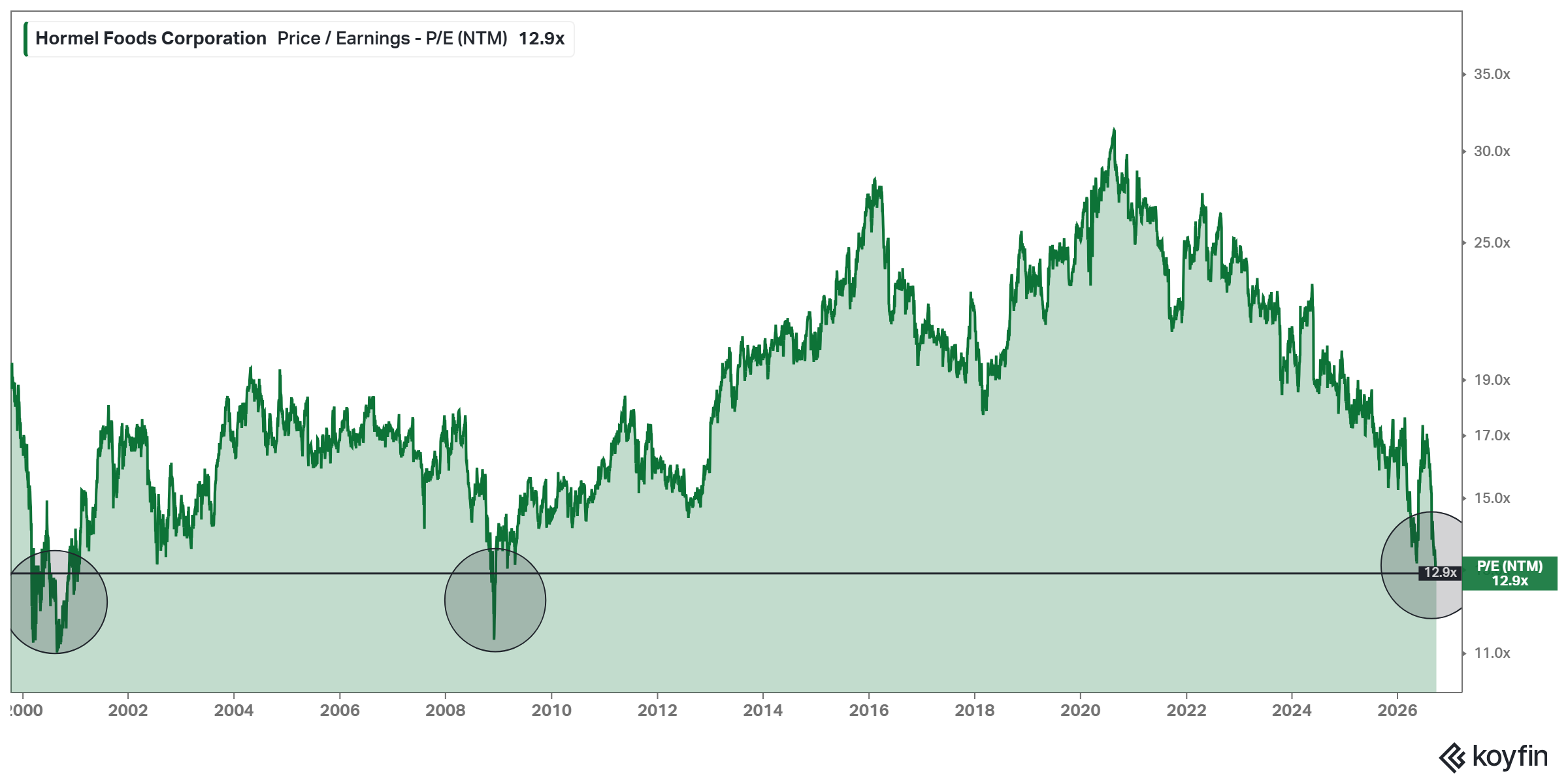
The market is giving Hormel very little credit for either its turnaround progress or the demand backdrop, with the stock sitting ~60% below its 2022 highs, a drawdown of a magnitude matched only once before in Hormel’s history, from 1968 to 1970. The stock is now trading at just ~12.9x forward earnings versus a 20-year average of ~19x, a depressed valuation only seen during the GFC and the dot-com bubble
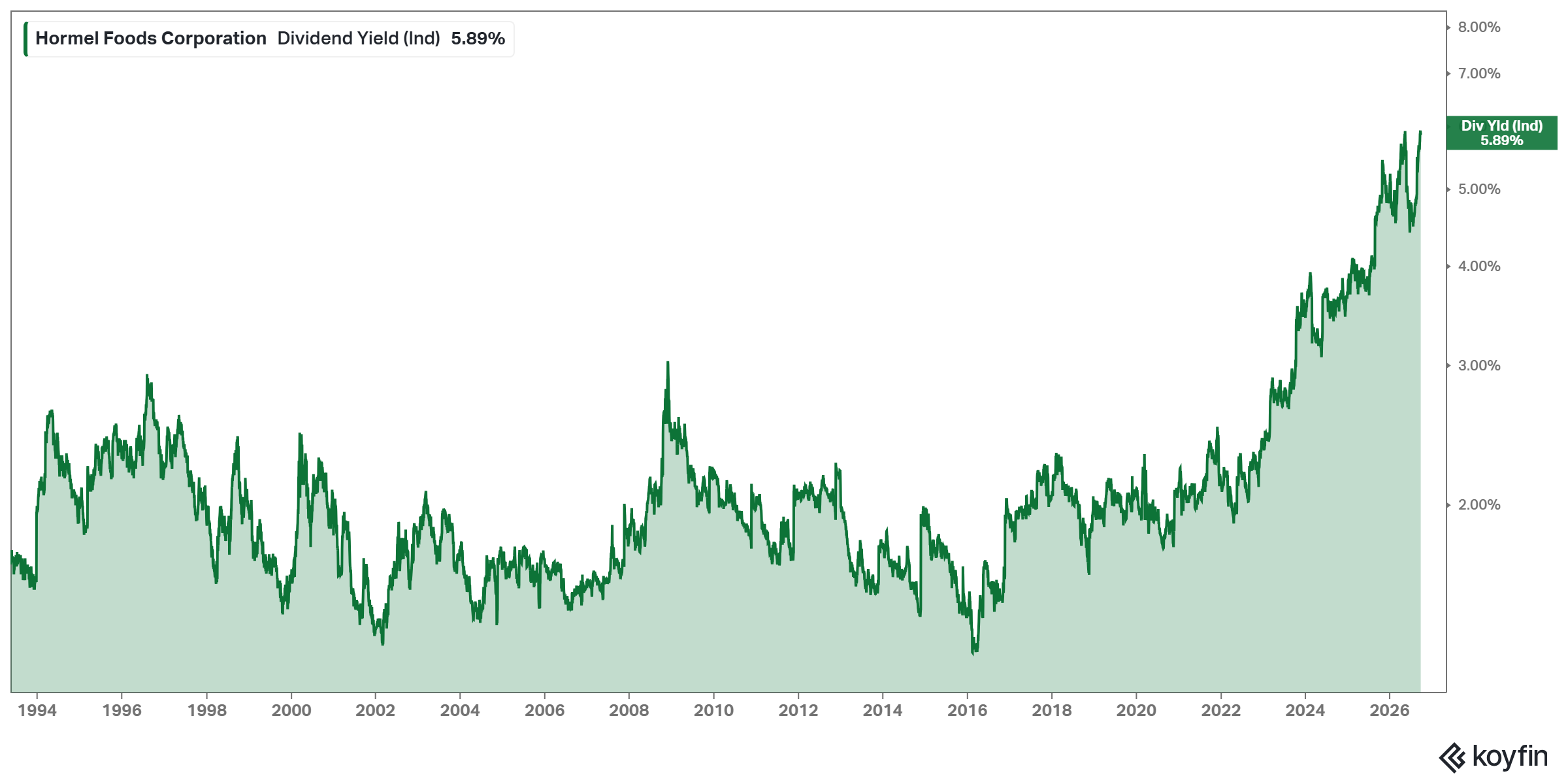
The recent selloff has also pushed Hormel’s dividend yield to 5.9%, the highest in the company’s history. It is backed by 392 consecutive quarterly payments, 60 straight years of increases, a rock-solid balance sheet, and a management team that has made the dividend a clear priority.
Dividend payers have fallen out of favor in the near term as investors can lock in a 5.2% yield on the 10-year Treasury, but for reasons we’ve discussed in detail in recent weeks, we see the current spike in yields as temporary by nature. As yields come down, we expect out-of-favor dividend payers like Hormel to catch a bid as investors are forced to find yield elsewhere. Not to mention, investors locking in a 5.9% yield from Hormel today are getting a dividend that has grown ~3.8% annually over the past five years, with the massive equity upside of a recovering business on top.
And the pessimism extends well beyond Hormel, with the entire staples sector now making up just 4.5% of S&P 500 market cap, the lowest on record, while the ratio of staples to the S&P 500 sits at its lowest level since April 2000.
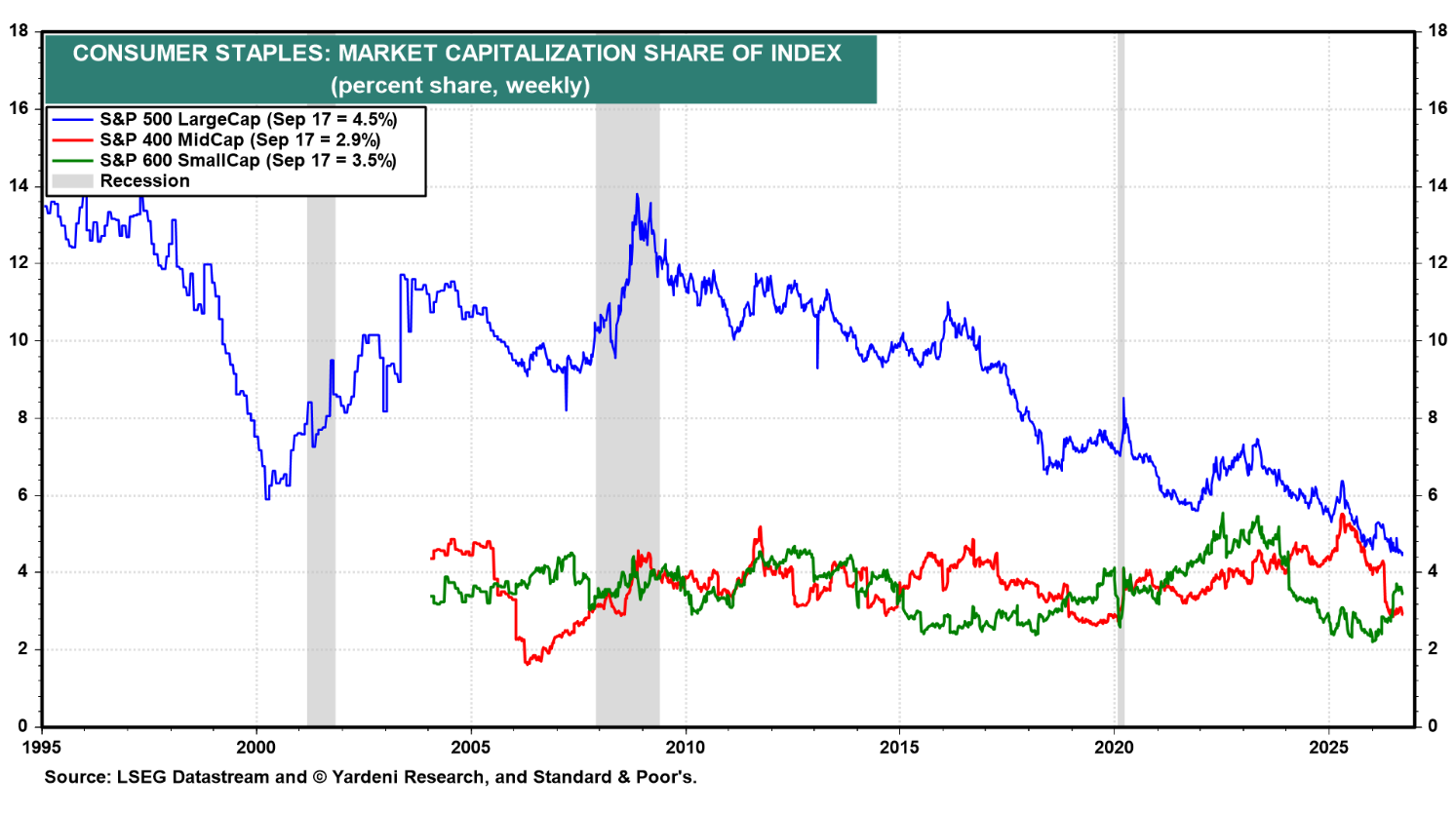
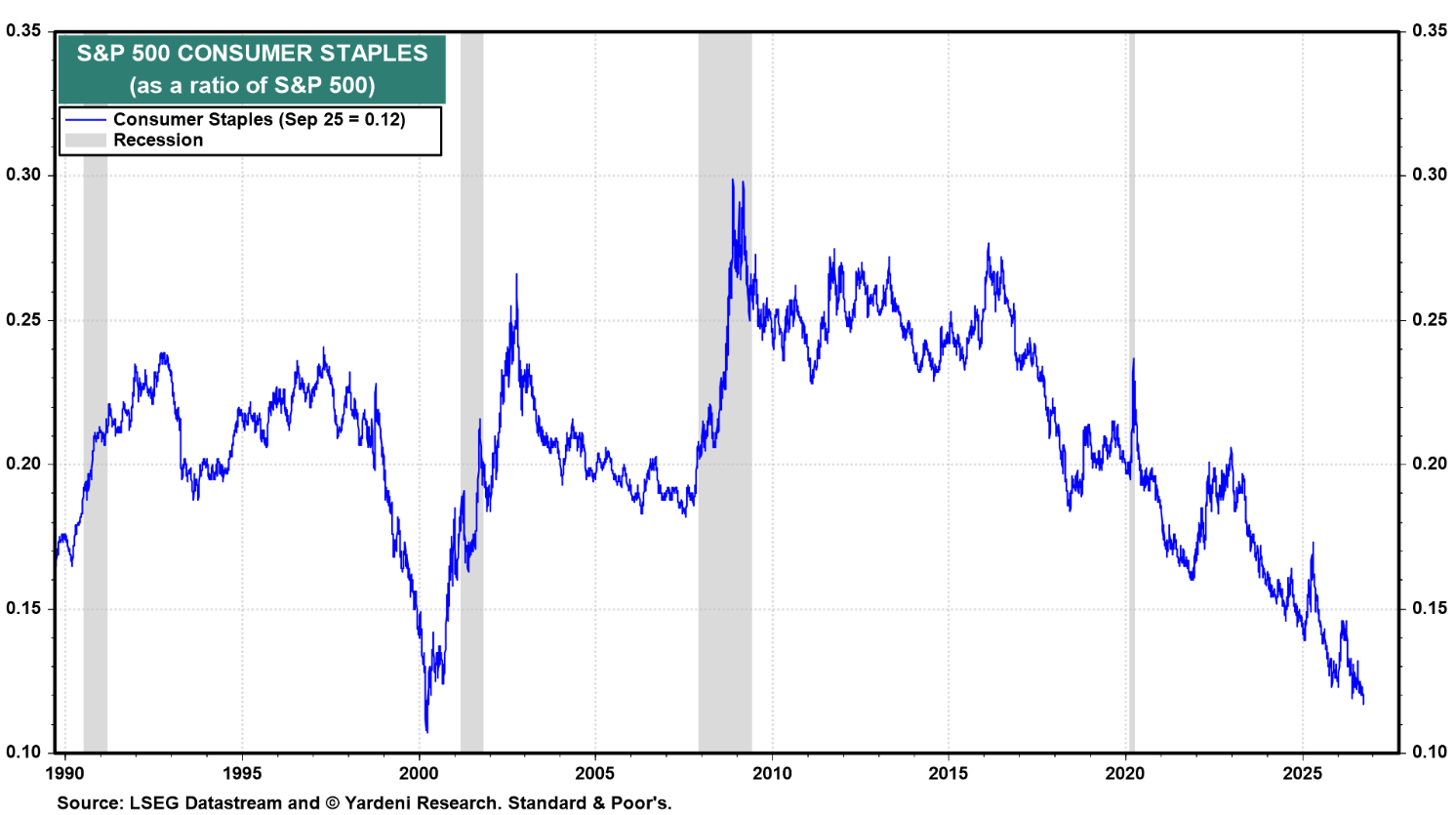
The last time the sector was this deeply out of favor, it went on to outperform the S&P 500 for three consecutive years as the tech bubble unwound. Yet you still can’t give the sector away, with fund managers a net 33% underweight, more than two standard deviations below normal and the largest underweight since January 2004.
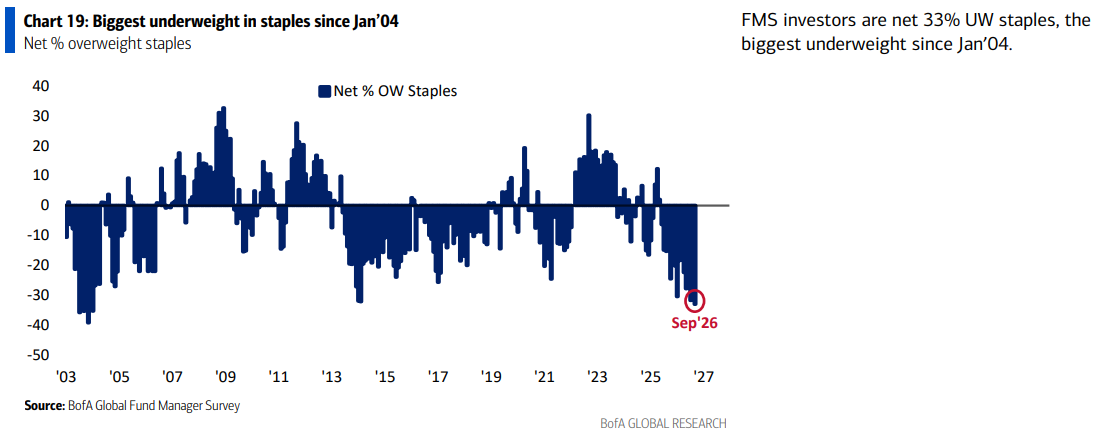
It is the same pattern we see every time in the Wall Street fashion show, where nobody wants to own staples until they suddenly do, leaving today’s lopsided sentiment and positioning with a very low bar for a reversal.
We don’t think it will take much for Hormel to get back on the menu.
Q3 Earnings Breakdown
10 Key Points
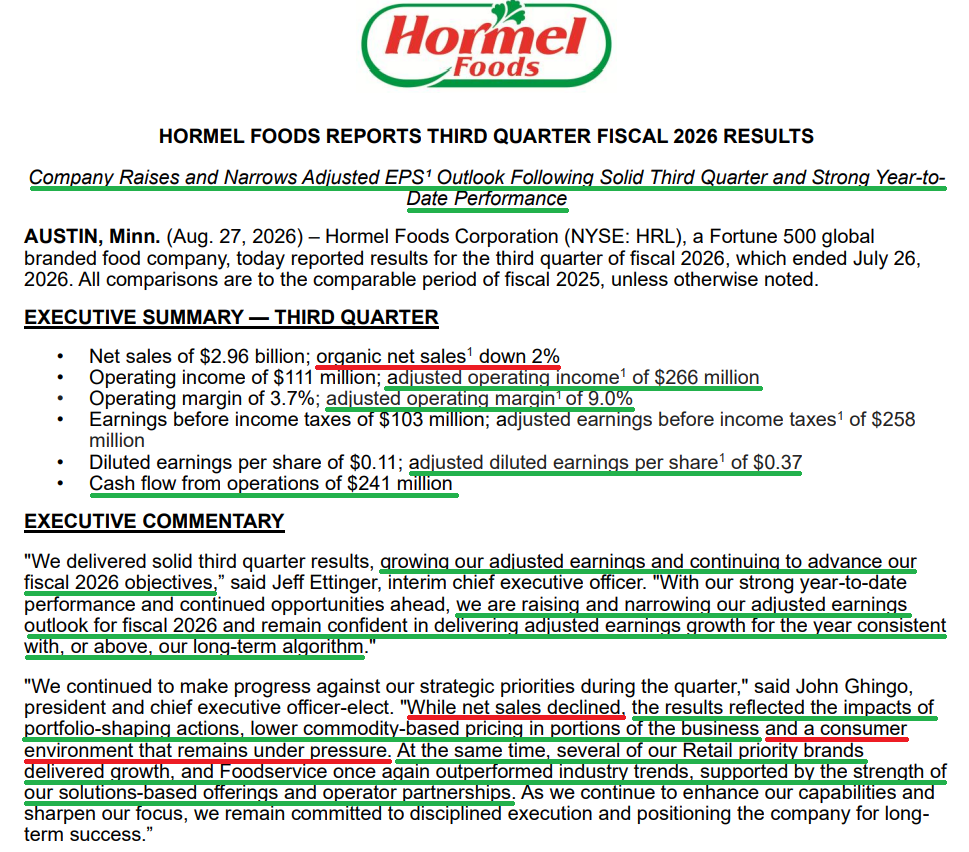
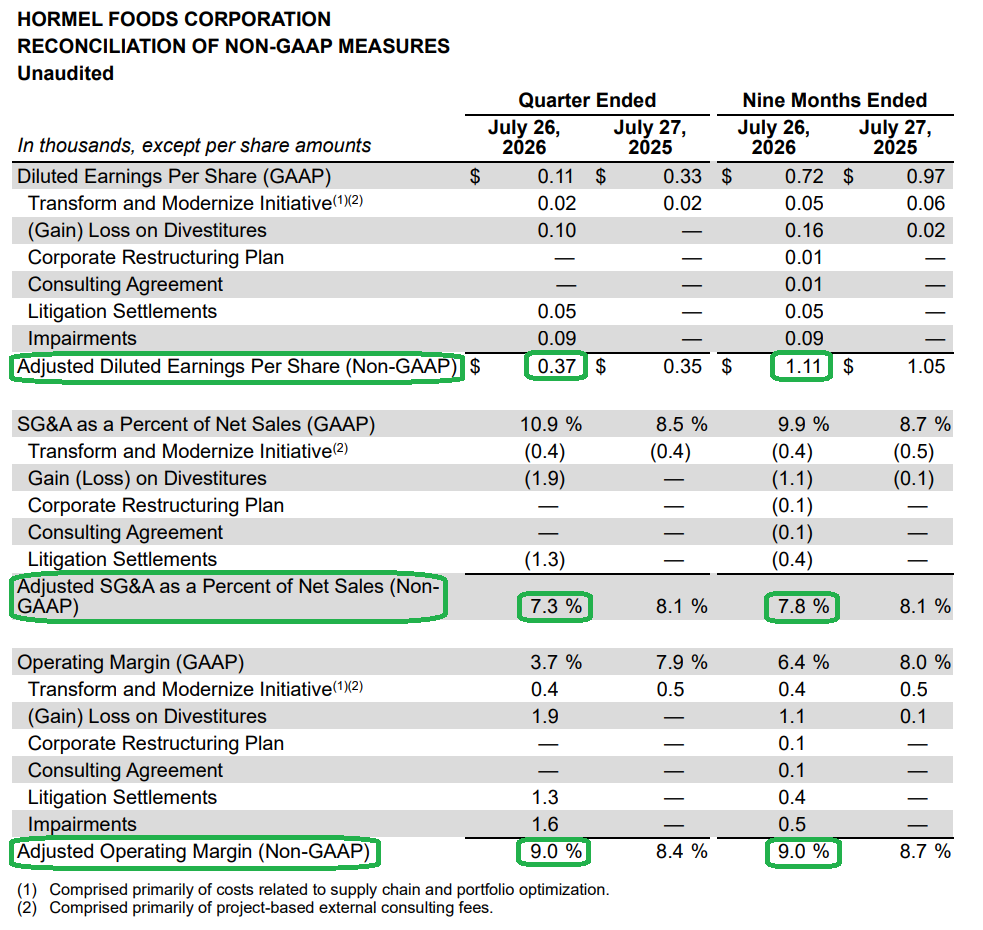
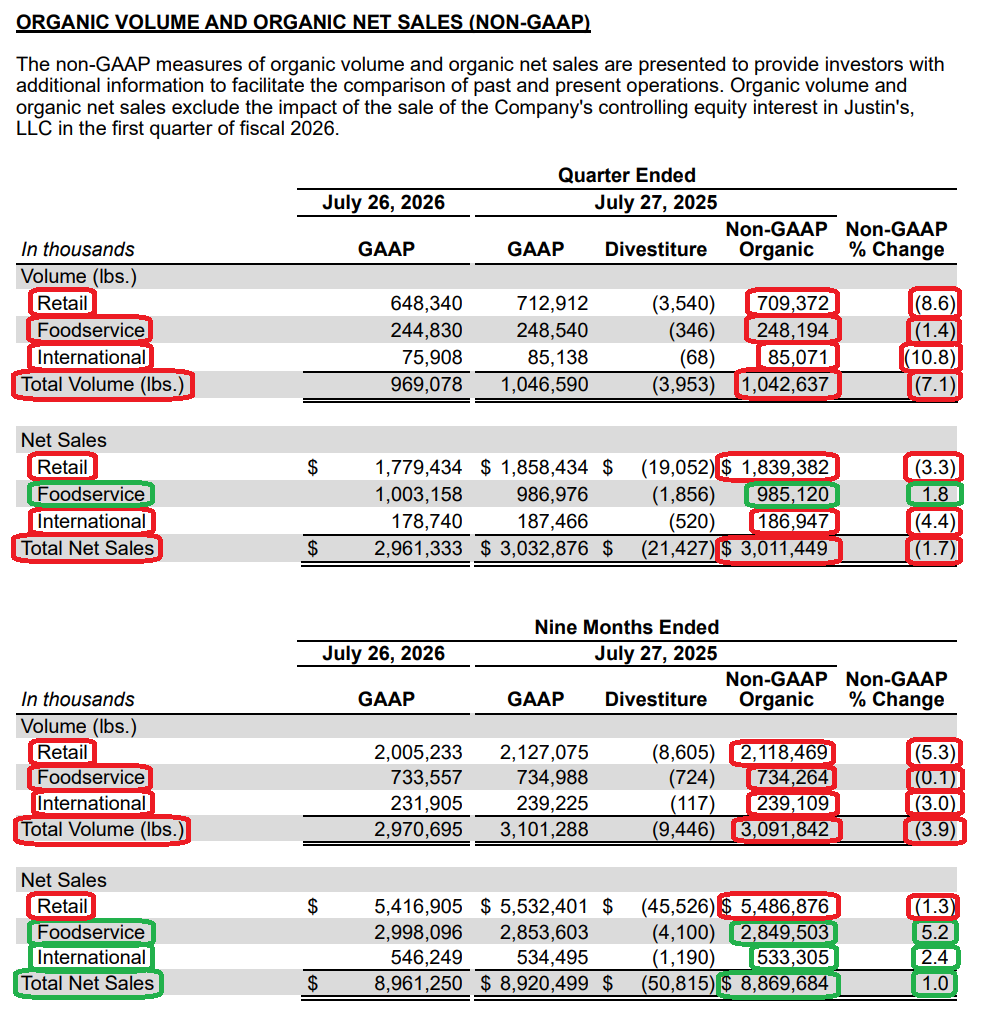
1) Hormel reported net sales of $2.96B (-2.4% Y/Y), missing consensus expectations of ~$3.04B by ~$80M, with organic net sales of -1.7%, its first negative organic print in over a year. The decline was driven by portfolio-shaping actions, including the whole-bird turkey divestiture and private label snack nut exit, lower commodity-based pricing, and a pressured consumer. Adjusted diluted EPS of $0.37 (+5.7% Y/Y) beat consensus expectations of $0.35. Year-to-date, organic net sales are +1.0%, with adjusted EPS of $1.11 (+5.7% Y/Y).
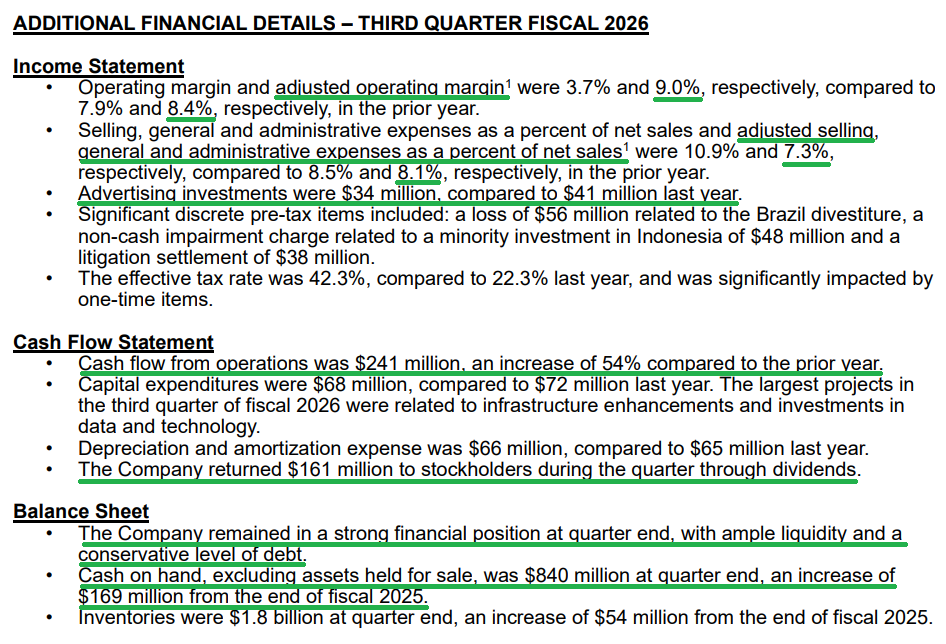
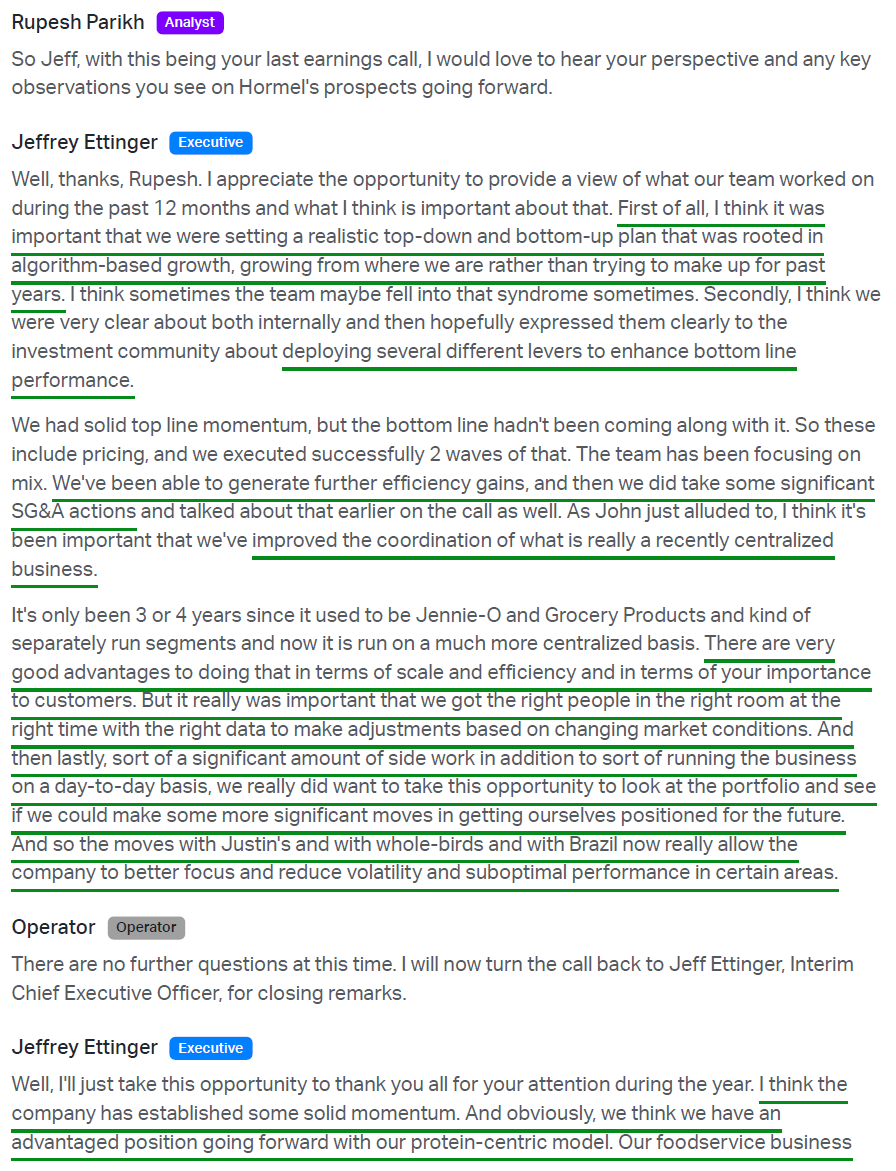
2) Gross profit came in at $471.5M (-3.2% Y/Y), with gross margin declining 14 bps to 15.9%. Lower plant utilization from planned inventory rebalancing, softer volumes, elevated freight costs, and discrete turkey supply chain and weather-related headwinds weighed on the quarter. Pork deflation began partway through Q3, so only a partial benefit was recognized, with the larger share expected to flow through in Q4 and into FY2027 as higher-cost inventory works through. Beef remained elevated Y/Y. Year-to-date gross margin stands at 16.3%, up 7 bps from 16.2% at the same point last year.
3) Adjusted operating income of $266.2M (+4.7% Y/Y) came in ahead of the ~$263.0M consensus expectation, with adjusted operating margin expanding 61 bps to 9.0% from 8.4% a year ago, versus ~8.8% expected. Cost discipline drove the expansion, with adjusted SG&A falling 11.6% Y/Y to $216.9M, or 7.3% of net sales versus 8.1% last year, its lowest dollar level since Q4 FY2023. Lower employee-related expenses reflect the corporate restructuring actions now fully taking hold, while advertising came in at $34M versus $41M last year due to timing, with management planning a step-up in Q4. Year-to-date adjusted operating margin sits at 9.0%, up from 8.7% at the same point last year.
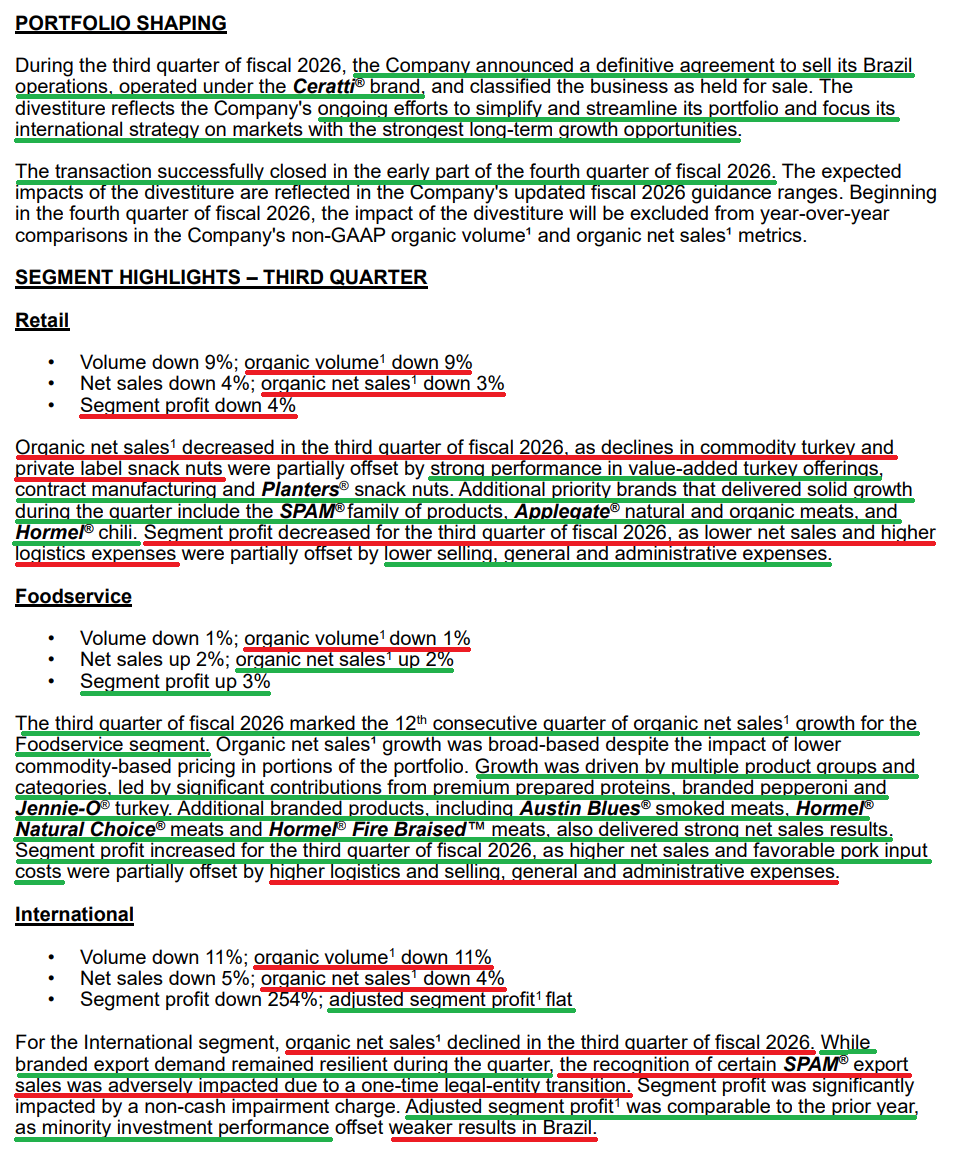
4) The Retail segment (60.1% of net sales, 41.9% of adjusted segment profit) posted net sales of $1.78B (-4.3% Y/Y), with organic net sales of -3.3%, organic volume of -8.6%, and segment profit of $118.1M (-3.7% Y/Y). Segment profit margin was 6.6%, up 4 bps Y/Y. About half of the volume decline stemmed from the whole-bird turkey divestiture and private label snack nut exit, with the remainder tied to expected elasticity from the two rounds of pricing and incremental softness. Total Hormel dollar consumption was -1% for the quarter versus ~+1% earlier in the year, though priority brands continued to gain traction. Jennie-O ground turkey and Hormel entrees posted mid- to high-single-digit consumption growth, while Applegate, the SPAM family, Hormel chili, Herdez, Black Label bacon, and Planters also grew. Planters benefited from in-store activations, with marketing dollars across Retail continuing to shift toward retailer media, e-commerce, and digital channels.
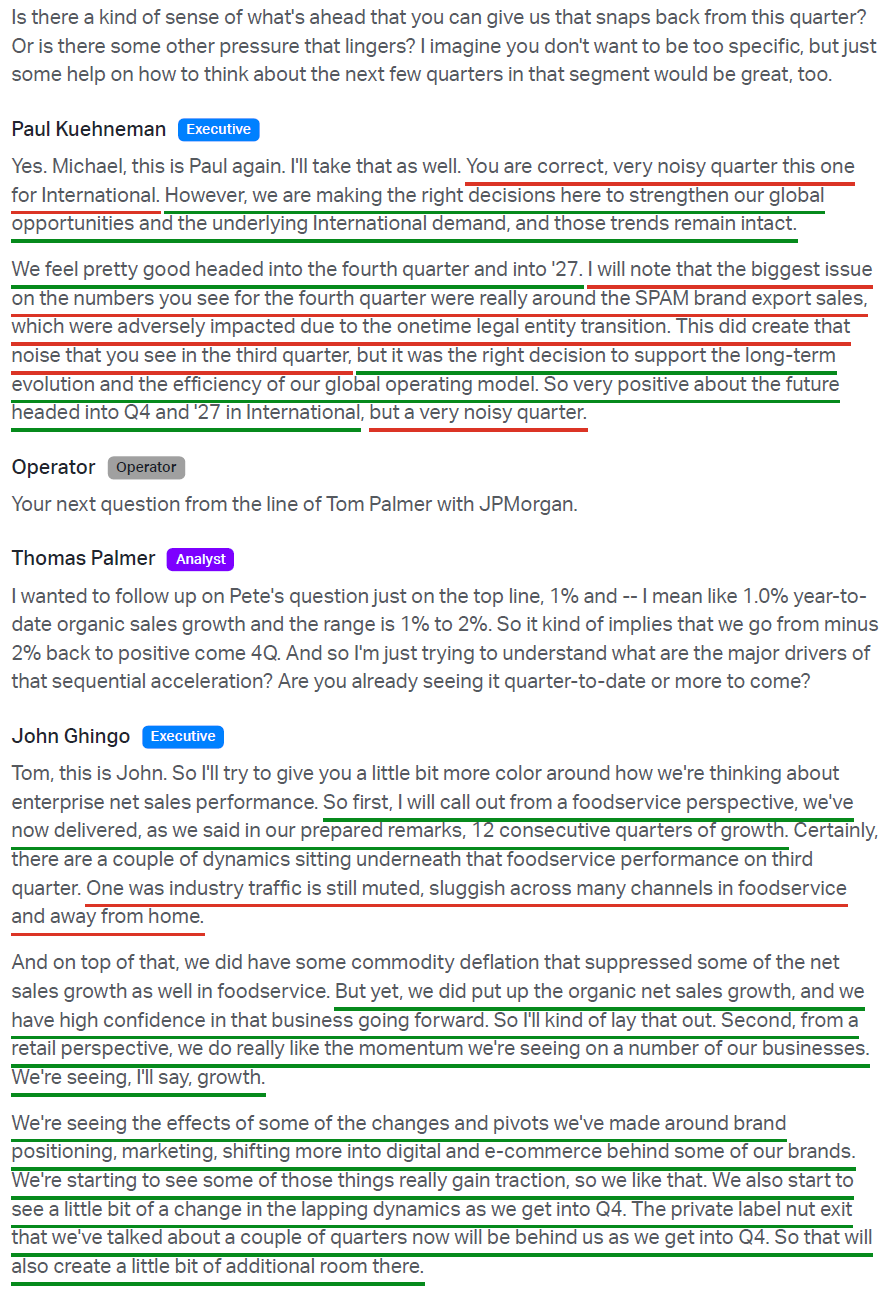
5) The Foodservice segment (33.9% of net sales, 51.3% of adjusted segment profit) posted net sales of $1.00B (+1.6% Y/Y), with organic net sales of +1.8%, marking its 12th consecutive quarter of organic growth. Segment profit grew 2.7% to $144.5M, with margin expanding 15 bps to 14.4%. Growth was broad-based across channels, customers, and product platforms, led by premium prepared proteins, branded pepperoni, and Jennie-O turkey, with Austin Blues, Hormel Natural Choice, and Hormel Fire Braised also delivering strong net sales results. The segment outperformed industry trends despite muted away-from-home traffic, while lower commodity-based pricing suppressed net sales across portions of the portfolio.
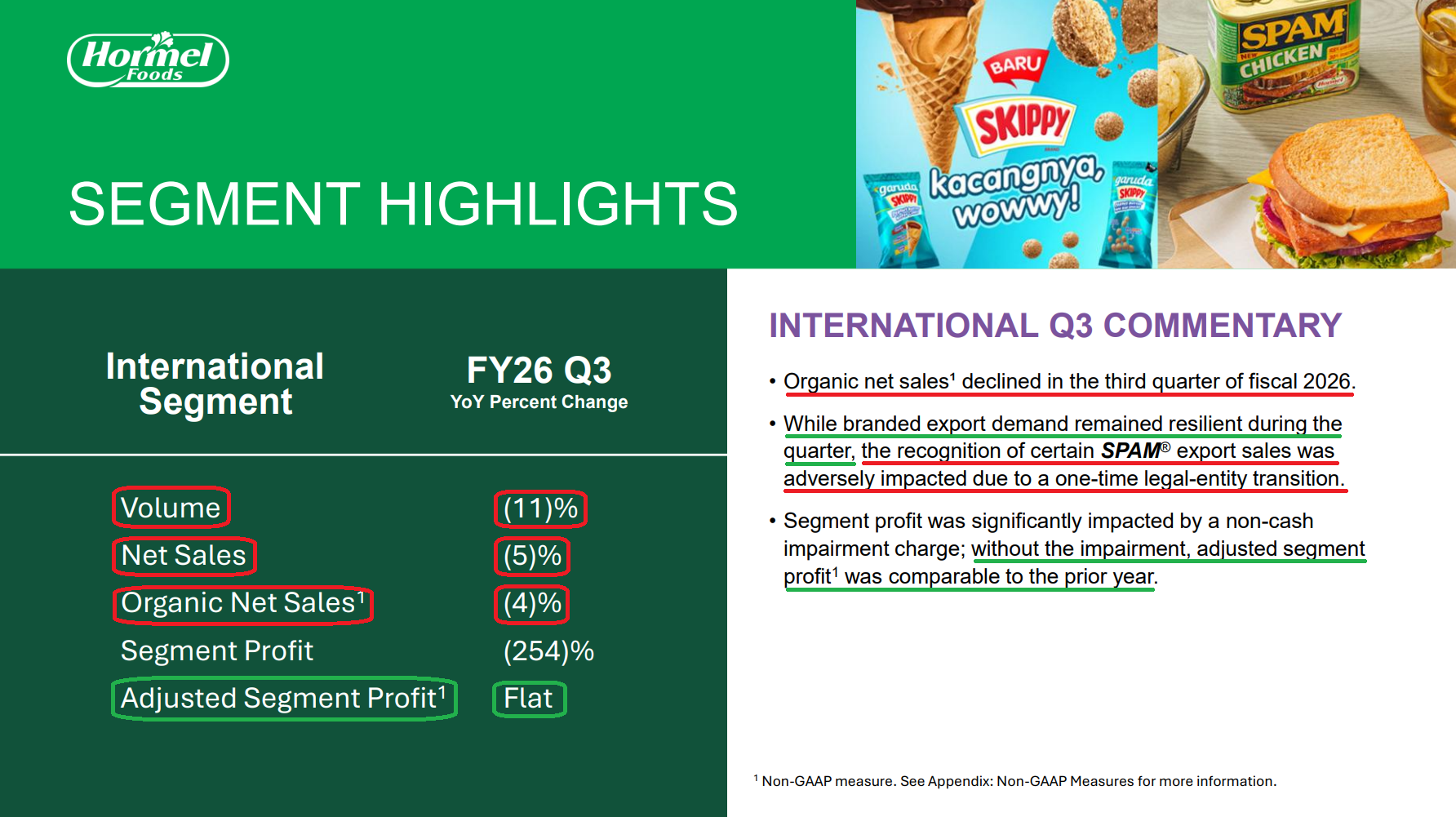
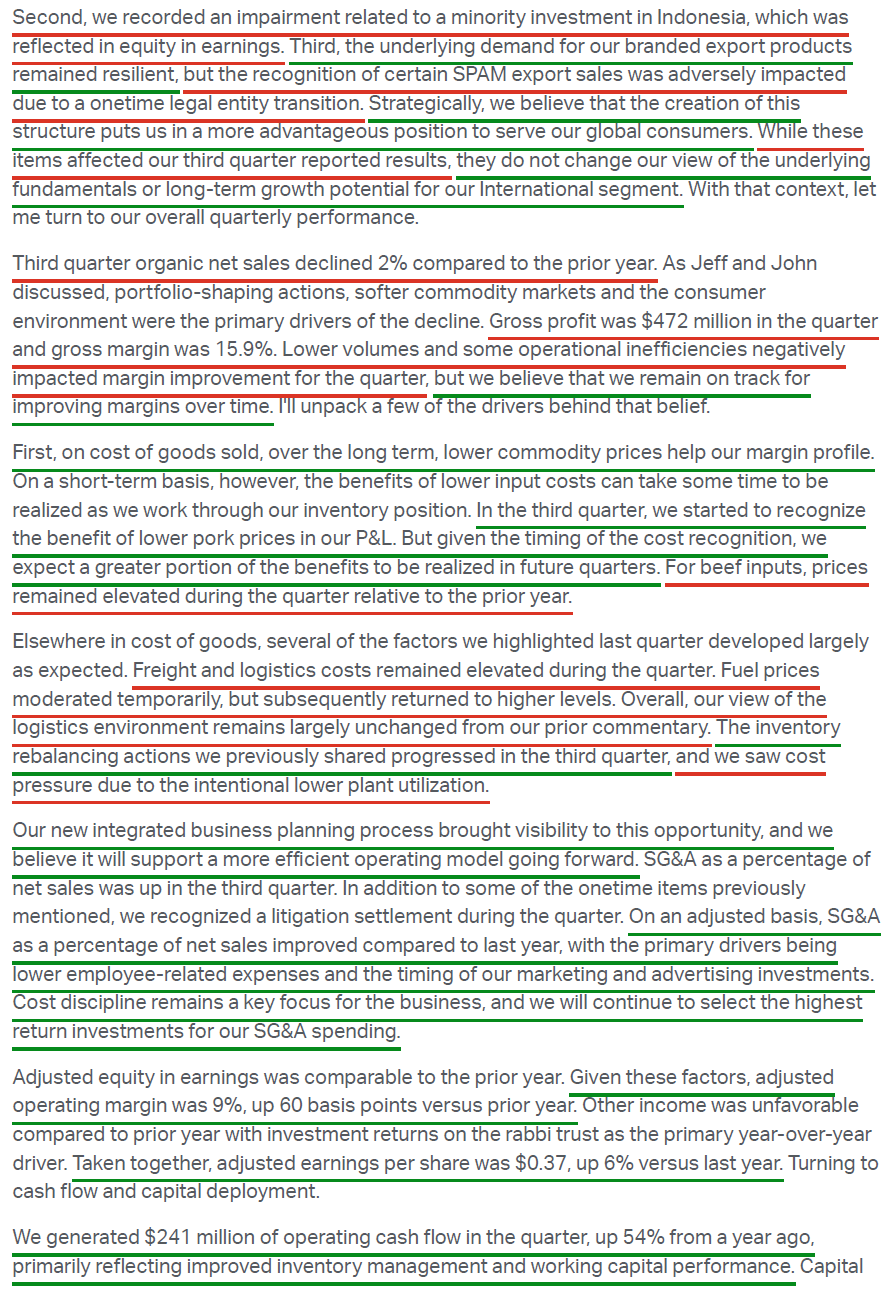
6) The International segment (6.0% of net sales, 6.7% of adjusted segment profit) posted net sales of $178.7M (-4.7% Y/Y), with organic net sales of -4.4%. Adjusted segment profit was essentially flat at $19.0M (+0.2% Y/Y), with margin expanding 52 bps to 10.6%. Branded export demand remained resilient, though a one-time legal-entity transition delayed recognition of certain SPAM export sales, accounting for the majority of the volume decline. Hormel also divested its Brazil operations, which closed early in Q4, to sharpen its focus on Asia Pacific, where the Group VP of International has relocated to Singapore.
7) Operating cash flow came in at $240.6M (+53.5% Y/Y), driven by improved inventory management and working capital. After $68.2M of capex versus $72.2M last year, free cash flow was ~$172.4M, more than double the ~$84.5M generated a year ago. Year-to-date, operating cash flow totals $768.8M (+47.2% Y/Y), with capex essentially flat at $219.3M, bringing year-to-date free cash flow to ~$549.4M (+81.4% Y/Y).
8) Cash on hand totaled $839.6M, up $169.0M since fiscal year-end, against total debt of ~$2.86B. Inventories stood at $1.8B, up $54.3M since fiscal year-end due to operating supplies and work-in-process, while finished goods were flat sequentially and down significantly Y/Y in both dollars and pounds. The majority of the inventory rebalancing was completed in Q3, with a modest remainder expected in Q4. Management noted that the balance sheet provides flexibility to continue investing in the business, with the company open to strategic partnerships and acquisitions following several quieter years on the M&A front.
9) Hormel returned $161.0M to shareholders through dividends during the quarter, marking its 392nd consecutive quarterly dividend payment and maintaining its Dividend Aristocrat status, supported by 60 consecutive years of dividend increases. The quarterly dividend of $0.2925 per share ($1.17 annualized) is up 0.9% from $0.29 a year ago. Year-to-date dividends paid total $481.4M versus $473.7M last year, covered ~1.1x by year-to-date free cash flow of ~$549.4M. The current annual dividend yield stands at ~5.9%, with management reiterating that the dividend remains a priority.
10) Management cut FY2026 net sales guidance to $12.1B-$12.2B from $12.2B-$12.5B, with the midpoint of $12.15B versus consensus of $12.24B. Organic growth guidance was narrowed to +1% to +2% from +1% to +4%. Adjusted operating income guidance was raised to $1.08B-$1.12B from $1.06B-$1.12B, representing +6% to +10% growth, while adjusted diluted EPS guidance was raised and narrowed to $1.45-$1.51 from $1.43-$1.51, also representing +6% to +10% growth. Segment profit growth is still expected from all three segments, with full-year advertising expected to be comparable to the prior year, implying stepped-up brand support in Q4, and capex of $260M-$290M.
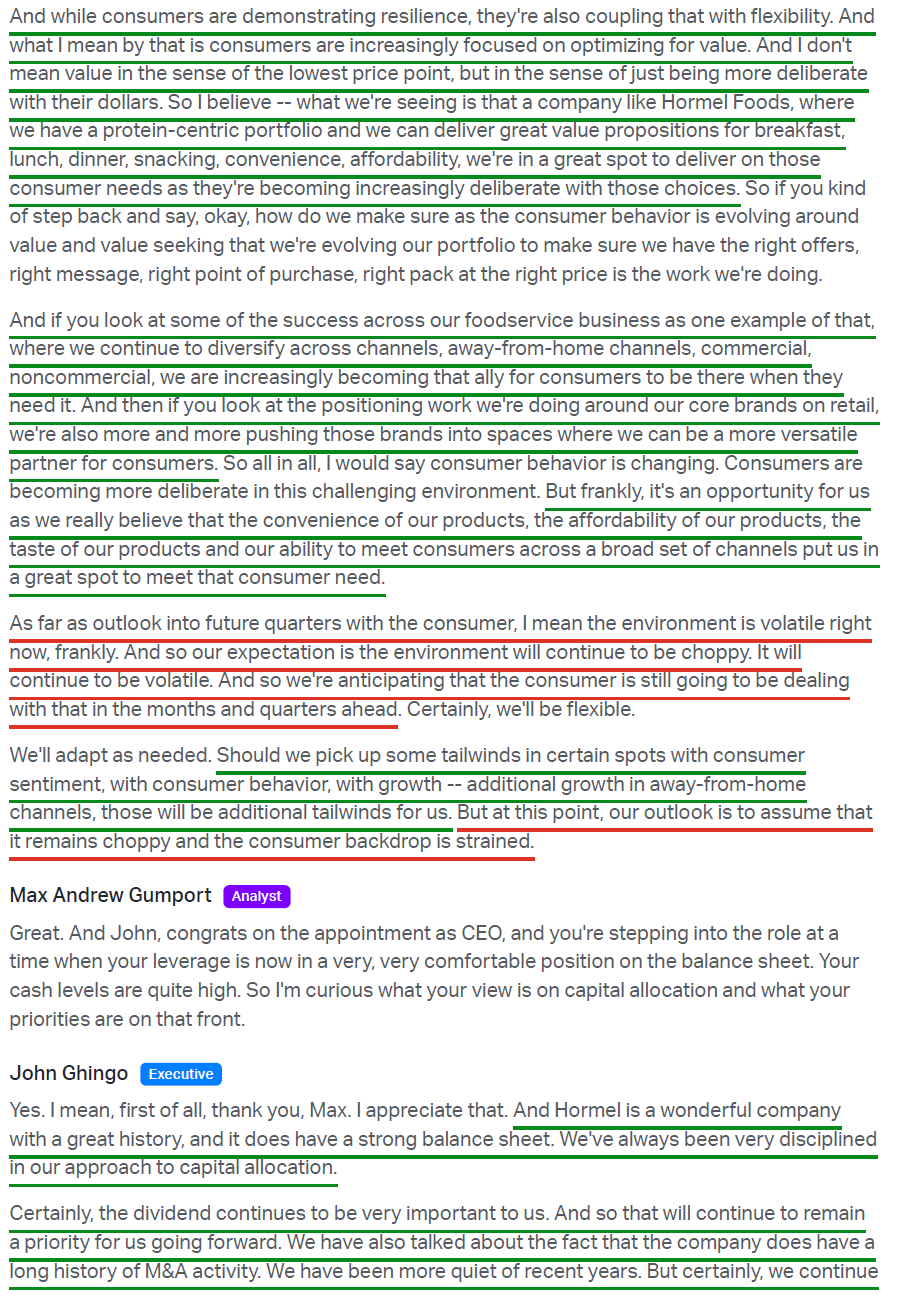
Earnings Call Highlights
Morningstar Analyst Note
Diageo (DEO) Update
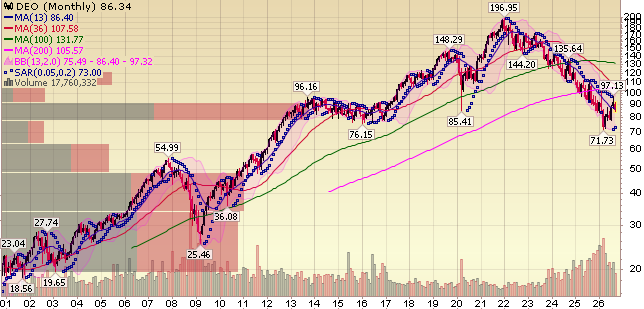
For newer readers, here’s a brief overview of the key drivers behind our thesis on Diageo, the world’s largest premium spirits company priced as if nobody will ever sip alcohol again as the market mistakes a cyclical hangover for permanent impairment:
Company Overview
Global leader in premium spirits and beer — the largest international spirits player by retail sales value at 1.8x the nearest competitor
Formed in 1997 through the merger of Grand Metropolitan and Guinness; headquartered in London, selling in nearly 180 countries
Portfolio of 200+ brands including 13 billion-dollar brands: Johnnie Walker, Guinness, Smirnoff, Don Julio, Crown Royal, Captain Morgan, Tanqueray, Baileys, and Casamigos
#1 global share position in scotch, tequila, vodka, gin, liqueur, and non-alcoholic spirits — Johnnie Walker 1.3x the #2 scotch, Don Julio 1.7x the #2 tequila
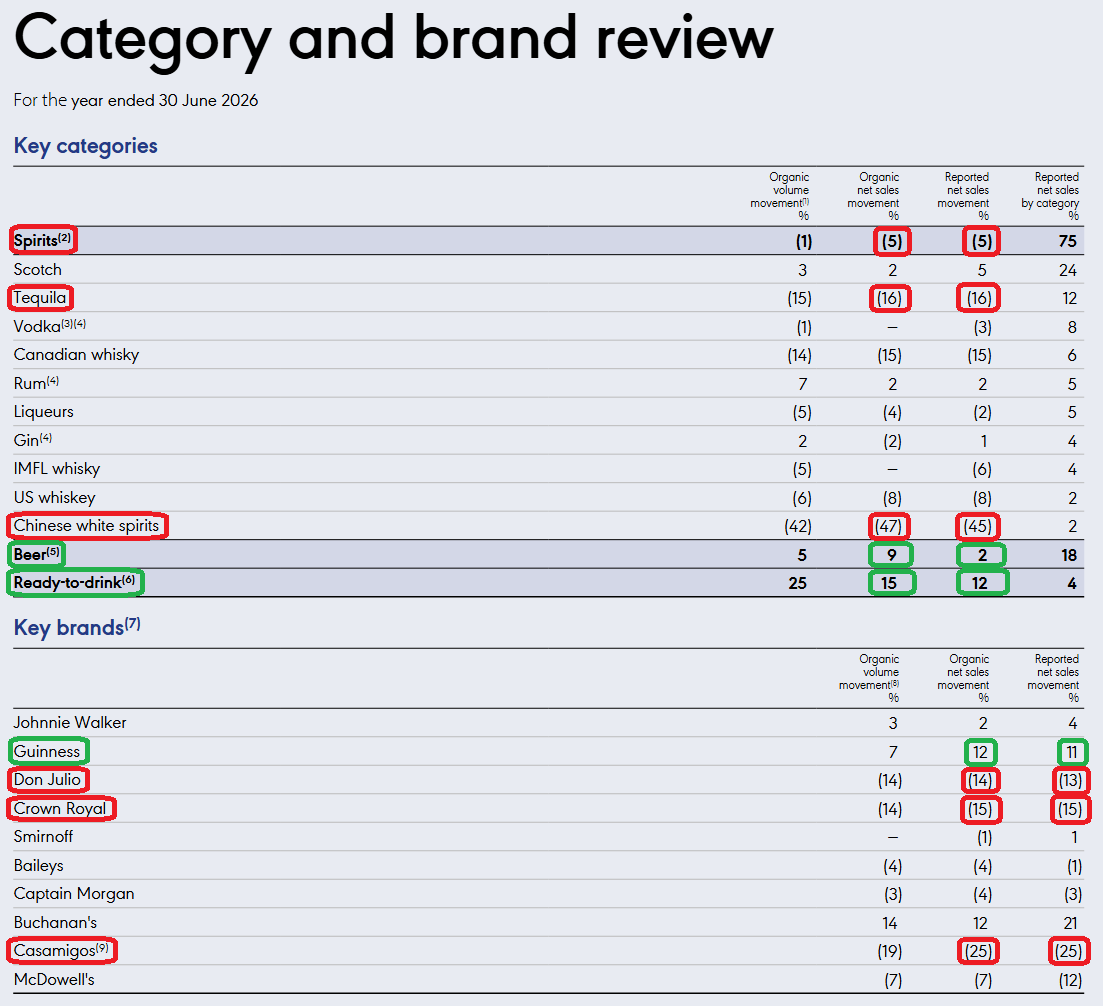
Mix: ~75% spirits, 18% beer, 4% RTD; 62% premium or higher; 61% developed markets, 39% emerging
Top categories: 24% Scotch, 12% tequila, 8% vodka, 6% canadian whiskey, 5% rum
Regional split FY2026: North America ~37% of net sales (largest market), Europe ~26%, Asia Pacific ~17%, Latin America/Caribbean ~11%, Africa ~8%
~$19.6B in reported net sales FY2026 (~$20.2B FY2025)
Shares down ~56% from 2022 highs and trading at 15-year lows at ~12.8x forward earnings (GFC-level cheap)
Cyclical downturn in the context of a long-term secular premiumization uptrend — buying straw hats in the winter
Management
New CEO Dave Lewis (effective January 1, 2026) — proven turnaround specialist and consumer goods veteran with 27 years at Unilever (UL), known as “Drastic Dave” for his rigorous cost discipline
Former Tesco Group CEO (2014–2020): took over with the UK chain in crisis and transformed it post-accounting scandal by cutting prices, slashing the workforce, selling non-core international businesses, and removing management layers — leaving Tesco with structurally higher margins than several UK grocery peers
Named WPP finance chief Joanne Wilson as CFO, replacing Nik Jhangiani just over two years after he took up the role. Wilson joins the Board and Executive Committee some time in 2027, with Jhangiani remaining in the role during the transition to ensure a smooth handover
Worked with CEO Dave Lewis at Tesco, with prior roles at Britvic, dunnhumby and KPMG
Latest move in Lewis’s top-team overhaul following the August capital markets day
Named John O’Keeffe (one of Diageo’s most experienced spirits executives) as North America President and CEO, replacing Sally Grimes who departed with immediate effect. Previously Diageo’s President of Asia Pacific and Global Travel Retail.
Catalyst for a full operational reset and a safe pair of hands to lead the turnaround
Cost Savings Program
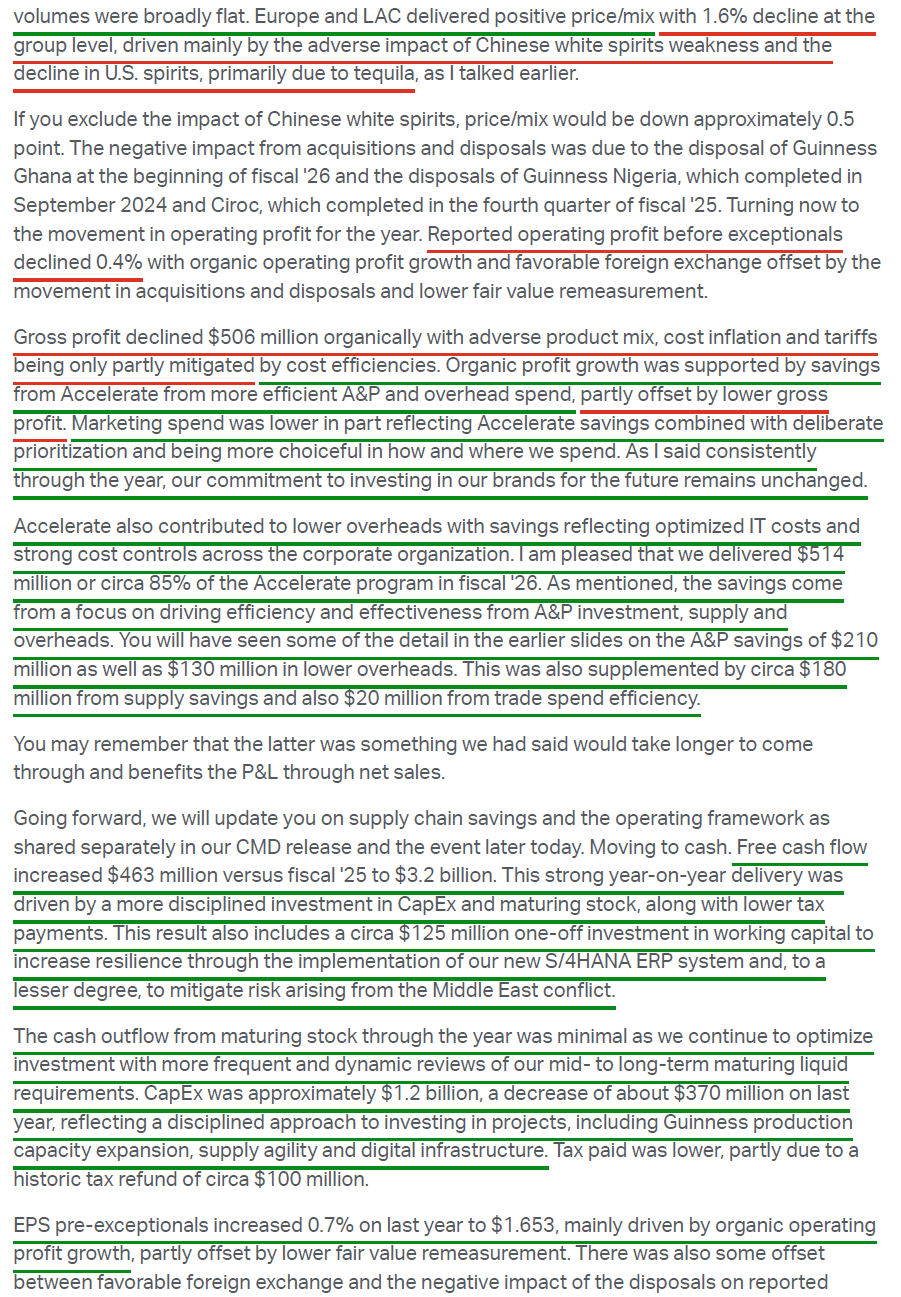
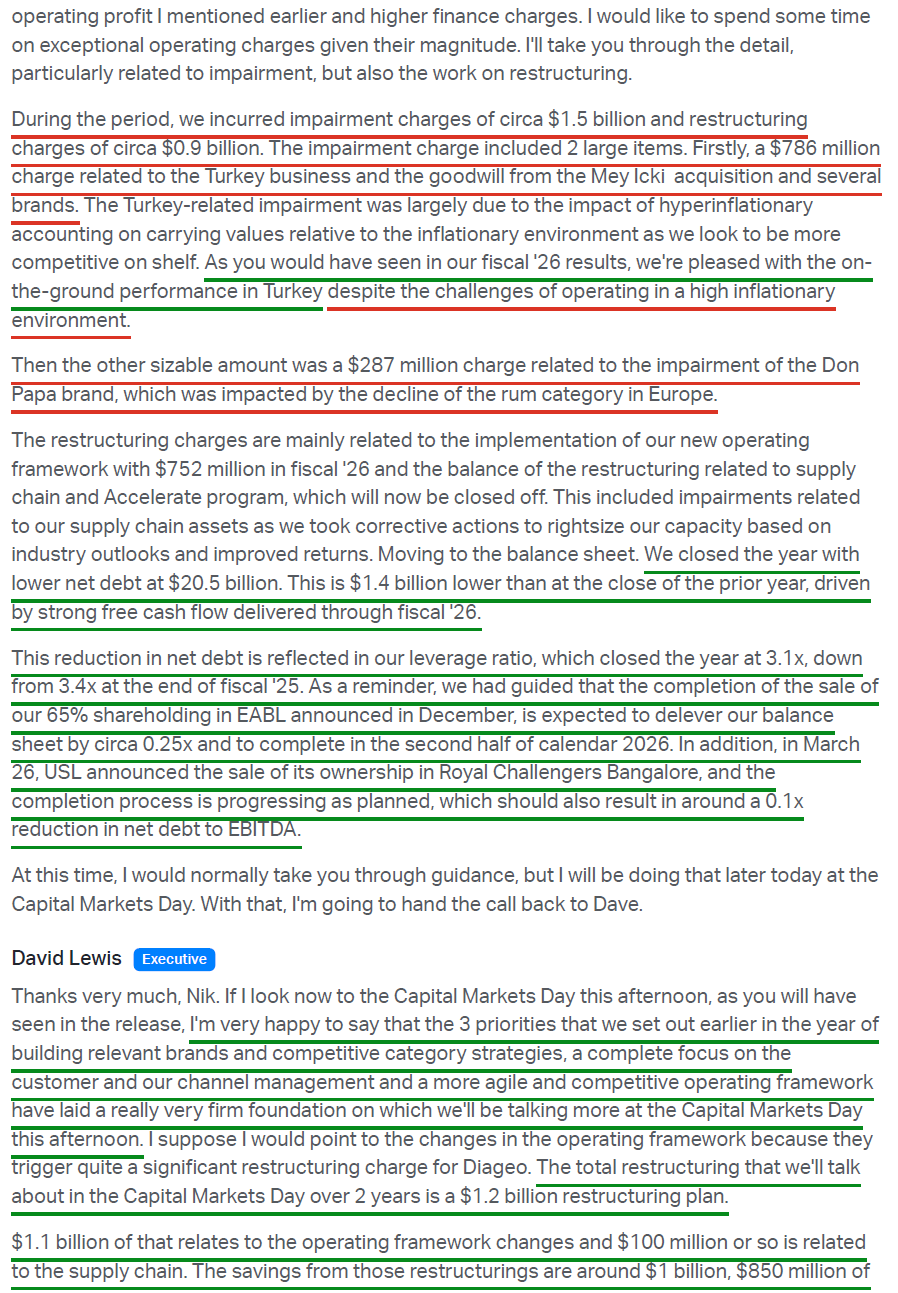
Accelerate program (launched 2025): three-year productivity initiative with a savings target raised to ~$625M, up from the original $500M. Over-delivered its guide with ~$540M of savings secured in FY26 (~85% of the program), split ~$230M A&P/trade, ~$180M supply chain, ~$130M overheads.
~50% of savings reinvested in brands, marketing, and growth; the remaining ~50% drops to the bottom line, driving positive operating leverage
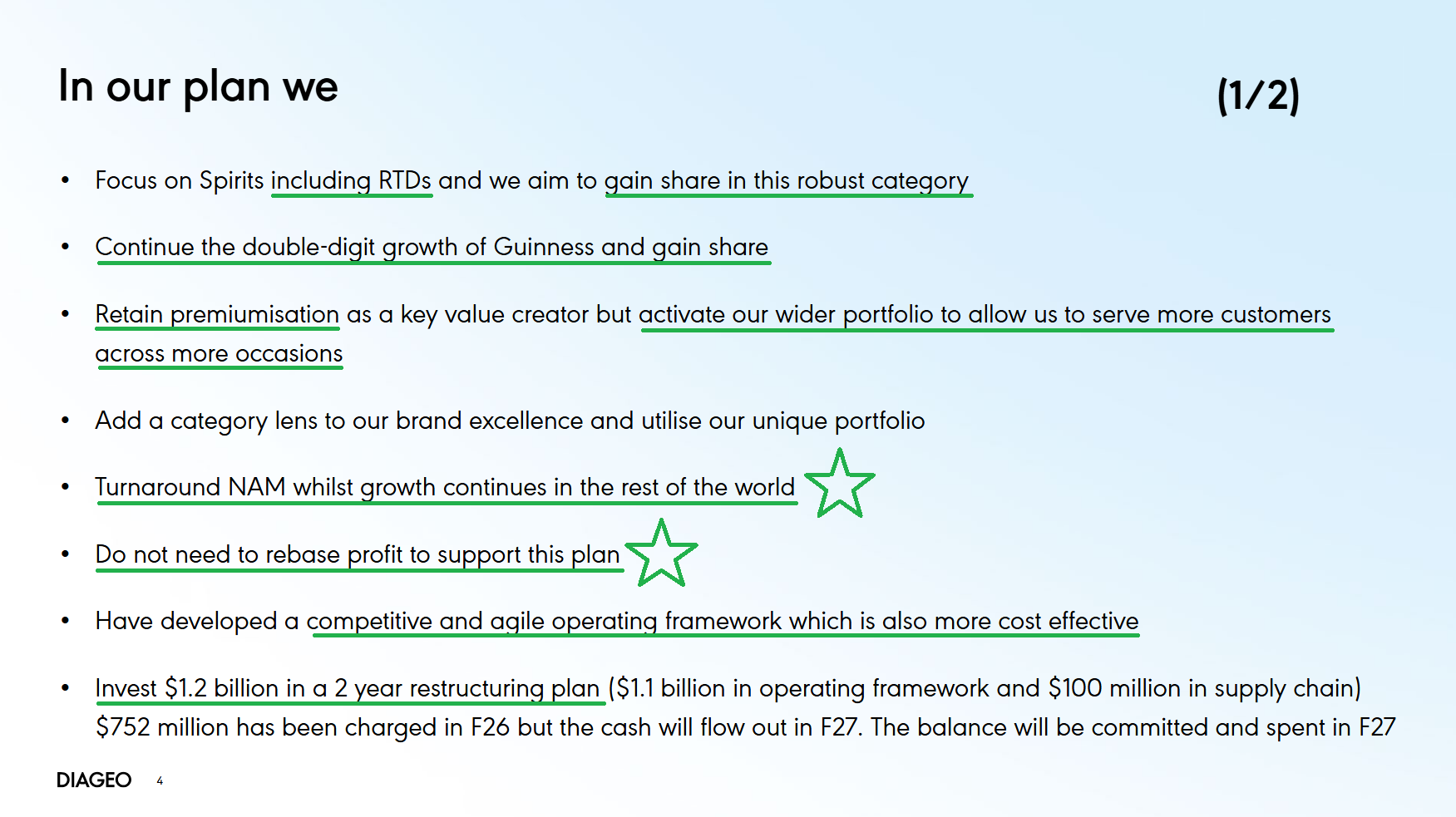
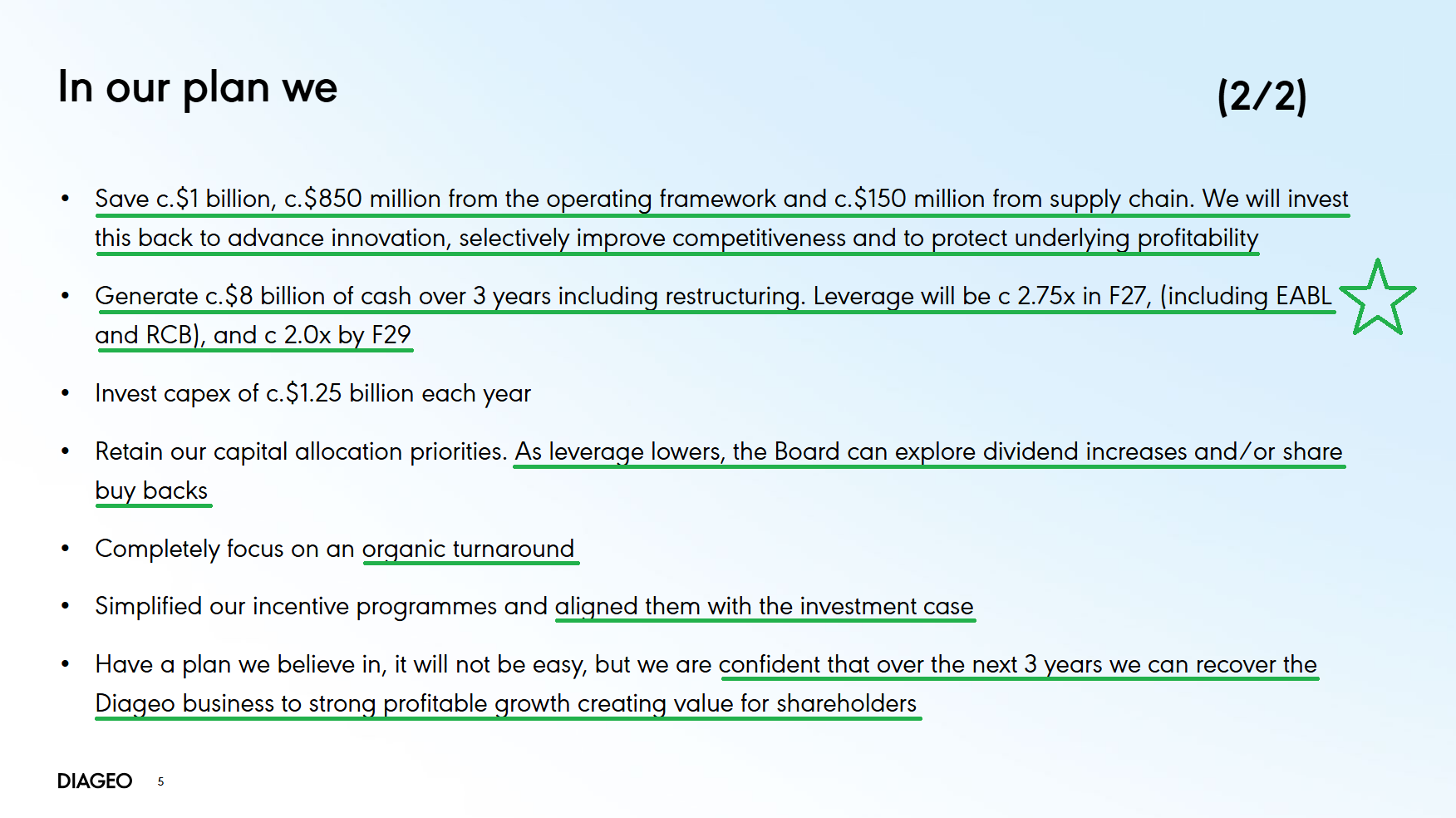
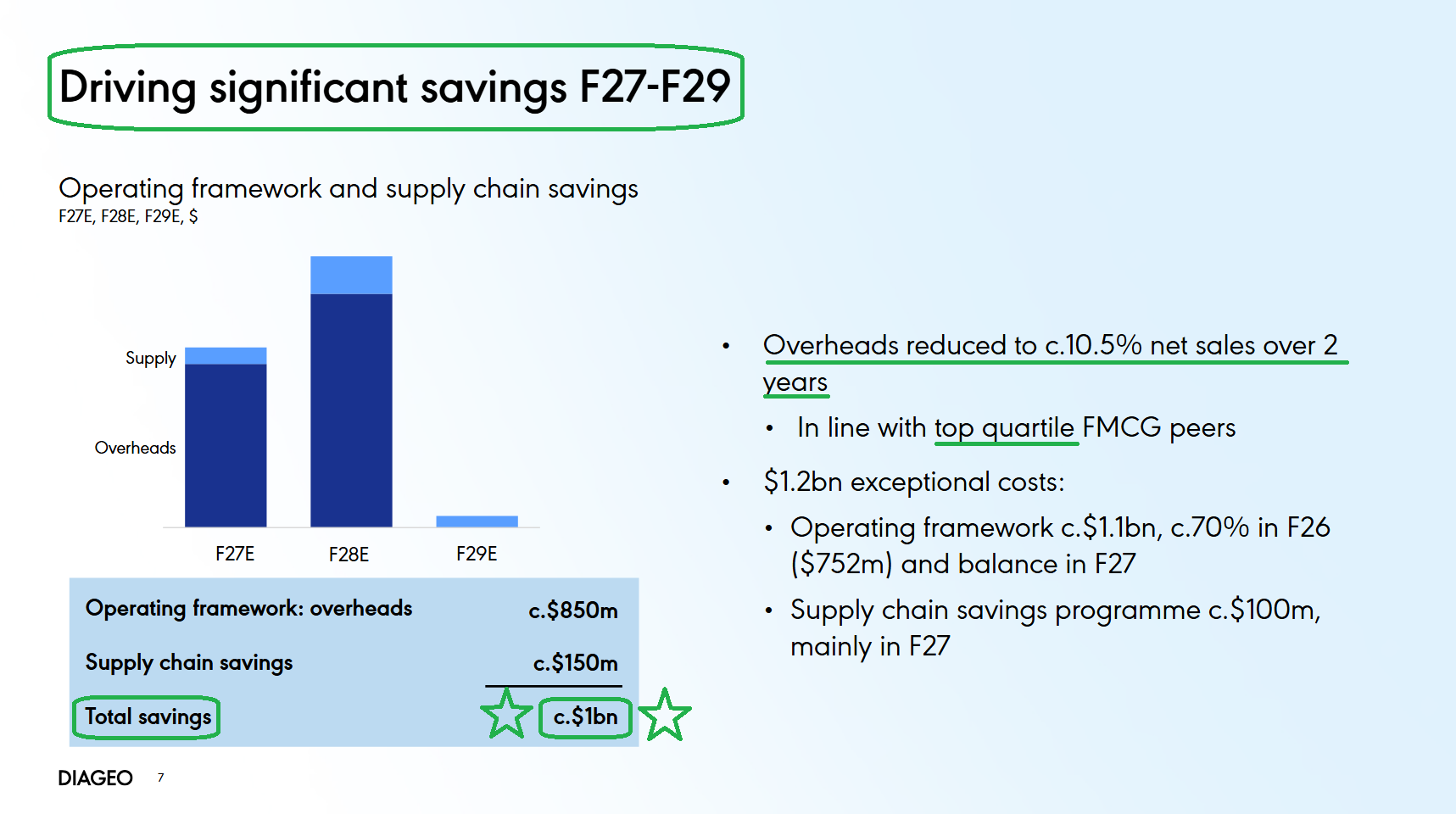
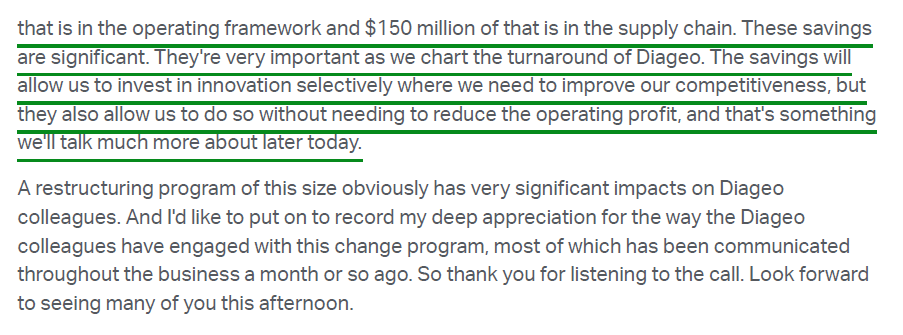
New two-year ~$1.2B restructuring announced at CMD (~$1.1B operating framework, ~$0.1B supply chain) targeting ~$1B of annual savings (~$850M framework, ~$150M supply chain), with ~40% of savings landing in FY27 and a further ~55% in FY28; ~70% of the restructuring cost already incurred
~$514M of severance costs implies roughly 3,000–5,000 job cuts from a ~30,000-person workforce
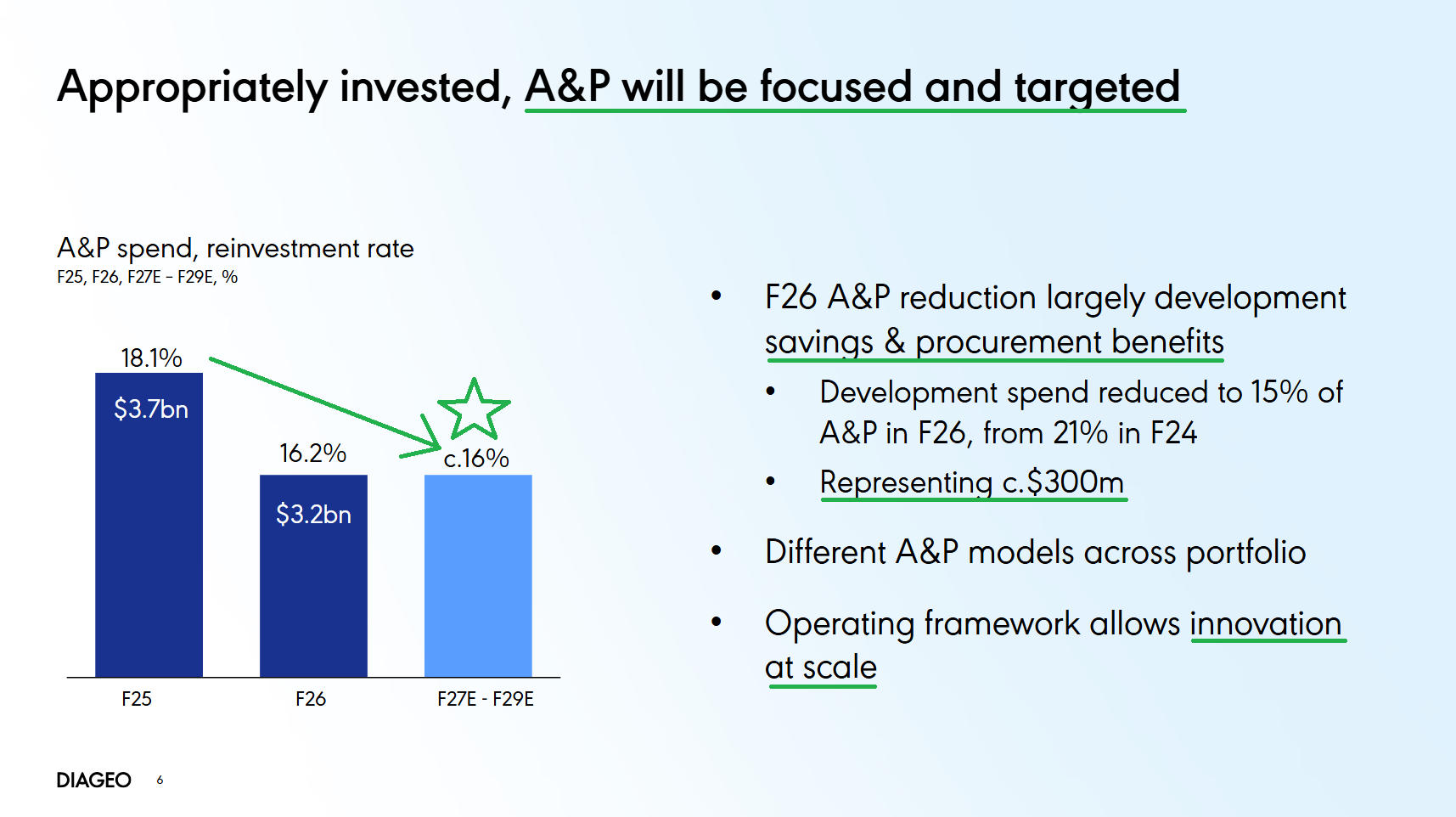
Overheads targeted down to ~10.5% of net sales over two years (from ~14%); A&P spend to ~16% of sales (from 18.1% in FY25), the level management views as optimal brand support
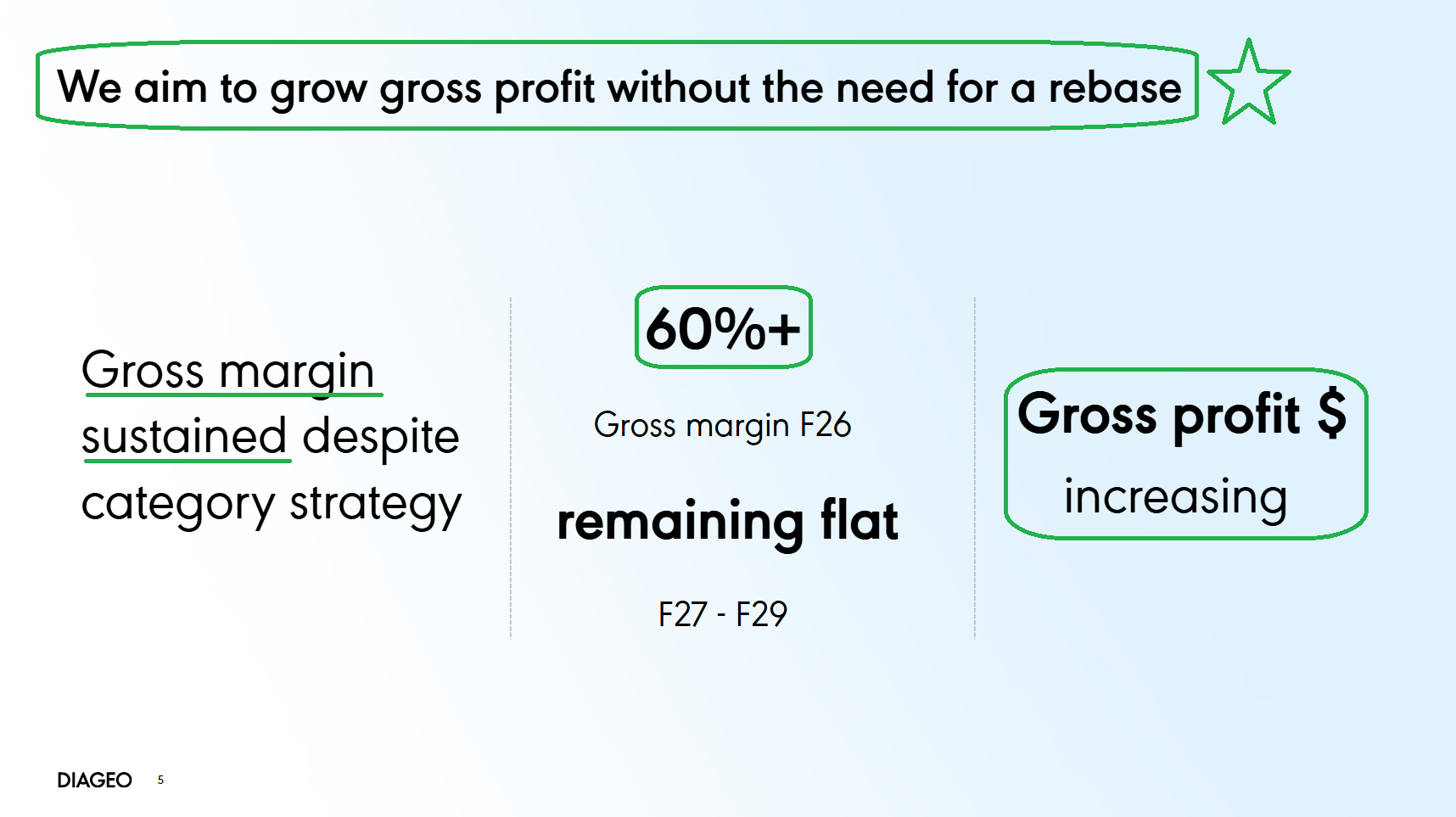
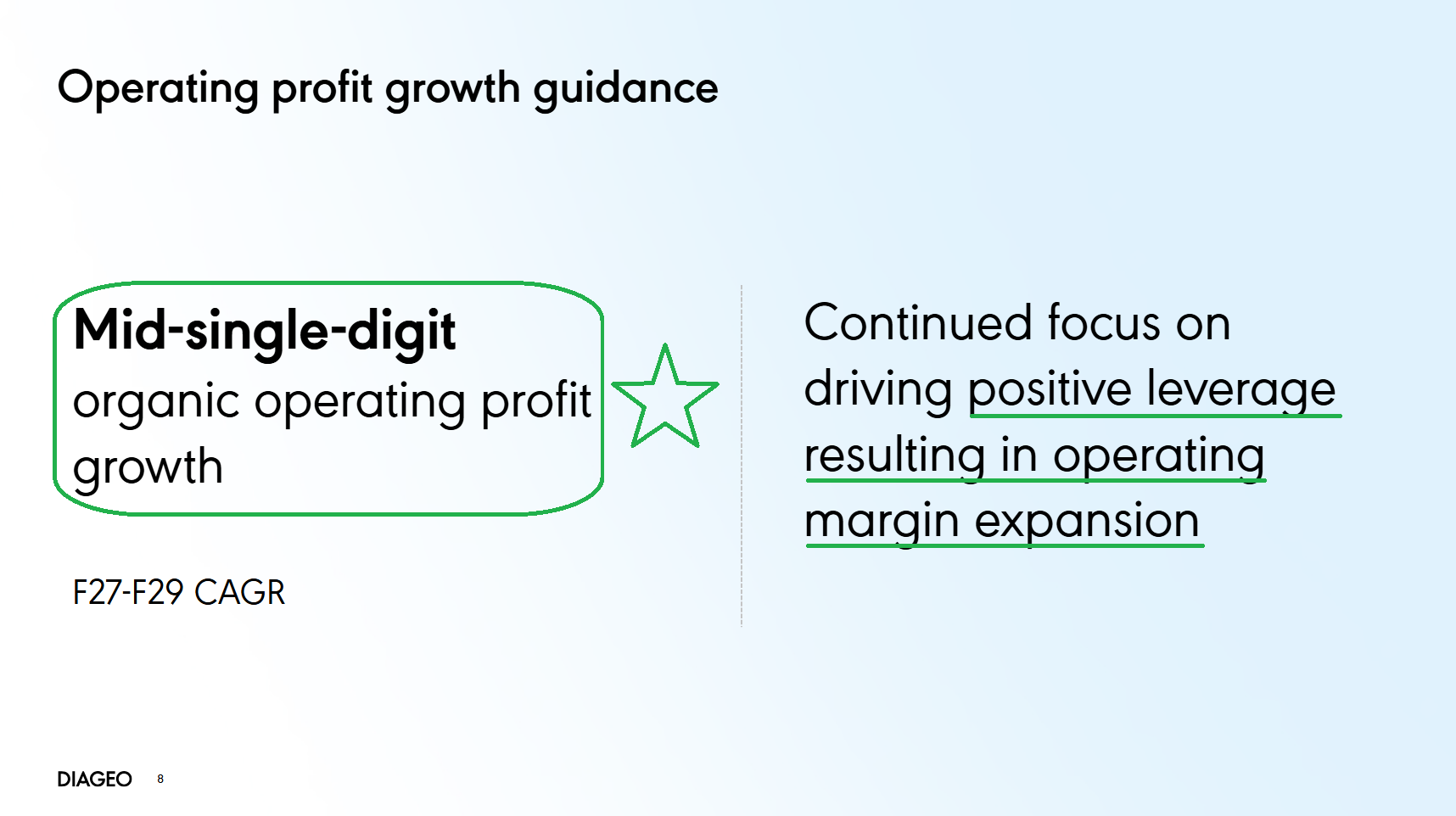
Explicitly no profit rebase — the outcome most feared. Savings fund the turnaround without resetting operating profit; gross margin held above 60% through FY29 with gross profit dollars growing, operating margin expanding, and mid-single-digit organic operating profit growth
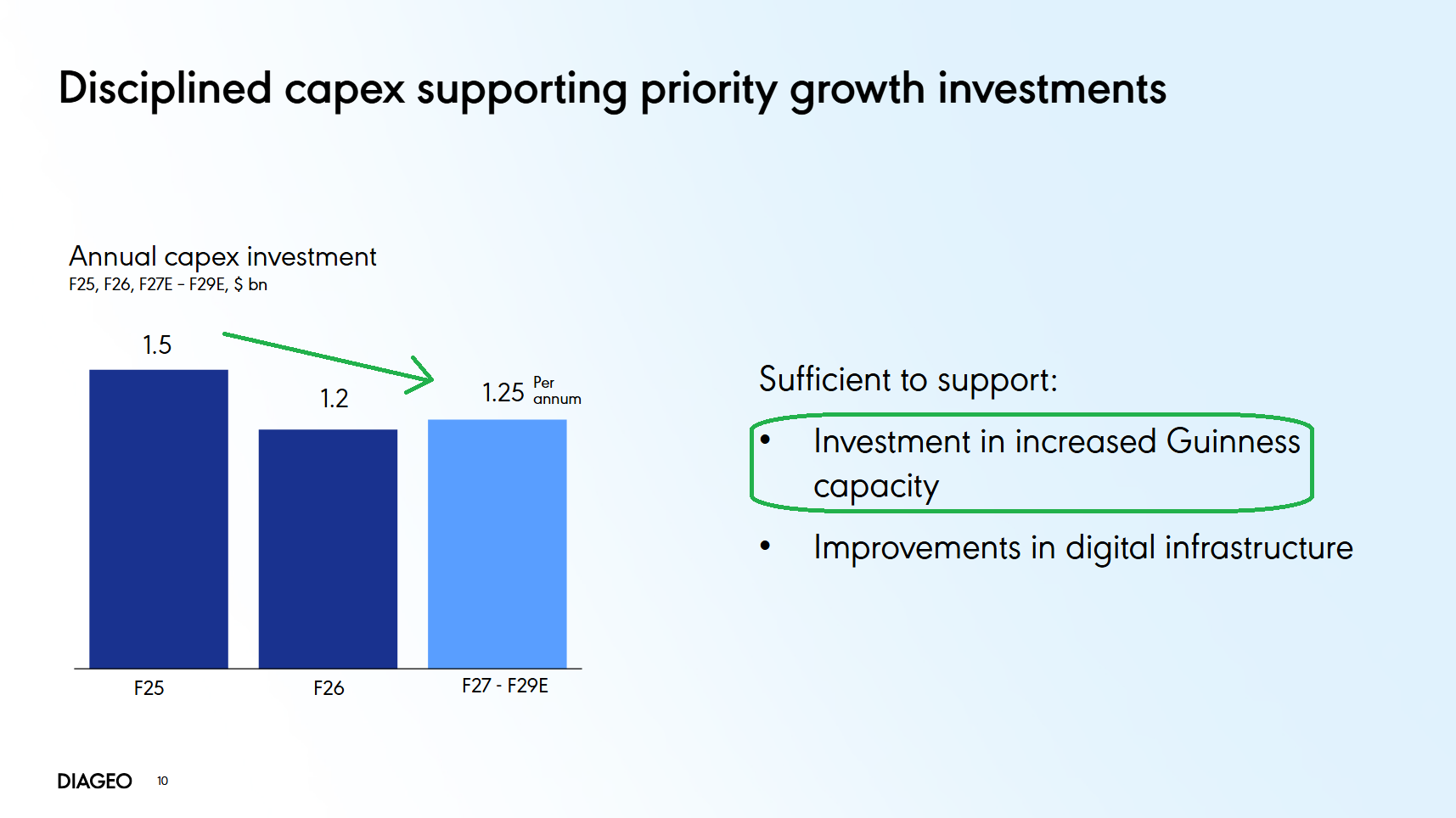
Capex declined from ~$1.5B in FY2025 to ~$1.2B in FY2026 (mid-single-digit % of sales), held at ~$1.25B annually through FY29, with spend focused on Guinness capacity expansion
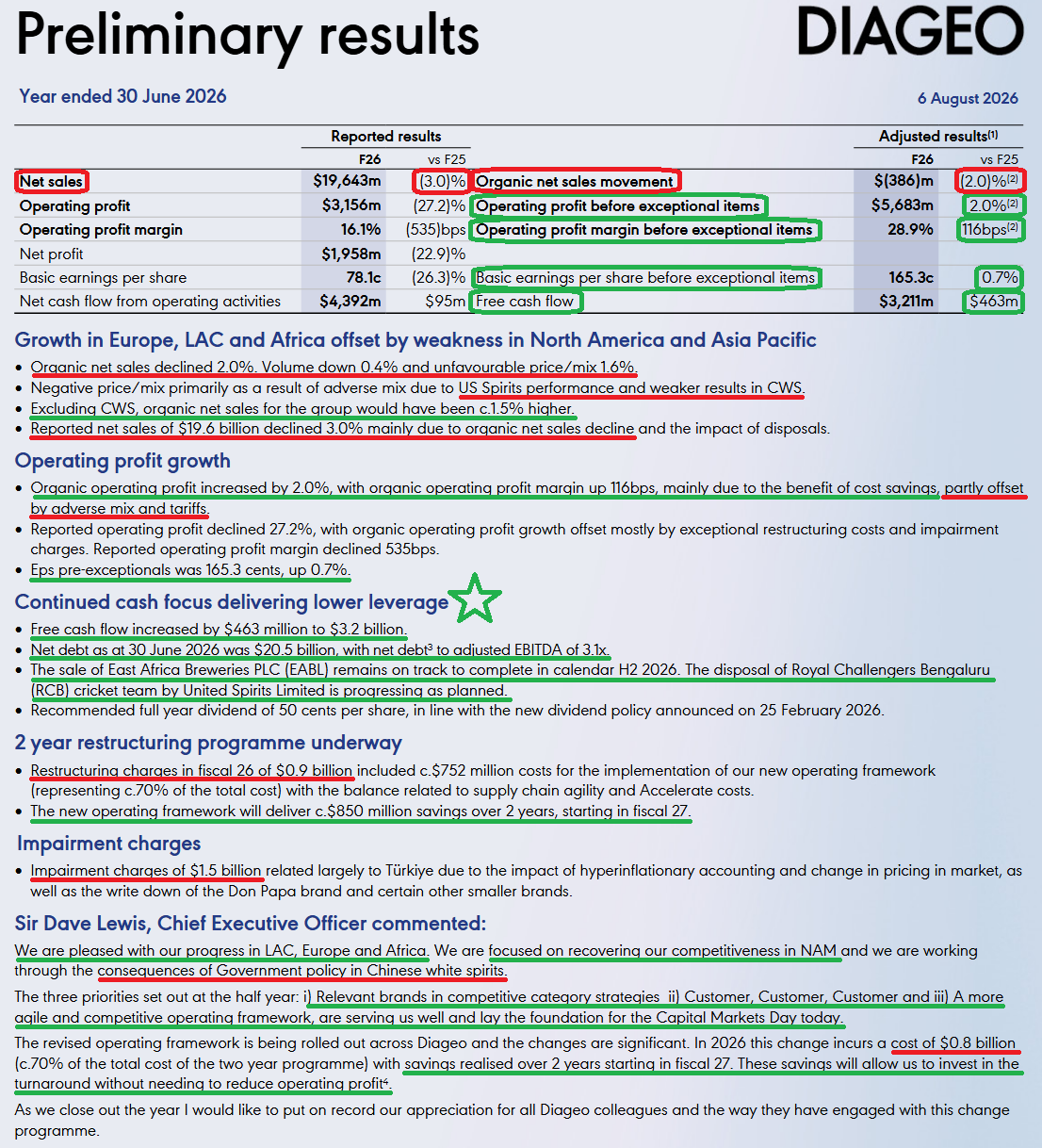
Industry-leading EBIT margins at ~28.9% in FY2026, up ~116bps organically, recovering off the FY25 low of ~28.3% (lowest since FY2015)
Low-hanging fruit: Lewis highlighted that Diageo is paying 10x more to run payroll for ~30,000 employees than Tesco did despite having 15x the headcount, and that ~65% of customer orders are still being entered manually
Deleveraging Through Asset Sales
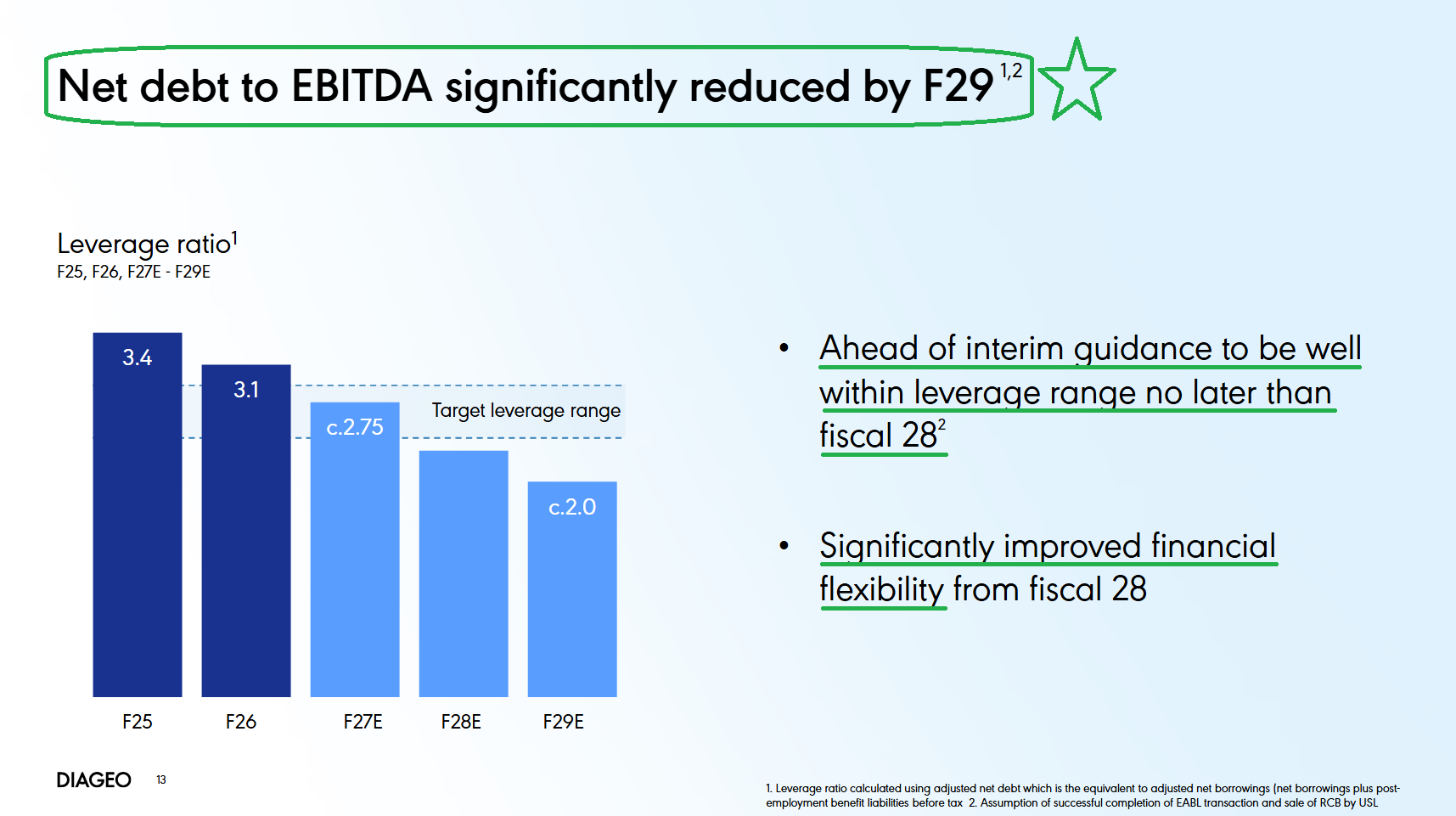
Net debt of ~$20.5B with leverage at 3.1x adjusted EBITDA, down ~0.3x Y/Y
Recent asset sales: ~$2.3B from Kenyan drinks businesses sold to Asahi (ASBRY); $1.8B sale of the Royal Challengers Bengaluru cricket stake (announced March 2026, progressing as planned, ~0.1x de-lever); disposal of remaining EABL shareholding (~0.25x de-lever) expected to complete in calendar H2 2026
Management has been explicit: no fire sales and nothing sold below fair value
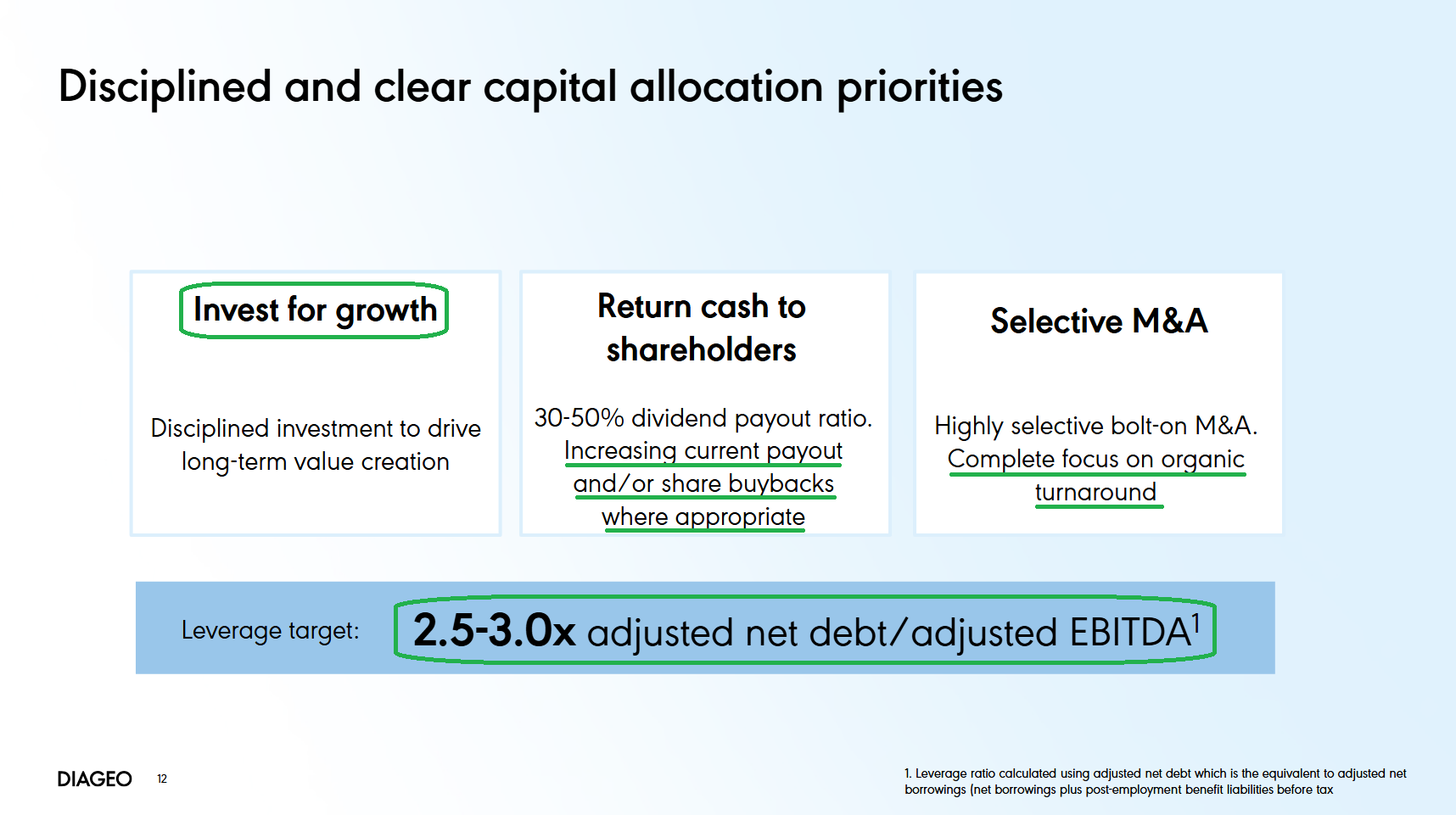
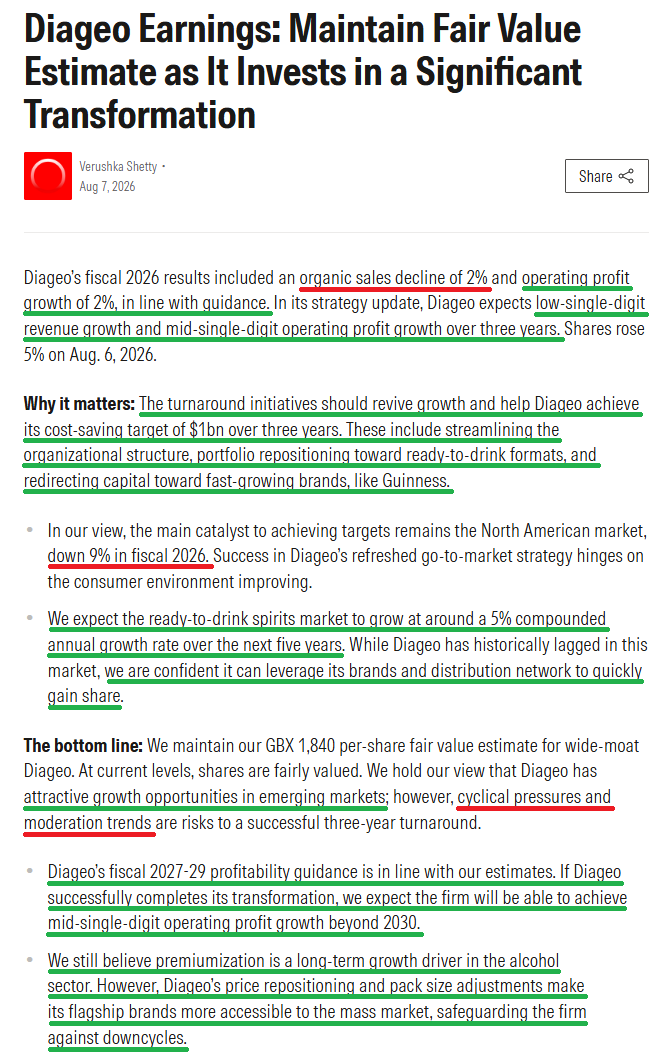
Target: leverage back to the 2.5–3.0x range, tracking to ~2.75x in FY27 (including EABL and RCB) and ~2.0x by FY29, improving flexibility for dividends, buybacks, and growth investment
Not buyers or sellers of scale — Lewis framed this as an organic turnaround with the assets already in hand
Return to Growth
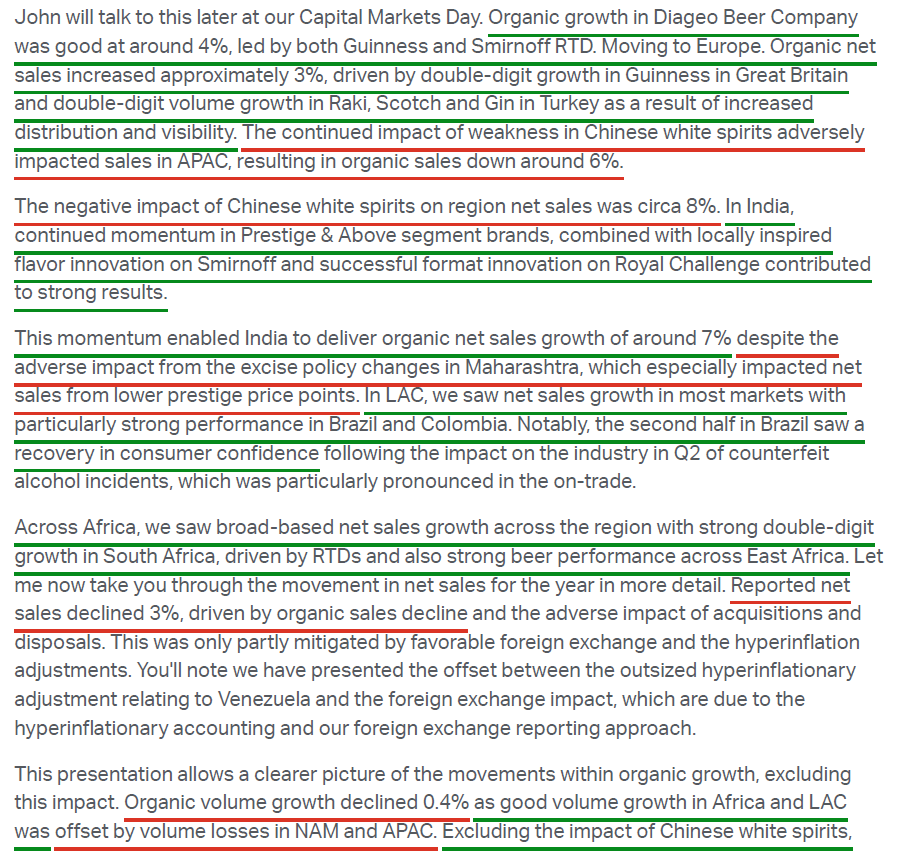
FY26 reported net sales $19.6B (-3.0% Y/Y). Organic -2.0% (volume -0.4%, price/mix -1.6%), ex-CWS ~-0.5%. Q4 organic -2.2%, a step down from Q3’s +0.3%. Growth in three of five regions.
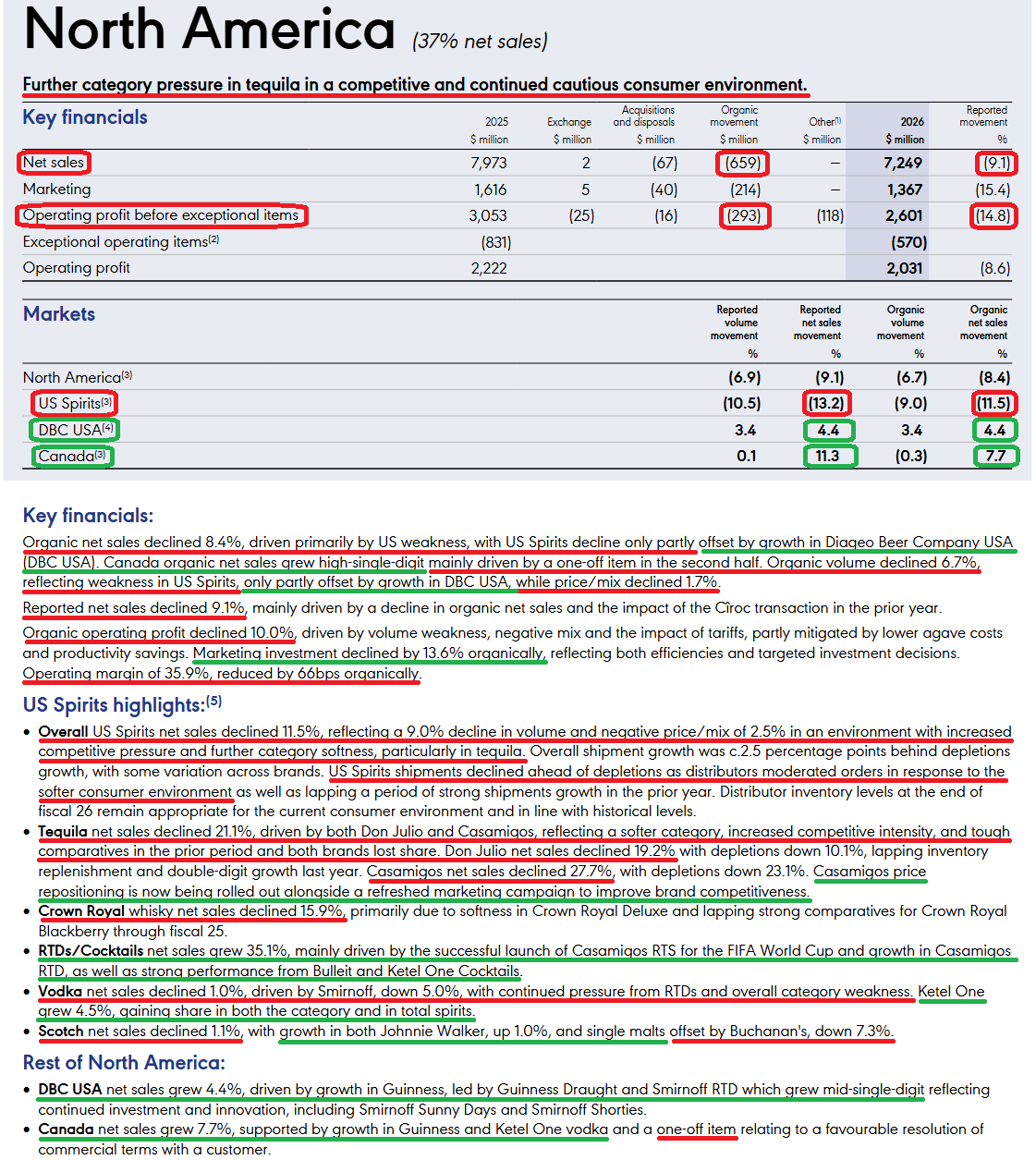
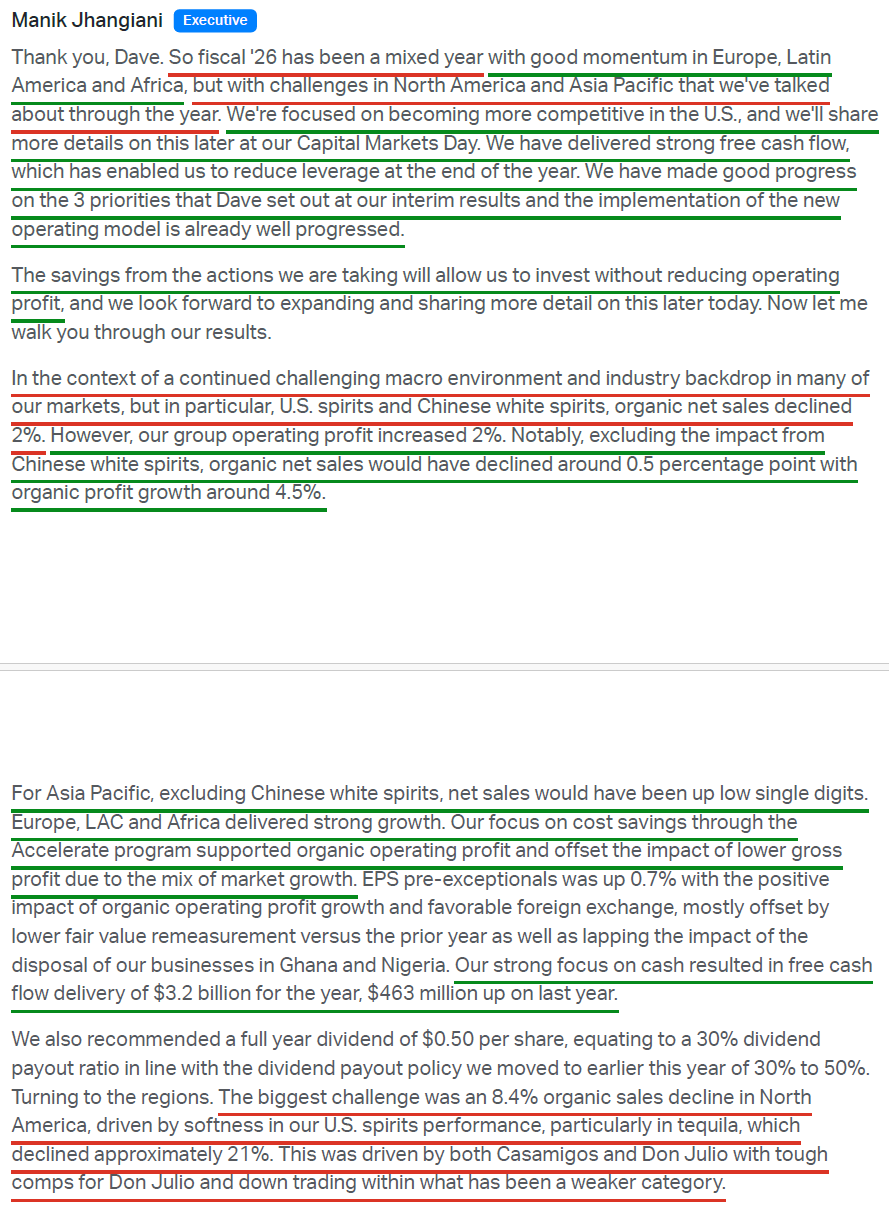
FY26 by region: North America -8.4% with US Spirits -11.5% and tequila -21.1%, RTDs/cocktails +35.1% (Casamigos RTS World Cup launch). Europe +3.4% on double-digit Guinness in GB. APAC -6.3% (~+1.5% ex-CWS). LAC +7.7%. Africa +13.3%.
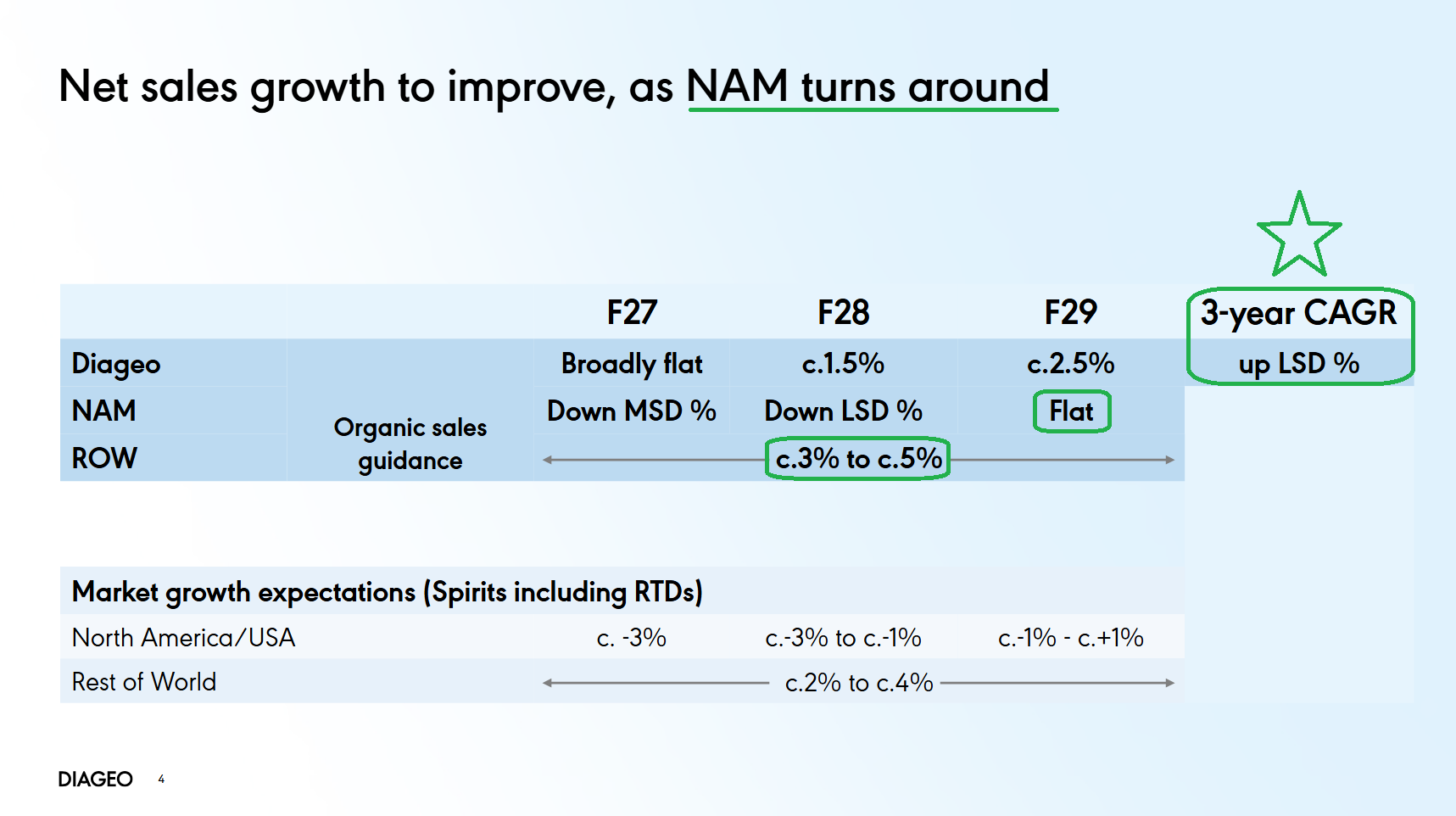
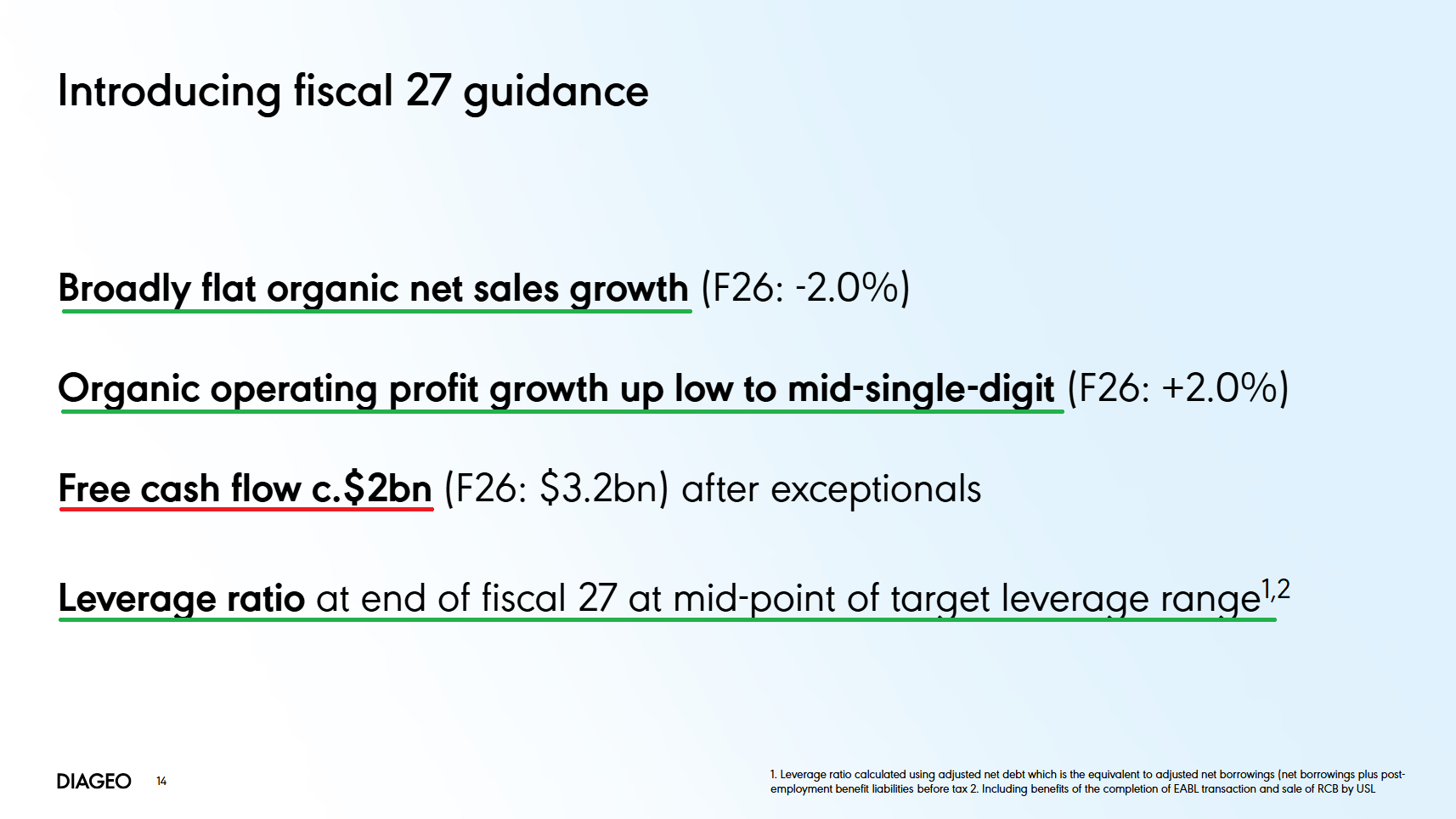
FY2027 guided to broadly flat organic net sales.
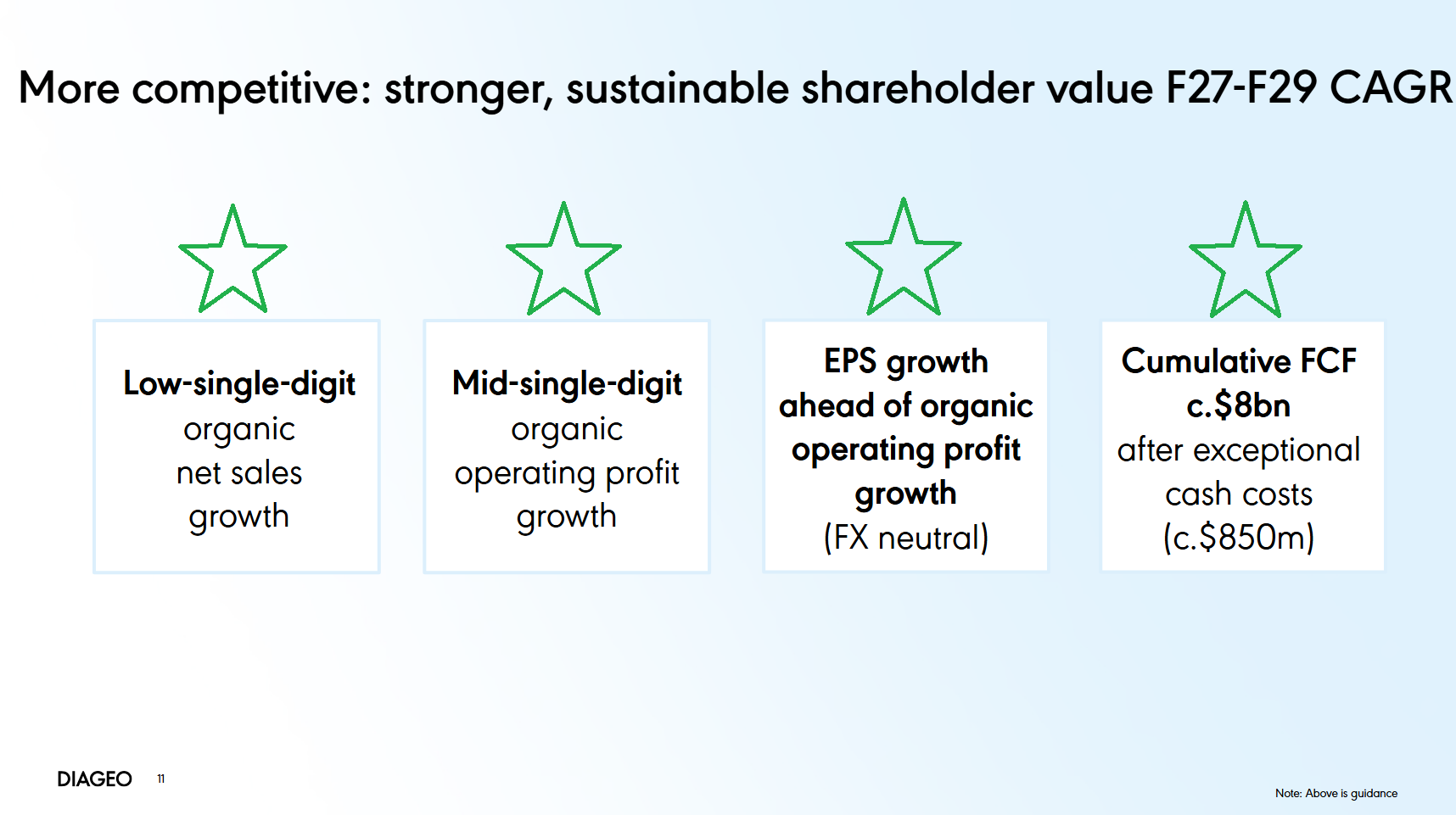
Medium-term framework: low-single-digit organic net sales CAGR through FY29, exiting FY29 at ~2.5–3% top-line growth even with North America only back to flat. Rest of world growing ~3–5%; North America improving from a mid-single-digit decline in FY27 to flat by FY29 against a global market growing 1–3% in value.
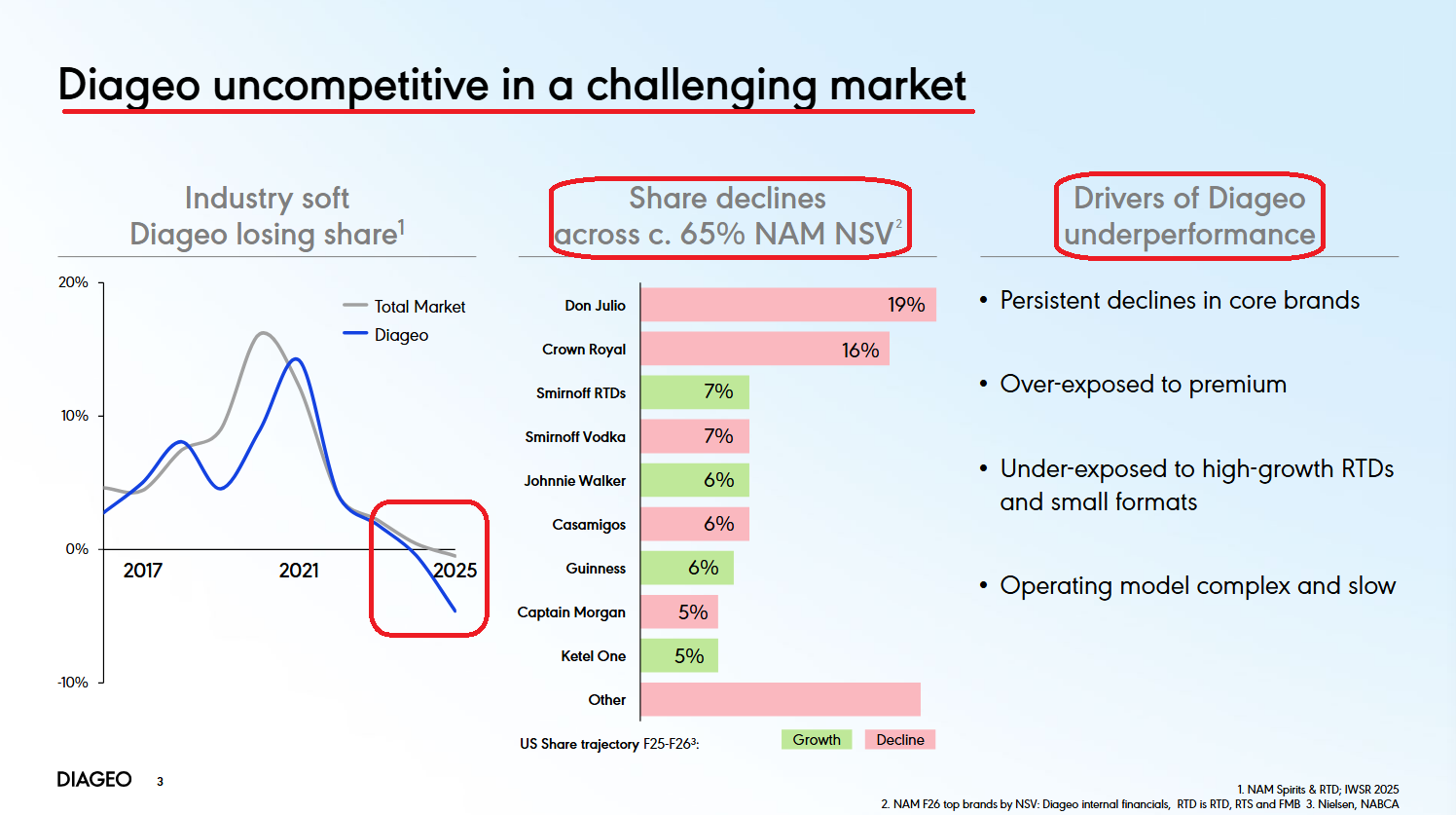
North America underperformance is largely self-inflicted and fixable: over-exposed to premium, under-exposed to high-growth RTDs and small formats, and an operating model that is complex and slow. Share declines across ~65% of NAM net sales value.
Three core brands in long-term decline being fixed — Crown Royal (#2 US brand), Smirnoff (losing share for eight years, packaging missteps now being undone), and Captain Morgan (leaning into “+ Cola” and RTD serves). Fixes centered on packaging, smaller formats, and quality.
Selective price repositioning on Casamigos already underway, with early results described as positive — same playbook Lewis ran at Tesco to claw back share
Scaling small formats: expanded Smirnoff capacity to accelerate distribution; targeted 50ml innovation for Don Julio
Non-alc segment +40% Y/Y, leading the market at 4x the nearest competitor; global tequila portfolio +18% in FY25 with #1 share position
Significantly underrepresented in the mass market — Lewis exploring price repositioning, new proposition spaces, and RTDs to broaden the portfolio beyond the prior premiumization-only focus
Official Spirits Supporter of the FIFA World Cup 2026 in the Americas — the first time spirits producers have ever sponsored the tournament (largest World Cup in history)
The Casamigos activation turned a three-year share decline into share gains of total spirits over the following weeks.
Guinness and RTDs — the Two Strategic Battlegrounds
Guinness: +12% organic net sales in FY26, a 13% NSV CAGR over five years against ~5% for premium beer, in a $135B market where premium is the fastest-growing segment. 14 consecutive quarters of share growth in North America.
Economics justify the capital: 60%+ gross margin and ~30% ROIC, roughly twice the group
Investing just under $1B of capex over FY26–FY30 to lift capacity more than 50% by FY29, with potential for more; ambition is a top-10 US premium beer position and ~150,000 new on- and off-trade accounts by FY30
RTDs: #2 player globally with ~8% market share, global RTD net sales +10% in FY26 and +15% organic, in a $47B category forecast to grow 4–6% over three years
Underinvested since Smirnoff Ice dominated the early 2000s while the category grew from ~5% to ~15% of the market; RTDs are only ~14% of North American volume, leaving significant runway
Lewis plans canned cocktails across every core spirits brand. Smirnoff Ice is nearly a $0.5B US brand growing 6% with +13bps share; Ketel One Cocktail Collection +58%; Casamigos Margarita new with +14bps share. #1 RTD player in LAC.
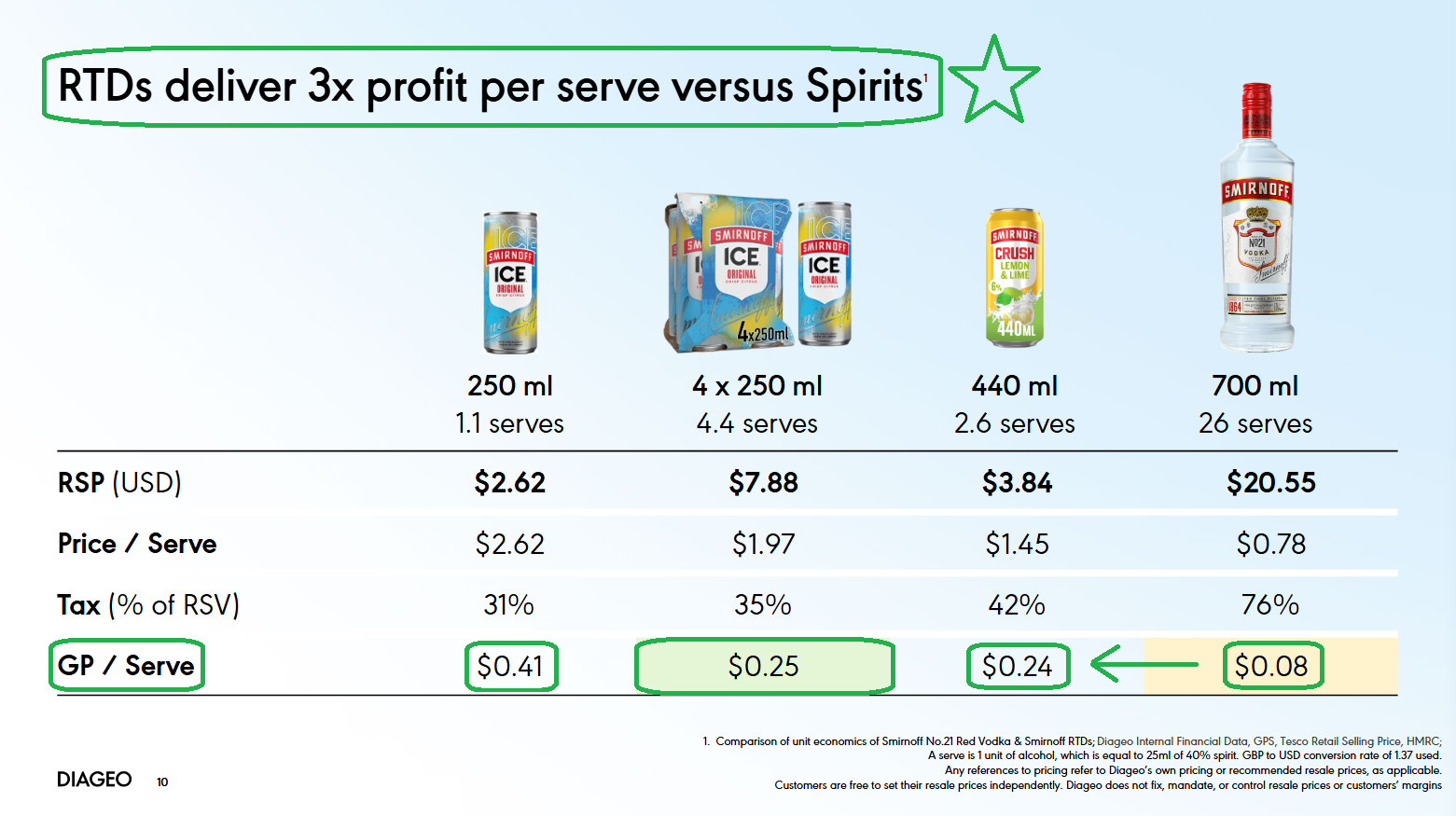
RTDs deliver ~3x the profit per serve of spirits and recruit new drinkers — Casamigos RTD buyers are 5x more likely to buy the tequila
Drinking Less but Better
Consumers are drinking less overall but steadily shifting toward premium and higher-quality brands
Current headwinds are cyclical, not structural — spirits remain an affordable luxury category and the premiumization trend is intact
The category is working through three distinct cycles: a long premiumization supercycle, a Covid acceleration and pull-forward, and an affordability-driven consumer reset. North America grew 20% organic in FY21 and 14% in FY22 against a typical low-single-digit range — distorting today’s picture rather than signaling a permanent retreat from alcohol.
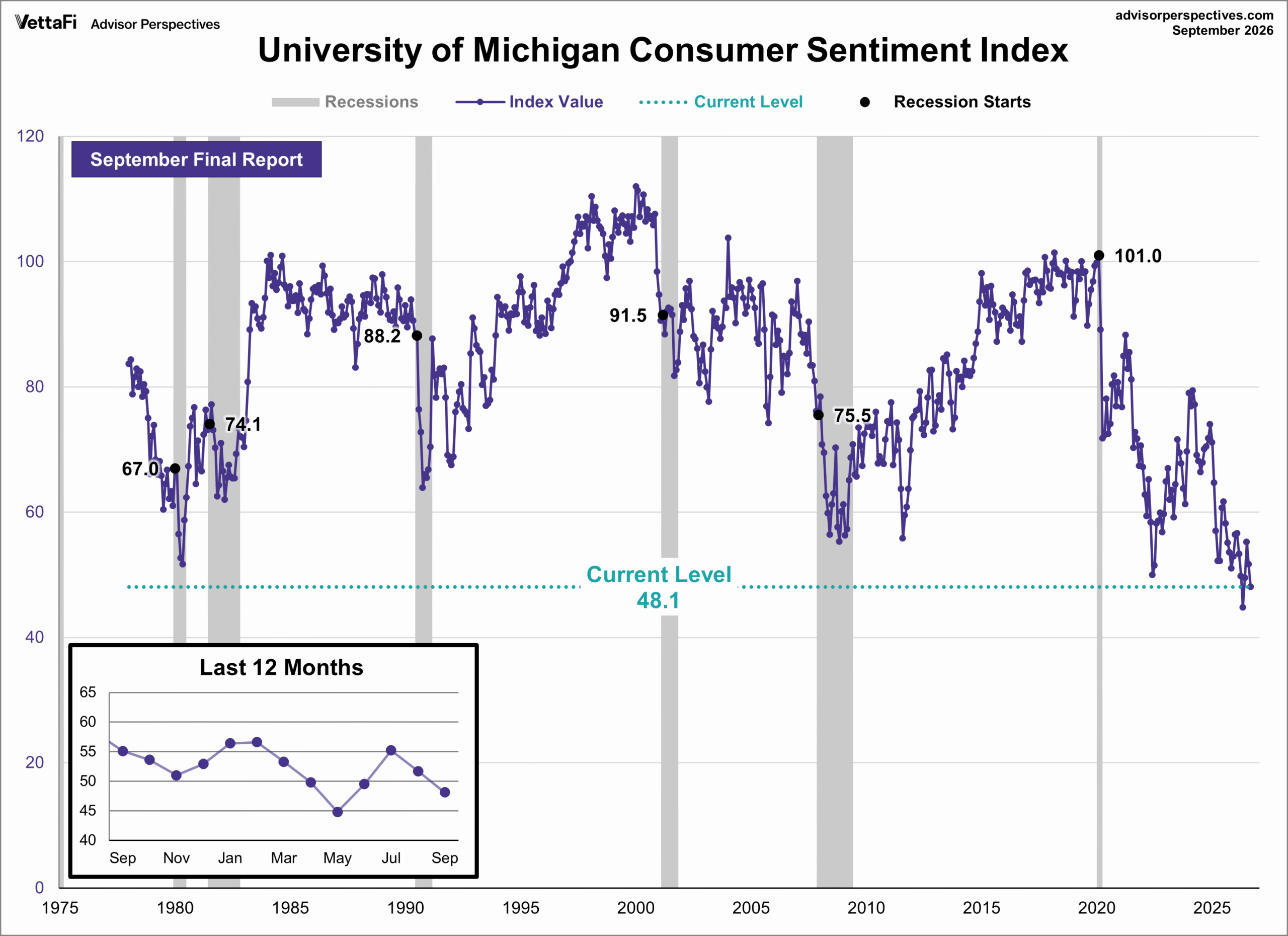
US spirits volume is highly correlated with consumer sentiment, which sits near record lows
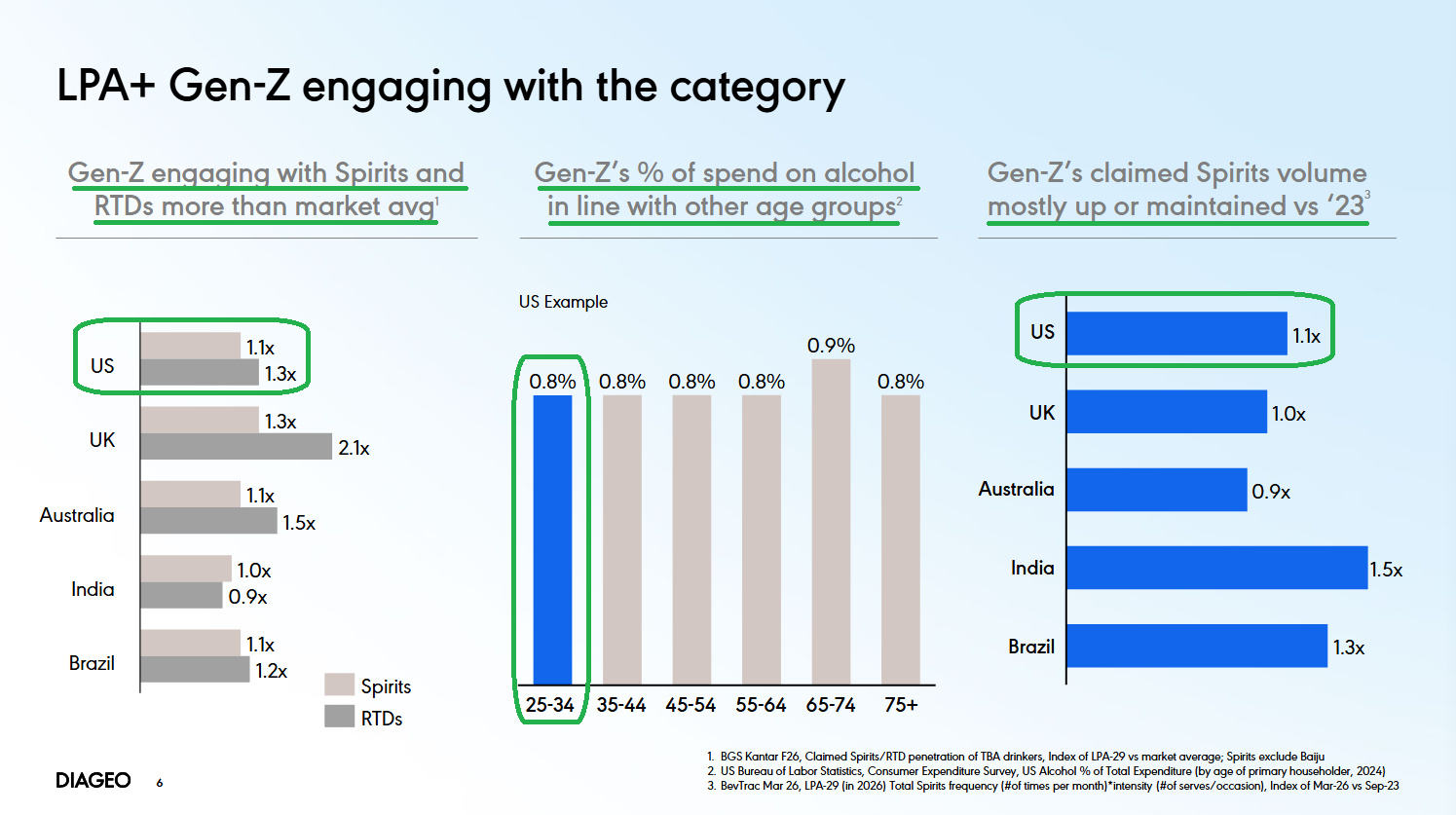
The Gen Z narrative is false: 74% of Gen Z report drinking in the past six months, up from 66% three years ago and in line with the 76% adult average. They drink less by volume but trade up when they do.
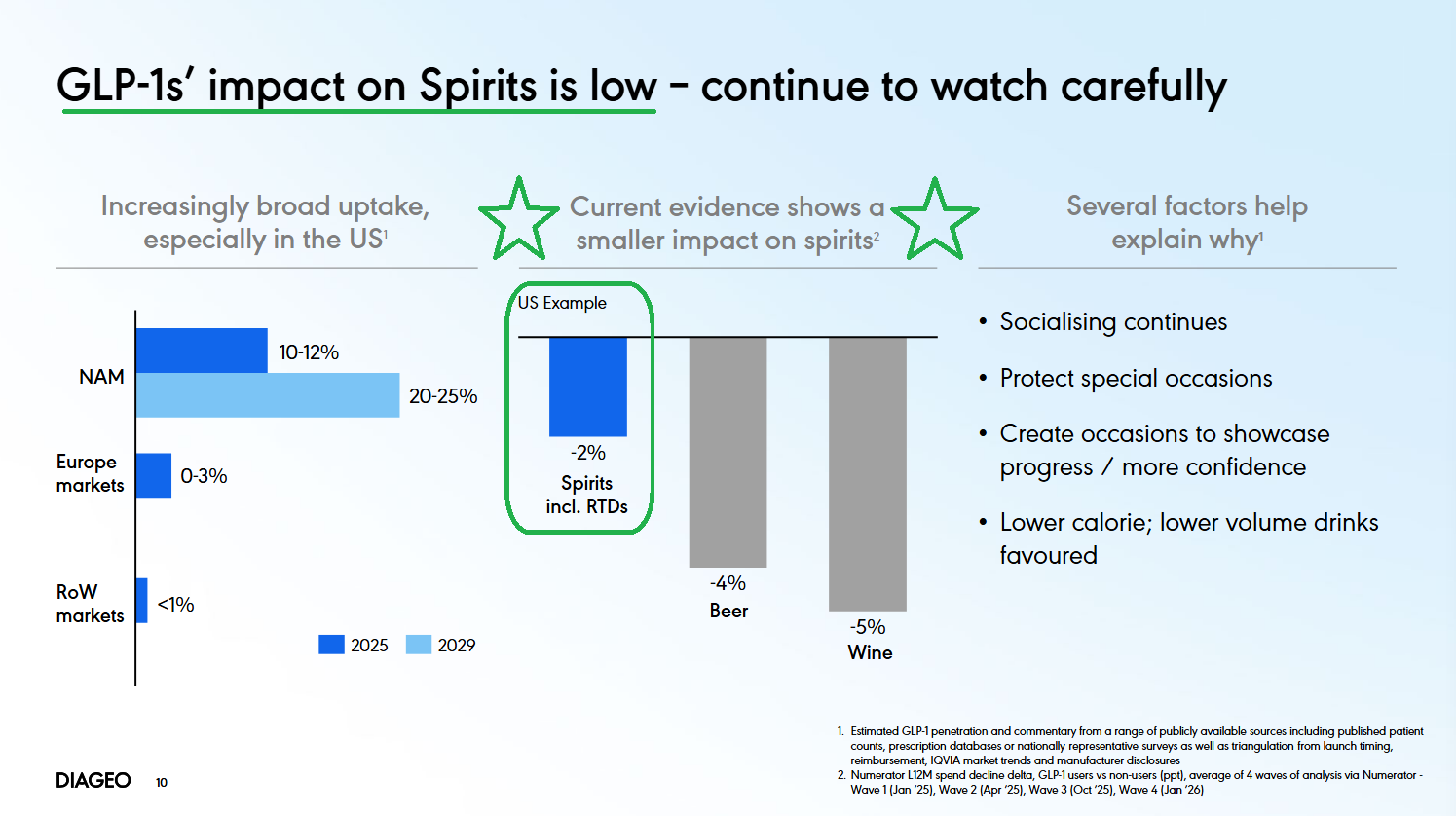
GLP-1 impact modest — users spend just 2% less on spirits (vs 4% beer, 5% wine), and 85% discontinue within two years; penetration is 10–12% today, rising to 20–25% by 2029
The biggest macro headwind remains disposable income; cyclical, not structural
Long-term secular tailwind: the “drinking less but better” dynamic supports sustained price/mix growth across the portfolio
Demographic tailwind: mid/older households spend more on spirits
Key Financials + Valuation
Dividend held at a floor of $0.50/share (vs. $1.03 in FY2025); 30% payout in FY26 under the new 30–50% payout policy, with capital allocation pivoting to deleveraging and reinvestment. As leverage falls, the board can revisit dividend increases and buybacks.
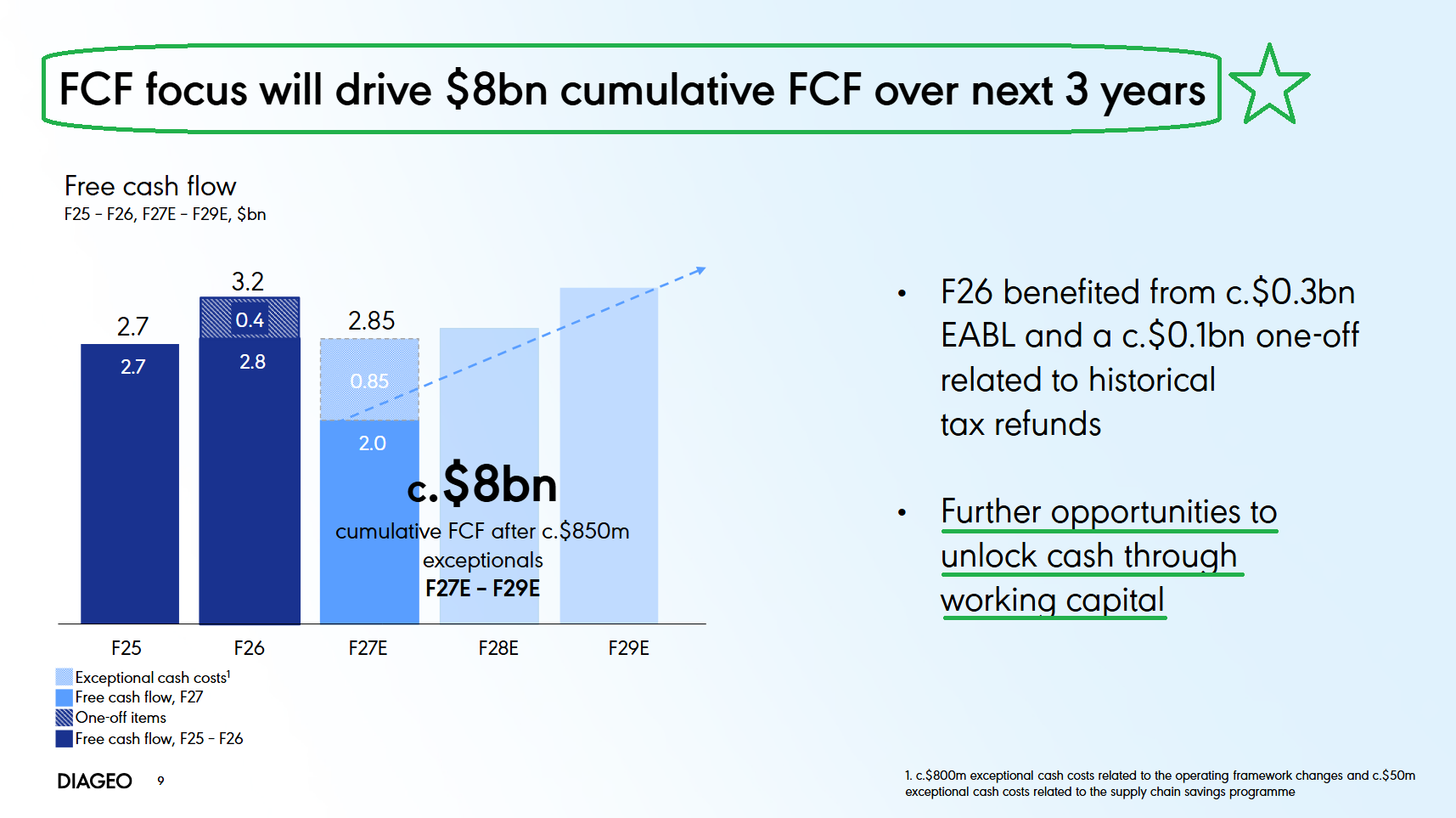
FY26 FCF of $3.2B, +$463M / +16.8% Y/Y from $2.75B, ahead of the $3.0B guide.
Capex of ~$1.2B in FY26 (vs $1.5B in FY25), with spend focused on Guinness capacity expansion
Valuation: ~12x forward earnings against a 25-year average of 18x and the ~30x peak at the early-2022 high; troughed at 11x in March, more than two standard deviations below average and a level only reached during the GFC
Trades at 0.6x relative to the S&P 500 against a long-term ~1.1x premium — near record-low relative valuation
13.4% ROIC in FY2026 (13.7% FY2025), consistent mid-teens historically
FY27 outlook: organic net sales broadly flat (NAM ~-mid-single-digit on an assumed ~3% US market decline plus share gains), organic operating profit low-to-mid-single-digit growth, FCF ~$2B after ~$850M exceptional restructuring cash costs.
Medium-term through FY29: low-single-digit organic net sales growth, mid-single-digit organic operating profit growth, ~$8B cumulative FCF after exceptional cash costs.
Of the ~$3.75B of invested capital going in over the next three years, just under $1B goes to Guinness with the rest supporting growth
Shares outstanding down 11.6%+ over the past 10 years via consistent buybacks
Paid to wait: high-quality compounder trading at trough multiples — the market is pricing this as if people will never sip alcohol again
Q4 Commentary
Much like Hormel, Diageo is another one of our preferred names offering exposure to the left-for-dead staples sector. The world’s largest spirits company closed out FY26 with organic net sales down 2.0%, landing at the favorable end of its -2% to -3% guide. Three of five regions posted growth, led by Africa (+13.3%), Latin America (+7.7%) and Europe (+3.4%), leaving North America (-8.4%) and Asia Pacific (-6.3%) as the lone drags. Excluding Chinese white spirits, where the decline stems from a shift in Chinese government policy, APAC actually grew 1.5%, making North America the only real weak spot within management’s control.
Cost savings did the heavy lifting on profitability, with organic operating profit up 2.0% (its first increase since 2023) on an industry-leading 28.9% operating margin, while free cash flow climbed ~17% Y/Y to $3.2B. Solid as the numbers were, they took a back seat to the long-awaited Capital Markets Day, where Dave Lewis, three quarters into a tenure that began in January, finally laid out the full turnaround plan he previewed during his kitchen-sink first half.
The biggest fear heading into the event was that Lewis’s Tesco playbook would require a price reset at the expense of profits. That fear never materialized, with a two-year ~$1.2B restructuring, ~70% of which was already booked in FY26, set to deliver ~$1B of savings, weighted ~40% to FY27 and ~55% to FY28. Those savings will fund reinvestment in competitiveness, a word nearly everyone but Lewis read as code for price cuts. Instead, the plan centers on small packs, better packaging and quality fixes, all while gross margins hold >60% and organic operating profit compounds at a mid-single-digit rate through FY29, both ahead of consensus expectations.
Overheads are set to fall from north of 14% of sales to 10.5%, which would place Diageo in the top quartile of its peer set, while A&P spend settles at ~16% of sales, down from 18.1% in FY25. “Drastic Dave” has already made his mark, with headcount down 6.4% Y/Y to 27,938 (~2,000 roles) and analysts expecting 3,000 to 5,000 roles to go in total.
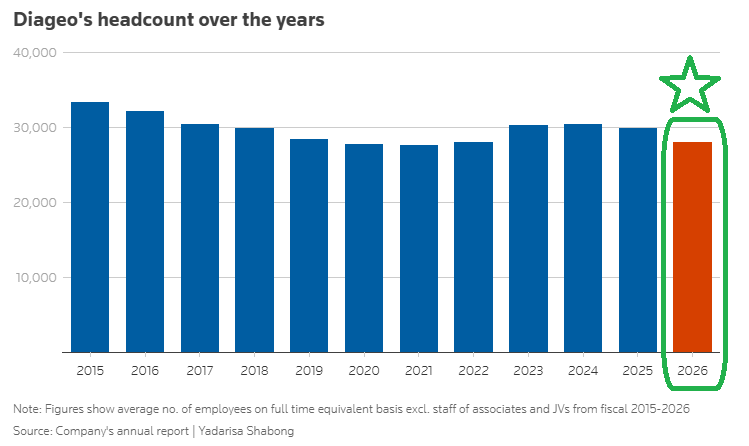
Layer in the ~$540M delivered by the Accelerate program, and Diageo is already back to accelerating profit growth, even with FY27 sales expected to be broadly flat.
A leaner cost base only matters if the top line eventually follows, which brings us to North America, the company’s biggest problem child. At nearly 40% of sales, the region is the engine of the business and the key to the turnaround. While the rest of the world compounds at low-single-digit rates or better (ex-CWS), North America fell 8.4% organically in FY26, dragged down by an 11.5% decline in U.S. spirits. To understand why the market has priced this as permanent impairment, it helps to separate the problem into two layers.
The first layer is the industry backdrop, which is cyclical rather than structural. The Covid boom pulled years of demand forward, with North America growing 20.2% organically in FY21 and 14.5% in FY22 versus a typical low-single-digit range.
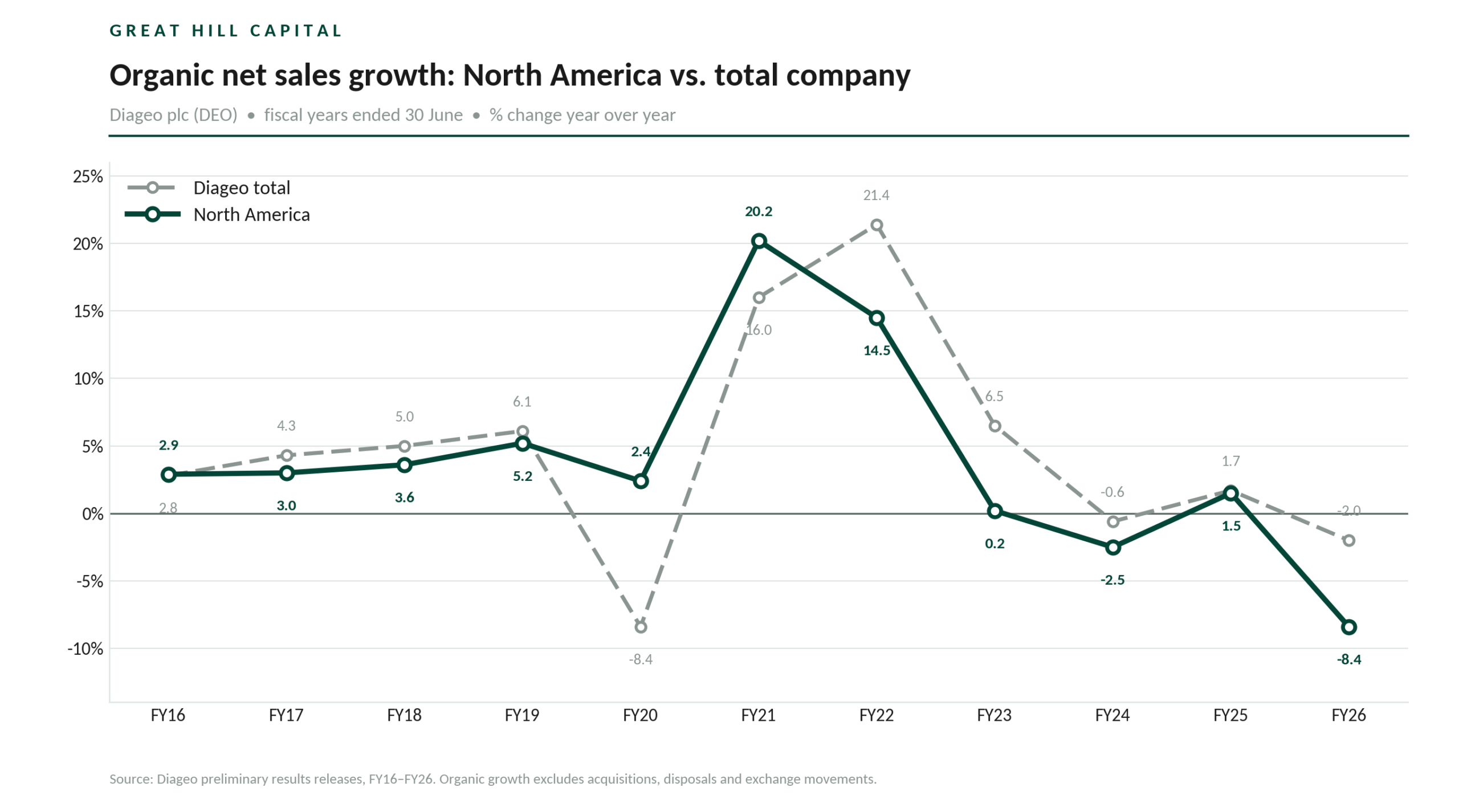
The hangover from that acceleration has simply taken longer to normalize than investors or companies expected, weighed down by income growth that has trailed inflation for four straight years. At the end of the day, spirits are a discretionary purchase, especially the premium-and-above brands that make up ~62% of Diageo’s portfolio. That is why Diageo’s 25 years of data show U.S. spirits volume moving closely with consumer sentiment, which currently sits in the first percentile of its historical range at record lows.
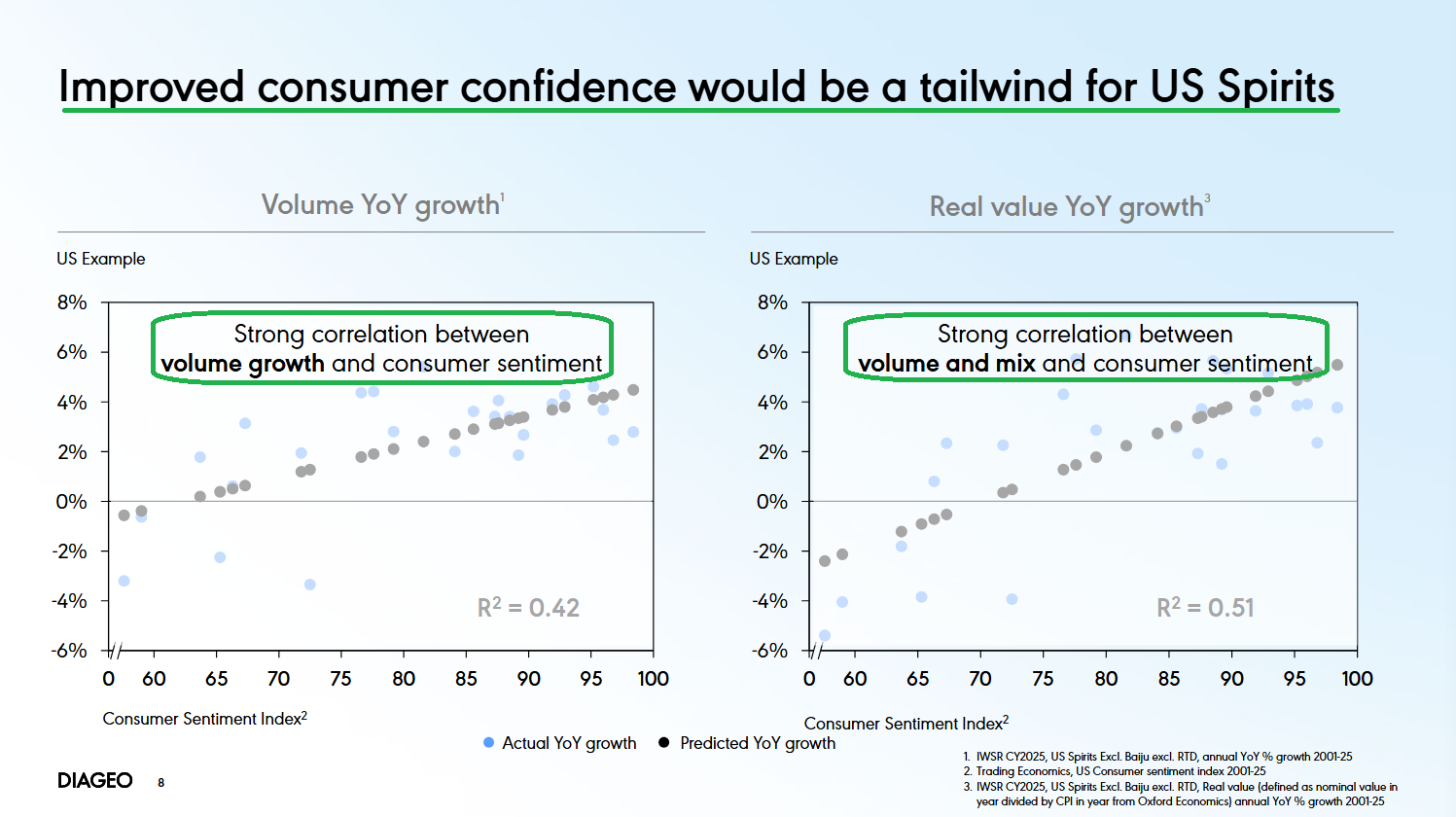
Two overhangs have convinced the market that this cycle is different: GLP-1s and a supposedly sober Gen Z. Both are overblown. GLP-1 users spend just 2% less on spirits than non-users, a one-time level effect rather than a compounding one, while 85% of users discontinue within two years.
As for Gen Z, 74% report drinking in the past six months, up from 66% three years ago and in line with the 76% adult average. They are drinking less but drinking better, which is precisely the consumer Diageo’s portfolio was built to serve.
The second layer is Diageo’s own execution, where the diagnosis is less flattering but far more encouraging. By Lewis’s own admission, North America had been underperforming for quite a while, with the tequila boom masking much of it. Over the last twelve months, U.S. spirits industry sales declined 2.0% while Diageo’s fell 6.9%, a gap that widened to 1.4% versus 7.0% over the last three months, with share slipping across ~65% of the U.S. portfolio. Lewis’s first major move was installing John O’Keeffe, one of Diageo’s most experienced spirits executives, as head of North America. After his first 100 days, O’Keeffe laid out the problems clearly: the business was over-exposed to premium, under-exposed to RTDs and small formats, and slowed by an organization that ran spirits and beer as separate divisions, while core brands like Crown Royal, Smirnoff and Captain Morgan had been losing ground for years.
The fixes are straightforward, centered on packaging, quality, formats and a single commercial organization. The good news is that these are all self-inflicted problems, giving Diageo plenty of self-help levers to pull rather than banking on a cyclical recovery to bail the business out. Casamigos offers an early proof point, as a 10-15% price repositioning that stopped it from fighting Don Julio for the same top-shelf consumer, paired with a FIFA World Cup activation, flipped a three-year share decline into share gains within weeks.
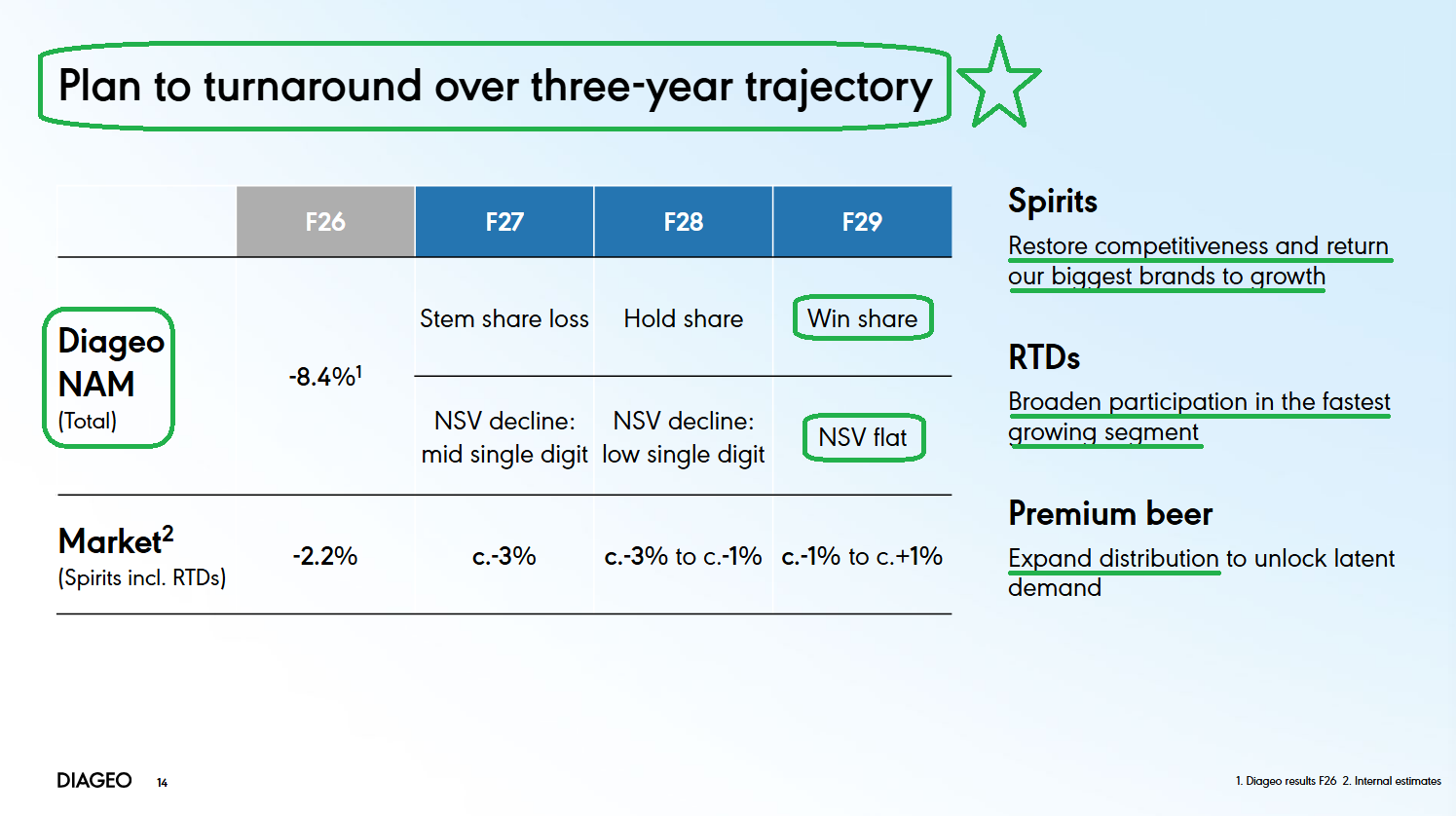
Management expects North America to move from stemming share losses in FY27 (mid-single-digit decline) to holding share in FY28 (low-single-digit decline) to winning share by FY29 (flat). The plan assumes a U.S. market that shrinks ~3% in FY27 before improving only slowly from there, a conservative assumption relative to industry peers’ forecasts. Any rebound in industry volumes would therefore be pure upside to a plan already built to work without it.
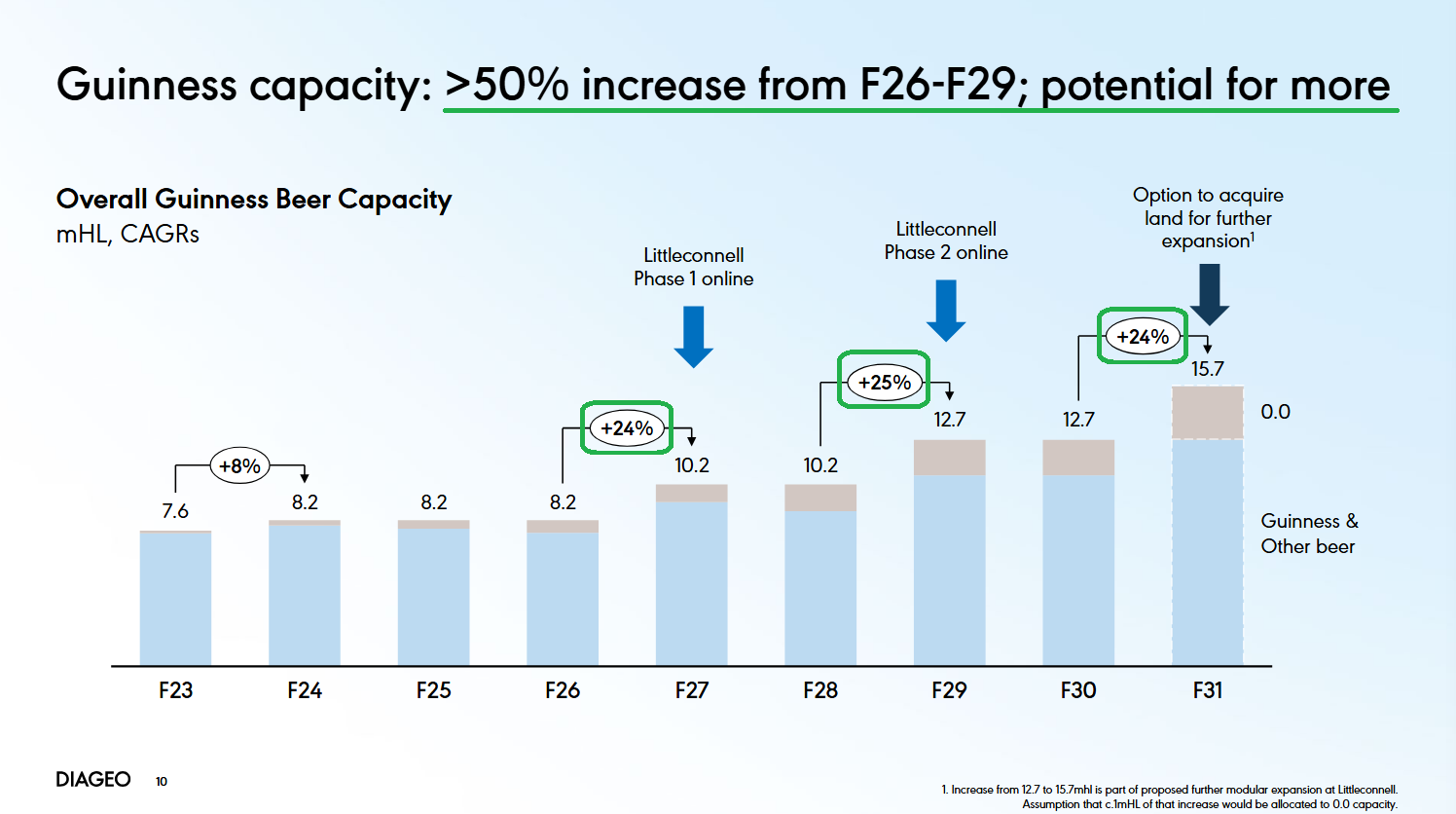
Beyond fixing North America, Lewis has narrowed Diageo’s focus to two key growth drivers. The first is Guinness, which continues to grow like a weed, up 12% in FY26 and compounding at 13% annually over five years versus ~5% for premium beer, alongside 14 straight quarters of share gains in North America. It does so with a >60% gross margin and ~30% ROIC, more than twice the group average. For Guinness, the constraint has never been demand but capacity, which is why just under $1B of capex will lift production by more than 50% by FY29 and nearly double it by FY31, creating a long runway for growth across both core and new markets.
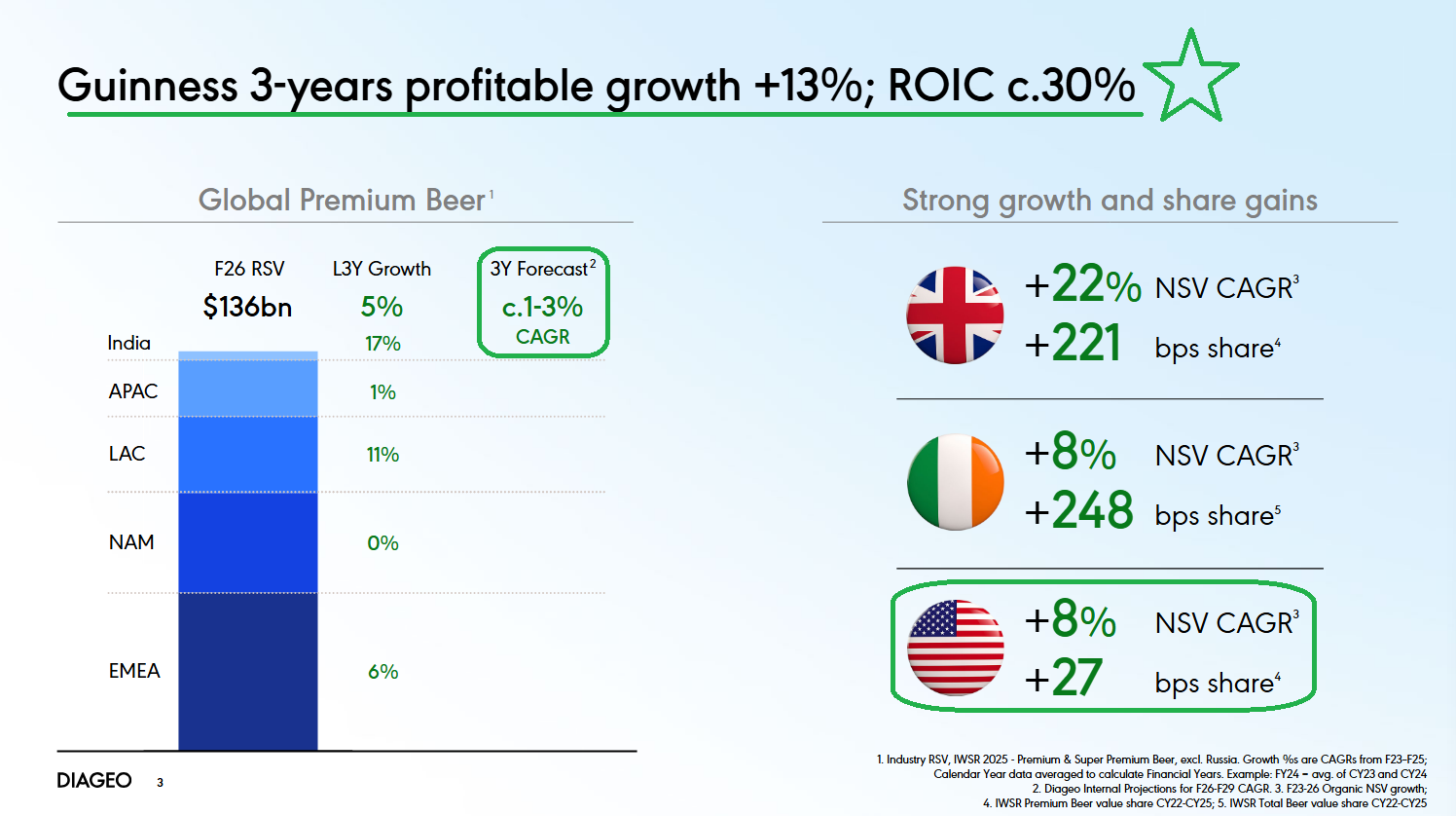
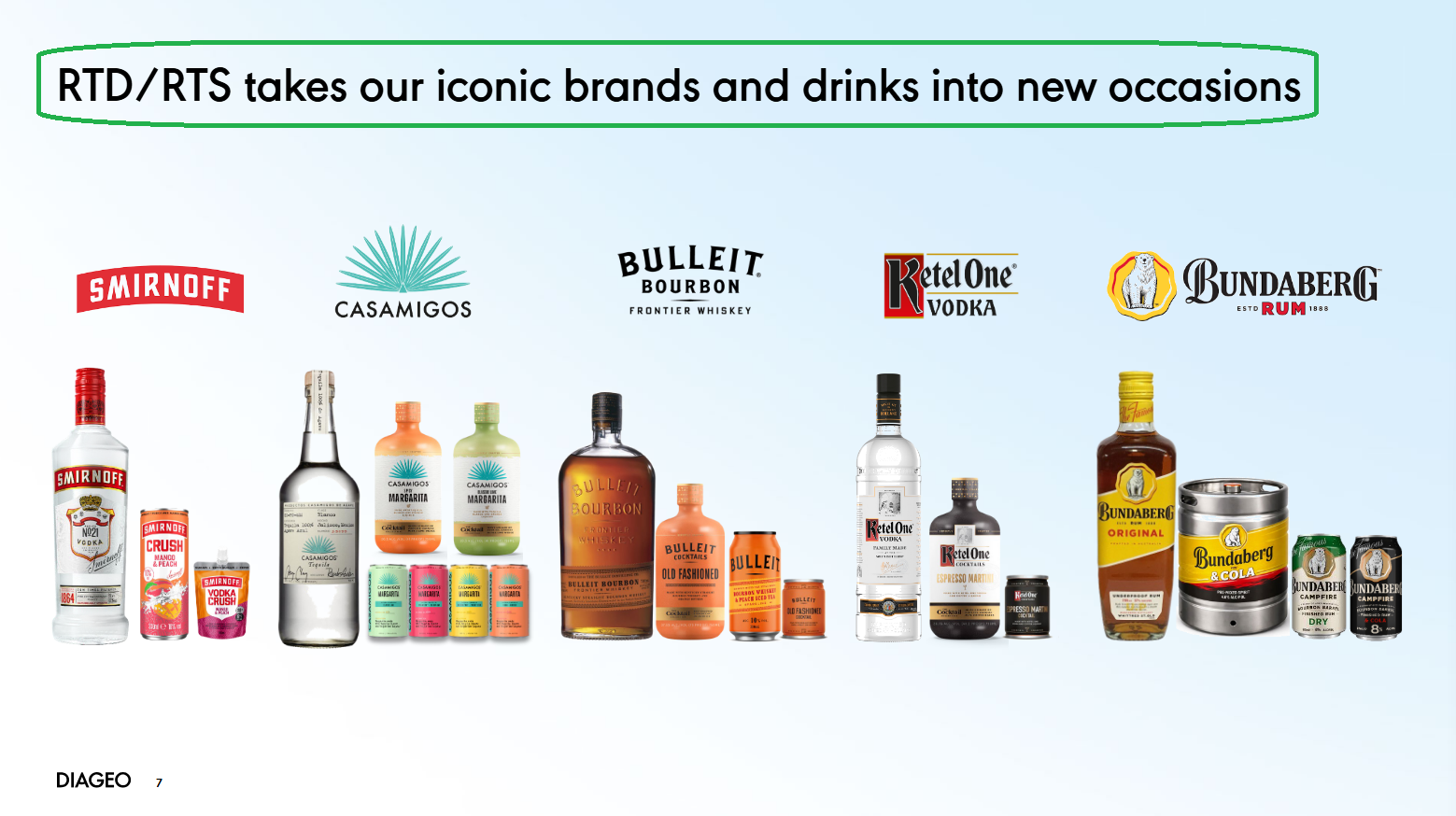
The second growth driver is ready-to-drink cocktails, one of the few categories that has continued growing through the broader alcohol downturn. U.S. RTD servings have compounded at 13% annually since 2016 versus 1% for spirits, rising from ~5% to ~14% of North American volume. Diageo is already the #2 player globally, with RTD sales up 15% organically in FY26 and 35.1% in North America. Yet the category represents just ~4% of total sales after prior management largely abandoned it in favor of premiumization at all costs, fearing margin dilution. Those fears overlooked the economics, with RTDs generating ~3x the profit per serve of spirits while also serving as a recruiting tool, with Casamigos RTD buyers 5x more likely to go on to buy the tequila. Lewis plans to roll out canned cocktails across every core spirits brand, leveraging names consumers already know rather than chasing the latest flavor of the day.
All of this is backstopped by a healing balance sheet and a free cash flow inflection. FY26 free cash flow of $3.2B was the highest since 2022, helped by capex falling to $1.2B from $1.5B. Management expects cumulative FCF of ~$8B through FY29, which, along with proceeds from the EABL and RCB disposals, should bring leverage from 3.1x to the midpoint of the 2.5x-3.0x target range in FY27, a year earlier than previously anticipated, with a path toward 2x by FY29 absent any action. That leaves the Board with what CFO Nik Jhangiani called a “nice problem” of deciding between buybacks and a higher dividend, with management clear that this is an organic turnaround and there is no appetite for M&A.
The only thing that has changed since the August 6 Capital Markets Day is the appointment of Joanne Wilson as Jhangiani’s successor sometime in 2027, with Jhangiani remaining in place through the handover.
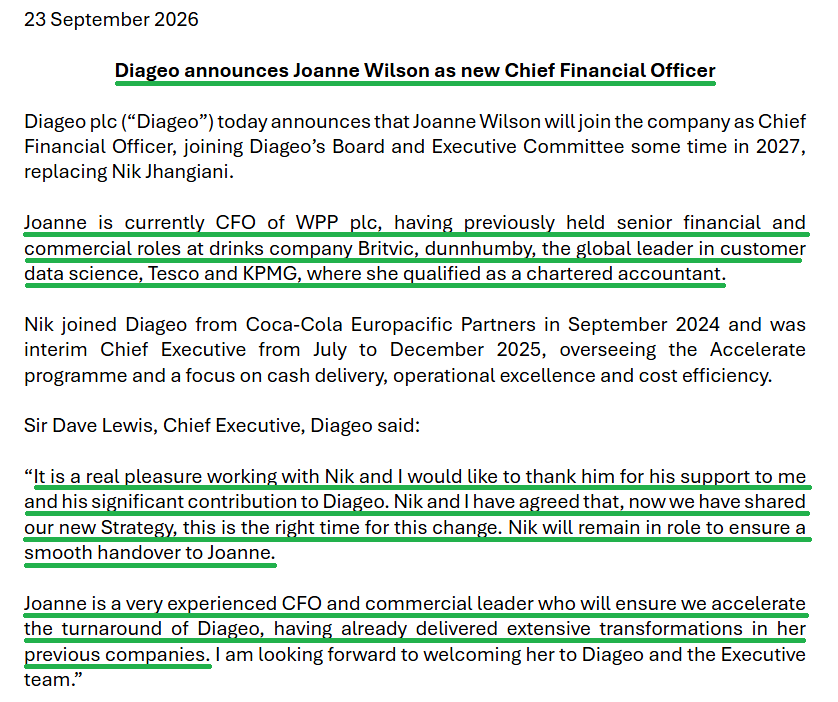
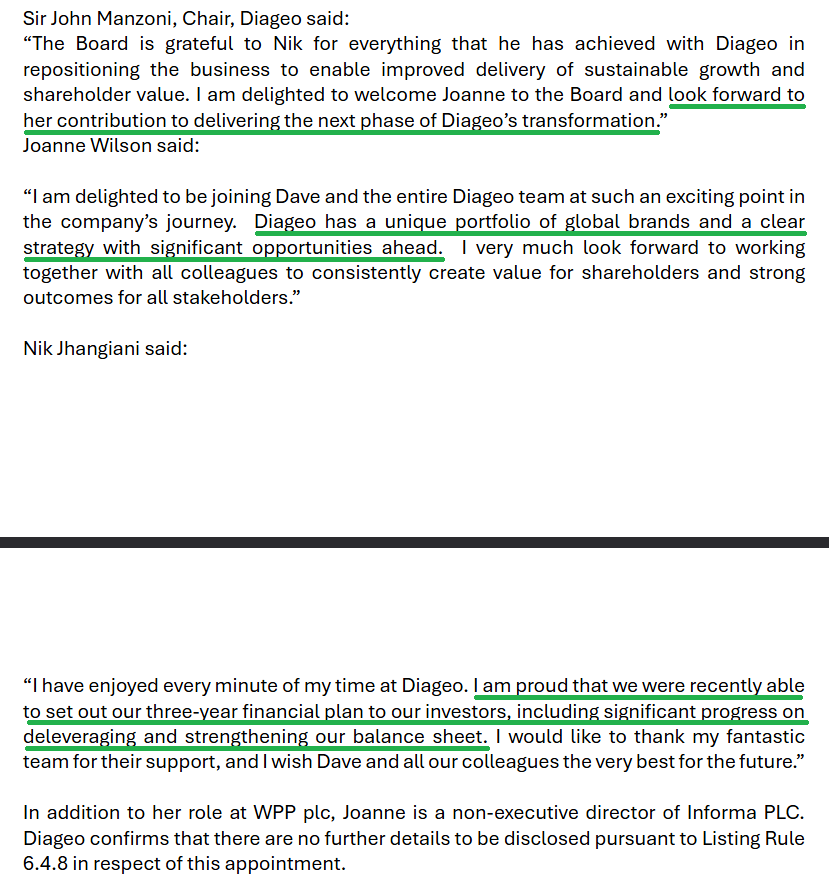
While the announcement was unexpected and removes a strong CFO who was once seen as a front-runner for the top job, it is more likely than not just the latest piece of Lewis’s executive team rebuild. Wilson spent a decade at Tesco alongside Lewis, including her final two years as head of M&A, and brings prior drinks experience from Britvic. With the financial framework already laid out, Wilson now steps in to lead the execution phase alongside a CEO she already knows how to work with.
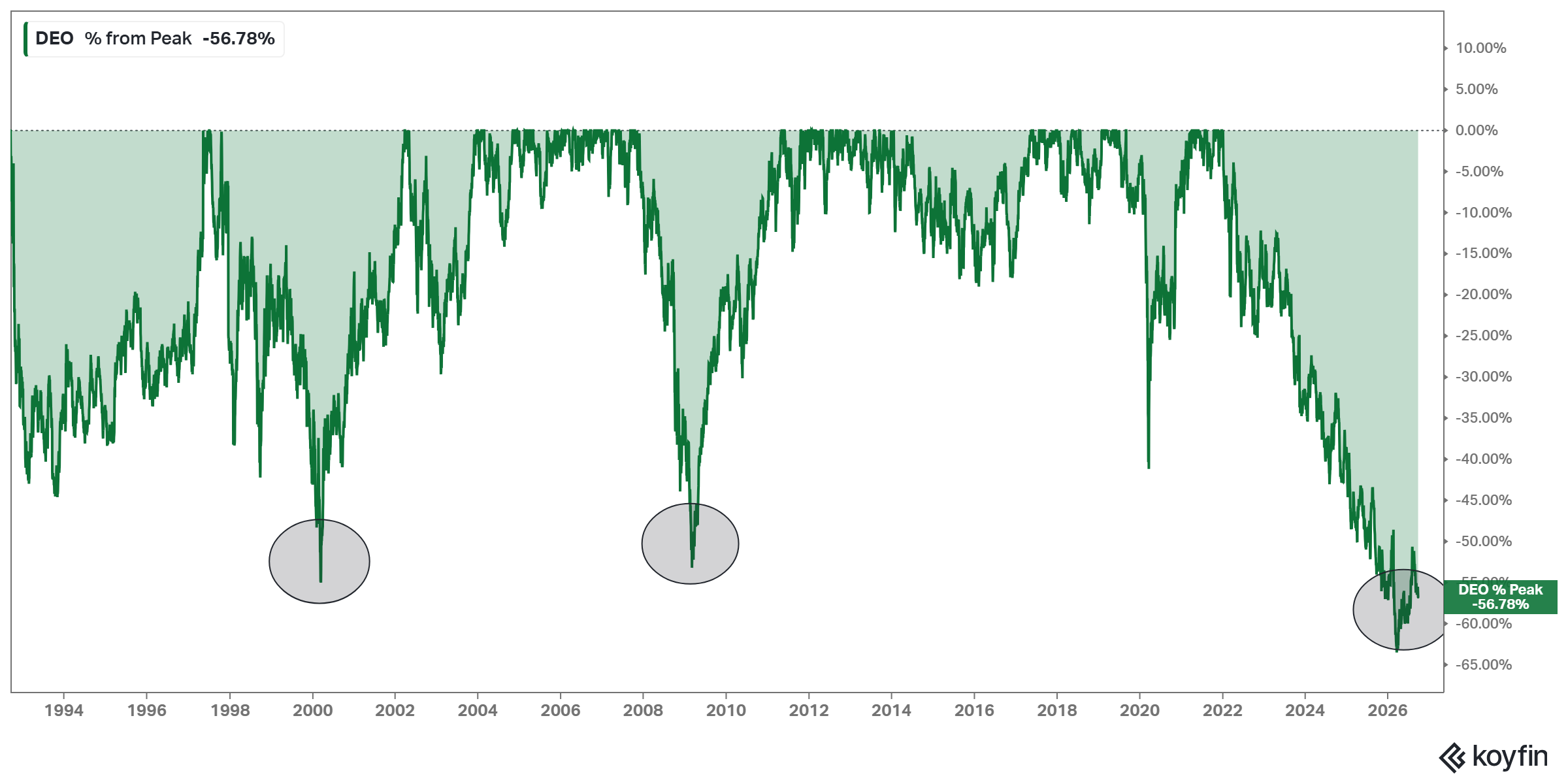
Even after a self-help turnaround plan that cleared the bar without the dreaded profit reset, none of this has found its way into the share price. Diageo remains down nearly 60% from its 2022 high, only the third 50%+ drawdown in its history after the dot-com bubble in 2000 and the GFC.
The stock trades at 12.6x forward earnings against a 25-year average of ~18x and a ~30x peak in early 2022, while its 0.6x relative multiple to the S&P 500 sits near record lows against a long-term premium of ~1.1x.
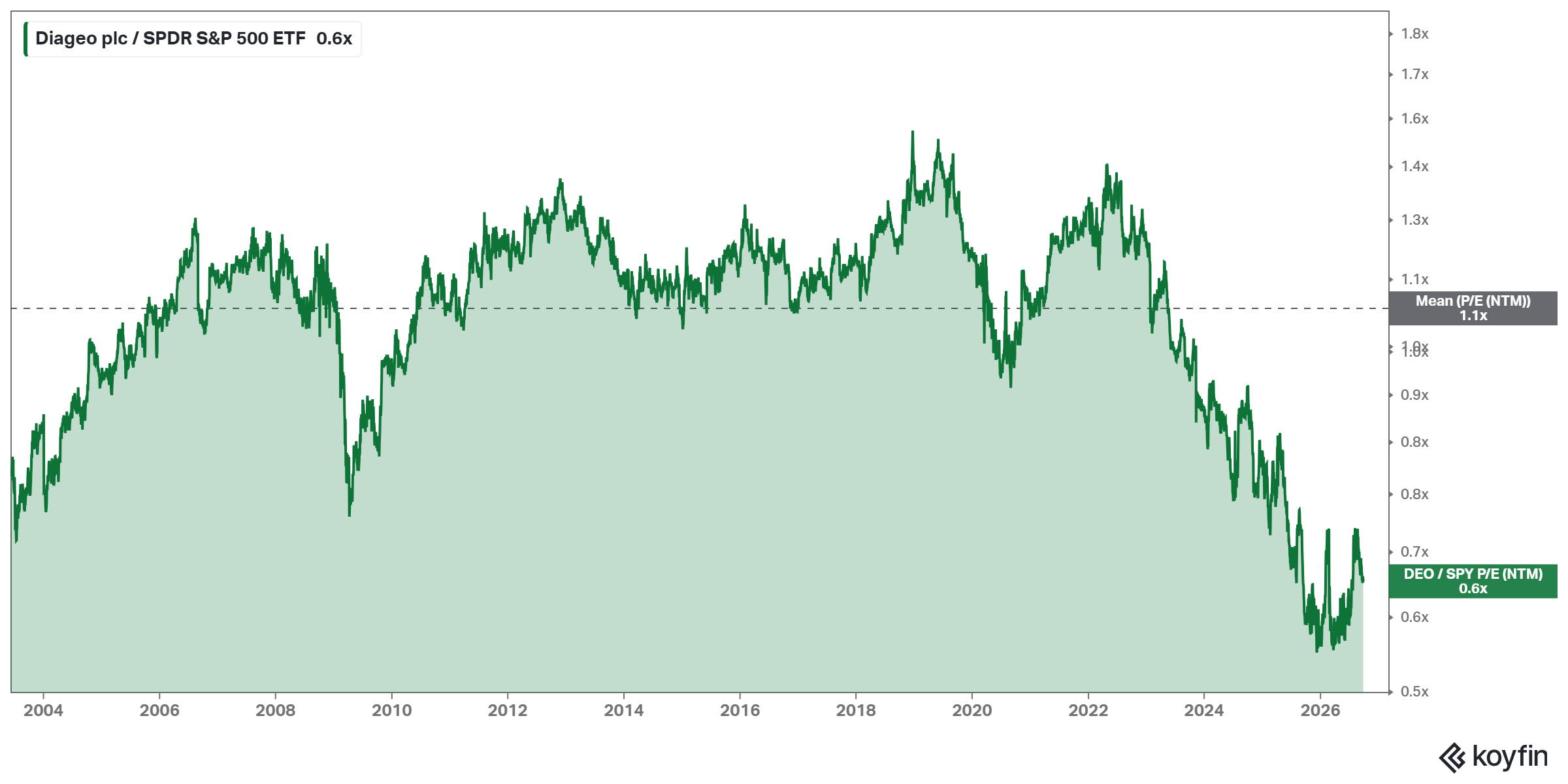
The market is pricing a cyclical hangover as permanent impairment in one of the highest-quality names in global spirits, now led by a proven operator with a fully funded plan. At these levels, we don’t expect Diageo to remain on the rocks for much longer.
Capital Markets Day Financial Framework
Click here to view the full Capital Markets Day presentation
Q4 & FY26 Earnings Breakdown
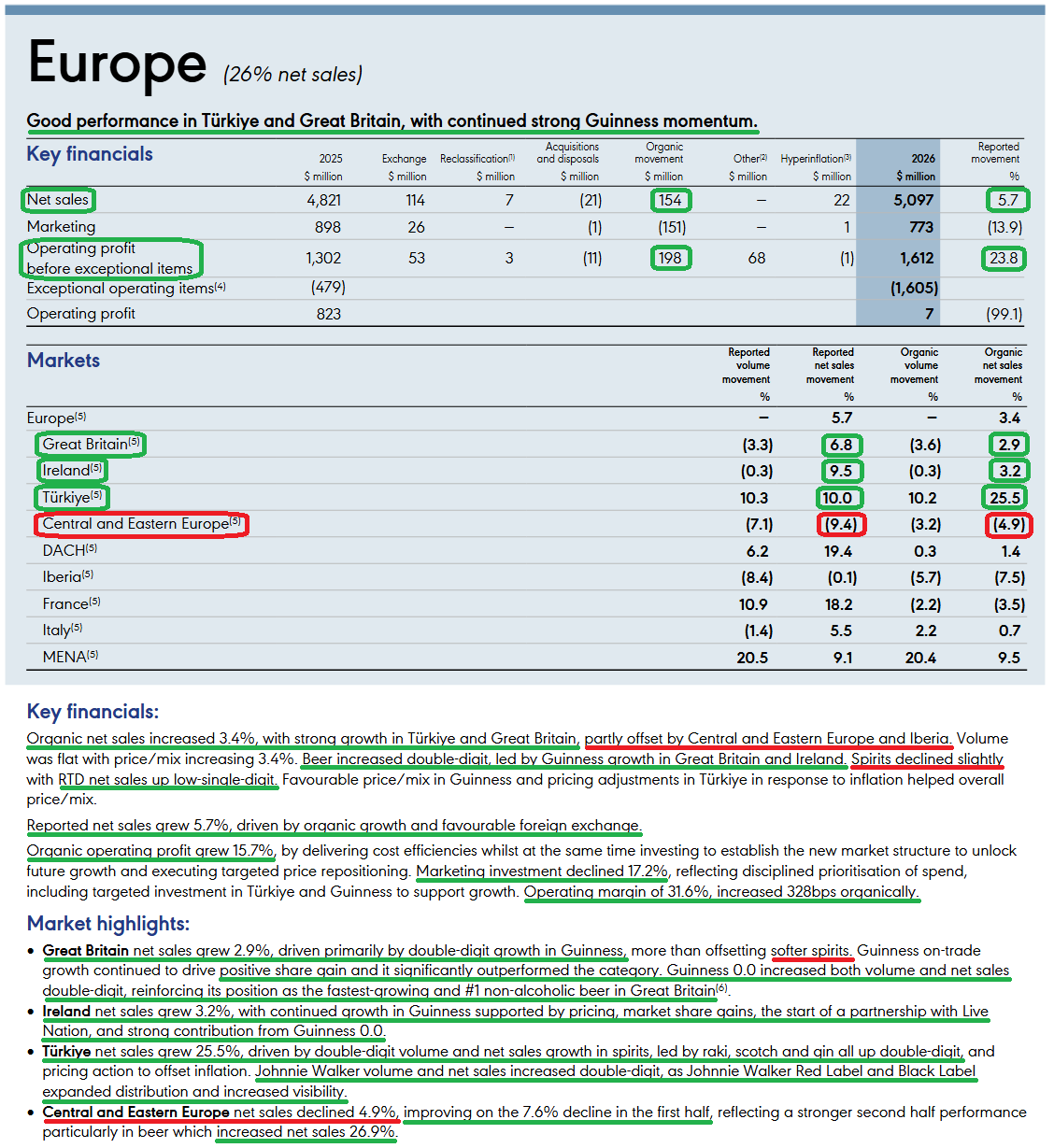
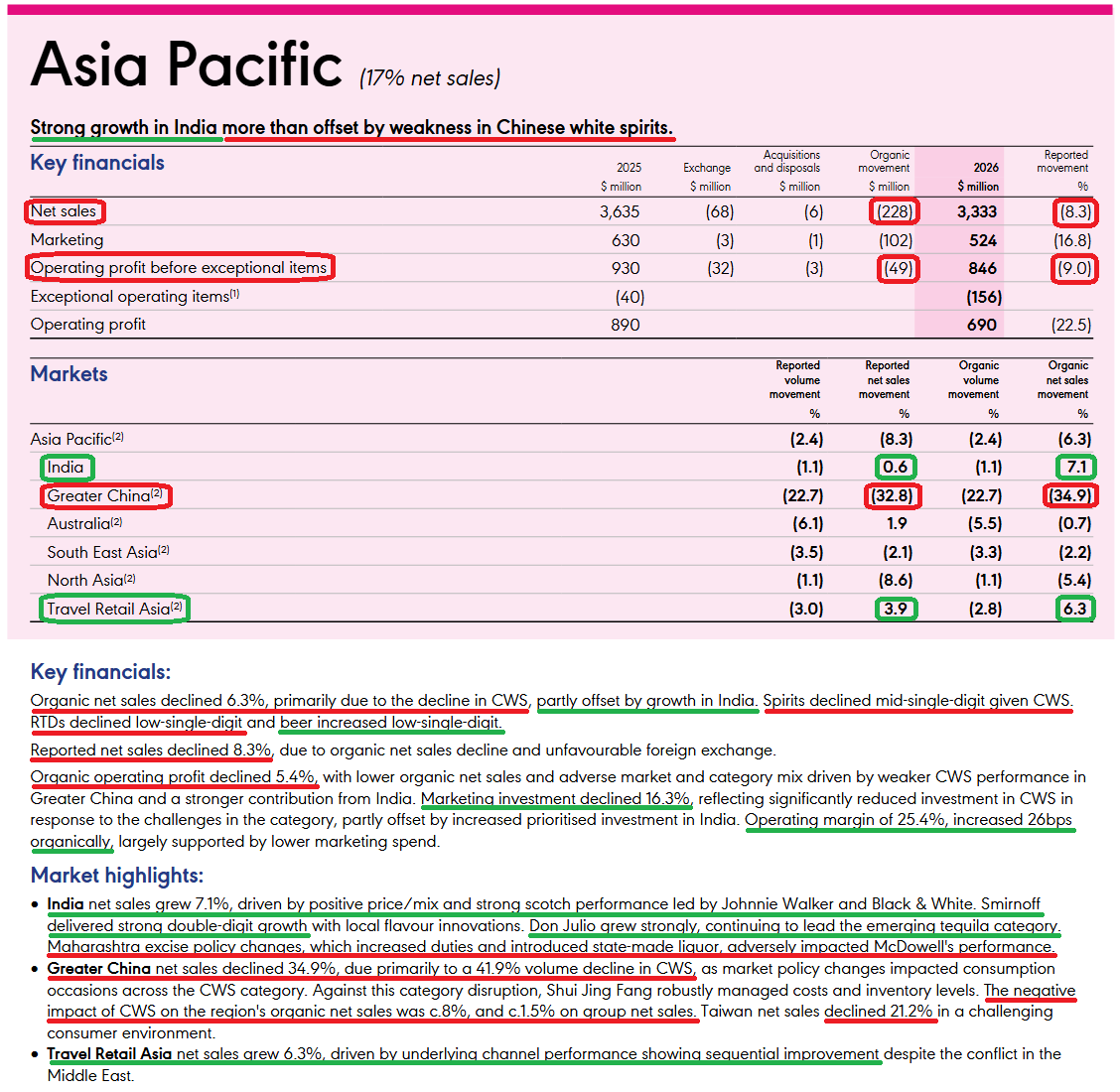
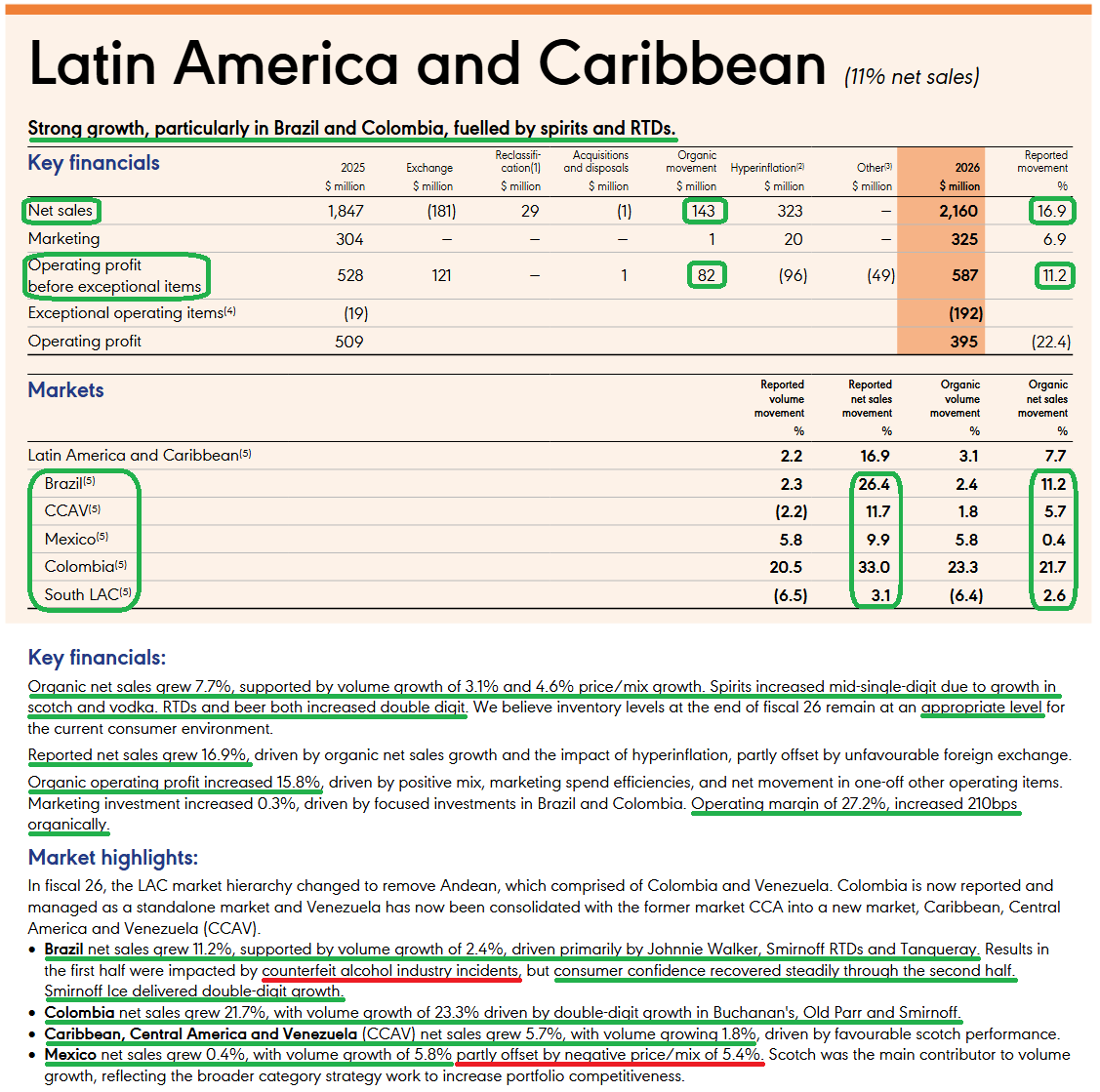
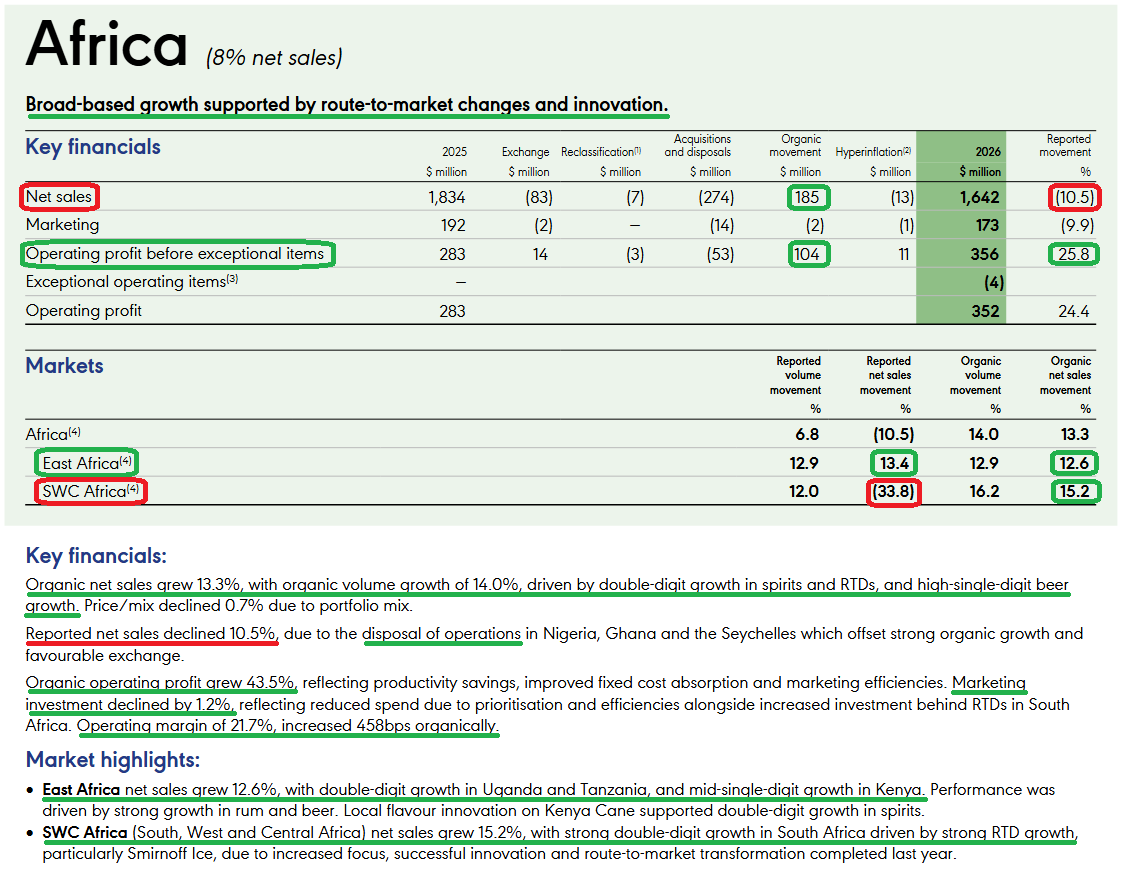
Earnings Call Highlights
Morningstar Analyst Note
General Market
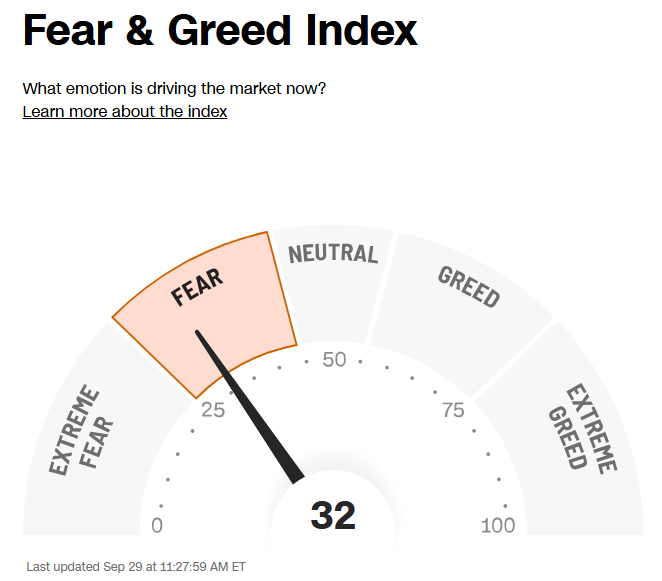
The CNN “Fear and Greed Index” ticked down to 32 this week from 35 last week. You can learn how this indicator is calculated and how it works here: (Video Explanation)
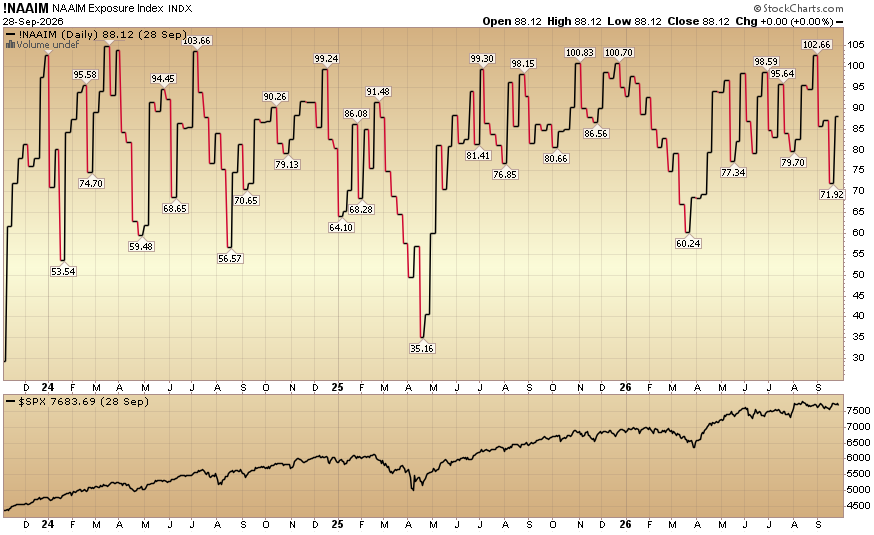
The NAAIM (National Association of Active Investment Managers Index) (Video Explanation) ticked up to 88.12% equity exposure this week from 71.92% last week.


Comments
Log in or sign up to join the conversation.