


Oil prices have just surged sharply following the announcement of new U.S. strikes in southern Iran. Brent crude surpassed $92, and WTI approached $90.
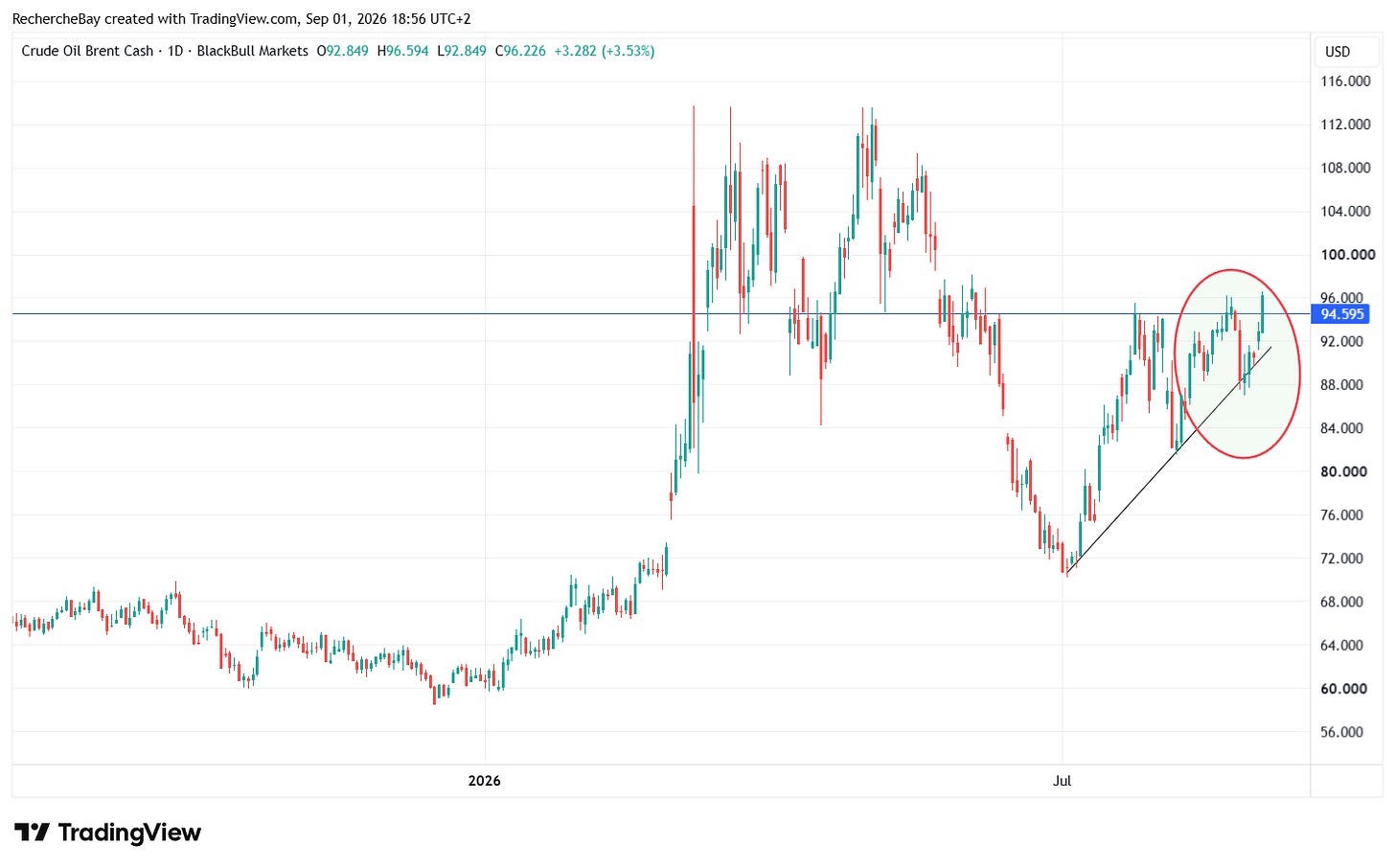
Several explosions were reported around Bandar Abbas, Qeshm, and near the Strait of Hormuz. Two supertankers leaving the strait were also reportedly hit by projectiles, which immediately reintroduced a risk premium on the most strategic maritime passageway in the global energy market.
This development is significant because it comes at the very moment when the market was beginning to believe that the energy risk associated with Iran was gradually being brought under control. Some trade flows had resumed, crude oil had lost some of its geopolitical premium, and the stock markets had begun to look elsewhere. The new U.S. strikes serve as a stark reminder that nothing has been resolved. The Iranian president says he is ready to return to a ceasefire if Washington honors its previous commitments, but the United States has resumed its military operations. The prospect of a series of limited strikes now raises the risk of an intermittent conflict rather than that of a genuine return to normalcy.
But crude oil is still only part of the story. The real source of tension remains the one we’ve been tracking for several weeks: refined products. The crack spread for U.S. diesel has just surpassed $100 per barrel. Disruptions in the Gulf are now compounded by Ukrainian attacks on Russian refineries, at a time when global refining capacity was already under extreme strain. Estimates cited this week show global refinery runs to be approximately 7 million barrels per day lower than last year’s levels and nearly 6 million barrels per day below seasonal norms since March.
This is the figure to watch — far more so than Brent at $92. A shortage of crude oil drives up the price of oil. A shortage of refining capacity drives up the prices of diesel, gasoline, kerosene, and heating oil much more rapidly than crude oil itself. Yet it is precisely these products that directly factor into the costs of transportation, agriculture, and logistics, before being passed on to the prices of a large portion of consumer goods.
This shock at the start of the month has therefore come at the worst possible time for central banks. And that is where the second event of the day takes on its full significance.
The Japanese bombshell
The yield on the 30-year Japanese government bond (JGB) has just surpassed 4.18%, an all-time high, while the 10-year yield has now reached 3% for the first time since 1996.
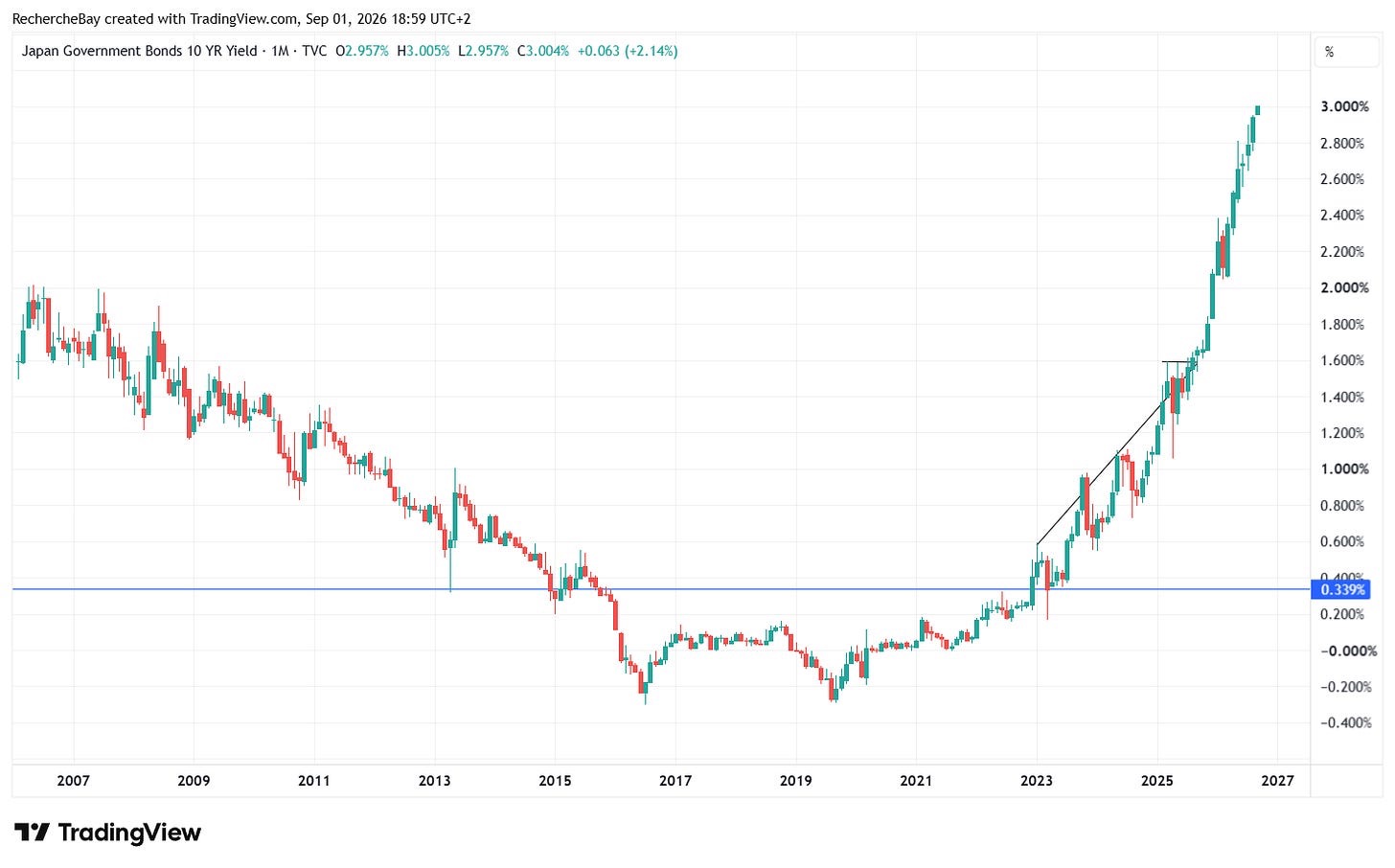
These figures may seem relatively ordinary from the perspective of the United States or Europe. They are absolutely not ordinary for Japan.
For nearly three decades, Japan served as the anchor of low interest rates in the global financial system. The Japanese government was able to refinance its massive public debt at extremely low rates, while Japanese banks, insurers, pension funds, and investors were driven abroad in search of returns. These savings helped finance U.S. Treasuries, European bonds, and a considerable number of carry strategies around the world.
That era is coming to an end.
This trend had already been signaled by the failure of last week’s auction of Japanese two-year bonds. Investors had refused to rush to buy the bonds, even as the market anticipated another rate hike by the Bank of Japan. Now, the rise is spreading across the entire yield curve. The 10-year at 3%, and especially the 30-year above 4%, are profoundly altering Japanese investors’ risk-reward calculations.
Why would a Japanese insurer agree to take on currency risk on a U.S. Treasury when its own government now offers a yield close to 4% on long-term bonds?
The problem extends far beyond Japanese purchases of Treasuries. For decades, the yen has been one of the main currencies used to finance global leverage. When the cost of Japanese financing rises, certain carry trades become less attractive. When JGBs regain yield, part of Japan’s savings has less reason to leave the country. And when these two trends occur simultaneously, a structural source of global liquidity begins to contract.
Japan also faces its own fiscal challenges. With one of the largest public debt stocks in the developed world, a few dozen additional basis points do not pose an immediate problem, since the entire debt is obviously not refinanced all at once. But each new issuance and each maturing bond is gradually refinanced at a higher cost. The Japanese Ministry of Finance is already forecasting a sharp increase in debt service costs over the next fiscal year.
This leads to a particularly uncomfortable situation: oil is driving up global inflation at the same time that Japan is driving up the global duration premium.
And these two phenomena reinforce each other.
Higher energy prices force central banks to remain tight for longer. Tighter central bank policies keep the cost of financing high. Higher sovereign bond yields, in turn, raise the hurdle rate for all debt-financed investments.
Sovereign bond yields effectively serve as a benchmark for much of the financial system. A company seeking to borrow to build a data center must offer a higher yield than that of government debt. The higher this cost rises, the more profitable the project must be to justify the investment. Some projects that were profitable with 3% financing are therefore no longer viable when financing costs 6 or 7%.
The hurdle rate simply refers to the minimum return a project must generate to justify the investment, given its financing costs and the risk involved.
This is where Nvidia (NVDA) comes back into the story.
Nvidia exits the corporate bond market
During 2025, Nvidia accumulated more than $20 billion in corporate bonds in its investment portfolio. It still held approximately $15 billion of them at the beginning of 2026. In its latest financial statements, this category has disappeared: Nvidia’s tradable bond portfolio now consists primarily of Treasuries and U.S. agency securities.
Of course, this move should not be interpreted as evidence that Nvidia is anticipating a credit crisis. Nor is there any basis for claiming that the bonds sold were primarily those of neoclouds or companies directly related to artificial intelligence. But the timing is particularly interesting.
Nvidia already bears a tremendous amount of corporate risk elsewhere. It invests directly in its ecosystem, grants longer payment terms to certain customers, and provides substantial guarantees for infrastructure projects intended to purchase its own GPUs. In particular, it has provided a residual value guarantee of up to $105 billion for the OpenAI/SB Energy project in Ohio. It is therefore perfectly rational for its cash portfolio to become, conversely, extremely liquid and minimally exposed to credit risk.
But this decision contains a paradox.
By protecting its cash position against corporate credit, Nvidia is also removing a buyer from that market. $15 billion is obviously not enough, on its own, to shift the balance of the U.S. bond market. But if other investors begin to adopt Nvidia’s reasoning, the consequence becomes very different: less demand for corporate bonds means higher yields to absorb new issuances.
Yet the industry that currently needs the bond market the most is precisely the one on which Nvidia’s future growth depends.
The hyperscalers spent approximately $166 billion in capex last quarter, nearly 90% more than a year ago. At the same time, Nvidia continues to post extraordinary figures, with more than $96 billion in quarterly revenue, including $89 billion from data centers. So there is currently no visible collapse in demand. But the capital needed to sustain this growth is increasing even faster.
This is where Japan and oil become much more important to Nvidia than their absence from its quarterly results might suggest.
The cost of the next data center is not determined solely by the price of GPUs. It also depends on electricity, the diesel fuel needed for the supply chain and backup systems, materials, construction, and, above all, the capital that finances the project.
This cost of capital can be summarized very simply: sovereign rate + credit spread.
While Japan is contributing to a rise in the global cost of duration — as the energy crisis prevents central banks from cutting rates — the risk-free rate remains high. If, at the same time, investors begin to demand a higher return to finance AI-related infrastructure, the credit spread also widens.
This is the worst possible combination for a capex cycle.
It is by no means necessary that demand for artificial intelligence should collapse. Data centers may be full, GPU orders may continue, and Nvidia may still beat expectations for several quarters. The cycle can begin to turn well before these indicators deteriorate, simply because the expected return on the next project falls below the cost of capital required to build it.
This is precisely why Nvidia’s earnings can become a lagging indicator of the cycle. They largely reflect investments that were decided and financed in the past. To understand what will be built in the future, one should instead look at sovereign bond yields, corporate spreads, CDS spreads for the most indebted companies, the terms of new issuances, and the projects that hyperscalers may begin to reconsider.
And today, two of these variables have suddenly taken a turn for the worse.
Japan is driving up the global cost of capital. At the same time, oil prices are limiting central banks' ability to bring it back down.
And now, gold
That’s ultimately where all the pieces start to come together.
If oil prices continue to rise, central banks must maintain a more restrictive policy to prevent a new wave of inflation. But higher interest rates are gradually undermining the massive piles of public and private debt accumulated when borrowing was virtually free.
Japan now stands as the most striking example of this contradiction. Allowing rates to rise protects the yen and combats inflation, but increases the cost of refinancing a massive public debt. Preventing rates from rising protects the budget and financial balance sheets, but risks reigniting yen weakness and imported inflation.
Japan is caught in a trap. The yen has lost nearly 60% of its value in five years. To halt this depreciation for good, the Bank of Japan would need to raise interest rates much more sharply. But with public debt exceeding 200% of GDP, it does not have the same leeway as other central banks: each rate hike gradually and significantly increases the government’s refinancing costs.
At the same time, government spending remains very high, and further tax cuts are being considered, which puts even more pressure on the bond market. Japan might be tempted to artificially suppress yields by returning to a form of yield curve control, the famous YCC. But in that case, the yen would serve as the adjustment variable: keeping yields artificially low while inflation and global rates remain high would exert further downward pressure on the currency.
And that is precisely what Washington — and Scott Bessent in particular — is seeking to avoid. Japan must therefore choose between letting its rates rise, at the risk of undermining its public finances, or keeping yields in check, at the risk of further weakening the yen. In either case, the problem does not go away: it simply shifts to another area.
This is exactly the kind of monetary and fiscal impasse that gold is beginning to reflect. When heavily indebted countries can no longer simultaneously defend their currency, contain their interest rates, and finance their deficits without resorting to increasing central bank interventions, gold regains its role as a monetary asset that is nobody’s debt.



Comments
Log in or sign up to join the conversation.