

There is no avoiding the truth that the Canadian labor market is in serious trouble. Canada lost 213,000 jobs and the unemployment rate jumped to 9.6% in January. This result follows on the heels of a drop of 53,000 in December, such that employment is at the lowest level since the summer of 2020. Significantly, the labor underutilization rate increased to 18 %, an indication of how far we are from our potential. Employment is nearly 900,000 below the level achieved in February 2020. Simply, there has been no meaningful recovery from the initial impact of COVID-19 on the Canadian economy.
Ontario and Quebec have been subject to an initial lockdown in the early spring, 2020, then re-opening during the summer and early fall, only to be returned to a lockdown state in January 2021. These stop-go measures have played havoc with thousands of small businesses and their employees. Nearly, the entire burden of job losses falls in the hospitality, retail, and information/cultural sectors.
Figure 1 Changes in Canadian Employment
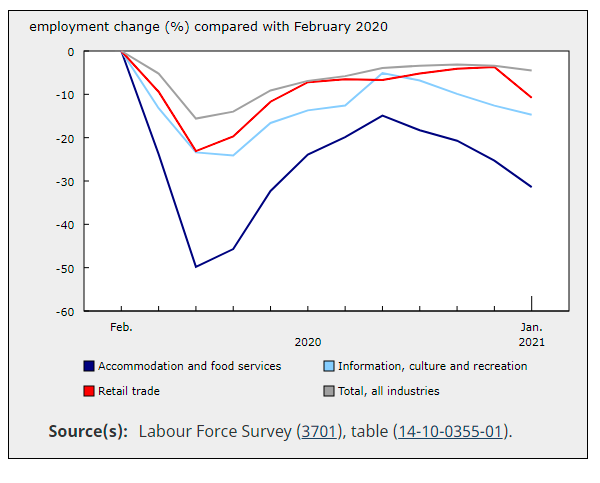
More importantly, the burden of job losses falls on the most vulnerable segments of the labor market, raising the prospects of long-term scarring. Inside the overall numbers, we find that young workers (age 15-24) accounted for 100,000 job losses alone in January. Prime age workers (aged 25-54) lost 107,000 jobs, but, more importantly, core-aged women accounted for 70% of those particular losses.
The dynamics of the labor market are ever more apparent during the COVID-19 crisis. Individuals are constantly making decisions regarding their participation in the workforce. Many have become discouraged and as a consequence, the size of the labor market has shrunk by 100,000 in the past two months. A declining participation rate reduces a country’s capacity to produce and weakens overall economic performance. Finally, the extent of the unemployment damage is often measured by how long one remains out of work. The number of long-term unemployed (people who have been looking for work or who have been on temporary layoff for 27 weeks or more) remains at a record high of 512,000. The longer one remains unemployed, the dimmer are his/her prospect for future employment. While we may take some comfort that we have rebounded considerably since the initial 3 million job losses a year ago, the recovery process is extremely slow, painful and the longer-term consequence have yet to be fully determined.



Comments
Log in or sign up to join the conversation.