

There's a game every kid has played at a birthday party.
Musical chairs. Everyone walks in a circle while the music plays. Laughing, having a good time. Nobody's worried. The music is playing, there are (almost) enough chairs for everyone, and the mood is festive.
Then the music stops.
And suddenly every person in that circle is scrambling -- elbows out, eyes wide -- trying to find a seat before someone else takes it. The fun evaporates in about three seconds.
That's exactly what I'm watching in the memory chip sector right now.
The Music Is Playing — Loud
Look at the charts for Micron (MU), Seagate Technology (STX), and Western Digital (WDC).
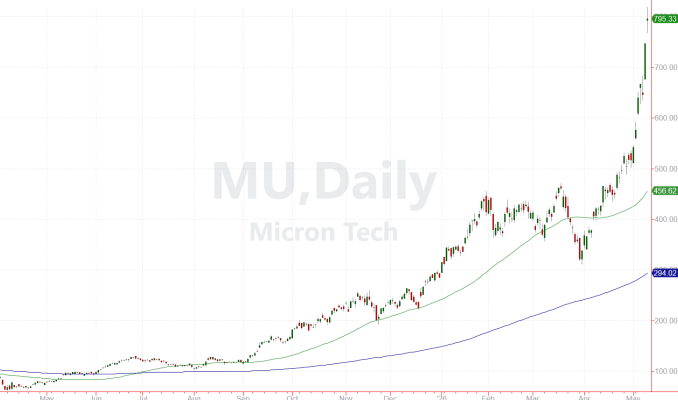
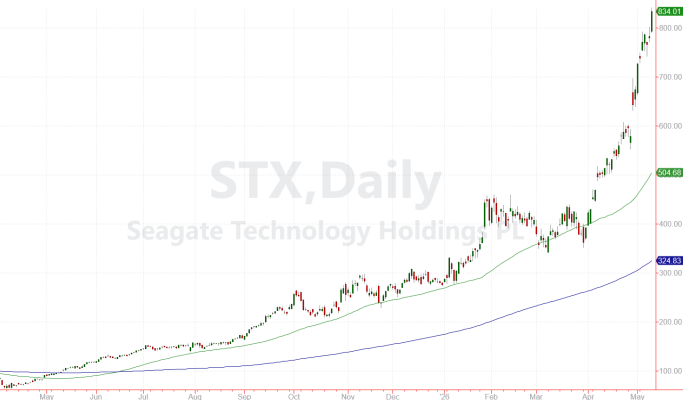
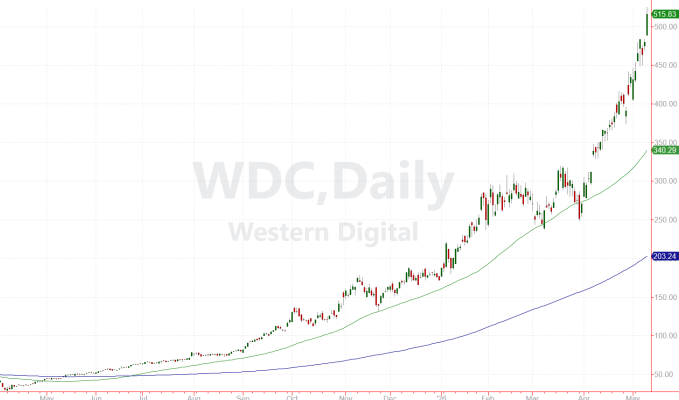
They've gone parabolic. Not "up nicely." Parabolic: The kind of chart where the price line stops looking like a trend and starts looking like a launch trajectory.
Seagate has gone from around $100 a share a year ago to over $830.
Micron has gone from under $100 to nearly $800.
Western Digital has climbed from under $50 to over $515.
These are not small moves. These are once-in-a-career moves for investors who have been holding.
And here's the thing: The story behind these stocks is genuinely good!
Data centers are hungry for memory. AI infrastructure demands are real and growing. There's a supply shortage that these companies are capitalizing on right now.
Even on a valuation basis, if you look at current earnings and reasonable one-year-out estimates, these stocks aren't wildly overpriced.
The bull case is real. I'm not arguing against it.
But I've been in this game long enough to know that the bull case and the chart don't always get to exist peacefully at the same time.
Why Parabolic Moves Are Dangerous... Even For Good Companies
When a stock runs this fast, this far, something subtle shifts in the investor base.
The people who bought at $100 and are now sitting on gains of 700% aren't just excited anymore. They're nervous. They're watching every tick. They're doing math in their heads: "What does this look like if I give back 30%? 40%?"
That psychology changes how they behave.
They're not adding to positions. They're watching for exits. And when enough investors with huge gains start watching for exits at the same time, it doesn't take much to start a stampede.
Here's the number that made me stop and stare this week: a 40% pullback in Western Digital would bring the stock back to roughly where it was trading in early April.
One month ago.
That's how much ground these stocks have covered, and how quickly that ground could be given back if the selling starts in earnest.
We've seen 20%, 30%, even 50% corrections follow parabolic runs like this. Not because the companies are bad. But because the gap between price and gravity gets too wide to hold.
What I'm Watching For
I'm not positioned bearish on these stocks yet. The music is still playing, and I've learned the hard way not to fight momentum until it actually breaks.
But I'm watching closely for two specific signals.
The first: a day where one of these stocks opens higher... everyone's excited, more good news...
And then the stock slowly bleeds lower throughout the session, closing near the lows of the day. In technical terms, that's called distribution. The big money is quietly selling into the enthusiasm.
When you see that pattern after a parabolic run, it's a warning shot.
The second: a day where news hits (even slightly disappointing news) and the stock opens lower and then can't bounce. No buyers step in. The stock just sits heavy at the lows. That tells you the bid has dried up.
Either one of those scenarios, especially if it repeats over a few days, tells me the probability of a sharp decline is high. And close.
How I'm Planning to Play It
When I see those signals, I plan to move quickly. My vehicle of choice will be in-the-money put contracts: options that gain value as the underlying stock drops. In a fast move, these can generate returns of 50%, 100%, or more in a short window.
Could the overbought condition last longer than I expect?
Absolutely!
I've seen momentum grind higher for weeks after I was convinced it had to roll over. I'm not predicting the exact day the music stops. Nobody can.
What I AM saying is that when it stops, it will stop fast. And I want to be ready to pounce when it does. Not scrambling around looking for a seat.
The potential trade here isn't a long-term bearish thesis on these companies. It's a short-term bet that when the sellers finally show up, they'll show up all at once.
Even a week or two of sharp downward pressure could be enough to turn a well-placed put trade into a very profitable one.


Comments
Log in or sign up to join the conversation.