


Quick quiz. What does “Level 5” mean to you?
If you’ve read anything about self-driving cars, you’ve probably run into this scale.
It goes from Level 0 (a human does everything) to Level 5 (the car drives itself, anywhere, no human needed at all).
The auto industry has spent the better part of two decades inching up that ladder. Most of what’s on the road today tops out around Level 2 or 3.
So when I tell you a company just announced it hit Level 5… you’d assume we’re talking about cars.
We’re not.
We’re talking about a company that designs computer chips. And most people have never heard of it.
The Blueprint Before the Chip
Before a chip like an NVIDIA (NVDA) processor can be manufactured, somebody has to design it.
And just as importantly, somebody has to verify it. Every wire, every logic gate, every connection has to be checked and re-checked, because a mistake that slips through isn’t found until the chip is already etched into silicon. By then, fixing it costs a fortune.
The company I want to show you today, Cadence Design Systems (CDNS), makes the software that does exactly that.
Think of Cadence as the architectural firm and structural engineer for practically every advanced microchip on Earth, working out every detail before a single wafer gets made.
A Moat That’s Nearly Impossible to Crack
Here’s what makes this business so interesting.
Cadence and one other company, Synopsys (SNPS), control roughly 85% of this entire market between them.
Practically every advanced chip made today (by Nvidia, AMD (AMD), Broadcom (AVGO), Apple (AAPL)…) passes through software from one of these two companies before it ever reaches a factory floor.
And once a chip company picks Cadence, they don’t switch. Customer retention runs close to 100%.
Think about why.
An engineering team spends years mastering one company’s design tools on a chip family. Switching to a competitor mid-project would be like changing architectural firms in the middle of building a skyscraper.
The risk of costly mistakes is too high. So once you’re in, you stay.
The Level 5 Moment
Now here’s where it gets genuinely wild.
In June, Cadence, working closely with NVIDIA, announced that its ChipStack AI system had reached full Level 5 autonomy. The industry’s first fully autonomous AI chip design engineer.
What does that actually mean?
Verifying a chip design used to require an engineer to write tests, run simulations, comb through the results, find the bugs, fix them, and run it all over again.
Over and over.
It’s exhausting, meticulous work, and it can take weeks.
Cadence’s Level 5 system does that whole loop on its own. It writes the tests, runs the simulations, finds the bugs, proposes fixes, and keeps iterating, all without needing an engineer to walk it through each step.
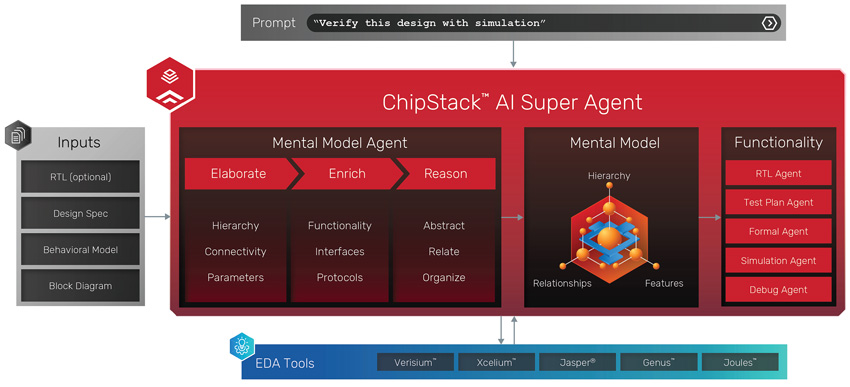
The humans stay in charge, reviewing the results and signing off. But the grinding, repetitive work now runs itself.
The results are already showing up in the real world. A verification cycle that traditionally took five weeks of human effort is now finishing in less than a day.
That’s a 40-times speedup.
And this isn’t a lab demo. It’s already running in production at NVIDIA, and chipmakers like Altera and Tenstorrent are seeing similar results. (Altera reported more than a 10-times improvement on its flagship chip projects. — source: DesignLines)
Why the Timing Matters
I always watch how Wall Street analysts revise their earnings estimates. This data tells me a lot about whether a company is meeting expectations, or forcing analysts to make adjustments.
In the case of CDNS, analysts have been steadily raising their profit estimates throughout this year.
That’s not analysts guessing on optimism. That’s analysts reacting to a company that keeps outperforming what they expected, forcing them to mark their numbers up again and again.
That kind of revision trend tends to act as a tailwind for a stock. It’s exactly the signal I look for when I’m hunting for names on the bullish side of my watch list.
Which is exactly why Cadence just earned a spot there.
The Stock
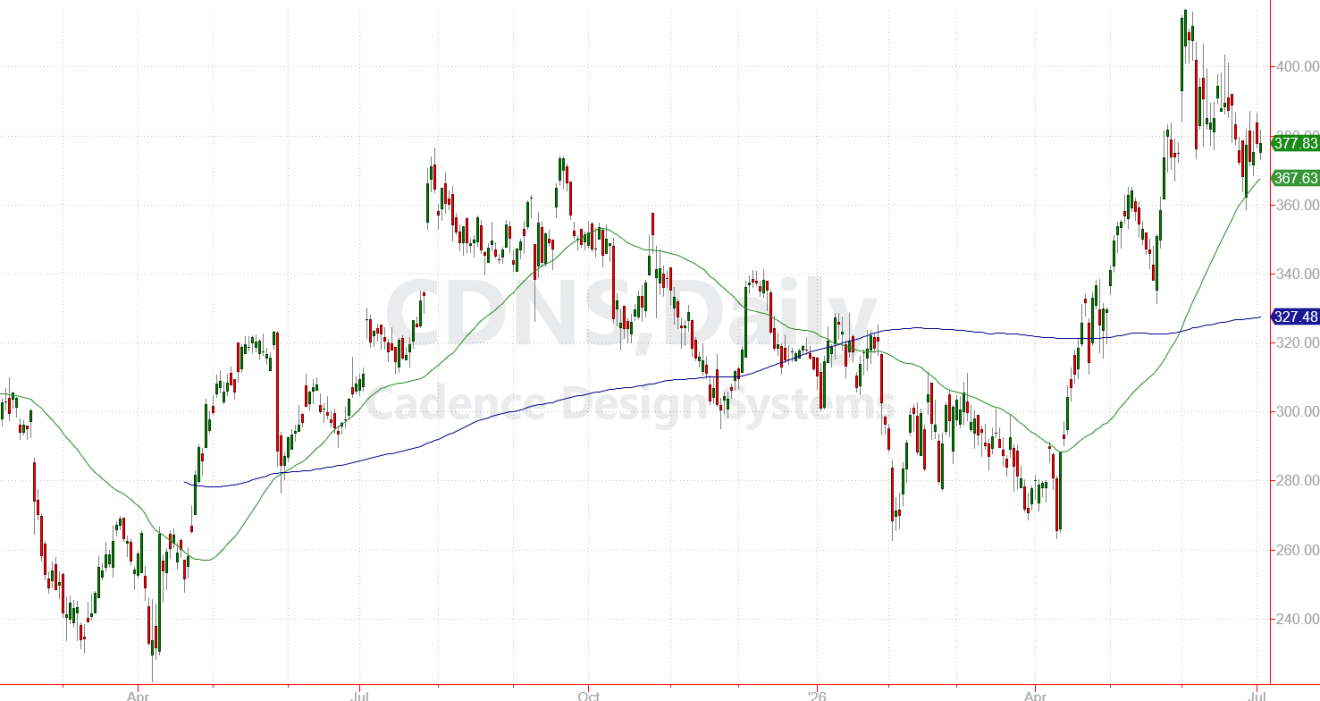
CDNS currently trades around $380. The stock hit a new high in early June before pulling back as the broader AI trade cooled off.
Shares found support at the 50-day moving average, a good sign the pullback was healthy rather than the start of something worse.
Analysts expect the company to earn just under $8 per share this year, growing to over $9 in 2027. Shares trade near 40 times next year’s expected profits.
That’s not a cheap stock. But it’s a valuation that’s been getting easier to justify with every earnings estimate that gets revised higher.
Next earnings report: late July.


Comments
Log in or sign up to join the conversation.