


Just a couple of quick hits today, starting with the Glenmede Global Secured Options Fund (NOVIX).
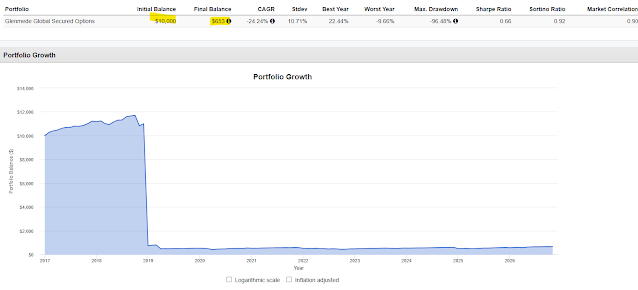
That's a price-only chart. Here's total return.
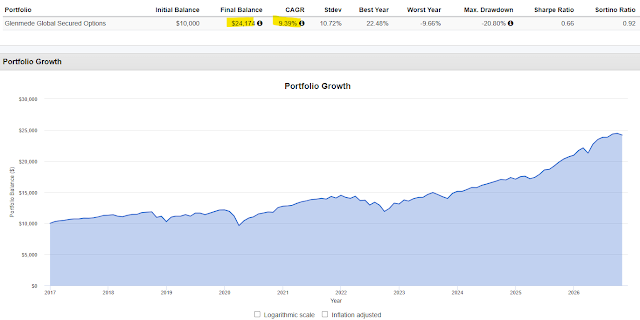
The fund isn't very yielding. The one huge drop-off is a $9 capital gains distribution. In an IRA account, it doesn't matter; the distribution can just be reinvested, but in a taxable account, that could be a serious problem. Not every strategy fits neatly into the ETF wrapper, but where you have a choice, go with the ETF. Mutual funds report any unrealized gains or losses to help people avoid buying a fund right before a massive distribution. NOVIX has had a couple of disproportionately large distributions in its history, but nowhere close to the one for $9.
Last month we looked at a Bloomberg article about "dividend nomads," some of whom live off of distributions from derivative income funds. The Trillions podcast did a follow-up on the article that was fun to listen to. Hosts Eric and Joel had the writer of the article on (makes sense) and an advisor who doesn't have any clients doing this, so I don't know why he was on. The general take was that it can work with funds that have JEPI-like yield, but it would be optimal.
That's pretty similar to our conclusion, but there does need to be an ability/willingness to live on less of a payout in a down market. The S&P 500 isn't going to go out of business, so any fund referencing the S&P 500 and not incinerating its NAV should also not go out of business. That doesn't mean it's optimal, just that there's not much risk of it completely failing. Here's one that I think is an NAV incinerator, continuing to erode quickly and eventually reverse splitting.
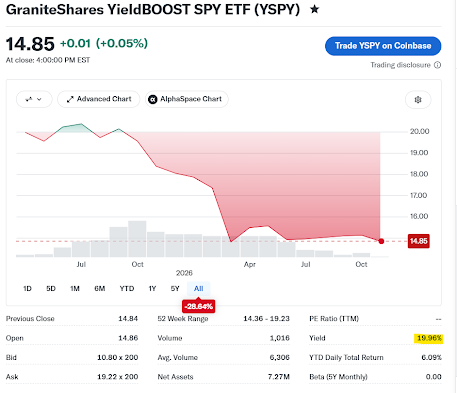
I don't think JEPI or SPYI are NAV incinerators. Living on derivative fund income is still probably better thought of as a bridge to the next financial milestone rather than something a 40-year-old FIRE guy should plan on sustaining for 50 years.
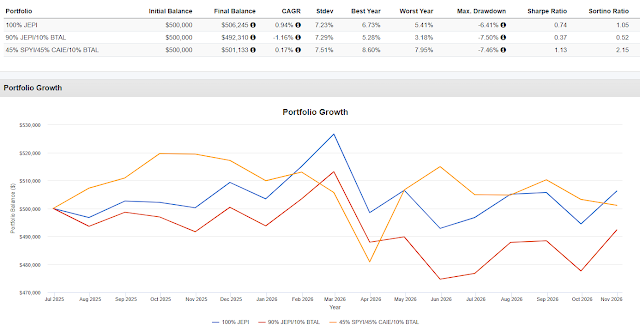
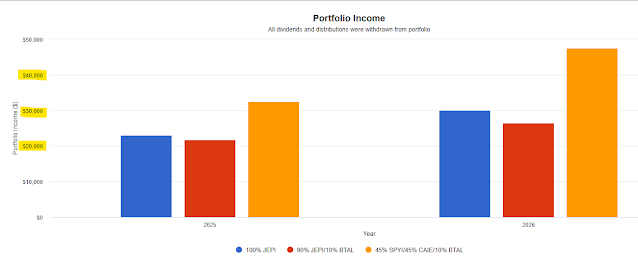
Those are price-only returns, and you can see the income levels for $500,000 invested. These portfolios are not very robust. 100% in JEPI has no robustness. Putting 10% into BTAL potentially becomes a source of funds if the market drops a lot, causing distributions to go down. If the S&P 500 drops 30%, the need to hedge with BTAL or anything else becomes less. You probably don't need to hedge against a large decline after a large decline. Mixing SPYI and CAIE isn't really diversifying; they both reference the S&P 500. Portfolio 3 has a higher yield than the ones that own JEPI, but I don't think of that as NAV incinerating; I would expect erosion if the market has smaller gains than it has in recent years. Portfolio 3 wouldn't owe taxes for a while, as both funds return capital for their distributions. You can look up why that is if you are unfamiliar.


Comments
Log in or sign up to join the conversation.