


From Ben Carlson;
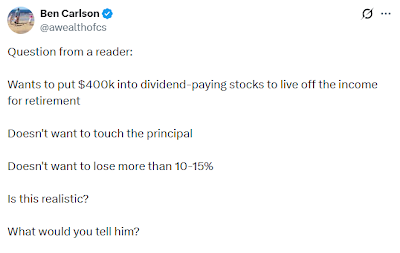
Is it realistic? How realistic is it? What parts are realistic? In his blog post, Ben talked about the mechanics of how dividends work. If you have $100 in stock and the company pays out $1 in dividends, you now have $99 worth of stock and $1 in cash. If you spend the dollar, then you just have $99 in stock, and that's it. Maybe I misunderstood, but he seemed to discount the idea because of these mechanics and needing to price appreciate that $1 in dividends back.
He did say that just living off the dividends without touching the principal was the "retirement dream." People like dividends/distributions, so the better question is: can a dividend-centric portfolio in this context outgrow its yield? If so, then it is at least partly realistic.
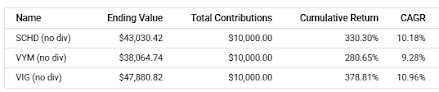
Quite clearly, it is possible. The above three funds' numbers go back to late 2011; those are price-only returns. Whether owning one or more dividend ETFs is a good idea or optimal is another discussion, but if the stock market goes up most of the time, it is a reasonable probability that dividend funds that are not crazy high yielders or NAV incinerators can have a growth rate that exceeds their yield. The next time we have a lost decade, that might not be the case, but then if we have a lost decade, growth for simple market cap weighting would also be lost.
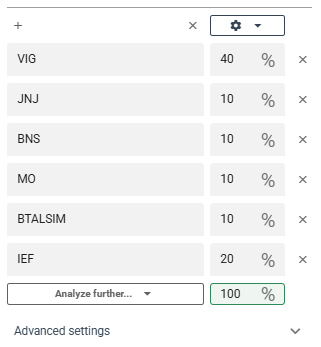
This mix allows us to backtest just over 20 years. I've owned JNJ and BNS for clients since 2004. I owned MO back then but switched to PM when the company split.
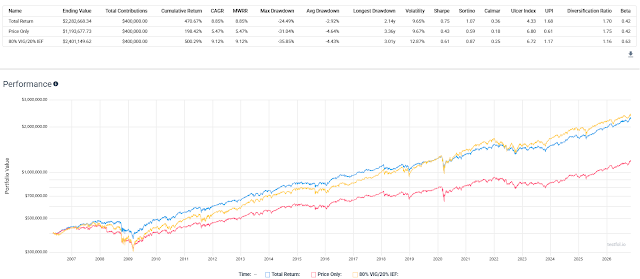
Using BTAL speaks to the reader's concern about drawdowns. Having 10% in BTAL brings down the volatility and helps with drawdowns, but there are some declines that portfolios can't hide from.
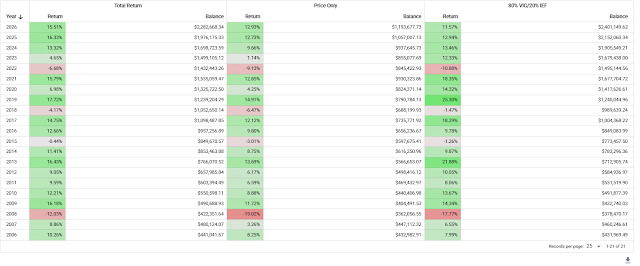
But 2008 was the only calendar year where the price-only version exceeded a 15% decline. There were a handful of very fast declines, though, where the 15% level was breached. That could be offset with more than 10% in BTAL, but the more in BTAL, the less that is producing income. There's a tradeoff here that the reader would need to sort out.
Here's an updated version that swaps out 20% in IEF for 20% in SHRIX. This allows us to go back 10 years.
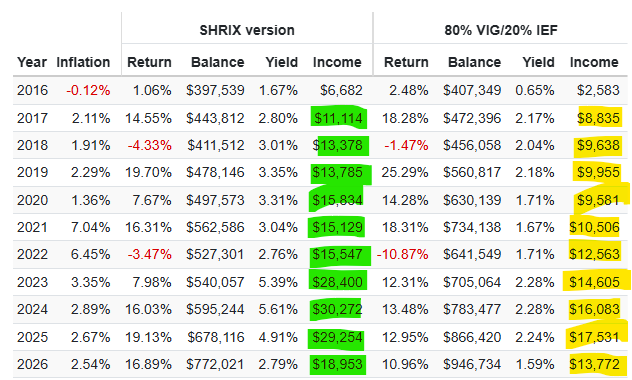
We're getting far more income, obviously, which is what the reader wants, but the tradeoff is a lower price-only growth rate.
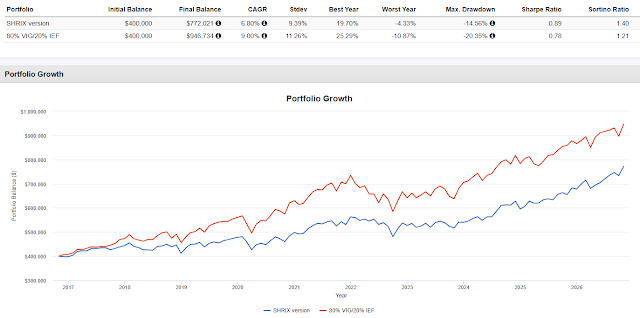
There's still 6.8% in growth after taking out the income versus an inflation rate of 3.39% for the period tested. The dividends for the stocks and ETF should be qualified, but not the dividends from SHRIX.
This can work with tradeoffs. Here's an example of something that probably can't work as a long-term plan.
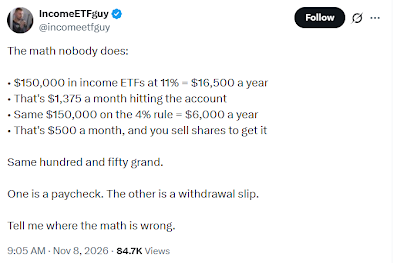
Funds like JEPI, SPYI, or BALI have distributions in this neighborhood.
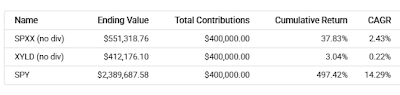
That goes back to mid-2013 and actually is better than I expected as I was typing the previous sentence. Adjusted for inflation, SPXX compounded at a negative 0.48% and XYLD at negative 2.33%. While this is not a great long-term portfolio strategy, we've looked at this sort of thing in the context of a bucket strategy needing to last maybe eight-ten years to get someone to the next financial milestone like Social Security or RMDs. Success here is not riding out SPXX for 30 years but being willing to exhaust a smaller piece of money over a much shorter period.
Success would be something like hoping to make this type of bucket or bridge last for 10 years; like I said, getting to ten years having depleted most of it but maybe having enough leftover for an emergency fund. In 2016, someone did this with $400,000; they've been taking a long-term unsustainable $40,000 out per year, and instead of having zero today in that account (which would be ok), they have $100,000 left over for a robust emergency fund. Saying it more plainly, you expect to deplete the account, but instead you have some left over. That is plausible; counting on 11% forever is probably doomed because of longer-term growth rates not being that high and loss of purchasing power.
Comments
Log in or sign up to join the conversation.