


The Monday email from Finominal looked at whether there is any added benefit to leveraging investment portfolios. My use of the word up is not fair; really, the idea is whether using leverage for better diversification is additive. The following is what they studied.
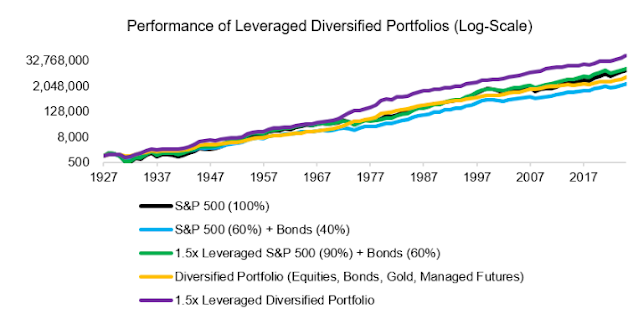
We can't go back 100 years on testfol.io, but I think we can go far enough back to be useful.
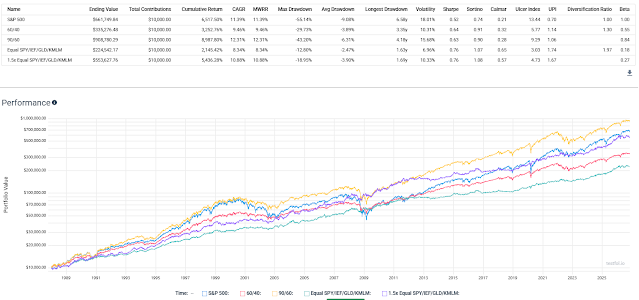
The result for 90/60 being better than the straight S&P 500 is consistent with the backtesting done by WisdomTree (WT) to support their NTSX ETF. The next image adjusts the growth rates for inflation.
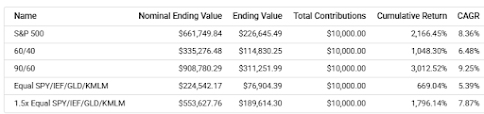
A real return of 5% is a common target for endowments. Portfolio 4 obviously has the lowest growth rate, but it also has the lowest volatility by far and a pretty small max drawdown when you think about all the crazy things that have happened since 1988, and the beta is only 0.18. All good, but the differences in compounding are meaningful. Portfolio 4 has grown to $224,000 while simple 60/40 is $335,000. Yes, 100% equities did much better than both, but someone really needs to look themselves in the mirror about going 100% equities and being able to hold on no matter what.
Someone could put it all in NTSX, so levered up, but that would have meant being down almost 30% in 2022 versus 18-19% for SPY/IEF. The math checks out, of course, but enduring 30% requires enduring 30%. There's not a tidy this is best for everyone answer here. We talk frequently about understanding our own emotional limits for our investment portfolio as well as the tradeoffs to whatever we decide. Going full NTSX should result in a better long-term result but with more pain along the way. Portfolio 4 is very unlikely to keep up with the others, but I would expect very little anguish along the way.
Where this exercise is quadrant-inspired, the Permanent Portfolio Fund PRPFX compounded at 7.08% for the period studied, with a volatility of 8.94%. I feel like most of the investment industry would consider the permanent portfolio idea to be valid but clearly not always optimal, but nothing is always optimal.
I don't think it is that difficult to assess the pros and cons of most of the portfolios we explore here. With today's example, a portfolio with a 25% weight to equities might be all-weatherish; I would say Portfolio 4 fits that bill. It's not going to keep up with a portfolio that is 60% equities.
The other day, we used a Twitter fight as an opportunity to look at a new (to us) ETF that fits in with some of the other funds that we've looked at over the last few weeks. Over the weekend, the Twitter fight drew a lot more attention, really a lot. I think this screenshot gives some context of how the instigator engages on Twitter.

The Hedgeye company that McCullough runs is a research shop; they have some ETFs, and there is a very active trading service. Hedgeye runs a lot of ads about learning their process, which includes a universe of 140 ETFs that allows them to "go anywhere, not everywhere."
Based on all the back and forth I read over the weekend (I couldn't help it!), the success is very questionable, but there are plenty of people (or bots, maybe; I don't know) that were very supportive of Hedgeye. But the 140 ETFs, and I also believe there are individual stocks involved too, are interesting to me.
The trading appears to be very active, and if they exercise all 140 ETFs frequently, that is going to be hard to keep track of. This all helped me crystallize a couple of things we do here that I hope are productive for readers but that I know help me.
You have probably noticed that when we explore portfolio theory, we use a much narrower universe of funds. I am very much a believer in holding long term when possible. By using far fewer funds for blogging purposes, I think it creates the effect of regular readers getting a sense of how these funds do through various events. I first started writing about SHRIX for cat bonds three years ago. Cat bonds are a core holding; the weighting is small, though, and most portfolios we experiment with include SHRIX. Love the idea or hate it, if you're reading this blog regularly, you are getting a sense of how they do.
There are others too, of course; cat bonds are just an easy example. Clients own EMPIX, not SHRIX; SHRIX has a much longer track record, which makes for better backtesting. EMPIX is managed to have even less volatility than SHRIX, which is why I prefer that one.
The continuity makes it much easier to learn versus being all over the place with very frequent trading changes.



Comments
Log in or sign up to join the conversation.