


In response to yesterday's post about living on dividends without spending principal, a buddy left a comment on Bluesky noting the strategy/idea is more difficult than it seems, which is where the title for this post comes from. At his suggestion, I took a look at a preferred stock ETF, and I threw in PFD, which is a closed end fund that invests in preferred stocks.
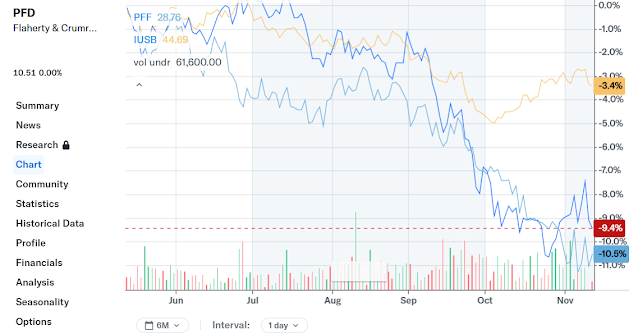
IUSB has been no great shakes either, but yikes for PFD and PFF, which is an iShares Preferred Stock ETF. Preferreds sound good in theory, but they are tough to live with in practice. This was also the case for individual bank preferred stocks in the Financial Crisis; they got pasted.
I try to really hit on what it's like to actually own various types of assets and strategies versus just looking at a pretty backtest.
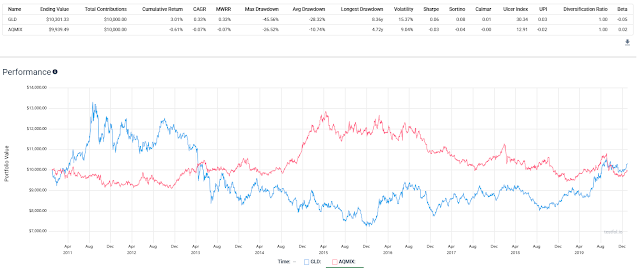
Managed futures always backtest fantastically well as part of a diversified portfolio; gold too, to a lesser extent, but nine years is a very long time to compound at zero. A 3-5% diversifier is one thing, but 25% is something else entirely. It's not that a portfolio couldn't succeed in that nine-year period, but sitting with a huge allocation to something that isn't growing for nine years will be very challenging.
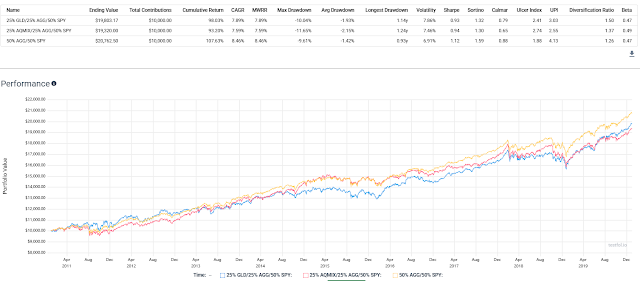
The portfolio with 25% in GLD had a two-year run in the middle where it lagged noticeably, but the overall nine-year period, the backtest is fine. I know 25% in one alt is the wrong path for me; I'm not saying it's wrong for anyone else. You all can decide for yourselves, but it is important to consider what enduring a long stretch of an asset just sitting there doing nothing would feel like if it happened again.
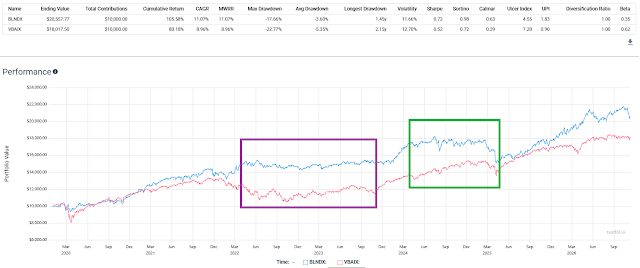
If I were forced to own just one fund, I guess it would be BLNDX. It's hard to argue with that backtest. It has delivered in terms of the expectation that I believe the managers set when the fund launched. I doubt that the period inside the purple box would have been very challenging, as it went sideways while 60/40 had a very painful drawdown. During the period in the green box, though, BLNDX again traded sideways while 60/40 did very well. If BLNDX does well because it is willing to differentiate, that's part of the story; then anyone buying the fund needs to be ready for a repeat of the pattern in the green box or maybe worse.
Actually, the idea for BLNDX came about because, as strong a diversifier that managed futures is, it is very difficult for many investors to hold on through thick and thin. Blending the two is an attempt to solve that problem.
It's easy to throw a bunch of things into testfol.io and play around until you get something that looks good, but hopefully you also take my context of trying to paint a picture of what owning these various alts and strategies will actually be like, repeated for emphasis.
One last point.
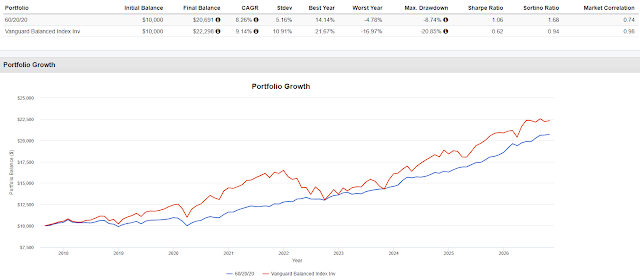
The blue line portfolio is a variation of an idea we looked at a couple of weeks ago that puts 60% into diverse alts and 20% each into equities and fixed income. The backtest is fantastic, but look at the year-by-year results.
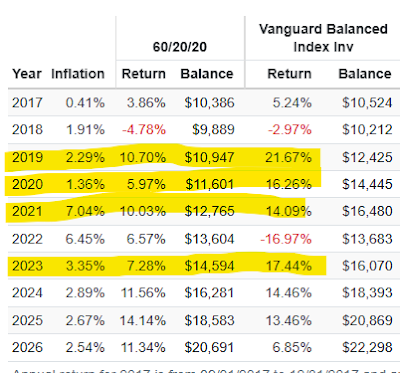
How difficult would it have been to stick with it after stumbling out of the starting blocks and through that three-year period where the lag was enormous?
Linear modeling, lumpy living.

Comments
Log in or sign up to join the conversation.