


Sentiment was modestly firmer on Thursday morning, although as oil swung into the positive, index futures turned lower. Reports that Iran’s supreme leader has issued a directive that its uranium must stay in Iran hurt sentiment. Whether that is a dealbreaker remains to be seen, but oil did pop higher by $4 on the news, while European markets and US index futures slipped back into the red. For now, the mood across stock markets remains cautious rather than outright bullish. Investors are still weighing the implications of another sharp move in oil prices, while Nvidia (NVDA)’s latest blockbuster earnings failed to generate the kind of excitement that would normally accompany such numbers.
Will we see a deal?
Crude oil prices dropped heavily in the previous session after renewed optimism emerged around a possible US-Iran agreement. Remarks from President Donald Trump, combined with reports that two super tankers had successfully navigated the Strait of Hormuz, briefly eased fears surrounding global supply disruptions.
Still, traders were reluctant to fully price out geopolitical risk and so far, they have proven correct and oil has rebounded. Trump reiterated that military action remained an option should negotiations break down and made it clear he was under no pressure to finalise a deal quickly. That tempered the sell-off in oil and served as a reminder that inflation risks tied to energy markets have not disappeared.
Markets have already attempted once this month to position for a breakthrough between Washington and Tehran, only for optimism to fade shortly afterwards. This latest attempt feels more restrained. Investors appear far less willing to aggressively chase headlines given the increasingly confrontational rhetoric coming from both sides and the lack of tangible progress so far.
Keep an eye on bond yields
The US 30-year Treasury yield briefly climbed to 5.20% yesterday, its highest level since 2007, before retreating alongside oil prices. But the broader trend remains troubling. Indeed, yields have bounced back today. Before the escalation of the US-Iran war, markets had been moving steadily towards a softer inflation outlook, with markets pricing in further easing of US monetary policy. But roughly three months later, yields soared due to a substantial repricing and all to do with the closure of the Strait of Hormuz. Even so, US technology stocks have surged higher, and the S&P 500 chart has only recently pulled back from its all-time highs again. But if yields start pushing higher again, then this may trouble some of the momentum trades and lead to a potential correction in equity markets. On the flip side, any de-escalation is likely to trigger a bond market rally and result in weaker yields. That scenario should provide support. Again, it all depends on oil prices and the Strait of Hormuz.
Nvidia delivers again, but expectations were already elevated
Nvidia once again comfortably exceeded Wall Street forecasts, beating on both earnings and guidance while also announcing an increase in its quarterly dividend to 25 cents per share. Under normal circumstances, those figures would have sparked another powerful rally.
However, the issue for Nvidia now is not whether the company can beat expectations, but by how much. Markets have become conditioned to exceptional results from the AI giant, and that creates an increasingly difficult hurdle for the stock to clear each quarter.
Attention now shifts toward Walmart (WMT) earnings ahead of the opening bell. As the largest grocer and one of the biggest private employers in the United States, Walmart’s outlook will offer another important read on the health of the US consumer and broader demand conditions.
Strong earnings continue to support risk appetite
For now, equity markets remain underpinned by what has been a remarkably resilient earnings season. Corporate guidance has generally improved, analysts have revised expectations higher, and that has provided a solid foundation for risk assets despite ongoing macro concerns.
At the same time, investors remain uneasy about the broader economic backdrop. Sticky inflation, elevated borrowing costs and signs of softer consumer demand continue to linger beneath the surface. That combination is preventing traders from embracing risk with complete confidence.
It is also worth noting that equity markets have spent several weeks gradually pricing in the possibility of easing geopolitical tensions in the Middle East. While oil retained a meaningful risk premium, broader indices have already partially discounted a more constructive outcome. As a result, even if a US-Iran agreement were eventually secured and crude prices declined sharply, the upside reaction for US equities may prove relatively limited.
Another issue quietly developing beneath the surface is weakening market breadth. Much of the rally over the past month has been concentrated within a relatively small group of AI-linked mega-cap stocks. If leadership within that segment begins to fade, the broader market may struggle to maintain the same momentum without stronger participation from other sectors.
S&P 500 (SPY) technical analysis
From a technical perspective, the broader trend remains firmly constructive. Nevertheless, markets are beginning to look increasingly stretched in the short term, and the likelihood of a near-term consolidation phase — or even a modest pullback — is rising.
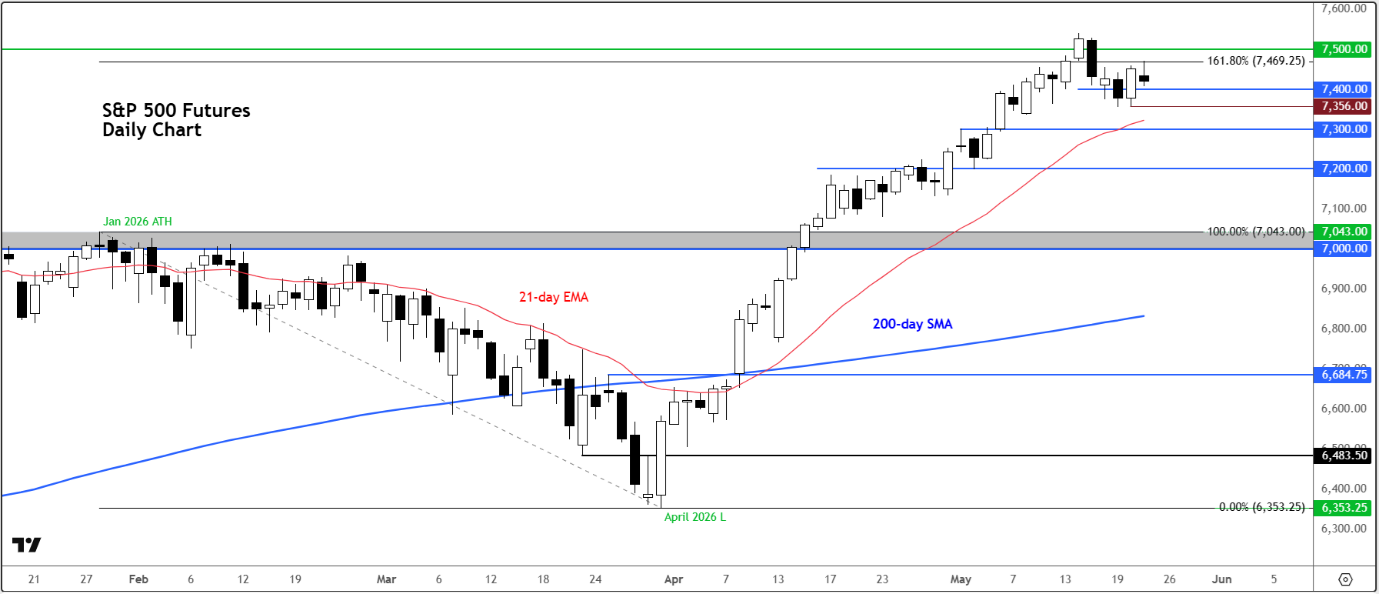
In fact, we have already seen a bit of a pause for about a week now. The S&P 500 future was trading around the same levels as it did last Wednesday. So, the pause I was warning about may have already happened. The key question now is whether that pause will continue to be a theme, or whether markets will push to new highs. A lot depends on oil prices and bond yields.
The S&P 500 futures contract has already pushed into the 161.8% Fibonacci extension of the major downswing that began in late January and concluded toward the end of March. That extension level sits around 7,470 and remains an area where traders have started to lock in profits.
The first support zone worth monitoring sits near 7,400. But should that level break and we move below yesterday’s low of 7,355, then there is nothing significant until the 7,300 region, which may prove more significant if profit-taking accelerates.
Longer term, the major support area remains between 7,000 and 7,043 — effectively the former all-time highs established earlier this year. To get to those levels, it would probably require fresh escalation in US-Iran tensions and therefore renewed gains in oil and bond yields.
On the upside, there are few obvious technical barriers beyond the psychologically important 7,500 level, which traders will likely monitor closely for signs of exhaustion or reversal behaviour. The all-time high from last Thursday comes in at 7540.
At this stage, any weakness may initially prove relatively shallow. Before a deeper correction becomes likely, markets would probably need to show clearer evidence that momentum itself is beginning to deteriorate more materially.


Comments
Log in or sign up to join the conversation.