


Outlook: Monday 12 to Friday 16 October 2026
Friday's rally gave equity investors some breathing room, but it didn't settle the argument about the cost of growth. The S&P 500 finished at 7,811.54, gaining 0.6% on the day and 1.2% over the week. The Russell 2000 lost 0.9% over the week. Large caps can keep the index moving higher while smaller businesses struggle, and that divide is the starting point for Week 42. This is a crucial earnings season about to start, and the jury is out as to whether resilience extends beyond a narrow group of winners.
Energy remains the awkward part of the recovery. Friday's early oil decline reversed, with reported WTI futures settlement at $91.85 a barrel and Brent at $104.72. While we closed higher on the week, we did so within a narrow range and appear to be consolidating after the push to new highs a few weeks back. The late Friday announcement of Russian diesel supplies offered a source of relief, but the volume imported is too small to count as a fix and we expect gas prices to rise regardless. Offshore production shutdowns and shipping insecurity still threaten the supply side, as do early reports of the Houthis hitting Saudi Arabian infrastructure. Energy costs in the intermediate term will contonue to rise.
With rising energy costs households are under real pressure here, reflected in the preliminary October consumer sentiment score which slipped to 46.3 from 48.1. Meanwhile, Thursday's unemployment claims release showed low initial claims alongside higher continuing claims. That combination potentially leaves room for spending to hold up, but nobody can yet quantify the result of a consumer worried about the higher cost of living over winter and tightening purse strings. We believe sentiment will worsen in the intermediate term regardless of stable/improving job statistics.
The calendar puts that distinction under scrutiny. JPMorgan and Goldman Sachs report on Tuesday 13 October, Bank of America follows on Wednesday, and TSMC's earnings conference is on Thursday. September consumer inflation arrives on Wednesday, followed by producer prices and retail sales on Thursday. Friday brings industrial production and import and export prices. There isn't a scheduled Fed rate decision during this outlook week, although the Beige Book and officials' appearances can still shift expectations. A reassuring earnings headline could have a short lifespan if inflation pushes borrowing costs higher again.
US indices: the rally still needs more participants
Leveraged funds became more defensive in E-mini S&P 500 futures between 29 September and 6 October. Their net short grew from 372,489 to 415,087 contracts, a deterioration of 42,598. They cut 12,230 longs and added 30,368 shorts, so this wasn't simply an adjustment on one side of the book. The signed net-position percentile was 12.0 within its rolling four-year history. That describes a relatively bearish position for this category, although some futures exposure may hedge other assets rather than express a standalone market forecast.
The Nasdaq comparison is useful. Leveraged funds improved their net position by 5,511 contracts to minus 19,212, adding longs and covering shorts. Its 77th percentile indicates a relatively high signed net position within its own history; it does not make that still-negative position net long. The contrast suggests greater willingness to hold growth exposure than broad S&P exposure at Tuesday's cutoff. It also leaves potential buying power if S&P shorts are forced to retreat, without telling us when that might happen.
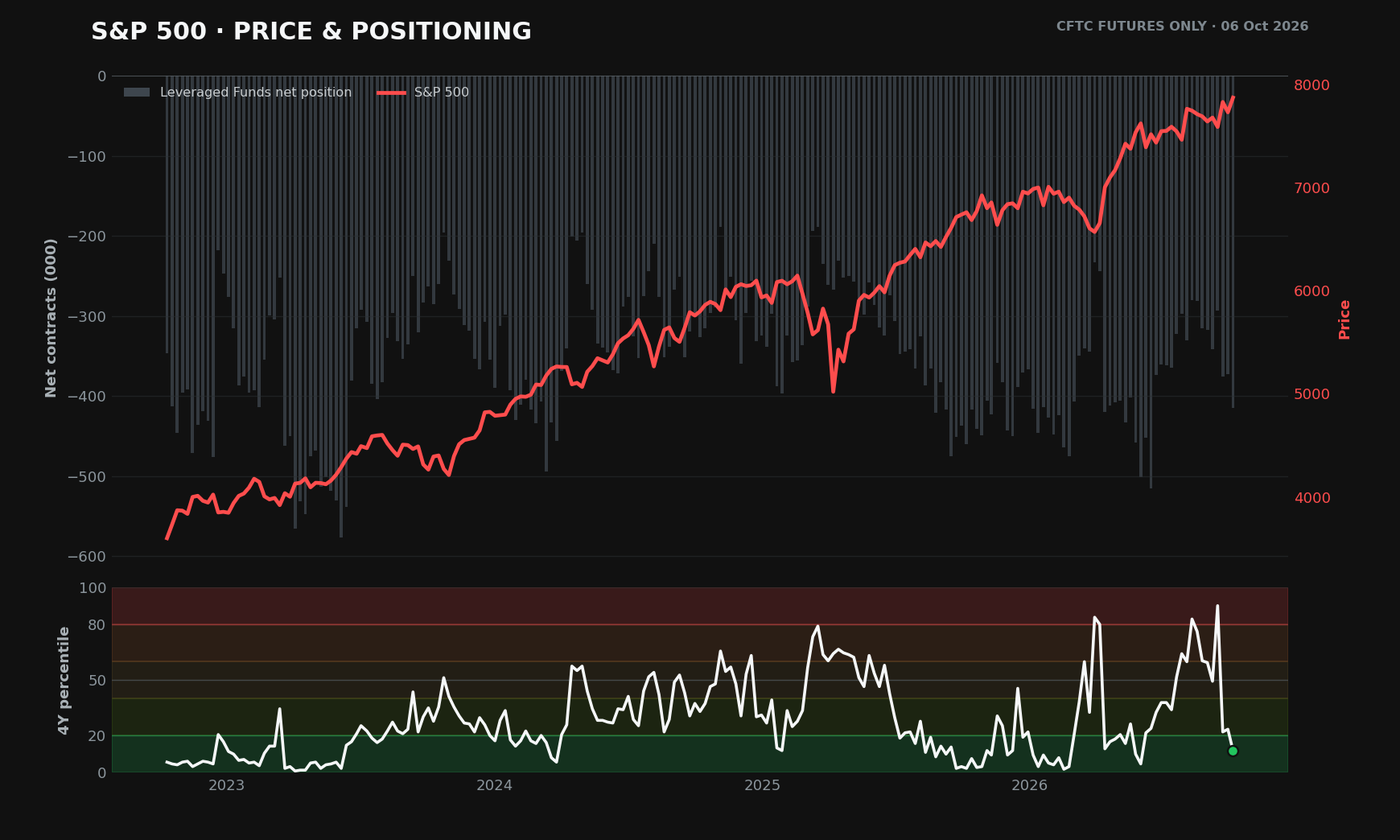
Wednesday–Friday positioning inference: the technology retreat followed by Friday's recovery is consistent with traders reducing risk and subsequently rebuilding it, or with shorts being covered during the rebound. Prices alone can't distinguish those explanations. We don't have post-Tuesday position counts, and the recovery doesn't establish that the defensive S&P stance has disappeared.
Participation is the check I'd put alongside price. Our breadth score was 37.2 on 9 October representing an improvement from the week before, while our sentiment score rose by 4.1 points, and we want to see this improvement hold through next week. This week's small-cap underperformance keeps the warning relevant, but Thursday also showed that weakness in large technology shares could coexist with gains in much of the wider market.
A broader recovery remains very possible here. SPY's five-year average path is uneven around the start of the coming week before improving, offering modest seasonal support rather than a reason to ignore the data calendar.
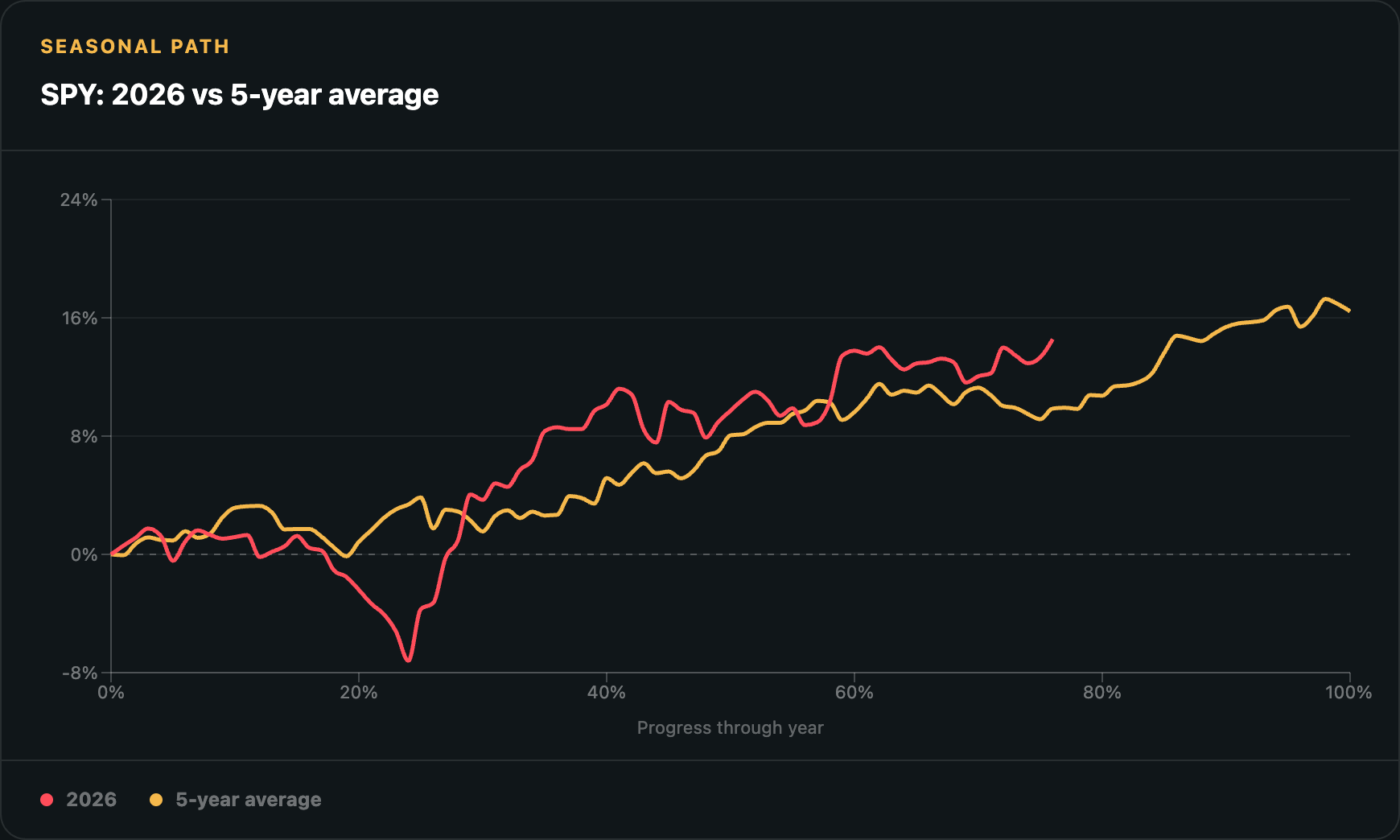
Last week we were looking for the rally to continue, and over the next week we still favour a hesitant upward bias in large-cap equities if bank results support the credit and spending outlook, and inflation doesn't provoke another yield jump. TSMC's guidance will help test expectations for AI investment. I'd become more constructive if equal-weight indices and smaller companies solidly joined the advance. A hot inflation release, weaker credit commentary or further shocks from the Middle East could hamper a rally, but overall i favour higher prices near term. In terms of positioning, the amount of short exposure creates scope for a squeeze, but earnings and news headlines have to give investors a reason to sustain it.
Gold: a recovery with a rates test ahead
Managed money reduced its COMEX gold net long from 120,318 to 110,987 contracts between 29 September and 6 October. The 9,331-contract decline combined 4,610 fewer longs with 4,721 additional shorts. Its four-year signed net-position percentile stood at 58.4, above the midpoint but hardly an extreme long. That leaves a different picture from indiscriminate demand for protection: funds retained substantial exposure while becoming less willing to hold it at the margin.
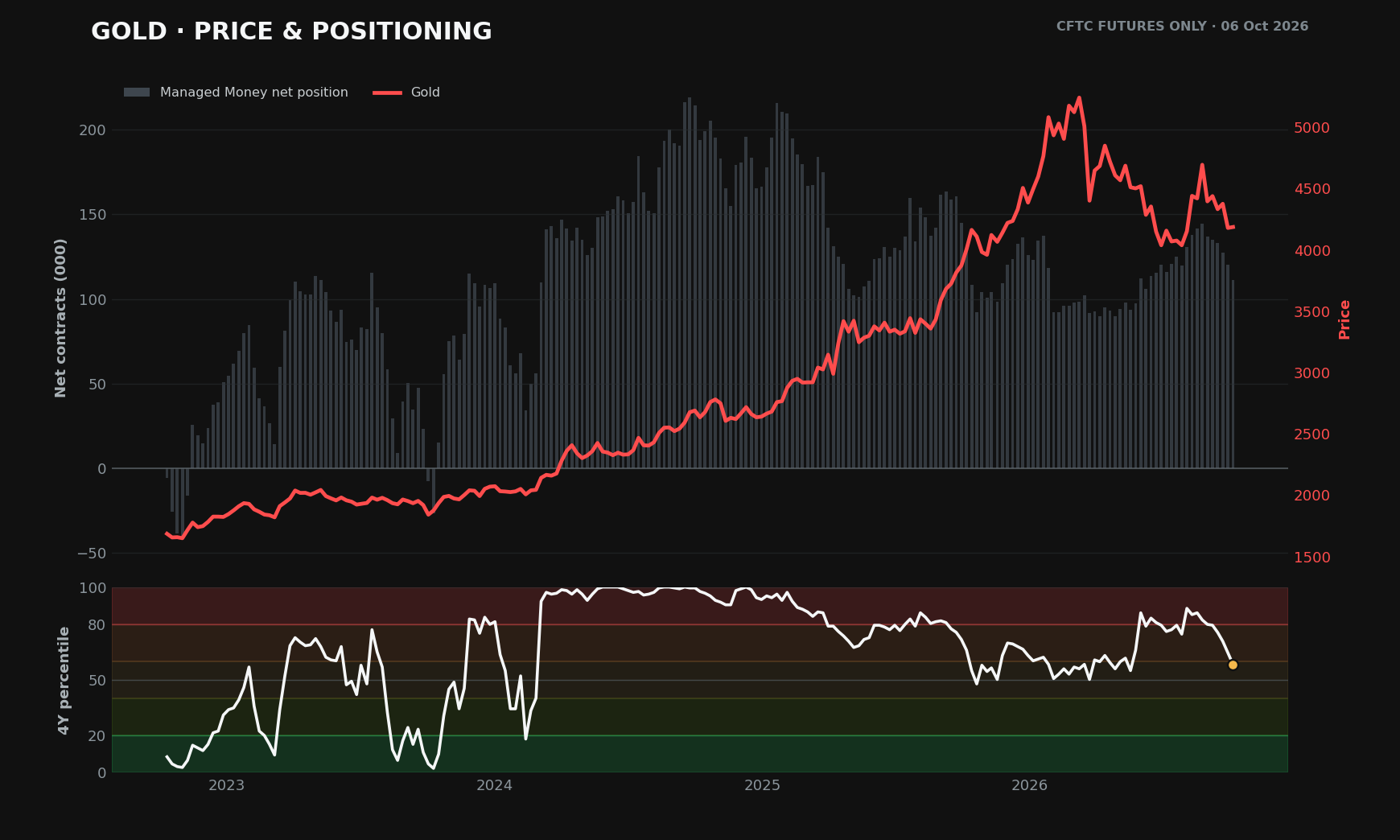
Wednesday–Friday positioning inference: the recovery following midweek weakness could reflect short covering, renewed defensive demand or both. Tuesday's combination of long selling and fresh shorts gives either interpretation room, but doesn't prove it occurred. The available late-week evidence supports a recovery attempt from support, and hints that we may have found a short term low.
The GLD 5 year seasonal path provides some supportive context, while its 2026 path remains well below that historical average, and a mean reversal would be a nice one to capture. Equity breadth provides background for risk appetite, but the real measure of demand for gold will be a rally in the face of headwinds from the dollar, real yields and when energy prices are firm. If we see an escalation of the ME conflict, and Democrats win the primaries to cause political uncertainty around foreign policy, we may see a strong rally into year end.
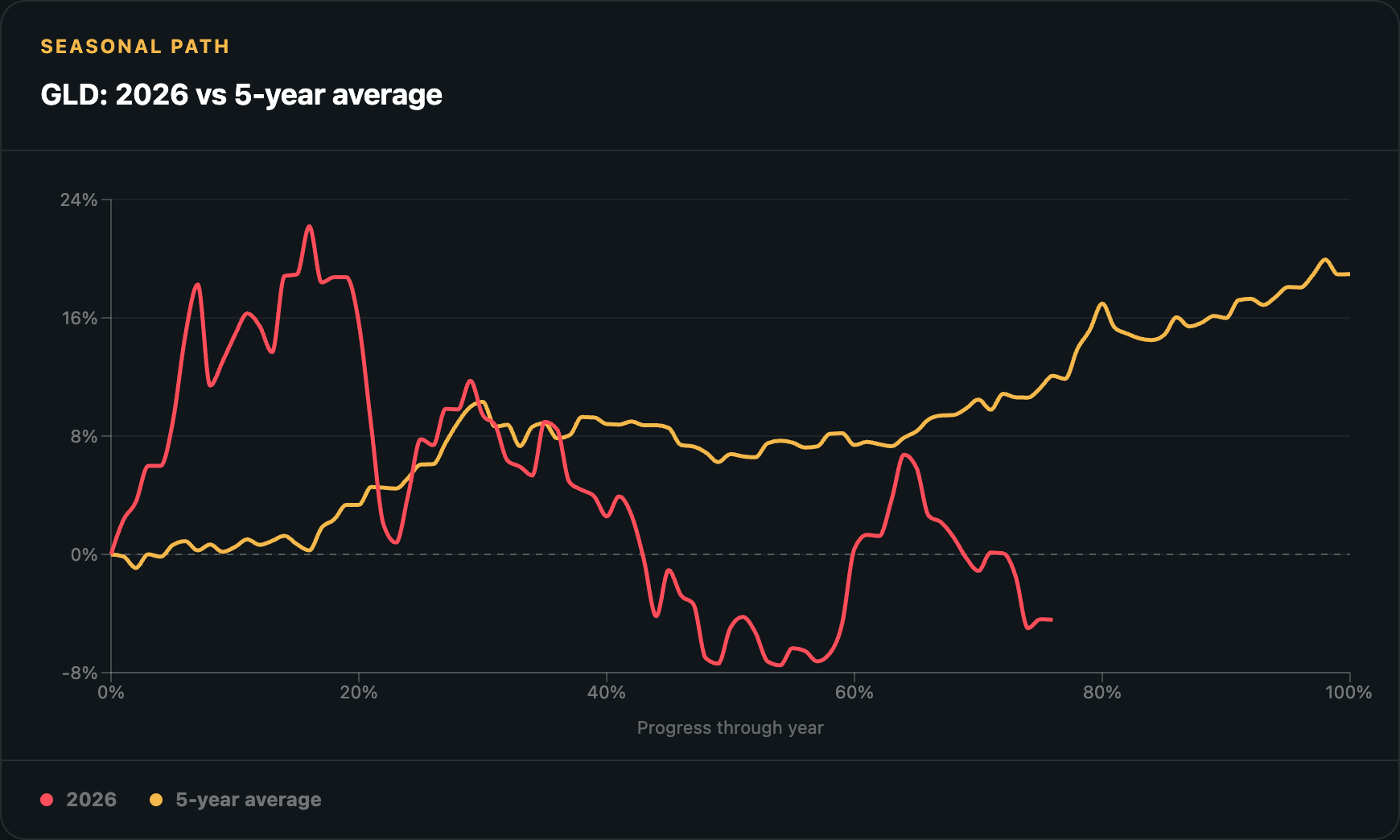
Last week we were looking for a potential low to form, and for the week ahead our bias remains cautiously positive provided the recovery survives Wednesday's inflation release. Softer inflation with resilient demand would offer a clean route higher. If inflation surprises higher and yields rise, we would expect a pullback to support followed by a recovery into the weekend.
Oil: promises of relief meet interrupted production
WTI's positioning showed a substantial retreat in commitment before the later supply headlines. Between 29 September and 6 October, managed money cut its net long from 79,592 to 53,598 contracts. Longs fell by 30,675 and shorts fell by 4,681, producing a net reduction of 25,994. The main action was long liquidation rather than an increase in bearish bets. At the 12.9th percentile of its four-year signed history, net length was relatively subdued, though still positive.
Friday's higher settlements make it difficult to call the supply problem resolved. The offshore regulator's Friday estimate put 71.51% of current Gulf oil production shut in, based on operator reports submitted at 11:00 CDT. That is a precautionary production interruption, not a measure of permanent damage. The speed of inspection and restart now matters. Russian diesel supplies could help refined-product availability, but the new licence doesn't verify cargo arrivals, and a diesel agreement doesn't automatically restore crude production or secure shipping routes.
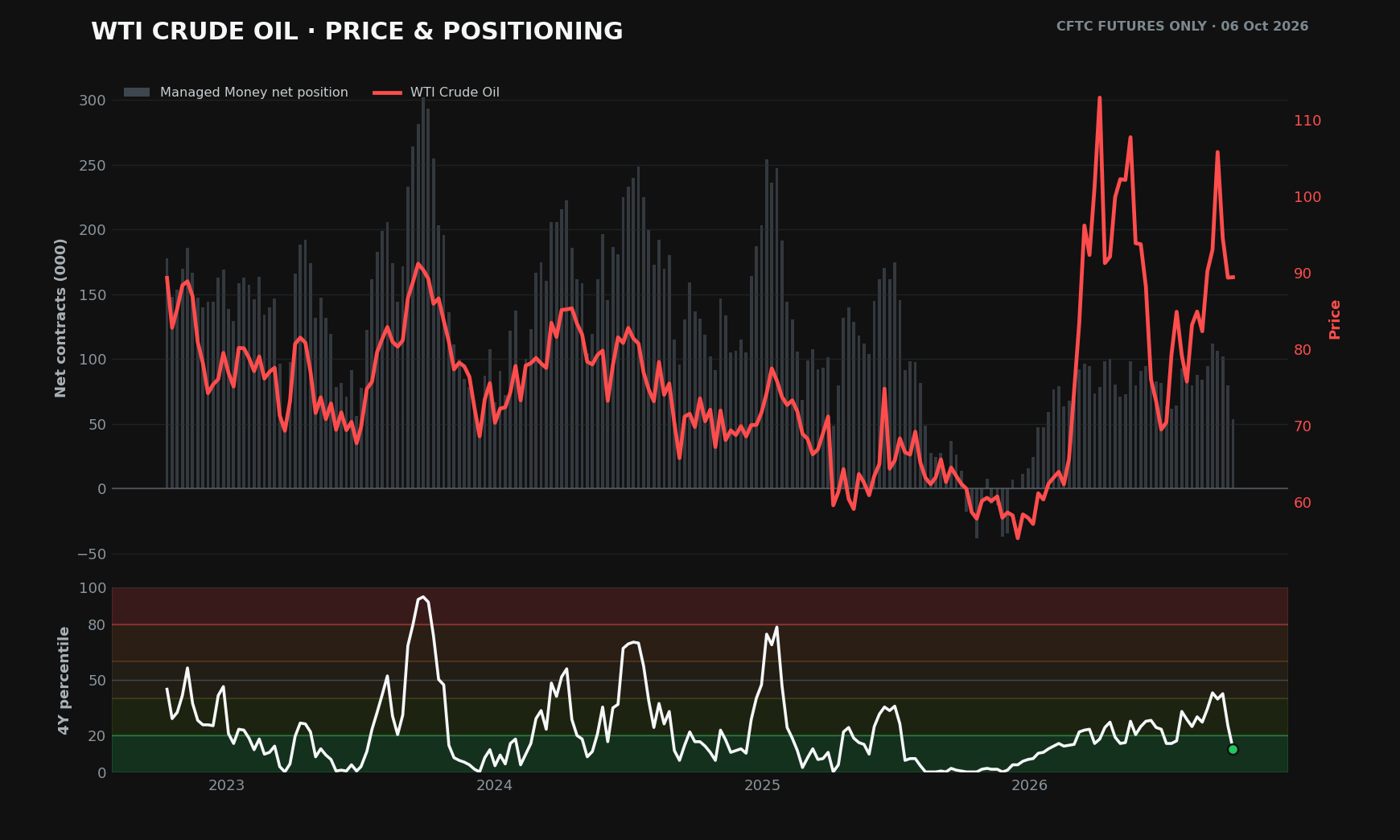
Wednesday–Friday positioning inference: the sequence of reserve-release relief, renewed disruption concerns and Friday's reversal could have encouraged both fresh buying and the covering of shorts. It could also have persuaded remaining longs to sell into strength. The weekend ME news hints at further supply disruption, and we are therefore wondering if we have found a tradable low.
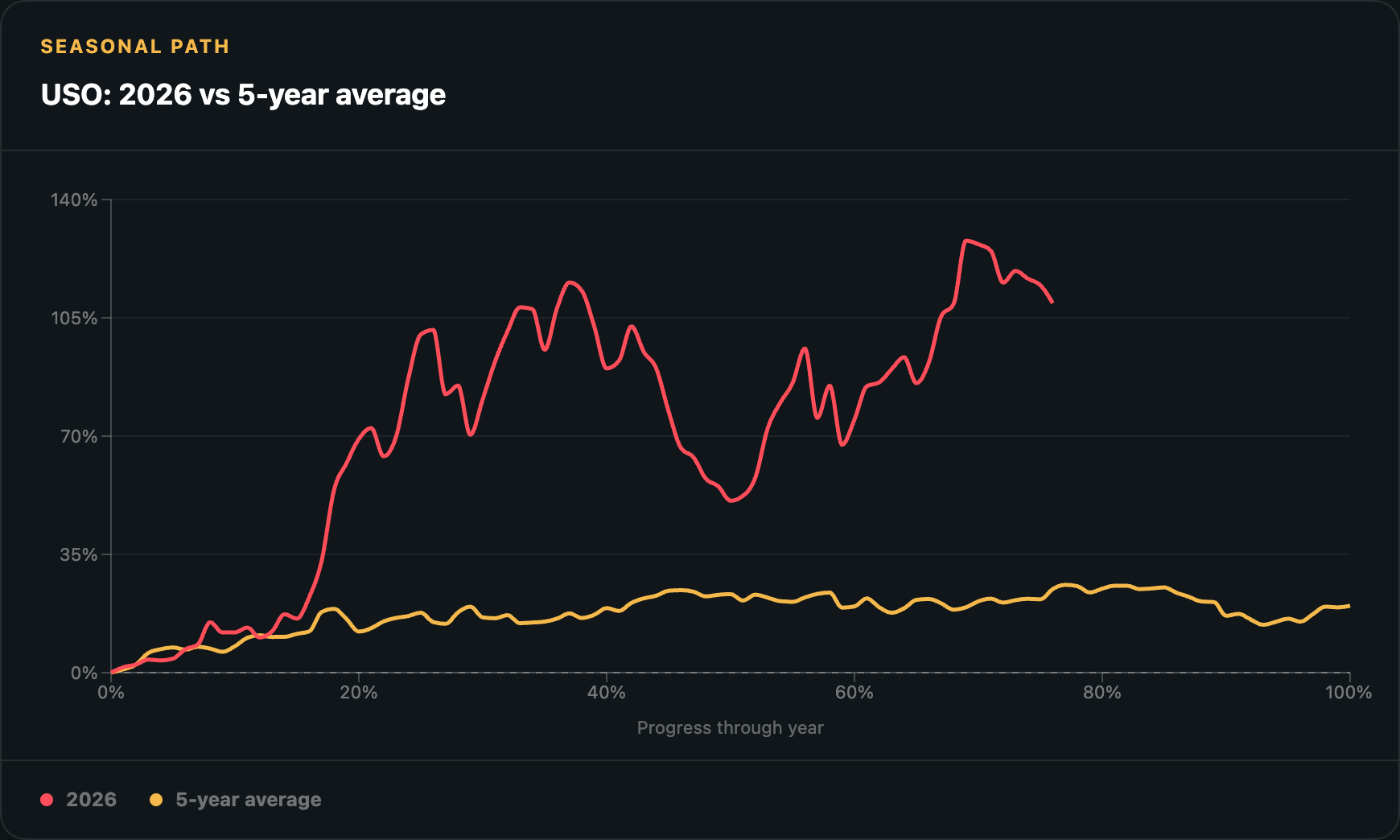
USO's five-year seasonal path softens around the coming week, which argues against assuming a bullish backdrop, but its unusually strong 2026 path also shows how far this year's conditions have departed from that average. For oil sentiment, the positioning data is more directly relevant here, with plenty of room for longs to be added if a rally does take shape.
Last week we were looking for rangebound price action with a downside bias, so half right. For the coming week we expect further choppy price action but this time we have a firm upside bias. In terms of price catalysts, the holiday shifts the weekly US petroleum report to Thursday 15 October at 17:00 BST. Its crude and product detail will help separate temporary weather effects from a broader shortage, while retail sales and industrial production provide checks on demand.
US bonds: crowded longs need inflation relief
Asset managers increased their net long in ten-year Treasury futures from 2,776,531 to 2,828,139 contracts between 29 September and 6 October. They added 95,636 longs and 44,028 shorts, leaving a net increase of 51,608. The signed net position reached the 99th percentile of its own four-year history. That's a crowded positive stance for this trader category, not a statement that every participant expects bond prices to rise. Institutional futures positions can also sit alongside cash holdings and other hedges.
The price backdrop is less comfortable than that positioning suggests. The ten-year yield was reported around 5.24% late on Friday, below the week's earlier stress levels but still restrictive for borrowers. The broader futures chart shows that accumulated long exposure hasn't prevented price weakness, and in fact this may act as a drag on a sustained rally here as longs reduce exposure into what has been rare price strength of late.
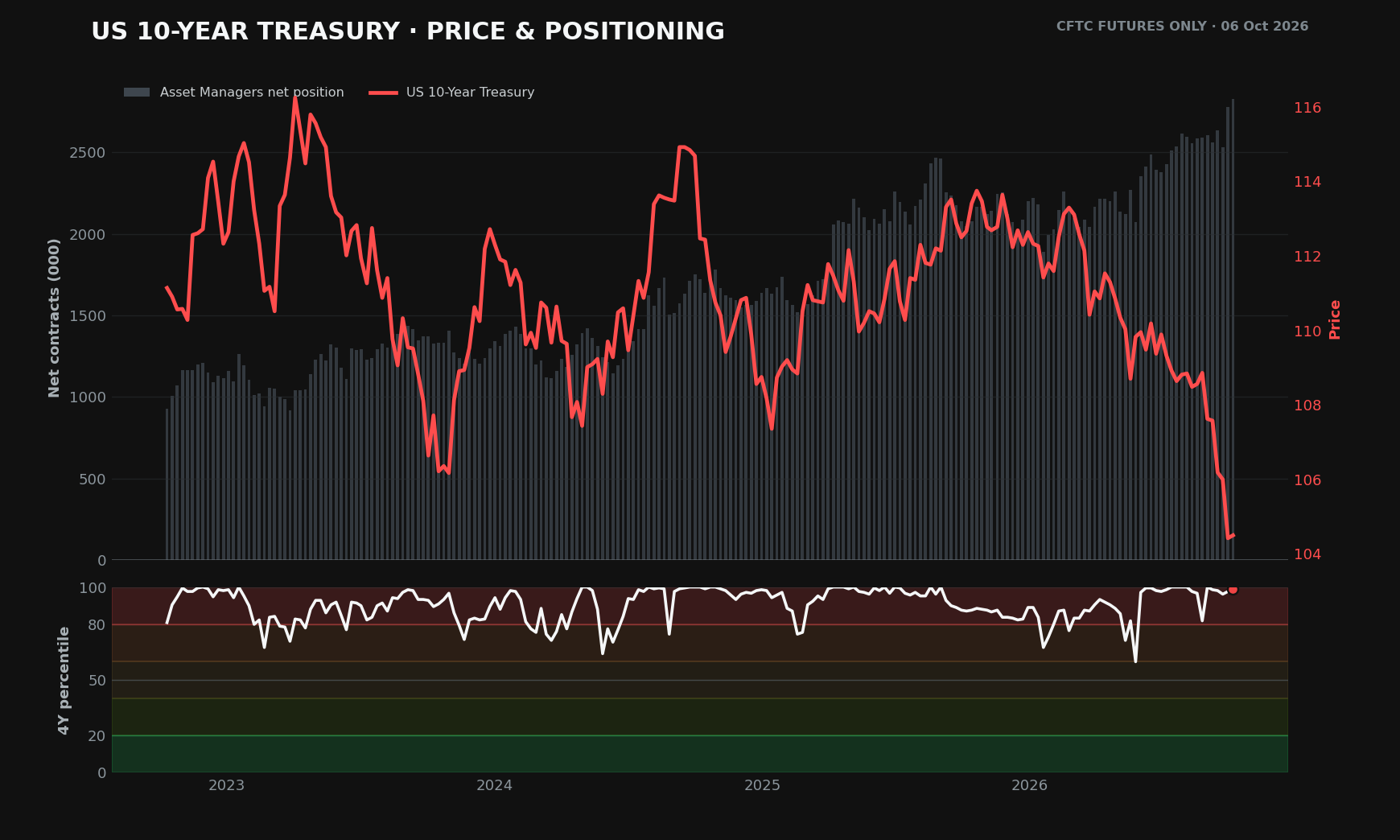
Wednesday–Friday positioning inference: the midweek yield spike followed by Thursday's reversal suggest a market struggling to settle on the balance between inflation risk and demand for duration. Friday's late yield indication doesn't establish a new sustained rally, but gives us some hope that a temporary low may have formed. Some managers may have bought falling prices, while others may have reduced exposure; but only the next positioning report can define the result.
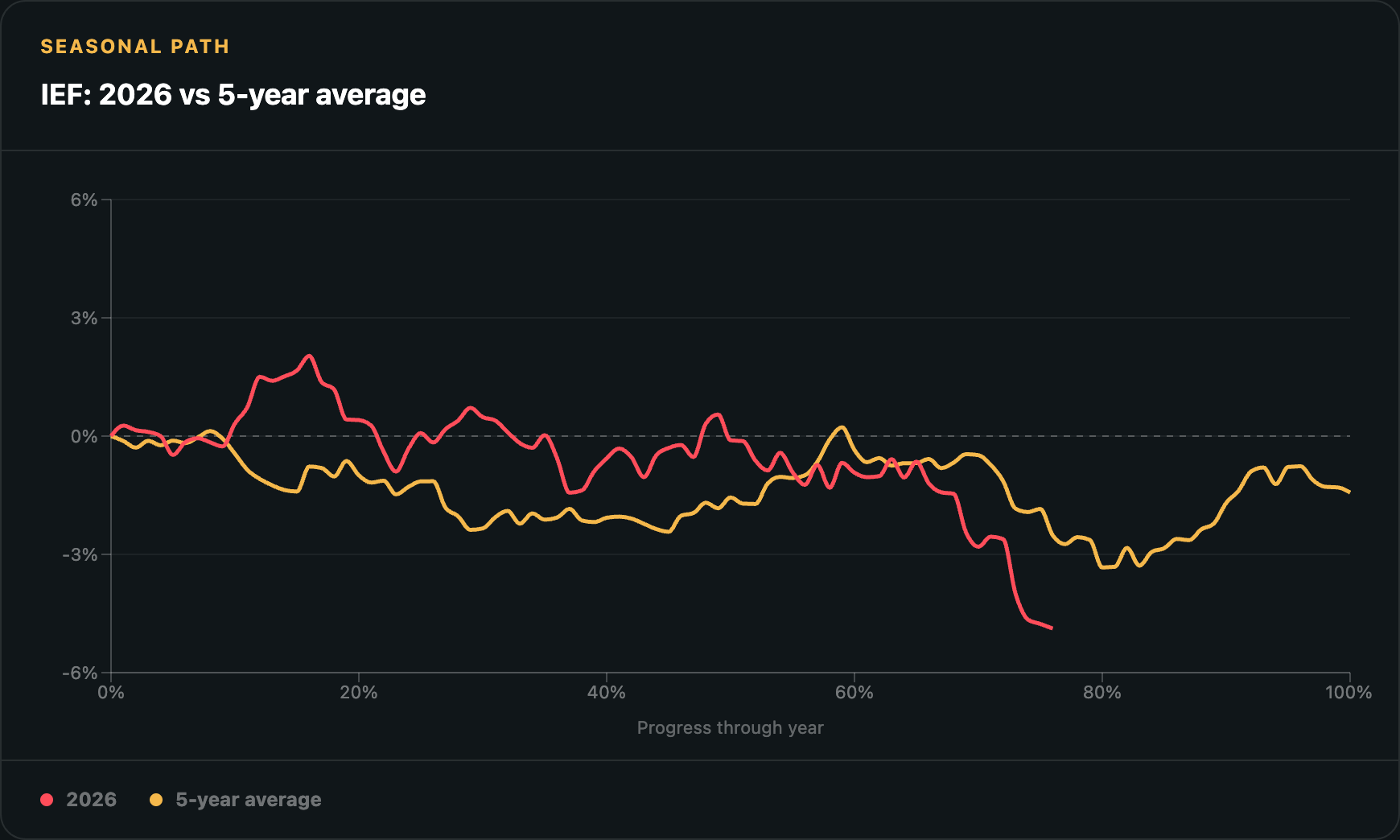
IEF's five-year seasonal path is mixed around the coming week and weakens further into October. It doesn't offer a strong seasonal case for chasing a bond rally, but with performance well under the seasonal path, we may see a low form earlier than expected and a choppy relief rally materialise. Recovering equity breadth plus an energy-driven inflation shock can hurt bonds still, but as we said last week the decline looks a little overdone short term.
For the coming week then, we favour a cautious rally in bond prices, but expect any rally to be choppy as managers use short term strength to reduce long exposure. Price catalysts are Wednesday's CPI and Beige Book, Thursday's producer prices and retail sales, and Friday's industrial production. A softer inflation reading with weaker activity would support higher bond prices. Persistent inflation, resilient spending and another energy rise would leave the crowded long vulnerable.
We wish you well for the week ahead. If you have any questions about anything covered here, please get in touch. We’re always happy to hear from you.

Comments
Log in or sign up to join the conversation.