Market Briefing For Tuesday, Jan. 25

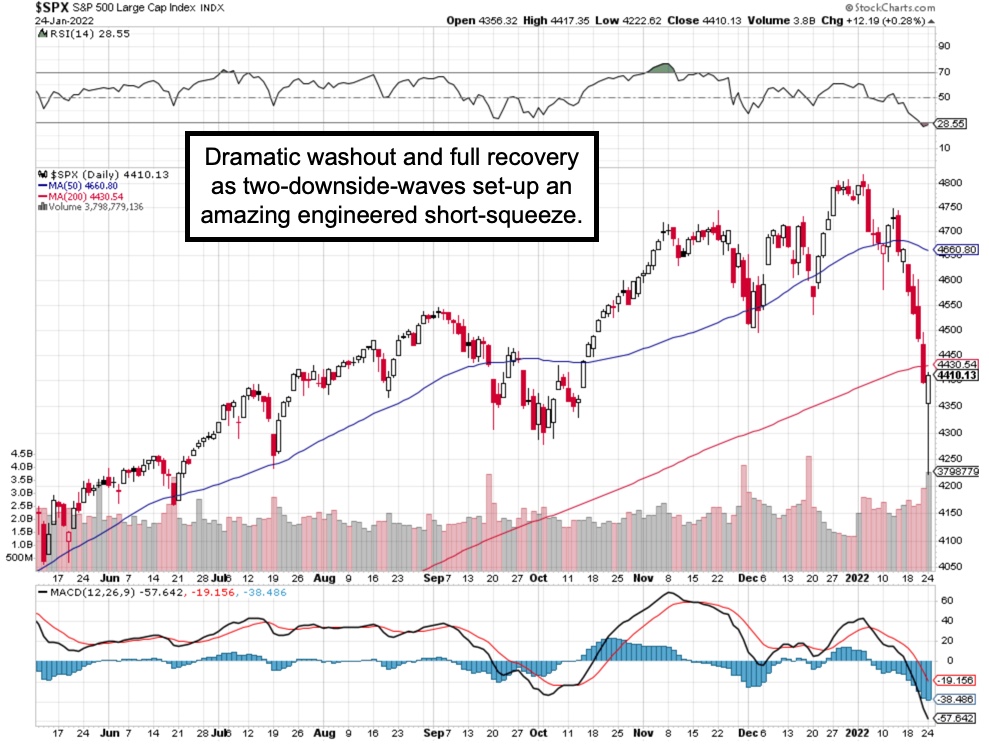
Capitulation of the 'grand dame' mega-caps is the dropping the jaw type of behavior, that's often associated with 'completions', not initiation, of serious decline.

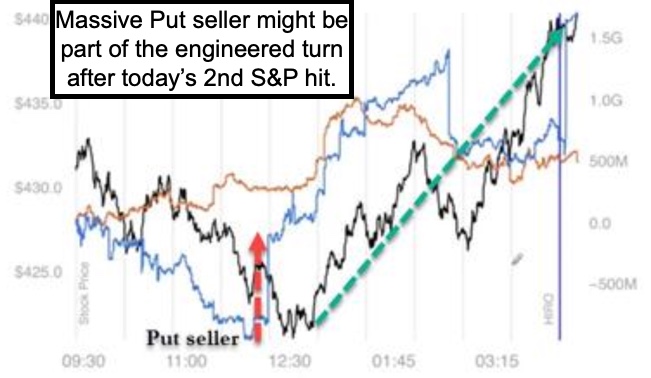
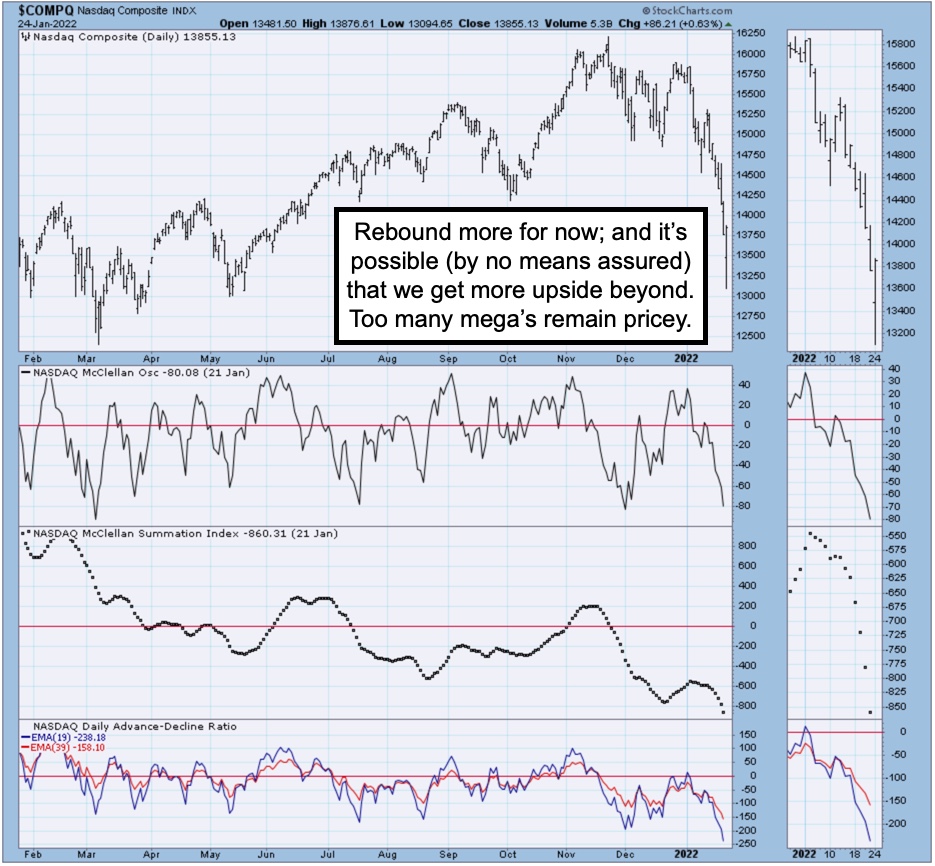
Capitulation of the 'grand dame' mega-caps is the dropping the jaw type of behavior, that's often associated with 'completions', not initiation, of serious decline. I can't say this was serious 'enough' for many mega-caps, but sure is is for the moment, and we had looked for a turnaround early this week.

Architecture, Stole, Company, Modern

Pixabay

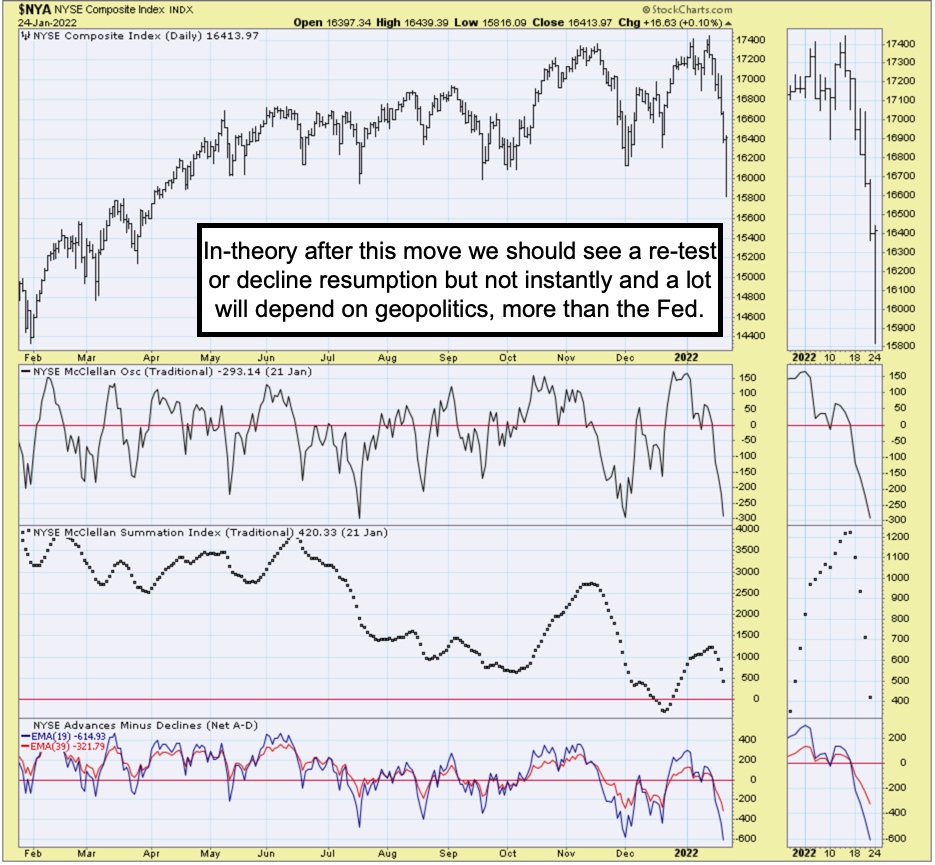
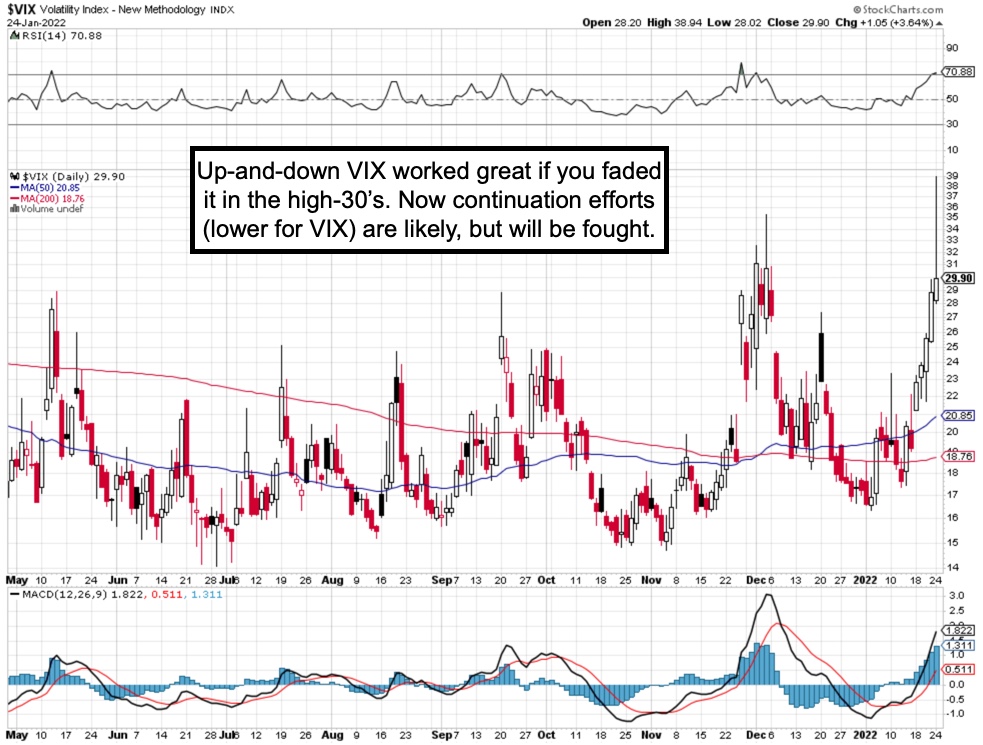
So we have it, and follow-through is likely. However during February we deal with a lack of visibility about the Fed (unless they clue us in better and sooner which is possible if they want to remove some of their threatening policies. At the same time those policy 'expectations' have alone been sufficient to throttle the excess speculation in some of the 'grand dames', but the broad market as you know was declining for the better part of the year, so 'possibly' you have a period of further chaos looming, even though it was a big short-covering affair.

Tonight I'll focus on a threat which is even more immediate than the Fed, and of course that's the geopolitical 'manufactured' crisis in Ukraine, by Russia, as they perhaps perceive a weakened U.S. resolve (and situation), so after a few years of indecisive skirmishing in Eastern Ukraine, they decide now's the time to exploit the situation. Yesterday I conferred with a teacher who emigrated to the USA from Georgia (the one on the Black Sea, not above Florida) and was there when Russian troops occupied South Ossetia (and never left).

He thinks Putin is agitating to occupy the East, and split Ukraine, and that the US will let him get away with it. Of course that's problematic as it's essentially what Pres. Biden inadvertently hinted-at, with my remark last week it forced a tougher policy from Sec'y. of State Blinken, which we got. Today elements of a couple paratroop divisions have been put on-alert for deployment to Europe in a message of firmness to emphasize that. Of course that's an escalation from Russia's perspective, although they asked for it. Media still reports that USS Truman is 'on the way', actually the Battle Group has been there for 2 weeks.

So I will address today's forecast market action a bit more later in this Briefing but for now let me do a special summary about Ukraine which may be off a bit but my effort to put the more recent history into some chronological order. If it comes to fighting over there, everyone will benefit knowing how it got to this, a rough outline I'm sure we all know, but let's give a refresh overview anyway.

With credit to controversies about Ukraine's origins a hundred or more years ago, here's a modern summary of the progression of events over 50 years:

  • The two nations, Russia and Ukraine, have been divided for centuries, not merely since the Soviet collapse, they have different languages and cultures, so let's look at a several agreements over the last ~50 years.
  • 1975, all OSCE countries, including Russia, signed the Helsinki Final Act. It established 10 guiding principles for international behavior, including respect for national sovereignty, refraining from the threat or use of force, the inviolability of frontiers, the territorial integrity of states, the peaceful settlement of disputes, and non-intervention in internal affairs. Russia has violated all those principles in Ukraine.
  • 1990, OSCE countries, including Russia, agreed to the Vienna Document, a set of confidence-and-security-building measures intended to increase transparency and predictability about military activities, including military exercises. Russia selectively mostly followed those provisions.
  • 1991, the Ukraine, Russia and Belarus signed an accord that effectively dissolved the Soviet Union. Moscow maintained its influence in the region with the Commonwealth of Independent States (CIS) as a tool to do so.
  • Russia thereby recognized Ukraine as an independent state, also thought cheap gas supplies would keep Ukraine in its orbit 'sphere of influence', but Ukraine increasingly turned to the West.
  • Subsequently, seems that Putin’s pressure on Ukraine backfired totally, pushing Ukrainians (especially Western Ukraine) further toward the West.
  • 1994, in the Budapest Memorandum, Russia, the United States and Britain committed to “respect the independence and sovereignty and the existing borders of Ukraine and to refrain from the threat or use of force against” the country.
  • Key: those promises helped persuade Ukraine to give up their big nuclear arsenal inherited after the dissolution of the USSR. Nevertheless, for the time, Russian submarines were still fitted with missiles in Ukraine.
  • 1997, Russia and Ukraine signed the Treaty on Friendship, Cooperation and Partnership, known as the "Big Treaty.", with this agreement, Moscow recognized Ukraine's official borders, including the Crimean Peninsula, (without Odessa, that's one logical reason for Russia's Crimea invasion in the quest to maintain at least one warm-water port (hence Med access).
  • 2014, Russia invaded then annexed Crimea, beginning the undeclared war that continues today. Russian paramilitary forces also mobilized in the eastern Ukrainian Donbas region and instituted Russian-led "people's republics" or quasi states in Donetsk and Luhansk.
  • That takes us to the present, with sloppy diplomacy and concession hints forcing a tougher most-recent stance to impede Moscow's ambitions.
  • With landing craft (likely intending to invade Odessa), and forces moved to Belarus as I've warned for weeks would put Russian troops an hour up the road from Kiev, the prospects are greater that Putin intends a broader invasion / occupation, rather than merely concessions in the Donbass.
  • As it looks, Russia will probably prevail, not because Ukraine is a failed state propped-up by the IMF as some pro-Russian pundits allege, rather it is more industrial than Russia, provided 'wheat' as Russia's breadbasket, while Russia has the Oil & Gas (Oil in the Carpathian mountains is limited, I know because my Dad drilled many of the wells in the 1930's and aided the U.S. Army / War Dept. in spotting Oil pumping stations during WW 2, thus inhibiting -by bombing- the Nazi's ability to move Oil to Germany).

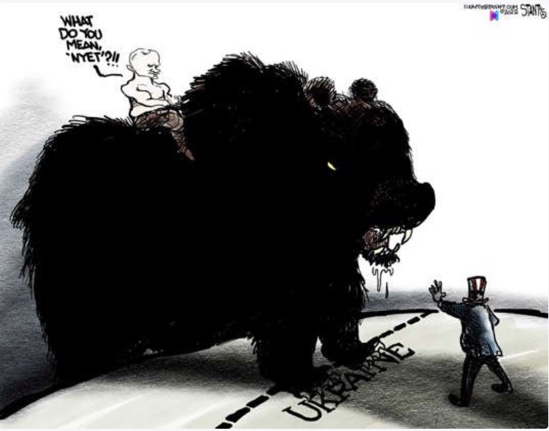
That's the backdrop (at least my summary), and coup or not, deterring the Bear from going after the honey (Ukraine was considered the 'best' of the Soviet Republics back in the day) is not going to be easy if even doable, hence the Stock Market is girding not only for the Fed, but War in Europe.

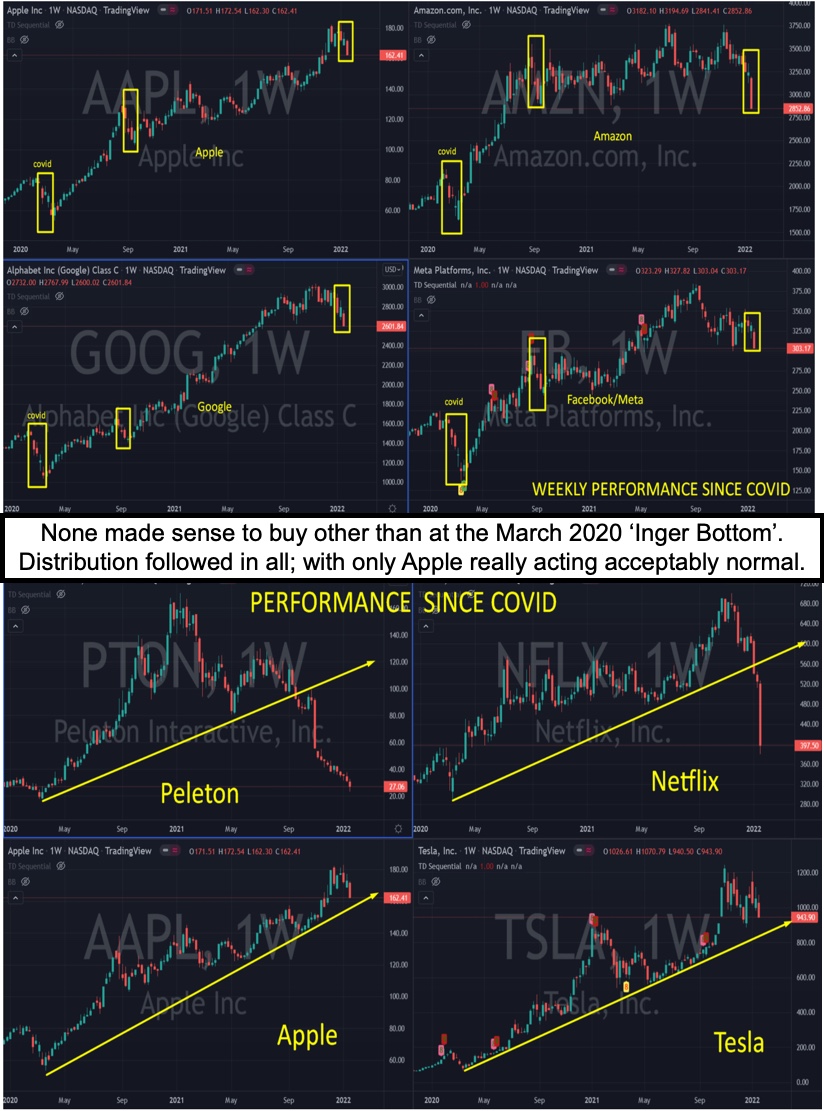
(The above stocks all bounced to a degree, with renewed risk down-the-line.)

Summary on Ukraine: 

This matters. Ukraine is a nation with its own culture and language. The Russians (as Soviets) perpetrated a genocide in Ukraine, the Holodomor in 1932–33. Most Ukrainians do not love Russia or want to be part of it. By denying nationhood of another country Putin follows to a degree the old the Hitler playbook. Remember he annexed Austria, for a start. And carved-out the Sudetenland in Czechoslovakia, using the excuse they spoke German so had more affinity toward Berlin than to Prague. (One present-day friend, who reads these Briefings, was born in Sudetenland, German heritage and is a officer in the Czech Republic's Army.) They are loyal Czechs, just as a vast majority of Ukrainian troops who also speak Russian, are loyal to Kiev.

Putin has stayed in power by being mostly rational for 20 years. Putin avoided 'grand initiatives' for the most part, and engaged in opportunistic reactions, of course with a bit more aggressiveness in his Syrian expeditionary ventures. It should be noted Putin tried to get Ukraine to carve-out Donbass, but failed.

It's true Putin fundamentally considers Ukraine tied to Russia (there's the 30% language commonality), while he knows an outright invasion could antagonize Ukraine for years to come. For the U.S. it's a concern, but not national phobia like Putin has created. If negotiations fail, Russia will likely recognize breakoff areas as 'republics', like he did with the breakaway regions of Georgia.

Also sanctions on Russia could impact gas revenues to Ukraine (lost) and his pipeline into Germany being certified is a token prize to expect. If this all falls apart, an Energy Crisis will blossom in Europe regardless of anything our Fed does, or any effort to suppress Oil prices. That would thrust Oil over 100/bbl, a level that creates an economic price to pay, more inflation, and lower stocks at least temporarily. There are off-ramps to avoid all this, but some consider it Chamberlain-esque to do so (Biden hinted at just that then re-stated/clarified), such as the carve-out of the Donbass region (land-bridge to Crimea).

When the Soviet Union collapsed, many Russians were genuinely so excited about chances of becoming an ally of the United States, until hopes dashed in the bombing on Yugoslavia by NATO in 1999. Russian Premier Primakov was airborne on a flight to Washington, and turned his aircraft around when staff notified him of the attack. Perhaps wrong interpretation, but in a conservative way, the propaganda was that the U.S./NATO would block Eastern Orthodox fragmentation and would bomb.. in Europe. It's a twisted tale they still believe.

COVID note:

  • Research is underway across the U.S. to develop a universal COVID-19 vaccine that would be effective against future coronavirus variants, this is something I've wanted to see for months (common target of viruses).
  • Part of the research is occurring at three U.S. universities that received $36 million in grants last fall (Duke, Wisconsin and Harvard/Brigham).
  • The U.S. Army is also working on a universal vaccine that involves a specific type of spike protein (Sorrento was involved similarly, no idea).
  • Experts say these types of vaccines could also help with other diseases such as influenza and Ebola, and that might relate to the Dyadic platform.

In-sum: 

Ukraine has become an existential crisis for Putin (his continuity as much wrapped-up in it now), and risks being more democratic and successful than Russia, so part of his motivation is actually jealousness of their capacity.

As the stakes are raised Wall Street's focus has to consider the implications. I think it is a fundamental question for Putin, per his essay last summer. If there is a way-out that is satisfactory, without making Russia appear as a 'victim' (a perception of Putin's essay last year), then the West can control Unity and the freedom to progress by Ukraine (towards the West and better democracy).

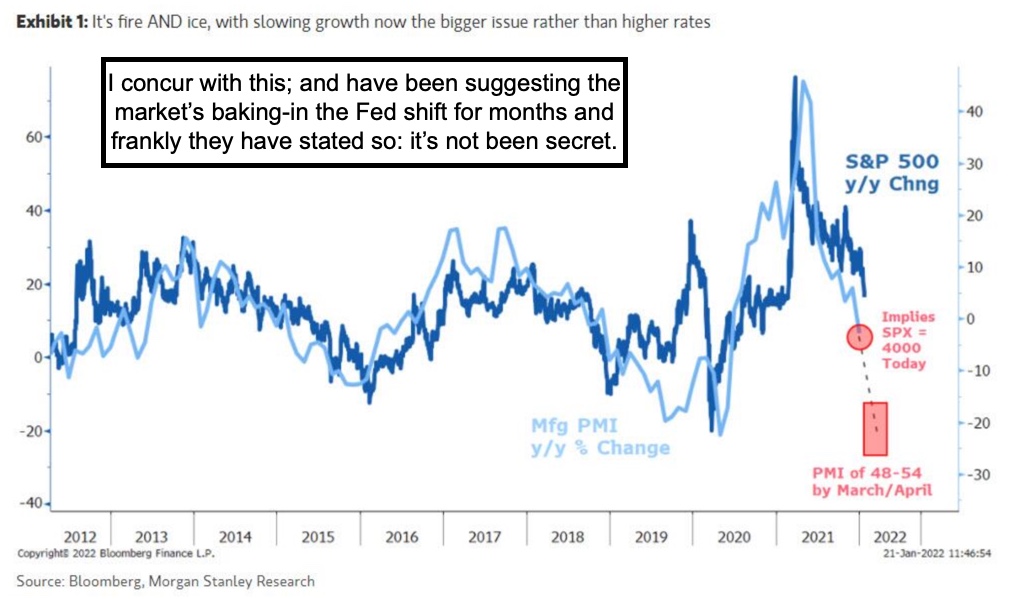
This market was broken and beaten months ago, and it's only in past weeks a seemingly permanently-bullish group of analysts detected 'bifurcation' as I've called it for a year. That made it impossible to crash without breaking 'megas', and now a year after warning of coming buybacks leading to insider-sales and high-wealth individuals seeking shelter, now they break the S&P at last. It can be the conclusion of the most painful part, but doesn't have to be. Variables.


Bludgeoning of smaller stocks and collapse of mega-caps was indeed what I'd called the Generals retreating to join troops in the trenches, already so beaten down to a great extent. Now you see a handful of big-caps that haven't really broken, and it's an 'iffy' situation if they sell-off too (like Apple and AMD).

Normally 'if' you're going to see a complete capitulation that occurs. However it is fairly conventional technical thinking, so you've got some convinced it has to go that way. Nothing is certain here. For-instance if you avoid an expanded war in Ukraine (or heaven-forbid beyond), the markets might not revisit these levels, or at least horse around pending seeing how the Fed 'behaves'.

If you abort this spectacular turnaround sooner (like this week) that will have a demoralizing and destabilizing effect. S&P didn't get as low, as we ideally sort of have in mind (though what we think it might do isn't important beyond rough contemplation), but it sure was low enough (overall) for small stocks to be just screaming 'toes in the water' accumulation (new or adding to positions).

I'm not saying this has to quickly revert to defense, just recalling a few swings like that last year, where S&P had a sharp move, then a similar thrust going in the other direction almost immediately. That's unlikely here, but just recalling.

In-sum:

There is too much worry about the 'newer' investors not acclimated to volatility and how things work. This market (down and up) is mechanical, it's a great bit driven by algorithms, and individual thinking and emotions have very little (sorry to say) to do with it. That's a market characteristic growing over a period of years and it's not dependent on how investors 'feel' about it.

Now, if fund investors are wiped-out totally (say we drop 50% in S&P) that's another story. Because they would be so-alienated as to not return for years, and of course get bullish at the next high zone, again. But this isn't about such individual perceptions, as much as possibly it should be. This is 'macro', as it's been during the year of distribution under-cover of the strong S&P and NDX and only now will most pundits acknowledge the internals were already down. That's also why it's not impossible to structure a low, but suspicion is justified.

It's the idea of 'selling climax' and 'automatic rally' as I term it, seen Monday, a perfectly normal way to conclude a panic and start revival. It's follow-through that matters though, and that's going to be contested for a bit I suspect. We'll possibly view Microsoft's (MSFT) behavior as more indicative of the overall mentality out there, which may be why I mentioned it more last week and others today. There are some stocks which are very impactful, even Apple (AAPL) or our Advanced Micro Devices (AMD). Or of course Google (GOOGL), Amazon (AMZN), Tesla (TSLA) or so on. However something says watch Microsoft for a hint as to whether they can really lean on this after rebound.

Finally, beware if 7th Army moves. The idea of 8500 troops moving from the US is symbolic, the movement of 7th Army would clearly provoke Putin, who really still counts on 'revenue' from gas sales to Germany. Those won't occur anytime soon if Russian tanks roll into Ukraine. So that's likely both why you'd heard of Germany's reticence to be tough, but also why being tough deters a somber Putin from cutting of his nose to spite his face over Ukraine and gas.

I do suspect that if 'fair' elections had been held in Russia and the opposition was in-control, not only would Ukraine not be threatened, but Russia's primary dream few dare talk about, would push it closer to Europe, not more hostile.

STOCKS IN THIS ARTICLE

Comments