


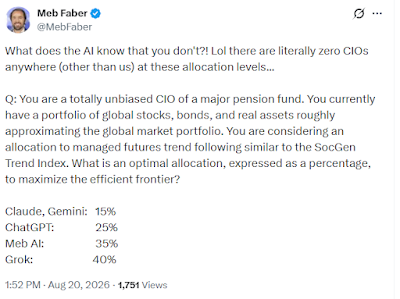
From Meb Faber;
And for what it's worth, plugging Meb's question into Copilot came up with a range of 15-25% and then zeroed in on 20%. The following are built using SPY for equities and an even split of QMHIX and DBMF simulated for managed futures. Both are volatile; QMHIX is a full implementation, and DBMF is a replication strategy.
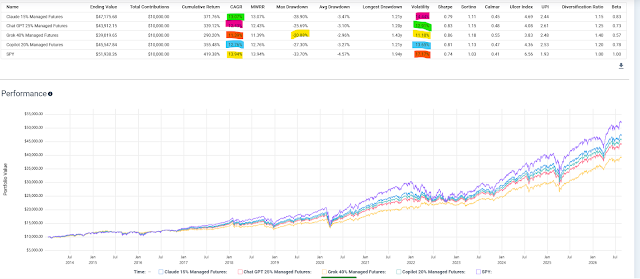
I tried to color code the backtest results but am not sure how helpful that is. Putting 40% in managed futures optimizes the Sharpe Ratio, the Calmar Ratio, and has by far the lowest drawdown.
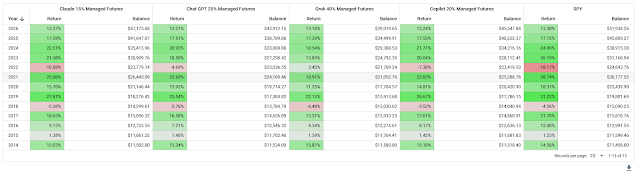
You can see in the year-by-year where the various equities/managed futures combos lagged by a lot.
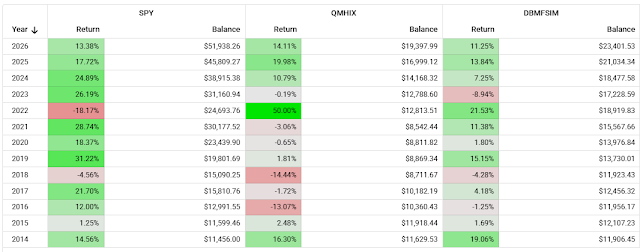
The second table is the definition of line-item risk. We said before, and others have also observed, that every backtest with managed futures looks fantastic, but the experience of owning the strategy is very difficult, especially in size.
There's no answer that makes owning managed futures easier when it is lagging. That is why I keep client allocations toward the lower end of the scale and blend in other alts (diversify your diversifiers) that give the opportunity for similar diversification benefits in the good times for managed futures without the huge drag during periods like 2016-2021.
Updating the above, Portfolio 1 introduces Eric Crittenden's idea that underlies BLNDX (he uses all countries, not domestic though).
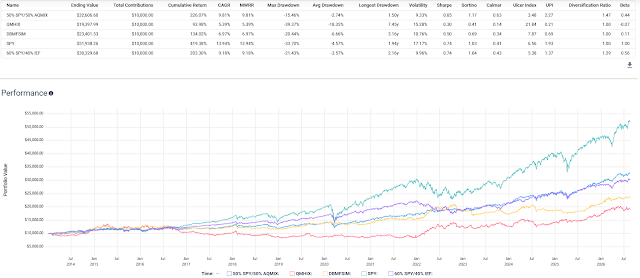
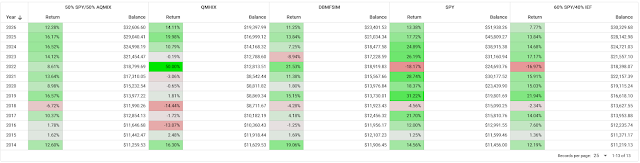
This supports Eric's thesis, but there have been a couple of shorter periods where BLNDX has struggled, ditto funds that combine domestic equities and managed futures.
I am a huge believer in small doses of managed futures, but repeating the point, there is no magic bullet. There's no solid conclusion to this post, which is similarly frustrating in the same way managed futures can be frustrating.
Comments
Log in or sign up to join the conversation.