


Although a new sheriff has come to town, the problem of inflation has gotten worse, posing an even greater challenge to the Federal Reserve. Chairman Walsh's appointment was very reflective of President Trump's wish to have rate cuts. Vowing to preserve the Fed’s independence, Walsh had to face up to a potential inflationary spiral that bond investors signalled was on its way. Oil prices lost their anchor once the Straits of Hormuz were closed, and gas prices soared, starting a wave of price increases throughout the economy.
Prior to the start of hostilities, the market was all in towards a soft-landing set of rate cuts. Short-term rates were set well below long rates, as near-term inflationary expectations were very well anchored (green line). Today, all that has changed. The front end of the curve has moved up very aggressively, reflecting investors' concern that rate cuts are about to give way to hawkish rate hikes ( red line). Often referred to as “ bear flattening”, this new shape assumes that the Fed will not cut rates and may possibly raise rates to combat inflation. Long rates moved up sharply as the market required a premium to offset longer- term inflation prospects.
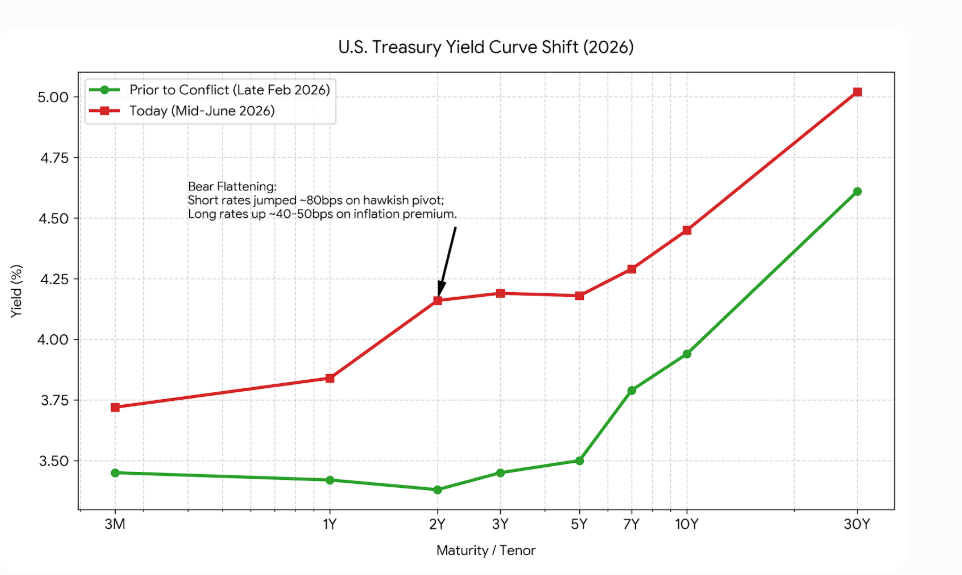
The Fed has abandoned its earlier bias towards lowering rates, even as oil prices have returned to pre-war levels. The forecasts by voting members of the Fed committee reveal a broad consensus that rates will tend higher, starting as early as the end of this year. This is in stark contrast to the March projections when no member anticipated any rate hikes. Those forecasts highlight that the Middle East conflict has set off a ripple effect throughout the world’s economy, yet to be fully realized.
Using the PCE inflation measure, which is lower than the CPI measure, the inflation rate still rose to 3.8% in April. Even with the ceasefire deal announced this week, economists expect US inflationary pressures to continue, as the earlier oil price surge is working its way through the supply chains. And, there is no weakness evident in the job market or in incremental output, further supporting an upward bias in the rates.
The market immediately reacted to the Fed’s upward bias with the 2-year yield hitting a 14-month high of 4.22 %. Moreover, the decision was made without a dissenting vote. Everyone is on board with rates moving up.
Comments
Log in or sign up to join the conversation.