

Key Market Outlook(s) and Pick(s)
On Friday, I joined the great Stuart Varney on Fox Business’ Varney & Co. to discuss markets, the economy, outlook, Estee Lauder (EL), PayPal (PYPL), and a lot more. Thanks to Stuart and Maggie Edwards for having me on.
On Tuesday, I joined the great David Asman on Fox Business’ Varney & Co. to discuss markets, the economy, outlook, the Fed, Micron (MU), Comstock Resources (CRK), and a lot more. Thanks to Stuart Varney, Maggie Edwards, Nick Palazzo, and David for having me on.
On Friday, I joined Brian Sozzi on Yahoo! Finance to discuss markets, the economy, outlook, rotation, tech, defensives, Midterms, and a lot more. Thanks to Brian and Kayla Hawkins for having me on.
Bank of America (BAC) Fund Manager Survey Update
On Tuesday, we put out a summary of the monthly Bank of America Global Fund Manager Survey. This month, they surveyed 180 institutional managers with ~$525B in AUM.
Here were the 5 key points:
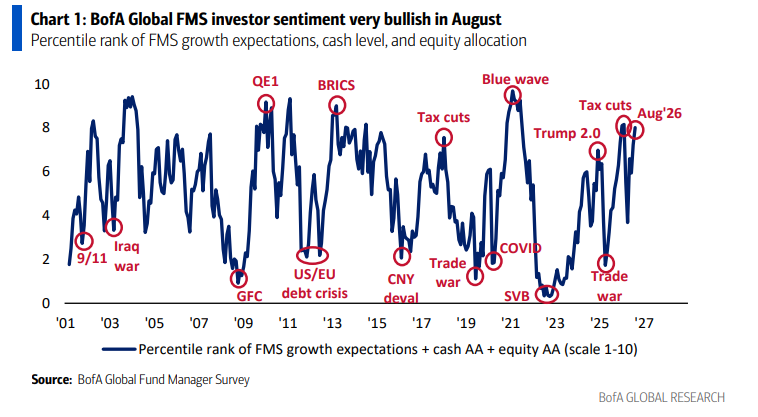
1) BofA's broadest sentiment gauge, built off cash levels, equity allocation, and global growth expectations, moved higher again in August, making this the third most bullish FMS reading since 2022.
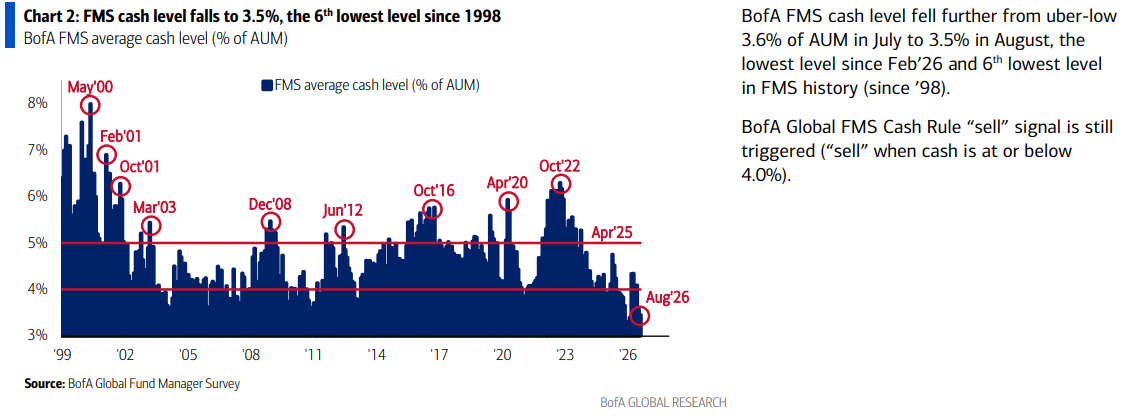
2) Fund managers' average cash level fell further from an uber-low 3.6% in July to 3.5% in August, the lowest since February 2026 and the sixth lowest reading in FMS history dating back to 1998. That keeps the sell signal on the BofA Global FMS Cash Rule triggered, which flashes at or below 4.0%.
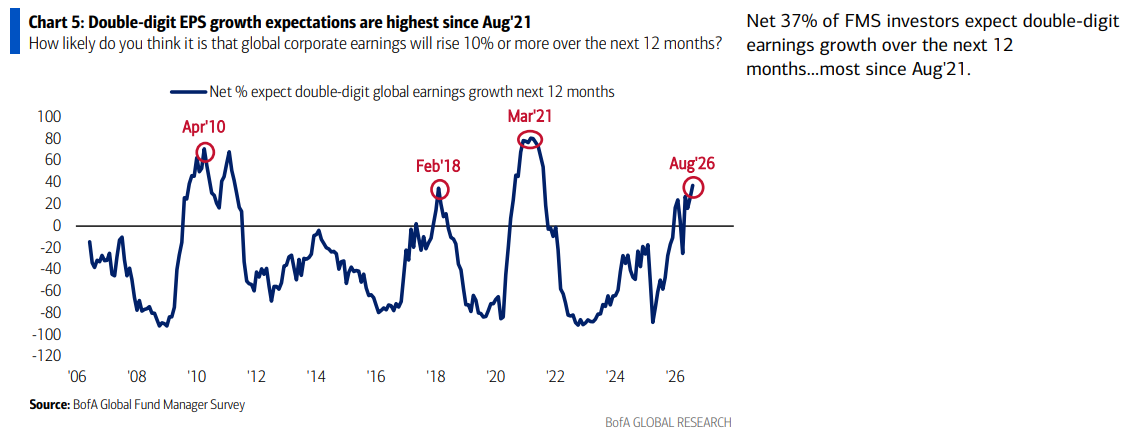
3) A net 37% of fund managers now expect double-digit global earnings growth over the next 12 months, the most optimistic reading since August 2021.
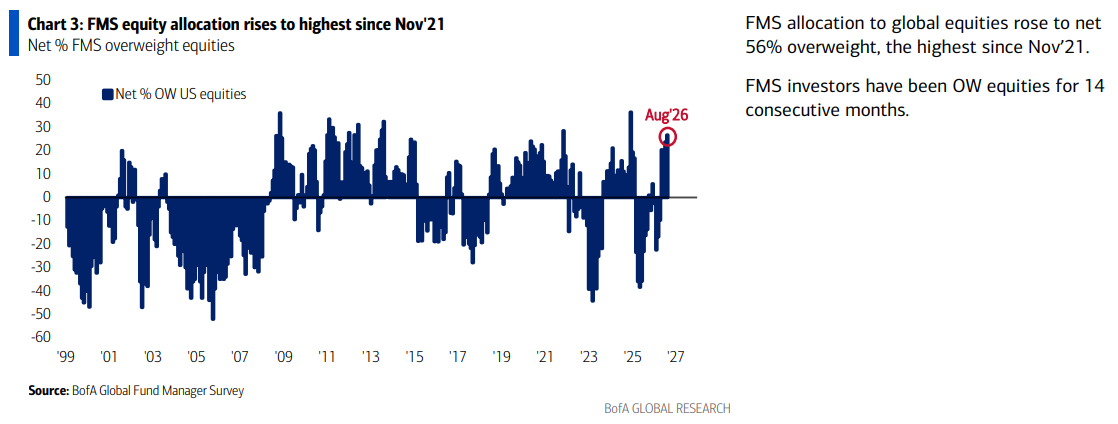
4) Allocation to global equities rose to a net 56% overweight, the highest since November 2021, with managers now overweight equities for 14 consecutive months. As we have said before, when everyone is all in, who is left to buy?
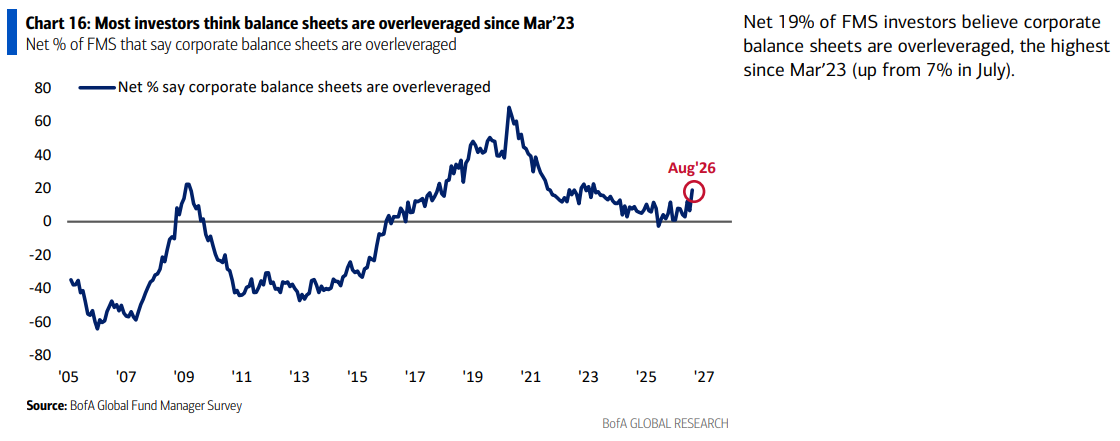
5) A net 19% of fund managers believe corporate balance sheets are overleveraged, up from just 7% in July and the highest reading since March 2023.
Dentsply Sirona (XRAY) Update
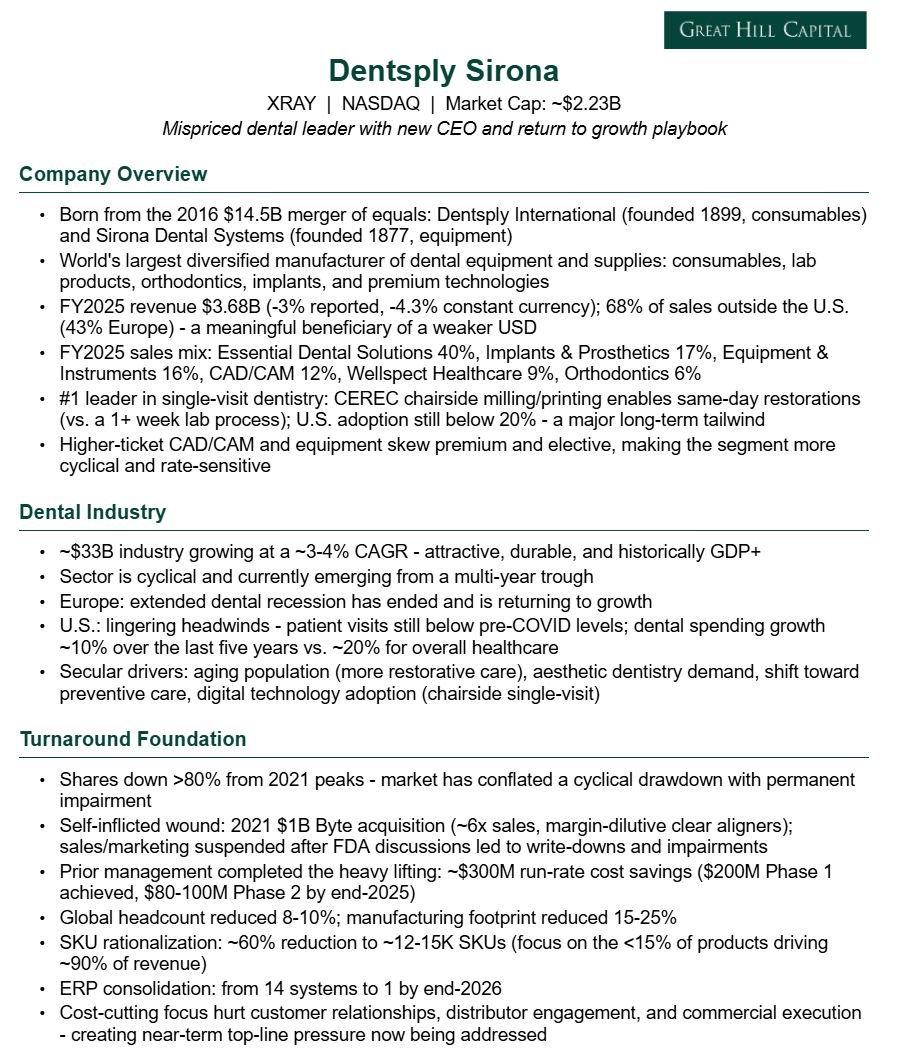
For newer readers, here’s a brief overview of the key drivers behind our Dentsply Sirona thesis, a global dental leader with a proven new CEO, a clear self-help playbook, and a cyclical inflection underway as the industry turns the corner:
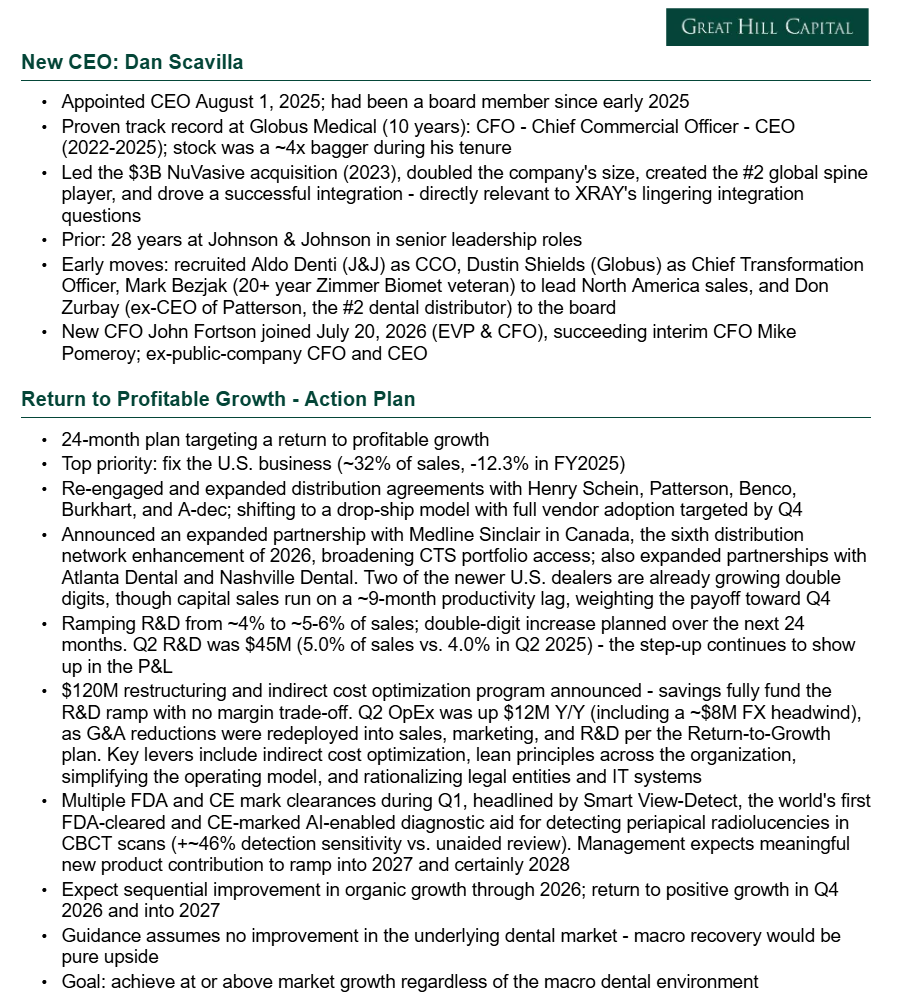
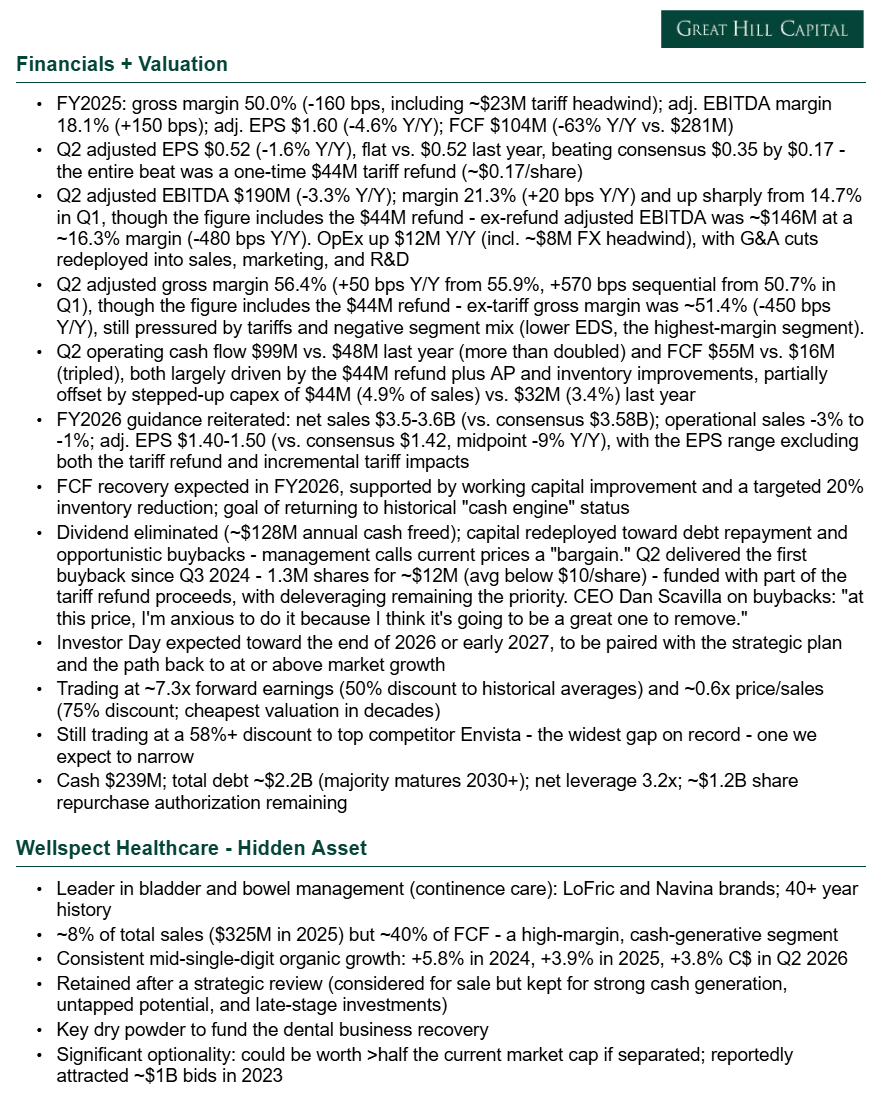
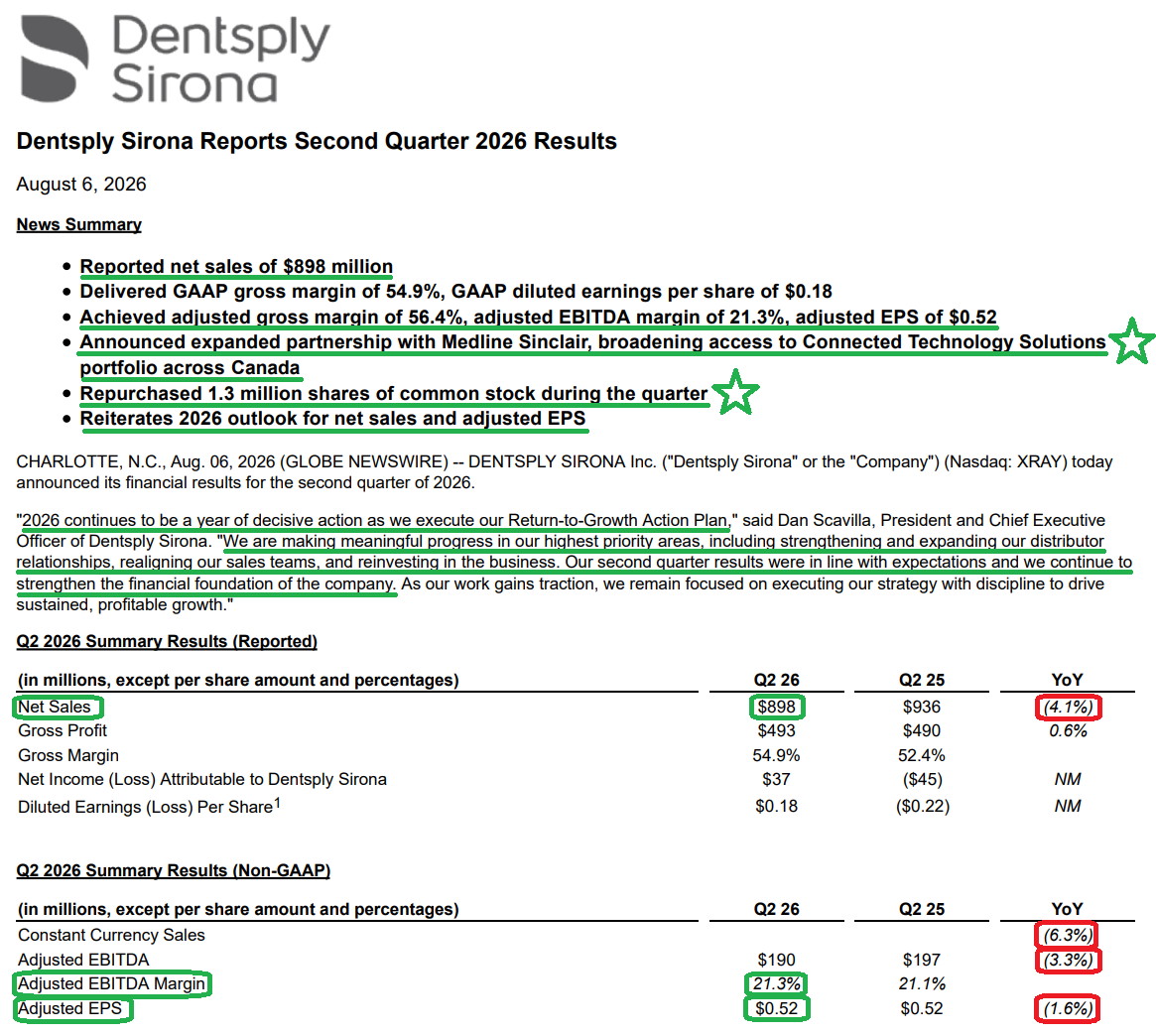
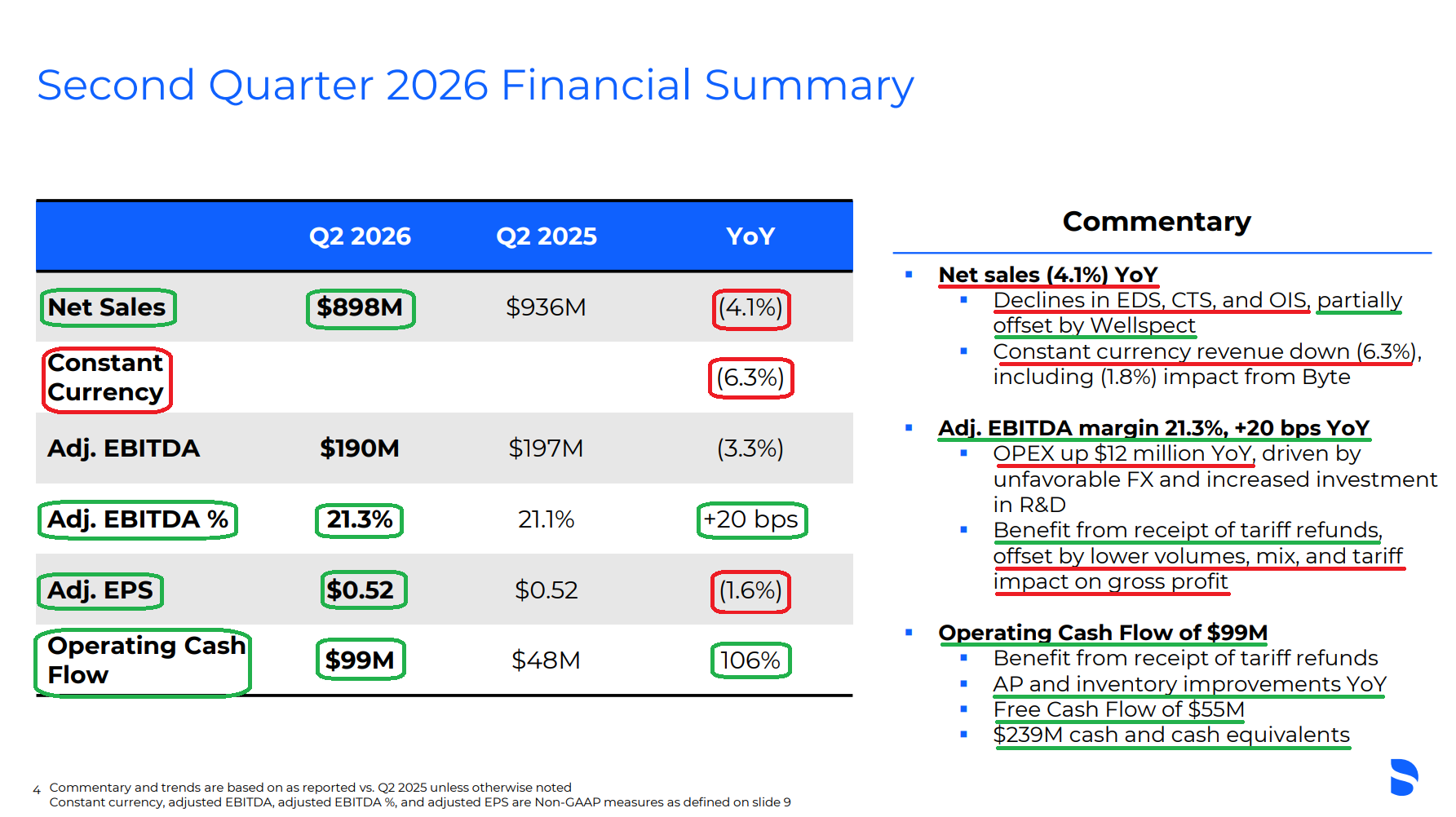
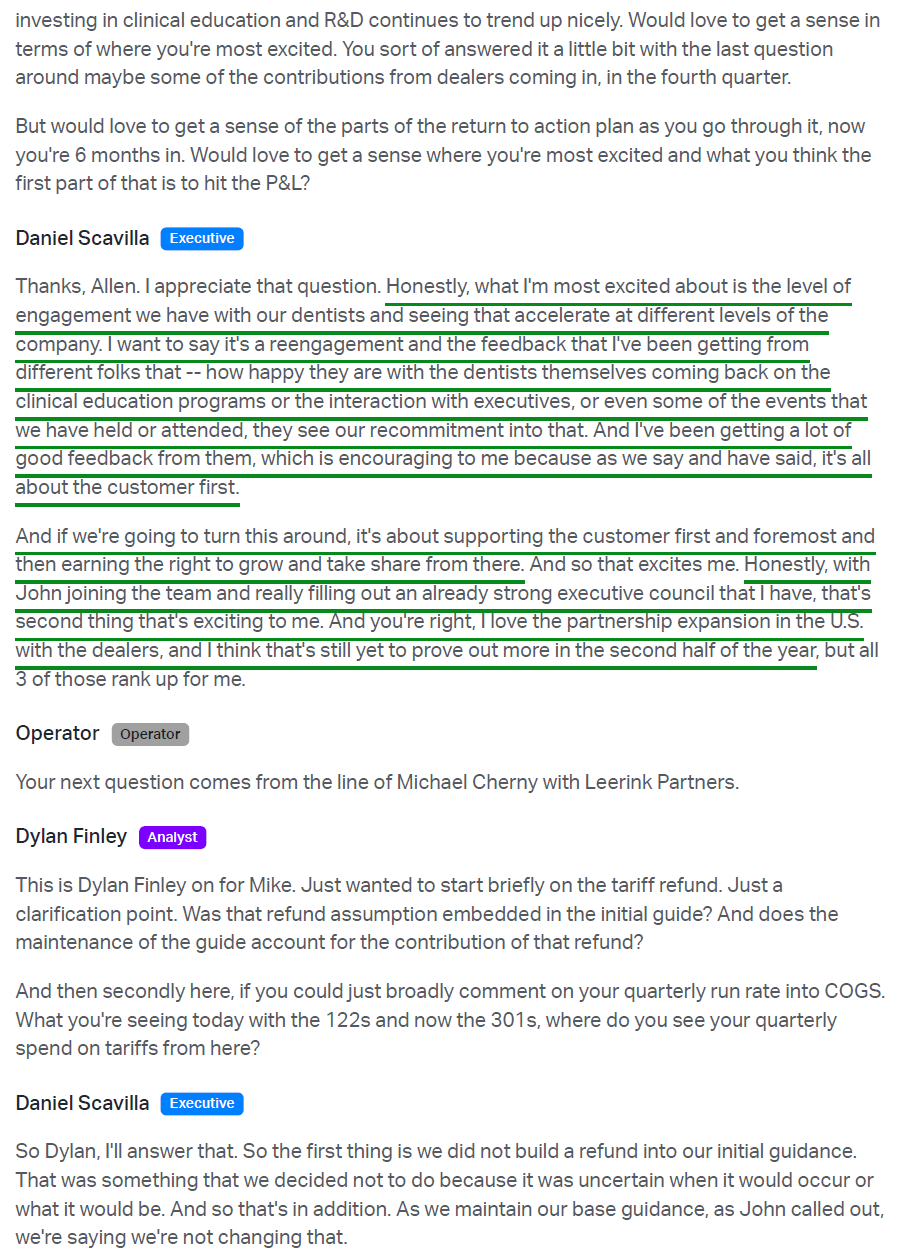
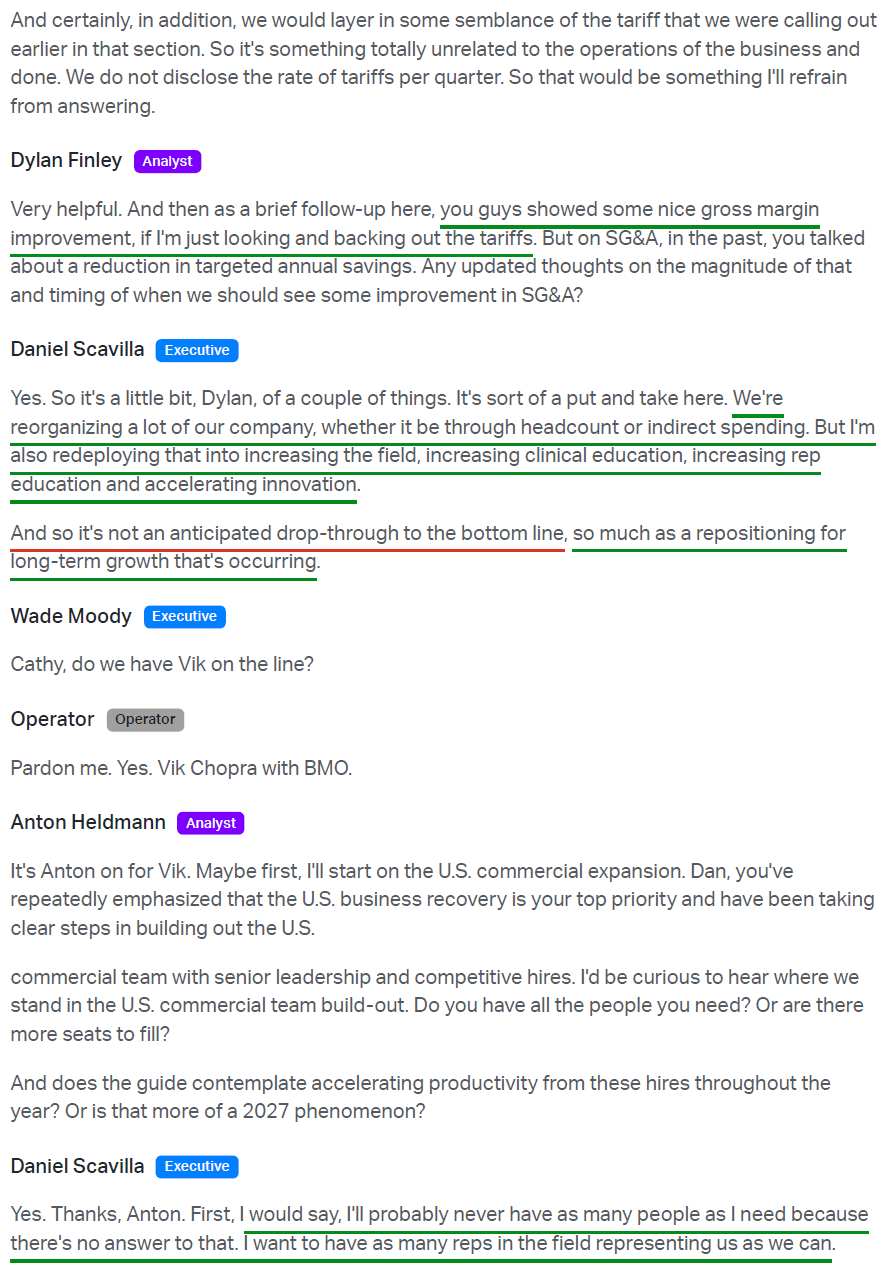
Like many companies this Q2 earnings season, Dentsply Sirona's headline results were boosted by an unexpected one-time $44M tariff refund. The refund pushed adjusted EPS to $0.52, $0.17 ahead of consensus, with adjusted gross margin at 56.4% (+50 bps Y/Y, +570 bps sequentially) and adjusted EBITDA margin at 21.3% (+20 bps Y/Y, +660 bps sequentially). Backing out the refund, adjusted EPS would have been ~$0.35, right in line with consensus, with gross margin at ~51.4% and adjusted EBITDA margin at ~16.3%. Revenue, on the other hand, was a clean beat, reaching $898M, ~$9M ahead of consensus, despite falling 4.1% reported and 6.3% on a C$ basis.
The good news is that, tariff refund aside, the underlying trend continues to move in the right direction. With no refund in Q1, the sequential comp provides a clean read on the business, with gross margin improving ~70 bps from 50.7% and adjusted EBITDA margin expanding ~160 bps from 14.7%. The spending mix is also shifting exactly as management laid out, with G&A savings from the $120M cost optimization program being redeployed into sales, marketing, and R&D. That has allowed R&D to step up to ~5% of sales from ~4% a year ago and fund the innovation ramp without forcing a margin trade-off.
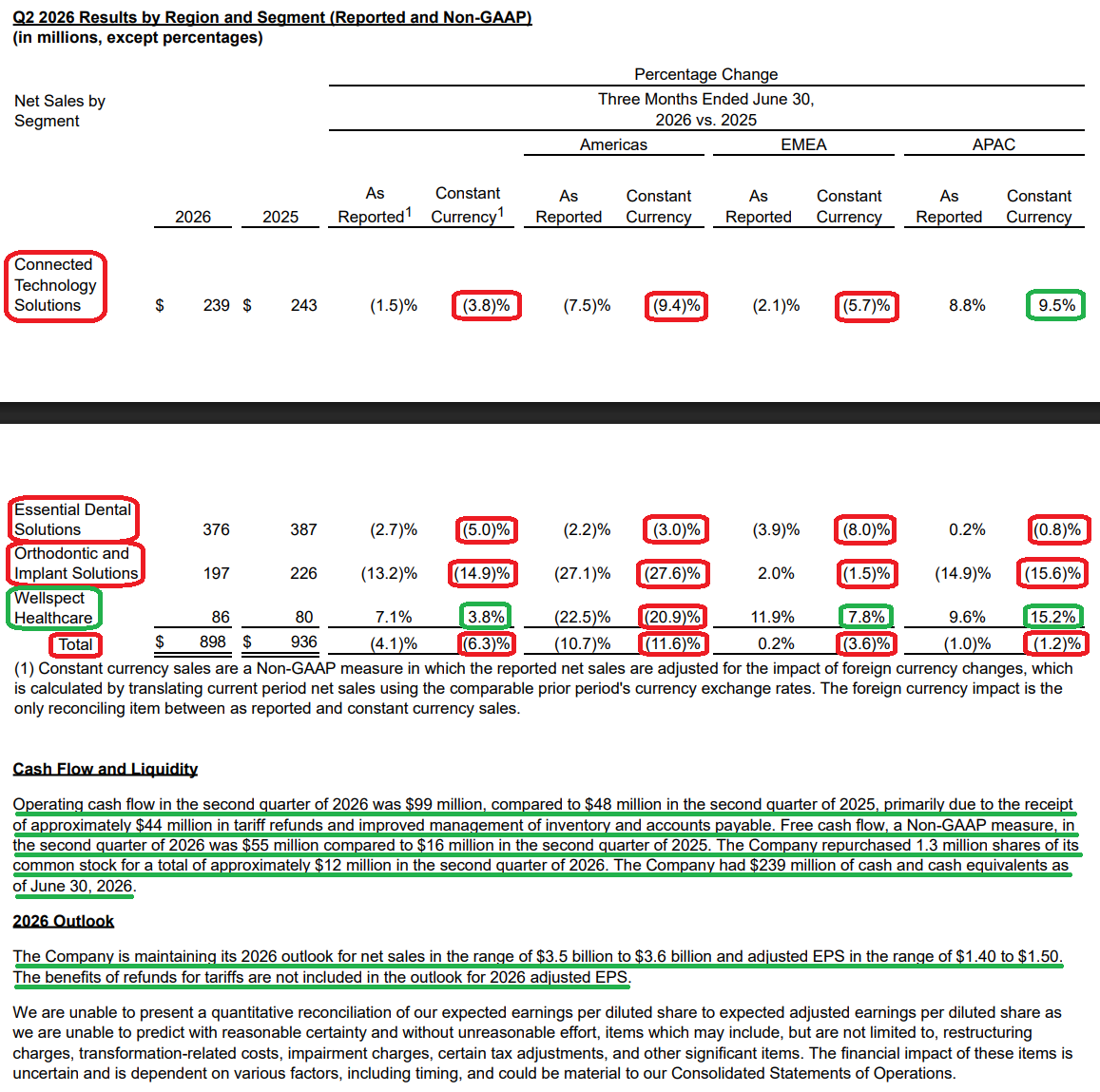
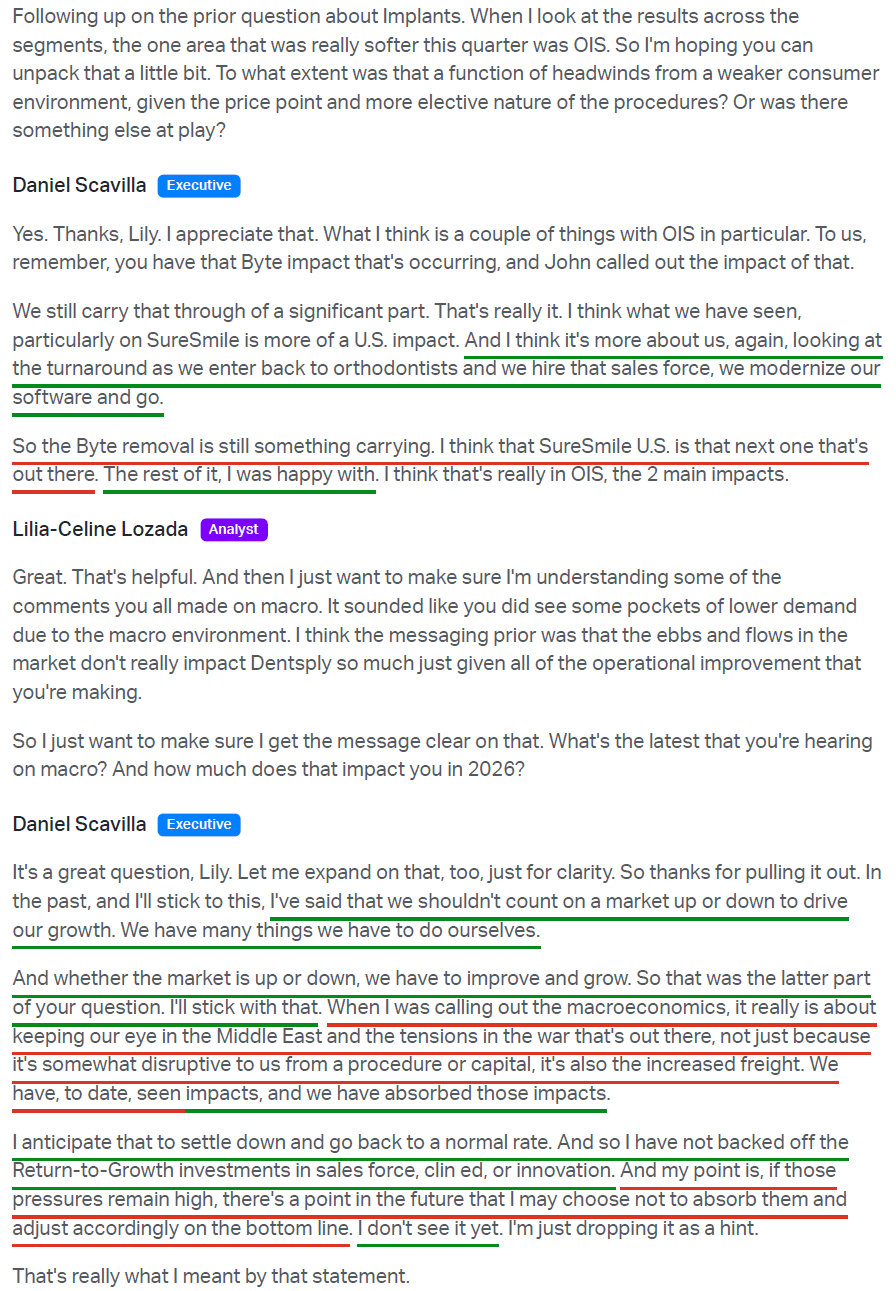
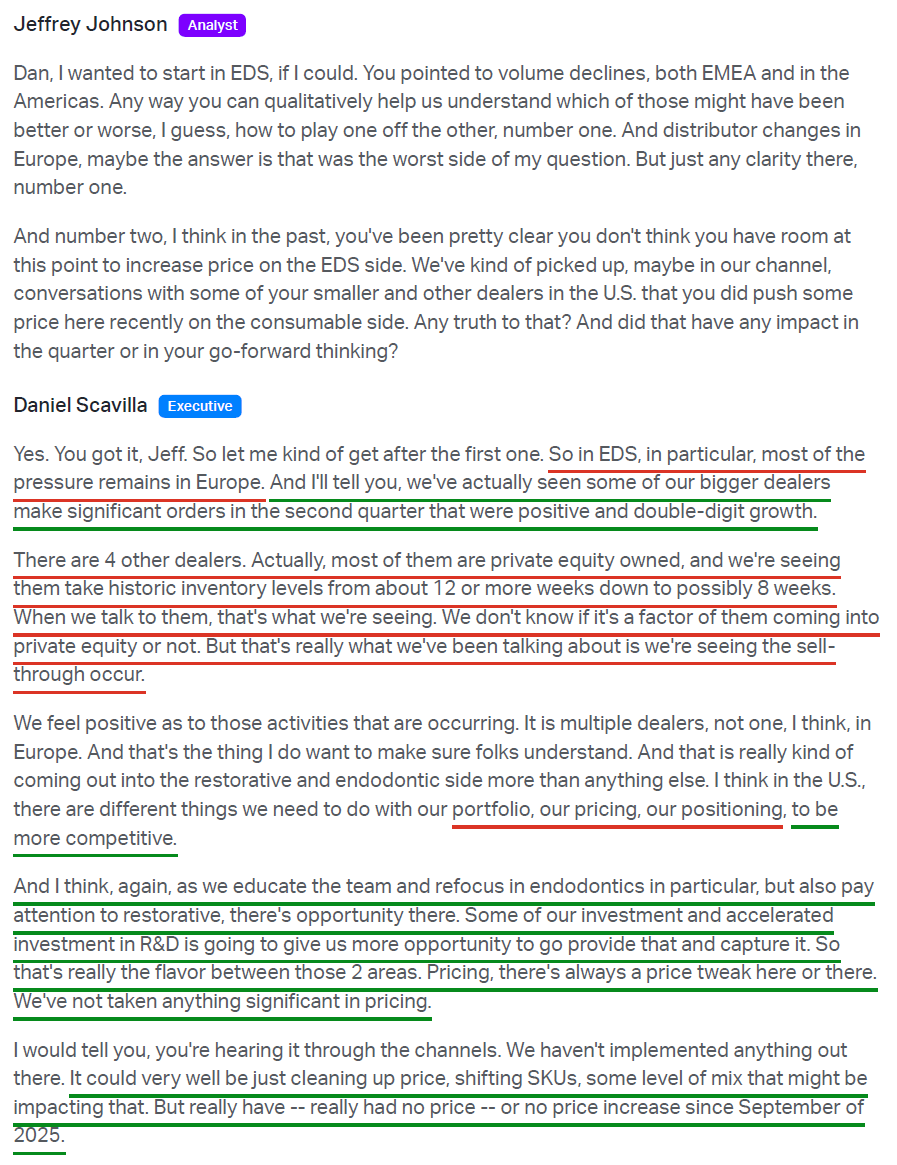
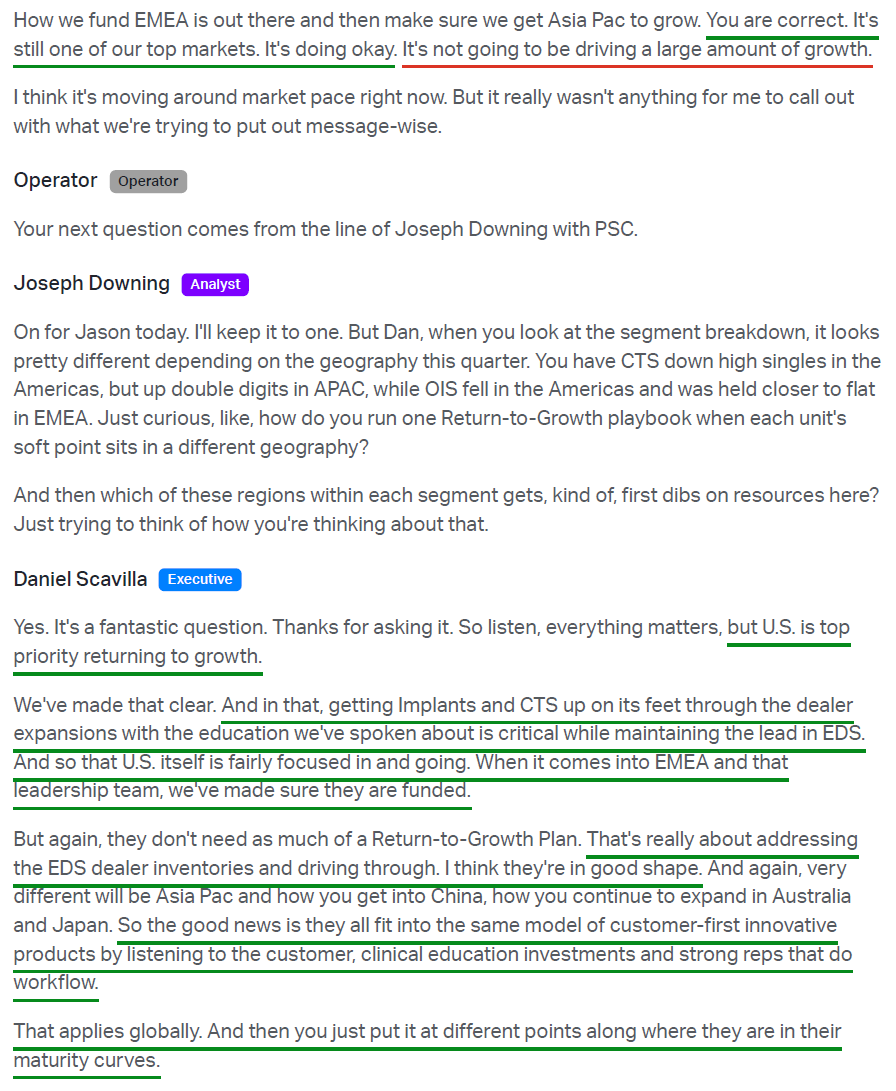
While the cost discipline and self-funding innovation ramp matter, they are only one piece of the turnaround. The top line is ultimately where this story gets decided, and that brings us to the U.S., the #1 focus of the plan and the single biggest source of upside. At ~32% of sales and coming off a 12.3% decline in FY25, the U.S. has the most room to recover, with Americas revenue still down 11.6% in C$ this quarter. The weakness was concentrated in Orthodontic & Implant Solutions, which declined 27.6% on the Byte removal impact and SureSmile weakness, while CTS declined 9.4% and EDS held up slightly better at -3.0%.
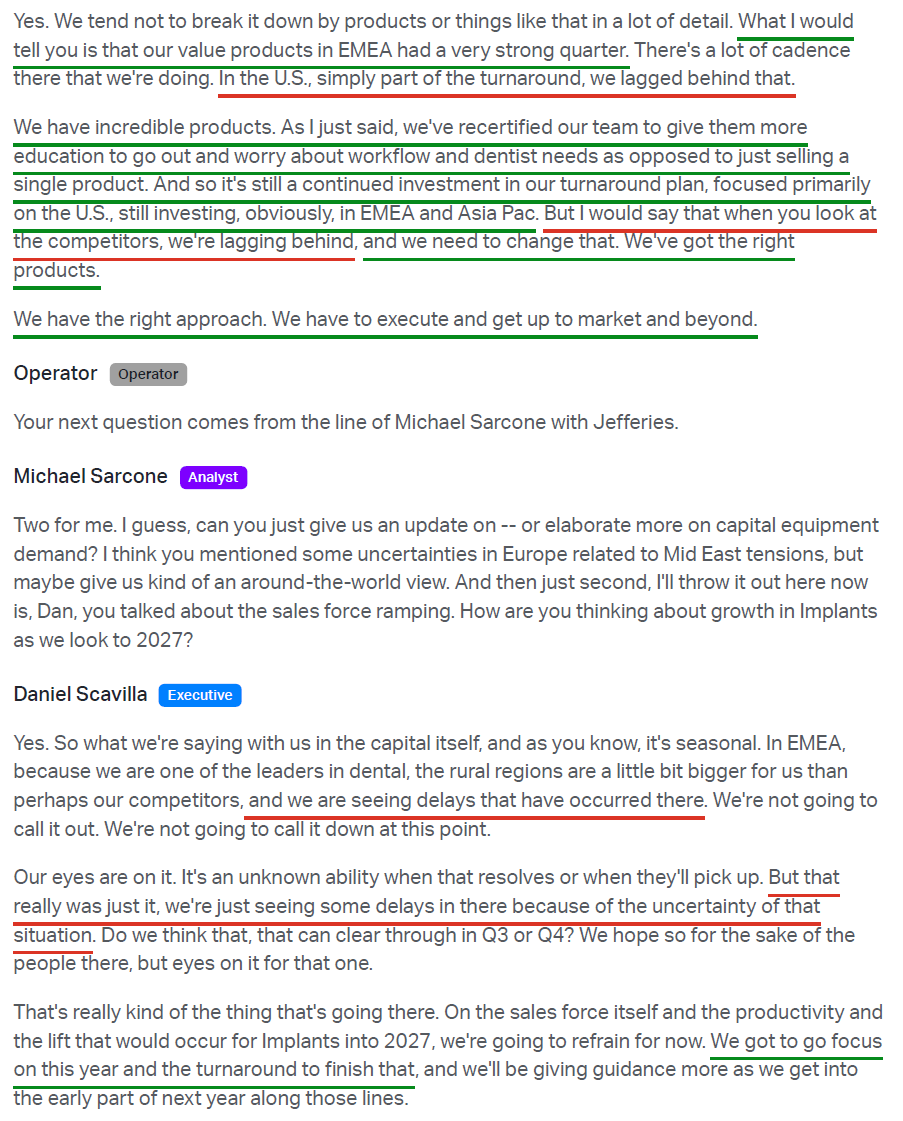
Six months into a 24-month turnaround plan, these ugly headline numbers shouldn't be all that surprising. In a return-to-growth plan centered on rebuilding the commercial engine, the reality is that sales forces have to be retrained before they become productive, dealers get signed long before they sell anything, and clinical education gets funded well ahead of when it converts. The spending comes first; the revenue follows. While we wait for the latter, what we want in the meantime is a management team that is direct about where things stand, which is exactly what Scavilla provided:
"I would say that when you look at the competitors, we're lagging behind, and we need to change that. We've got the right products. We have the right approach. We have to execute and get up to market and beyond."
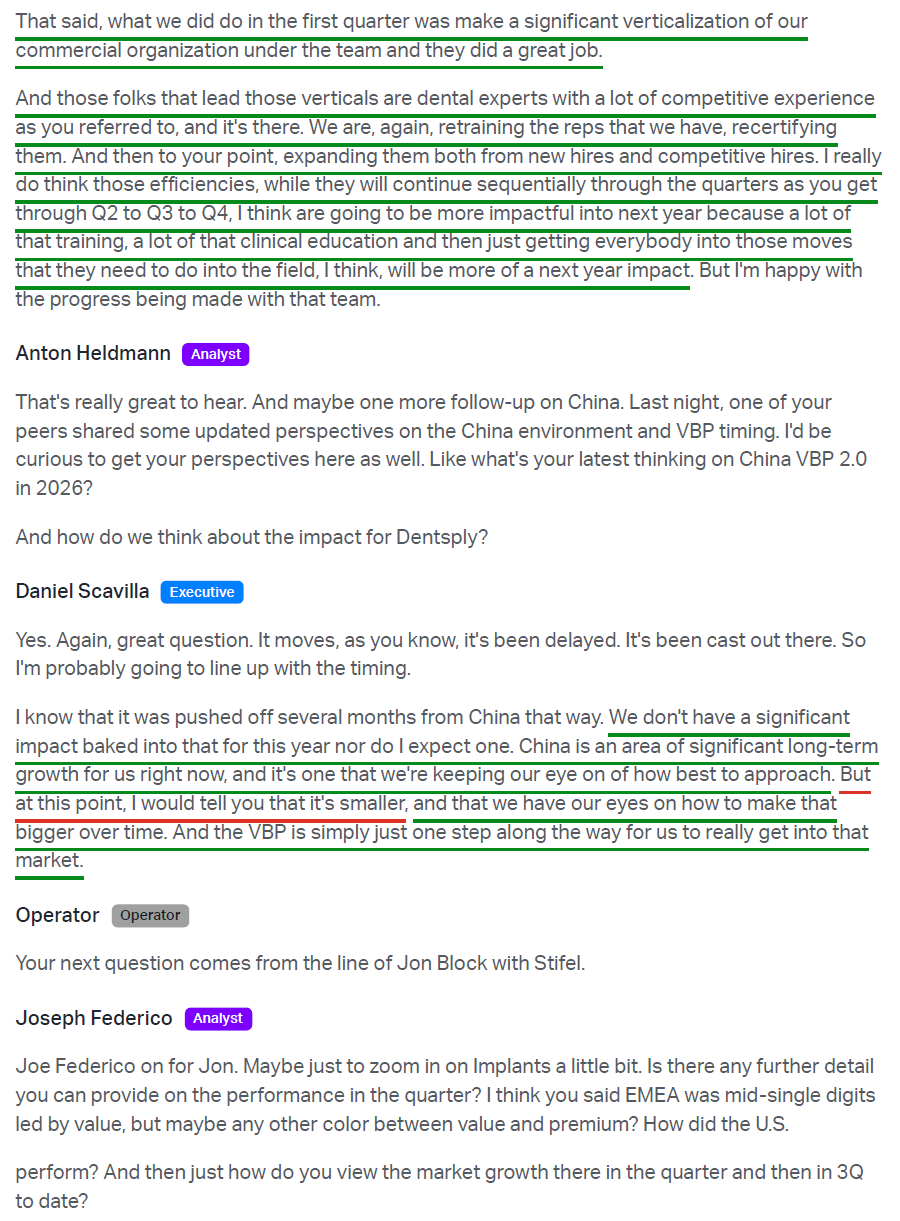
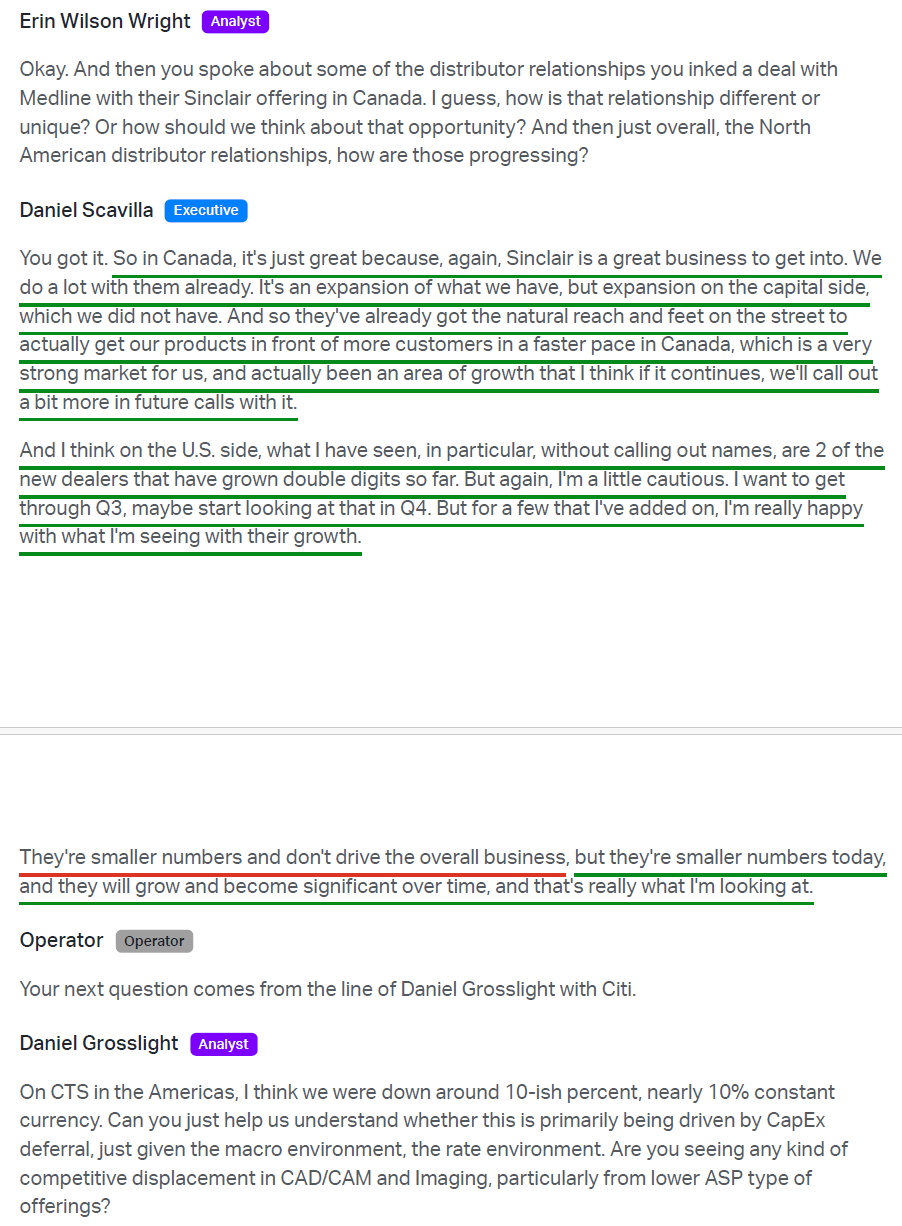
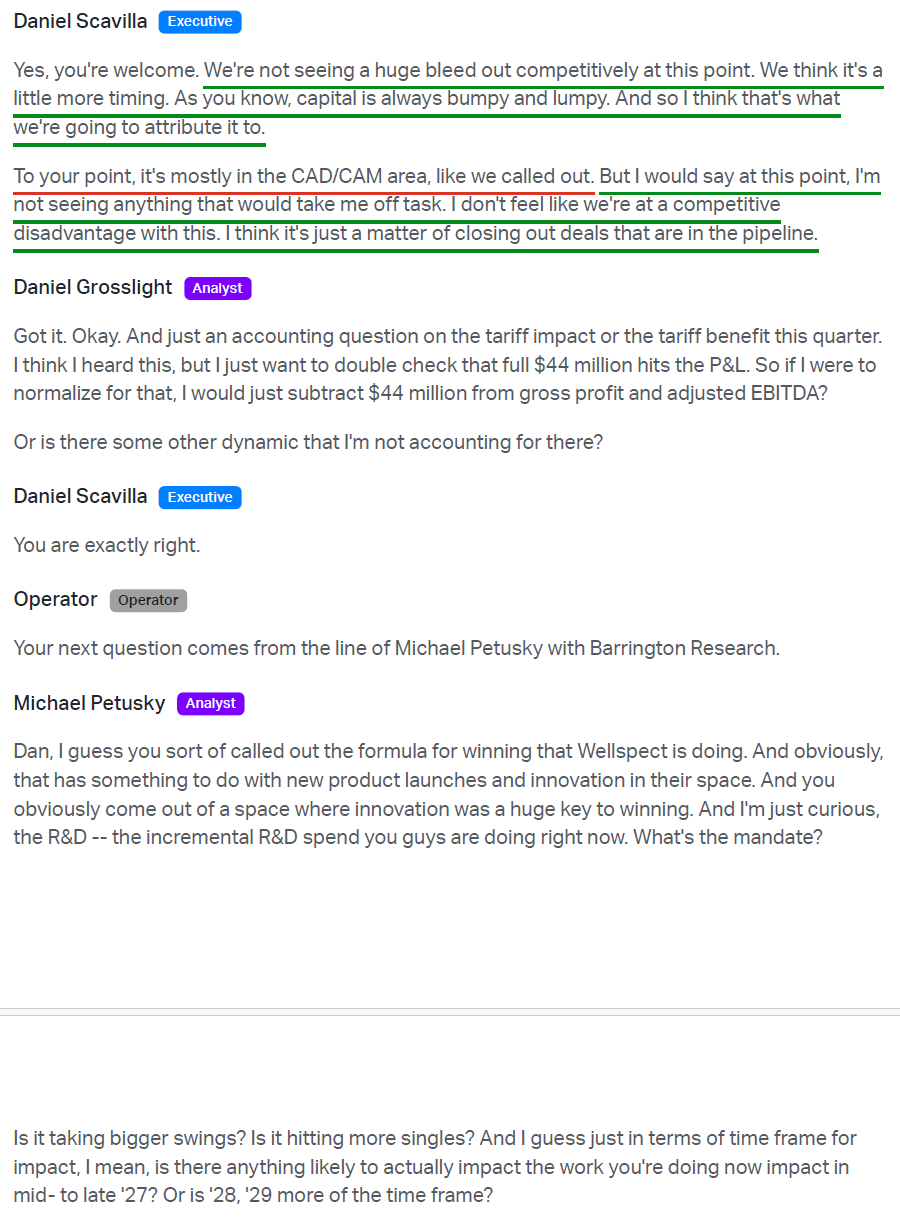
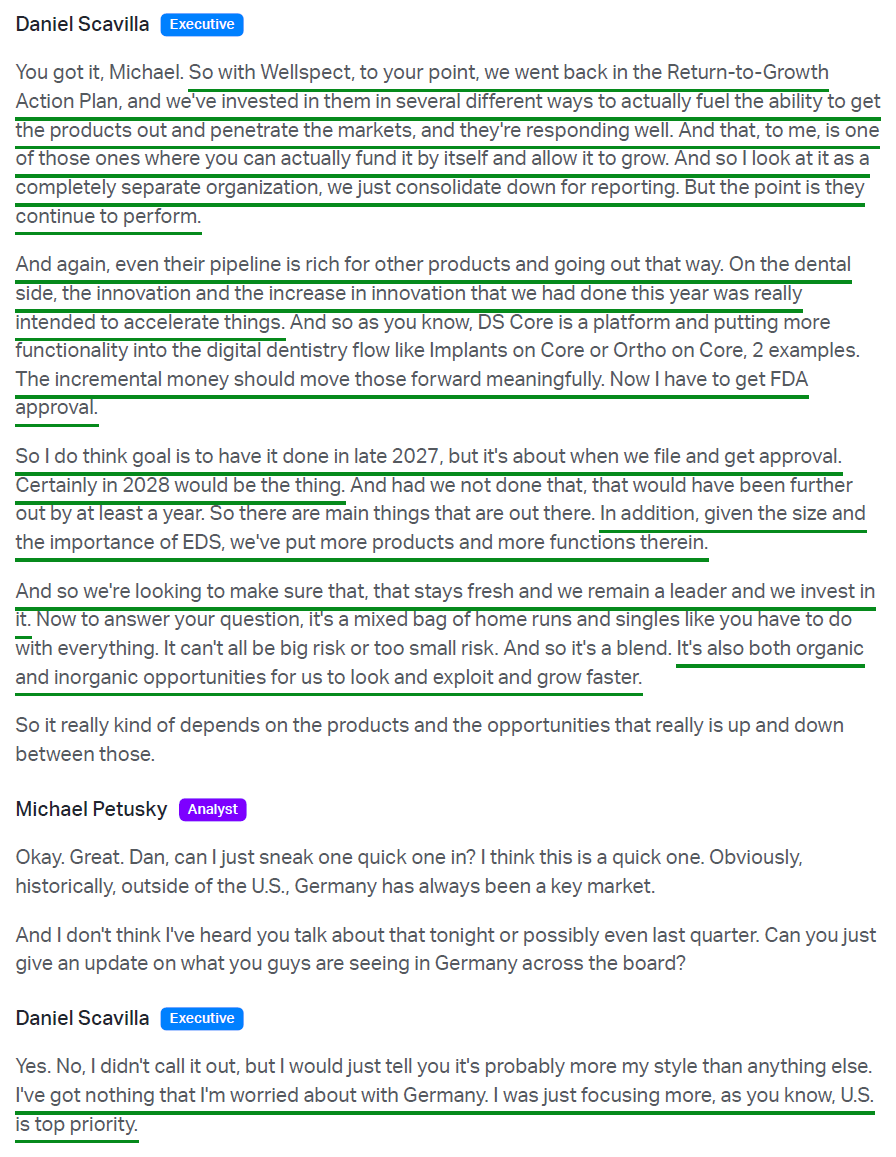
The self-help levers being pulled to close that competitive gap are starting to gain traction. Starting with distribution, XRAY announced an expanded agreement with Medline Sinclair in Canada, marking its sixth distribution enhancement of the year and continuing to repair a channel that prior management severed while chasing its DTC ambitions. Encouragingly, two of the newer U.S. dealers are already growing double digits, though management flagged the typical nine-month lag between onboarding a partner and driving capital sales, given the time required to train reps, get them into the field, and build a pipeline before deals close. That timeline puts the bulk of the revenue benefit into the fourth quarter and beyond.
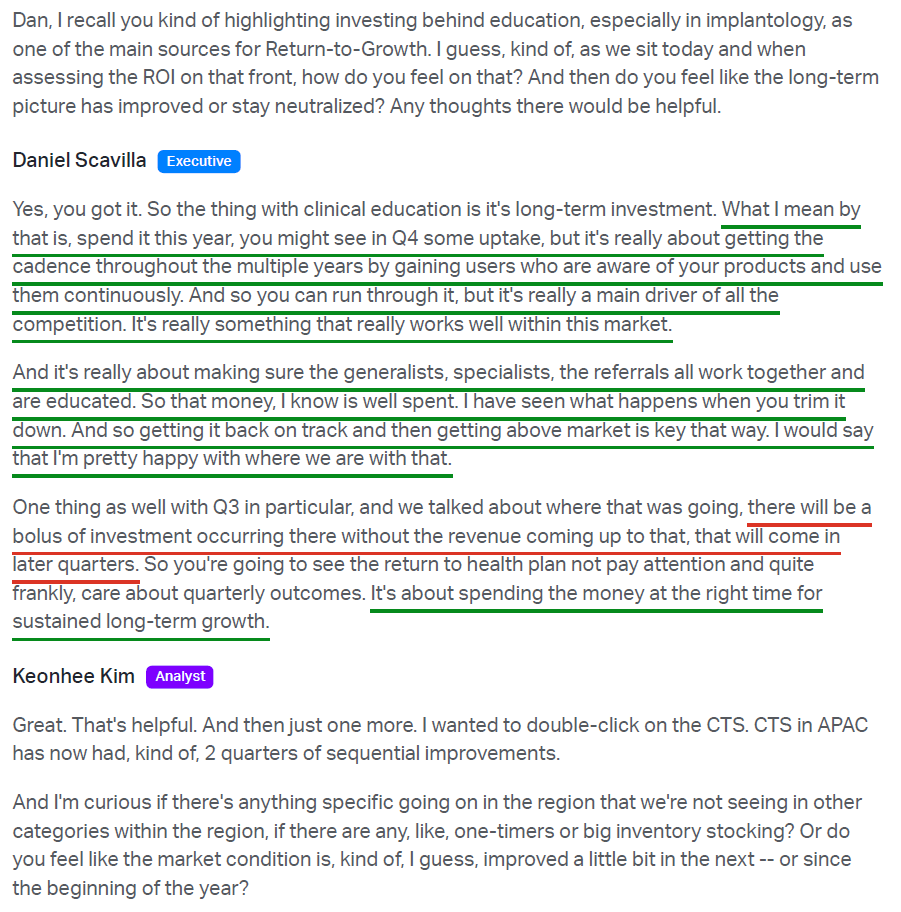
Running alongside the distribution effort is a renewed focus on clinical education, another area prior management pulled back from in pursuit of short-term cost savings. XRAY brought more than 1,000 clinicians together at its Global Implant Summit, hosted endodontic key opinion leaders at the 2026 Endodontic Forum, and put every U.S. implant sales rep through its most comprehensive certification program to date. Clinical education has long been a key competitive lever in the market, with the benefits compounding over time through referral networks and greater product familiarity. The catch is that those returns take time to materialize, showing up well after the initial investment and making this another tailwind to watch through the back half of the year and into 2027.
Both efforts ultimately serve the same objective: making XRAY easier to do business with. That is something prior management seemingly worked overtime to complicate, with the consequences still visible in today's depressed results.
On top of addressing these operational gaps, the appointment of John Fortson as CFO fills the last open seat on Scavilla's bench, bringing an end to a search that had been outstanding since November 2025.
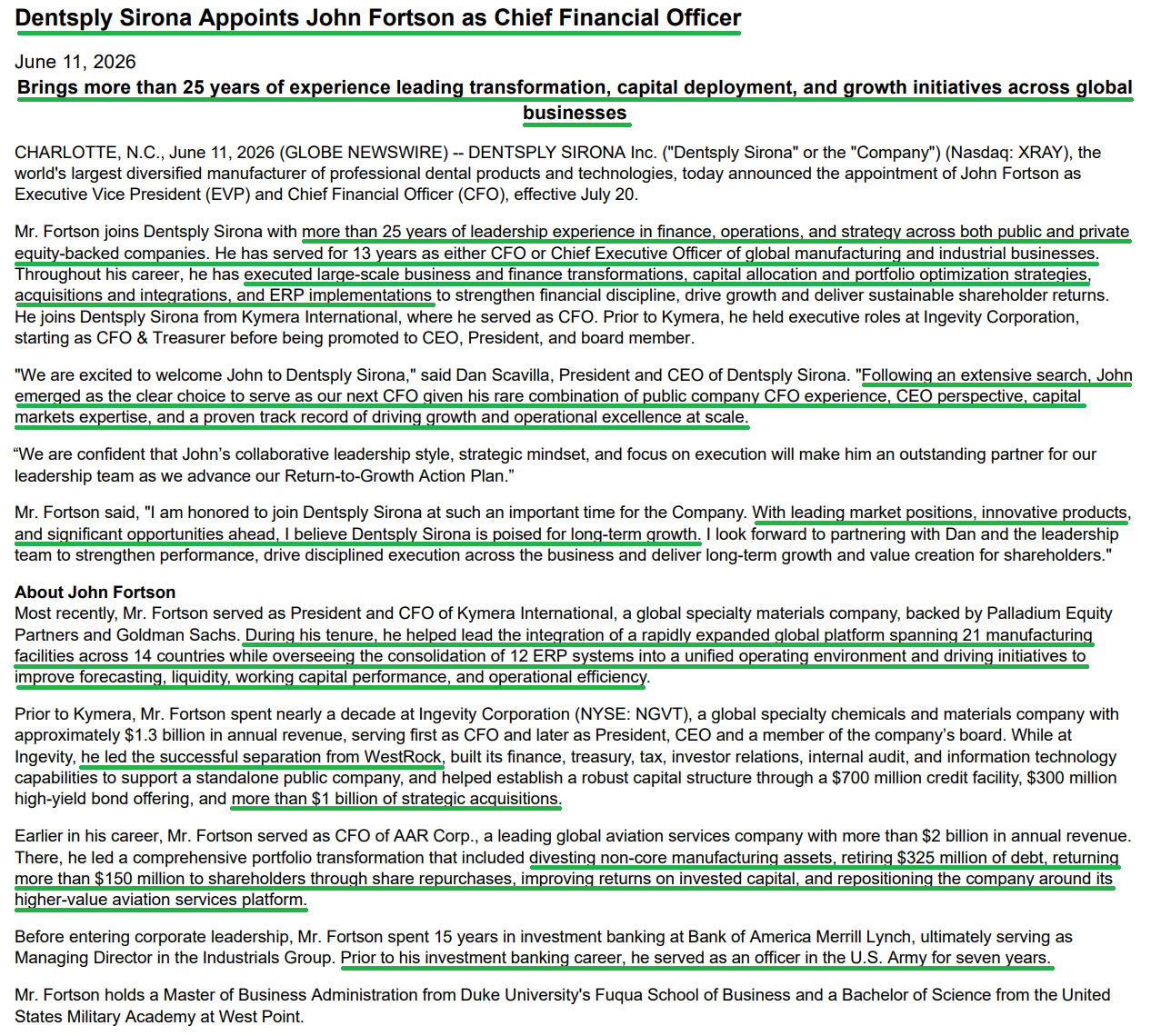
Alongside three new board members, a new Chief Commercial Officer, Chief Transformation Officer, and head of Americas commercial, Scavilla now has the complete team he has been assembling since taking over.
Combined, management expects these changes to turn the U.S. positive in the fourth quarter and accelerate growth into 2027.
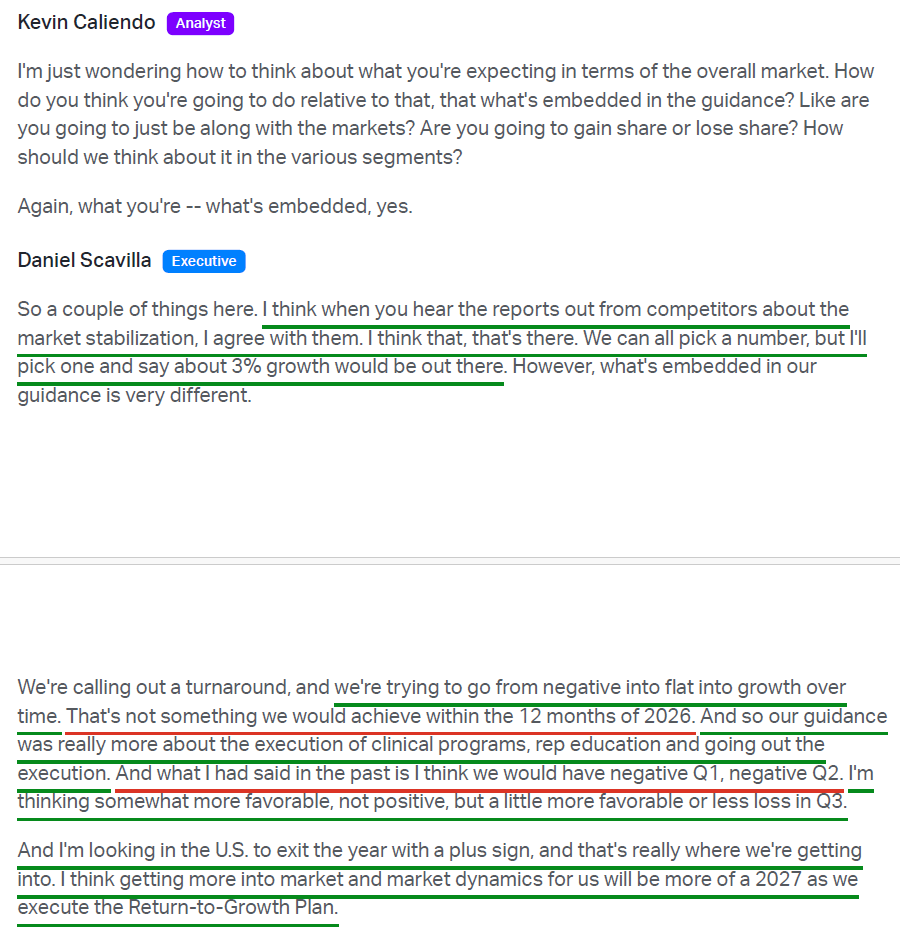
Keep in mind that each of these is an internal, XRAY-specific lever. None depends on a broader market recovery, as simply reversing a series of self-inflicted missteps can go a long way in a turnaround of this kind. The good news is that the market appears to be cooperating anyway. Management pegged industry growth at ~3% and agreed that conditions have largely stabilized, which lines up with U.S. dentist confidence at its highest level since Q4 2024.
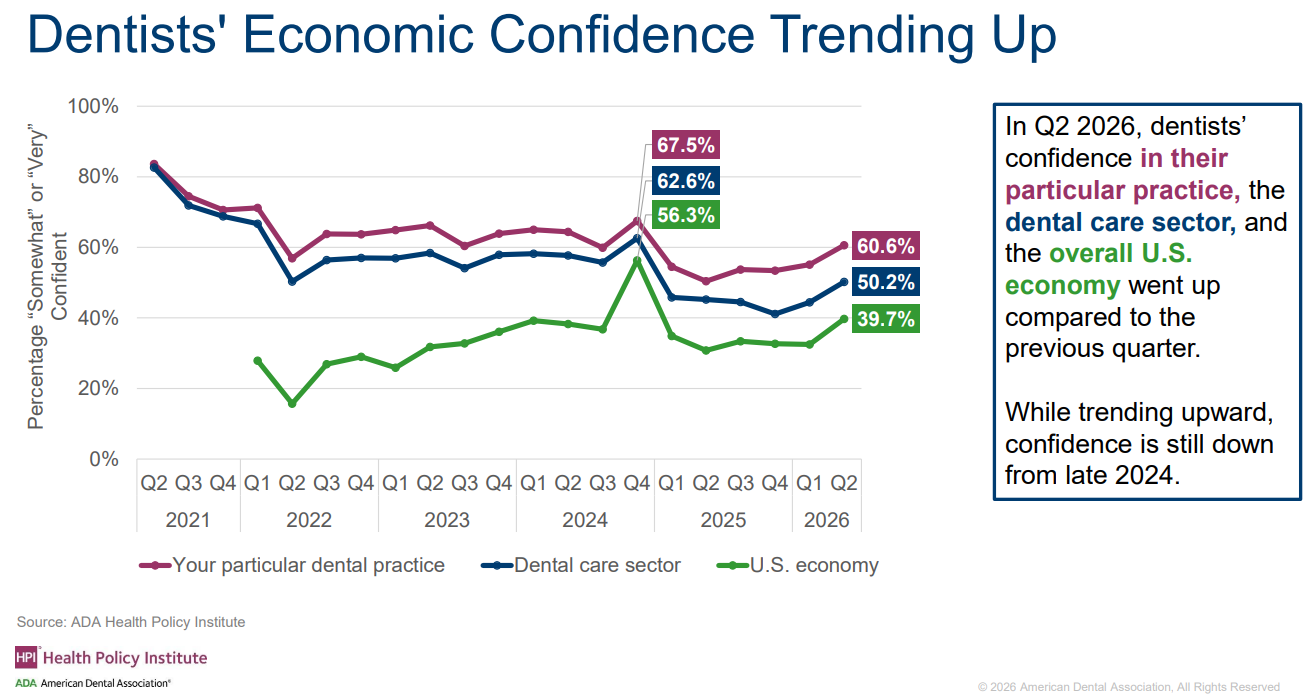
While stabilization is a great first step, the sector still has a long way to go after spending the last several years in the gutter, with dental spending growing just 24% over the past decade compared to 39% for healthcare overall. Much like a car whose owner skips oil changes for years, deferred dental work doesn't disappear. It simply accumulates until it has to be addressed, creating a large pool of pent-up demand on top of a long list of secular drivers, including an aging population, aesthetic demand, the shift toward preventive care, and digital technology adoption. The point is that XRAY is no longer fighting uphill on volumes, with any further improvement in the sector from here representing pure upside.
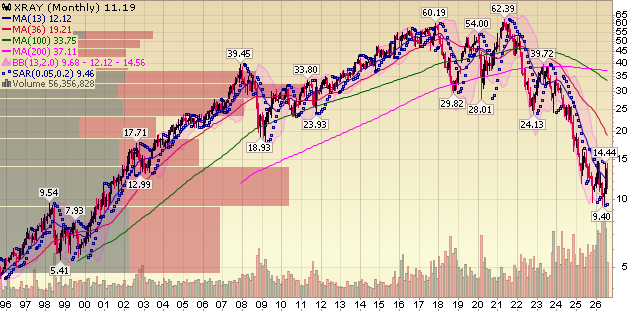
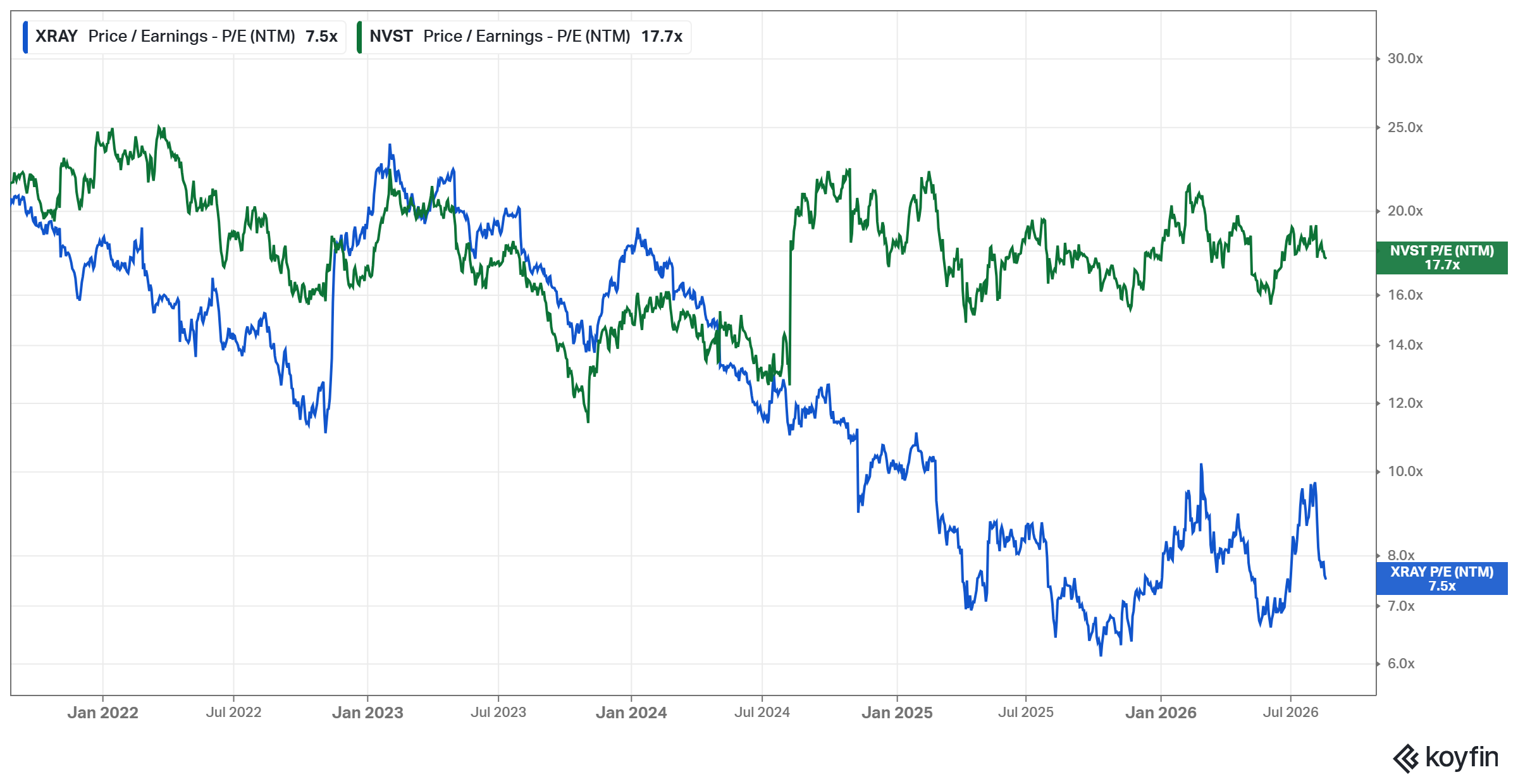
Rather than applause, these improvements have been met with yawns by the market. XRAY trades at a depressed 7.5x forward earnings versus a ~18x long-term average and at a 58% discount to dental peer NVST, with the valuation gap among the widest on record, and one we expect to narrow.
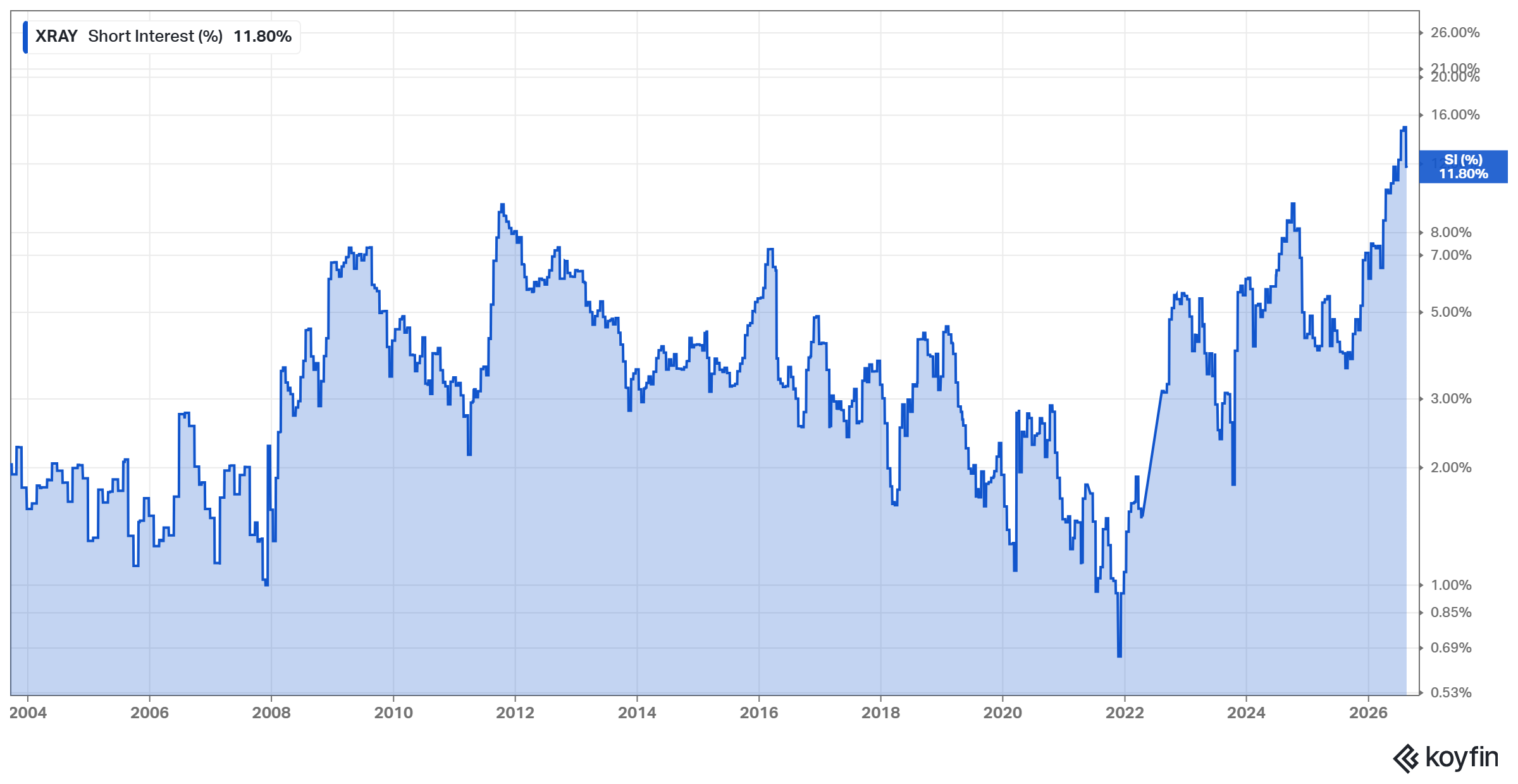
Meanwhile, short interest sits at 11.8%, just off the multi-decade high of 14.9% reached earlier this month, with a considerable amount of capital still wagered against a turnaround that is progressing right on schedule.
We think a few quarters of solid execution and steady improvement will go a long way for XRAY. Nothing heroic is required, just boring, consistent, ordinary execution. And with so little priced in, ordinary should be worth quite a lot.
Q2 Earnings Breakdown
10 Key Points
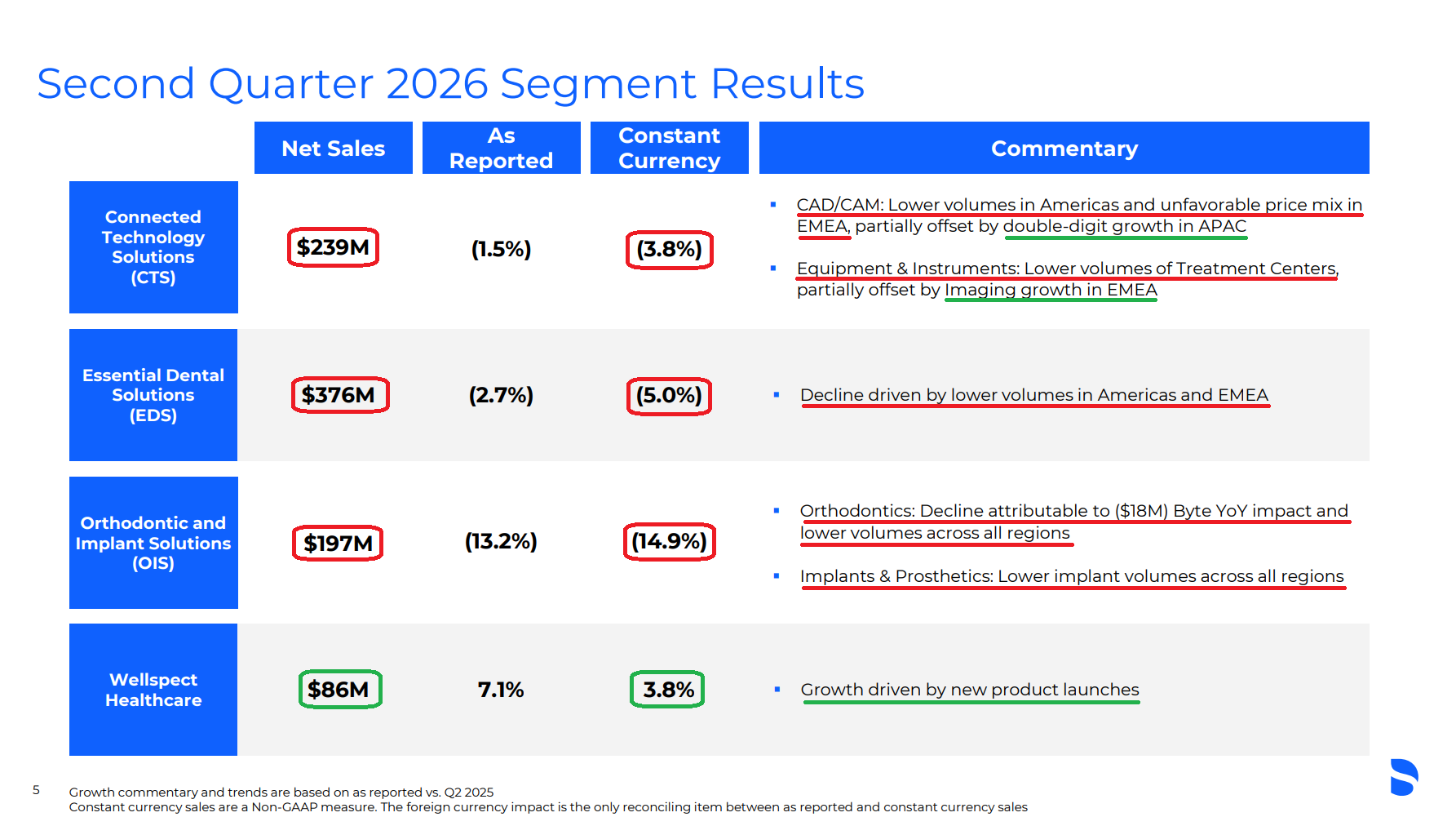
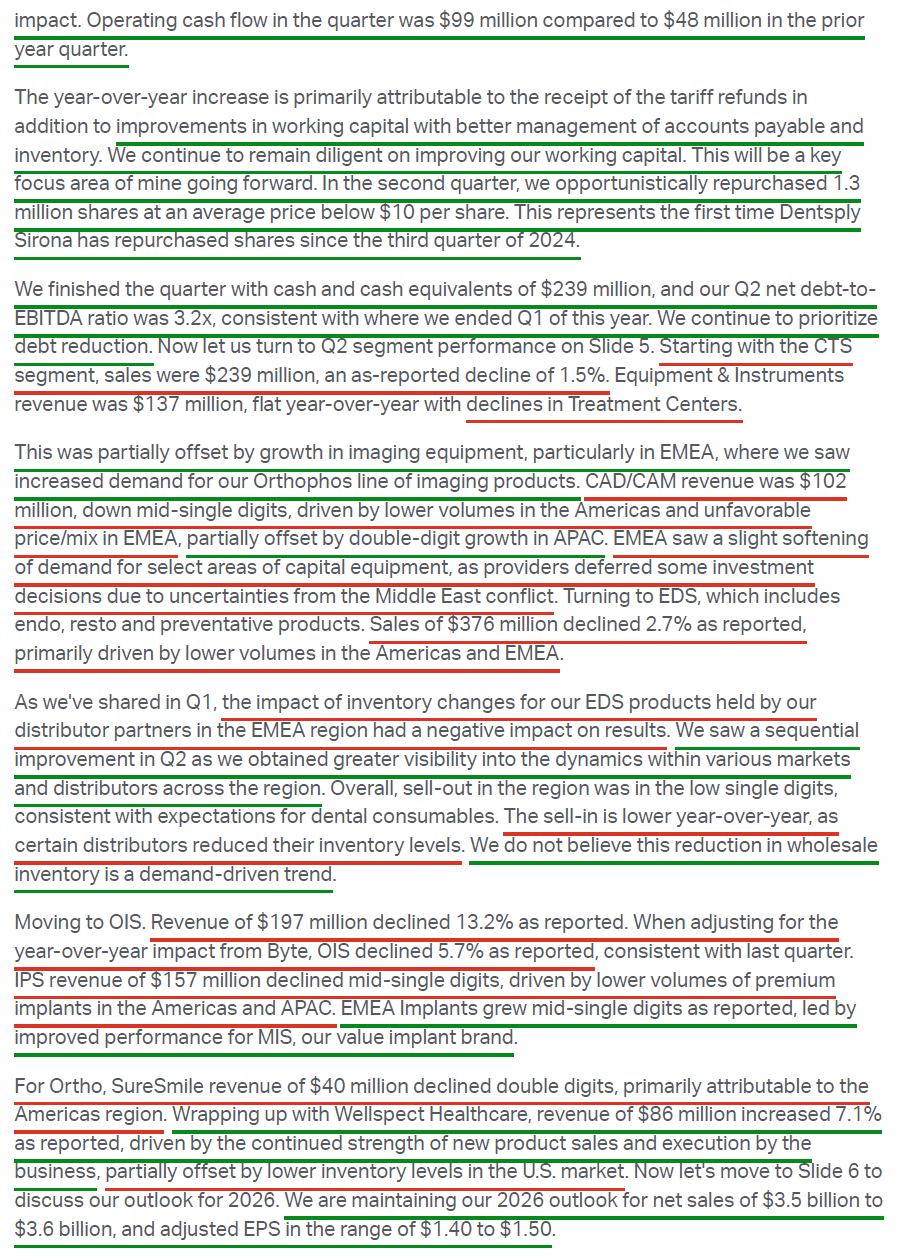
1) XRAY posted Q2 revenue of $898M (-4.1% reported, -6.3% C$), beating consensus of ~$889M by ~$9M. The C$ decline includes a (1.8%) Byte headwind, with underlying sales down ~3.6% after adjusting for both Byte and a planned ~$8M dealer inventory reduction in the quarter. At the segment level, Wellspect Healthcare led the way again (+7.1% reported, +3.8% C$), followed by CTS (-1.5% reported, -3.8% C$), while EDS (-2.7% reported, -5.0% C$) and OIS (-13.2% reported, -14.9% C$) remained the key drags.
2) Adjusted EPS of $0.52 (-1.6% Y/Y) beat consensus of $0.35 by $0.17. The entire beat, however, was attributable to a one-time $44M tariff refund worth ~$0.17 per share. Backing that out, adjusted EPS was ~$0.35, in line with the Street.
3) Adjusted gross margin came in at 56.4%, up 50 bps Y/Y from 55.9% and up 570 bps sequentially from 50.7% in Q1, largely driven by the $44M tariff refund. Excluding it, adjusted gross margin was ~51.4% (-450 bps Y/Y, +70 bps sequentially), still pressured by tariffs and negative segment mix, including lighter EDS, the highest-margin segment. Management expects underlying margins to continue recovering as tariffs and European destocking dynamics work through.
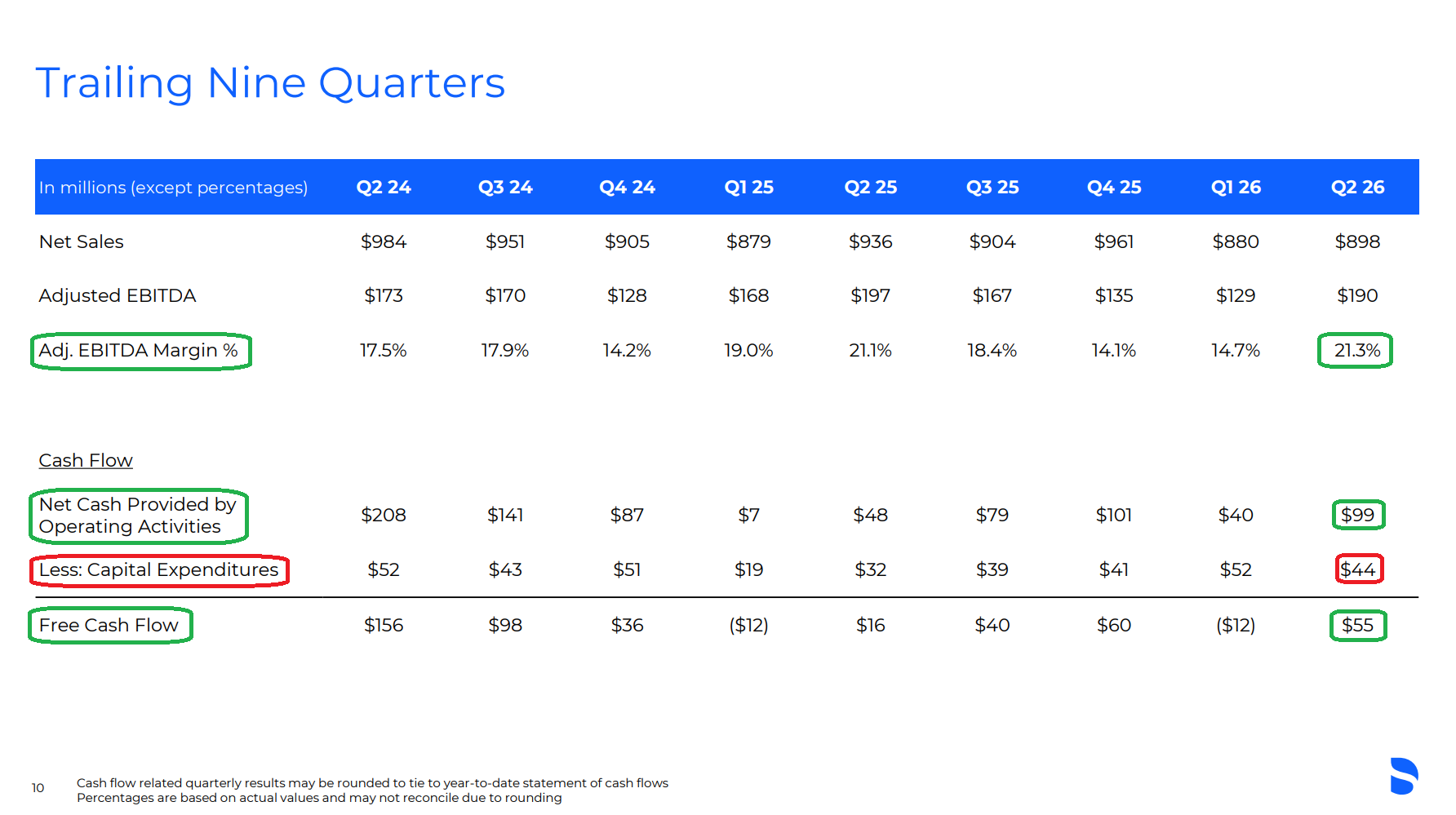
4) Adjusted EBITDA of $190M (-3.3% Y/Y from $197M) carried a margin of 21.3% (+20 bps Y/Y from 21.1%) and marked a strong sequential recovery from 14.7% in Q1. Excluding the tariff refund, adjusted EBITDA was ~$146M at a ~16.3% margin (-480 bps Y/Y, +160 bps sequentially). OpEx rose $12M Y/Y, including a ~$8M FX headwind, as reductions in G&A were redeployed into sales, marketing, and R&D in support of the Return-to-Growth plan.
5) Operating cash flow more than doubled to $99M versus $48M in the prior-year period, with free cash flow tripling to $55M versus $16M. Both were driven largely by the $44M tariff refund, alongside improved management of accounts payable and inventory, partially offset by stepped-up capital expenditures of $44M (4.9% of revenue) versus $32M (3.4%) last year. New CFO John Fortson made clear that improving working capital remains a top priority.
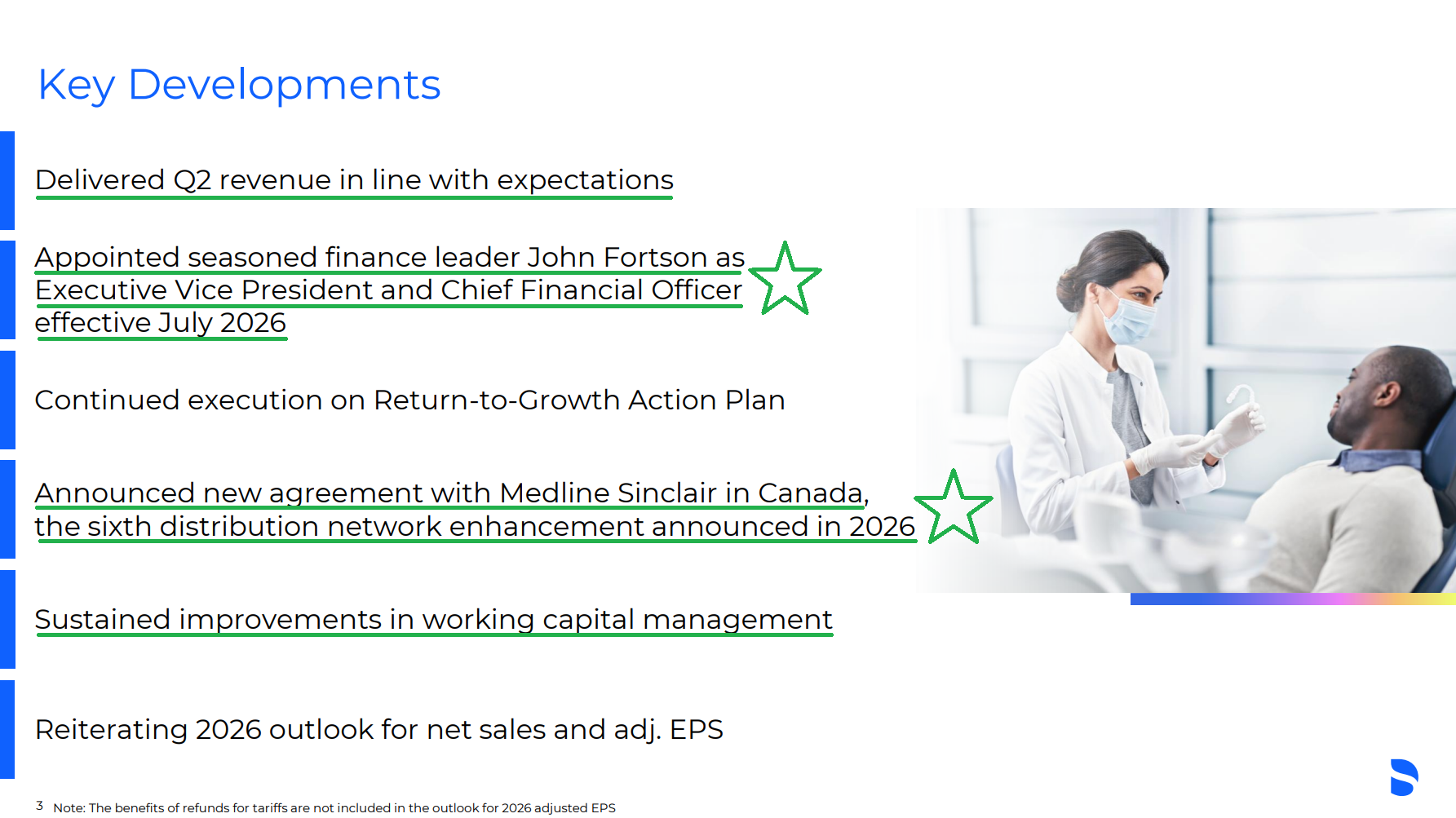
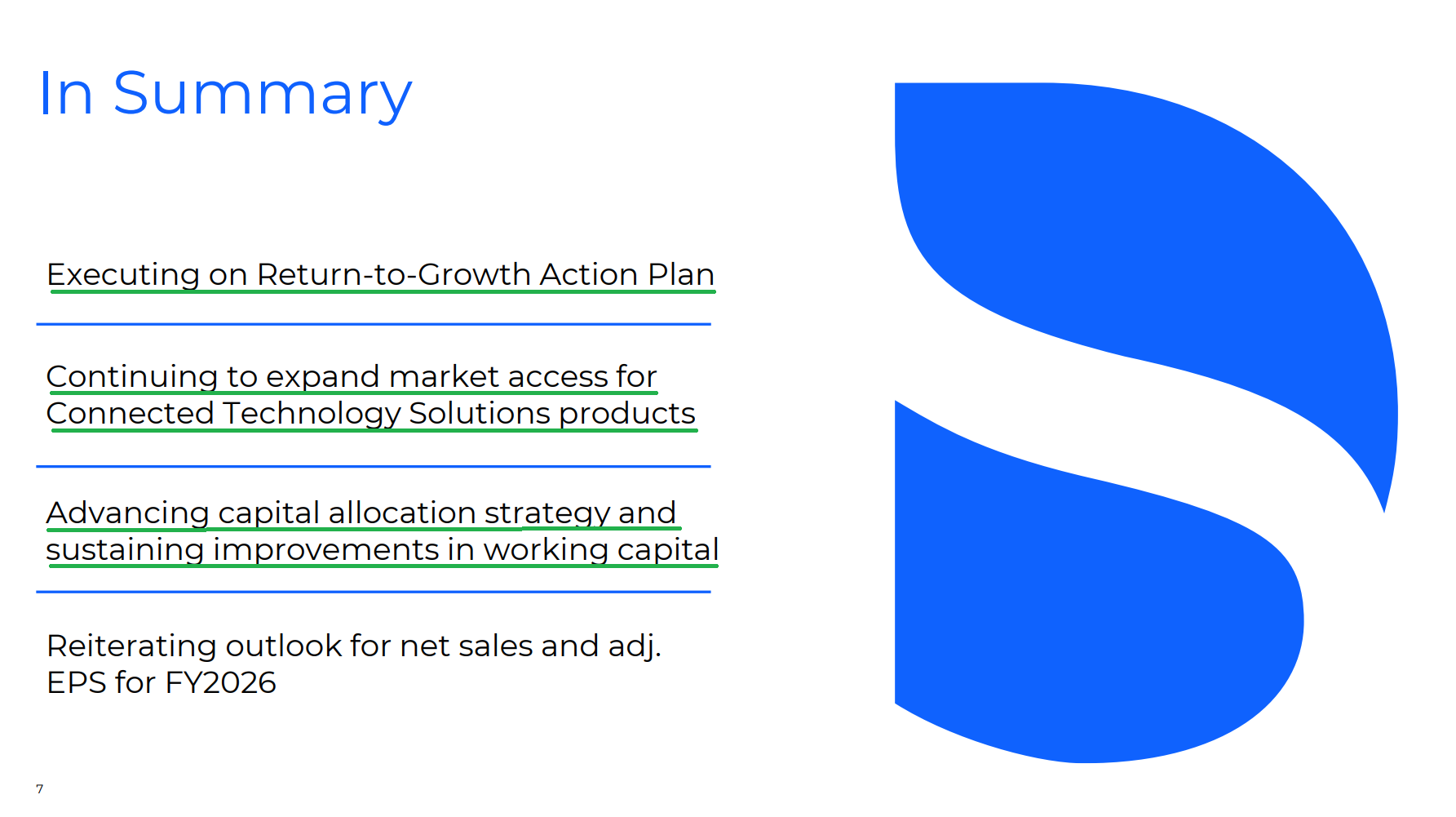
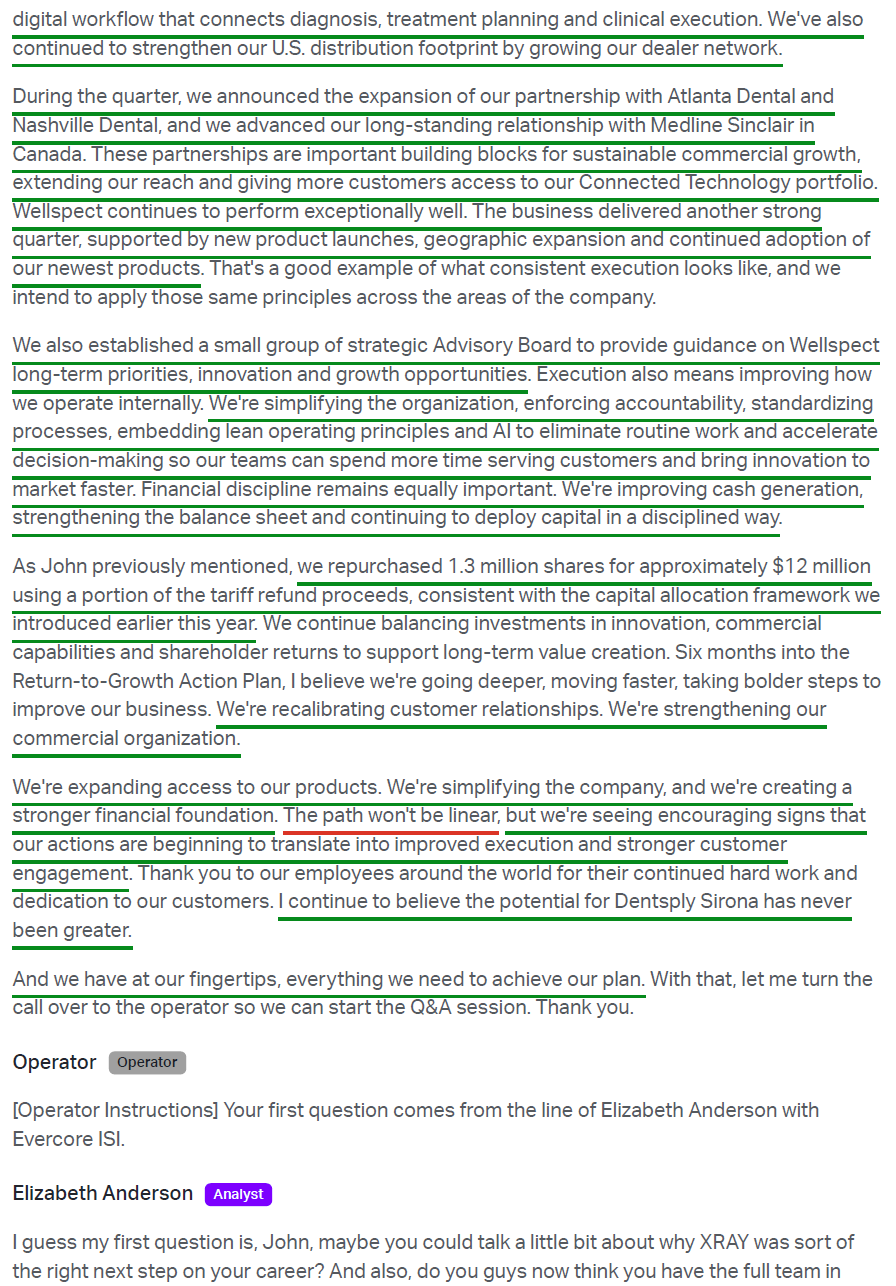
6) XRAY continued rebuilding its distribution footprint, announcing an expanded agreement with Medline Sinclair in Canada that broadens access to the Connected Technology Solutions portfolio and marks the sixth distribution network enhancement announced in 2026. Building on a series of prior dealer re-engagements, two of the newer U.S. dealers are already growing double digits, though management flagged a ~9-month lag between onboarding a dealer and driving capital sales, given the time needed to train reps, get them into the field, and build a pipeline before deals close.
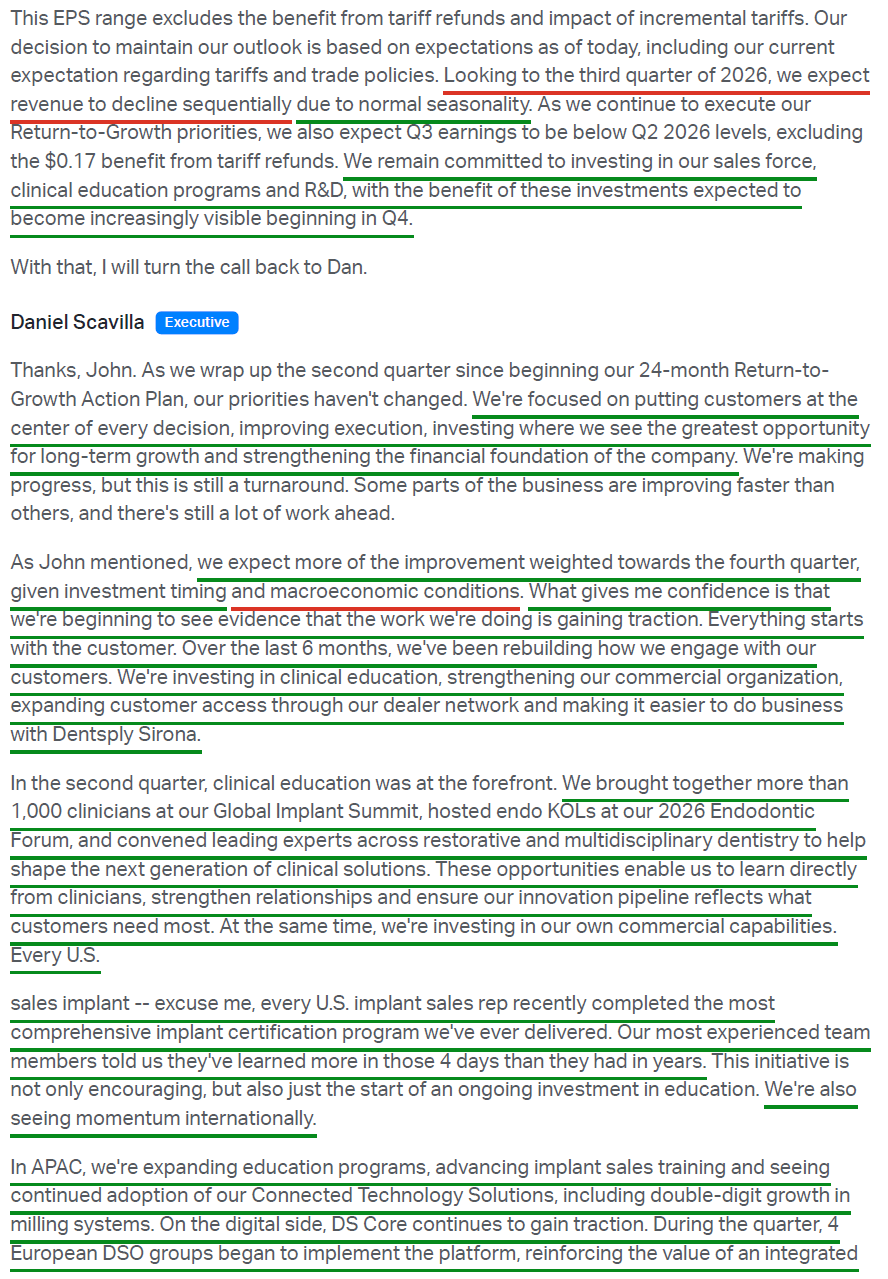
7) XRAY leaned heavily into clinical education this quarter, bringing together more than 1,000 clinicians at its Global Implant Summit, hosting endodontic key opinion leaders at the 2026 Endodontic Forum, and engaging restorative and multidisciplinary experts to help shape its innovation pipeline. Management framed clinical education as a multi-year investment and a key competitive driver, with the higher spending central to the Return-to-Growth plan. The company expects the investment to weigh on Q3 ahead of the related revenue benefit, but views it as necessary to rebuild customer engagement that eroded under the prior cost-cutting focus.
8) XRAY repurchased 1.3M shares for ~$12M (an average price below $10 per share) during the quarter, its first buyback since Q3 2024, funded with a portion of the tariff refund proceeds. The company ended the quarter with $239M of cash and equivalents against ~$2.2B of total debt, bringing net debt-to-EBITDA to 3.2x, consistent with Q1. Management reiterated that deleveraging remains the near-term priority, with repurchases remaining opportunistic at what it views as depressed prices.
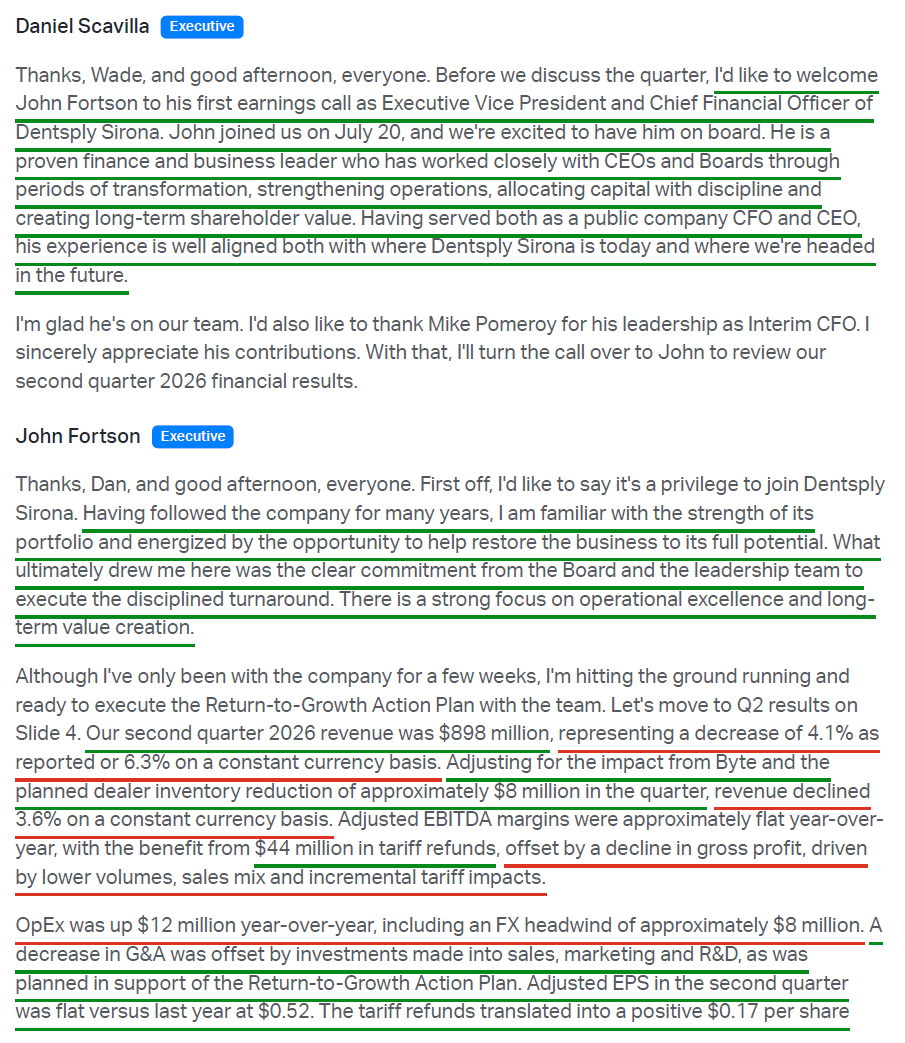
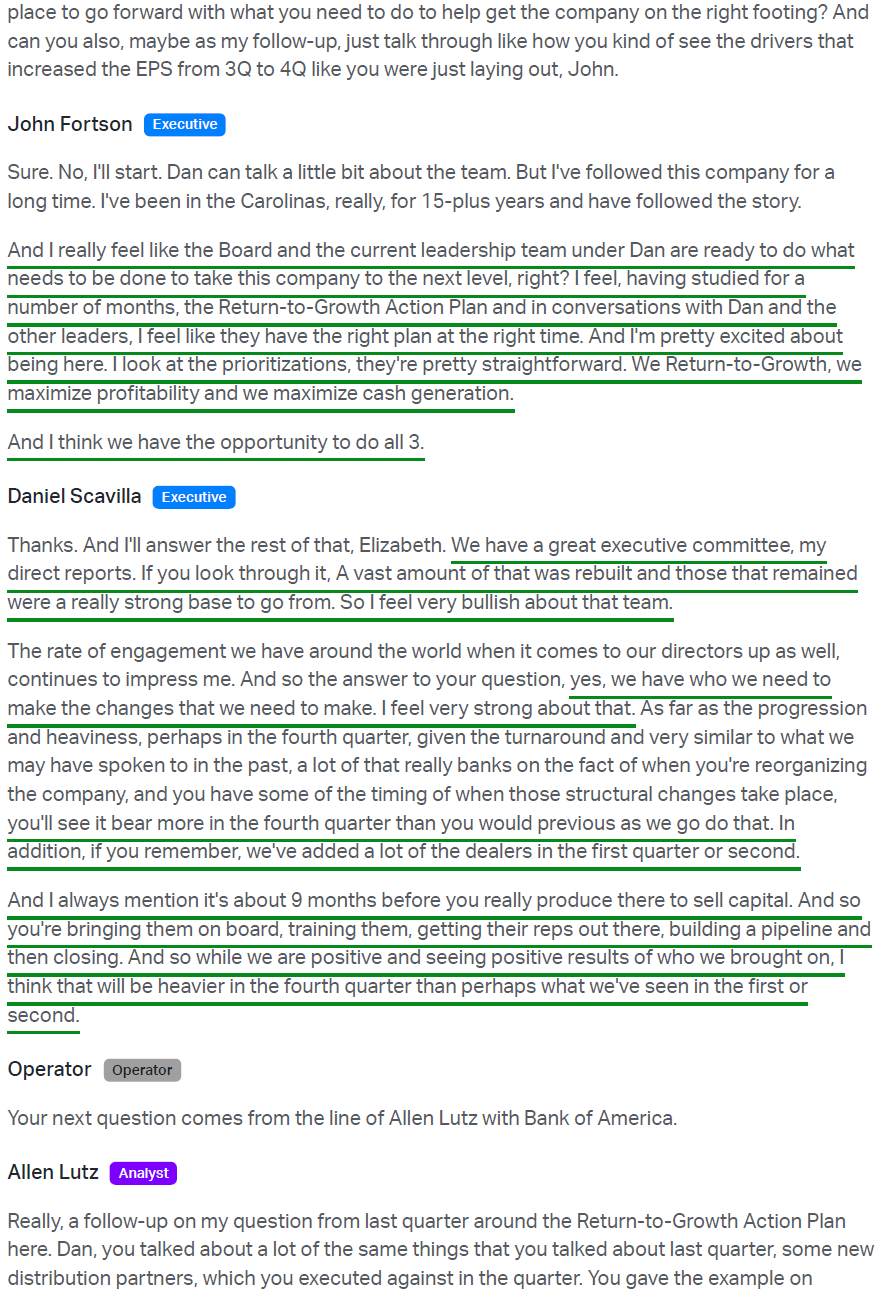
9) On the leadership front, XRAY appointed John Fortson as Chief Financial Officer effective July 2026, with Q2 marking his first earnings call. Fortson brings experience as both a public-company CFO and CEO, along with a strong track record of allocating capital and strengthening operations through periods of transformation. The appointment completes the permanent CFO search that had been outstanding since 2025, with Scavilla characterizing the executive team as largely rebuilt and now having the people it needs to execute the turnaround.
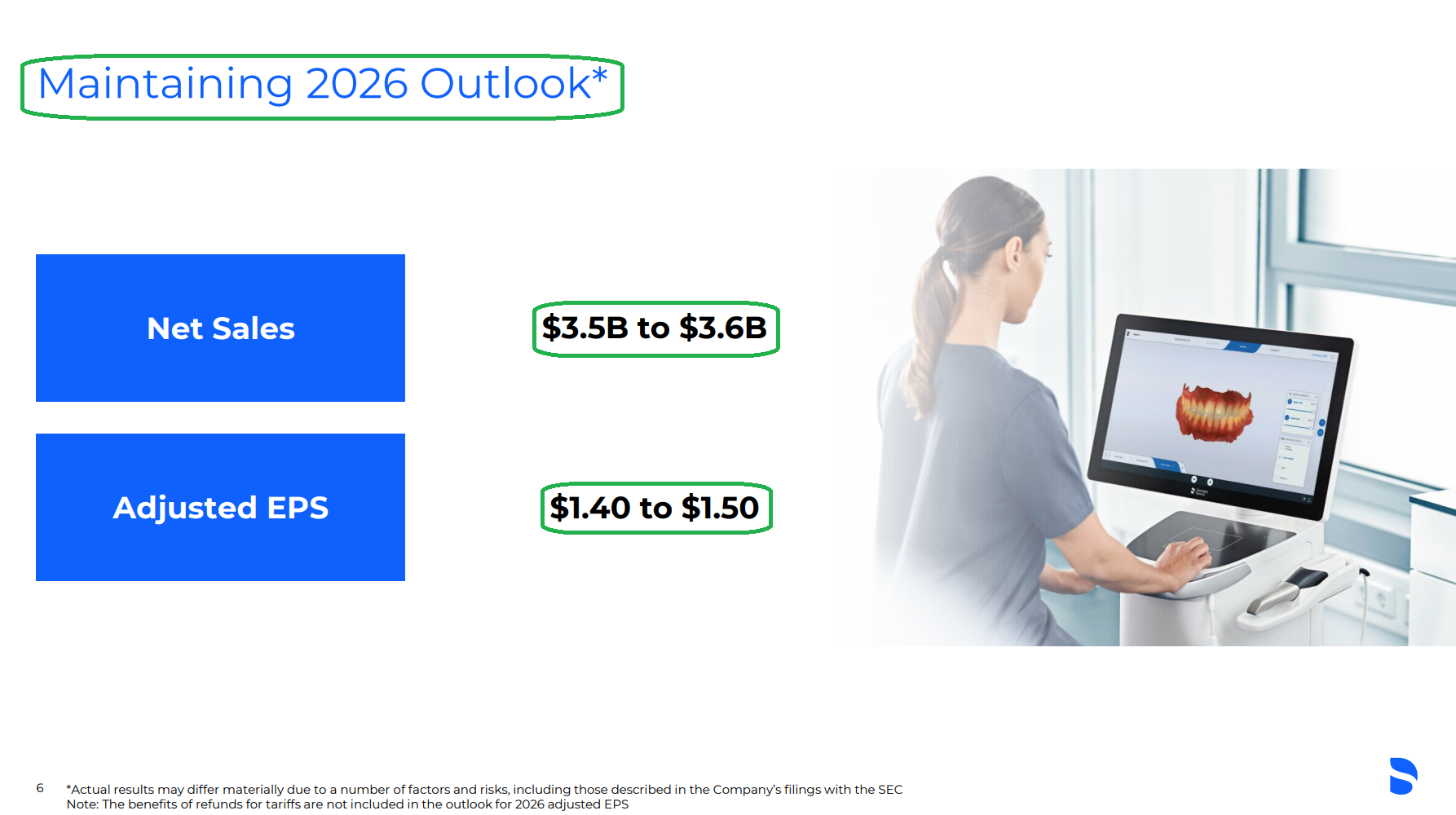
10) Management reiterated its FY26 outlook for net sales of $3.5B-$3.6B (versus consensus of ~$3.58B) and adjusted EPS of $1.40-$1.50 (versus consensus of ~$1.42), with the EPS range excluding both the tariff refund and the impact of incremental tariffs. Looking to Q3, management guided earnings below the Q2 ex-refund base of ~$0.35 on normal seasonality, with the benefit of the sales, clinical education, and R&D investments expected to become increasingly visible beginning in Q4. Management also acknowledged broader market stabilization of ~3% growth but stressed that its guidance reflects internal turnaround execution rather than the market, and it continues to target a U.S. exit-year "plus sign."
Earnings Call Highlights
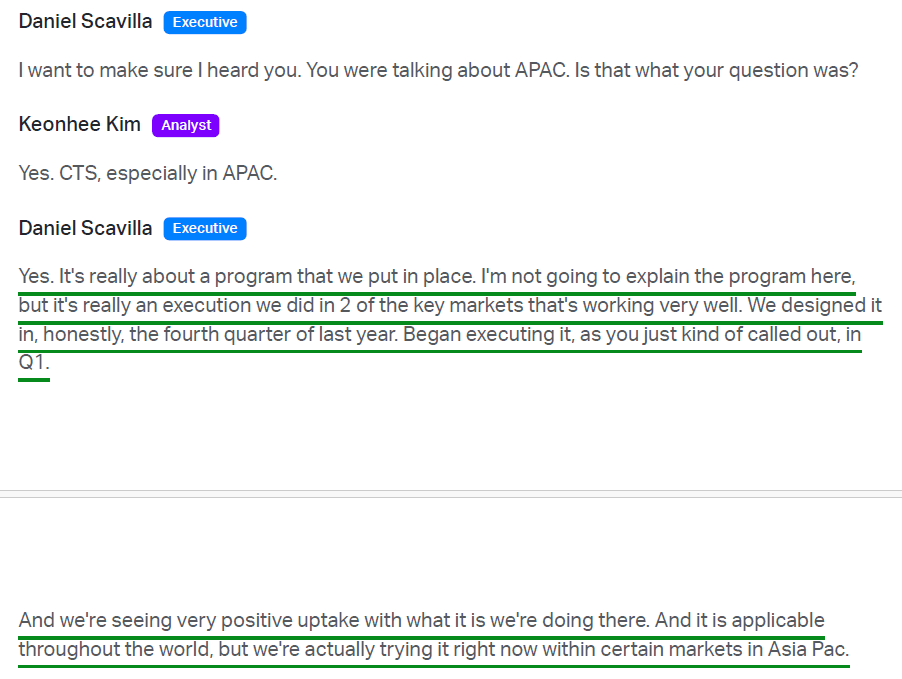
Morningstar Analyst Note
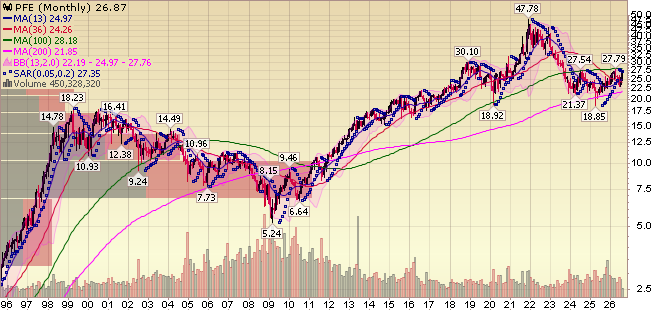
Pfizer (PFE) Update
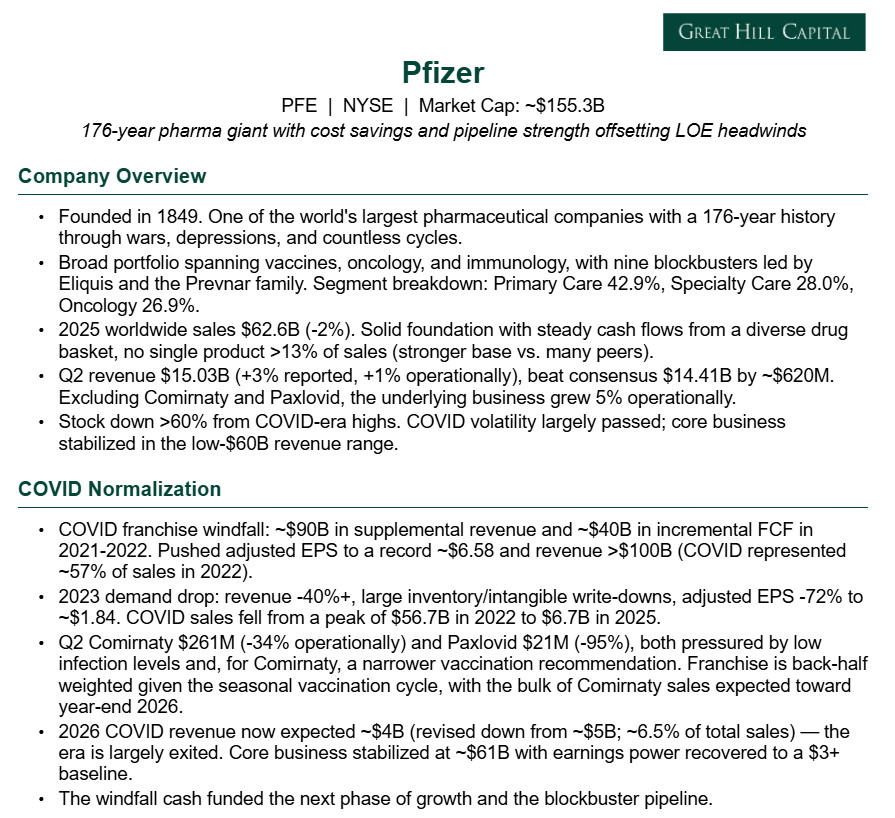
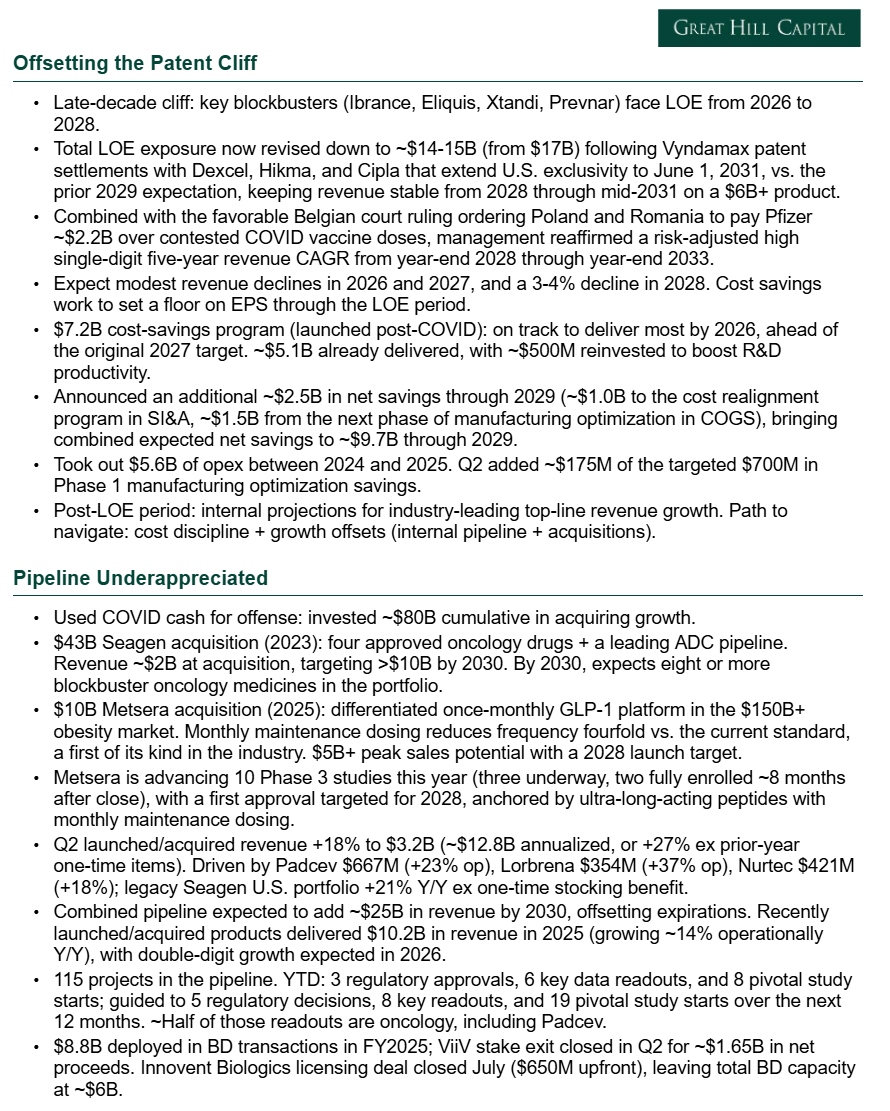
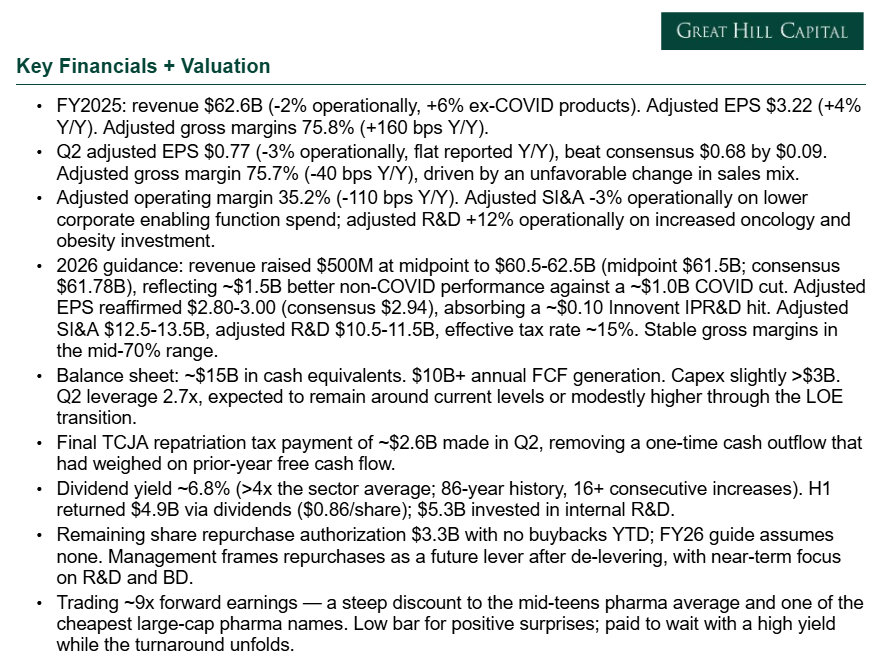
For newer readers, here’s a quick overview of our thesis on Pfizer, a 176-year pharma giant navigating a post-COVID earnings reset, where disciplined cost management and a pipeline built around oncology and obesity are laying the groundwork for a post-LOE recovery:
Q2 Earnings Breakdown
10 Key Points
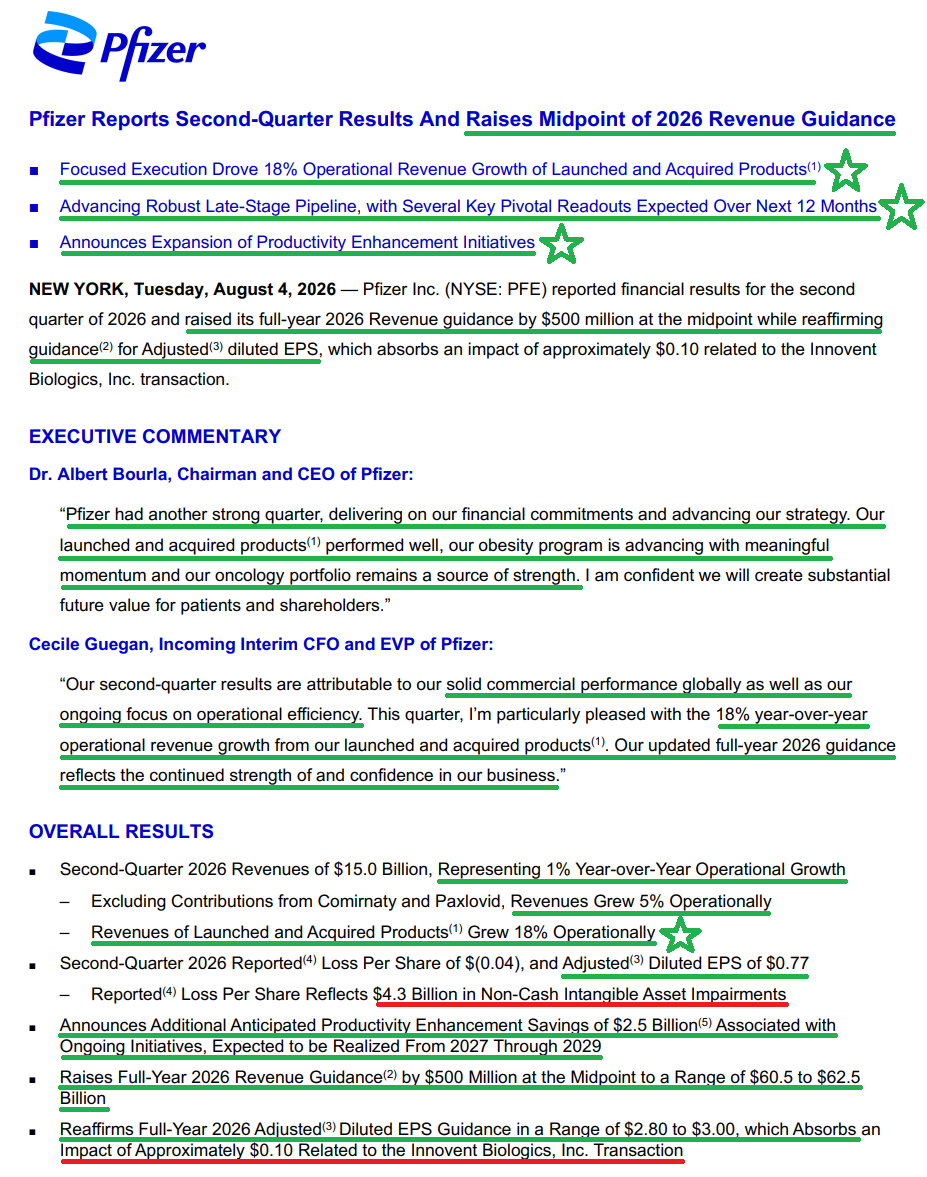
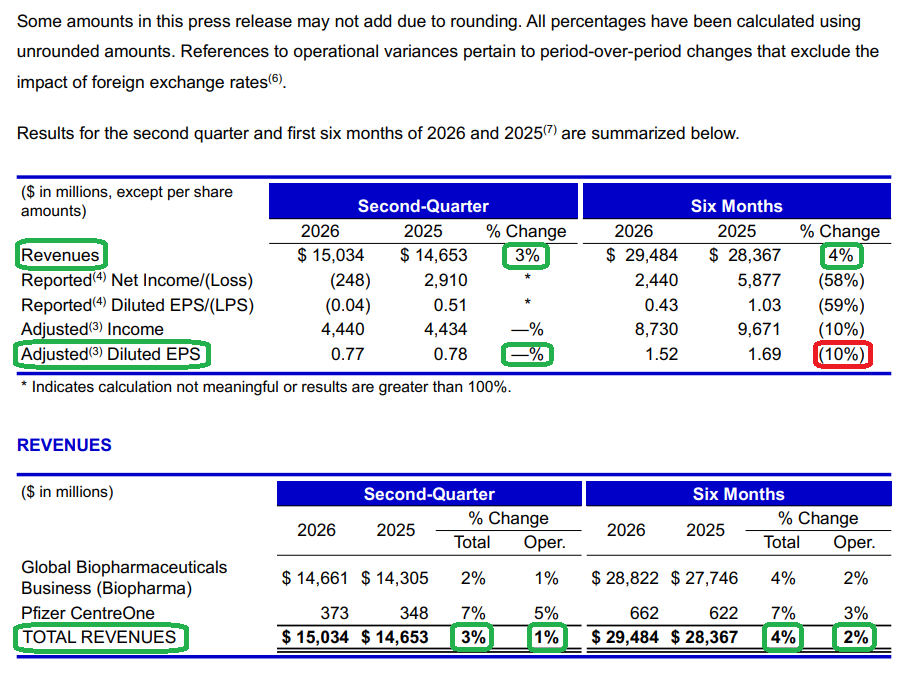
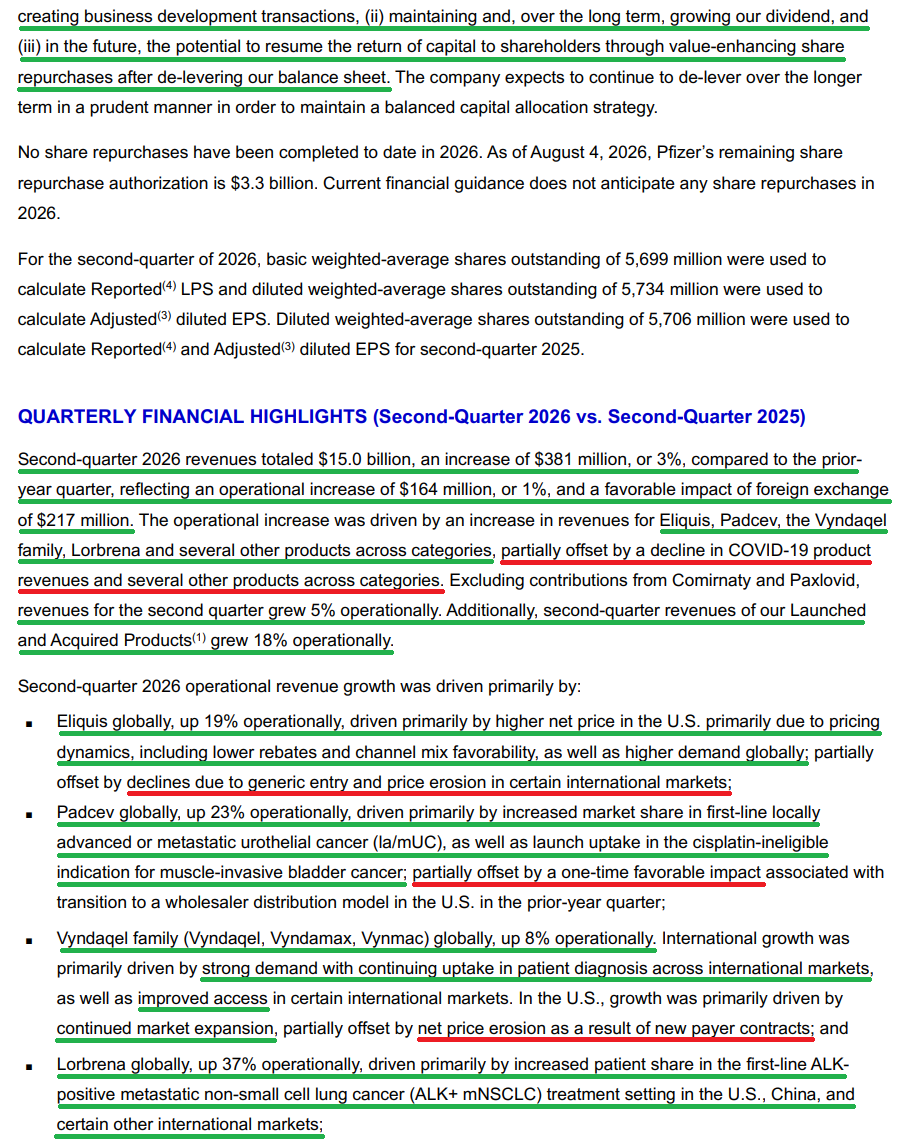
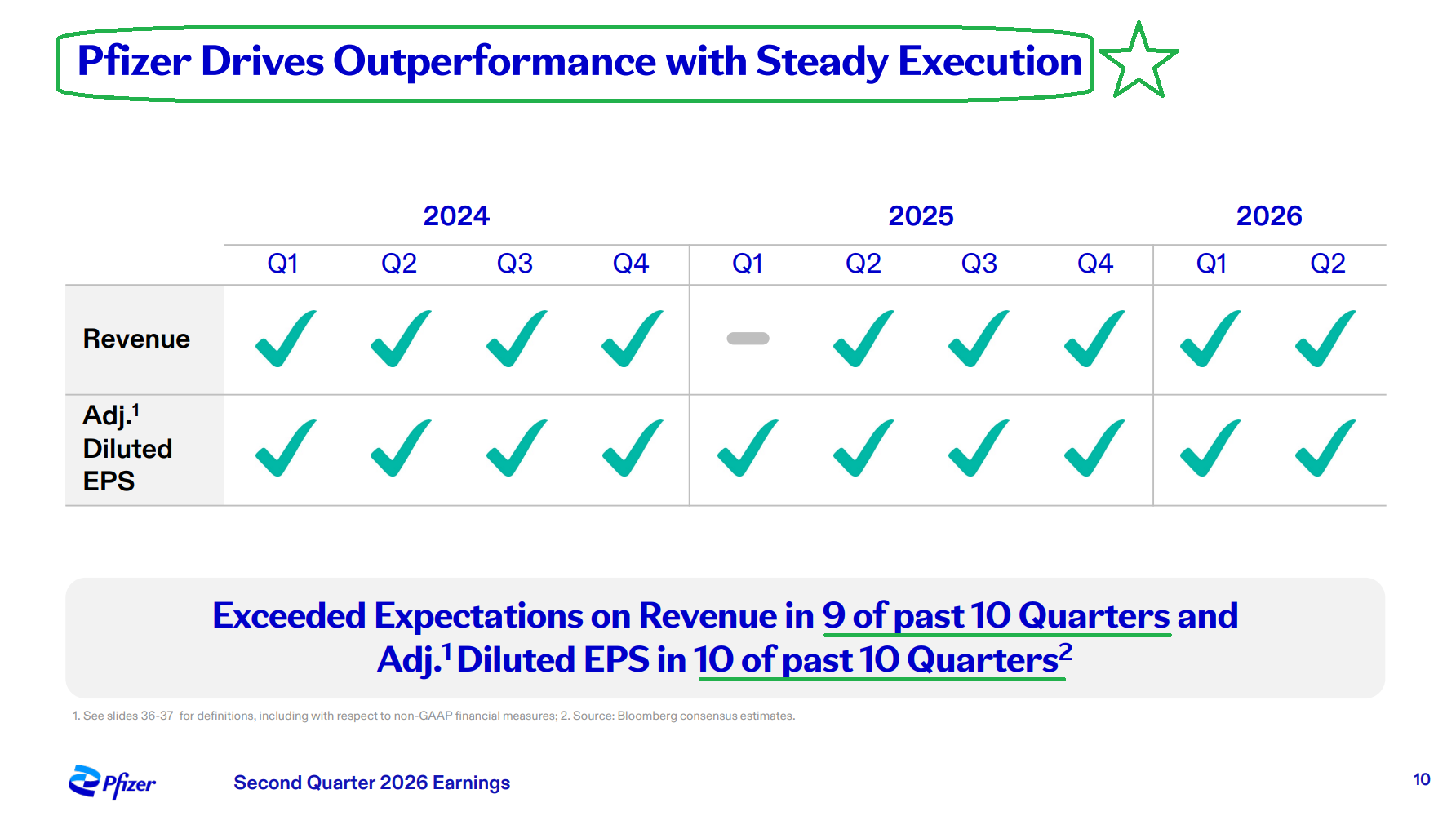
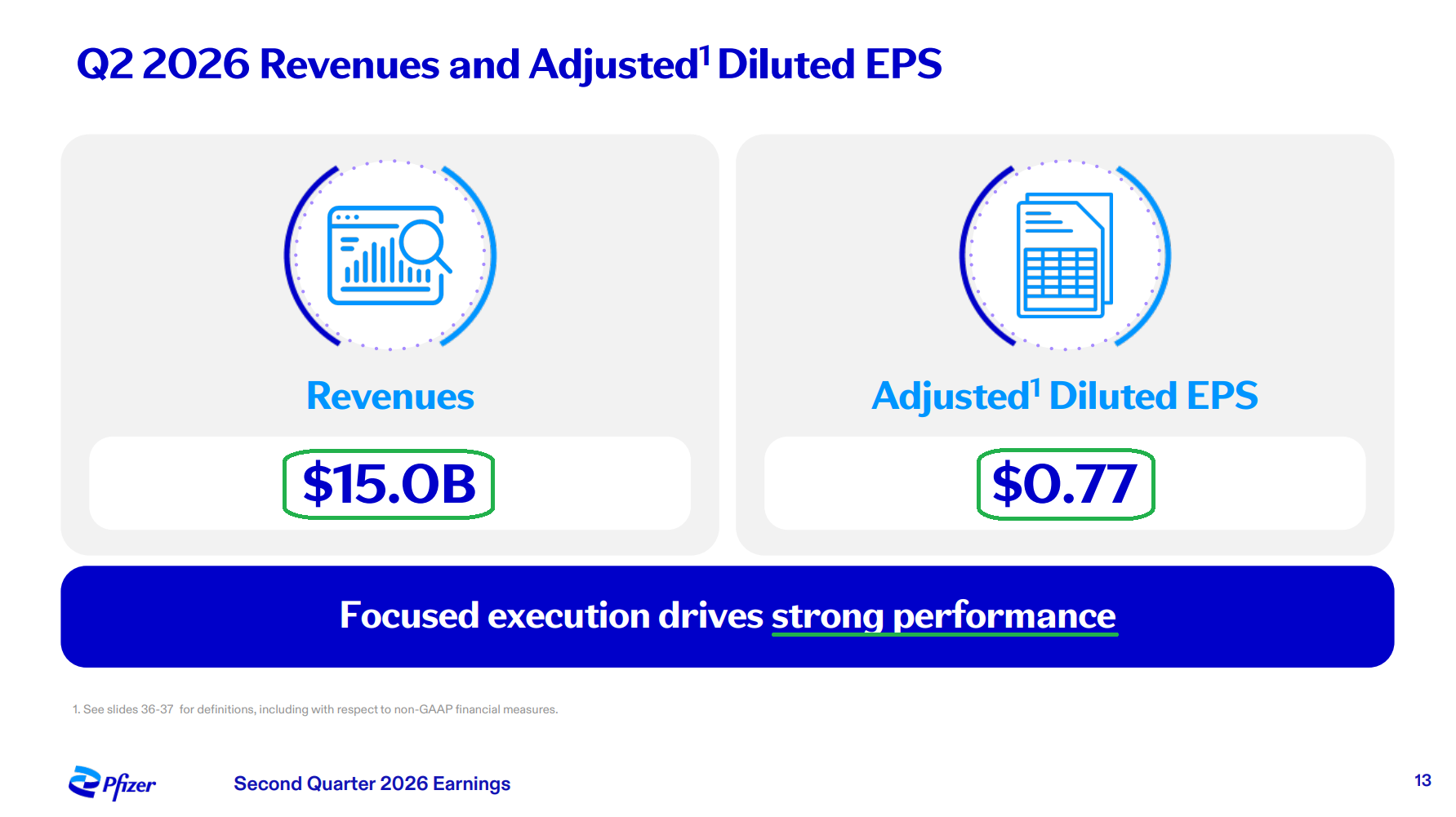
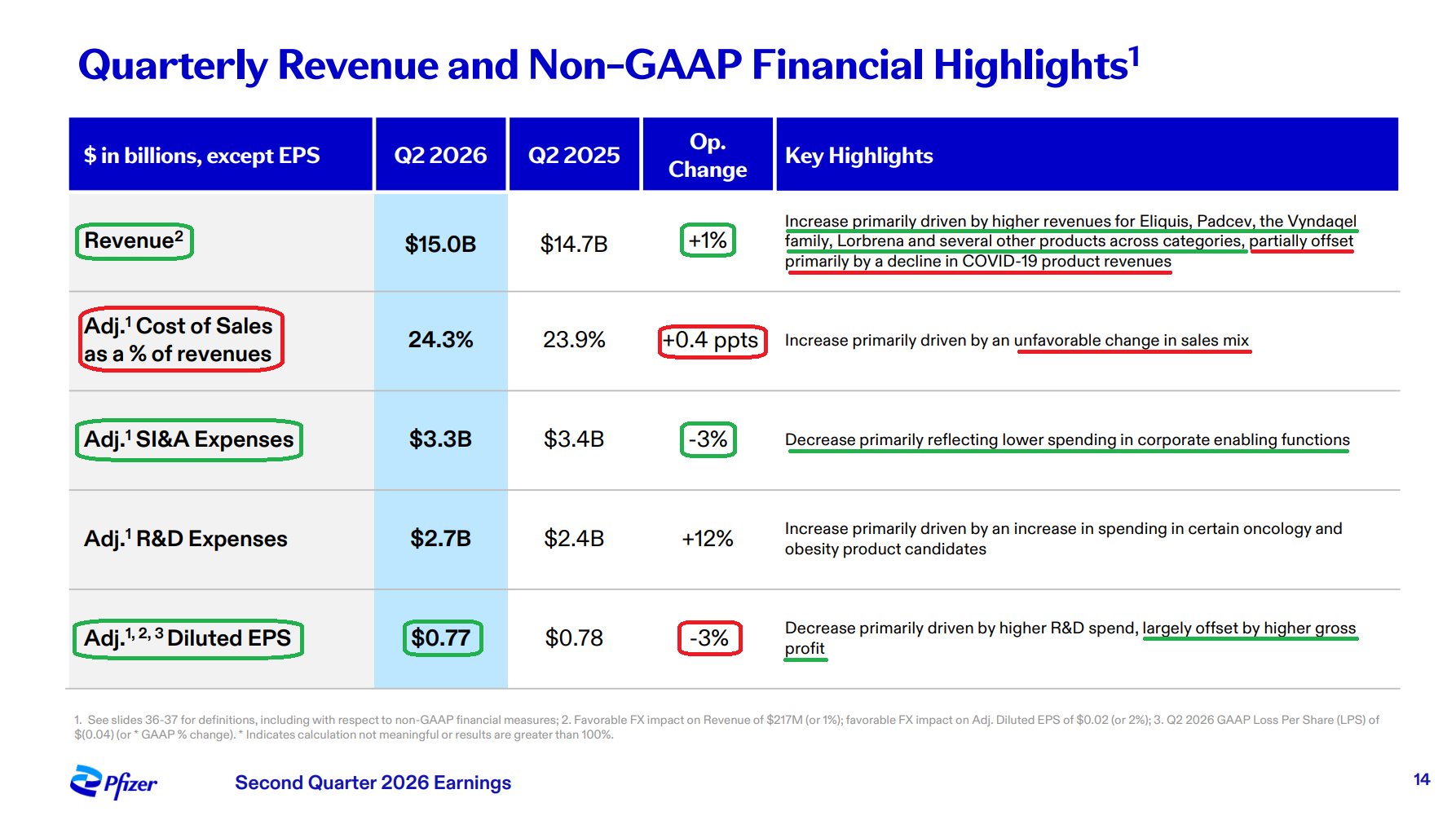
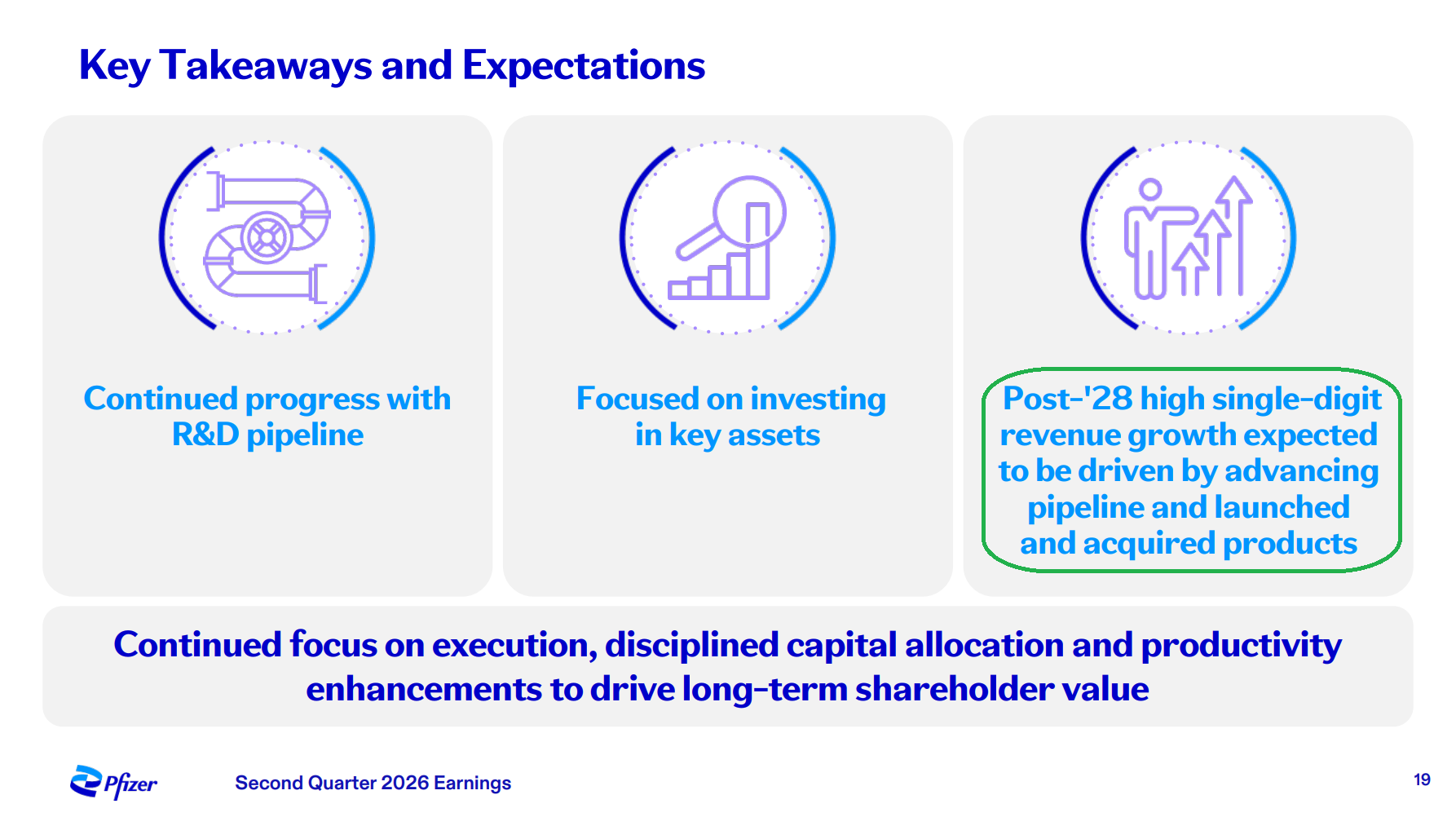
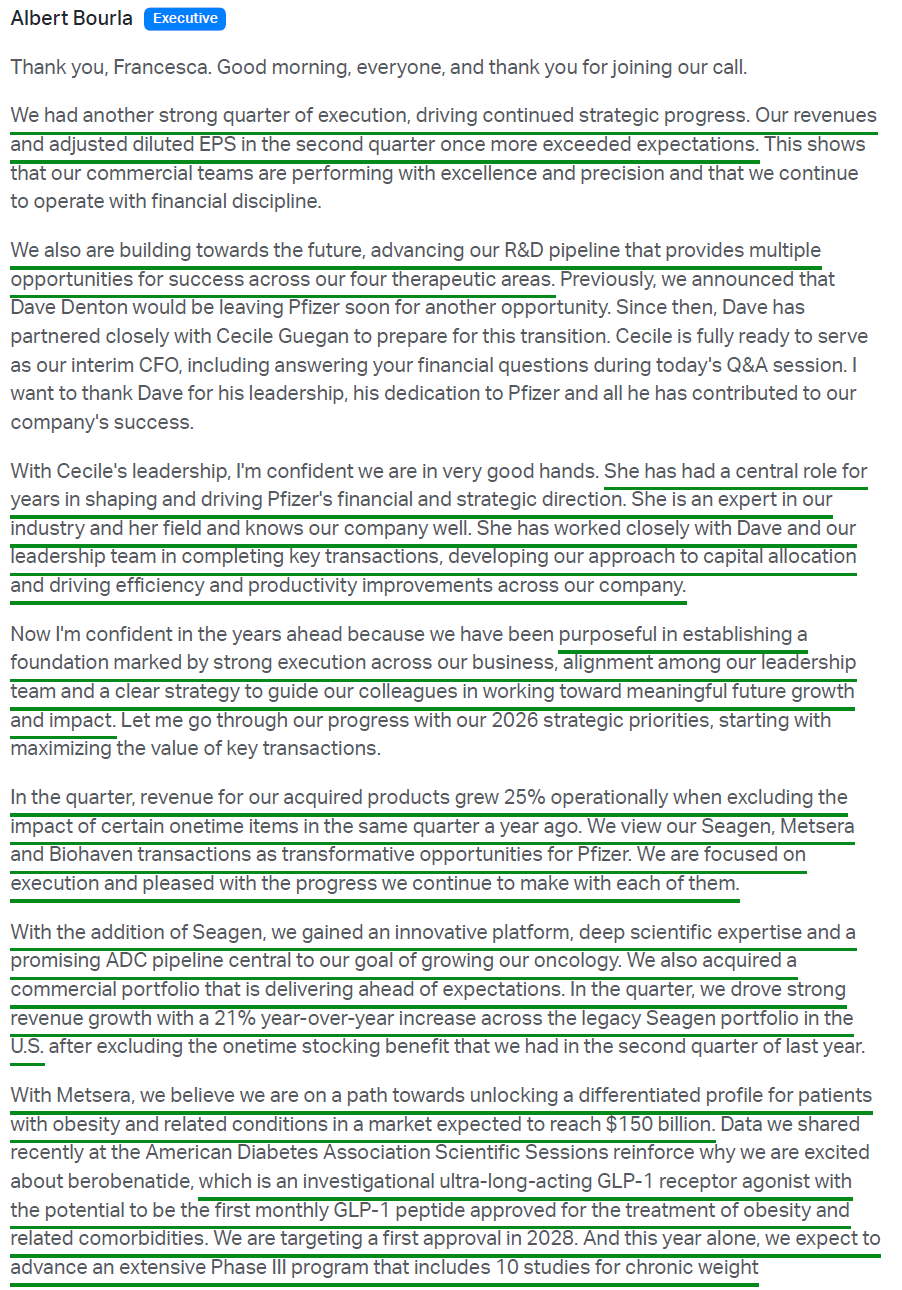
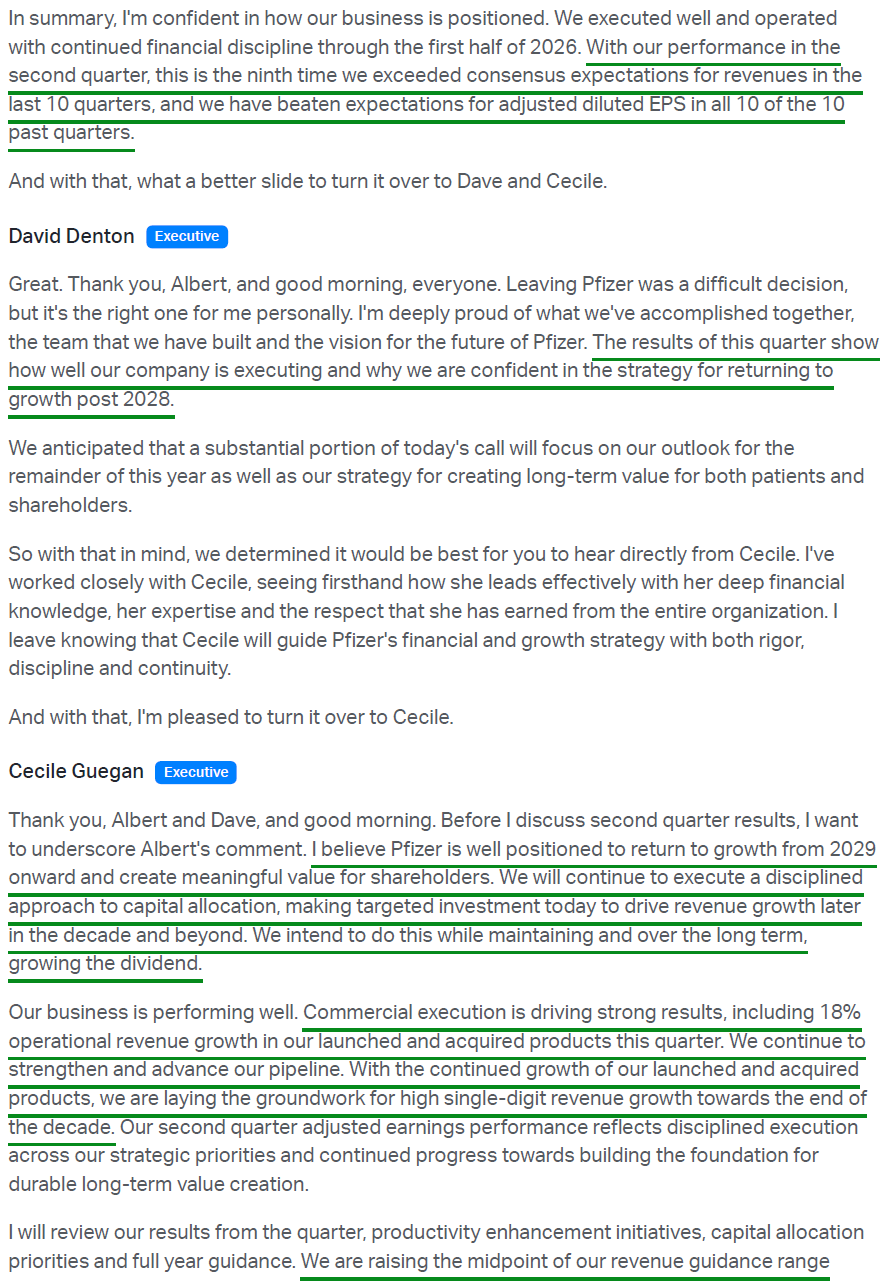
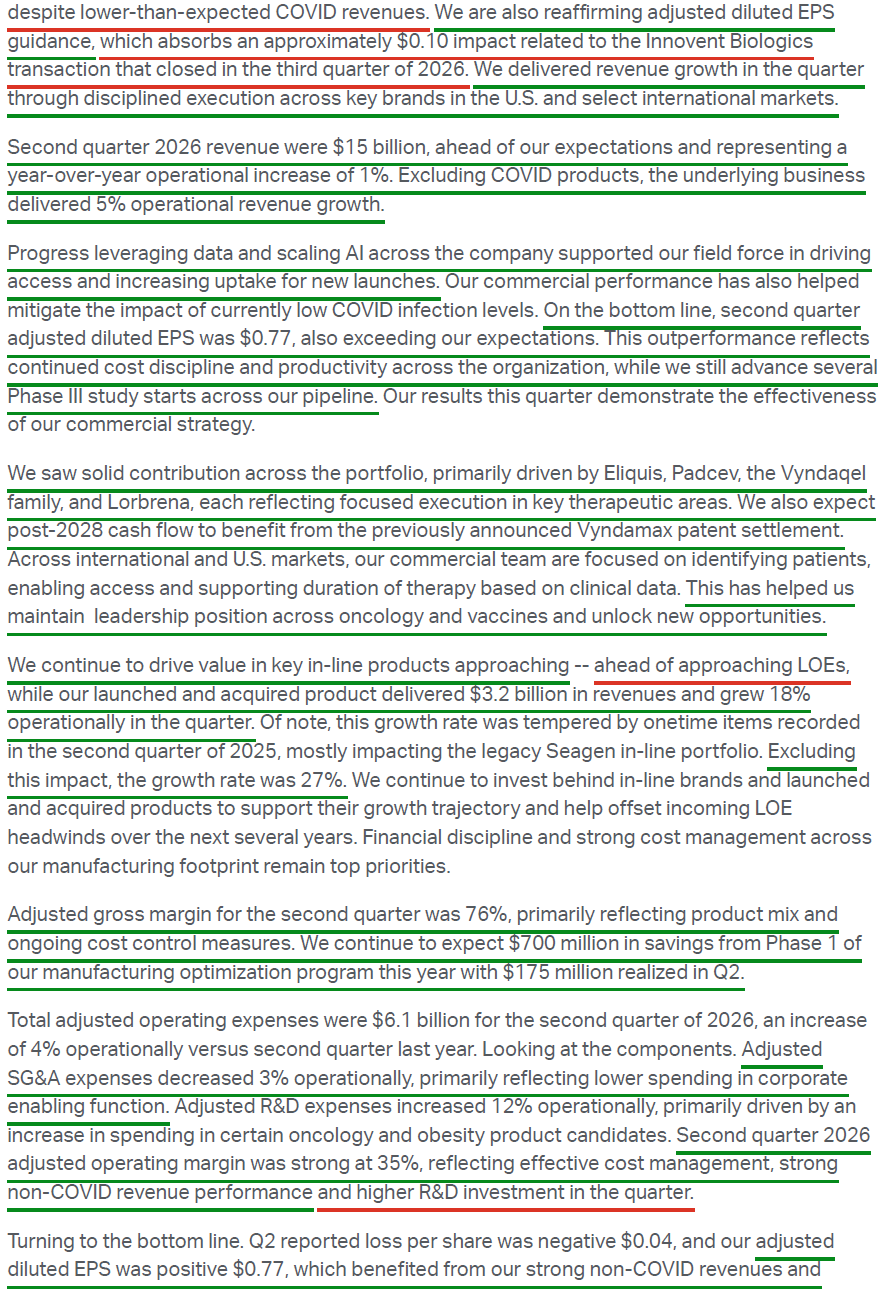
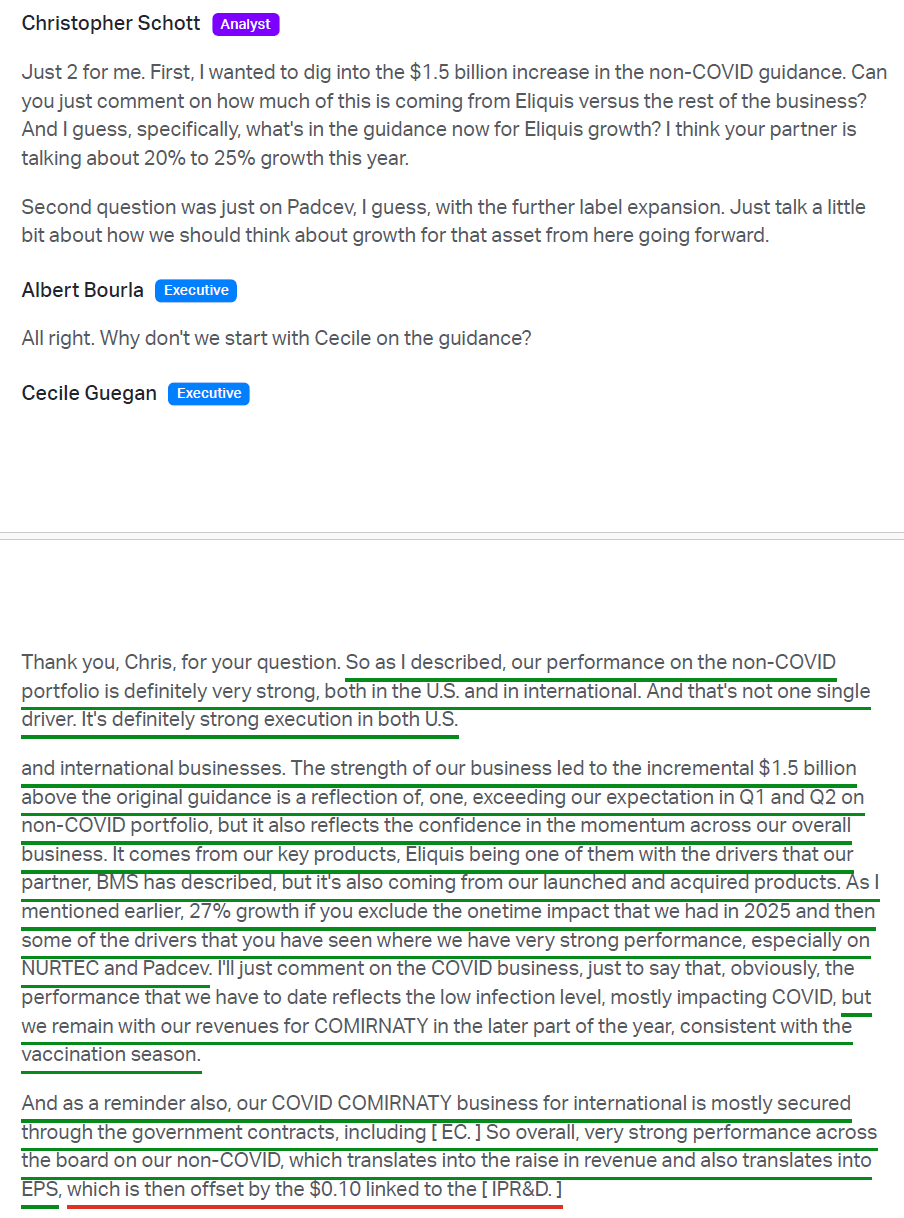
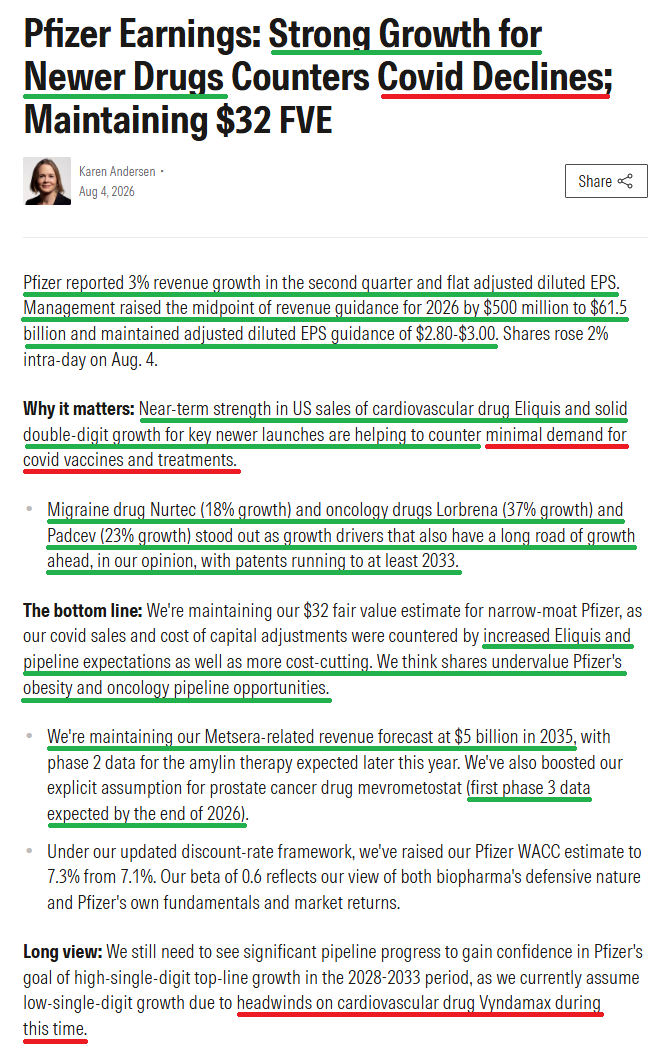
1) Pfizer posted Q2 revenue of $15.03B (+3% reported, +1% operational), ahead of consensus of $14.41B by ~$620M. Excluding Comirnaty and Paxlovid (COVID franchise), the underlying business grew 5% operationally, driven by continued commercial execution across key brands in the U.S. and select international markets. This marks the ninth revenue beat in the last ten quarters.
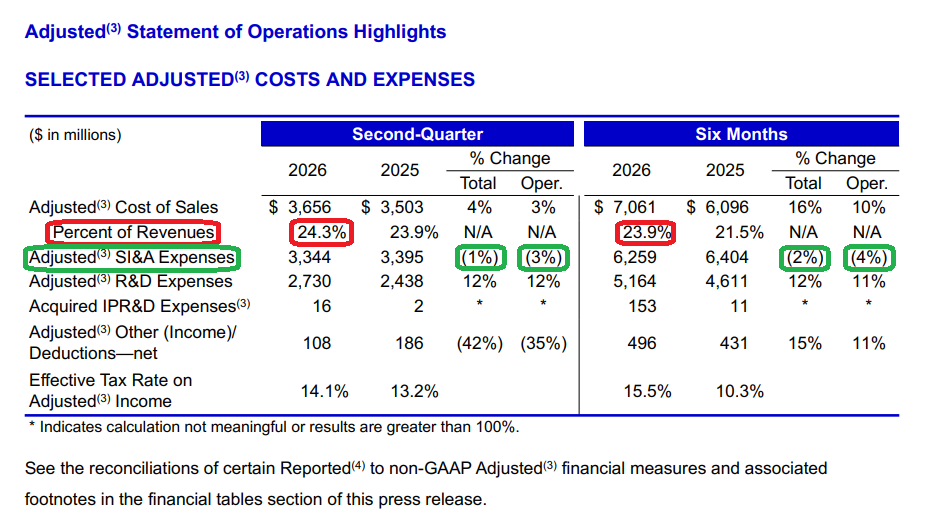
2) Adjusted diluted EPS of $0.77 beat consensus of $0.68 by $0.09, down 3% operationally and flat on a reported basis Y/Y. The decline was driven by higher R&D spend as Pfizer funds its oncology and obesity programs, largely offset by higher gross profit. Pfizer has now exceeded adjusted EPS expectations in all ten of the past ten quarters.
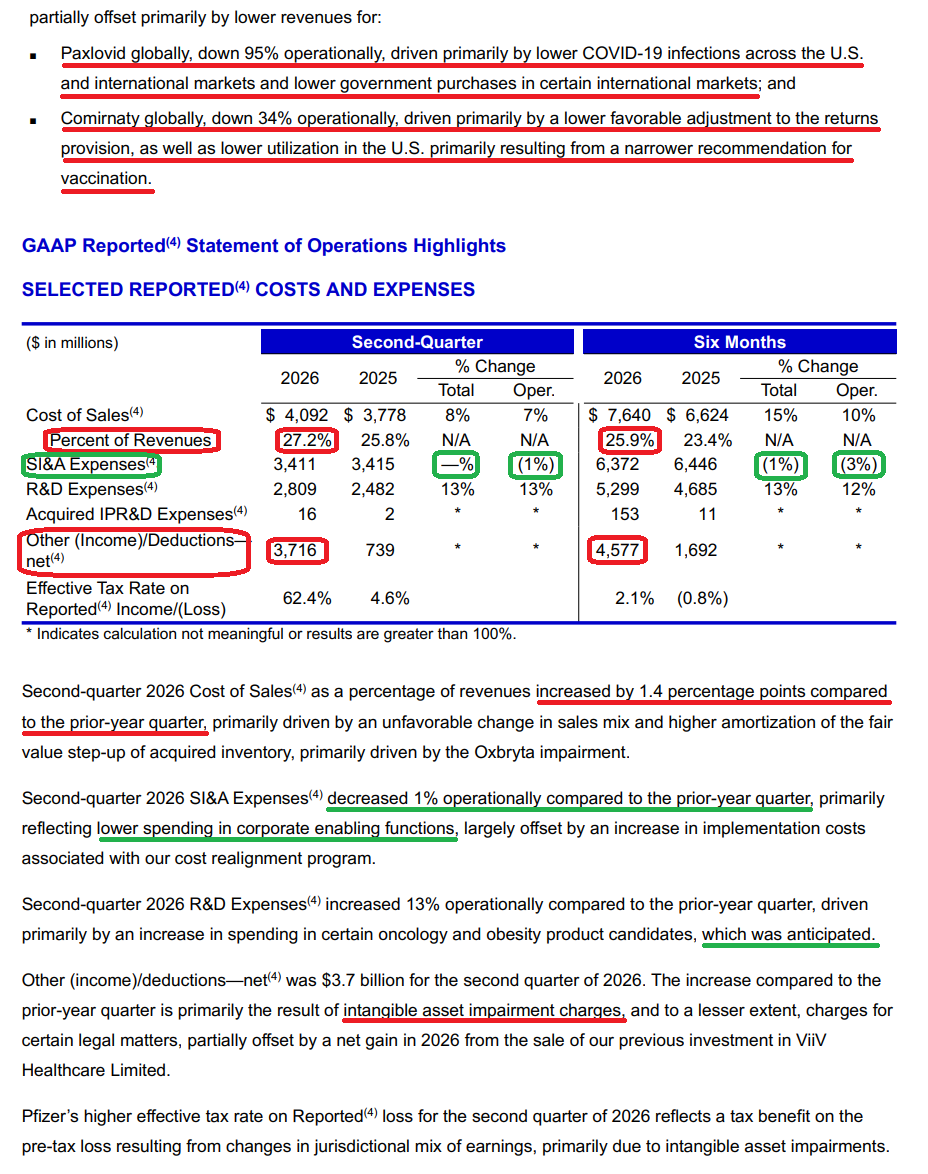
3) Adjusted gross margin came in at 75.7% (-40 bps Y/Y), driven by an unfavorable change in sales mix. Adjusted SI&A expenses declined 3% operationally to $3.3B on lower spending in corporate enabling functions, while adjusted R&D expenses rose 12% operationally to $2.7B on increased investment in certain oncology and obesity product candidates. That brought adjusted operating margin to 35.2%, down 110 bps Y/Y, with the compression almost entirely a function of deliberate pipeline investment rather than any erosion in the underlying cost structure.
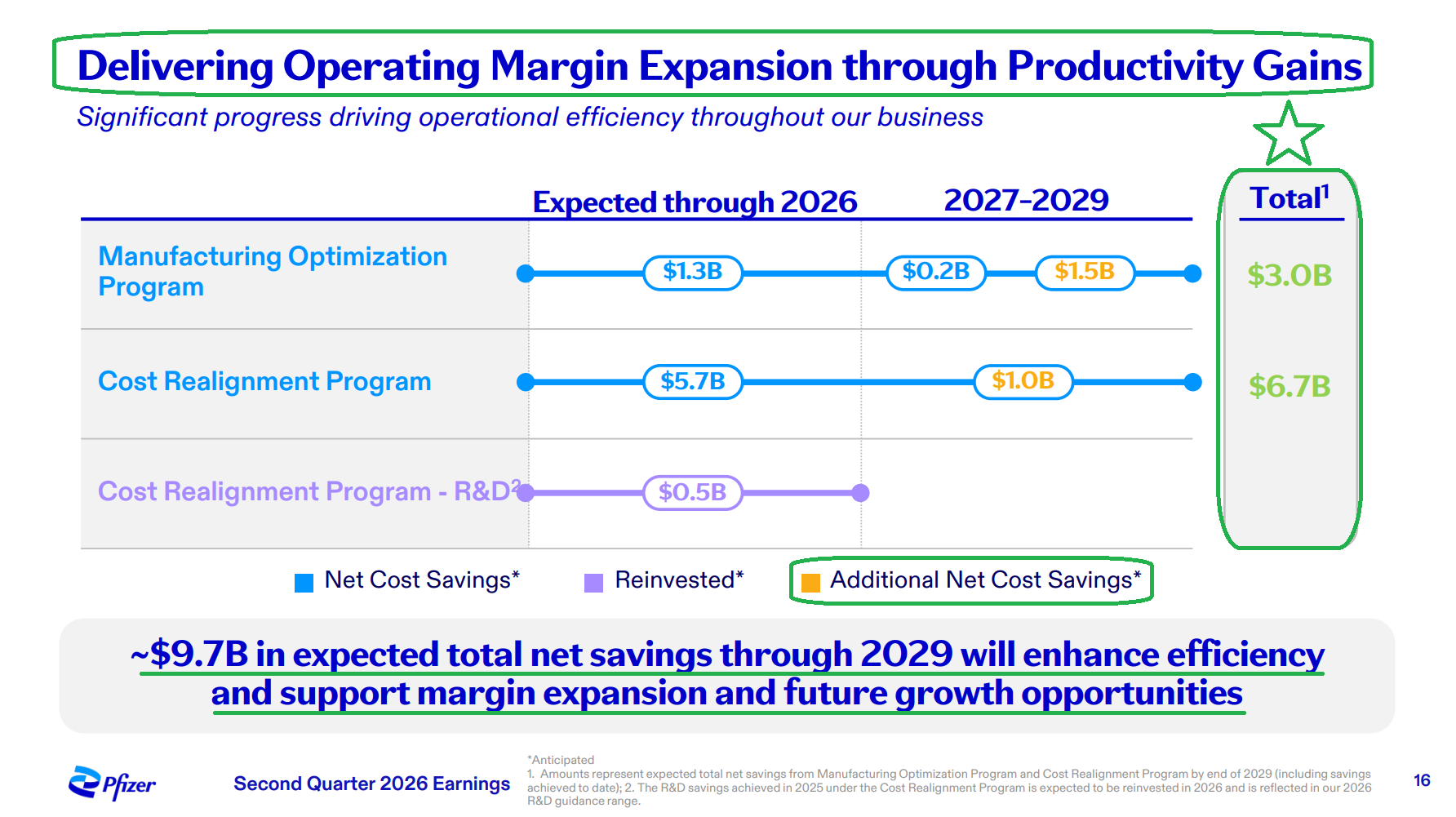
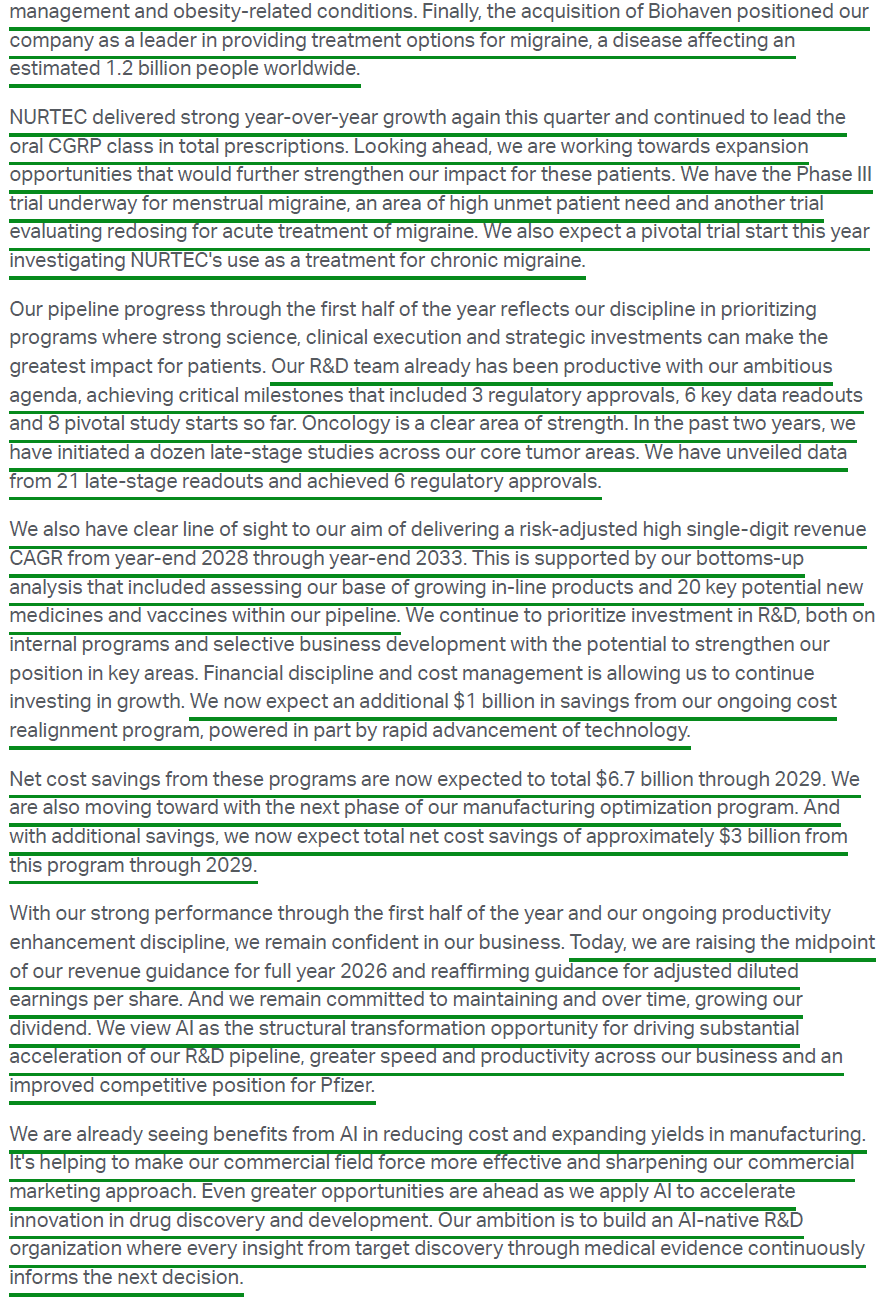
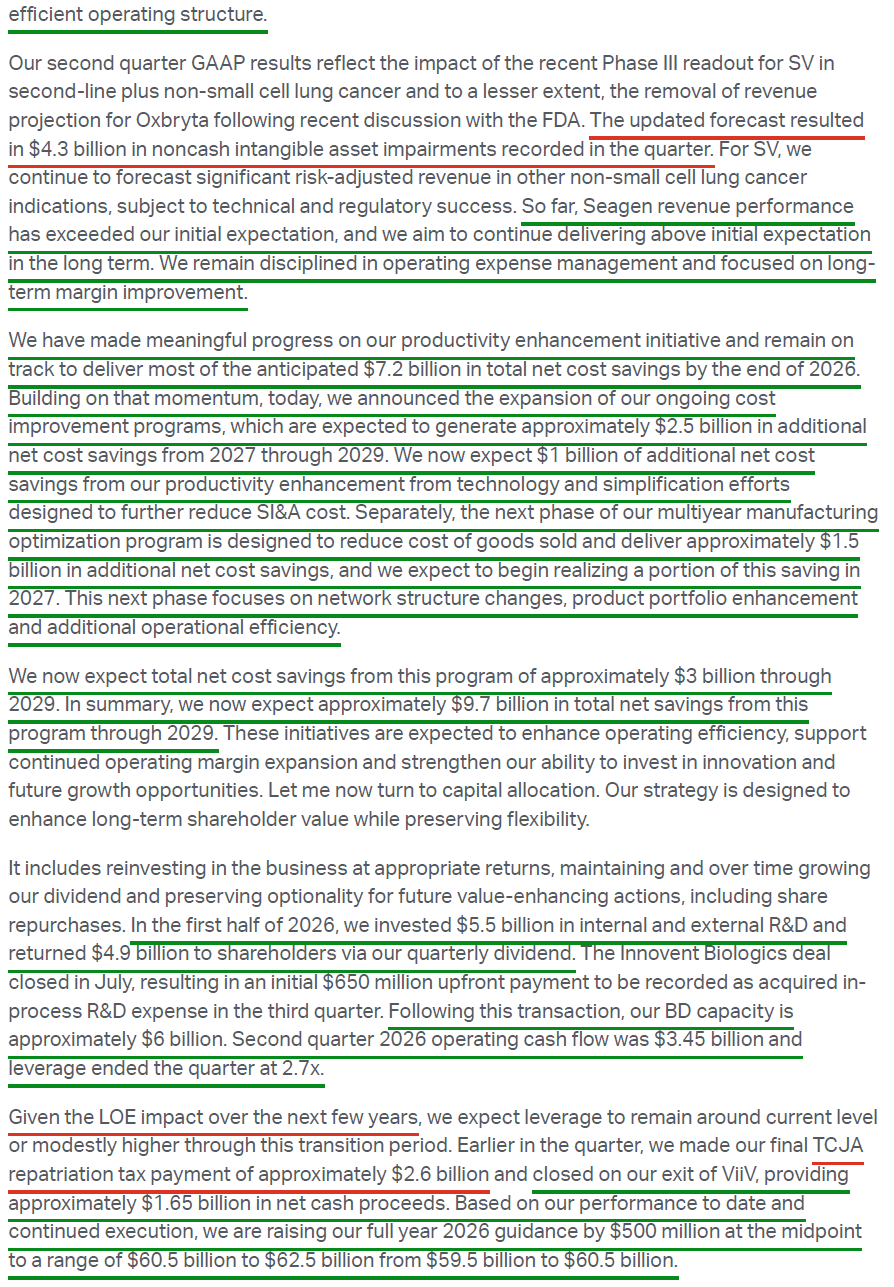
4) Pfizer expanded its cost savings programs, announcing ~$2.5B in additional net savings to be realized from 2027 through 2029. ~$1.0B is being added to the cost realignment program targeting SI&A through technology and simplification efforts, and ~$1.5B comes from the next phase of the manufacturing optimization program targeting cost of goods sold through network structure changes and portfolio enhancements. Combined expected net savings now total ~$9.7B through 2029, up from $7.2B. Pfizer remains on track to deliver the majority of the original $7.2B program by year-end 2026, with ~$175M of the targeted $700M in Phase 1 manufacturing optimization savings realized in Q2.
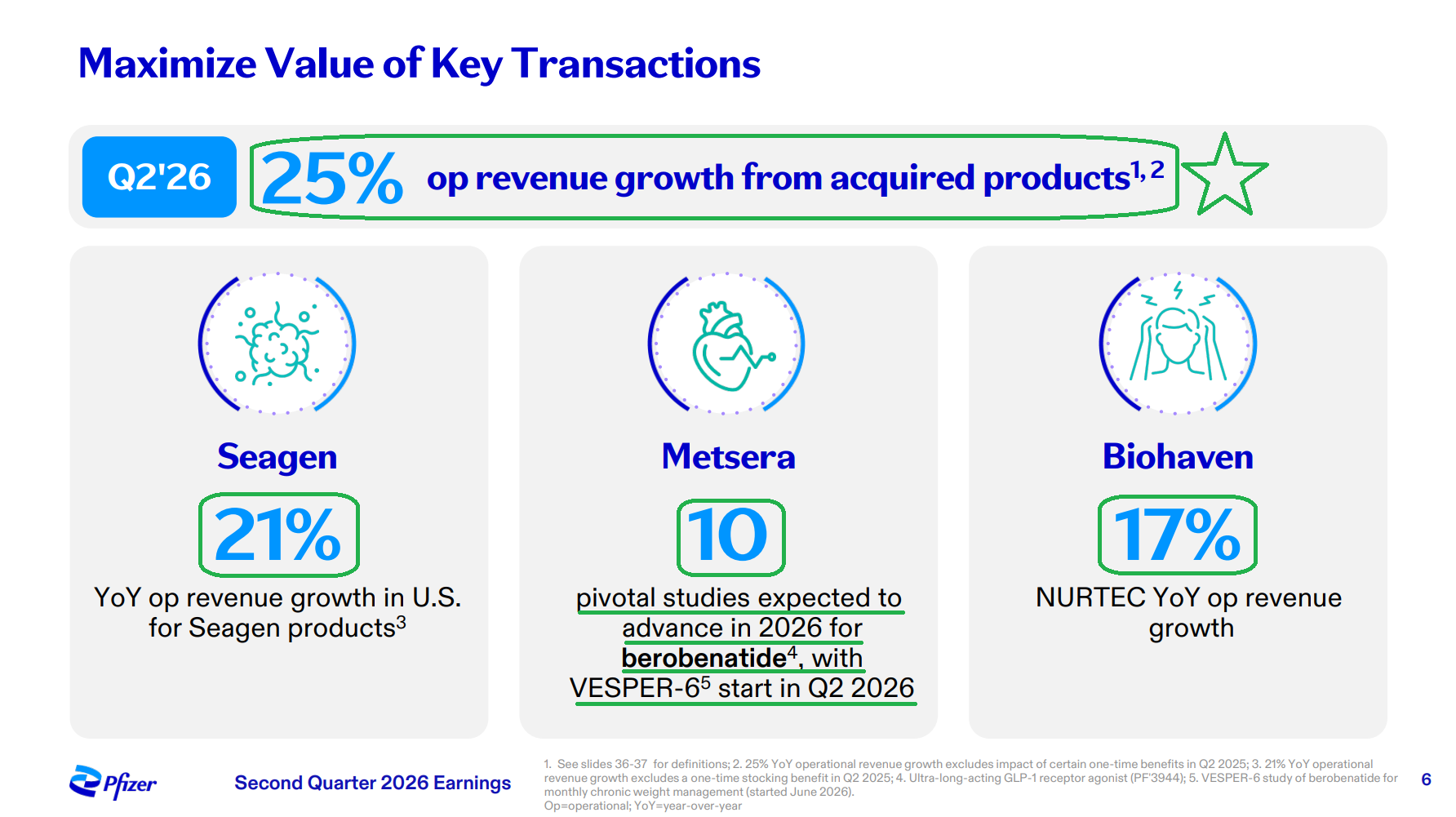
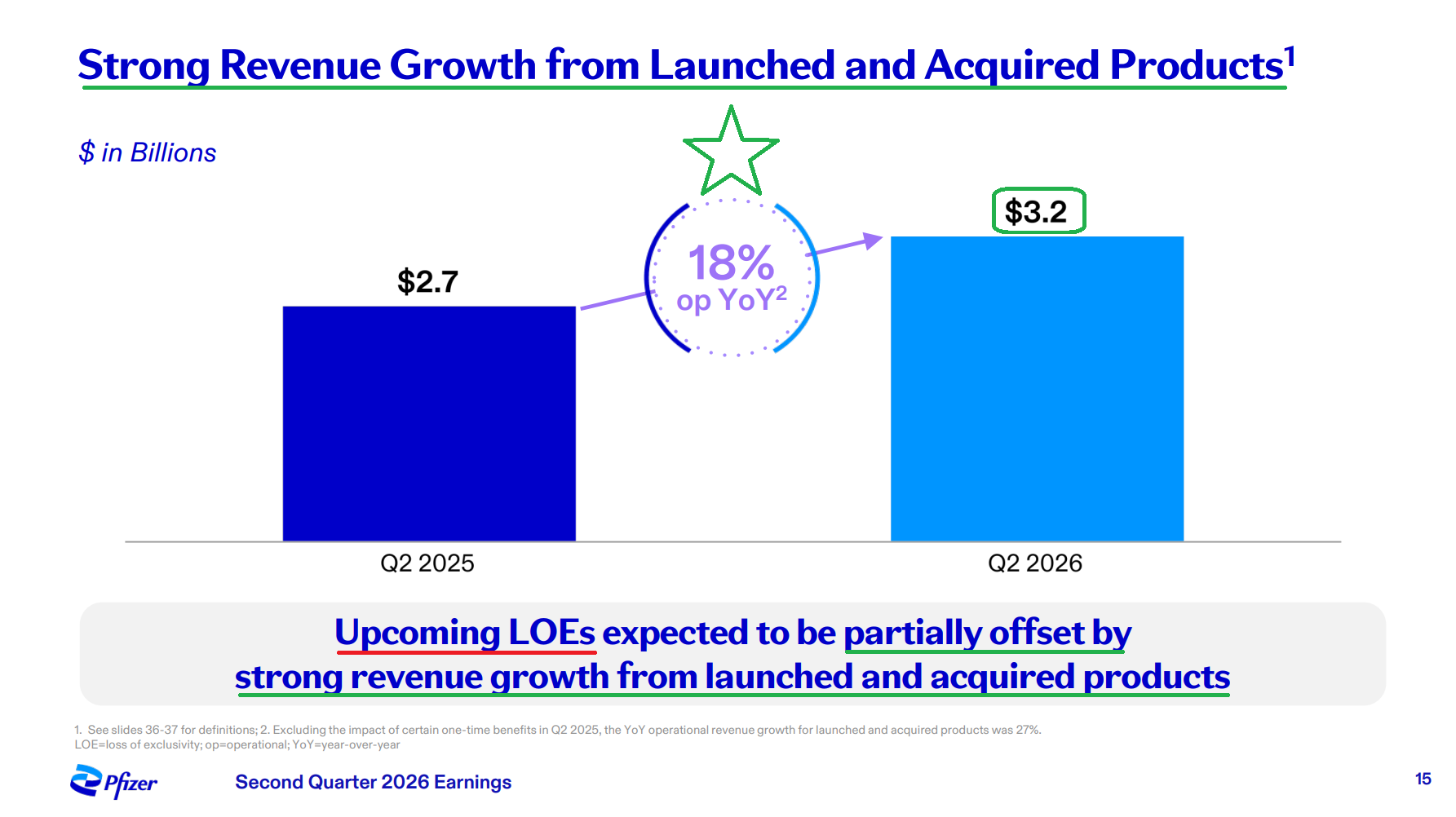
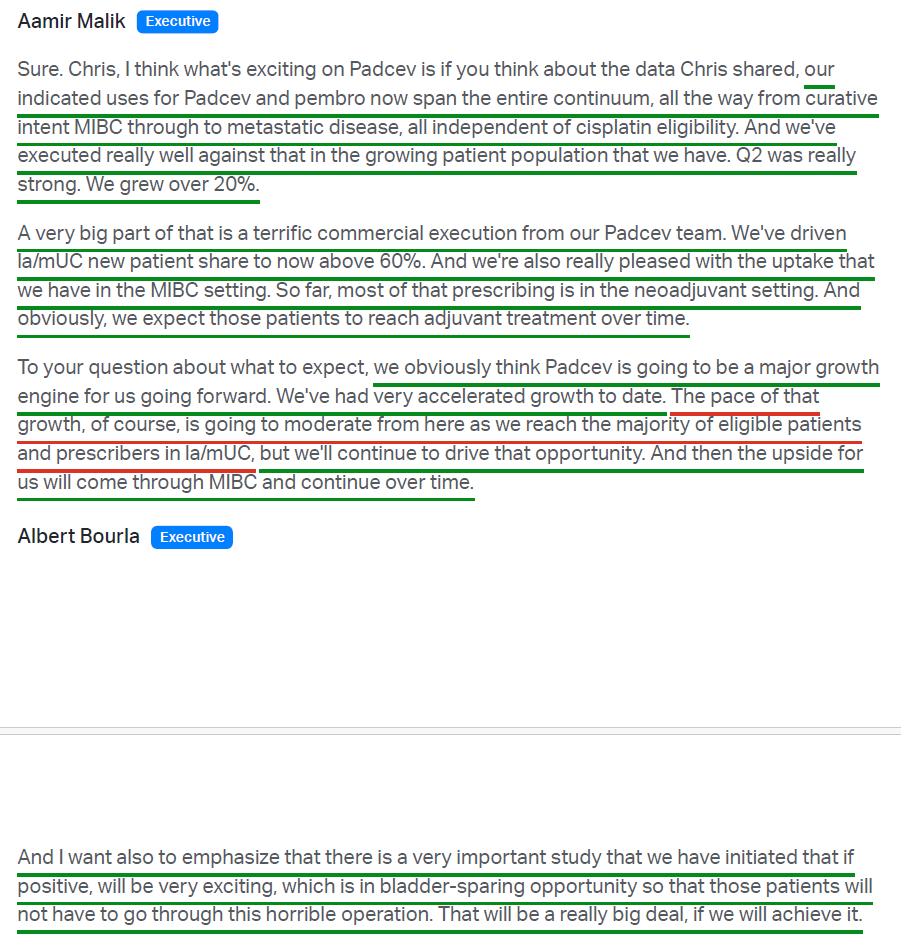
5) Recently launched and acquired products remained the key growth driver, delivering $3.2B in Q2 revenue (+18% operational Y/Y vs. $2.7B in Q2 2025) and tracking to ~$12.8B on an annualized basis. Excluding one-time items recorded in the prior-year quarter that mostly hit the legacy Seagen in-line portfolio, growth was 27%. Padcev (bladder cancer) led with $667M (+23% operational) on first-line market share gains in locally advanced or metastatic urothelial cancer and early uptake in muscle-invasive bladder cancer, followed by Lorbrena (lung cancer) at $354M (+37% operational) and Nurtec (migraine) at $421M (+17% operational). Continued scaling of these newer growth drivers is the primary offset to upcoming LOE headwinds.
6) The legacy blockbuster portfolio held up better than expected. Eliquis was the standout at $2.43B (+19% operational), driven by higher U.S. net price on lower rebates and favorable channel mix alongside stronger global demand, well ahead of the ~$2.08B consensus and the single largest contributor to the revenue beat. The Vyndaqel family added $1.76B (+8% operational) on continued patient diagnosis uptake internationally, while Ibrance was flat operationally at $1.06B. The Prevnar family declined 4% operationally to $1.34B on continued U.S. pressure.
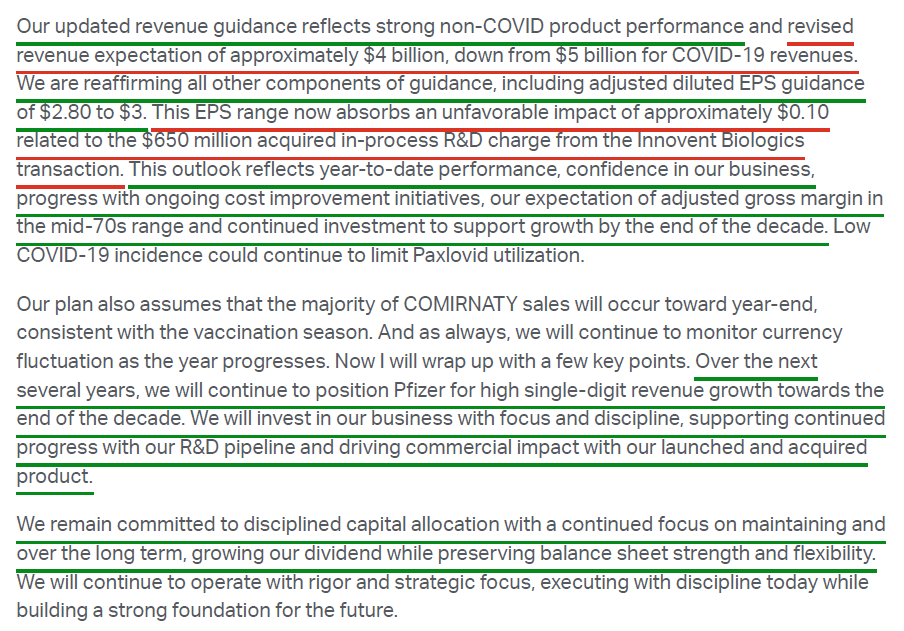
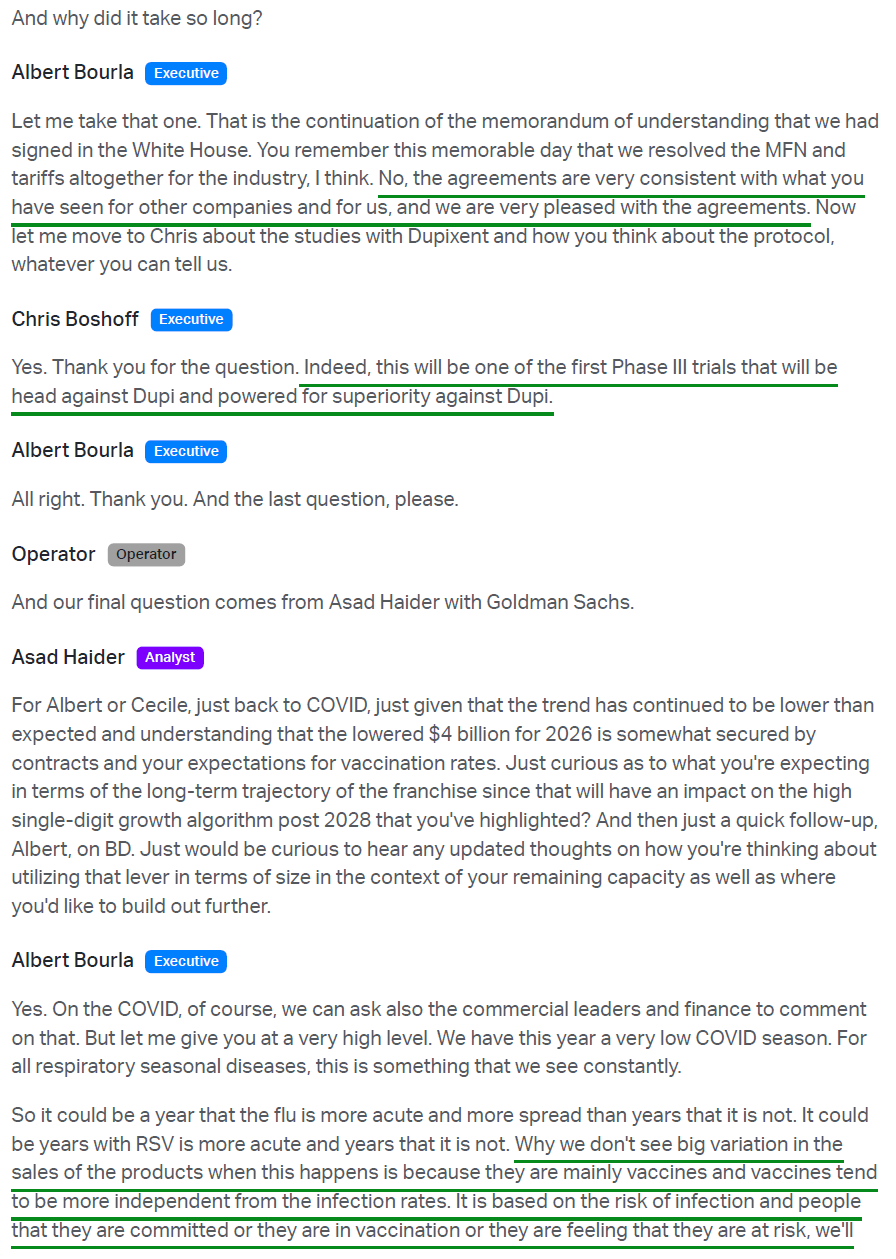
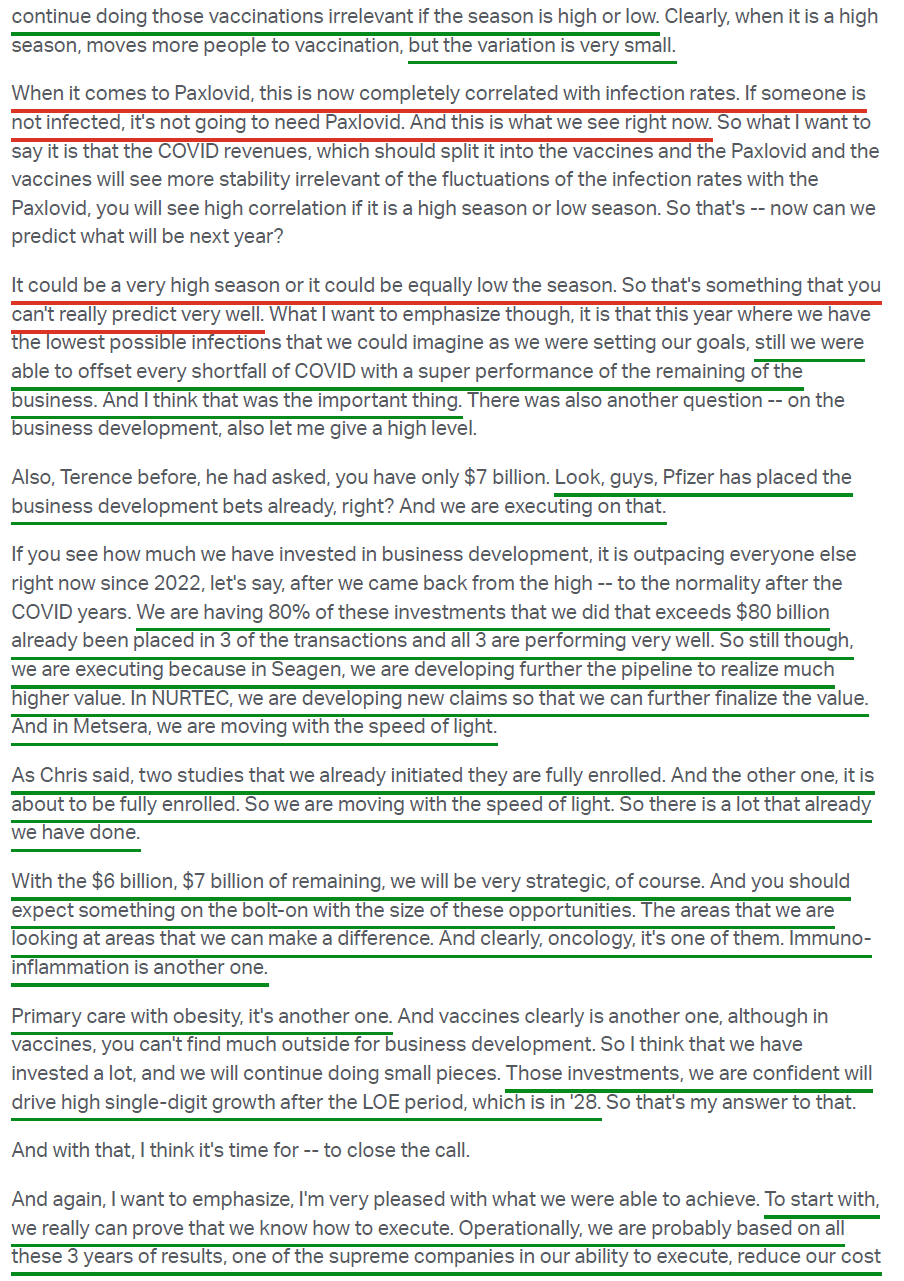
7) The COVID franchise declined further, with Comirnaty revenue of $261M falling 34% operationally on a lower favorable returns provision adjustment and narrower U.S. vaccination recommendations, while Paxlovid fell 95% operationally to just $21M on the lowest infection levels the company has seen. Management cut its full-year COVID revenue expectation to ~$4B from ~$5B previously. Management noted that vaccine demand stays relatively stable regardless of infection rates, while Paxlovid is directly correlated to them, and reiterated that the majority of Comirnaty sales fall toward year-end, consistent with vaccination season, with international revenue largely secured through government contracts.
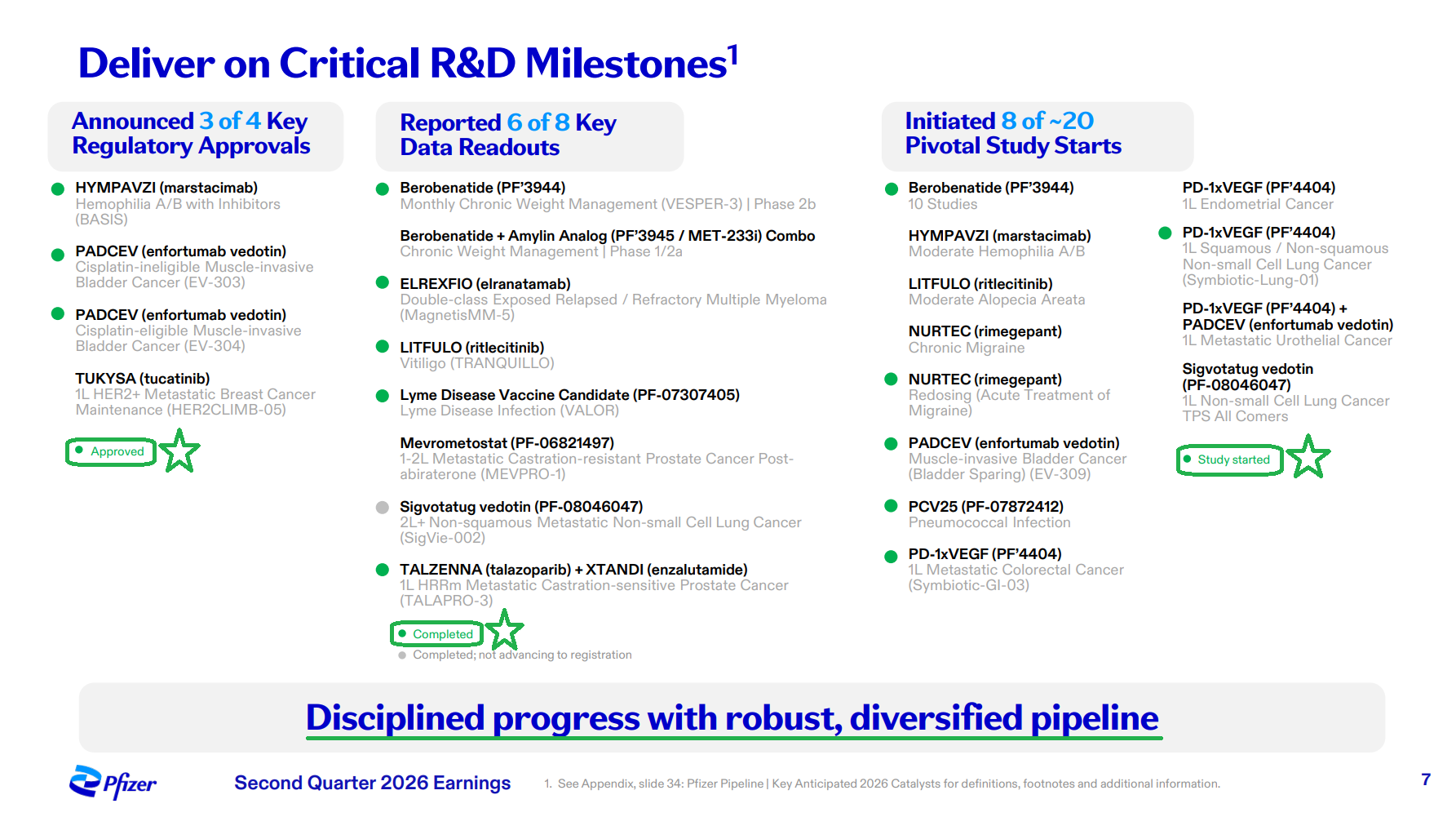
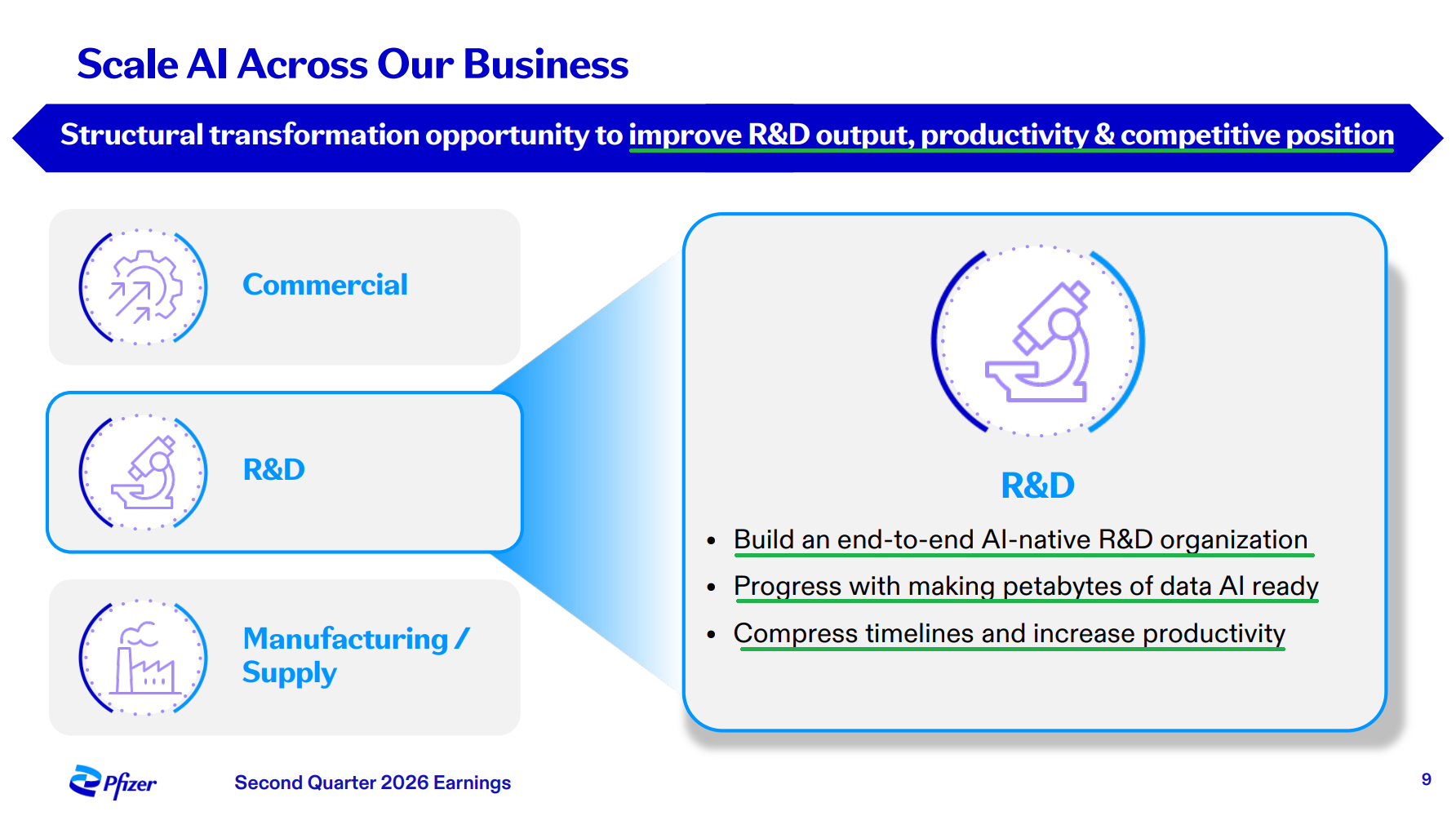
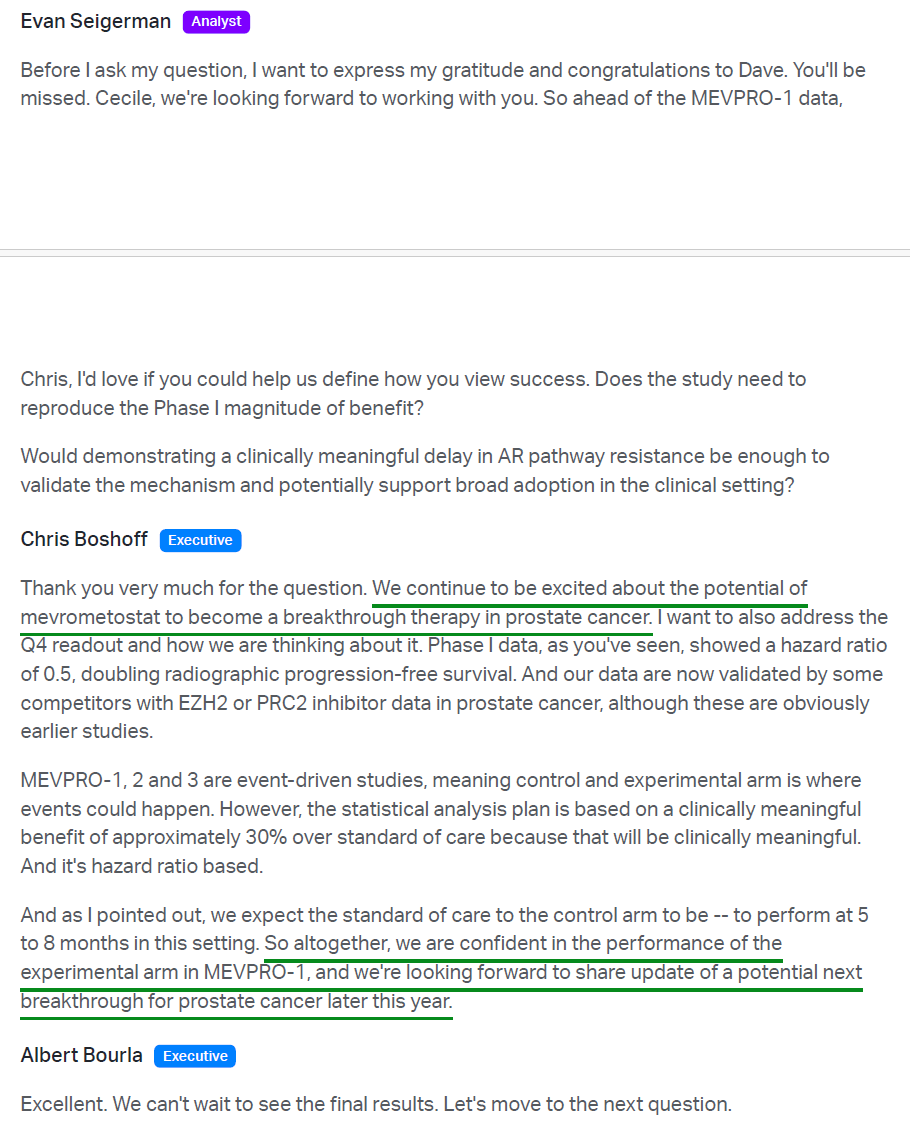
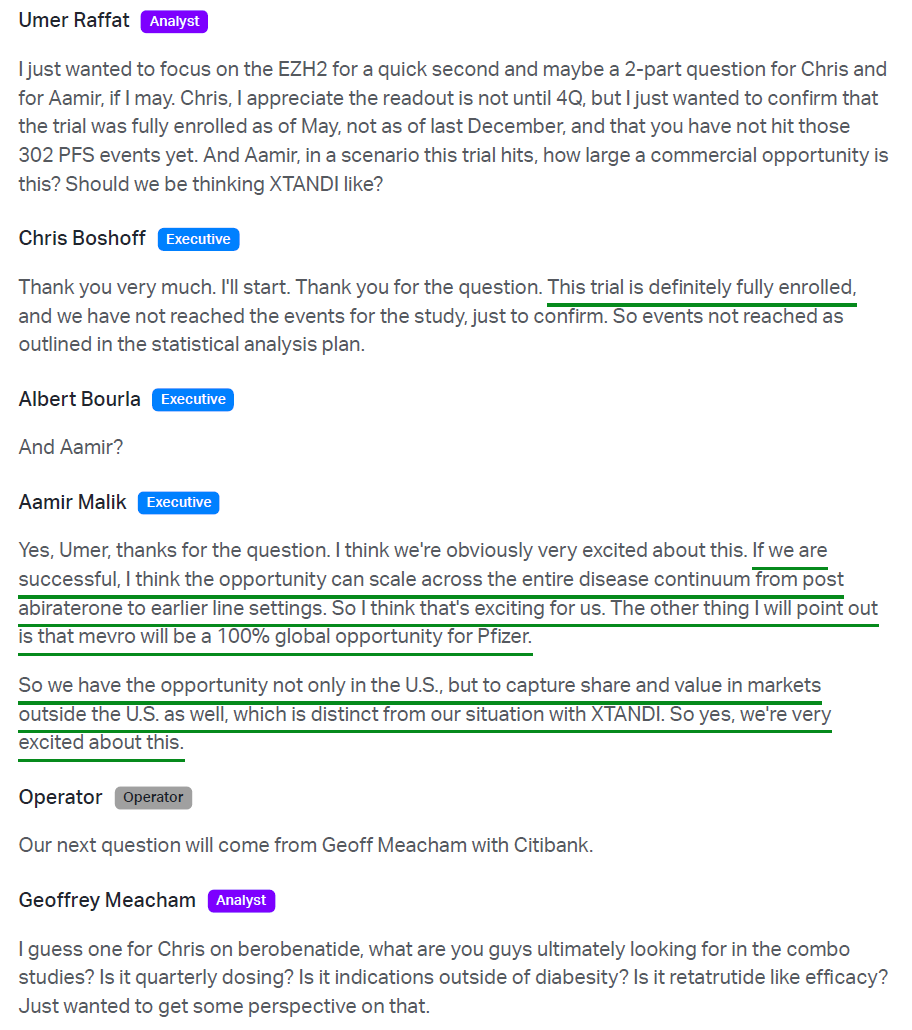
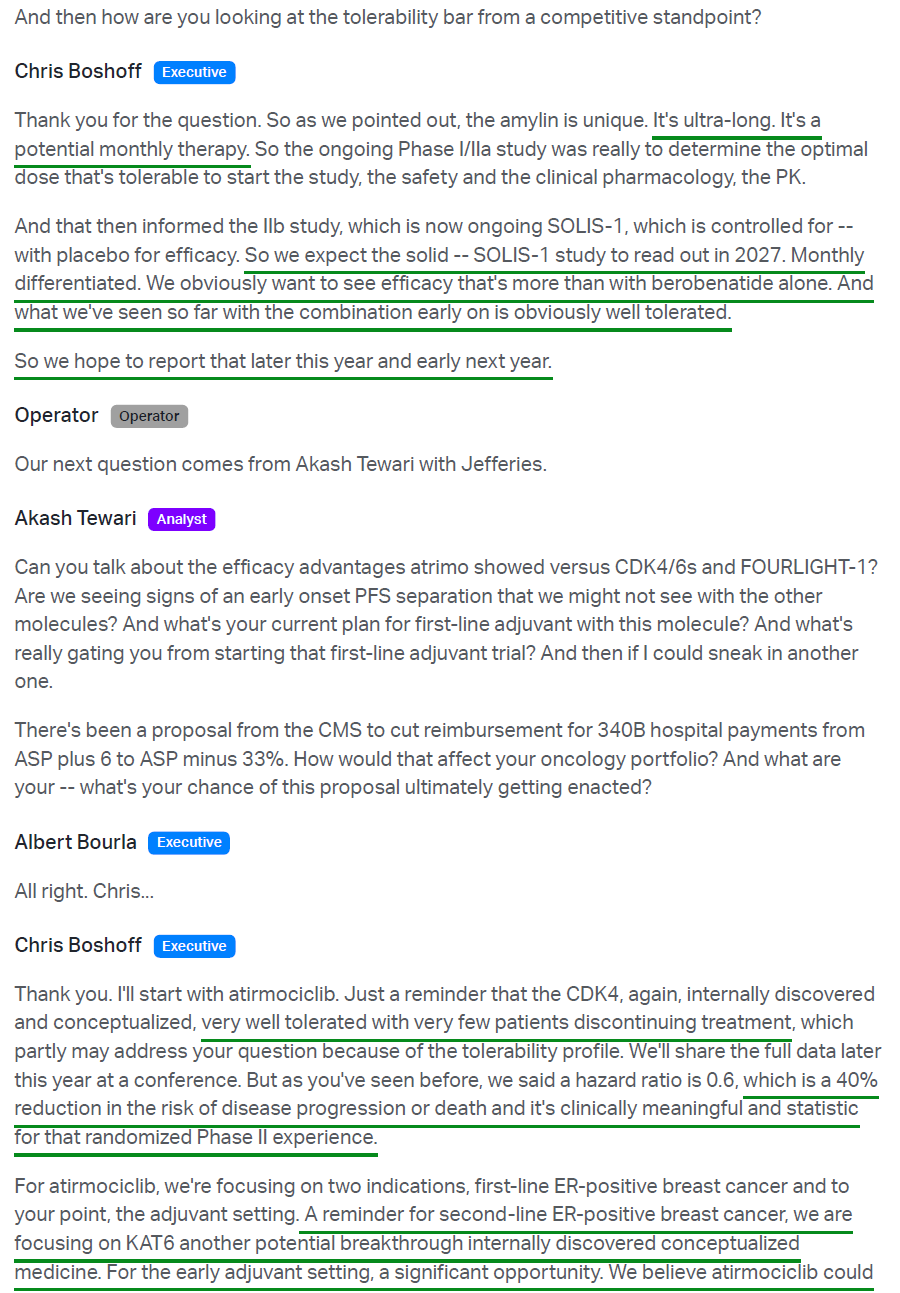
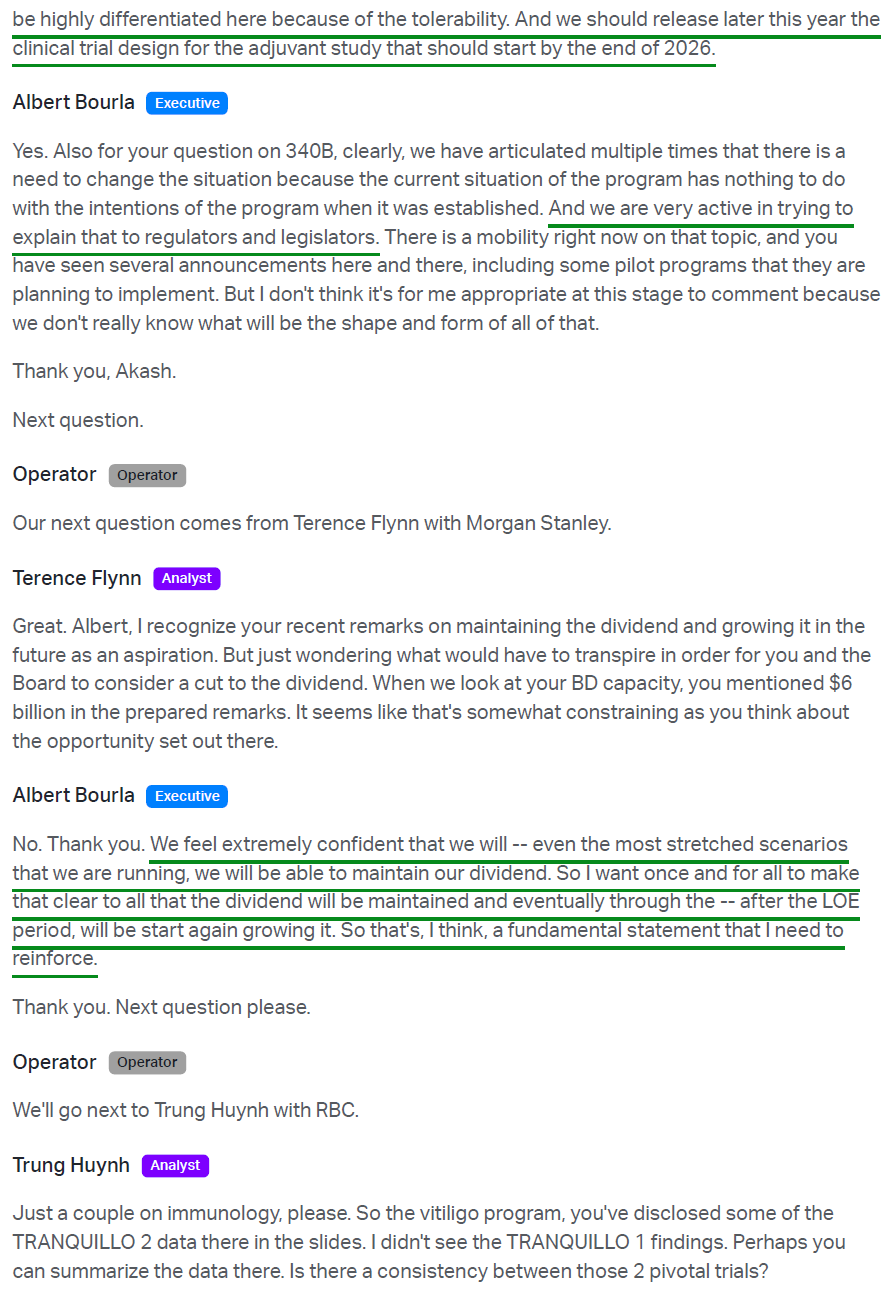
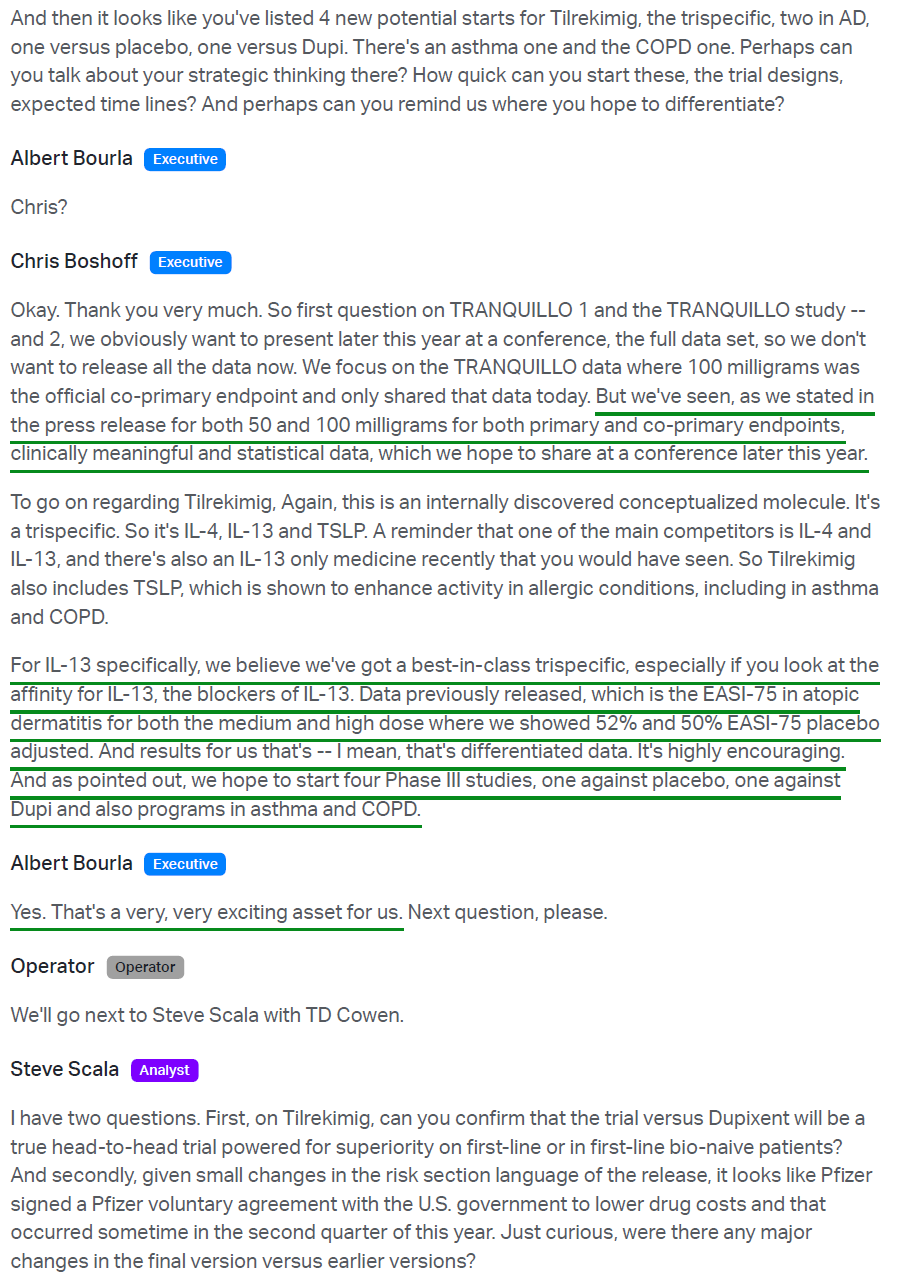
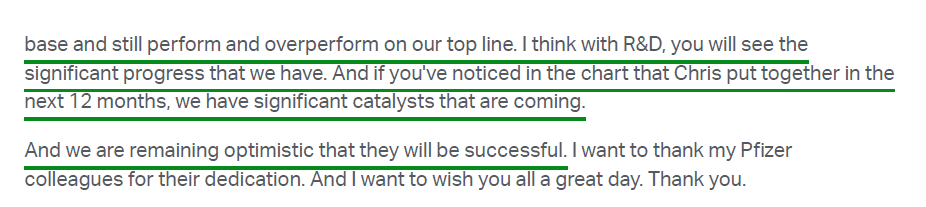
8) R&D execution stayed on pace, with three regulatory approvals, six key data readouts, and eight pivotal study starts completed year to date, with management guiding to five regulatory decisions, eight key readouts, and 19 pivotal study starts over the next 12 months. In obesity, berobenatide (the monthly GLP-1 peptide acquired via Metsera) is advancing 10 Phase 3 studies this year, with three already underway and two fully enrolled roughly eight months after the deal closed, targeting a first approval in 2028. Oncology continues to carry the near-term catalysts, with Padcev's approval expanding to cover more than 42,000 U.S. bladder cancer patients and a Q4 readout coming on mevrometostat, a prostate cancer candidate that doubled the time before disease progression in earlier trials.
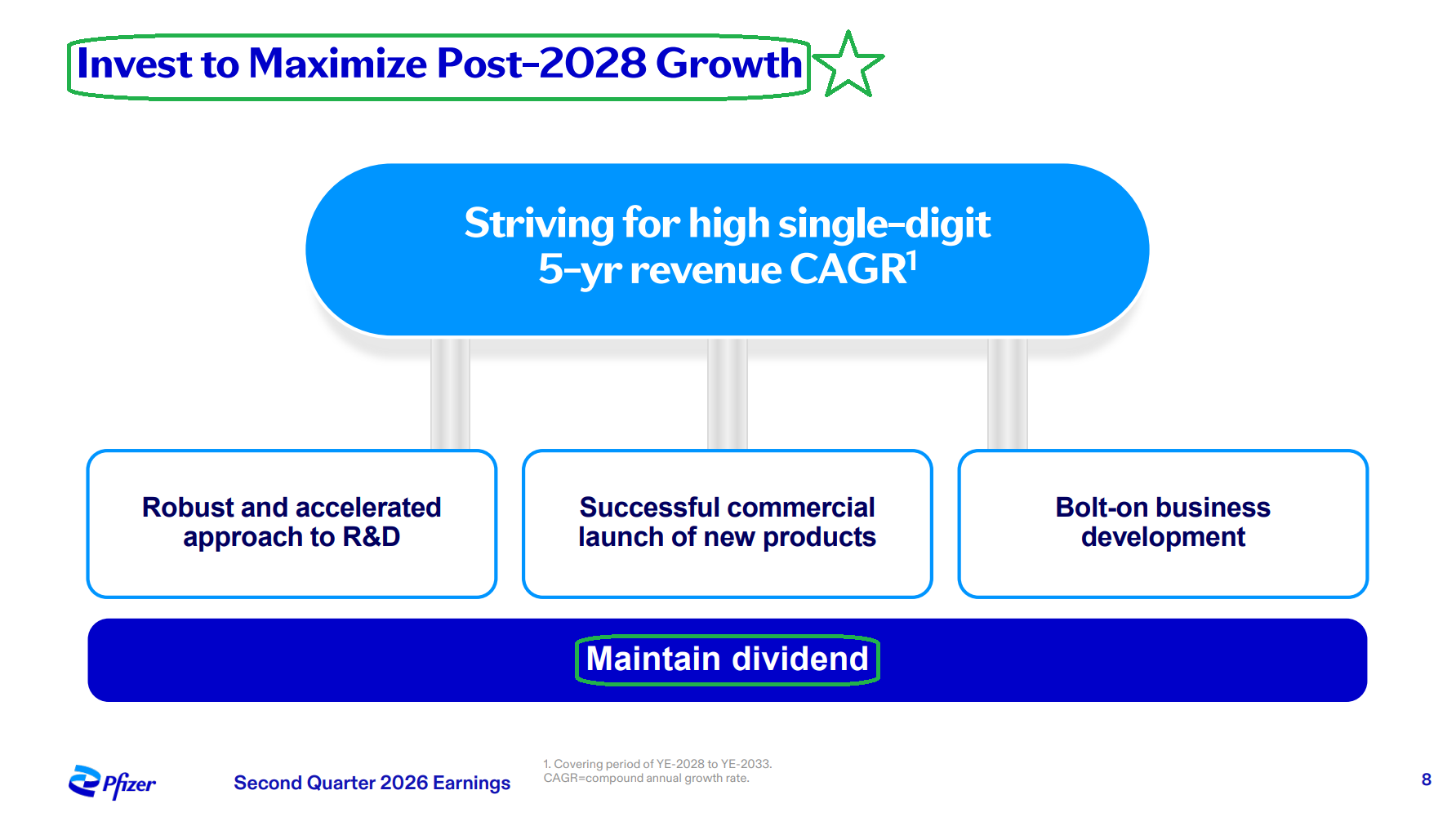
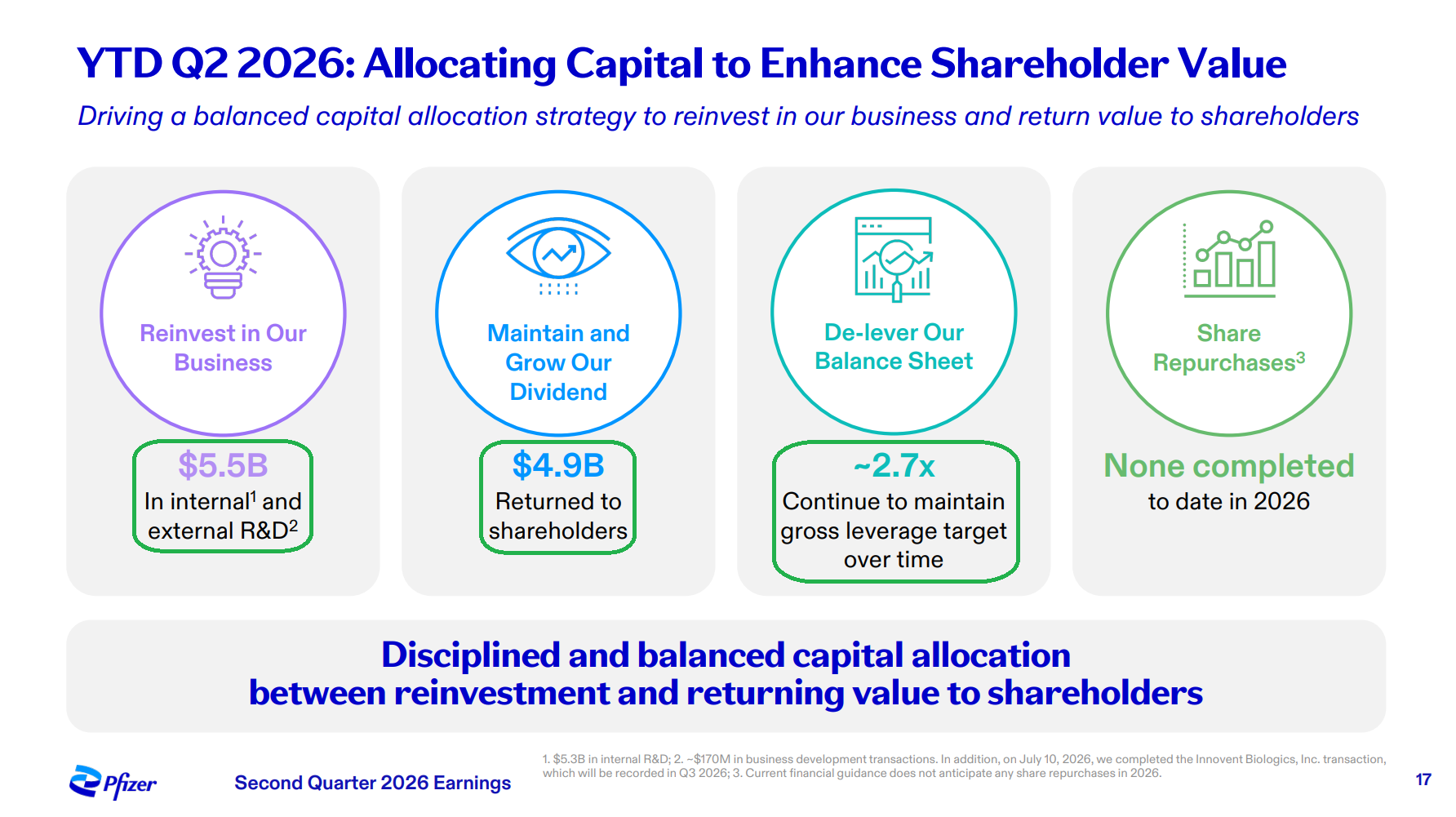
9) During the first half, Pfizer invested $5.5B in R&D ($5.3B internal, ~$170M in business development) and returned $4.9B to shareholders through the quarterly dividend of $0.86 per share, with management reiterating that even under the most stretched scenarios, the dividend will be maintained through the LOE period and grown again thereafter. Business development capacity stands at ~$6B following the Innovent Biologics licensing deal that closed in July, with management signaling bolt-ons rather than another transformative transaction. Gross leverage ended Q2 at 2.7x and is expected to hold around current levels or modestly higher through the transition.
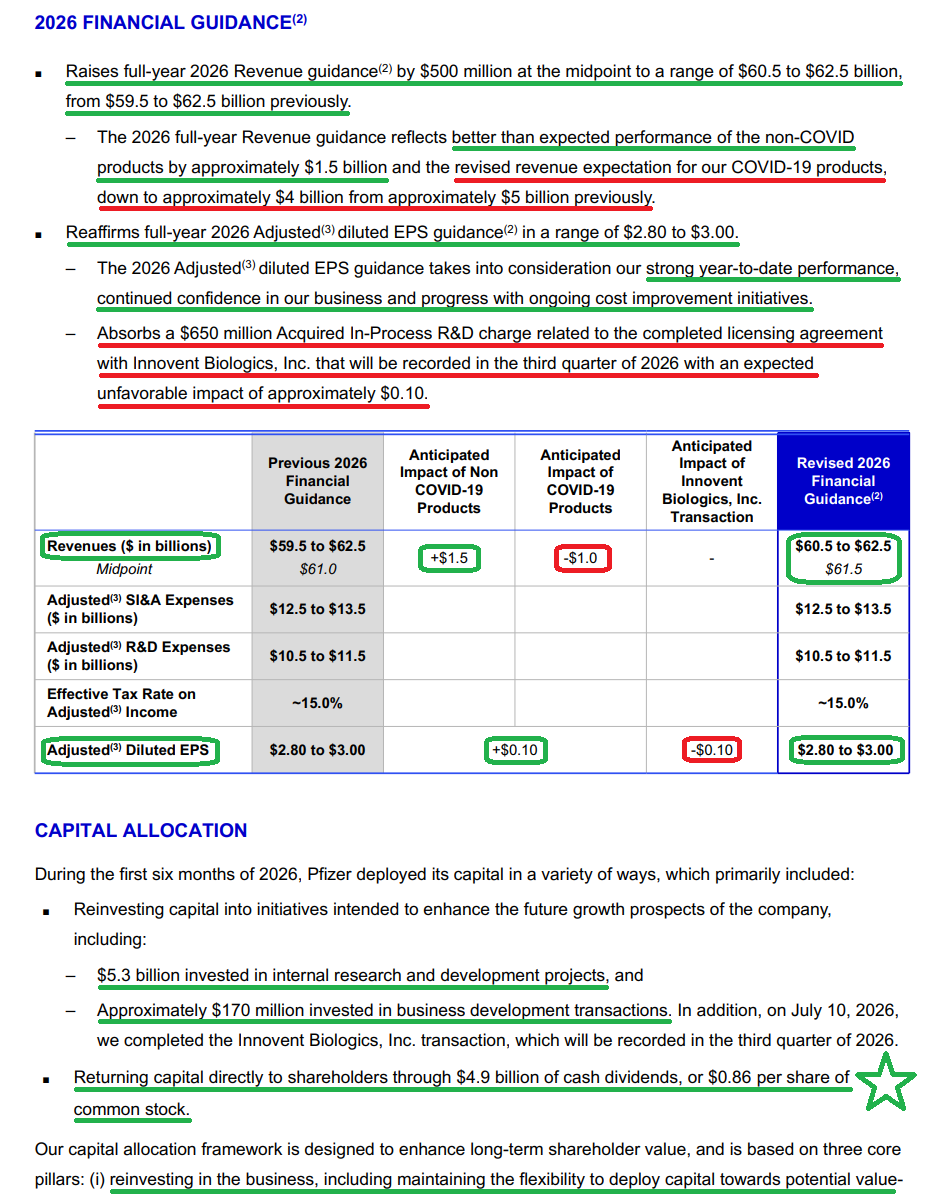
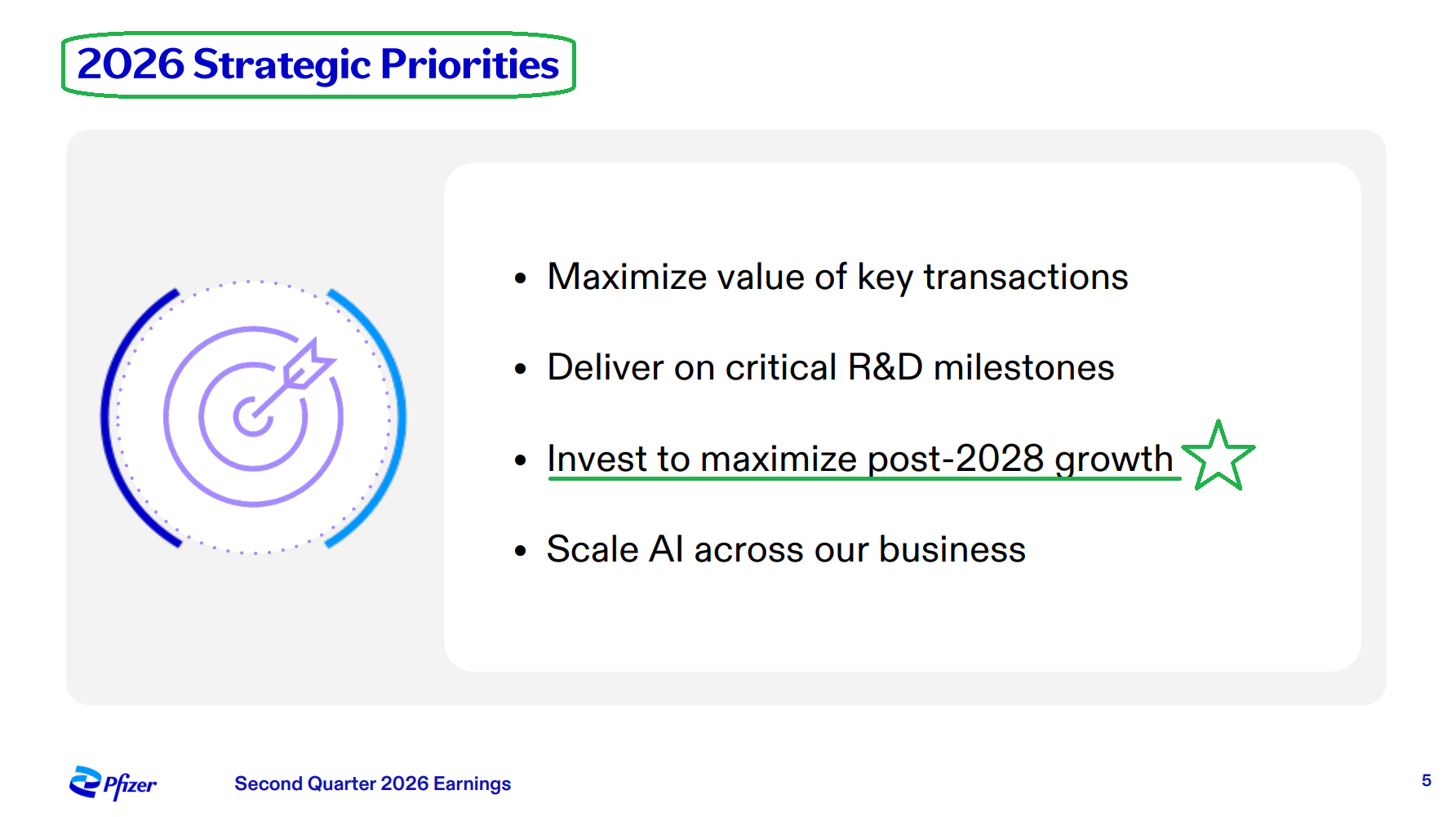
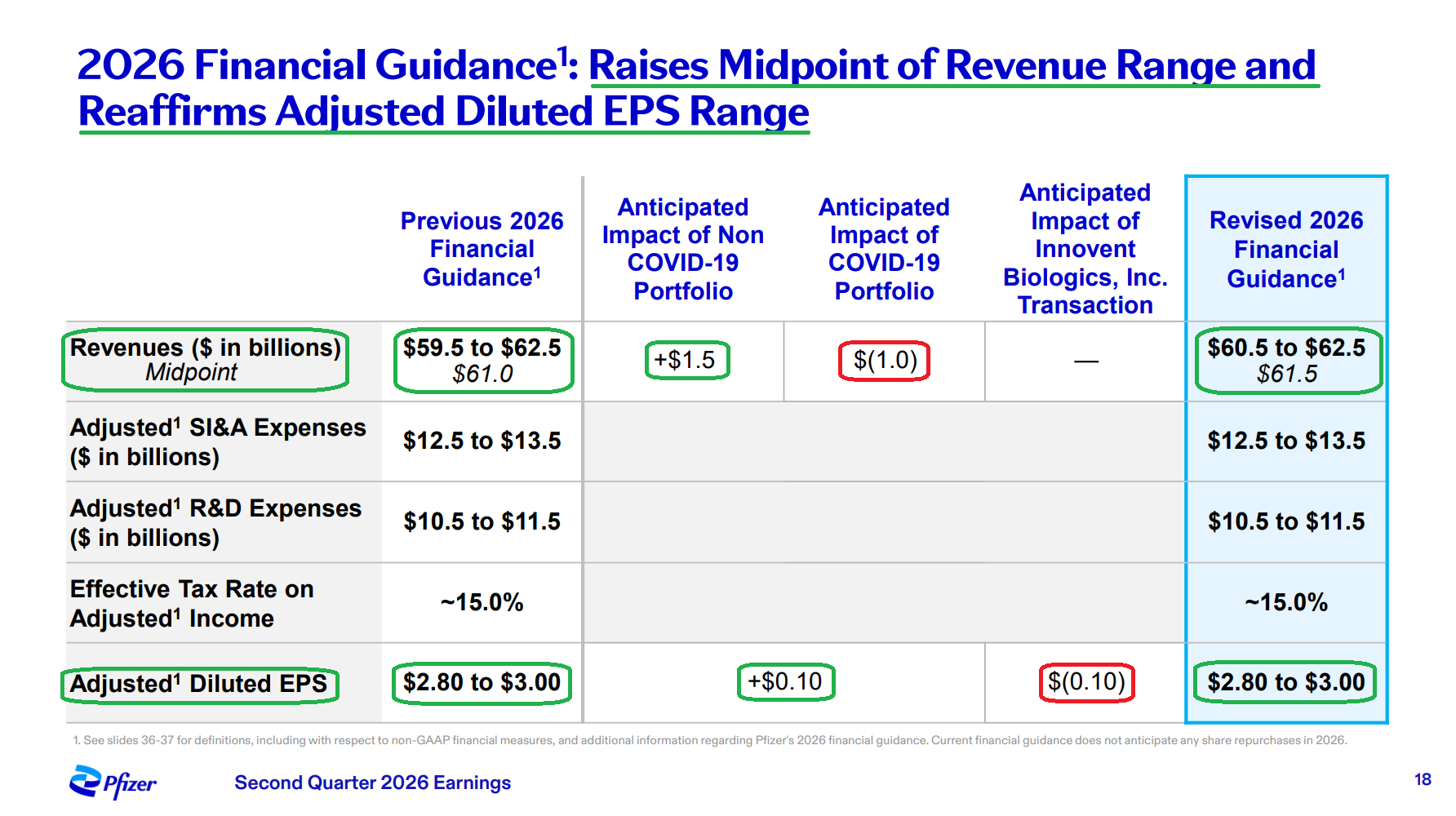
10) Pfizer raised full-year revenue guidance by $500M at the midpoint to $60.5B to $62.5B, from $59.5B to $62.5B previously, with the new $61.5B midpoint sitting ~$300M below consensus of $61.78B. Adjusted diluted EPS was reaffirmed at $2.80 to $3.00 (consensus $2.94), with the ~$0.10 hit from the Innovent acquired IPR&D charge absorbed by stronger non-COVID revenue and continued cost discipline. Management also reaffirmed its risk-adjusted high single-digit revenue CAGR from year-end 2028 through year-end 2033, supported by a bottoms-up analysis of its growing existing products plus 20 key potential new medicines and vaccines in the pipeline.
Earnings Call Highlights
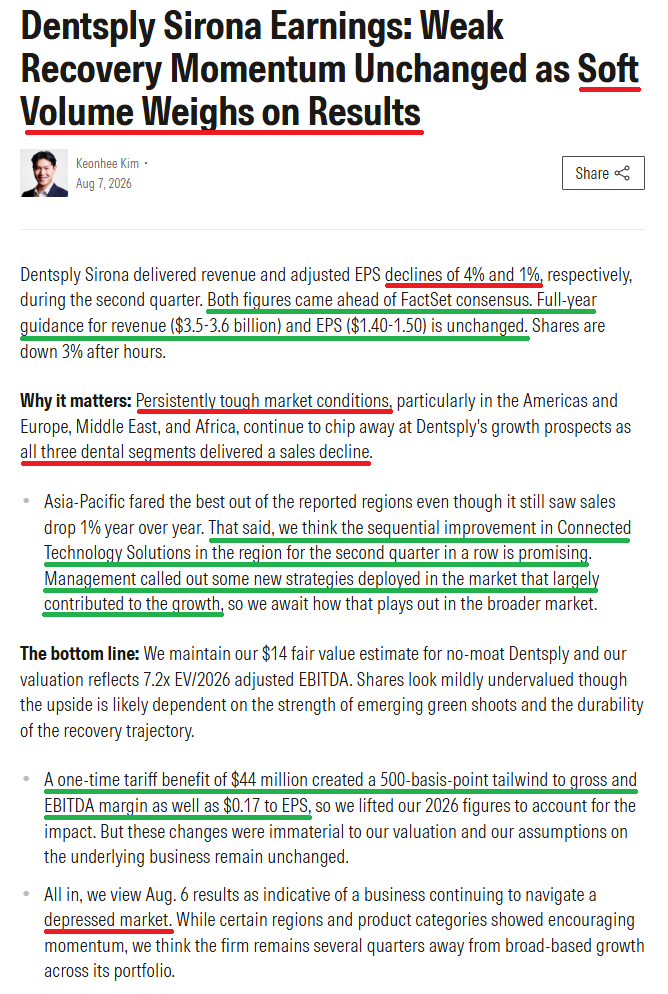
Morningstar Analyst Note
General Market
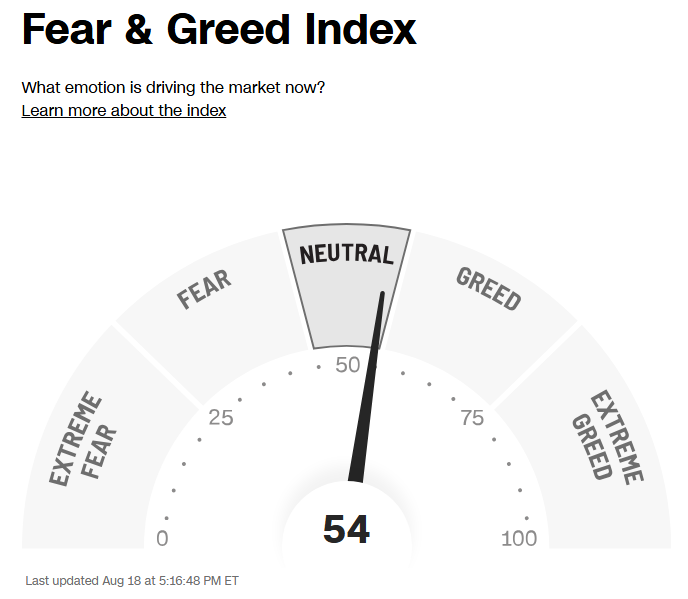
The CNN “Fear and Greed Index” ticked down to 54 this week from 65 last week. You can learn how this indicator is calculated and how it works here: (Video Explanation)
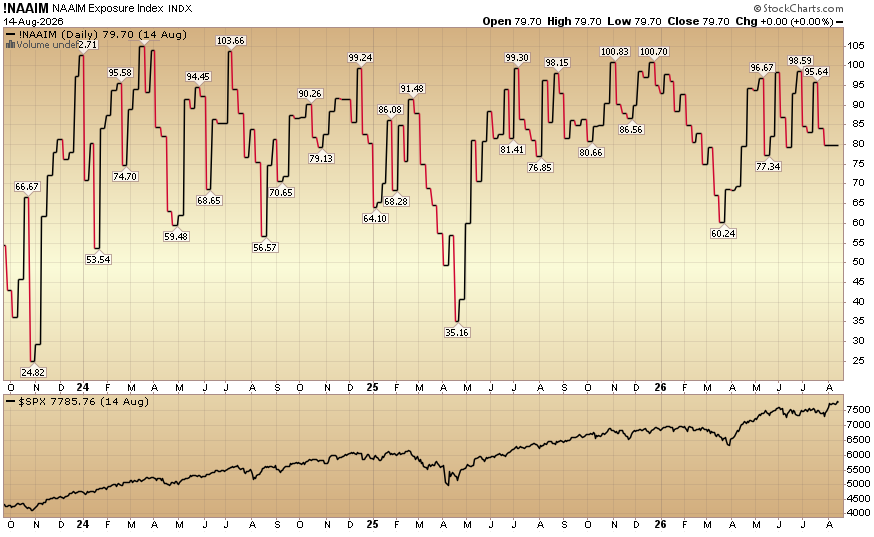
The NAAIM (National Association of Active Investment Managers Index) (Video Explanation) held steady at 79.70% equity exposure this week.


Comments
Log in or sign up to join the conversation.