

“The Prices Index has increased 25.6 percentage points to reach its highest level since April 2022 (84.6 percent).”

ISM chart and excerpts below by permission from the Institute for Supply Management® Highlights mine.
Please consider the April 2026 Manufacturing ISM® Report On Business® by Susan Spence, MBA, Chair of the ISM® Manufacturing Business Survey Committee. Emphasis Mine.
“The Manufacturing PMI® registered 52.7 percent in April, the same reading as March. The overall economy continued in expansion for the 18th month in a row. (A Manufacturing PMI® above 47.5 percent, over a period of time, generally indicates an expansion of the overall economy.)
The New Orders Index expanded for the fourth straight month after four straight readings in contraction, registering 54.1 percent, up 0.6 percentage point compared to March’s figure of 53.5 percent. The April reading of the Production Index (53.4 percent) is 1.7 percentage points lower than March’s reading of 55.1 percent.
The Prices Index remained in expansion (or ‘increasing’ territory), registering 84.6 percent, a 6.3-percentage point jump from March’s reading of 78.3 percent. In the last three months, the Prices Index has increased 25.6 percentage points to reach its highest level since April 2022 (84.6 percent).
The Backlog of Orders Index registered 51.4 percent, down 3 percentage points compared to the 54.4 percent recorded in March.
The Employment Index registered 46.4 percent, down 2.3 percentage points from March’s figure of 48.7 percent,” says Spence.
“In this second month of the Iran War (at the time of data collection), 31 percent of the comments were positive and 69 percent negative, with a positive to negative sentiment ratio of 1 to 2.2. Among comments, the war was mentioned in 47 percent and tariffs in 18 percent. As was the case last month, some panelists referenced both topics within a single comment or in mixed sentiment.
“Two of four demand indicators (the New Orders and Backlog of Orders indexes) remain in expansion, although the Backlog of Orders Index dropped 3 percentage points compared to March. The New Export Orders Index remained in contraction with a 2-percentage point decrease, and the Customers’ Inventories Index remains in ‘too low’ territory, contracting at a slightly faster rate. A ‘too low’ status for the Customers’ Inventories Index is usually considered positive for future production.
“Regarding output, the Production Index is in expansion for the sixth month in a row (although it lost ground compared to March), and the Employment Index decreased by 2.3 percentage points and remains in contraction. Among panelists, 60 percent indicated that managing head counts remains the norm at their companies as opposed to hiring, and of those managing head counts, 34 percent are using layoffs and 43 percent using attrition or not backfilling positions.
What Respondents Are Saying
“Demand for manufactured goods is trending higher versus last year; however, geopolitical uncertainty and rising oil and diesel prices continue to weigh on demand. Many customers are exercising caution and remain in a wait-and-watch mode.” [Transportation Equipment]
“Continued tariffs on products utilized in our product lines are being monitored by the business, with the business working to mitigate or limit tariff risk. Geopolitical risk, especially in the Middle East, as it pertains to commodity and energy markets remains a concern and is being monitored by the business. Supply chain risk concerns pertaining to increased cost and transit time for rerouted shipments due to conflict in the Red Sea, Strait of Hormuz and Suez Canal. These conditions are being monitored by the business and rerouting measures have been implemented where possible.” [Transportation Equipment]
“Continuing fluctuation in U.S. tariffs as well as market constraints for certain materials are affecting our current business. U.S. support of AI-related industry is also in flux which is causing some customer and investment hesitancy.” [Computer & Electronic Products]
“All products tied to crude, polyethylene resin or energy (liquified natural gas) have seen multiple increase spikes tied to the Iran crisis and market supply inflation.” [Chemical Products]
“Revenues are very strong. However, price increases are similar to a few years ago with the supply chain crisis. All imports from China are up 15 percent to 25 percent, which is impossible for us to absorb or to fully pass along. Our suppliers in China are telling us that oil is at an all-time high, which is putting huge challenges on their cost structures.” [Chemical Products]
“General uncertainty over the total impact of the U.S.-Iran war. Have not yet started to see the full impact of fuel increases but are aware they are coming.” [Machinery]
“Business levels have been decent this year, in line with the same period last year and improved from the second half of 2025. However, higher cost pressures are impacting margins.” [Fabricated Metal Products]
“Commodity markets remain mixed, with pockets of easing offset by ongoing volatility. Dairy and some soft commodities have cooled, while oils and grain-related inputs remain elevated given biofuel demand and feed costs. Pricing is still sensitive to policy changes, weather and global trade dynamics.” [Food, Beverage & Tobacco Products]
“Our business remains strong and stable, but there are a lot of concerns in the geopolitical arena. If the Iran conflict persists, the impact on market pricing and supply continuity could be extreme. Electronics component market remains very volatile (pricing and continuity) based on AI.” [Miscellaneous Manufacturing]
ISM Prices

The ISM® Prices Index registered 84.6 percent in April, an increase of 6.3 percentage points over its March reading of 78.3 percent, indicating raw materials prices increased for the 19th straight month. The Prices Index has risen 25.6 percentage points in the last three months to hit its highest reading since April 2022 (84.6 percent).
All the six largest manufacturing industries — Chemical Products; Petroleum & Coal Products; Machinery; Food, Beverage & Tobacco Products; Computer & Electronic Products; and Transportation Equipment, in that order — reported price increases in April.
“As was the case in March, the Prices Index reading continues to be driven by (1) increases in steel and aluminum prices that impact the entire value chain, (2) tariffs applied to many imported goods and now (3) increases in petroleum-based products as a result of the Middle East conflict.
Higher prices were reported by 70.3 percent of respondents in April, up 10.9 percentage points from March’s 59.4 percent,” says Spence. A Prices Index above 52.8 percent, over time, is generally consistent with an increase in the Bureau of Labor Statistics (BLS) Producer Price Index for Intermediate Materials.
In April, the 17 industries that reported paying increased prices for raw materials, in order, are: Nonmetallic Mineral Products; Paper Products; Plastics & Rubber Products; Textile Mills; Wood Products; Primary Metals; Furniture & Related Products; Chemical Products; Fabricated Metal Products; Electrical Equipment, Appliances & Components; Petroleum & Coal Products; Miscellaneous Manufacturing; Machinery; Food, Beverage & Tobacco Products; Computer & Electronic Products; Transportation Equipment; and Apparel, Leather & Allied Products. No industries reported paying decreased prices for raw materials in April.
Yesterday, I commented PCE Inflation Is Ripping Higher. Don’t Expect Fed Interest Rate Cuts
Year-over-year PCE inflation jumped to 3.5 percent. The Fed wants 2.0 percent.
PCE Year-Over-Year Details
PCE bottomed in April of 2024 at 2.3 percent, now 3.5 percent.
Core PCE bottomed in April of 2024 at 2.6 percent, now 3.2 percent.
PCE goods bottomed in September of 2024 at -1.2 percent now 3.8 percent.
PCE services bottomed at 3.3 percent last month, now 3.4 percent.
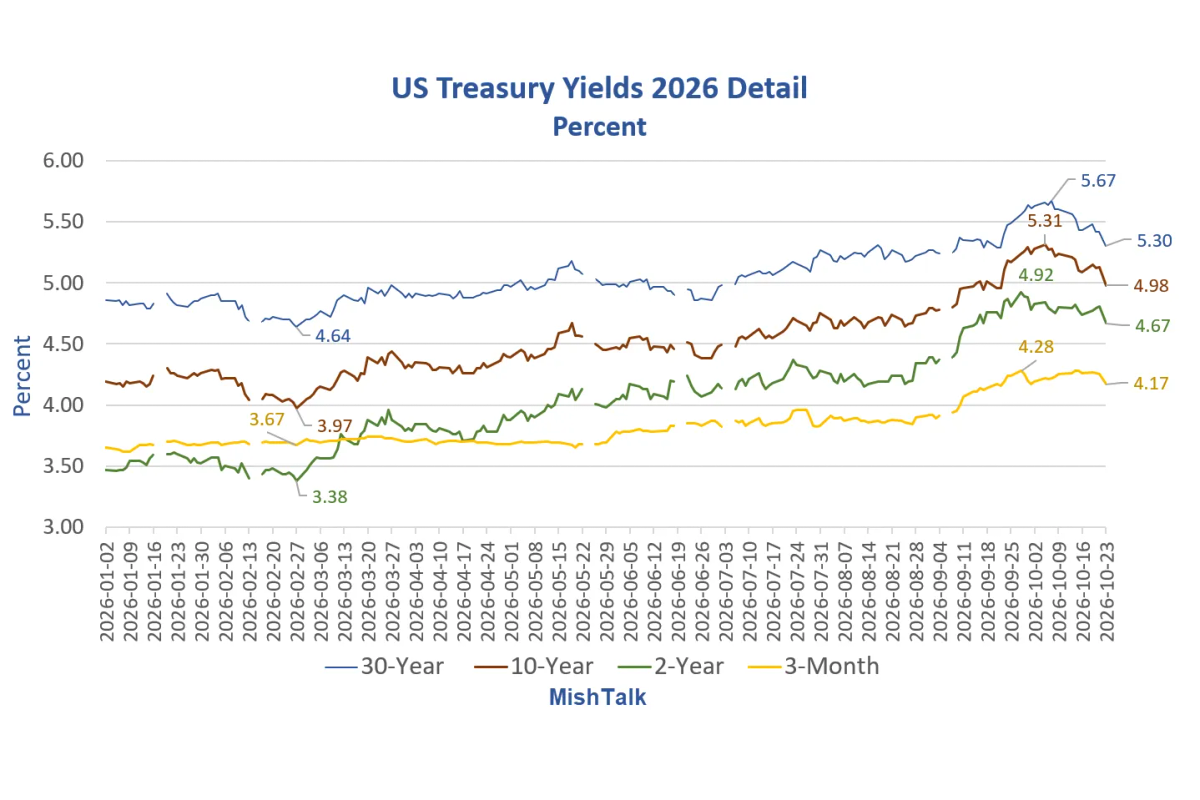
The Long Bond Yield Is Signaling a Huge Fear of Inflation
Also note The Long Bond Yield Is Signaling a Huge Fear of Inflation
The 30-year long bond yield is just 17 BPs from a new 18-year high.
Hello Kevin Warsh
Incoming Fed Chair Kevin Warsh keeps talking about rate cuts. Unless the economy collapses, this is crazy talk.

Comments
Log in or sign up to join the conversation.