

Worldwide the outlook for future interest rates has taken a major tumble as investors re-calibrate their expectations for rate changes in the future. Almost without exception, the yield curves in the major industrialized world are signaling that not only is economic growth slowly but that inflationary expectations are way down from those displayed six months ago and even from those of just over the past month.
Starting with the United States, the Fed rather abruptly announced a pause in its rate hike cycle in January. In addition, the Fed’s “quantitative tightening” program, designed to incrementally shrink its balance sheet will likely stop as early as September. Six months ago, the yield on the US 10-yr bond was 3.2% only to fall steadily to 2.63 % today (Figure 1). More significantly, the curve actually inverted in the mid-range between 2y and 5yr yields, suggesting that the majority of bond market participants do not anticipate any rate hikes in 2019. This perspective has been echoed by selective Fed speakers who cite the absence of inflationary pressures.
(Click on image to enlarge)
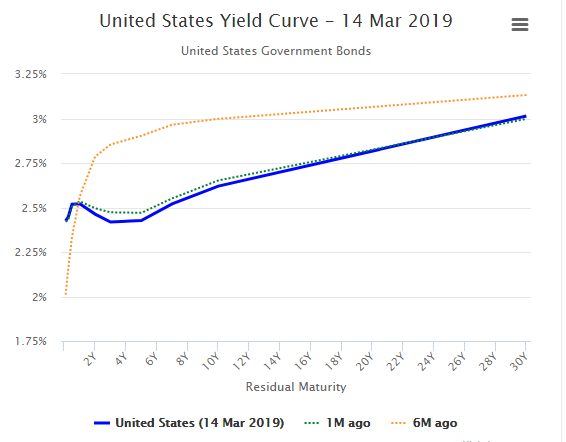
Figure 1
Just a half a year go the Governor of the Bank of Canada told Canadians to be prepared for a “neutral” bank rate somewhere range of 2.5% to 3.5% (compared to the current rate of 1.75%). This statement initiated a sharp increase in the front end of the curve, although the long end remained relatively flat. As the results of the fourth quarter 2018 rolled in, it became very apparent that the Canadian economy was deteriorating. It did not take long for Governor Poloz to alert Canadians that the path towards higher interest rates is “highly uncertain”.[1] Disappointing exports, especially in the energy sector, and the softness in business investment turned the markets’ attention to a faltering economy. The reaction in the Canadian bond market was swift as yields across the board fell and continue to fall this month (Figure 2).
(Click on image to enlarge)
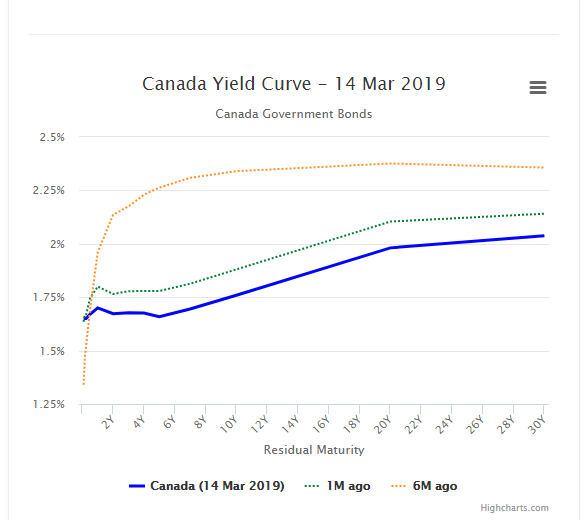
Figure 2
The European situation appears to be worsening. The ECB ruled out any rate hikes for all of 2019 in response to very slow growth and weak inflation. In addition, the central bank introduced measures to stimulate bank lending, since that sector is failing to provide the needed liquidity for business expansion. The German 10yr bond trades just barely above 0% and the entire yield curve has shifted down as much as a 5bps (Figure3). The situation is no different for gilts in the U.K., although that market is specifically affected by the daily machinations in Brexit saga.
(Click on image to enlarge)
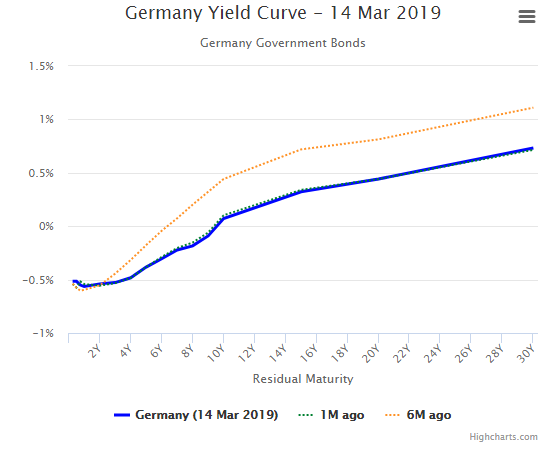
Figure 3
The deceleration in the Chinese economy is also pushing yields downward. As inflation stalls and growth forecasts are scaled back considerably, the Chinese yield has shifted more than 50bps across the spectrum in the past half year. (Figure 4).
(Click on image to enlarge)
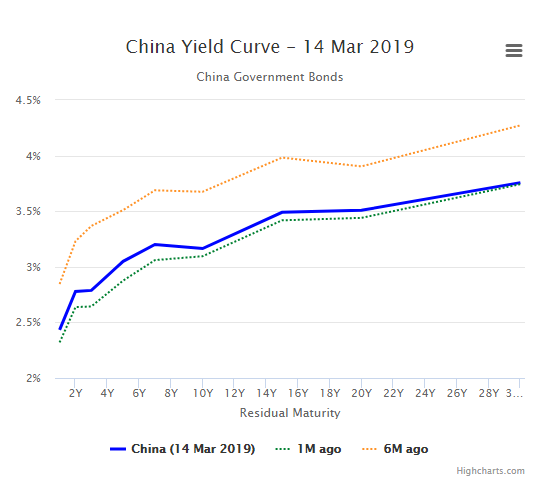
Figure 4
Japan, even with the lowest yields of any industrialized nation, managed to experience a further drop in yields over the past 6 months. The front end of the curve remains well below 0% and the 10yr yield sits at 0%.
(Click on image to enlarge)
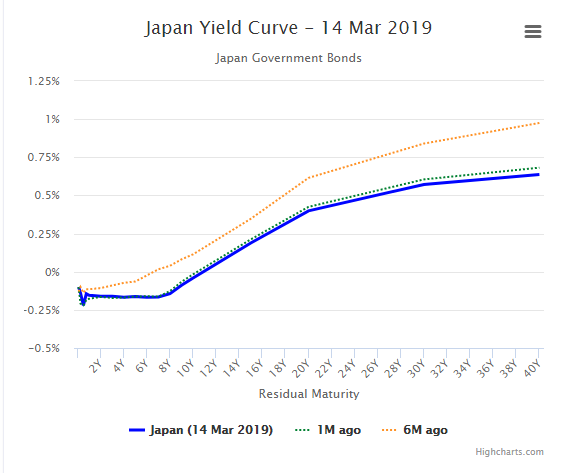
Figure 5
It is highly unlikely that these bond markets will revert to the yields existing just 6 months ago. There are just too many headwinds confronting the major economies. The strain in US-Chinese trade relations continue to haunt financial markets; international trading activity, especially within Asia, has slowed considerably; US growth forecasts for the first quarter have been downgraded into the 1%-2% range; and high debt levels in many emerging market economies act a constraint on economic expansion.
[1] The Canadian Recession Has Started And It Is Time To Consider Rate Cuts



Comments
Log in or sign up to join the conversation.