


i-80 Gold's first half reports an adjusted net loss of 8 cents a share.
The GAAP loss in the same document is 15 cents. Nearly all of that gap is one line, and that line is a royalty the company agreed to pay forever.
I rate i-80 Gold (IAUX) a Hold at $1.79, with a fair value around $1.40 to $1.60. Everything below comes from the filings and from four other companies' filings. The accounting is permitted, the election is disclosed, and the definitions are printed where you would expect them, so in reality this is a question about what a permitted election does to a reader who would stop at the adjusted number.
What They Signed
On 16 March 2026, i-80 did two financings in one day. National Bank and Macquarie took a gold prepay, $150.0 million gross and $144.1 million net of $5.9 million of issuance costs, against 39,978 ounces deliverable between January 2028 and June 2030. That is $3,752 an ounce on the gross proceeds, at a 13.5% effective interest rate, with a further $100 million accordion available for 24 months from closing.
The second one is the subject. Franco-Nevada bought a net smelter returns royalty for $250.0 million, of which $225.0 million has been funded. Franco-Nevada describes it in its own first-quarter statements as "a 1.5% NSR on all minerals produced, increasing to 3.0% in perpetuity beginning on January 1, 2031," applying to "Granite Creek, the Ruby Hill Property (including Archimedes and Mineral Point), Cove and Lone Tree."
I had to read the agreement. It is Exhibit 10.1 to the 27 March 8-K, and it runs to 11.5 million characters of raw HTML. Section 3(a) has i-80 "irrevocably grant and convey" the royalty and pay it "in perpetuity". Section 20(a) is one sentence long, which goes: "The term of this Agreement shall commence on the Effective Date and shall be perpetual." When I searched the document for buy-back, buyback, and repurchase, it returned nothing. Schedule G is a recordable royalty deed for filing at the county recorder, and Section 21(a) requires any transferee to acknowledge that the royalty "constitutes, and was intended at the time of the original grant to constitute, a real property interest that runs with land." It survives a sale.
Now Section 13(g) is a clause any buyer would want. i-80 CANNOT process third-party material through its own plants without an approved Commingling Plan, and if a Displacement occurs, there is an eighteen-month lookback under which production reductions are "deemed to be made in anticipation." Section 13(b) requires i-80 to operate "on the same basis as if the Payors retained full economic interest in the Minerals."
That matters because of where i-80 is heading. The company says it is "targeting to have the anticipated refurbishment of its autoclave facility at the Lone Tree Plant completed by December 31, 2027, to allow for all material from the Company's underground gold mines to be processed at its autoclave facility." Until then, it is paying a third party under a toll milling agreement that runs to the same date. The plan to bring processing in-house is the plan the whole business rests on, and it now runs through a consent right.
One Contract, Two Sets of Books
Franco-Nevada's first-quarter statements say the transaction was "accounted for as an acquisition of a mineral interest." Cost. It sits there without moving.
i-80 says the royalty is "classified as a financial liability" and that the company "elected the fair value option." The Level 3 note gives the inputs: "estimates of life-of-mine production volumes, timing of production, forward commodity prices and Company-specific discount rates."
I want you to read that list. More life-of-mine ounces make the liability bigger. Higher forward gold prices make it bigger. Producing sooner makes it bigger. Every input that improves the business enlarges the obligation.
It has indeed enlarged. The royalty was recognized at $225.0 million on 16 March. At 31 March, fifteen days later, it was $232.4 million. At 30 June, it was $256.0 million. The silver purchase agreement's embedded derivative moved the same way, from $20.4 million at year-end to $48.3 million to $57.7 million. The gold prepay embedded derivative is the offset and moved the other way, from nil to a $29.9 million asset.
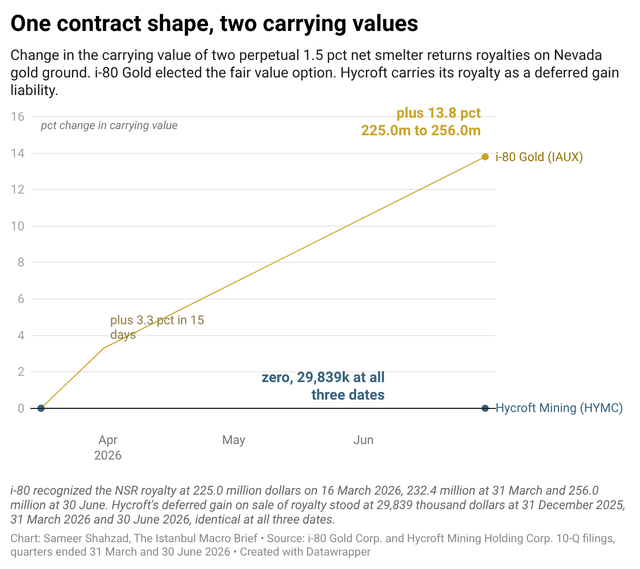
i-80 Gold Corp. and Hycroft Mining Holding Corp. 10-Q filings, quarters ended 31 March and 30 June 2026.
Where the Loss Goes
Management explains its own result. From the six-month MD&A: net loss was $131.1 million, "due to higher non-cash fair value revaluation net losses on derivative financial instruments of $39.5 million, as a result of changes in metal prices and discount rates."
That $39.5 million ties out. Add up every fair value line in the non-cash items table for the half, and you get a net loss of $39.5 million: silver derivative $36.1 million, NSR royalty $31.7 million, convertible loans $3.5 million, and the Orion prepay $3.4 million, against gains of $29.9 million on the 2026 gold prepay and $5.2 million on warrants.
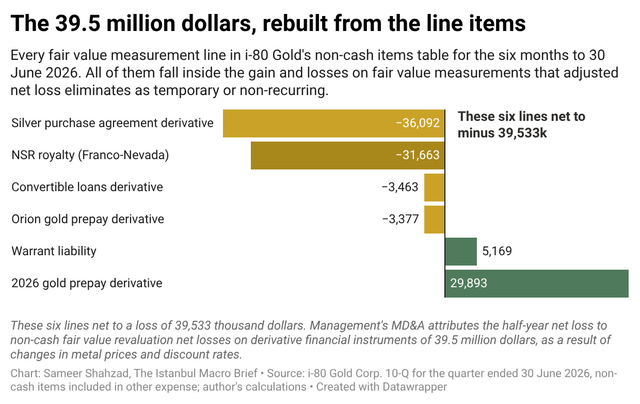
i-80 Gold Corp. 10-Q for the quarter ended 30 June 2026, non-cash items included in other expense; author's calculations
The non-GAAP reconciliation then carries a GAAP net loss of $131.1 million down to an adjusted net loss of $69.9 million, and 15 cents a share down to 8 cents. The company defines adjusted net loss as a measure that "eliminates temporary or non-recurring items such as: gain and losses on fair value measurements, loss on loan extinguishment, gain (loss) on Convertible Loans and finance fee expense." The NSR revaluation, $31.7 million of it, is inside that first category.
Naturally, a fair objection at this point arises. Stripping non-cash fair value movements out of an adjusted earnings measure is completely ordinary. I mean, half the sector does it. On its own, it proves nothing at all.
What is not ordinary is the pairing. The non-cash mark comes out of adjusted net loss as non-recurring. And in the property tables, "Royalties exclude NSR royalty payments," so the cash comes out of operating costs as well. The obligation is absent from the earnings measure and absent from the cost measure, and it is the same obligation both times.
What the Peers Actually Do
You might ask why any of this matters when every pre-revenue junior finances itself exactly this way. That was my own objection, so I went and tested it instead of making assumptions. I looked at 14 North American gold and silver developers, the most recent 10-K or 10-Q for each, and read the actual balance sheet line for every company with a metal-linked encumbrance.
Five US GAAP filers had one, including i-80. Between the five, four different treatments.
Hycroft Mining is the closest comparable, and it is very close. From its second quarter filing: "Pursuant to the Royalty Agreement with Sprott Private Resource Lending II (CO) Inc. in which the Company received cash consideration in the amount of $30.0 million, the Company granted a perpetual royalty equal to 1.5% of the net smelter returns from the Hycroft Mine, payable monthly." Then the next sentence: "The royalty is accounted for as a deferred gain liability."
Look closely: that is the same state, metal, word, and the headline rate. And on the balance sheet, deferred gain on sale of royalty, $29,839 thousand at 31 December 2025, $29,839 thousand at 31 March 2026, and $29,839 thousand at 30 June 2026. They are identical across three consecutive dates. Gold rose hard across that window, and Hycroft's number didn't budge.
I searched Hycroft's filing for a buyback too. I came back with nothing, exactly as at i-80. So I had to give up the loudest version of this story. A perpetual royalty with no repurchase right is not exotic. Just something these companies sign when they need money. The difference between the two is not the contract; rather, it is the measurement election, and that election is the reason $31.7 million ran through one income statement and nothing at all ran through the other.
Paramount Gold Nevada splits its Sprott royalty convertible debenture into a debt liability at amortized cost of $11.8 million and a royalty conversion feature at Level 3 fair value of $8.4 million, up from $4.1 million. So fair value measurement of a royalty does happen, and I am not claiming otherwise.
Vista Gold sold Wheaton (WPM) a gross proceeds royalty on Mt Todd for $20.0 million, an escalating structure with a combined range of 1.125% to 3.0%, and recognizes no liability for it at all. Its total liabilities are $1.6 million against $52.3 million of assets, with the royalty sitting in commitments and contingencies. Vista's rate is also reducible by a third on a change of control or on delivery of 3.47 million ounces to a third party. i-80's steps up in 2031 and never comes back down.
McEwen carries its Fox Complex streaming arrangement as a contract liability of $8.1 million.
That is one economic idea with four treatments. i-80 picked the only one that runs gold prices through quarterly earnings, and then took the result back out of adjusted earnings.
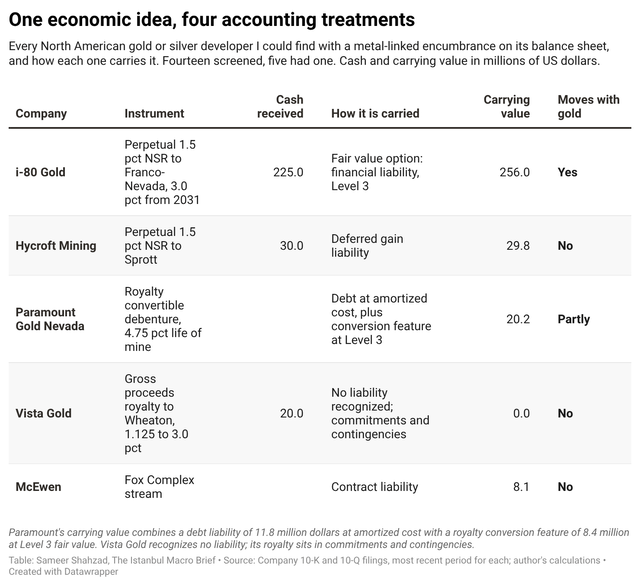
Company 10-K and 10-Q filings, most recent period for each; author's calculations
A Rate for the Leases and None for the Royalty
Paramount is worth a second glance, because it shows its work. It gives the royalty rate it used: 4.75% for the life of mine. It gives the discount rate: "the annual royalty amounts were discounted using a long term stock market rate of return of 10%." It explains that it changed valuation technique from Black-Scholes to Monte Carlo, and why: "because appreciation in gold and silver prices have caused the Company's buyback provision to become economically substantive."
So that is a company a fraction of i-80's size disclosing a number where i-80 discloses a category. i-80 gives you "Company-specific discount rates" and no rate. In the same 10-Q, i-80 discloses a weighted average lease discount rate of 8.42%. There is a rate for the office and equipment leases and no rate for the $256.0 million perpetual obligation.
To be fair to i-80, Paramount does not publish a sensitivity table either, nor do most of the others. The absent ASC 820 sensitivity is a sector habit and not one company's choice. The internal inconsistency is the part that is i-80's own.
The Ground it Attaches To
From the annual report: "Under S-K 1300, all our properties are exploration stage as no mineral reserves have been defined." And specifically, "The Granite Creek Property presently has no Mineral Reserves." Granite Creek is the mine that is actually running.
The resource tables state that "Mineral Resources have been estimated at a gold price of $2,175 per troy ounce and a silver price of $27.25 per ounce," and that "Metal price determinations were from 2024 Q3." Gold futures last traded near $4,476. Existing Seeking Alpha coverage on the name notes that 45% of resources are inferred and that no feasibility studies are complete.
So a perpetual royalty over a defined package of ground, valued off life-of-mine production drawn from a resource base with no reserves in it, priced on a two-year-old deck.
Blanks in the Exhibit
Six schedules to the royalty agreement carry the formula "(See attached.)". Two of them, Schedule A-2 Description of the Property and Schedule G Royalty Deed, are followed by the promised material and together account for well over half the exhibit. Four are followed by nothing at all: Schedule A-1 Maps of the Property, Schedule A-3 FAD Properties, Schedule F Existing Third-Party Royalties, and Schedule H 2026 Budget, which is the last thing in the document.
Section 14, Right of First Offer, appears in the table of contents at page 40, and in the body it appears as a heading followed immediately by Section 15. There is no text. Section 8 is expressly marked "[Reserved]," so the drafters did mark deliberate blanks when they meant to.
I want to be precise about Schedule H. The condition itself is disclosed. Section 7(b) says the further $25,000,000 is payable following "the incurrence in 2026 of $25,000,000 of budgeted expenses, in accordance with the copy of the 2026 budget plan provided to the Payee (a copy of which is attached hereto as Schedule H), to advance Mineral Point technical and permitting work," and Franco-Nevada describes the same condition in its own statements. What is missing is the budget, not the condition.
There is no Item 601(b)(10)(iv) redaction legend anywhere in the document and no redaction markers in 11.5 million characters of raw HTML. The contrast sits in the same company's own filings. Exhibit 10.2 to the first quarter 10-Q, the Supplementary Terms Agreement with National Bank as administrative agent, carries that legend on its first line and marks its redactions inline as "[Redacted - commercially sensitive information]" twenty times.
I emailed i-80 investor relations on 3 September about section 14, the empty schedules, the Schedule H condition, and the missing legend, and I have had no reply. I am not alleging anything. A filing agent error would explain all four at once. But Franco-Nevada never filed its own copy, so exactly one version of this agreement exists in the public record, and there is nothing to check it against.
What I think it is Worth
Coverage on the name puts i-80 at 0.43 times net asset value. The builds I have seen do not deduct the royalty or the silver derivative as a claim on future production. Together, those are $313.7 million, about 36 cents a share against $1.79. Shareholders' equity of $258.0 million against roughly $1.55 billion of market value is about six times book value.
Take the 36 cents off and apply a multiple that reflects a resource base with no reserves in it, and $1.40 to $1.60 is where I land.
There is a number that breaks all of this. The Q3 mark. If the NSR liability comes in flat or lower in November, the mechanism I have described has stopped working, and I bow out.
Where I could Be Wrong
Cash is $464.6 million. This is NOT a solvency argument, and nobody should read one here.
Gross profit went from $3.7 million to $24.7 million YoY on a realized price of $4,801 an ounce in the first half. Richard Young bought a million shares at $1.62 of his own money on 18 August, taking his holding to 5,971,000. That is not what somebody does when they think the balance sheet is a trap.
The Archimedes feasibility study matters here, and i-80 now anticipates completing it "approximately mid-year 2027," pushed back because the supporting drill program is "encountering slower than planned progress due to contractor staffing availability." A maiden reserve would validate the exact production input the entire fair value calculation rests on, and would make the growing liability a sign of a working plan rather than a warning.
The Lone Tree autoclave, once refurbished, is a genuinely scarce piece of infrastructure in Nevada. That scarcity is precisely why a buyer paid for perpetual exposure to it, and it is the same scarcity that underwrites the bull case.
And the direction reverses. If gold turns, the liability marks down, the prepay at $3,752 an ounce starts to look like good funding, and Young looks early, rather than wrong.
So
The royalty is permanent; it attaches to ground with no reserves, and it is carried on a basis that grows when the company does well. The peers who signed the same kind of contract do not carry it that way. And the movement in results is taken out of adjusted earnings as temporary, while the cash it will cost is taken out of operating costs.
Hold. $1.40 to $1.60.


Comments
Log in or sign up to join the conversation.