

This article is Part II in my series:
THE AGGRESSIVE EDGE Five Weeks to Smarter, More Aggressive Trades
Read Part I "The Elevator vs. the Staircase"
Last week I introduced you to the core idea behind my speculative trading approach, using in-the-money options to build trades that capture most of the upside when I'm right, and give up less than the full downside when I'm wrong.
Today I want to get practical.
Because understanding the concept of in-the-money options is one thing. Knowing how to actually find them, read them, and evaluate them is another. And if you've ever pulled up an options chain and felt your eyes glaze over at the rows of numbers, you're not alone.
By the end of this article, that changes. I'm going to walk you through a real options chain (one I'm actually using in my Speculative Trading Program right now) and decode every number that matters.
The Stock: Target Corporation (TGT) (TGT)
We're going to use Target Corp. (TGT) as our example today, because it's a name most of us know well. You've probably shopped there. You may even own the stock.
As of Tuesday, Target closed at $115.92 per share. The company has been undergoing a turnaround process and shares have been trending higher this year. More on that in a future issue.
For now, let's use TGT's options chain to learn the language.
Step One: Choosing an Expiration Date
When you pull up an options chain for any stock, the first thing you'll see is a list of expiration dates. Think of these as the different "timeframes" available for your trade.
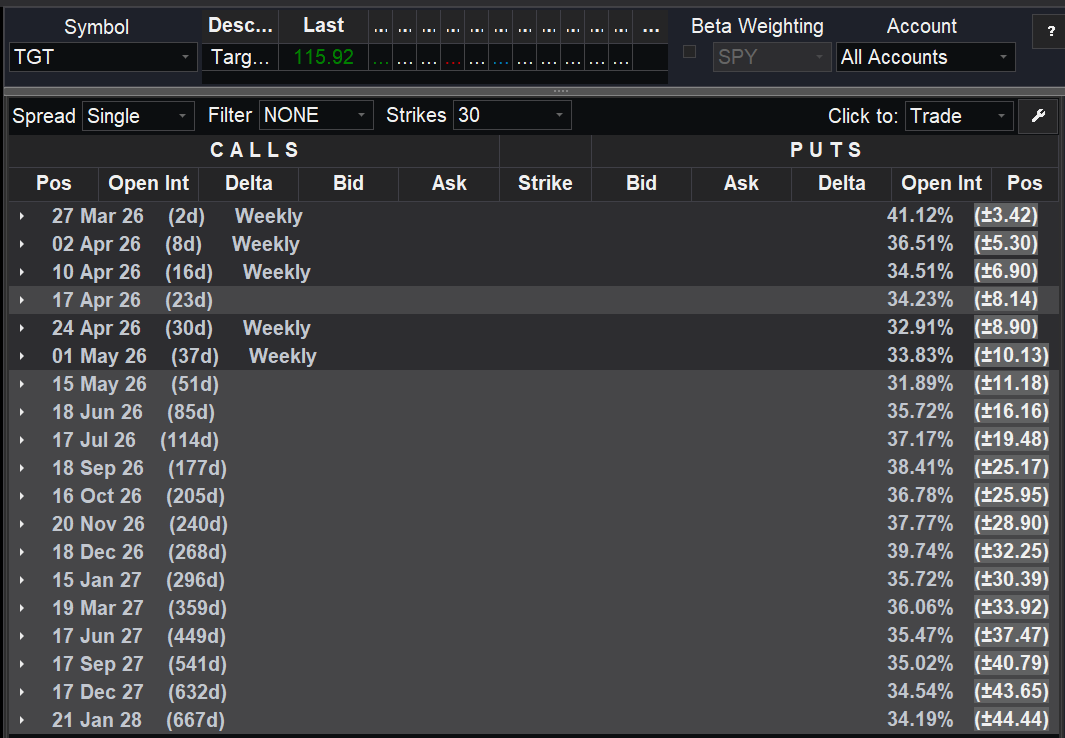
For TGT right now, you can see expirations ranging from just 2 days away all the way out to January 2028 -- nearly two years from now. That's a wide range, and your choice matters.
Short-dated options (2 to 8 days out) are cheap but unforgiving. There's almost no time for a trade to develop. They're high-risk even by speculative standards.
Long-dated options (a year or more out) are expensive and slow-moving. They're more forgiving, but you're tying up more capital for a longer period of time.
For my speculative trades, I typically look for options with 3 to 8 weeks until expiration. That's enough time for the trade to develop, while keeping the cost reasonable.
For this trade, I'm using the April 17th expiration -- 23 days from now. That's right in my sweet spot.
Step Two: Understanding Strike Prices
Once you've chosen an expiration date, you'll see dozens of different contracts available. The difference between them is the strike price: the price at which your option gives you the right to buy (for a call) or sell (for a put) shares of the stock.
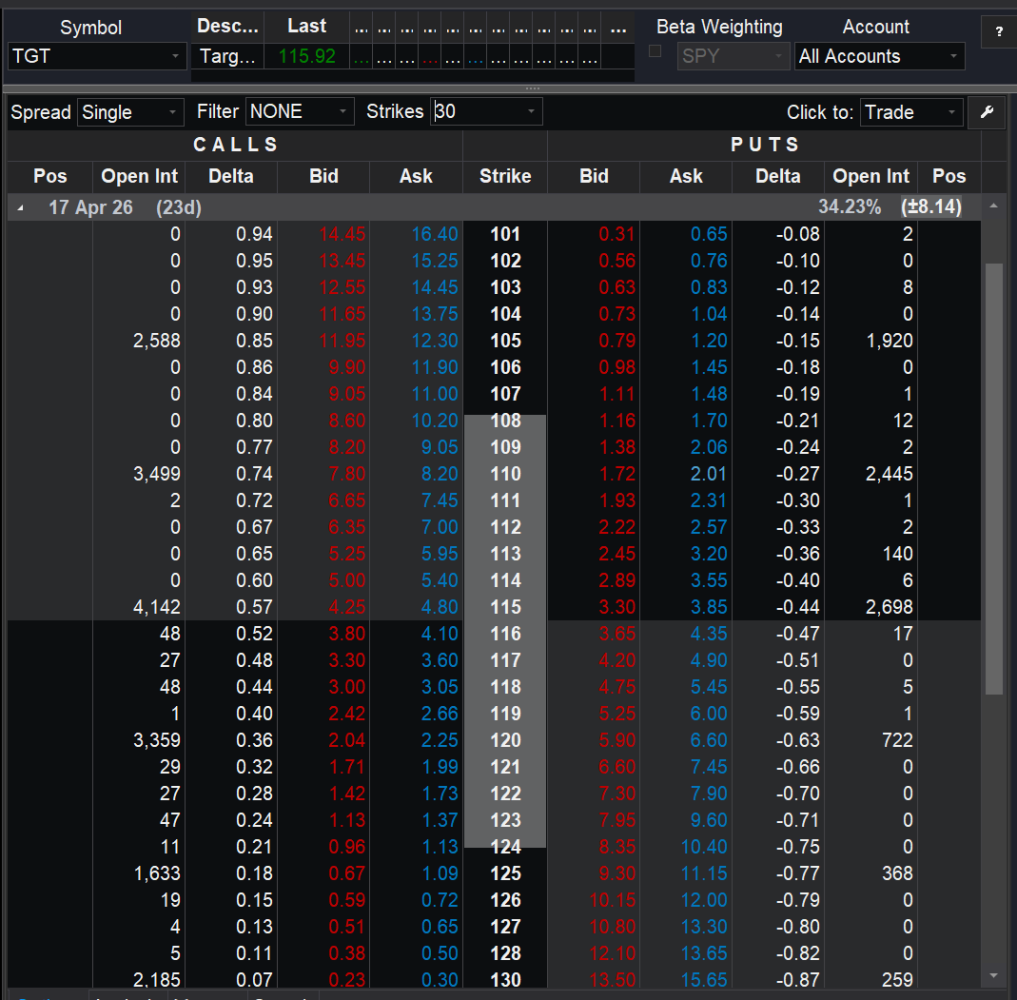
Here's the key visual: look at where the stock is trading right now ($115.92), and then look at the list of strike prices around it.
The call contracts with strike prices below the current stock price are your in-the-money calls. The ones above are out-of-the-money.
For TGT, the $105 strike price is $10.92 below where the stock is trading. That contract is solidly in the money. The $125 strike price is $9.08 above where the stock is trading. That contract is out of the money.
That distinction (in the money versus out of the money) drives everything else about how these contracts are priced and how they behave.
Step Three: Reading the Price
For each contract in the chain, you'll see two prices listed: a bid and an ask.
The bid is what you can sell for right now. The ask is what you'll pay to buy. The difference between them is called the spread, and it's essentially a transaction cost.
For the TGT April 17th $105 call contracts, the bid is $11.95 and the ask is $12.30. I entered this trade on Tuesday and paid $11.32. (This was before the stock moved higher.)
One important reminder: every option contract represents 100 shares of stock. So when you see a price of $12.00, you're actually paying $1,200 per contract. Keep that in mind as you're sizing your positions.
Step Four: Intrinsic Value vs. Premium — What's Inside the Price
This is where options get genuinely interesting, and where most investors have never spent any time.
Every option price is made up of two components:
Intrinsic value is the "real" value already baked into the contract: the amount the option is already in the money.
For my TGT $105 calls, I have the right to buy the stock at $105. Since the stock is trading at $115.92, the intrinsic value of this contract is exactly $10.92. That's the difference between the strike price and the current stock price.
It's real, tangible value that exists right now.
Extrinsic value (sometimes called premium or time value) is everything else... the extra amount the market is willing to pay above the intrinsic value.
The TGT $105 calls are currently priced near $12. Subtract the $10.92 of intrinsic value, and that leaves $1.08 of extrinsic value.
That $1.08 represents the market's hope that TGT will continue moving higher before April 17th. It also represents the cost of having time on your side. As expiration approaches and time runs out, this extrinsic value slowly erodes... a concept traders call "time decay."
Here's why this matters for my in-the-money approach: When a contract is deeply in the money, the vast majority of its price is intrinsic value -- real substance -- rather than hope and time.
That makes the contract behave more like the stock itself. And that's exactly what I want.
Let me show you the contrast with a quick comparison across three TGT contracts, all expiring April 17th:
The $105 call (my position) closed at $12.00. Of that price, $10.92 is intrinsic value and $1.08 is premium. The contract is $10.92 in the money.
The $116 call — right at the money — tells a different story. Its price is almost entirely premium, because there's almost no intrinsic value yet. The stock needs to move higher just to give this contract real substance.
The $125 call is out of the money entirely. Its entire price is premium. For this contract to have any intrinsic value at expiration, TGT needs to rally more than 8% in the next 23 days.
Step Five: Delta — A Quick Introduction
There's one more number on the options chain worth knowing: delta.
Delta tells you how much your option contract is expected to move for every $1 move in the underlying stock. It ranges from 0 to 1.00 for calls, and 0 to -1.00 for puts.
My TGT $105 calls have a delta of 0.85. That means for every dollar TGT trades higher, I can expect my option contracts to increase in value by roughly $0.85 per share.
That's the elevator going up: fast, efficient, capturing most of the stock's move.
I'll go much deeper on delta next week, because it's the key to understanding exactly why in-the-money options give us a better reward-to-risk profile than any other approach.
But for now, just remember: higher delta means your option moves more like the stock. And for my speculative trades, I always want a high delta.
Putting It Together: What I Actually Own
Let me bring this all together with my real position.
On Tuesday I bought the TGT April 17th $105 call contracts which currently trade near $12.00 per share -- or $1,200 per contract.
Here's what I know about this position:
The contract is $10.92 in the money, meaning the majority of what I paid is real intrinsic value, not hope.
I'm paying only $1.08 in time premium for the right to participate in any further move higher between now and April 17th. And with a delta of 0.85, this contract is going to move almost dollar-for-dollar with TGT when the stock moves in my favor.
That's a very different instrument than a cheap out-of-the-money lottery ticket. And next week I'll show you exactly how different, using the math of delta to demonstrate the reward-to-risk advantage we've built into this position from day one.



Comments
Log in or sign up to join the conversation.