

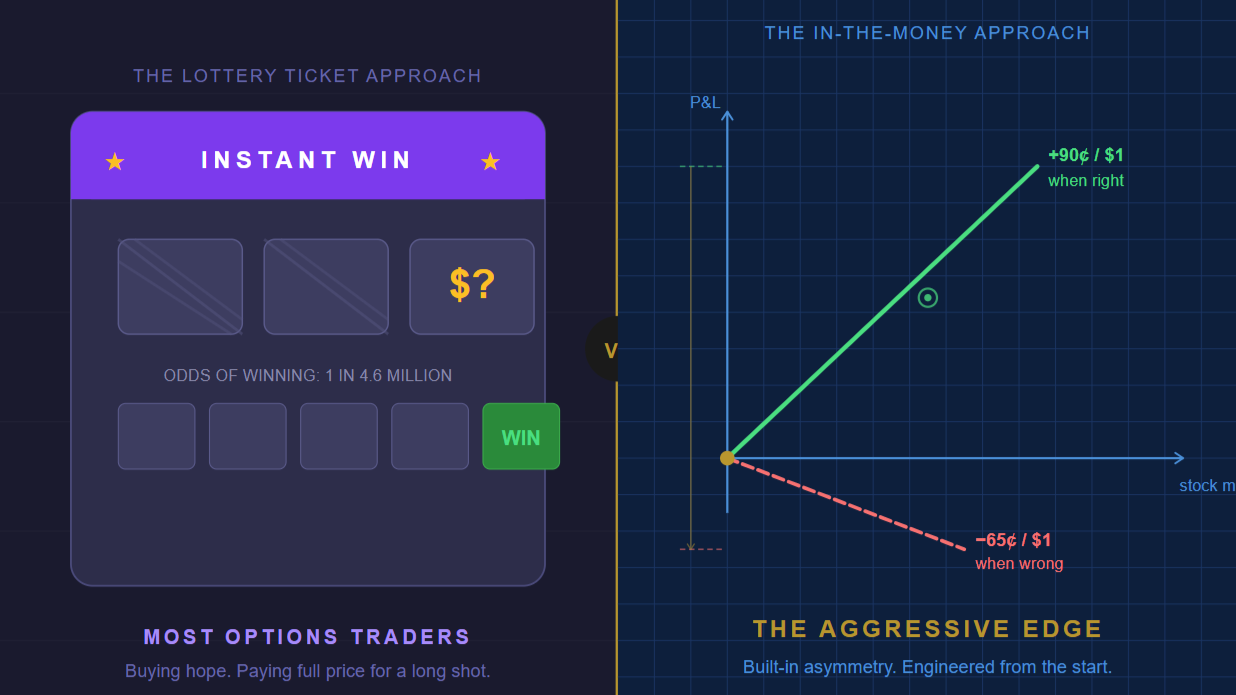
Most options traders are playing a different game than I am.
They're buying cheap, out-of-the-money contracts (lottery tickets, really) hoping for a massive move that turns a $200 bet into $2,000 overnight. Sometimes it works. More often, the contract expires worthless and the whole position goes to zero.
I've watched this pattern play out hundreds of times over my career. And while I understand the appeal of the long shot, it's not how I trade.
My approach is different. More precise. And in my opinion, significantly more intelligent. And to be fair, it took me years to learn, refine and settle on my own personal approach.
I use in-the-money options -- a specific, deliberate choice that changes the entire character of an options trade.
It's the difference between gambling and speculating. And if you've ever felt burned by options, or intimidated by them, I want to show you why that one distinction changes everything.
A Quick Refresher Before We Go Deeper
If you've been investing for any length of time, you've probably heard the terms "calls" and "puts." But let me give you a quick, plain-English refresher so we're all working from the same foundation.
A call option gives you the right to BUY shares of a stock at a specific price (called the strike price) before a specific date. If you expect a stock to go up, you buy calls.
A put option gives you the right to SELL shares at the strike price before expiration. If you expect a stock to go down, you buy puts.
Here's the part most people understand: options are leveraged instruments. You control 100 shares of stock for a fraction of what it would cost to own those shares outright. That leverage is what makes options exciting... and dangerous in the wrong hands.
But here's the part most people gloss over: which option contract you buy matters enormously. Not all options behave the same way. And the single biggest variable in how an option behaves isn't the stock you pick, it's whether your contract is in-the-money or out-of-the-money.
In the Money vs. Out of the Money
Let's say a stock is trading at $100.
An out-of-the-money call option might have a strike price of $115. For that contract to have any value at expiration, the stock needs to rally 15% or more. If it doesn't get there, the contract expires worthless. Zero. Gone.
An in-the-money call option might have a strike price of $85. The stock is already trading $15 above that strike. The contract already has real, built-in value... what traders call intrinsic value.
You're not betting on a miracle. You're buying an instrument that already has substance.
That distinction is the entire foundation of how I trade.
The Behavior That Changes Everything
Here's where in-the-money options get genuinely interesting, and where most investors miss the chance at repeatable profits.
When you own an in-the-money option, it behaves almost like owning the stock itself when the trade moves in your favor. For every dollar the stock moves higher (with call options) or lower (with put options), your contract gains close to a full dollar per share in value.
That's the elevator going UP.
Fast, efficient, capturing nearly all the upside of a stock move with a fraction of the capital.
But when the trade moves against you, something mathematically beautiful happens. The option starts to lose its sensitivity to the stock's price movement. Every dollar the stock moves in the wrong direction costs you less than a full dollar on your option contract.
That's the staircase going DOQN.
Slower. More forgiving. Cushioning your losses in a way that simply owning the stock never would.
I want you to sit with that for a moment because it's the core of everything I do with speculative trades.
When I'm right, I capture most of the move. When I'm wrong, I lose less than the stock loses. That's not a coin flip, that's a stacked deck.
In my favor!
Let Me Show You the Math
Let's make this concrete with a current example.
Imagine a stock trading at $125, similar to NextPower Inc. (NXT) -- one of the names I'm currently trading in my Speculative Trading Program. I'm expecting it to move $25 higher based on my research.
I bought an in-the-money call option with a strike price of $100. The stock is already $25 in the money, so my contract has real intrinsic value baked in.
Now let's run two scenarios.
Scenario A — The trade works: The stock rallies $25 to $150. My in-the-money call option, which was $25 in the money when I bought it, is now $50 in the money. I capture roughly $22-$23 of that $25 move.
That's close to 90 cents on the dollar, on a position that required far less capital than buying the stock outright.
The percentage return on my invested capital is extraordinary.
Scenario B — The trade doesn't work: The stock drops $25 to $100. My call option, which was $25 in the money, is now right at the strike price (essentially at the money).
Here's where the math works in my favor: instead of losing the full $25 that a stockholder would lose, my option contract loses significantly less. Maybe $16 or $17 per share.
I've lost real money, no question. But I've lost about 65-70 cents on the dollar. Not the full dollar.
So to put it plainly: I win $22-$23 when I'm right. I lose $16-$17 when I'm wrong. If I can pick the right stocks even half the time (and I intend to do considerably better than that), this math works heavily in my favor over time.
That asymmetry is the entire point.
Why Most Options Traders Never Find This
The reason most options traders don't gravitate to in-the-money contracts is simple: they're more expensive upfront.
An out-of-the-money call on that same $150 stock might cost $3 or $4 per share. An in-the-money call might cost $28 or $30. On the surface, the cheap contract feels more exciting! More leverage, more potential upside percentage.
But what those traders are really buying is a high probability of a total loss.
The option has no intrinsic value. It's pure premium... pure hope.
And the clock is always ticking against them as expiration approaches.
My in-the-money contracts cost more because they're worth more. There's real value inside them from day one. And that real value is exactly what creates the asymmetric behavior -- The elevator up, the staircase down -- that I depend on.
This Is How I Trade. And It Can Work For You Too.
Over the next four weeks, I'm going to walk you through every element of this approach.
Next week we'll get into how to actually read an options chain...
finding the right contracts
understanding the numbers
and knowing exactly what you're buying before you place a single trade.
In the weeks after that, we'll cover how I select stocks for these trades, how I manage winning positions to lock in profits while staying in the trend, and how I handle trades that initially move against me -- resetting them rather than simply cutting losses.
By the end of this five-part series, you'll have a complete picture of how I use in-the-money options to build what I call an asymmetric trading edge... A systematic approach designed to capture more when I'm right and give up less when I'm wrong.
Because at the end of the day, that's what separates a professional speculator from someone just buying lottery tickets.
Here's to building and protecting your wealth,

Comments
Log in or sign up to join the conversation.