


Over the past few weeks, I’ve been writing a series of reports covering various facets of the commodities boom that is heating up and the different ways investors can take advantage of it. I believe this recent pickup in commodities is only the very early stage of the next commodities supercycle, which will rival and likely even exceed those of the 1970s and 2000s. Check out my other reports in the series covering precious metals, basic materials, energy, and base metals such as copper.
Agricultural commodity prices have been rallying sharply in recent weeks, and I believe this is just the beginning of a much larger bull market that will unfold over the next decade. In this latest report in the series, I’ll explain why I believe a major agricultural commodities bull market is ahead and highlight the different ways investors can position themselves to take advantage of it.
I want to preface this by saying that the coming agricultural commodities boom is an extremely deep topic, and entire books could be written about it, covering everything from detailed supply and demand statistics for each commodity to in-depth analyses of individual agriculture stocks and much more.
However, this boom is taking off very rapidly, so the aim of this report is to convey the overall thesis as efficiently as possible while giving readers enough forewarning to take advantage of the opportunities that are either breaking out or on the verge of doing so as we speak.
Before discussing agricultural commodities specifically, I want to start with the broader explanation for why I expect another commodities supercycle, of which agriculture will be a major part, including grains, soft commodities such as cotton, cocoa, and coffee, livestock, fertilizer, and even farmland.
To make it simple, commodity prices have basically traded sideways for nearly two decades, at the same time that the U.S. cost of living has soared 55%, according to the Consumer Price Index (CPI), which is known for understating inflation. And though I used the U.S. as an example, it’s the same story all around the world, as fiat, or paper, currencies are rapidly losing purchasing power.
Commodities trading sideways for nearly two decades, combined with significant inflation and a massive expansion of the global money supply, has resulted in them being cheaper today in real terms than at any time in modern history. I strongly believe they are going to catch up in a big way in the years ahead, especially once investors wake up to the fact that this is the cheapest asset class out there in a world glutted with overvalued and overinflated financial assets, while the world’s supply of natural resources continues to dwindle every day.
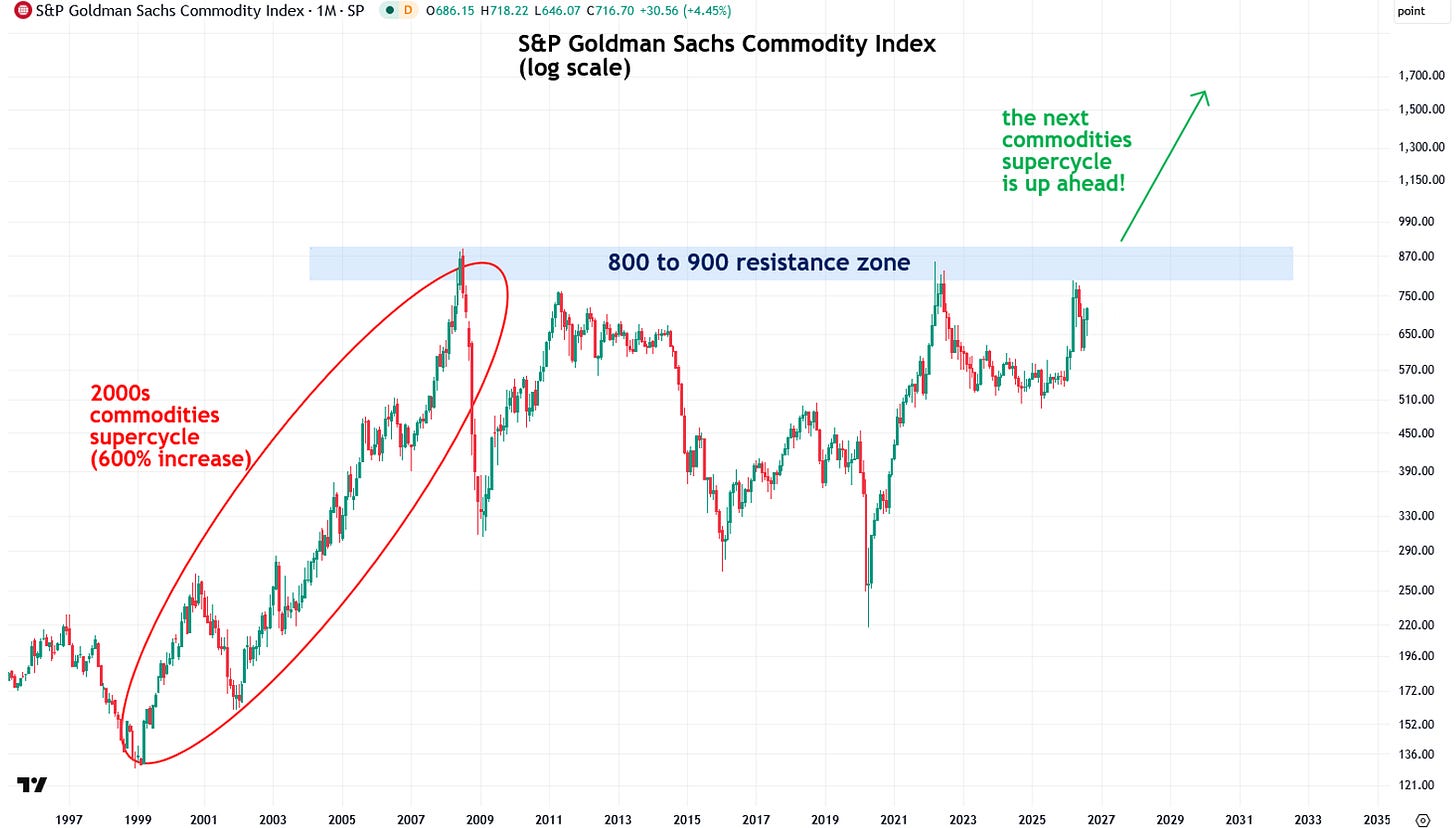
The S&P Goldman Sachs Commodity Index (GSCI), shown below, tracks a broad basket of commodities, including crude oil, gasoline, heating oil/diesel, wheat, soybeans, corn, cocoa, coffee, copper, gold, and silver, to name a few. The index can essentially be thought of as the Dow or S&P 500 of the commodities world, making it a useful benchmark for tracking broad trends in commodity prices.
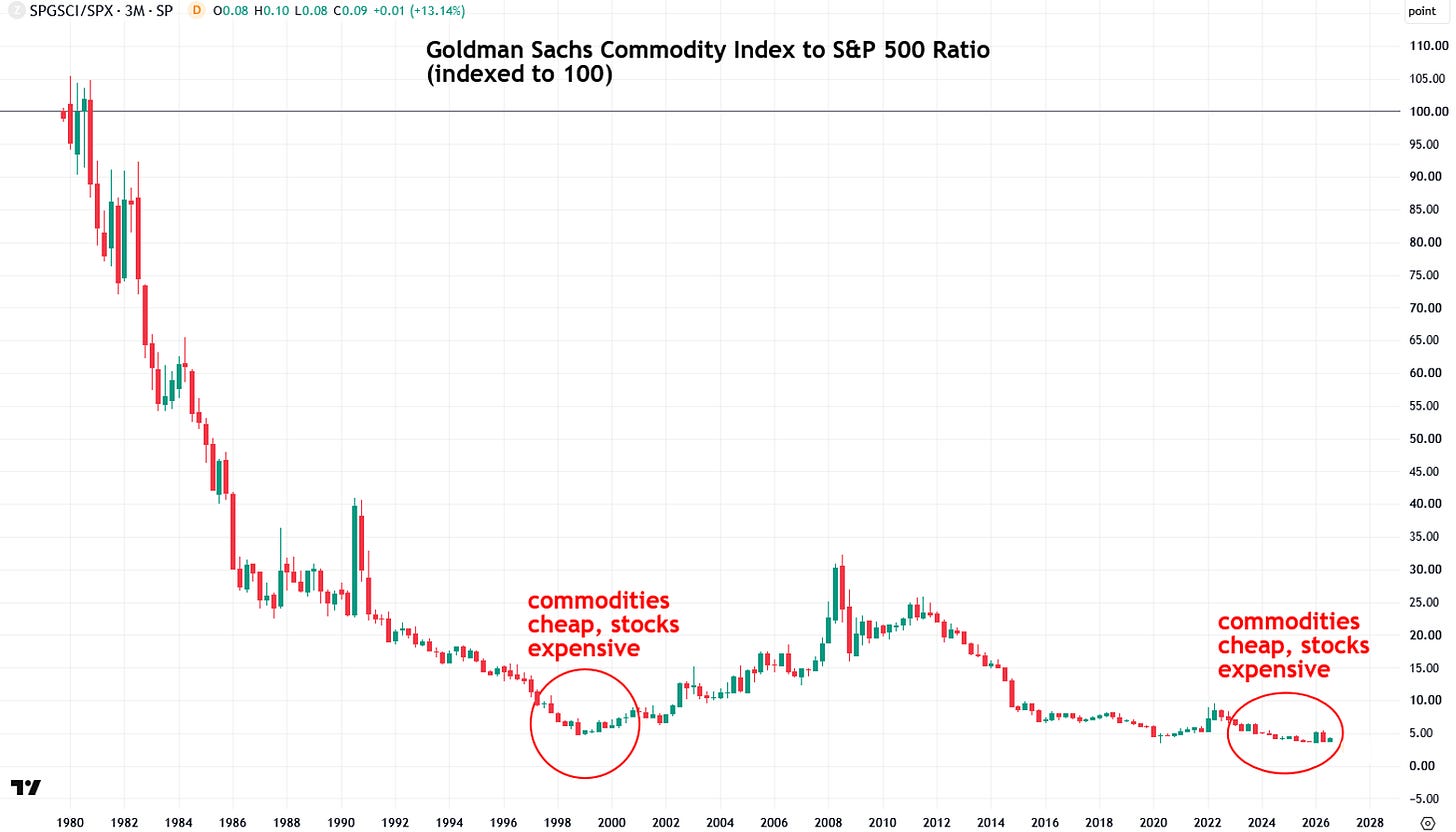
The last time commodities became nearly as cheap as they are today was during the late 1990s, after which a powerful decade-long commodities bull market, or supercycle, ensued. Commodities surged roughly 600% on average during that period, outperforming most other asset classes, including technology stocks.
However, ever since that supercycle ended in 2008, commodities have largely been dead money as investors once again became enamored with technology investments. This is no coincidence, as commodities and technology compete for capital and investor attention, booming in alternating waves or cycles that typically last a decade or more.
From a tactical perspective, a very important resistance zone between roughly 800 and 900 formed in the GSCI when the commodities supercycle peaked in 2008, and the index has since encountered resistance around that same zone during multiple subsequent peaks, including in 2011, 2022, and most recently in early 2026.
To learn more about support and resistance zones, I recommend reading my two-part tutorial (Part 1 and Part 2).
My bet is that when the GSCI finally breaks decisively through that critical 800 to 900 resistance zone, it will kick off the next commodities supercycle, which will be extremely beneficial for the basic materials and energy sectors, precious metals, base metals such as copper and zinc, agricultural commodities including grains, softs, and livestock, as well as fertilizer, farmland, and other natural resource investments.
Over the next decade, I fully expect commodities, including precious metals, and natural resources stocks to become the world’s best-performing assets, handily trouncing today’s darlings, overvalued and overhyped tech stocks. I expect a repeat of what happened after the dot-com bubble burst in the early 2000s and gave way to the powerful commodities supercycle that followed.
The main source of fuel I foresee for the coming commodities supercycle is the rapid expansion of the global money supply leading to the continued loss of purchasing power of fiat or paper currencies including the U.S. dollar, euro, British pound Japanese yen, and many others.
Not only do I see this process continuing, but I expect it to accelerate dramatically in the years ahead as heavily indebted governments and economies around the world increasingly attempt to inflate their way out of debt while propping up their economies through ever-greater money supply expansion, effectively running their digital printing presses, so to speak.
While fiat money is not backed by anything and can be created in virtually unlimited quantities, commodities are hard assets that cannot simply be printed or created out of thin air, and they are essential to keeping society functioning.
Crude oil, gasoline, diesel, corn, wheat, fertilizer, copper, silver, and gold cannot be conjured into existence at will. As fiat currencies are increasingly debased (learn more), leading to inflation, the prices of these finite and essential commodities rise over time.
The chart below shows the U.S. M2 money supply and how it has surged fivefold since the year 2000. For all the handwringing and politicking in our society over the soaring cost of living, remarkably few people are addressing its root cause: the relentless expansion of the money supply. And while I am using the U.S. money supply as an example, make no mistake, every major country has a money supply chart that looks much the same.
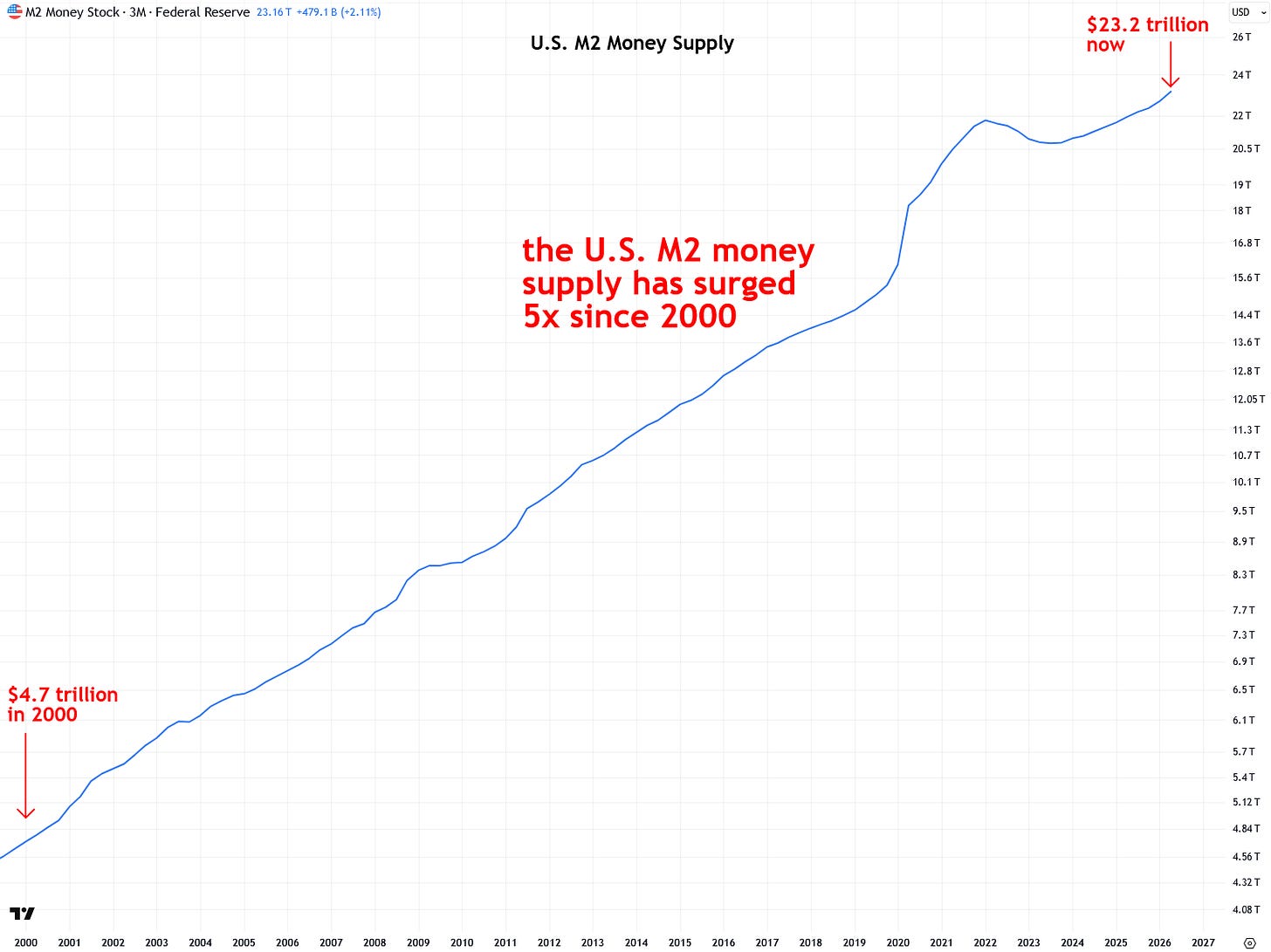
As I explained earlier, while commodity prices have indeed risen over time, they have still lagged far behind the growth of the money supply in recent decades. A major reason for this is that a good portion of the newly created money flowed into the stock market (as well as crypto), which acted as a relief valve for inflationary pressure and, as a result, has now become the biggest bubble in history, as I will explain shortly.
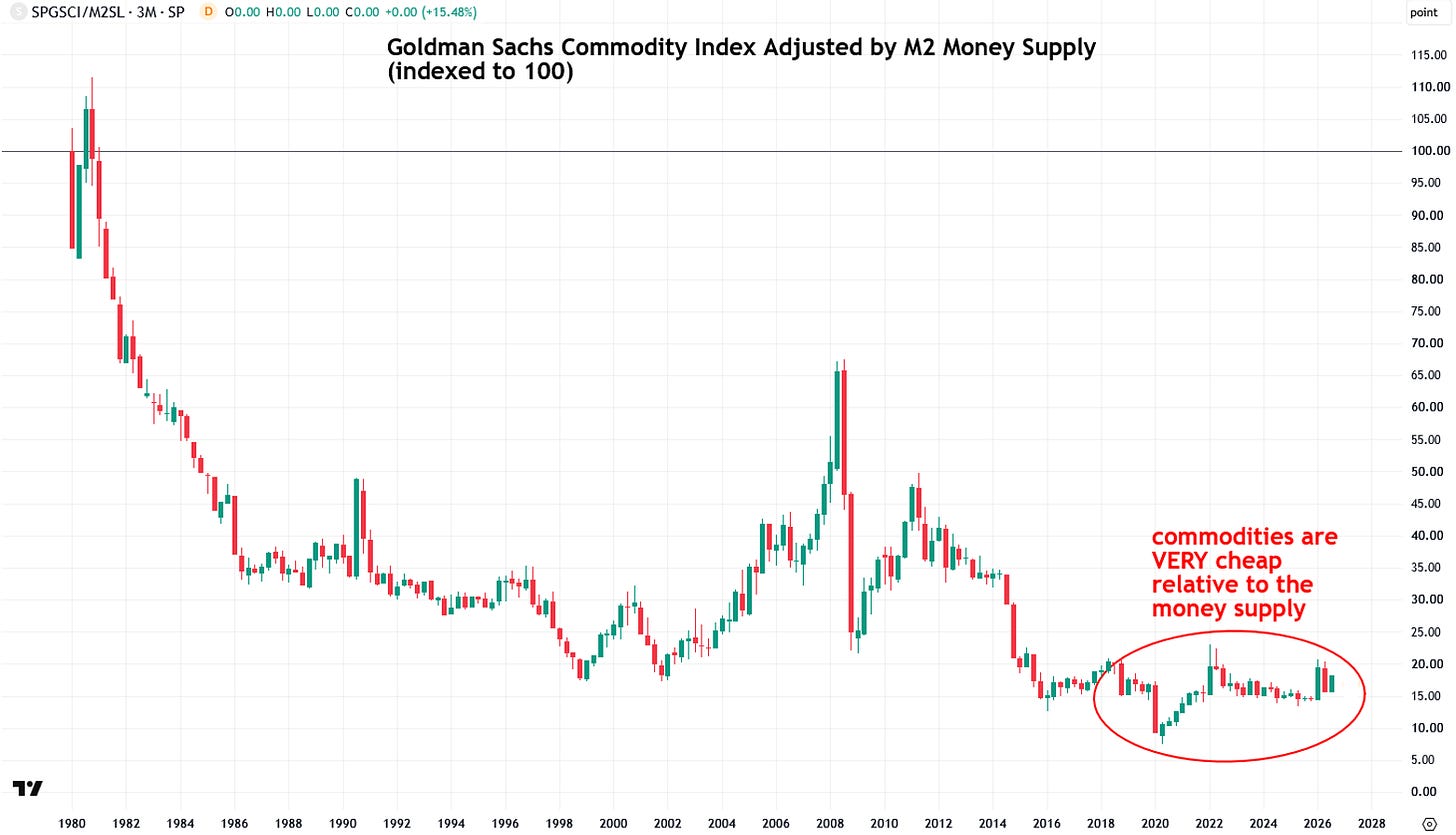
As a result of commodity prices lagging so far behind money supply growth, they are now the cheapest they have ever been in modern history. This extreme undervaluation is confirmed by numerous metrics, including commodity prices relative to the money supply, conventional inflation-adjusted prices using the CPI, commodity prices relative to stock prices, and much more.
The chart below shows commodity prices adjusted for the M2 money supply, confirming just how cheap they are relative to history. I should point out that this is essentially a form of inflation adjustment and, in my view, one of the most accurate of all, far more accurate than adjusting prices using the Consumer Price Index (CPI), which is known for understating inflation.
The Nobel Prize winning economist Milton Friedman famously stated that “inflation is always and everywhere a monetary phenomenon” which means that money supply expansion is the very root cause of inflation. That is why adjusting commodity prices for money supply growth is a valid way to adjust them for inflation.
Back to just how cheap commodity prices are according to practically every yardstick, I don’t expect this anomalous situation to last much longer. I expect commodity prices to rise dramatically in both nominal and real terms, especially after the U.S. stock market bubble bursts and tremendous amounts of capital flow out of stocks and into hard assets. This is essentially what happened during the commodities supercycles of the 1970s and 2000s, but I expect it to occur on a much greater scale this time because of how enormous the current stock market bubble has become.
Comparing commodity prices with the S&P 500, the main benchmark for the U.S. stock market, shows that commodities are at rock-bottom valuations and are even cheaper relative to stocks than they were in the late 1990s, just before the commodities supercycle of the 2000s began:
Now I want to delve into greater detail about the U.S. stock market bubble that has developed since 2009, fueled by trillions of dollars in monetary stimulus from the Federal Reserve through quantitative easing (QE) and ultra-low interest rates.
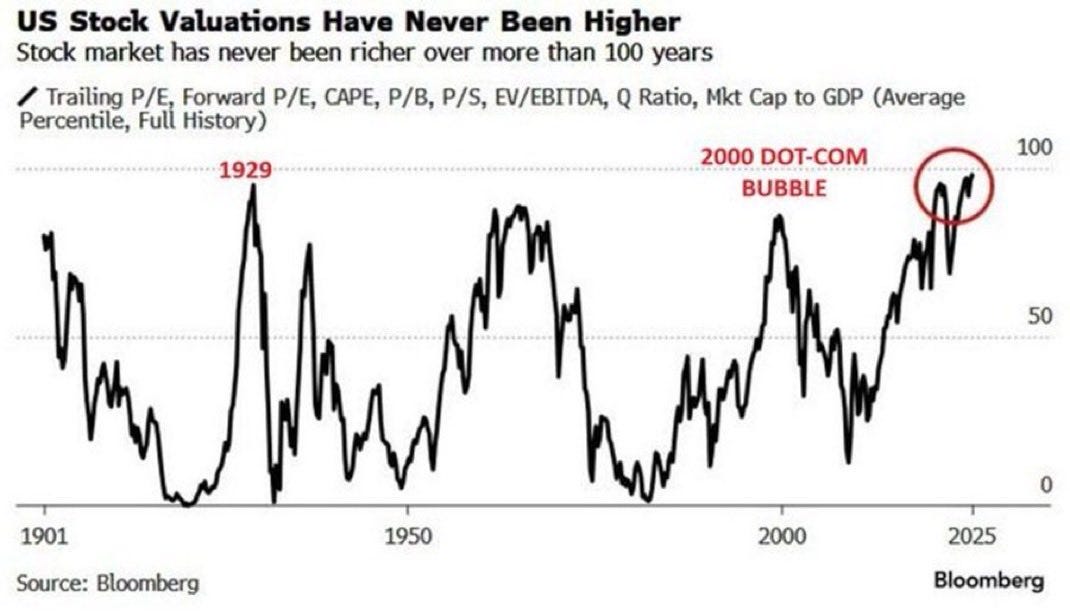
The chart below from Bloomberg is a composite of not just one, but eight different stock market valuation metrics, which, when combined, all tell the same story: the U.S. stock market is currently more overvalued than it was in 1929 and during the late 1990s dot-com bubble.
These metrics include the trailing price-to-earnings ratio, forward price-to-earnings ratio, cyclically adjusted price-to-earnings ratio, price-to-book ratio, price-to-sales ratio, enterprise multiple (EV/EBITDA), Q ratio, and Buffett Indicator (market capitalization-to-GDP ratio).
While there are plenty of bullish pundits arguing that “This Time Is Different!” as they always do during a bubble, I am confidently taking the opposite side of that bet. I fully expect one of the worst bear markets in history, and I do not see the market truly recovering for at least several decades due to the extreme overhang of debt, speculative excesses, and malinvestment that will need to be cleared out.
As I explained earlier, the stock market bubble has acted as a relief valve for the inflationary pressures created by the explosion in the money supply, which is why the inflation we have actually experienced, though certainly bad, has not been nearly as severe as the growth in the money supply would imply.
When the stock market bubble bursts, however, I expect a significant portion of the enormous amount of new money created over the past few decades that found its way into stocks to flow out of the stock market and into hard assets, sending their prices soaring and making even the inflation and commodities boom of the 1970s look tame by comparison.
At that point, the effects of the massive expansion in the money supply will increasingly find their way into consumer prices, including food prices, causing them to catch up in a very big way. For that reason, I believe investing in the coming agricultural commodities boom is an advantageous way to hedge against the inflationary scenario I see ahead.
One of the primary catalysts that will kick off the commodities supercycle of the next decade, including the coming boom in agricultural commodities, will be a breakdown in the U.S. Dollar Index from its two-decade-old rising channel, which will mark the beginning of the next secular bear market in the dollar.

Comments
Log in or sign up to join the conversation.