

Some ask whether or not big tech overspent. I ask by how much.
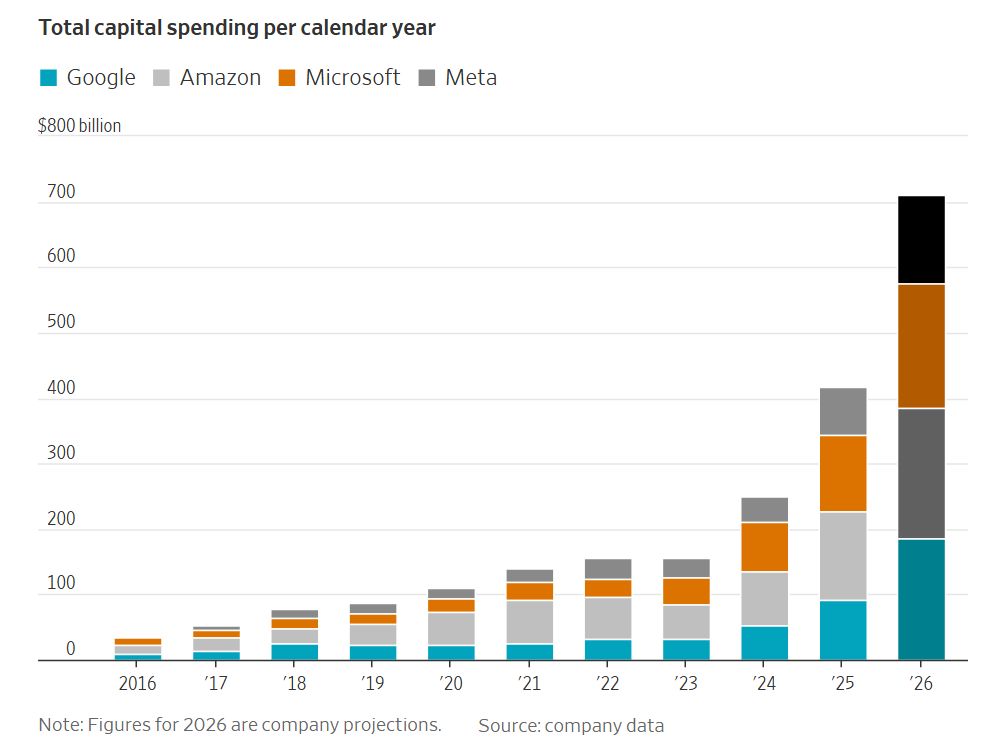
The AI Spending War
The Wall Street Journal asks Will Someone Finally Blink in the AI Spending War?
Big tech reining in its AI spending may be a tantalizing prospect for some. It would also be a costly one.
That doesn’t seem in the cards yet. Second-quarter reports coming later this month will likely show another period of blowout AI investments. Wall Street analysts estimate that combined capital spending by Google (GOOGL), Microsoft (MSFT) , Amazon (AMZN) and Meta Platforms (META) year over year to hit $168 billion in the June-ending quarter, according to consensus estimates from Visible Alpha.
This spending is crimping both the free cash flow and stock prices of those four companies; only Google-parent Alphabet has managed to outperform the S&P 500 (SPY) this year.
But there are also some signs that AI’s big spenders are looking for more ways to at least rationalize their investments. Before SpaceX went public last month, its xAI business signed a major deal to effectively share its computing capacity with Anthropic—for $1.25 billion a month.
Now Meta may be getting in on that action. Bloomberg reported last week that the social-network giant is developing a cloud-computing business using the extensive AI network it has built out.
Meta would be very late to that industry; Amazon, Microsoft and Google have all been selling cloud services to businesses for well over a decade. But Bernstein Research analyst Madison Rezaei says the scale of Meta’s network already “easily rivals cloud provider footprints.” She estimates the company has about 20 gigawatts of computing capacity now with an additional 14GW coming online over the next few years.
Renting out some of that capacity would effectively confirm that Meta has overshot in its build-out. Founder and Chief Executive Mark Zuckerberg said as much at the company’s annual shareholder meeting in late May. “We haven’t done that yet because we think that we have a use for the compute,” Zuckerberg said, in response to an investor’s question about building a cloud service. “But obviously, if we get to a point where we feel that we have overbuilt, then that is an option that we have.”
The big question would be whether renting out excess capacity is a short-term offset to continued mega-spending, or a sign that such spending is about to recede. Meta is a smaller company than Amazon, Microsoft and Google, but it has been the most ambitious in its AI investments. Zuckerberg has built up a division called Meta Superintelligence Labs in a push for the social network to be the first to develop a supercharged form of AI. Meta expects to spend well over half its revenue this year on capital investments, which will likely take its free cash flow into negative territory for the first time in its life as a public company.
Most analysts doubt that Meta plans to actually scale back its spending. “Meta is not stepping away from the AI race; it is turning early, aggressive capacity commitments into a strategic value creation option,” wrote Brent Thill of Jefferies. Still, the idea that the company has excess capacity at this stage of its AI cycle raises eyebrows. Justin Patterson of KeyBanc Capital said “it is conceivable that the scope of MSL’s ambitions have narrowed vs. Meta’s original AI goals when it began the capex cycle.”
Big Tech’s Financials Obscure True Cost of AI Buildout
The above link is a free WSJ link. The article has a related video that worth watching on the true cost of the ai buildout.
Here’s a stat that caught my eye. 90 percent of stock buybacks have gone to stock options for employees.
The competition for top AI recruits has been so intense that the big tech companies have been using free cash flow to hire employees masking shareholders dilution.
Free cash flow estimates are essentially a huge lie.
It’s a fascinating video well worth a play. It explains how and why companies get away with this.
And none of it is illegal.
Circular Financing
Nvidia (NVDA) is facing scrutiny over allegations of employing “circular financing” (or “round-tripping”), where the company allegedly invests in or lends money to AI startups and cloud providers (e.g., OpenAI, CoreWeave), which then use those funds to purchase Nvidia’s GPUs. Analysts worry this creates artificial revenue growth and inflates AI demand.
So not only has AI overbuilt capacity, free cash flow is very overstated as well.
$1.8 Trillion in Off-Balance Sheet AI Risk
Also note $1.8 Trillion in Off-Balance Sheet AI Risk Reminiscent of Enron
There’s $1.8 trillion in AI-related debt off the balance sheets vs $1.4 trillion on.
The hardware makers and cloud providers post massive revenues.
However, the pure-play AI developers like OpenAI and Anthropic are operating at a significant loss as they burn billions on infrastructure to build and run their models.
That money is fueling profits at the chipmakers. But most of the risk is hidden off the balance sheet, inflating earnings.
How long this can go on is unknown but cracks are clearly visible now.



Comments
Log in or sign up to join the conversation.