

Diesel Jumps a Nickel from Yesterday, Less Than 13 Cents from a New Record.
National Average Fuel Prices
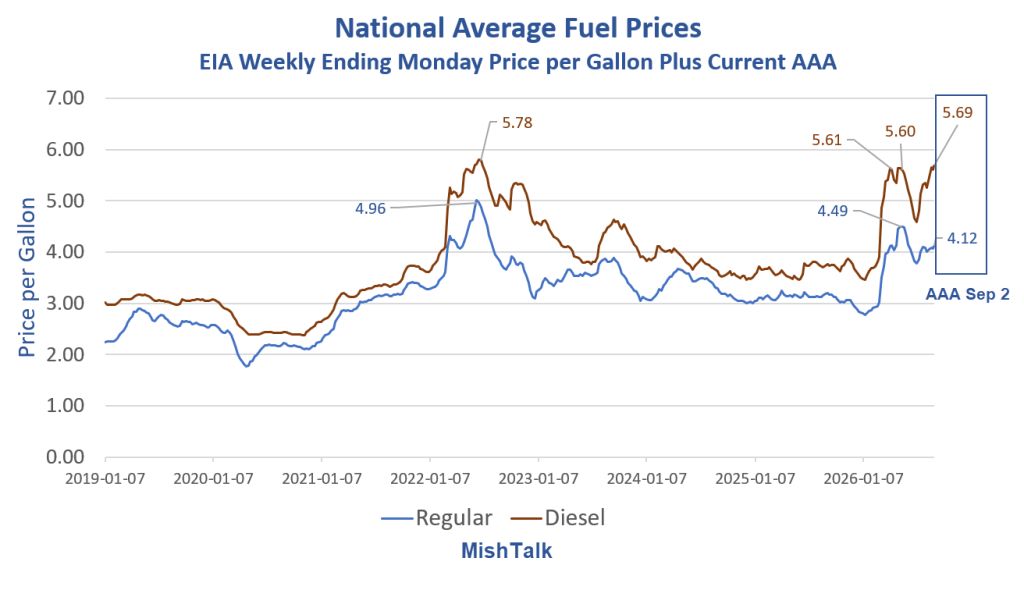
According to AAA the price of diesel and regular gasoline jumped over 5 cents from yesterday.
AAA does not have a data download so I use the Energy Information Agency data that is weekly ending Monday.
AAA Fuel prices
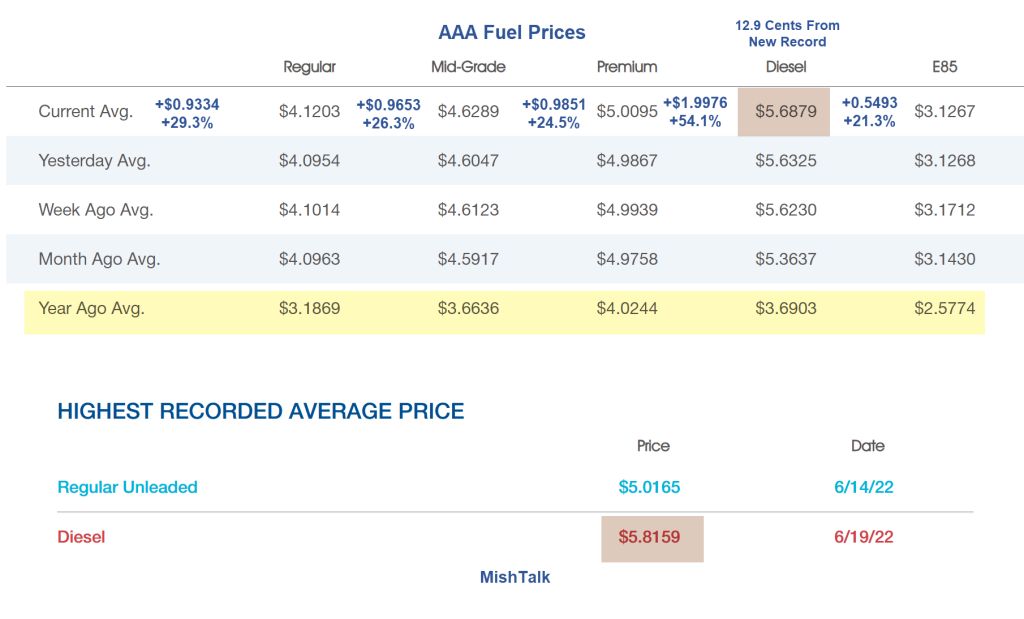
Diesel is only 12.9 cents from a new record high.
Change From Year Ago
Regular: $0.93 up 29.3 percent
Mid-Grade: $0.97 up 26.3 percent
Premium: $0.99 up 24.5 percent
Diesel: $2.00 up 54.1 percent
Hello Farmers and Truckers
Ukrainian drone strikes have hit a large share of Russia’s refining system—reports commonly cite about 22–24 of the country’s 34 major plants, covering a majority of nameplate capacity. That campaign cut Russian crude processing sharply (to roughly 3.9 million barrels per day at points in mid-2026, the lowest in two decades) and reduced diesel output. Russia responded with a diesel export ban to protect its own market, removing a major traditional supplier from global trade. oilprice.com
The United States does not import Russian diesel, so the effect is indirect. Former buyers of Russian cargoes (Turkey, Brazil, North Africa, and others) have turned to alternative sources, including U.S. Gulf Coast and other Western barrels. That extra export pull, on top of already tight inventories, high U.S. refinery utilization, and separate disruptions from the Iran conflict, has tightened the global diesel market and lifted U.S. prices.axios.com
Market Reactions
U.S. diesel futures jumping more than 11% in a single day after the Russian export ban—the largest daily gain in four years. reuters.com
Retail diesel moving above $5 per gallon in July 2026 and later reaching about $5.62–$5.69 per gallon by late August/early September 2026, roughly 53% higher than a year earlier and close to the 2022 record of $5.82
Refining margins (crack spreads) also widened to record or near-record levels, benefiting U.S. refiners while raising costs for trucking, agriculture, construction, and other diesel-dependent sectors. Analysts describe the price rise as the product of a genuine global product shortage rather than a crude-oil shortage alone; lost Russian refining capacity is one of the main drivers.
Prices remain sensitive to how quickly Russian plants can be repaired, whether the export ban is extended, and developments in the Middle East.
The attacks have therefore contributed to a sustained elevation in U.S. diesel costs through reduced worldwide supply and redirected trade flows.
The war in Ukraine and the war in Iran have contributed to rising prices.
Unpopular Wars
Trump In Very Tight Spot
Bloomberg:
President Donald Trump said renewed attacks on Iran would likely be short-lived, reiterating his claim that the US controls the crucial Strait of Hormuz after fresh fighting spiked energy prices and rekindled fears of an open-ended war
Diesel Supplies at Record Low
The peak season for gasoline is summer driving. The peak season for diesel is here now.
Harvesting Peak: August to November
The agricultural harvest is an “energy-thirsty” period driven by rigid seasonal schedules and heavily concentrated geographic demand.
The Core Drivers: High-volume fuel use shifts into overdrive as massive farming equipment—including combines, tractors, and grain carts—runs continuously from early morning until night. Once crops are reaped, heavy-duty trucks and freight trains consume massive amounts of diesel to transport commodities to storage elevators and processing plants.
Timing & Geography: In the United States, demand escalates heavily in the Midwest. The spike begins in late August, reaches its maximum crest in October, and tapers off by late November.
Market Dynamics: Because modern farming has increasingly adopted “no-till” or conservation planting methods in the spring, the agricultural demand for diesel is heavily lopsided toward the autumn harvest. Farmers typically buy fuel on an as-needed basis rather than storing it at scale, making them highly vulnerable to rapid price hikes
The Christmas / Holiday Shipping Peak: September to December
While harvesting centers on extracting raw materials, the Christmas peak centers on distributing finished consumer goods.
The Core Drivers: This surge powers multi-modal logistics networks—ocean containers, locomotives, long-haul trucking, parcel delivery vans, and retail restocking hubs.
Timing Phases: The “Holiday Peak” actually plays out in two distinct waves:
The Import/Wholesale Peak (Late Summer/Early Autumn): Ocean freight and rail transportation see massive volume spikes from August through October as retailers aggressively stock warehouses with holiday inventory ahead of time.
The Last-Mile/Retail Peak (November to December): High-intensity consumption shifts directly to e-commerce, parcel delivery, and regional food distribution networks, running intensely up until Christmas week.
Market Dynamics: Holiday logistics demand is completely price-insensitive. E-commerce companies, distribution centers, and couriers must meet strict contract and calendar deadlines to prevent late deliveries or canceled orders. They will buy diesel to keep trucks moving regardless of how high fuel prices go.
Market Vector | Harvest Impact | Christmas Impact | Combined Market Effect |
|---|---|---|---|
Inventory Impact | Draws heavily on localized fuel reserves, particularly in rural and agricultural hubs. | Drains nationwide commercial distribution inventories at terminal gates. | Compresses total available supplies right as winter heating oil demand begins to build. |
Price Volatility | Hits local cash/spot premiums and increases operational costs for low-margin farm businesses. | Drives up truckload freight rates and triggers carrier “peak-season fuel surcharges”. | Drives widening crack spreads (refining profit margins), which sharply raises prices for the end consumer. |
It’s likely only a matter of days before diesel hits a new record high.
Related Posts
August 30, 2026: Oil and Bond Yields Higher Following First US Attack on Iran in Weeks
U.S. Strikes Two Iranian Rocket Launchers in First Attack in Weeks
August 31, 2026: Political Realities May Force the Fed to Hike in September
It will be a stretch for the Fed to pause for many reasons, not just the CPI.
September 1, 2026: September Fed Rate Hike Odds Shift Dramatically Back Towards a Hike
It’s been a complete round trip in the last month.



Comments
Log in or sign up to join the conversation.