

For several weeks now, financial markets have gradually come to believe that the crisis in the Strait of Hormuz is now a thing of the past.
Every reassuring statement from the White House is immediately interpreted as proof that maritime traffic is returning to normal. Algorithms are selling oil, short positions are strengthening, and the consensus now holds that the worst is behind us.
This interpretation reminds me of the initial forecasts published by Goldman Sachs at the start of the conflict. At the time, the bank anticipated a rapid normalization of flows, convinced that the disruptions would be temporary:
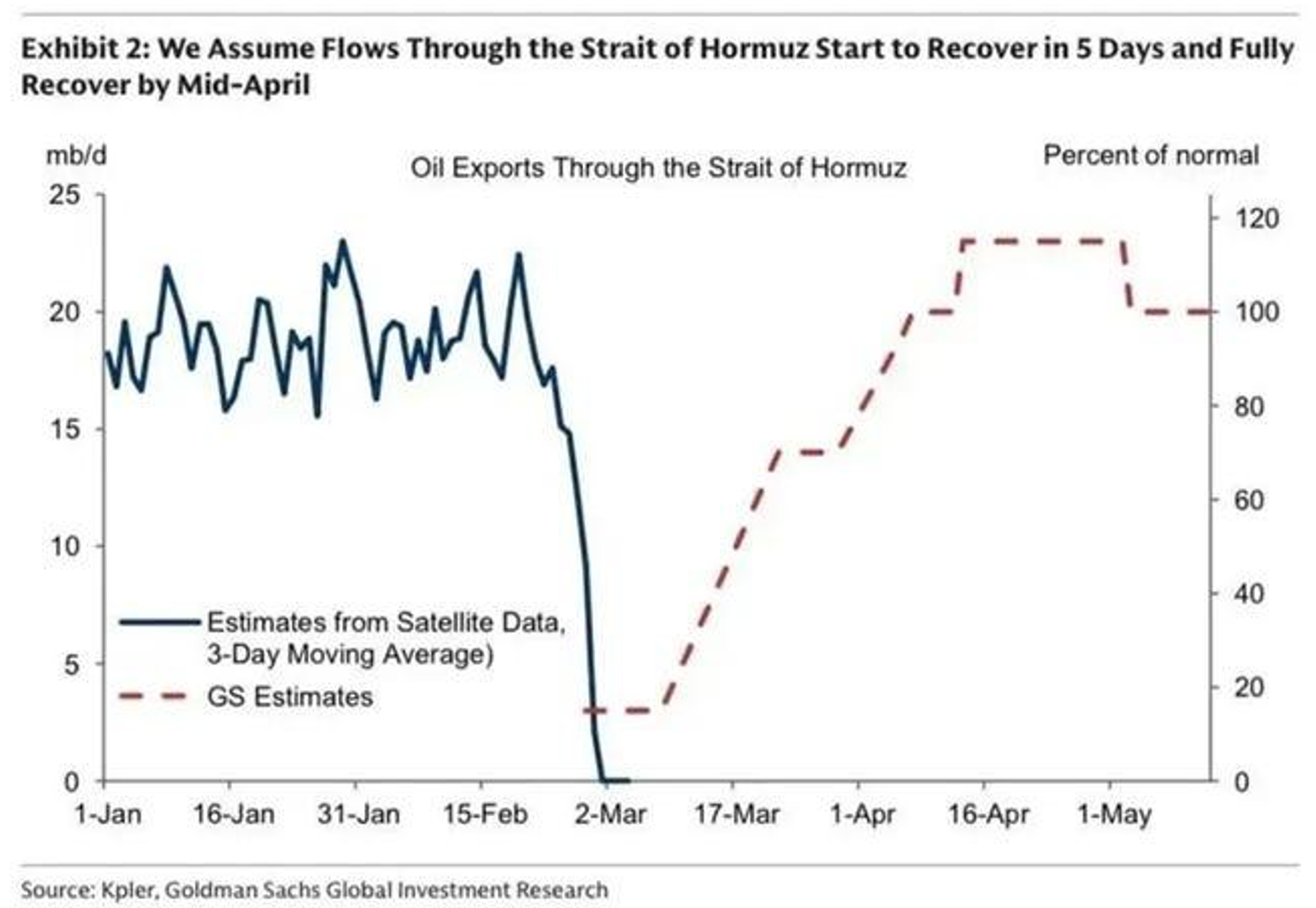
A few months later, it is clear that this assumption was far too optimistic. Yet the market continues to act as if a return to normalcy were merely a matter of time.
The physical data, however, tell a very different story.
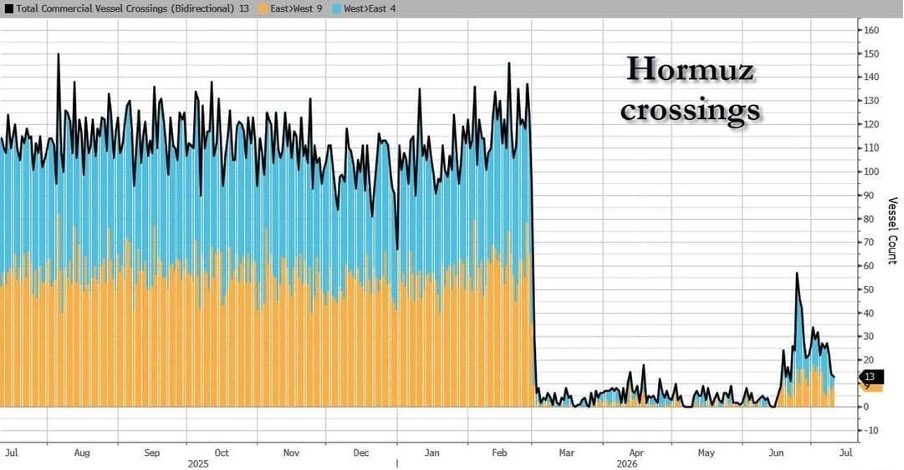
Exports from the Middle East remain about 5.6 million barrels per day below normal levels despite increased use of the Yanbu and Fujairah pipelines. The latest Iranian attacks on commercial vessels have once again caused maritime traffic to plummet. The recovery observed after traffic officially resumed through the strait turned out to be nothing more than a very temporary blip:
Even more concerning is that Donald Trump himself recently gave Iran 24 hours to officially announce a full reopening of the strait. This statement is telling. If U.S. escorts were truly sufficient to ensure normal traffic, such political pressure likely would not have been necessary.
The real problem is that markets today confuse administrative reopening with logistical normalization. A strait can be officially open while still being unable to return to its usual level of activity.
The real bottleneck has shifted
For several days now, a much more interesting trend has emerged in the traffic data.
The markets continue to monitor the number of ships entering the Gulf. However, this is likely no longer the right indicator.
Last week, 17 Sinokor VLCCs entered the Gulf. Yet nine of them were still in ballast several days later, having not yet loaded their cargo.
In other words, the ships have returned.
Now it is the cargo that is lacking.
This situation suggests that the bottleneck has gradually shifted from the strait itself to the entire supply chain.
Producers had to cut back on production when onshore storage capacity reached its limit. Terminals must now replenish their operational inventories, resume their loading schedules, and reorganize supply flows that have been severely disrupted for several months. Oil production running at several million barrels per day doesn’t resume overnight.
But there is likely a second factor that has received far less attention: insurance.
An empty tanker is not the same as a loaded tanker.
For an insurer, the difference is significant. A VLCC in ballast essentially represents only the value of the hull and its crew. Once loaded, it carries up to two million barrels of oil, in addition to environmental risks and civil liabilities in the event of an attack. The risk profile is therefore no longer comparable.
It is entirely possible that some shipowners are now willing to redeploy their vessels to the Gulf while postponing loading operations until insurance conditions return to an acceptable level. War risk premiums remain high, and the latest attacks on commercial vessels obviously do not encourage a rapid return to normalcy.
It is precisely for this reason that we continue to believe that the true indicator is not the number of tankers leaving the Gulf, but the number of ships that agree to return there, load their cargo, and then depart.
Until this logistics loop is fully restored, physical constraints will continue to weigh on the oil market, regardless of the prevailing narrative in the financial markets.
In our view, the market continues to prioritize political statements over physical data. As is often the case, this disconnect can persist for several weeks, or even several months. But when fundamentals eventually reassert themselves, the price adjustment could be much more abrupt than the current consensus anticipates.
Events in recent hours also show that the risk is no longer limited to the Strait of Hormuz alone.
The Revolutionary Guards have officially warned that the energy export infrastructure of U.S. allies is now considered a potential target. A few hours later, operations at the port of Fujairah in the United Arab Emirates — the main bypass route for the Strait of Hormuz — were suspended following a missile attack claimed by Iran.
This is a major development.
For several weeks now, the market has based its optimism on the ability of Gulf producers to bypass the strait using oil pipelines connecting the oil fields to Yanbu in Saudi Arabia or to Fujairah in the United Arab Emirates. But if these infrastructure facilities themselves become military targets, this alternative scenario collapses. The question then is no longer whether the Strait of Hormuz is officially open, but whether Gulf energy exports still have truly secure routes.
In our view, this is precisely where the main market risk lies today. Until now, Iran had primarily targeted traffic passing through the Strait of Hormuz. By now extending its threats to alternative routes, Tehran is potentially changing the very nature of the conflict. The market continues to operate as if several alternative solutions existed. The latest Iranian statements suggest, on the contrary, that these alternatives, too, could become vulnerable.
This disconnect is all the more striking given that the physical market tells a story that is completely different from that of WTI.
Driven by systematic selling by paper traders and algorithms that react to every statement deemed reassuring regarding the Strait of Hormuz, crude oil continues to price in a rapid normalization scenario. The derivatives markets are primarily focused on the political narrative.
The physical market, however, is sending a radically opposite message.
The best indicator is undoubtedly the 3-2-1 crack spread, which measures refiners’ theoretical margin when converting three barrels of crude oil into two barrels of gasoline and one barrel of distillates:
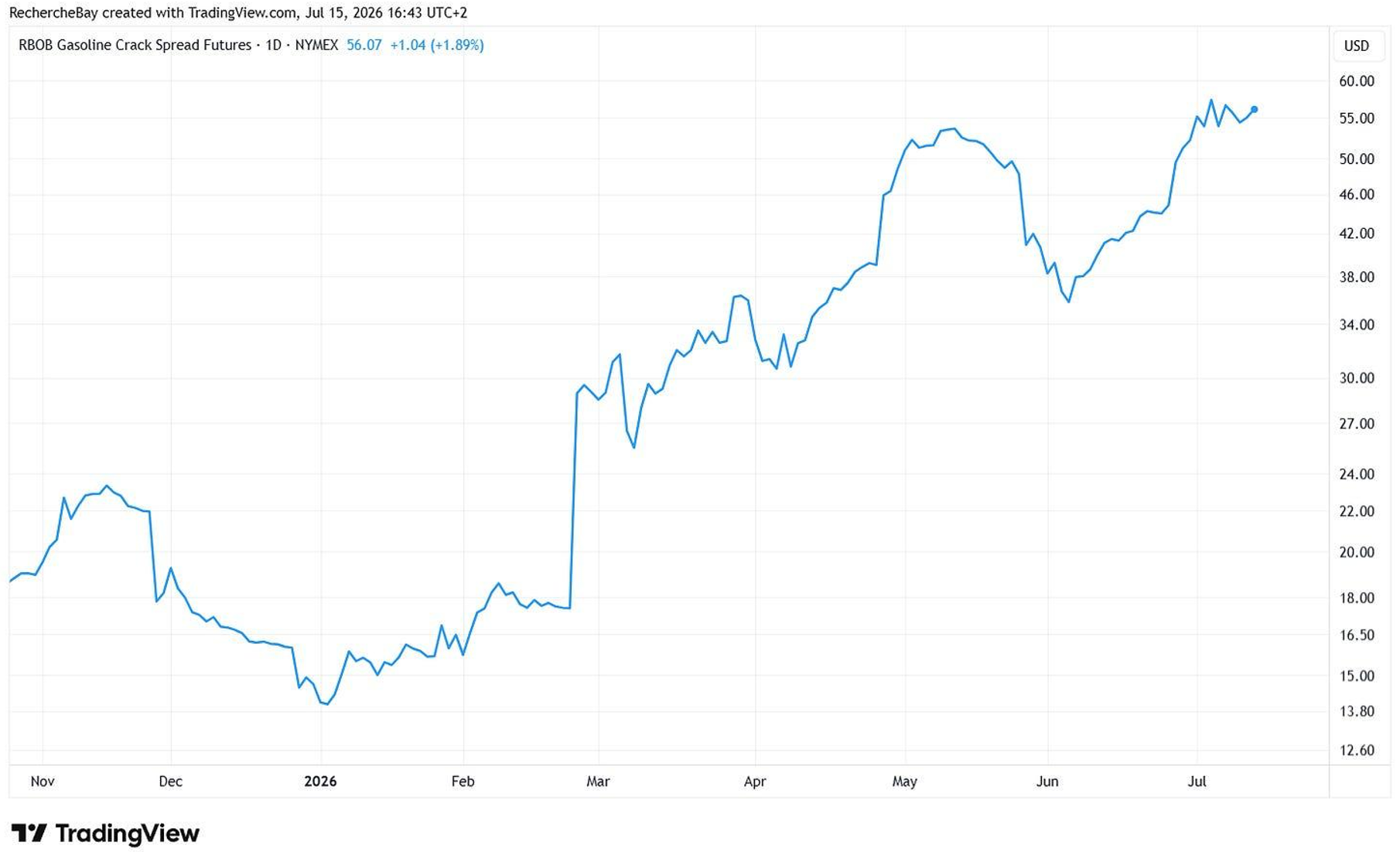
While WTI remains under pressure, this crack spread is now trading at its highest level of the year, a sign that refined products are becoming increasingly difficult to obtain.
This divergence makes perfect sense. The tensions no longer really center on the availability of crude oil, but on the ability of refineries to produce enough gasoline, diesel, and jet fuel from the grades of crude currently available. Exports of medium and heavy crude oils from the Middle East remain severely disrupted, while refined product inventories remain at historically low levels.
This situation sets the stage for particularly strong results for major North American refiners.
Early estimates released this week point to an exceptional second quarter for Canadian Natural Resources, Suncor, Cenovus, and Imperial Oil. The four companies are expected to generate nearly 13.2 billion Canadian dollars in free cash flow before dividends, while reducing their net debt by approximately 8.3 billion dollars despite more than 3.2 billion dollars in share buybacks. Analysts also note that the biggest surprise could come from refining operations, as margins rose sharply throughout the quarter.
In other words, while the market continues to sell off oil based on a narrative of normalization in the Strait of Hormuz, refining margins are reaching their highest levels of the year, and companies with the greatest exposure to refining are likely poised to report record results.
It is precisely this type of divergence between the paper market and the physical market that deserves our full attention today.
This disconnect between paper oil and physical oil likely also explains the current behavior of the gold price:
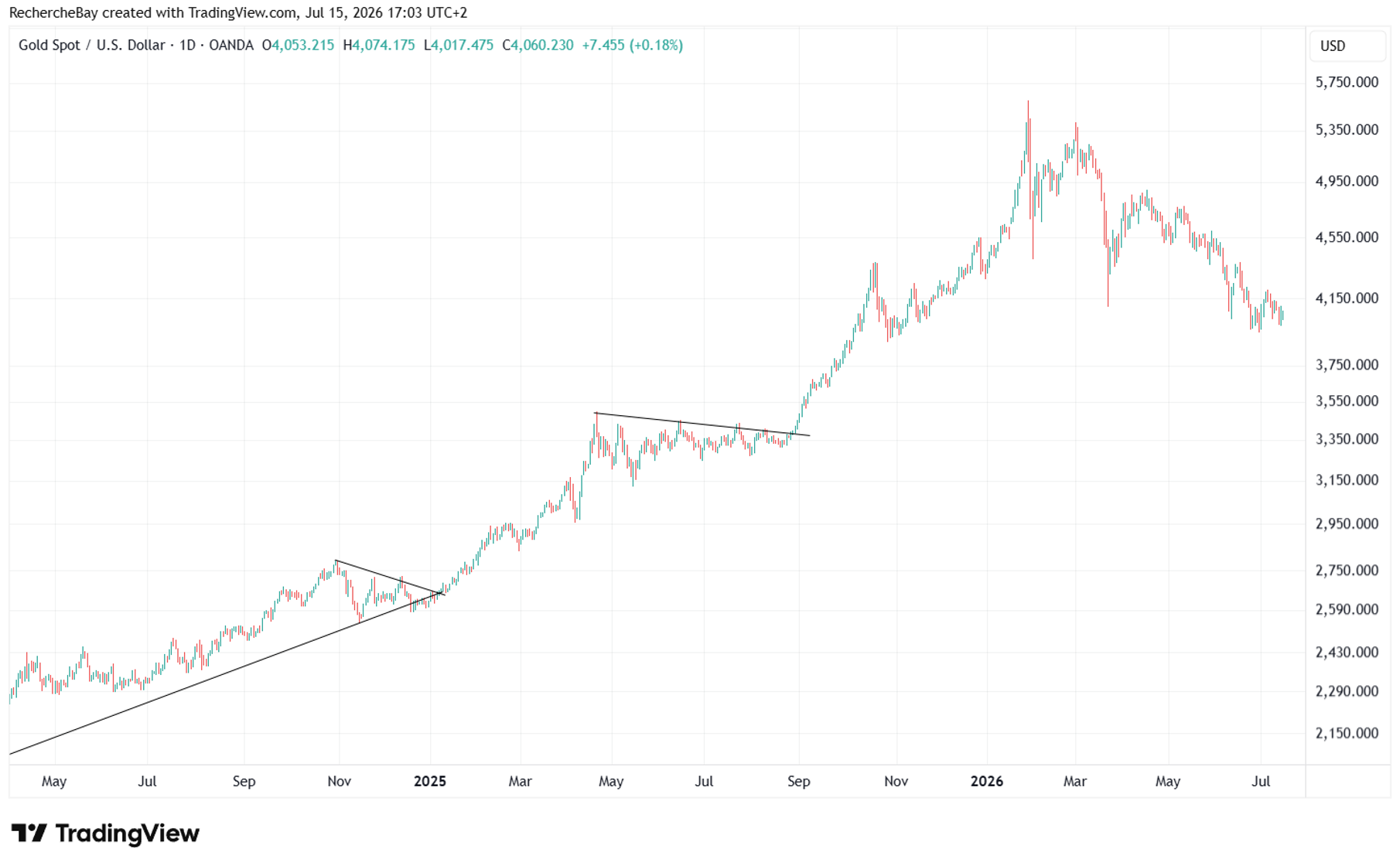
As long as the derivatives markets continue to suppress oil prices, they reinforce the notion that geopolitical risks are fading and that inflationary pressures will remain limited. This narrative deprives gold of a powerful driver of price appreciation. In other words, the artificial weakness of paper oil is currently preventing gold from fully reflecting the tensions in the physical market.
However, if our analysis is correct, this situation cannot last indefinitely. At some point, either oil prices will have to align with physical fundamentals, or the markets will recognize that the current price of crude does not reflect the true level of risk. In either case, this price dislocation should ultimately benefit gold, which would then regain its role as a barometer of geopolitical and inflationary risks — temporarily lost under the influence of the derivatives markets.


Comments
Log in or sign up to join the conversation.