

Key Market Outlook(s) and Pick(s)
On Monday, I joined the great Stuart Varney on Fox Business’ Varney & Co. to discuss markets, the economy, outlook, midterms, AI, tech, rotation, PayPal (PYPL), VF Corp (VFC), Crown Castle (CCI), SpaceX (SPCX), and a lot more. Thanks to Stuart, Maggie Edwards, and Nick Palazzo for having me on.
On Monday, I joined my good friend Lou Basenese on the Fox Business Rundown podcast to discuss markets, the economy, outlook, midterms, AI, tech, rotation, the Un-Magnificent 493, the consumer, healthcare, energy, VF Corp (VFC), Papa John’s (PZZA), Comstock Resources (CRK), and a lot more. Thanks to Lou for having me on.
VFC Update
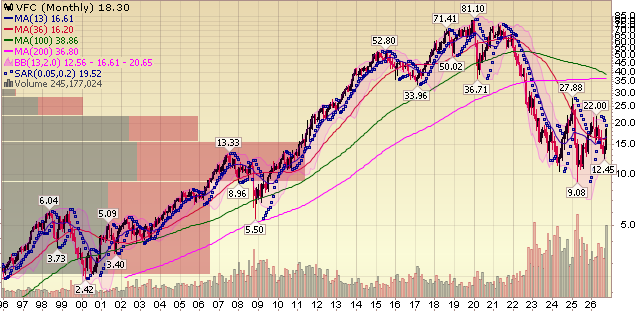
For newer readers, here’s a quick overview of the key drivers behind our thesis on VF Corp (VFC), a global apparel and footwear leader with a portfolio of iconic brands, now firmly in the growth phase of its turnaround with significant operating leverage ahead:
Company Overview
Founded in 1899 as a glove and mittens manufacturer. Evolved into a global apparel and footwear powerhouse via decades of acquisitions and brand building.
Portfolio led by The North Face, Vans, Timberland, and Altra, with smaller brands including JanSport, Eastpak, Kipling, Smartwool, Icebreaker, and Napapijri.
Geographic sales: ~50% Americas, ~35% EMEA, ~15% APAC.
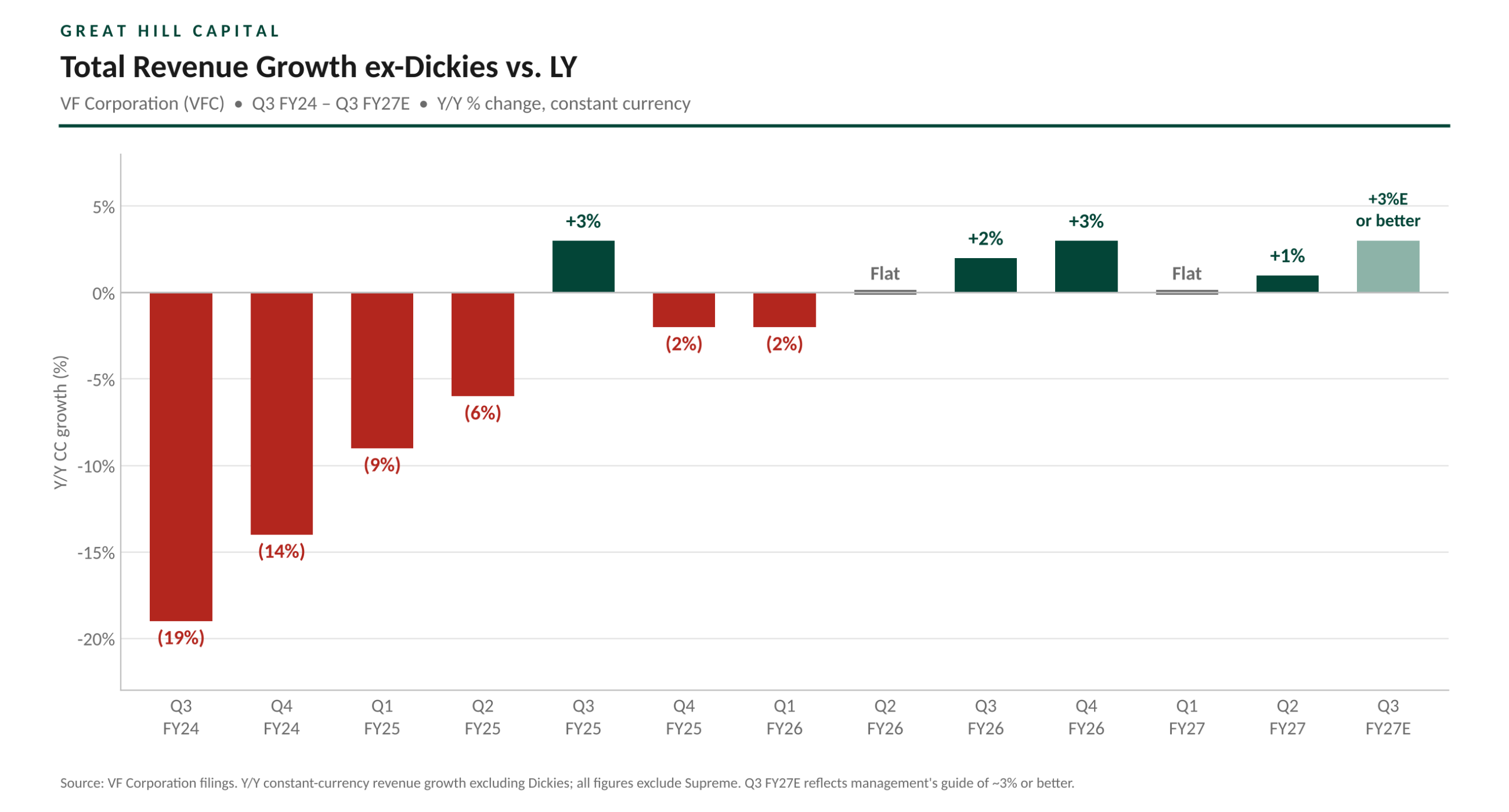
FY2026 revenue: $9.6B (+4% Y/Y, +1% FXN ex-Dickies), the first full year of growth in three years.
Trades at just ~13.5x NTM earnings (17-18x long-term average). 0.6x relative valuation to S&P vs. long-term average 1.0x.
Management – Bracken Darrell
Appointed CEO in July 2023.
Credited with the Old Spice turnaround at P&G, where he tripled market share in two years, one of P&G’s most successful brand relaunches.
Took over as Logitech CEO in 2013 with the stock down 82%, sales declining, and margins in collapse. Over eight years, took the stock from $5 to $133, a 26x bagger.
Has purchased ~$3.5M in VFC shares on the open market since his appointment. ~90% of his compensation is tied to financial targets, with 50% of stock options linked to long-term performance goals.
CFO transition (announced Q1’27): Paul Vogel stepped down effective Aug 1, moving to advisory; COO Abhishek Dalmia adds the CFO title in a combined CFO/COO role.
Dalmia brings 25+ years across global consumer companies (BCG Managing Director/Partner, Global SVP Digital at Lululemon, leadership roles at Dell, earlier GE and Citibank).
Supreme and Dickies Sale
Supreme was acquired in 2020 for $2.1B (~15x EBITDA, ~4x sales), widely viewed as an overpay. Sold to EssilorLuxottica for $1.5B cash (~12x EBITDA, ~2.5x sales). $600M below purchase price, but far better than feared.
Dickies sold to Bluestar Alliance for $600M cash (~1.2x sales, >20x EBITDA). Sale closed November 2025.
Total proceeds from disposals: $2.1B in cash directed toward debt paydown.
Balance Sheet Cleanup
FY26 leverage ratio of 3.1x, down a full turn vs. LY and two full turns vs. FYE24 of 5.1x.
Net debt of $4.6B as of Q2’27, down $1.1B or (20%) Y/Y. Net debt ex-lease liabilities of $3.1B, down $1.1B or (26%) Y/Y and down from $5.8B over the last three years (nearly half paid off).
FY27 leverage guide of 2.6x to 2.9x. On track for the medium-term target of 2.5x or better by FY28. Plans to prepay the April 2027 maturity in March.
FY2026 FCF of $405M, up over $90M Y/Y (excludes $100M net pension termination benefit).
FY27 guide of flat to up vs. LY of $405M, despite a ~$100M step-up in CapEx driven largely by Timberland full-price store openings, with actual FCF of ~$515M or better including ~$110M of net tariff refunds. (H1’27 FCF ($322.7M), up ~$130M Y/Y including tariff refunds received YTD.)
Return to Growth
After three years of revenue declines, the top line has officially inflected.
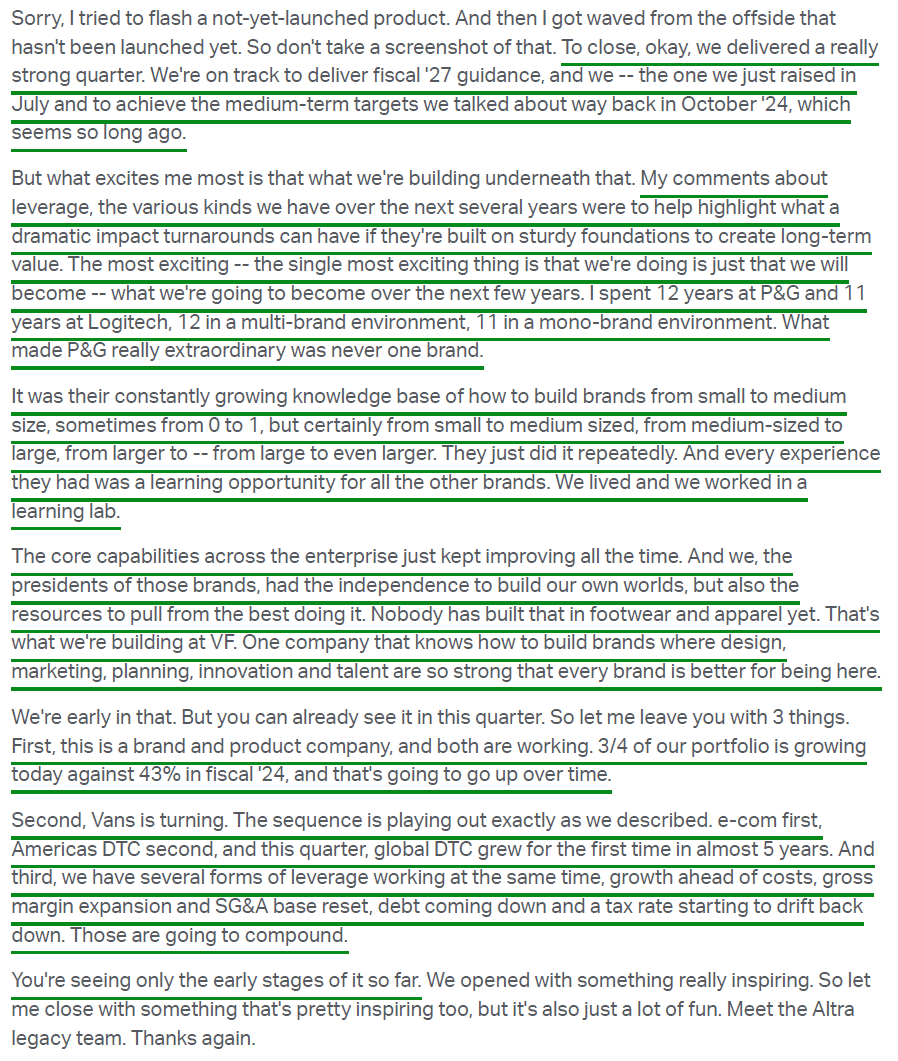
FY26 marked the first full year of growth since FY23. 75% of the portfolio is now growing, vs. 43% in FY24, with management targeting 80%+ over the long term.
Americas +5% FXN ex-Dickies in Q2’27 with growth across both channels. Management’s top priority is exporting the Americas DTC playbook to EMEA, where DTC is already outperforming wholesale.
FY2027 guide of revenue +2% or better FXN vs. LY ex-Dickies (raised in Q1 from +1% to +2%, reaffirmed in Q2), with The North Face and Timberland each up mid-single digits, continued growth at Altra, and Vans declines moderating to mid-single digits.
Partnered with DoorDash to make The North Face, Vans, and Timberland available on DoorDash’s expanding retail Marketplace, offering fast delivery and a new streamlined returns option.
NRF forecasts November and December retail sales up 4.2% Y/Y to $1.013T, the fastest growth since 2021 (+12.6%); compares with 2025 holiday sales up 3.1% to $972B.
Brands Overview
Vans
Acquired in 2004 and grew 10x over 15 years. FY2026 revenues remain >40% below the FY2022 peak.
FY26 revenue: $2,149.1M (-9% reported, -11% FXN)
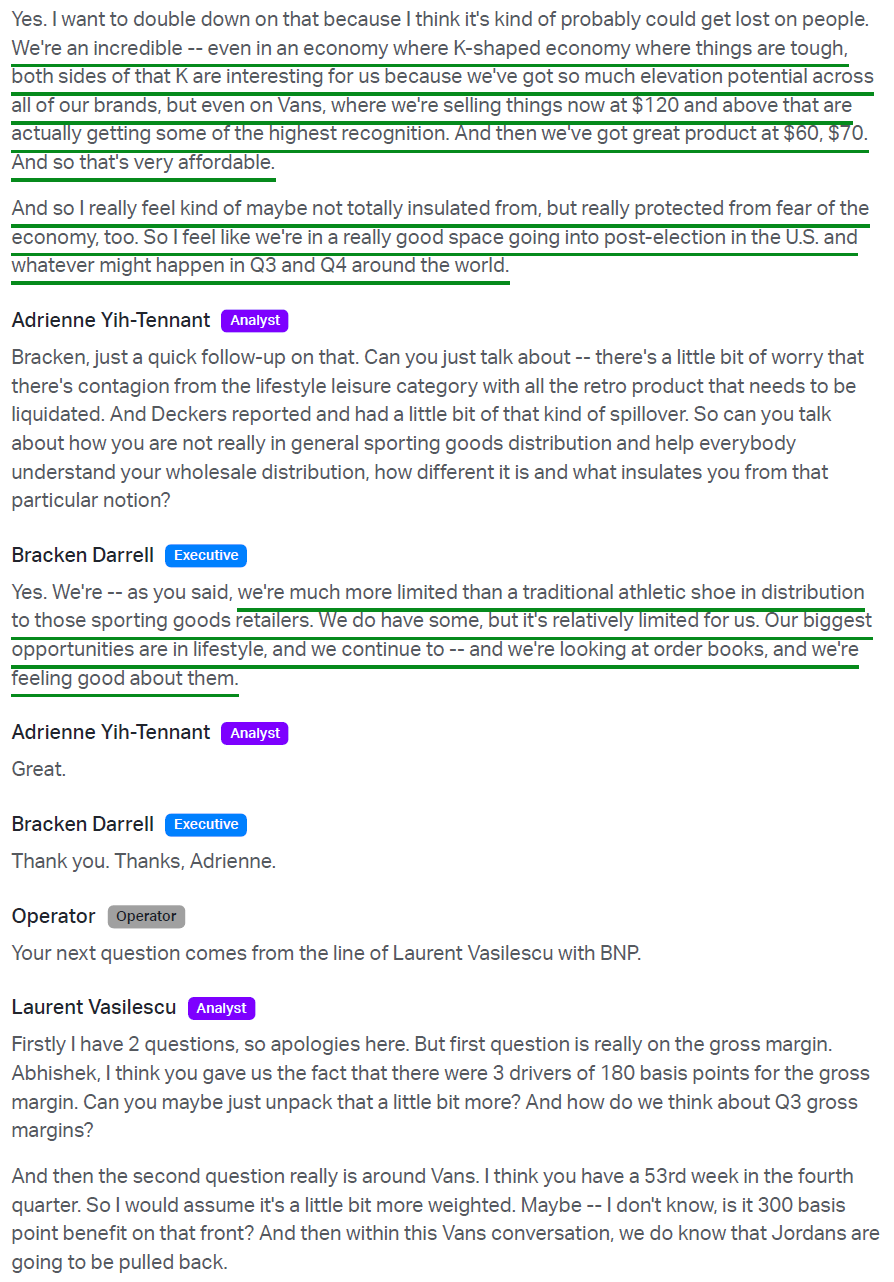
Core issues: overexposure to value channels, brand dilution, over-reliance on legacy franchises, and a loss of connection with the core audience.
Cleanup underway under new brand president Sun Choe, former LULU chief product officer: exiting value channels, closing unprofitable stores and rightsizing inventory, with solid gross margin expansion already delivered.
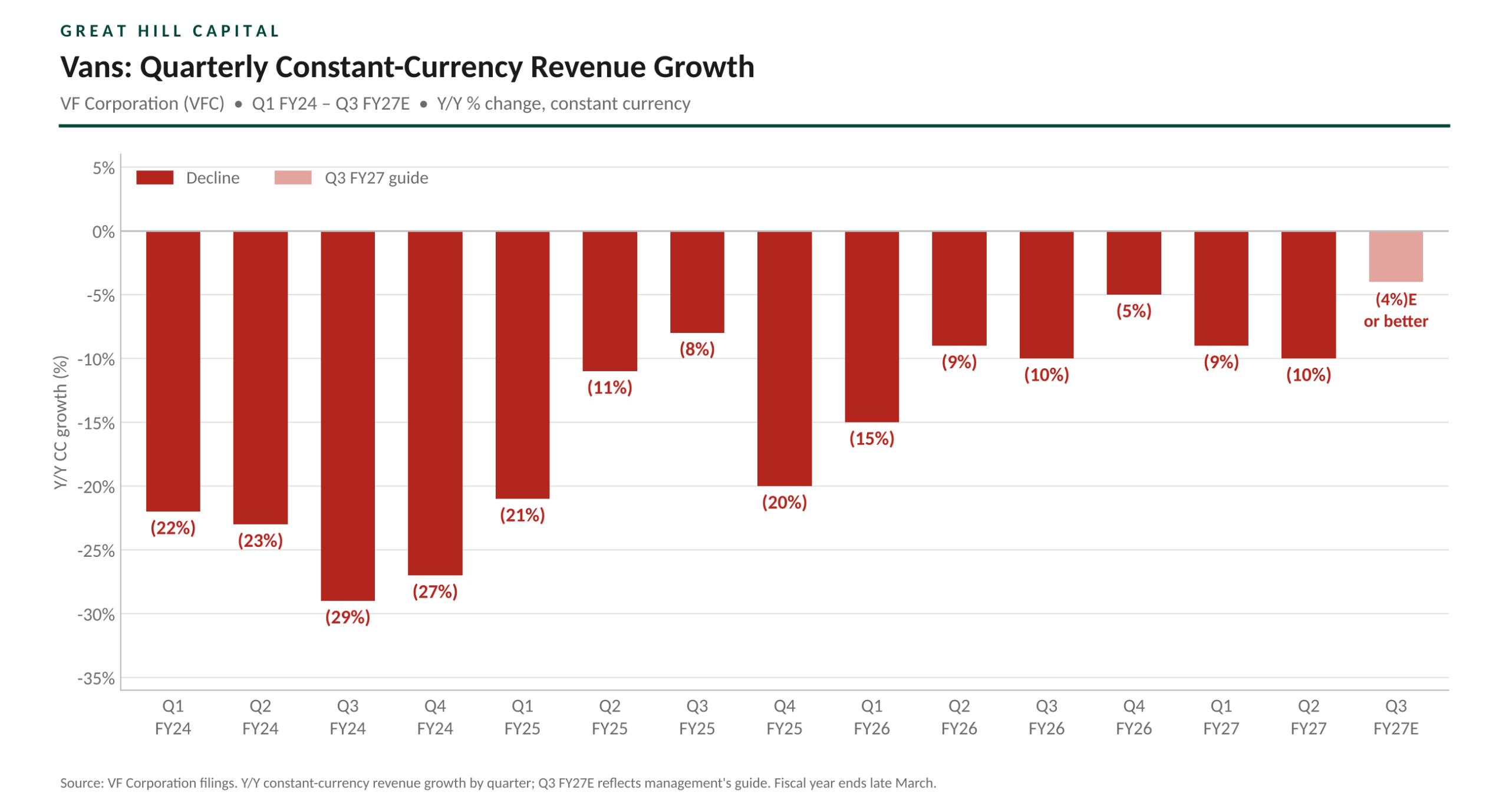
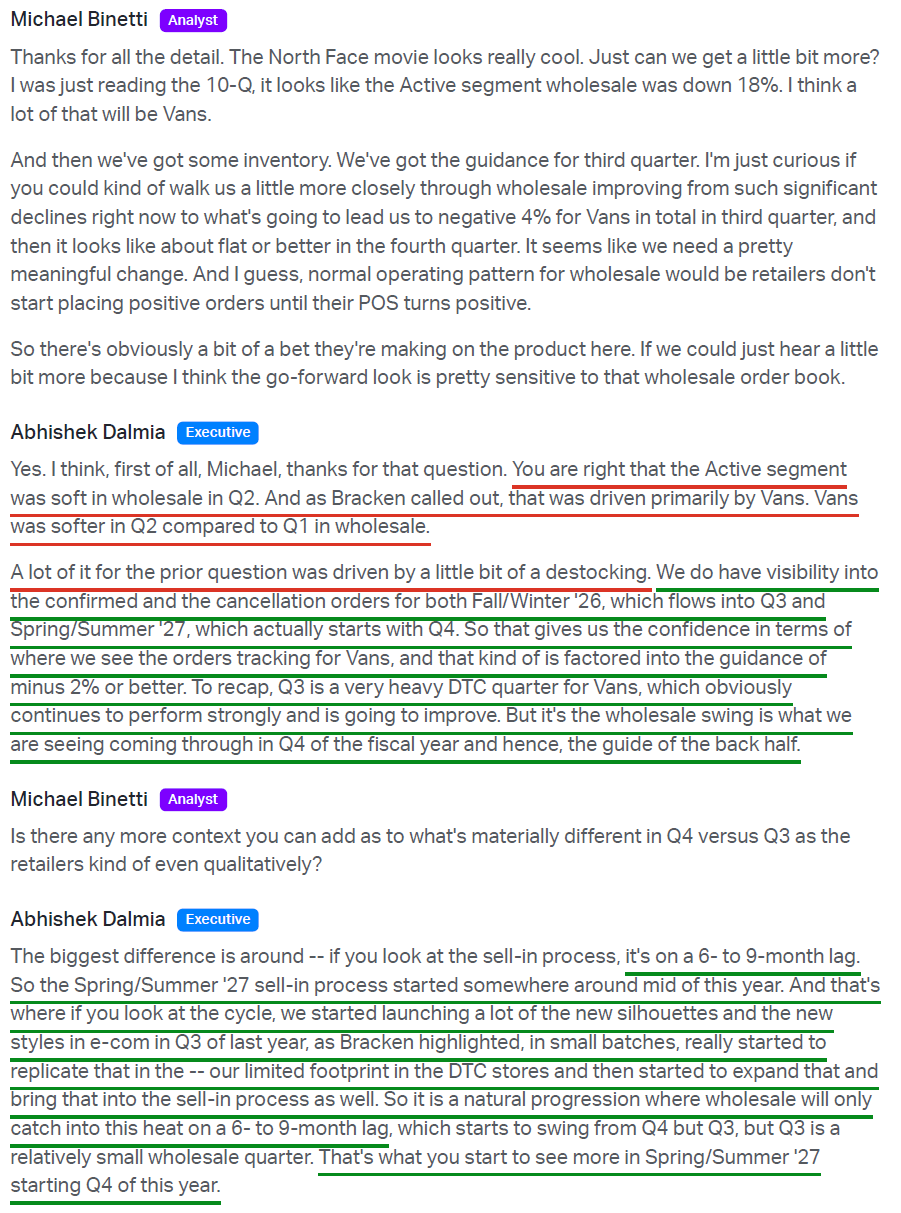
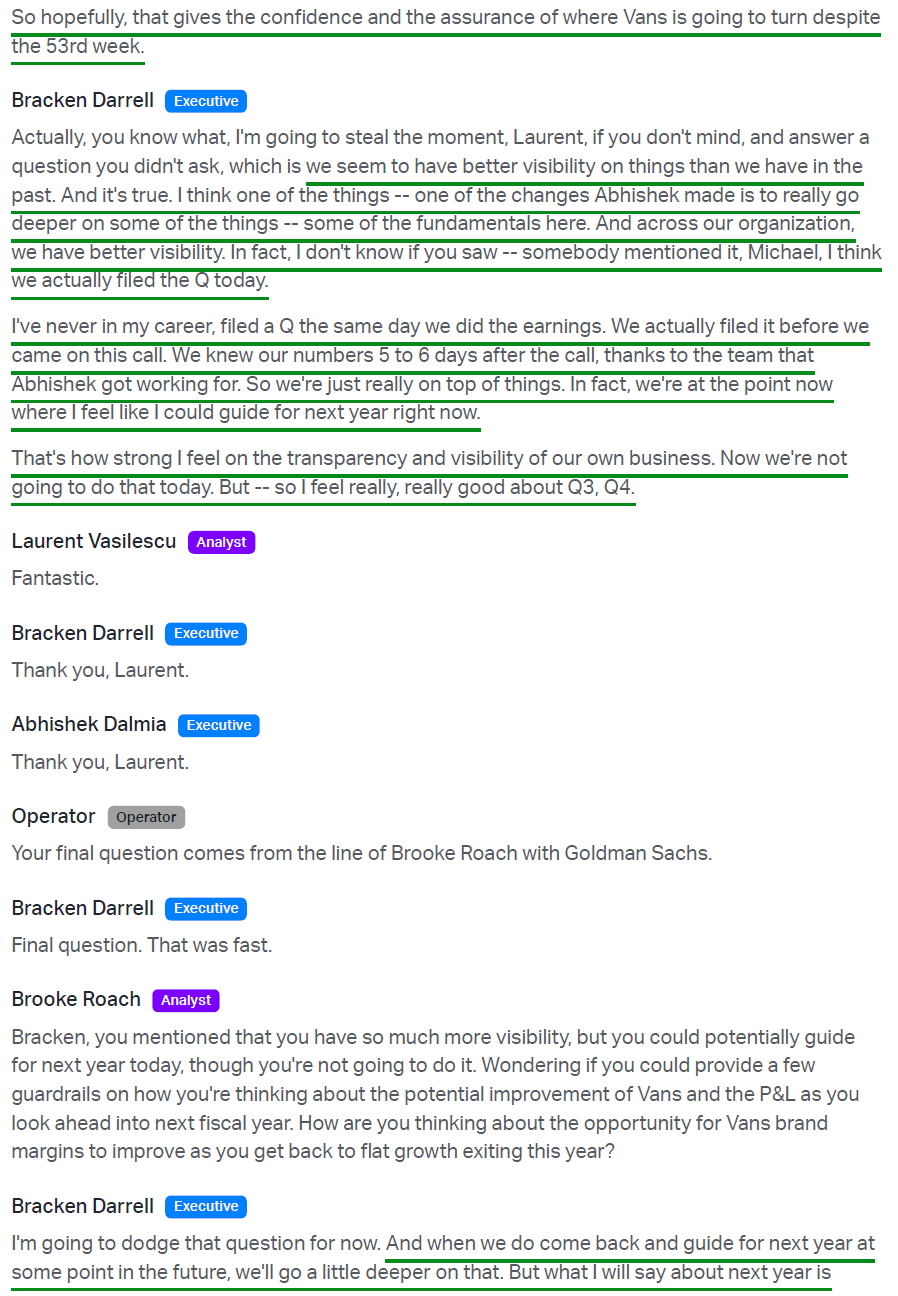
Q2’27 (9.8%) reported or (10%) FXN globally (H1 (8.8%)), with FY27 guidance of mid-single digit decline vs. -11% in FY26 and -15% in FY25; Q3 guided to (4%) or better and H2 to (2%) or better as wholesale inflects on firm orders for Fall/Winter ‘26 and Spring/Summer ‘27.
Global DTC grew in Q2’27 for the first time in almost five years, building on the Americas DTC recovery that began in Q4’26 (+5%, the first growth in over four years) and the clearest signal that the turnaround is taking hold.
Wholesale is the remaining gap: backward-looking sell-through creates a lag, with management expecting wholesale to inflect in 2H FY27 on the current order book at -2% or better. The Vans inflection is here.
Vans shoes were heating up in May and June as Spring/Summer 2027 wholesale orders began, with the usual 6-9 month lag putting that momentum in front of those bookings.
Americas is >50% of total Vans sales and Americas DTC is ~40% of global Vans business.
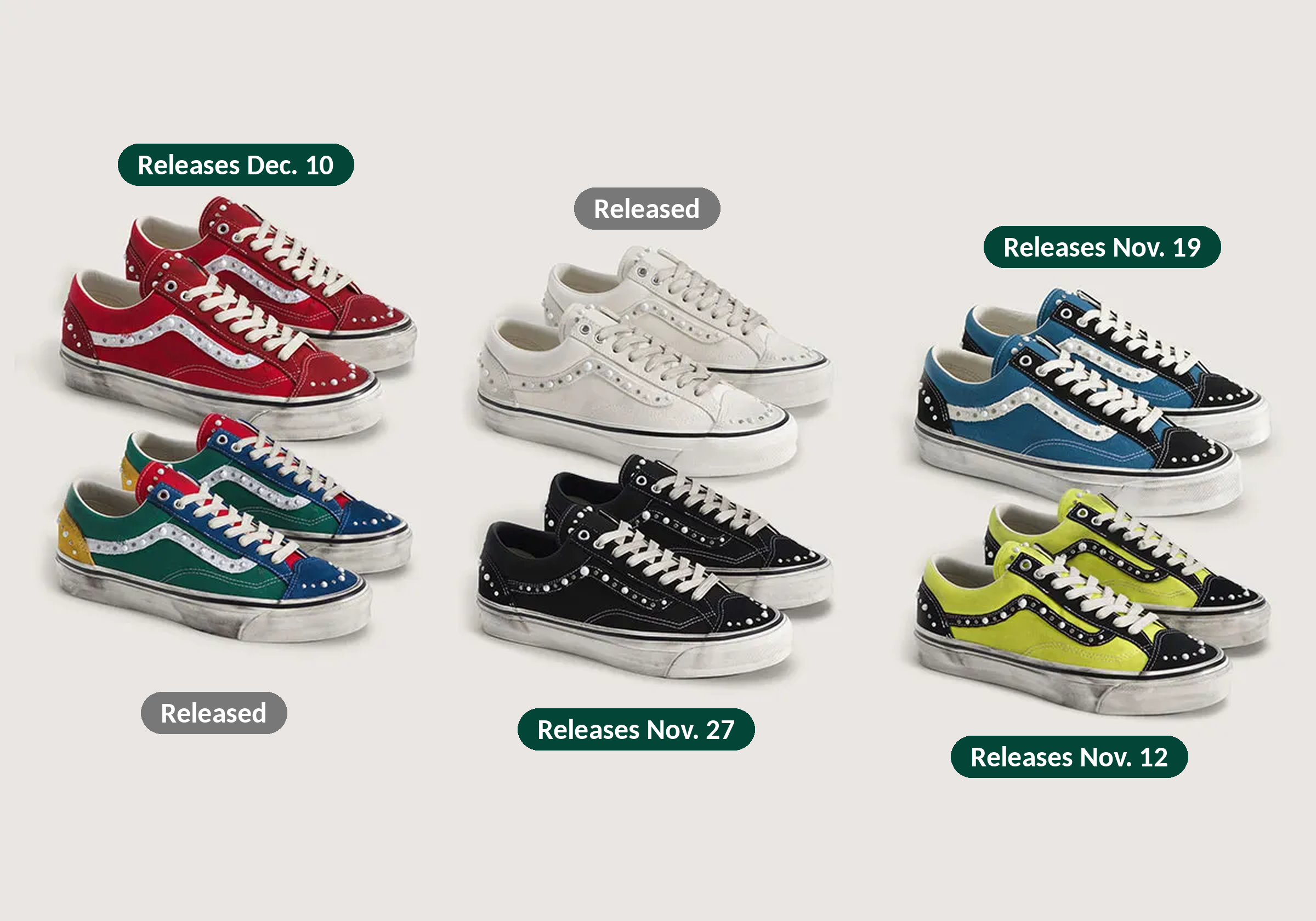
Authentic another strong double-digit quarter, Slip-On returned to DTC growth, and icons grew in DTC led by Old Skool, with the Pearlized Old Skool Yacht Club selling through 100% in the Americas in under 24 hours.
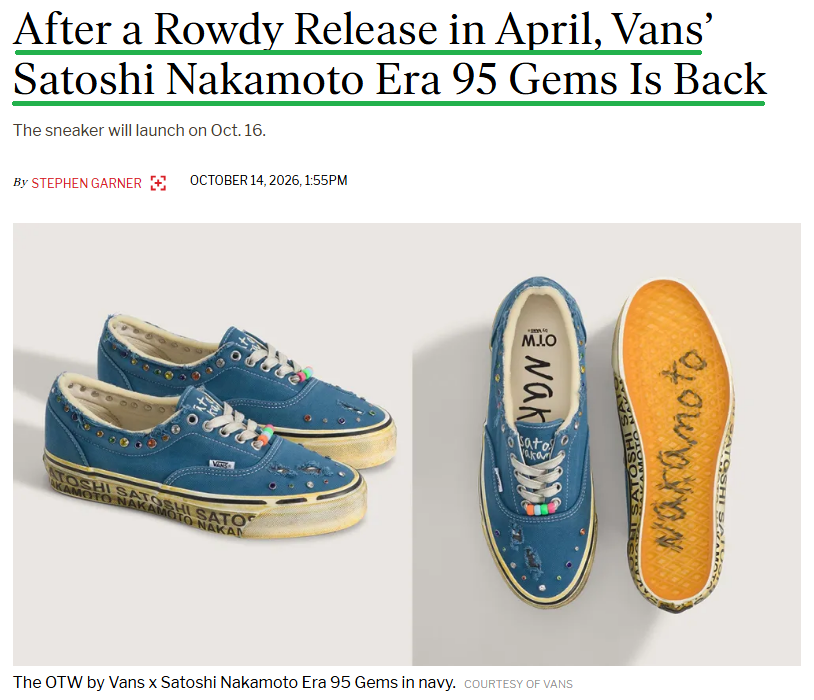
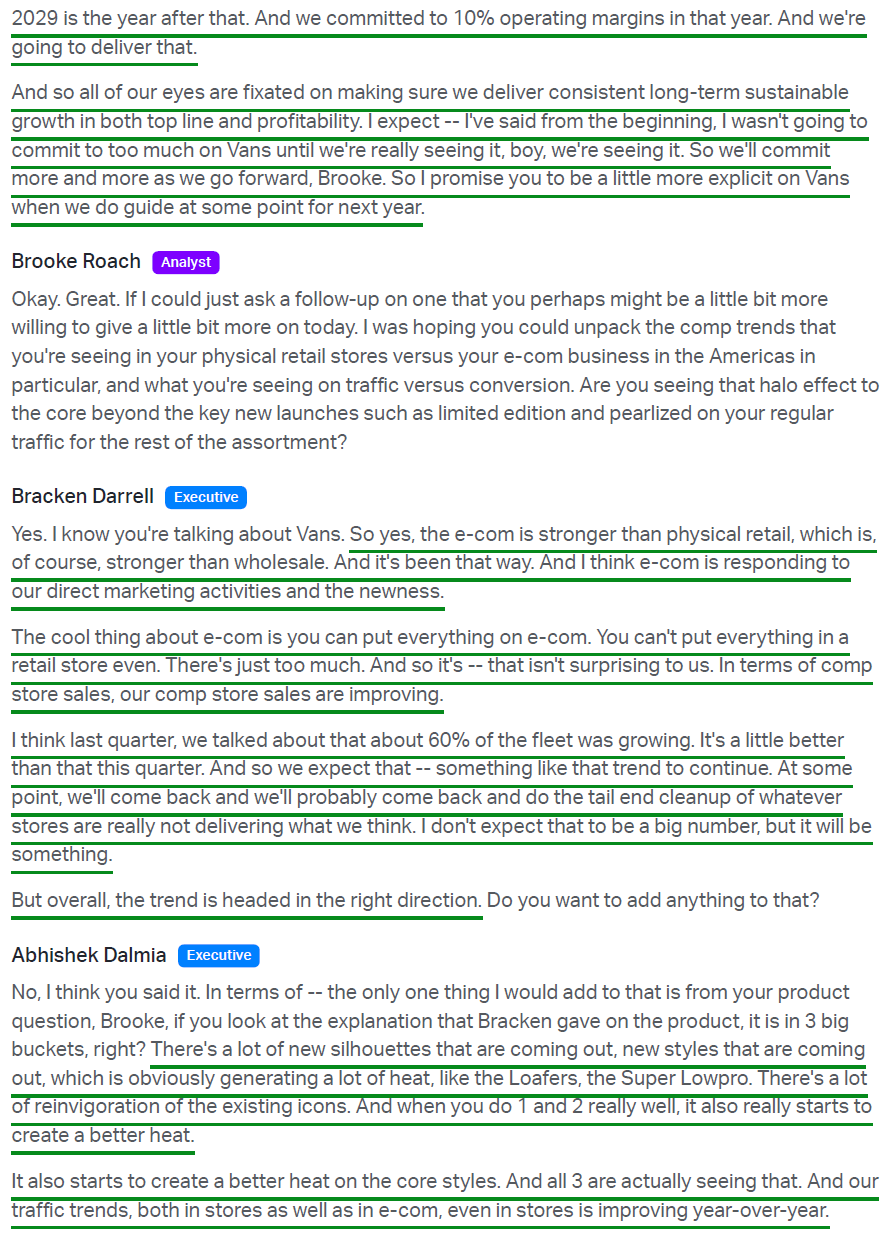
New styles (Super Lowpro, Mules, Loafer) adding heat, with the Satoshi collab DTC drop selling out in five minutes. 60%+ of stores now comping positive.
Vans trades on StockX rose 238% in 1H26, with the average price premium expanding from +12% to +69%.
Piper Sandler upgraded on Vans stabilization ($20 PT), with Vans holding steady as a favorite footwear brand among all males in its Fall Teen Survey (~9,000 teens) after declining in the past three surveys, while moving up among upper-income males.
September Vans DTC foot traffic the best since February 2023, suggesting mindshare has bottomed with growth expected as newness scales across wholesale into 2H FY27 and FY28.
Truist sees fashion trends rotating away from athletic aesthetics in a way that benefits Vans, with major retailers seeking to fill shelf space vacated by Nike (NKE) lifestyle pullbacks.
Truist data shows Vans the focus of 10% of Foot Locker (FL)’s brand-related Instagram posts since June 2026, up from 1% in 2H 2025.
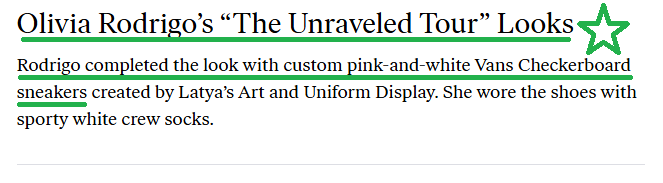
Buzz from Olivia Rodrigo wearing Vans at Unraveled Tour shows, with 10+ pairs worn over the past two weeks.
Olivia Rodrigo wearing Vans nightly at sold out Unraveled Tour (Oct ‘26-May ‘27).
Vans now selling at Zara, with three Vans Authentic styles featured on Zara’s U.S. e-commerce platforms as the “Zara Vans Sneakers.”
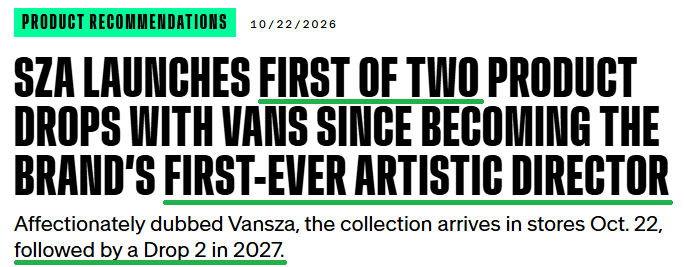
SZA joined Vans as its first artistic director in August 2025 under a multi-year creative partnership.
SZA (22.9M Instagram followers) launched the first Vansza drop Oct 22nd, 18 products including two shoes.
Second drop set for April 8, 2027, featuring the Vansza camouflage Knu Skools.
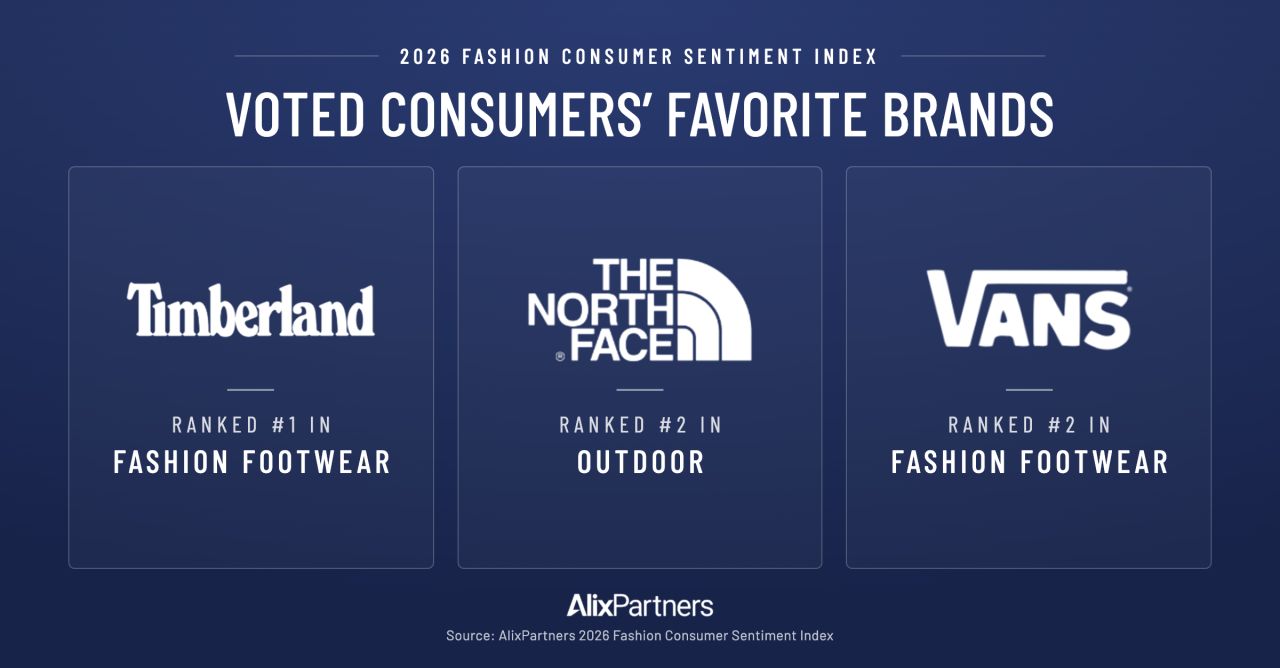
Vans ranked the No. 2 fashion footwear brand in the AlixPartners Consumer Sentiment Index.
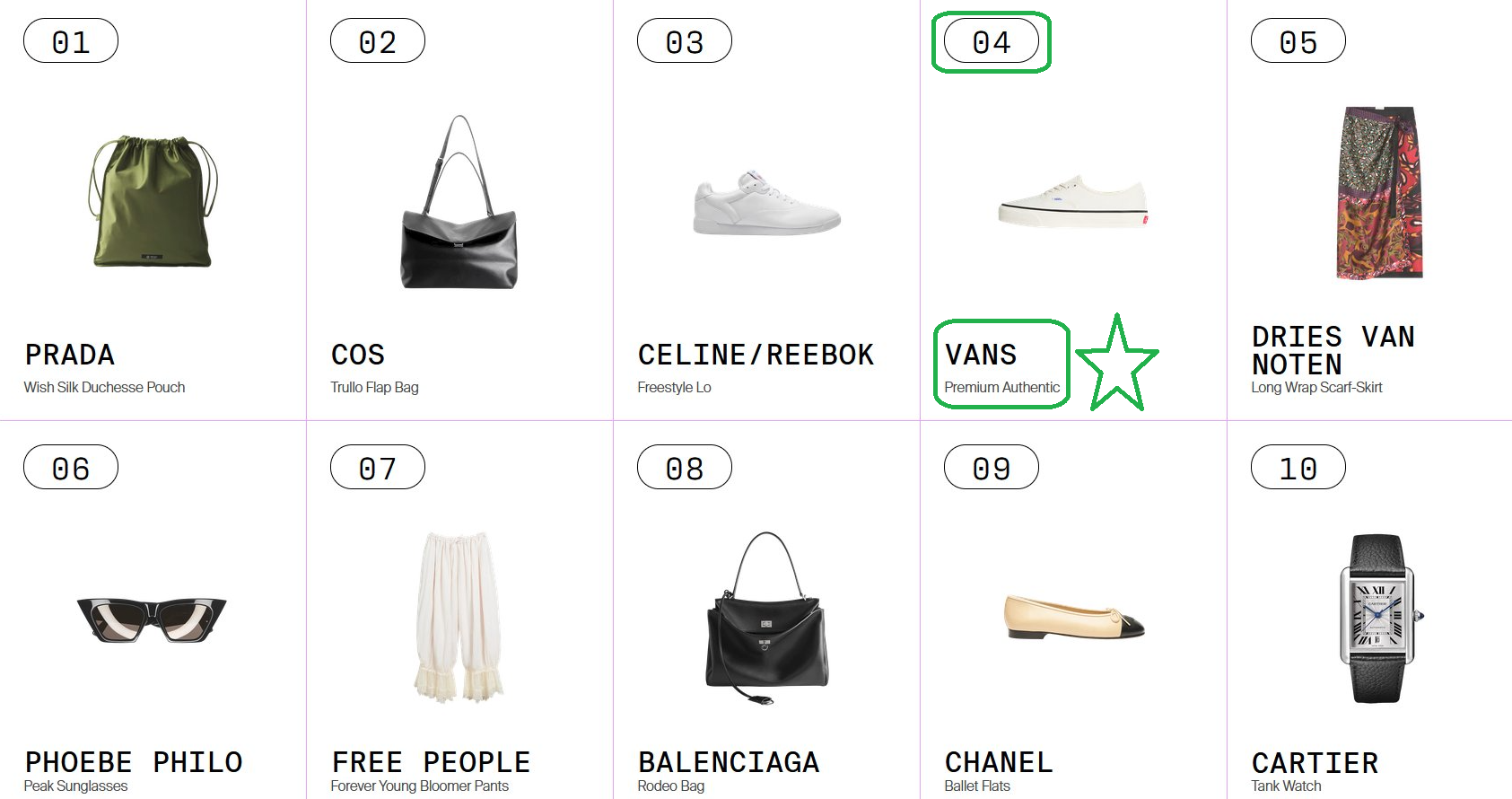
Lyst shows interest in Vans up 29% Y/Y, fueled by 2010s fashion nostalgia, with the Vans Authentic resurgence set to continue.
The North Face
The world’s largest outdoor brand. Goal is to become a true four-season brand.
FY26 revenue: $4,005.8M (+8% reported, +5% FXN)
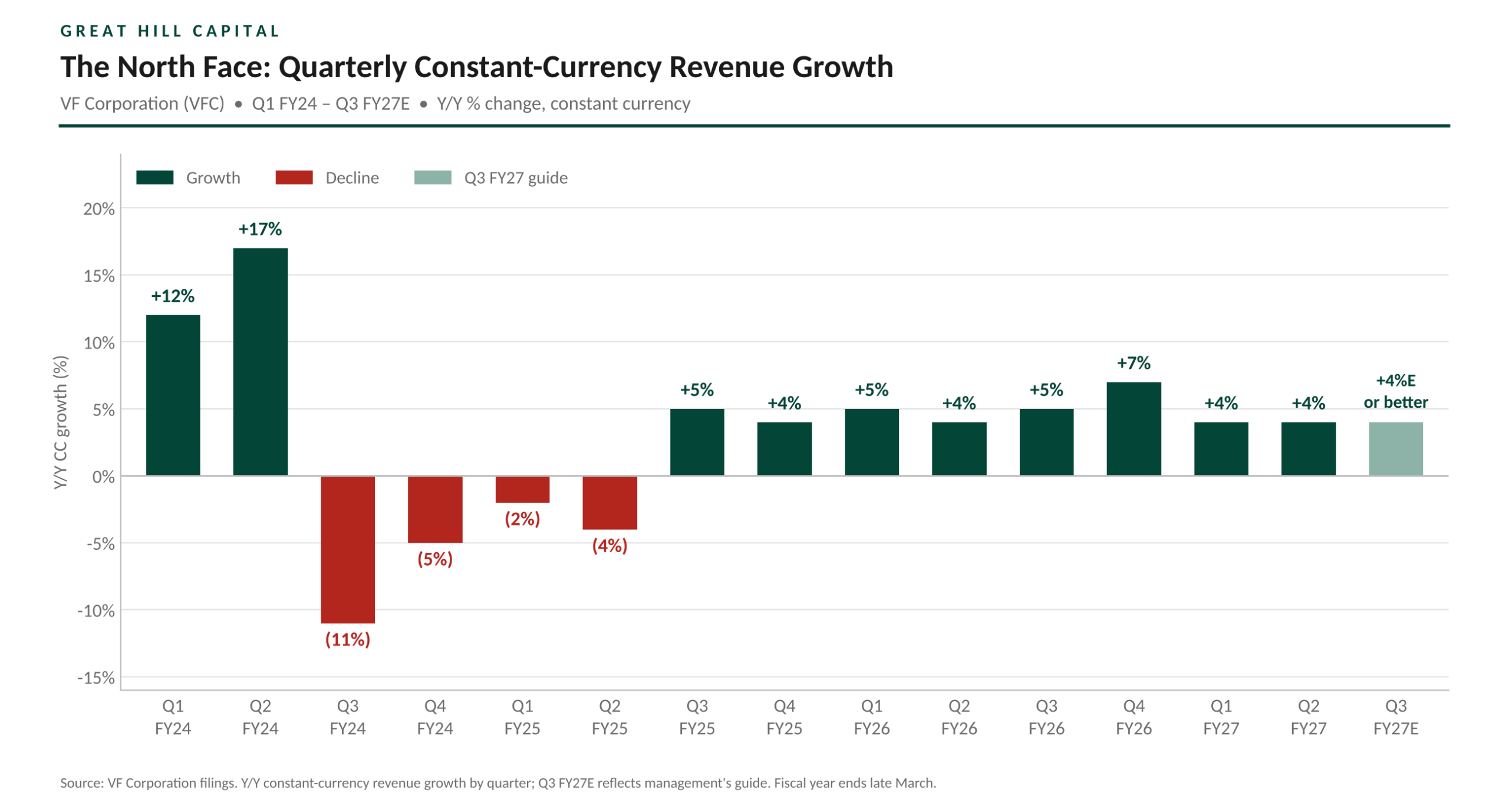
Q2’27 +4% Y/Y or +4% FXN, the eighth straight quarter of FXN growth and well ahead of management’s ~flat expectation, with the Americas +8%. Footwear up double digits across all regions. Named a top 10 athletic clothing brand in Piper Sandler’s teen survey for the first time in three years.
Recently announced 8-year strategic partnership with the U.S. Ski and Snowboard teams through at least 2034, including the upcoming Winter Olympics, further cementing performance credentials. First drop lands this quarter.
Long-term targets: 2x apparel, 2x bags/equipment, 3x footwear. Management reiterated the long-term ambition of doubling The North Face’s revenue base over time.
Timberland
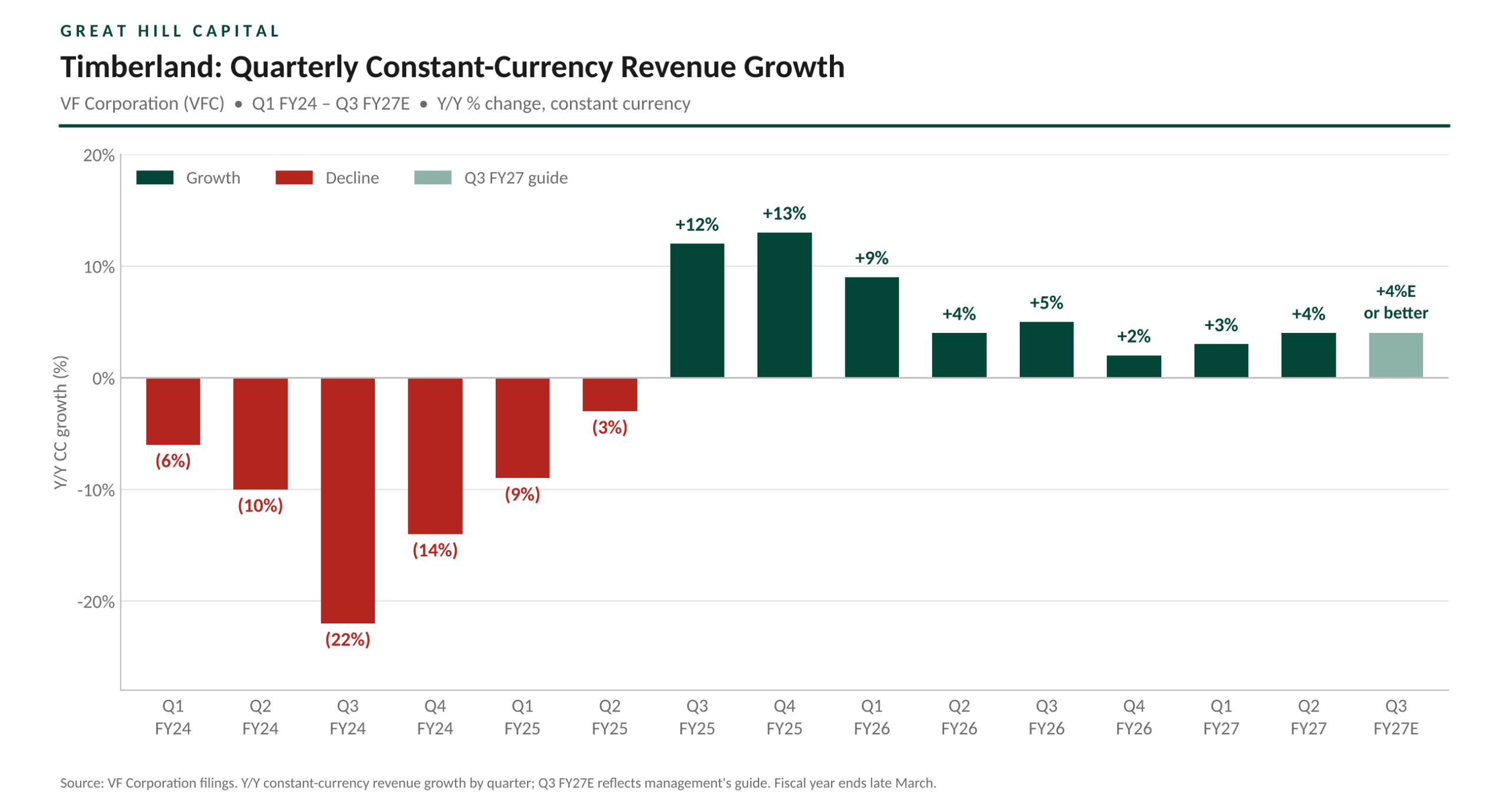
Q2’27 +4% Y/Y or +4% FXN, the eighth straight quarter of FXN growth. Americas +15%, partially offset by APAC (21%) as VF works through changes with its regional partner.
FY26 revenue: $1,735.9M (+8% reported, +5% FXN)
Major DTC push in the Americas, 19 full-price stores now open with outsized productivity validating the new operating model. Significant whitespace ahead.
6″ Premium franchise continues to drive performance, with shoes the fastest growing category. Boat shoe also showing strong results across all regions with significant growth potential ahead.
Timberland broke into the Top 10 at No. 10 position in the teen survey for the first time in survey history (Piper Sandler). Also ranked the No. 1 fashion footwear brand in the AlixPartners Consumer Sentiment Index.
Altra
The #1 trail running shoe in the U.S. and the fastest-growing brand in road running. U.S. awareness remains below 10%, even lower globally.
Acquired in 2018 at ~$50M in revenue. FY26 revenues crossed $270M, a 5x+ increase. Q2’27 up 40%+ across all regions and channels, marking the 7th straight quarter of double-digit growth.
Driven by major franchise launches including the Lone Peak 9 and Experience. Road running has now overtaken trail as the larger business for the brand.
In FY27, Altra footwear growth is expected to fully offset the Vans footwear decline.
Management sees $1B+ in annual sales potential, a large and underappreciated growth driver within the portfolio.
Margin Expansion
Delivered >$225M in structural SG&A savings since FY24, now fully in the run rate.
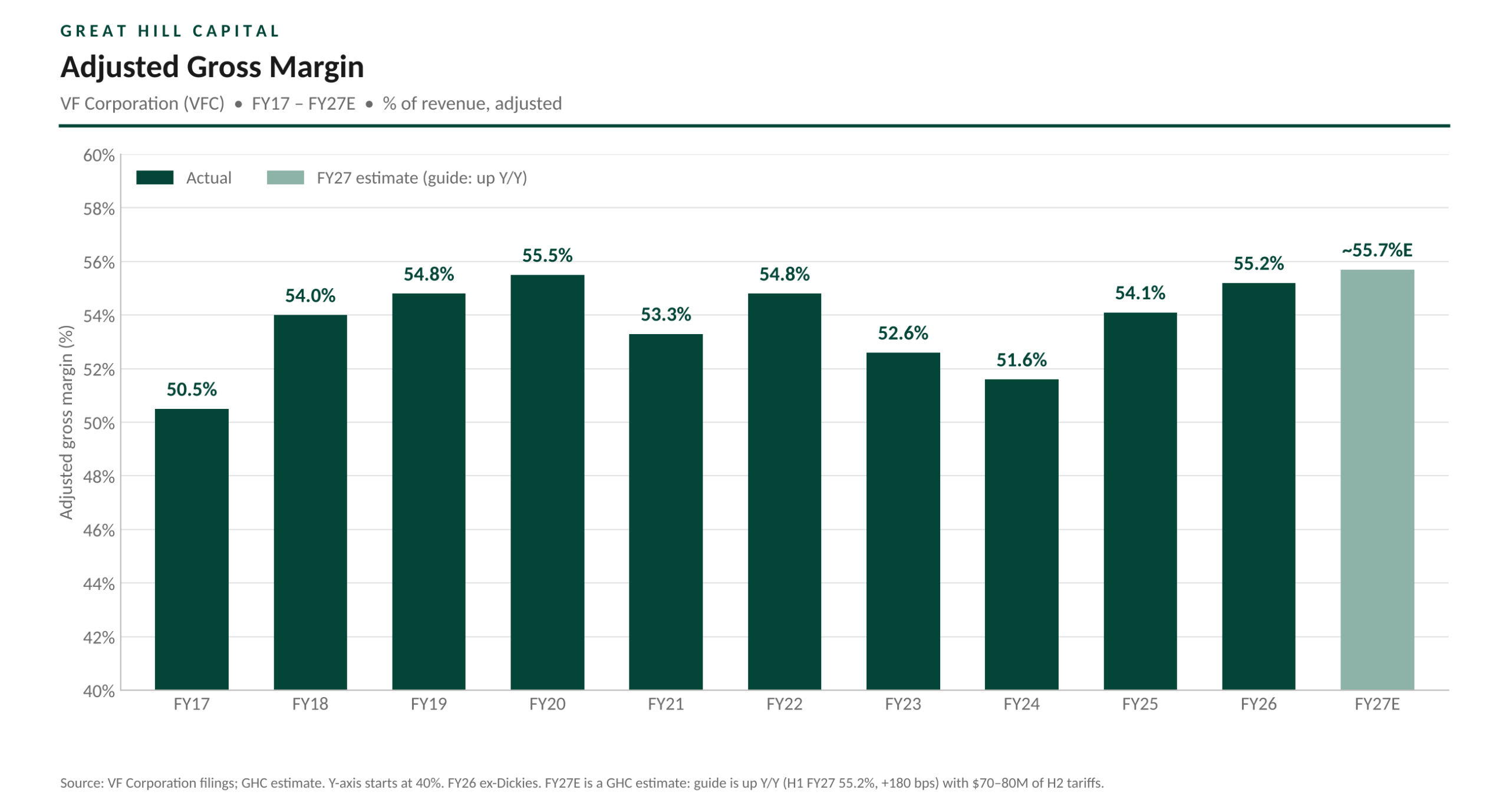
Adjusted gross margin ex-Dickies of 55.2% in FY26, up 110 bps Y/Y and up 360 bps over the past two years (~100 bps from Dickies divestiture, ~260 bps from operational improvements including higher-margin product mix, targeted pricing, and AI-powered markdown management).
Q2’27 adjusted GM ex-Dickies of 55.4%, up 290 bps Y/Y (~180 bps structural, ~110 bps FX tailwind).
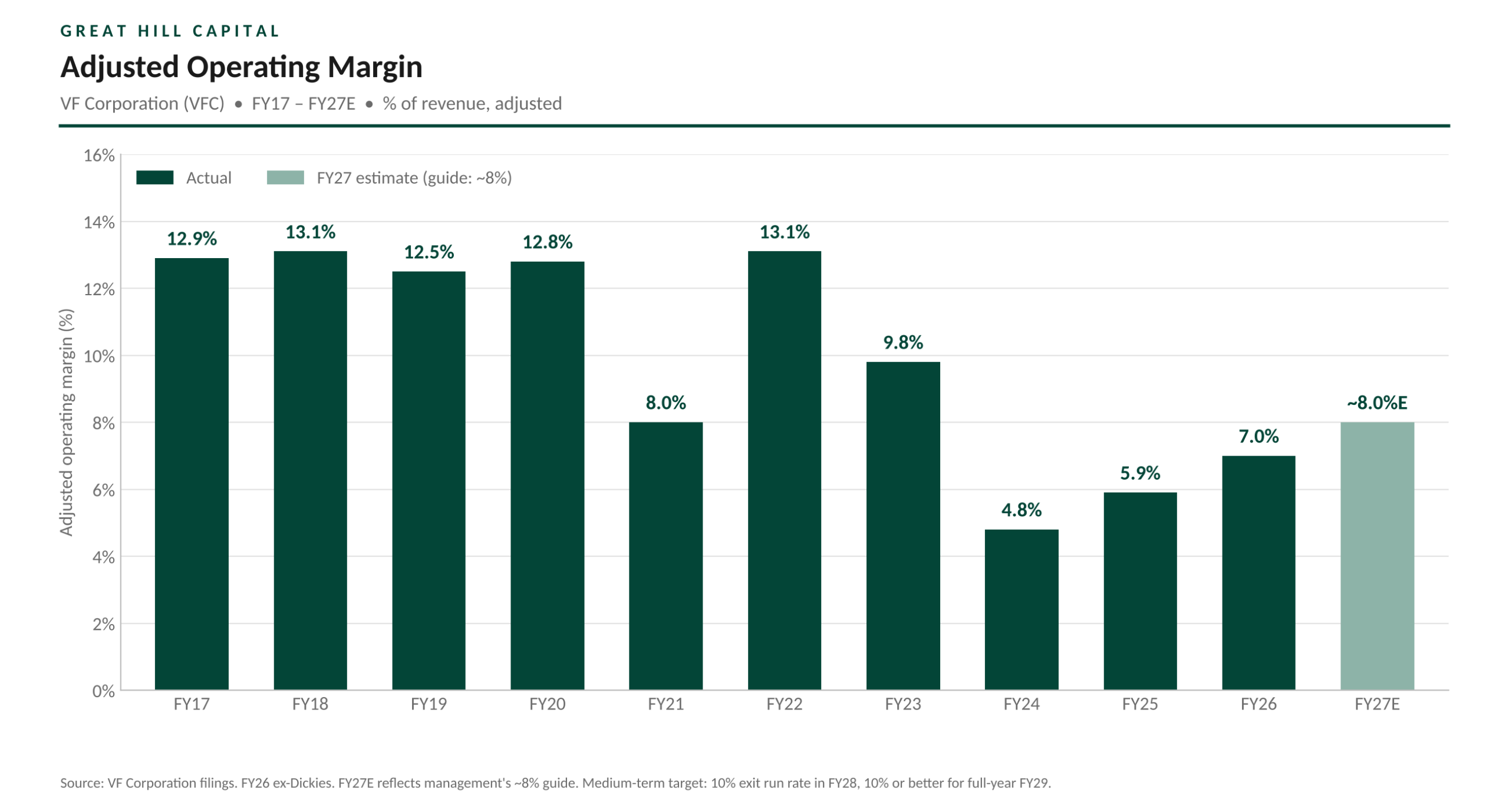
Adjusted operating margin ex-Dickies of 7.0% in FY26, up 110 bps Y/Y and up 220 bps vs. FY24. Q2’27 adjusted OM ex-Dickies of 13.5%, up 170 bps Y/Y, on adjusted OI of $364M, well ahead of ~$315M guidance.
Medium-term targets: gross margin at or above 55% (achieved), a 10% operating margin exit run rate by FY2028, and 10% or better for full-year FY2029. These targets are based on cost savings alone and assume zero top-line growth.
Each $1B in added sales drives ~150-200 bps of EBIT margin expansion via operating leverage.
Pre-pandemic historical operating margins were 12-13%.
FY2027 outlook: adjusted operating margin of ~8%, supported by gross margin expansion and SG&A leverage (mix now leaning more on gross margin than SG&A).
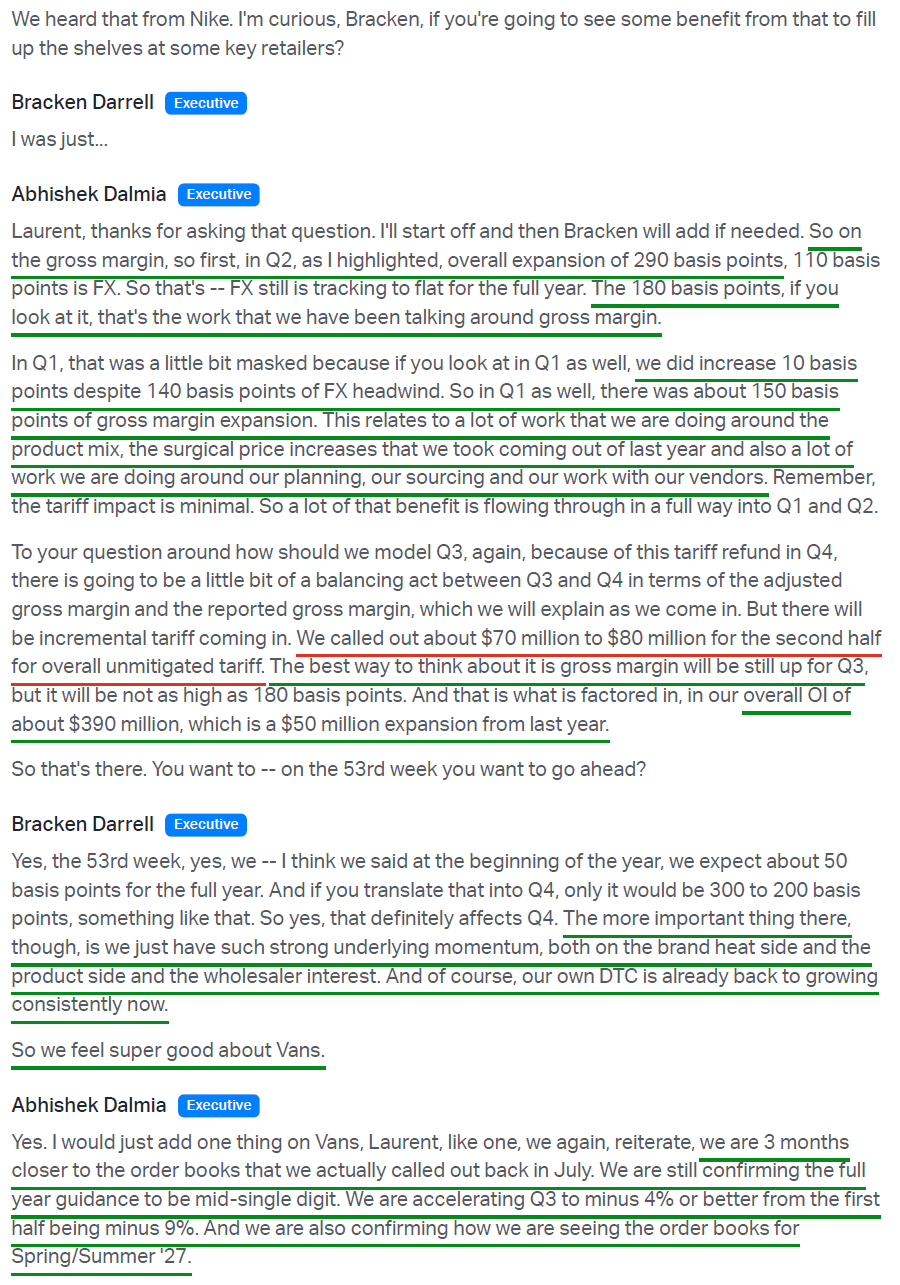
Tariff headwind of $70-80M assumed in back half, with management confident in mitigating “almost all of it” via sourcing footprint changes and vendor partnerships.
Q2 Commentary
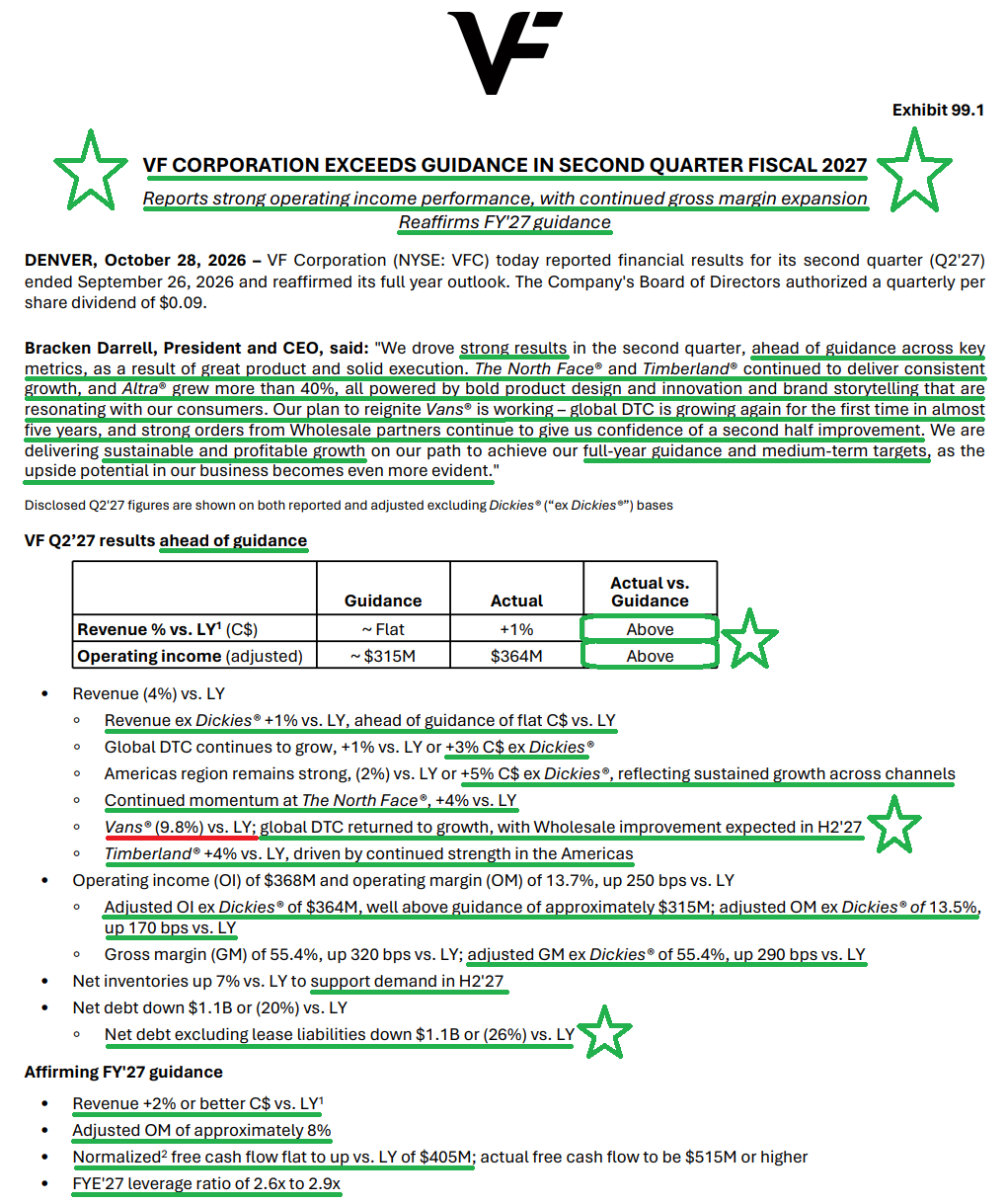
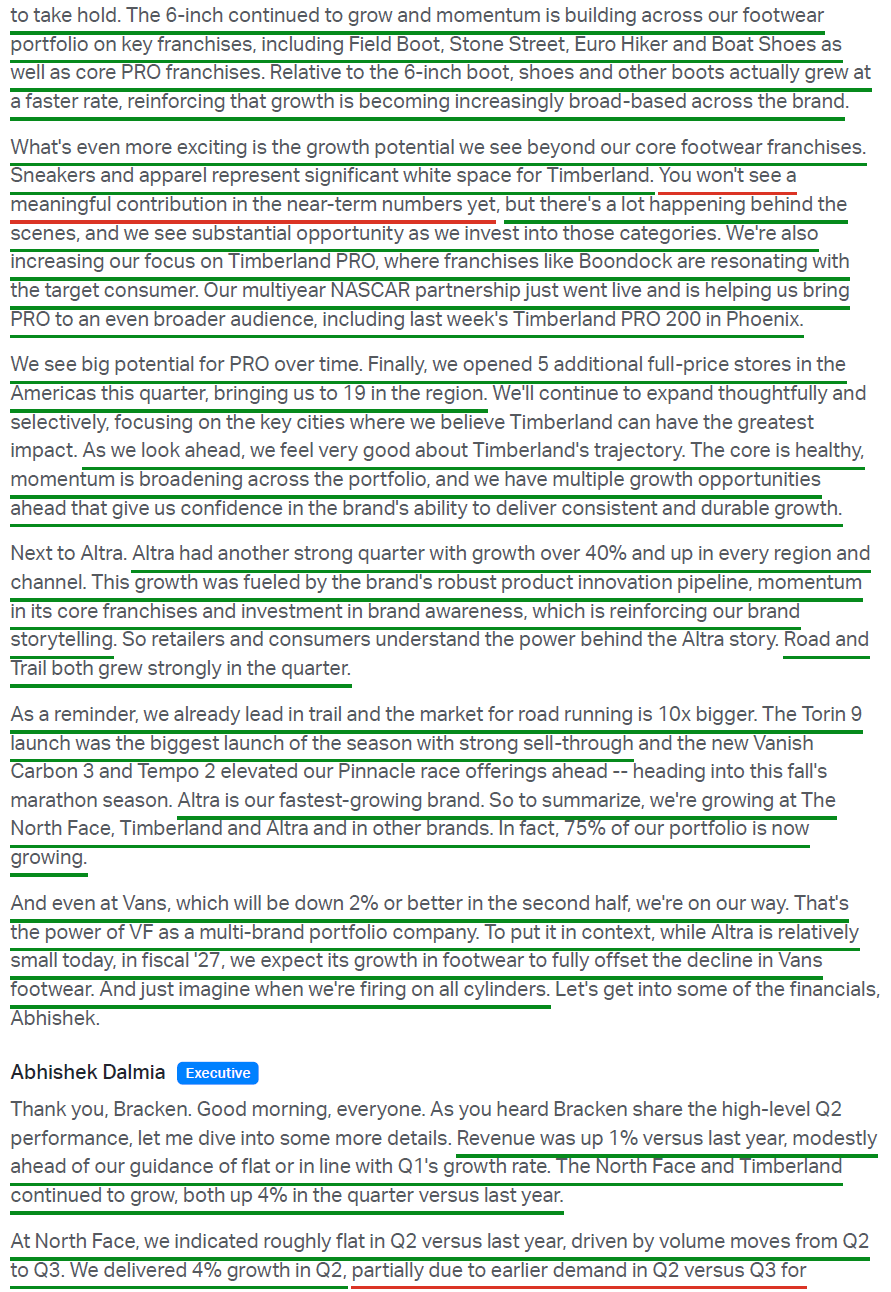
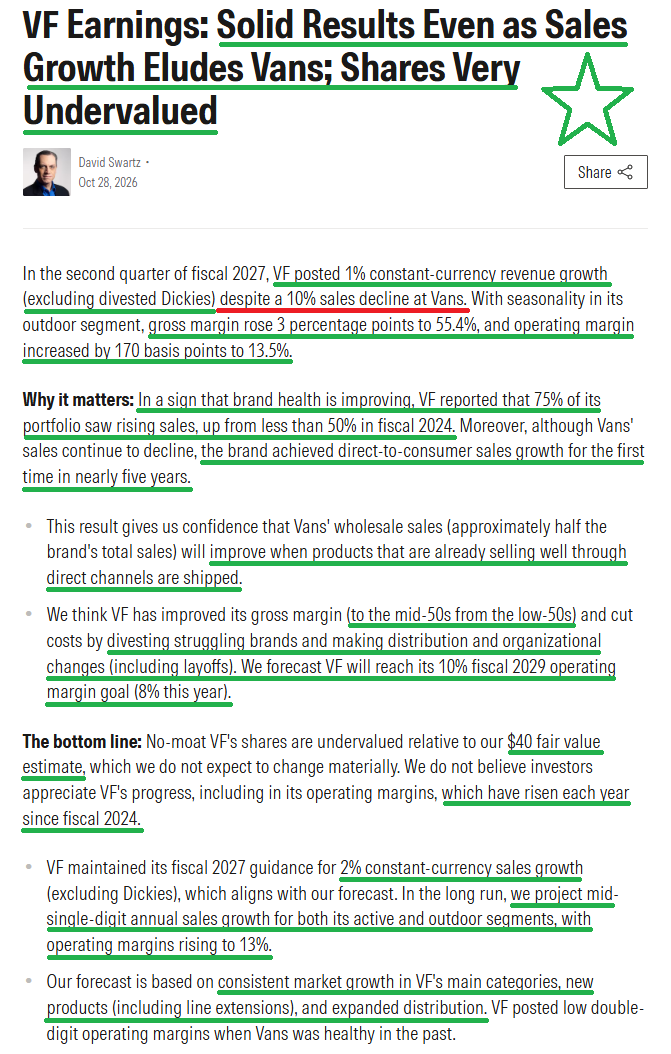
VF Corp. continues to hit its stride, with Q2 revenue of $2.70B growing +1% C$ ex-Dickies against guidance for a ~flat quarter, while adjusted operating income of $363.7M cleared management’s ~$315M guide by nearly $50M. The bottom line was even stronger, as adjusted EPS of $0.70 jumped +42.9% Y/Y to come in $0.17 ahead of consensus, with management reaffirming its full-year outlook across revenue, margins, free cash flow, and leverage.
Shares initially slipped ~5% on the print, with investors likely frustrated by another double-digit decline at Vans after months of building brand heat heading into the release. Once the market digested the call, however, it became clear that the pieces are falling into place for a much stronger second half, which is exactly what investors are now sniffing out as shares have climbed nearly 18% since earnings.
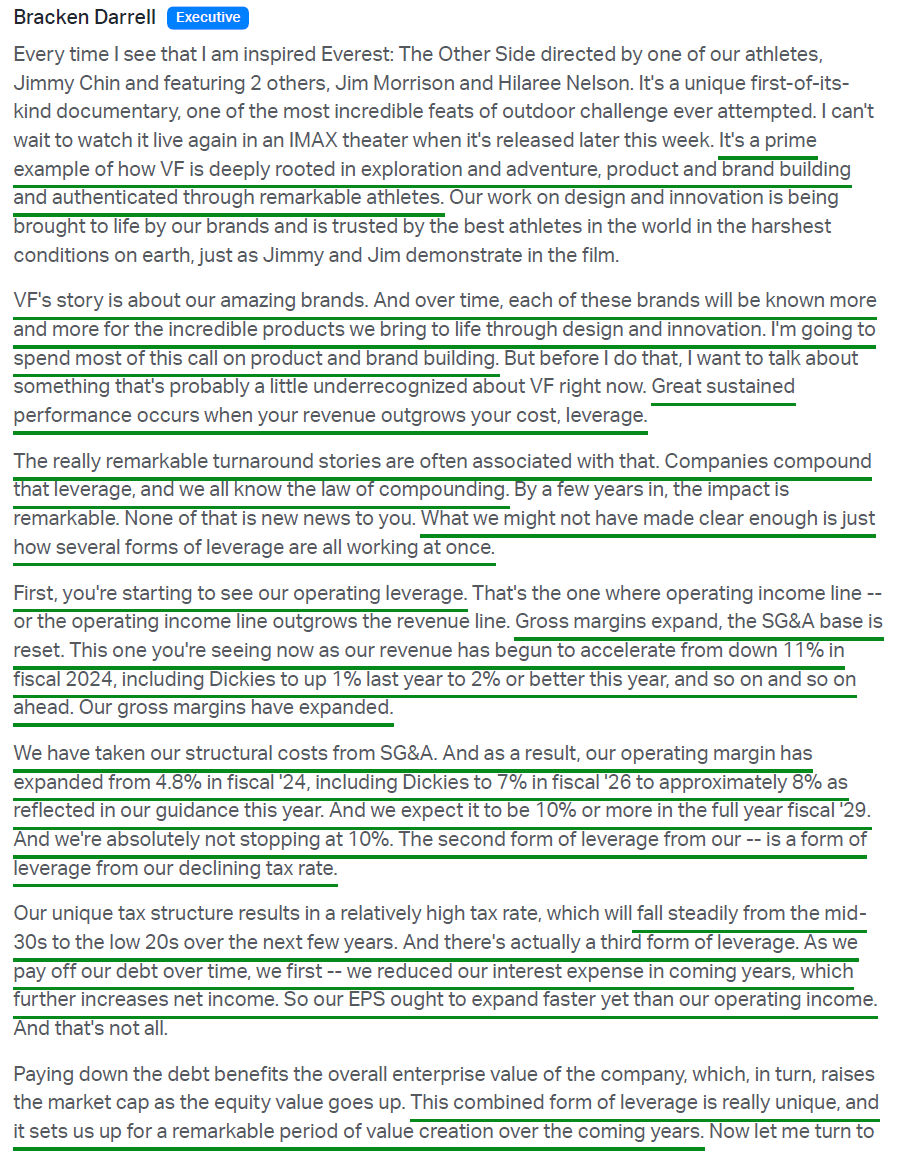
The biggest takeaway from the quarter is that VF is back in growth mode. 75% of the business by revenue grew in Q2, up from just 43% in FY24, putting VF within a stone’s throw of the 80%+ that Bracken Darrell considers the hallmark of a healthy multi-brand company. Getting to this point has required three years of heavy lifting under Darrell, focused on cutting costs and repairing an overleveraged balance sheet. That work has laid the foundation for broader growth to drive operating leverage and unlock normalized earnings power that the market has yet to fully appreciate.
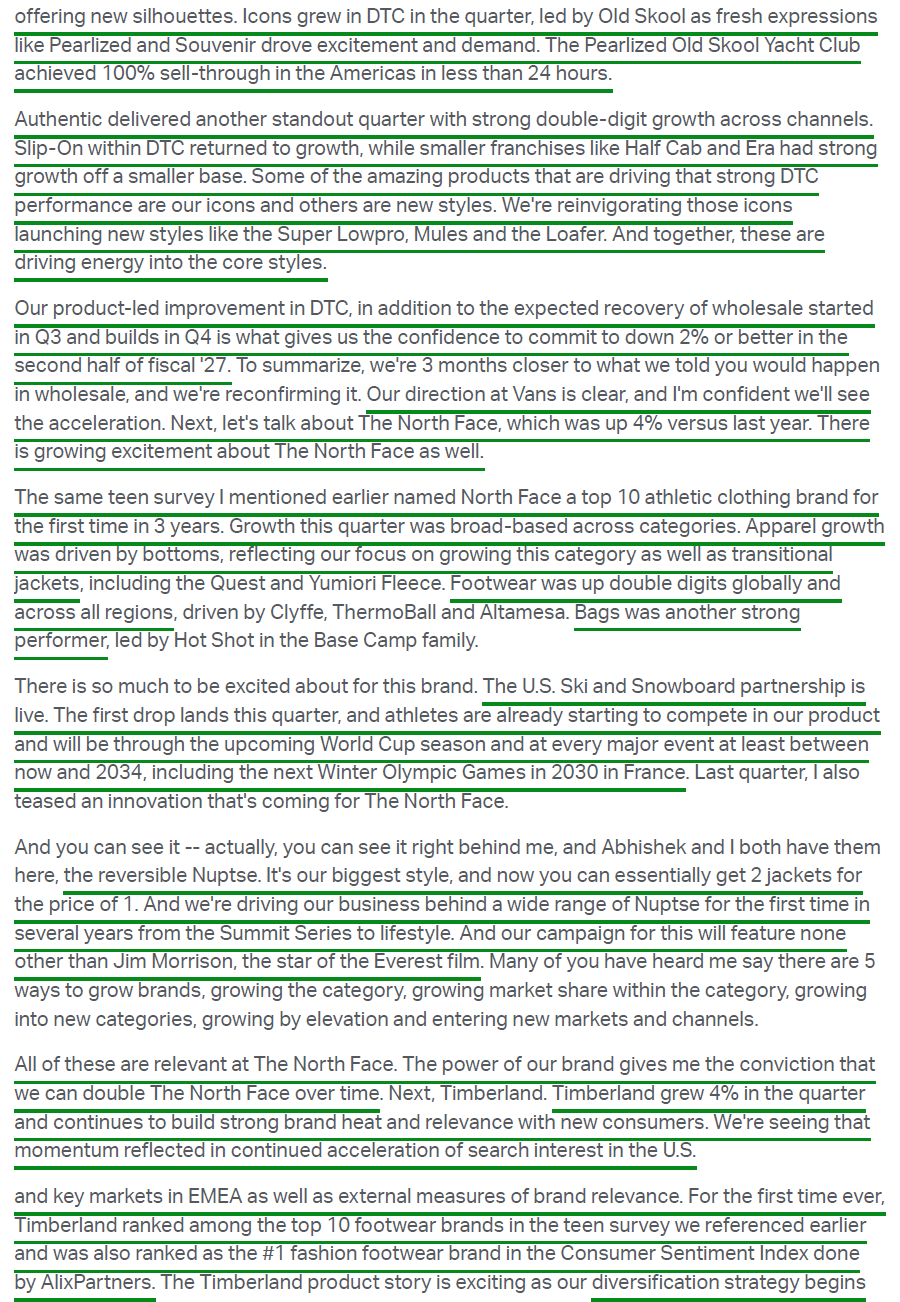
Leading the way is The North Face, the workhorse of the portfolio, which accounted for ~45% of revenue in the quarter while growing +4% C$ to $1.21B for its eighth straight quarter of growth. Growth was led by the Americas at +8% C$, while performance was broad-based across categories, with apparel driven by bottoms and transitional jackets, footwear growing double digits in every region, and bags posting another strong quarter. That momentum was confirmed in Piper Sandler’s teen survey, which named The North Face a top 10 athletic clothing brand for the first time in three years. Even as the largest brand in the portfolio, The North Face still has a long runway ahead, with category growth, share gains, new categories, product elevation, and new markets supporting management’s ambition of doubling the brand over time.
Timberland is another bright spot in VF’s recovering portfolio. After spending most of the time since VF acquired it in 2011 stuck in a ~$1.7B revenue range, Timberland finally looks ready to break out, growing +4% C$ to $525.9M to notch its eighth straight quarter of growth, led by a standout +15% in the Americas. That strength comes on the heels of a continued DTC push, with five full-price stores added during the quarter to bring the Americas total to 19 and more planned in key cities. Growth is also broadening beyond the Yellow Boot, as shoes and other boots grew faster than the iconic 6-inch boot, while management continues to see significant white space in sneakers and apparel alongside untapped potential in Timberland PRO over time. The brand’s progress was also confirmed in Piper Sandler’s teen survey, where Timberland broke into the top 10 footwear brands for the first time in the survey’s history.
Then there is Altra, which is on track to become VF’s next $1B+ brand. It grew 40%+ in every region and channel to remain the fastest-growing brand in the portfolio. Altra already leads in trail running, while road running is a market ~10x larger, giving the brand a massive runway with U.S. awareness still below 10%. To put that growth into perspective, Altra’s footwear growth alone is expected to fully offset the decline in Vans footwear this year, a great example of one of the many outs built into this investment.
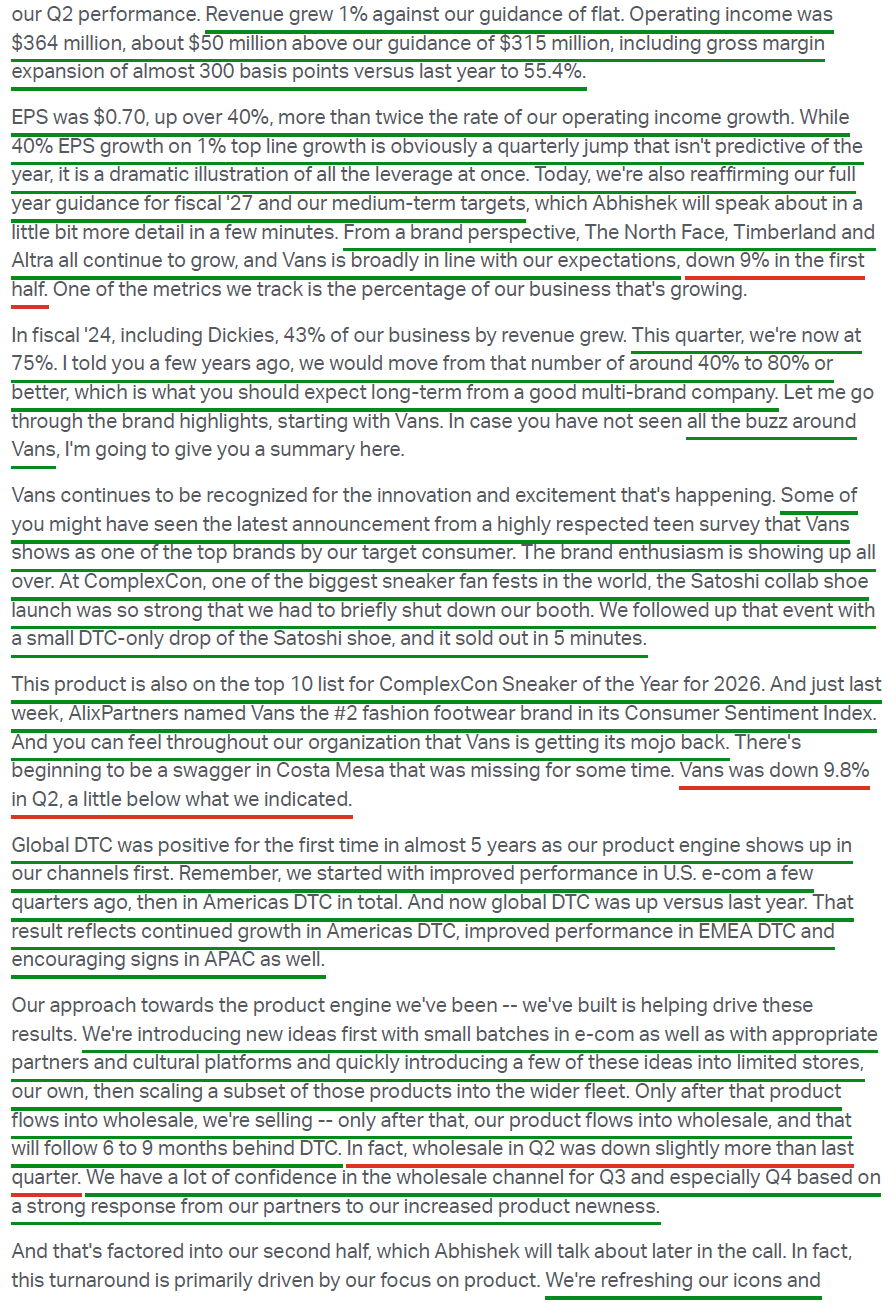
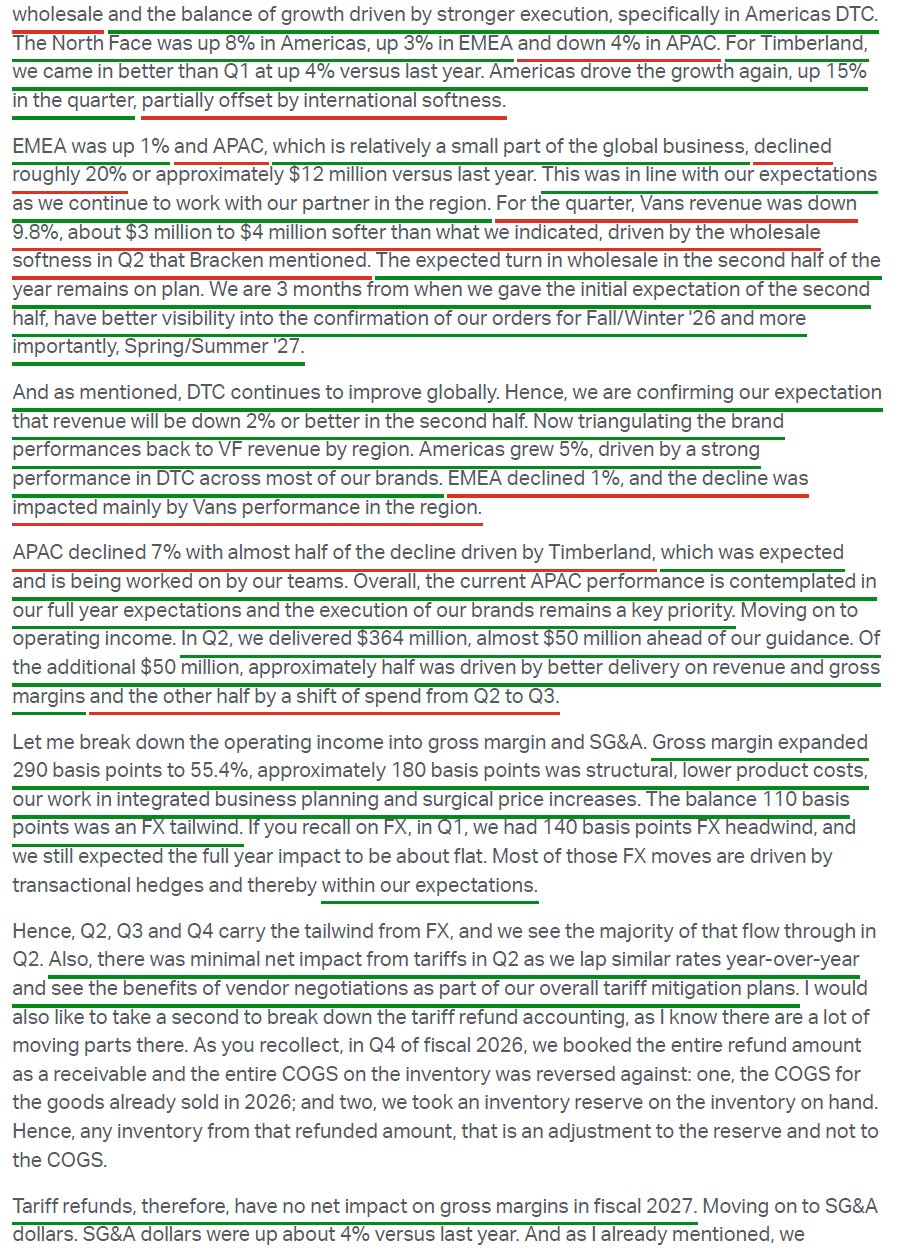
That brings us to Vans, which accounts for the vast majority of the ~25% of the portfolio still in decline and is ultimately the needle mover that takes VF from low-single-digit growth to mid-single digits and higher over time. Another double-digit drop in Q2 drove the initial frustration around the print, with revenue down (10%) C$ and ~$3-4M shy of guidance as wholesale destocking continued. What that headline decline masks, however, is the most encouraging data point of the quarter: global DTC returned to growth for the first time in almost five years.
This is the next step in the recovery management laid out from the beginning. Americas e-commerce first turned positive in Q3 FY26 for the first time in over four years, followed by Americas DTC returning to growth in Q4 FY26 after 14 consecutive quarterly declines and growing again in Q1 as e-commerce accelerated. This quarter, the recovery broadened further, with continued growth in the Americas alongside improving performance in EMEA and encouraging signs in APAC. Traffic improved Y/Y across both stores and e-commerce, while slightly more than 60% of stores are now comping positive.
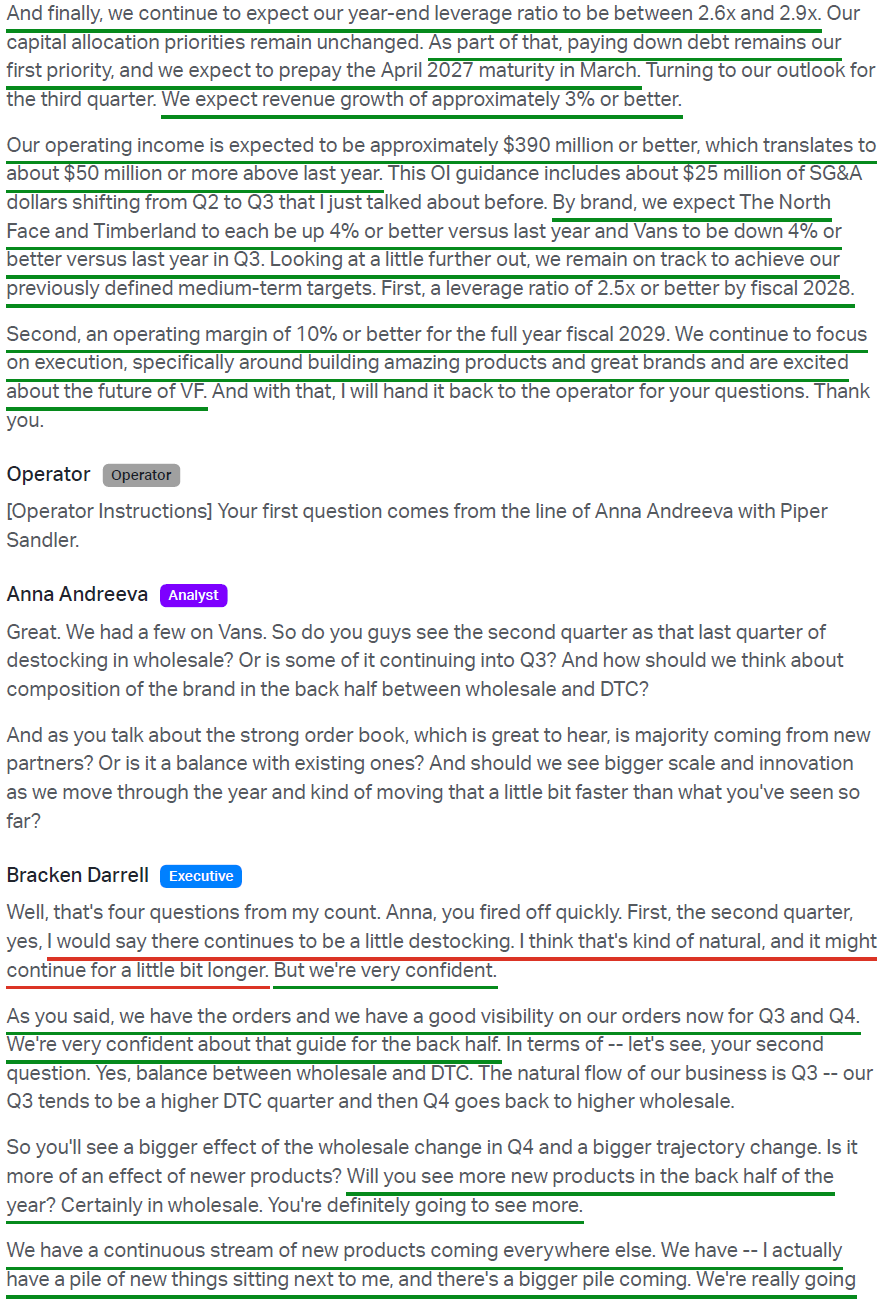
The last domino to fall is the stubborn wholesale channel, which comes down to the timing lag every apparel and footwear company experiences. Vans tests new ideas in small batches through e-commerce and select collabs before moving the winners into select stores and eventually scaling them across the fleet. Wholesale typically trails DTC by 6-9 months as retailers wait for proven sell-through before placing orders. This means the heat built over the past several months comes at a perfect time, just as retailers are placing orders for Fall/Winter ’26 and Spring/Summer ’27. Those firm orders give management confidence in a guide of (4%) or better in Q3 and (2%) or better in H2, with the larger wholesale swing expected in Q4. Given the brand heat we are seeing, we would not be surprised to see Vans inflect positive in Q4, which would mark the brand’s first quarter of growth in ~five years.
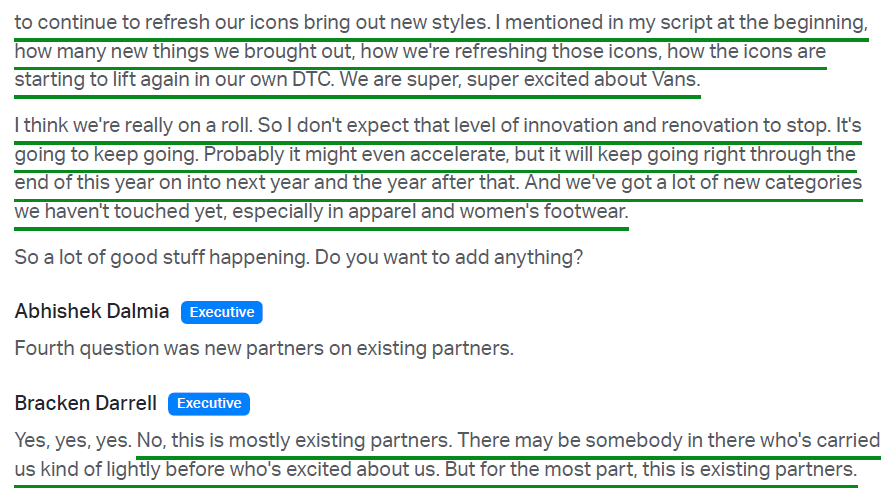
More importantly, the recovery is being driven by the product itself, with Vans refreshing its icons while launching new silhouettes as fashion shifts away from athletic sneaker styles toward the classic Vans look. Old Skool led icon growth in DTC, Authentic posted another strong double-digit quarter, and Slip-On returned to growth, while new styles such as the Super Lowpro, Mules, and Loafer added further heat. Growth built on product tends to feed on itself, with heat in the icons pulling consumers back into the core while newness keeps them coming back. Nowhere is that clearer than Pearlized, where the Old Skool Yacht Club sold through 100% in the Americas in less than 24 hours as part of a six-release series running from September through December, with four drops still to come.
Vans is also leaning into culture to build on its product momentum. SZA joined the brand as its first-ever artistic director in August 2025, with the first Vansza drop of 18 products launching on October 22 to massive demand. A second drop is already set for April 2027.

The brand is also getting a lift from Olivia Rodrigo, the Taylor Swift of today’s teen generation, who has become something of an unofficial brand ambassador. She has been wearing multiple pairs of Vans nightly on her sold-out Unraveled Tour, with custom pink and white checkerboards among the highlights.

At the high end, the Satoshi Nakamoto collab drew such demand at ComplexCon that Vans had to briefly shut down its booth, with a follow-up DTC drop selling out in five minutes and the shoe earning a spot on ComplexCon’s top 10 Sneaker of the Year list.
Third-party data is telling the same story. In Piper Sandler’s survey of ~9,000 teens, Vans held its No. 7 spot as a favorite footwear brand among male teens after declining in each of the prior three surveys, while AlixPartners ranked Vans the #2 fashion footwear brand in its Consumer Sentiment Index. Lyst also ranked Vans No. 4 on its top 10 hottest brands list for Q3, with interest up 29% Y/Y, putting Vans in very good company.
With The North Face, Timberland, and Altra already growing and Vans moving from a drag toward a contributor, VF is on a path from low-single-digit growth to mid-single digits and beyond. The real upside comes from what happens when that growth combines with the three earnings levers Bracken highlighted on the earnings call as the most underappreciated part of the VF story.
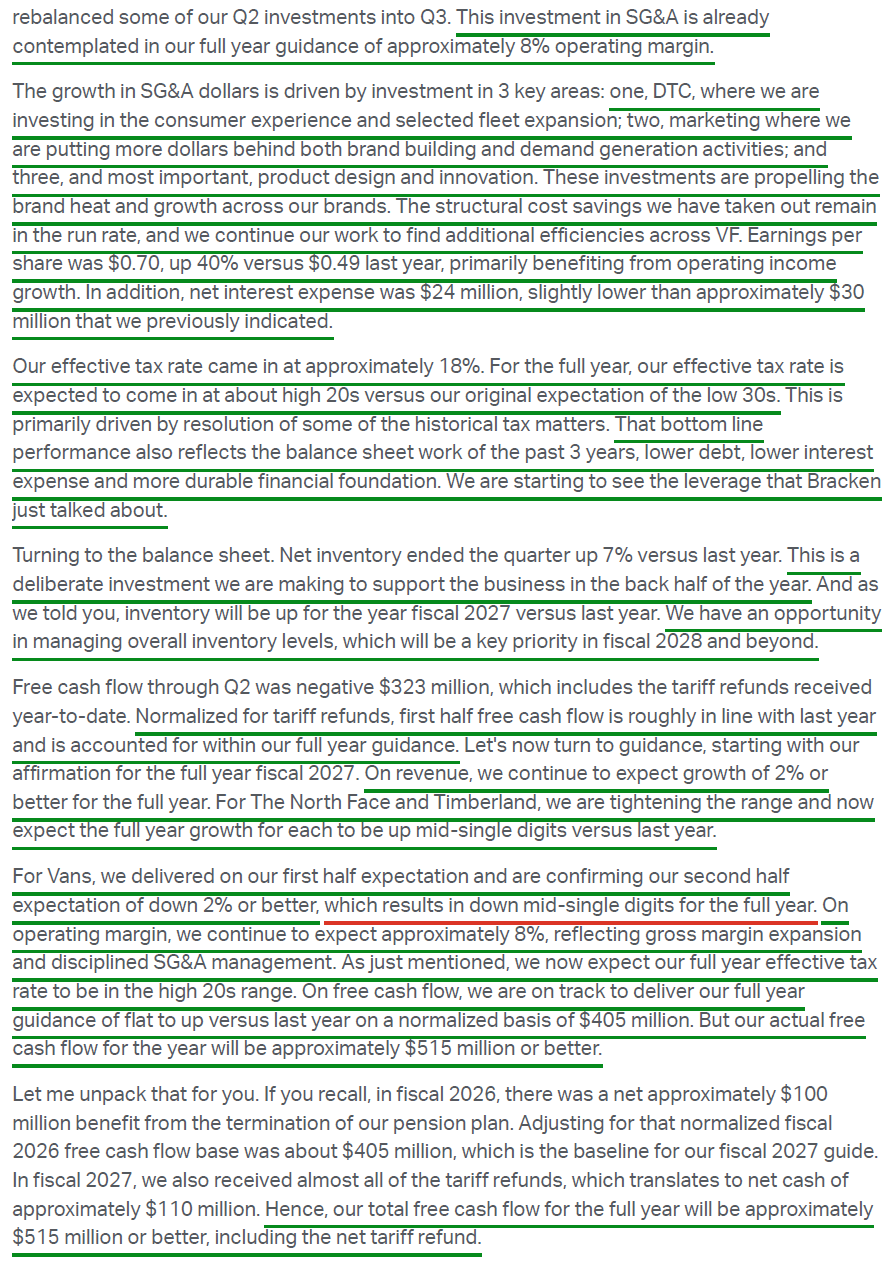
The first lever is operating leverage, where the heavy lifting of the past few years is already paying off. Gross margin has expanded on lower product costs, better planning, and pricing discipline, with adjusted gross margin rising 290 bps Y/Y to 55.4% in Q2, ~180 bps of which was structural. Full-year gross margin is expected to be up again, keeping VF comfortably above its FY28 target of 55%.
On the cost side, management has taken >$225M of structural SG&A out of the business since FY24, savings that remain fully in the run rate. VF is already getting its first taste of operating leverage, with operating margin climbing from a trough of 4.8% in FY24 (including Dickies) to 7.0% in FY26 and ~8% this year, on the way to 10% or better in FY29. Bracken made clear that VF is “absolutely not stopping at 10%,” a target that looks well within reach for a business used to running 12-13% operating margins before the pandemic.
The second lever comes from the balance sheet. The sales of Supreme and Dickies brought in $2.1B of cash that went straight to debt paydown, helping cut net debt excluding lease liabilities from $5.8B three years ago to $3.1B today, with leverage falling from 5.1x in FY24 to 3.1x in FY26 and guided to 2.6x to 2.9x by the end of this year. That progress is now flowing through the P&L, with net interest expense nearly cut in half to $48.3M through the first half of FY27 from $87.3M LY. With VF planning to prepay its April 2027 maturity in March as it works toward its 2.5x or better target by FY28, interest expense should keep losing its bite.
The third lever is a falling tax rate. VF’s tax structure has historically resulted in a relatively high rate, which management expects to decline from the mid-30s to the low 20s over the next few years. That process is already underway, with the FY27 tax rate lowered to the high 20s from the low 30s following the resolution of historical tax matters.
Q2 showed the potential of all three levers working together. ~1% revenue growth produced +15.5% growth in adjusted operating income and +42.9% growth in EPS, as lower interest expense and a lower tax rate helped earnings grow at nearly 3x the rate of operating income. Obviously, that is not a result we expect every quarter, especially with VF still working off a low base, but it nevertheless highlights the earnings potential before growth has really taken off.
That combination is what we expect to restore VF’s normalized earnings power, which we believe the market continues to overlook. Consensus currently sits at $1.17 of EPS this year (+39.7%), $1.40 for FY28 (+19.3%), and $1.68 for FY29 (+19.7%), despite revenue growth of just ~2.4%, ~3.1%, and ~3.7%, respectively. A Vans recovery that lifts VF to mid-single-digit growth, alongside operating margins that management has no intention of capping at 10%, puts well over $2 of EPS within reach. At ~13.5x forward earnings versus its 20-year average of 17-18x, a re-rating toward historical multiples offers a credible path to a $40-50 stock over the coming years.
So even as the market begins to give VF credit for the turnaround, we believe it still underappreciates the earnings power the past three years of heavy lifting can unlock. With the rest of the portfolio already firing and Vans showing signs of life, VF’s best days are still ahead.
Q2 Earnings Breakdown
10 Key Points
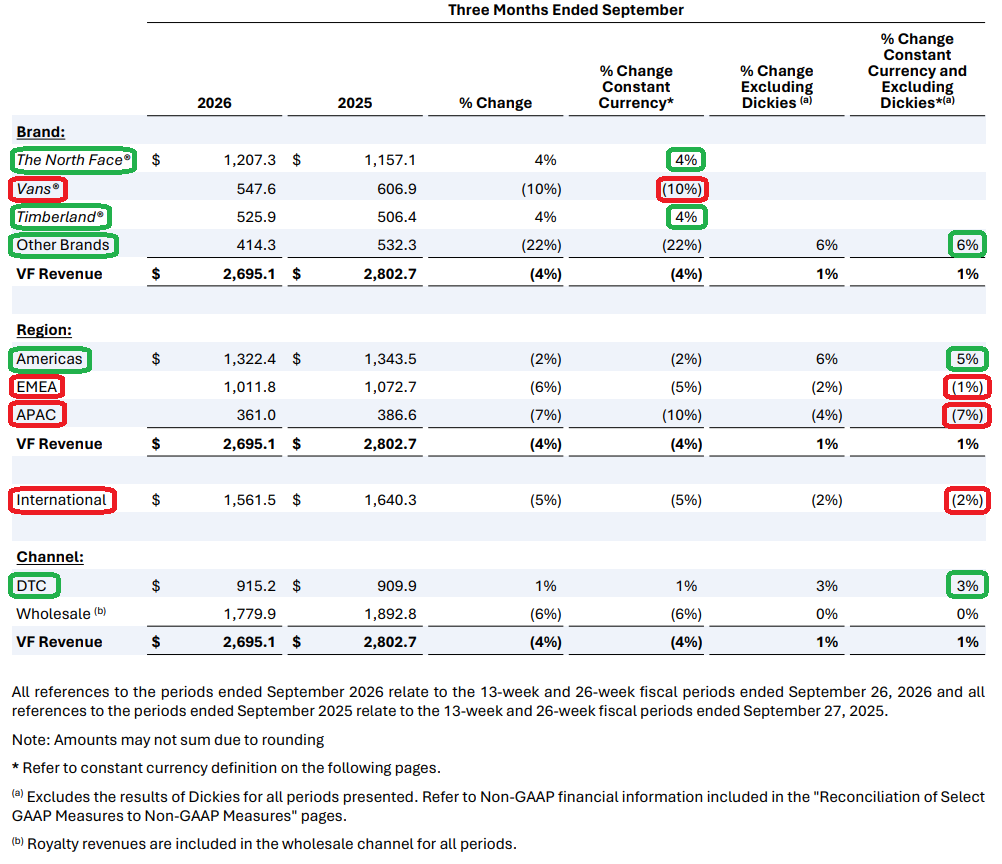
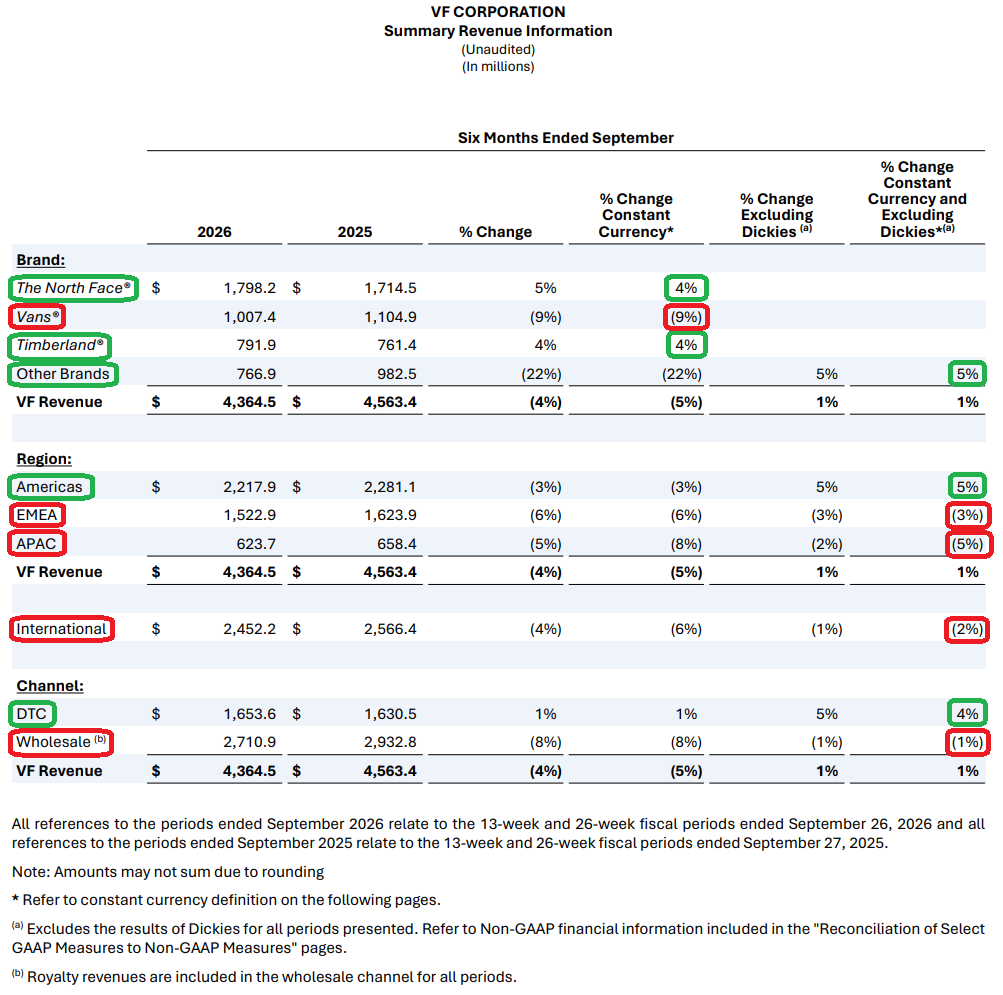
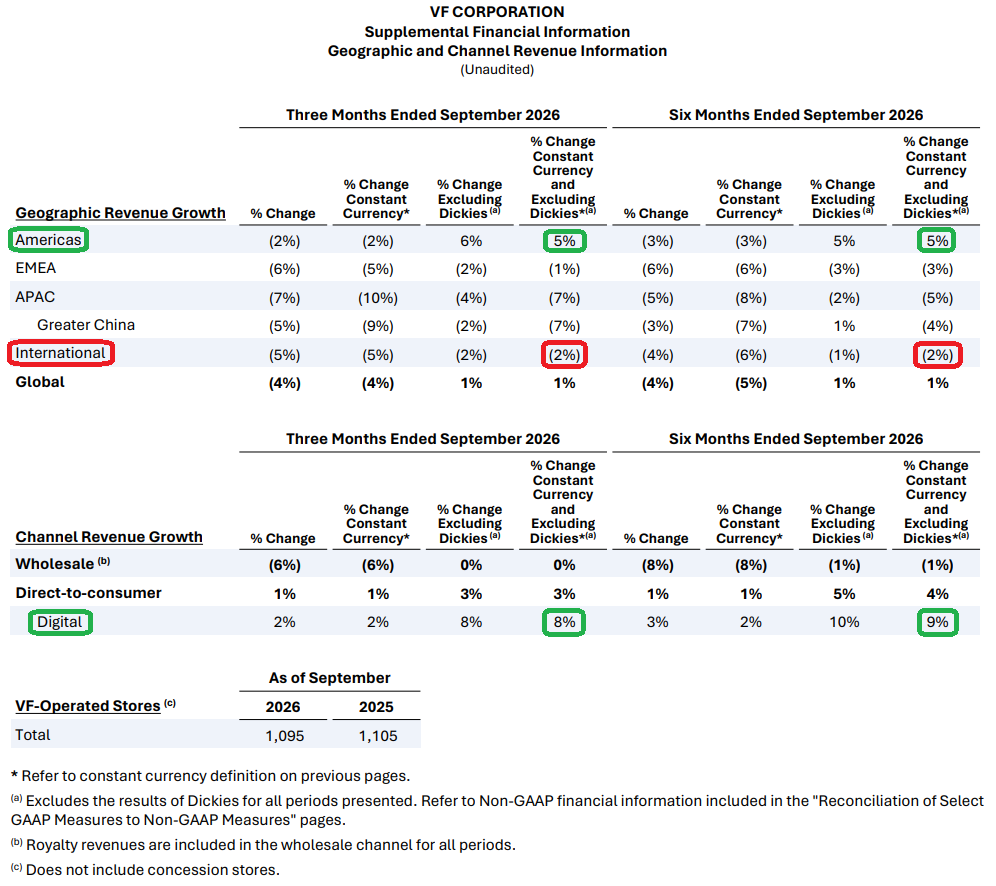
1) VF reported Q2 revenue of $2.70B, +1% C$ ex-Dickies, ahead of guidance for a ~flat C$ quarter and ~$30M above the Street. By region, the Americas grew +5% C$, while EMEA declined (1%) C$ and APAC declined (7%) C$. By channel, DTC grew +3% C$, including Digital at +8% C$, while Wholesale was flat as Vans destocking offset growth elsewhere in the portfolio. 75% of the business by revenue is now growing, compared to 43% in FY24, moving VF closer to management’s long-term target of 80%+ for a healthy multi-brand company.
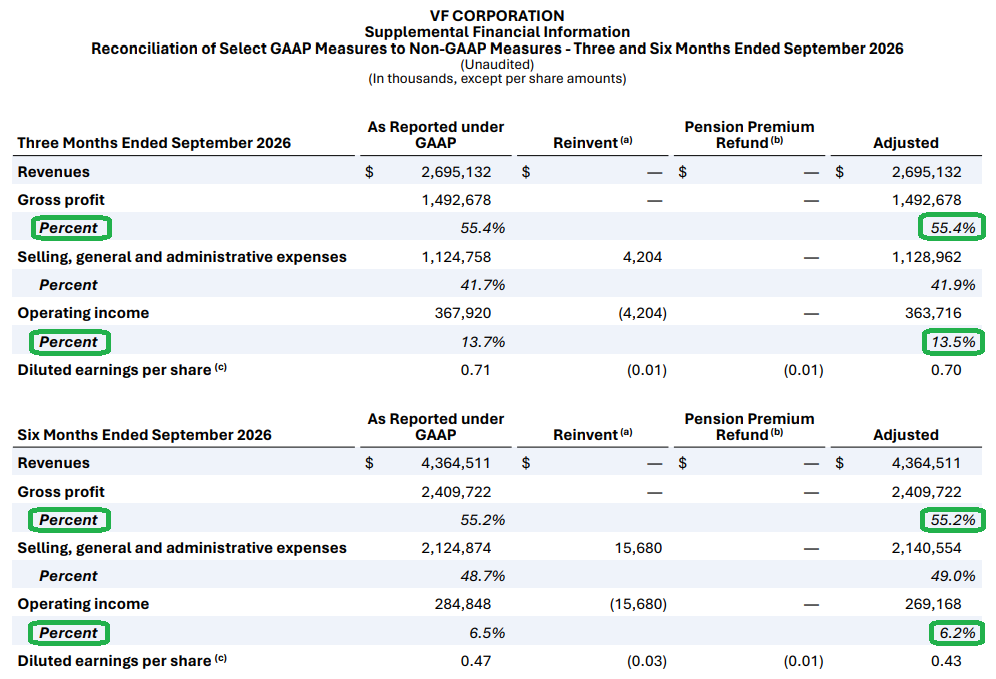
2) Adjusted EPS ex-Dickies came in at $0.70, up +42.9% from $0.49 LY and $0.17 ahead of consensus of $0.53. EPS grew at nearly 3x the rate of adjusted operating income (+15.5%) on just ~1% top-line growth, with all three forms of leverage management highlighted on the call showing up at once: operating leverage, lower interest expense, and a lower tax rate. Net interest expense fell to $23.7M from $46.2M LY, below the ~$30M guided, as debt paydown flows through the P&L, while the effective tax rate came in at ~18% following the resolution of historical tax matters.
3) Adjusted gross margin ex-Dickies expanded 290 bps Y/Y to 55.4%. ~180 bps of that expansion was structural, driven by lower product costs, integrated business planning, and surgical price increases. The remaining ~110 bps was an FX tailwind that reversed Q1’s ~140 bps headwind, keeping full-year FX tracking ~flat. Tariffs had minimal net impact as VF lapped similar rates, with help from vendor negotiations, while tariff refunds carry no net gross margin impact in FY27. YTD adjusted gross margin reached 55.2%, up 180 bps Y/Y, with management expecting Q3 gross margin to rise again, though at a slower pace than Q2’s structural gains as $70-80M of unmitigated H2 tariff costs flow through. This keeps VF on track for full-year gross margin expansion and comfortably above its FY28 target of 55%.
4) Adjusted operating income ex-Dickies of $363.7M grew +15.5% Y/Y and topped guidance of ~$315M by ~$50M. That produced an adjusted operating margin of 13.5%, up 170 bps Y/Y. ~Half of the beat came from stronger revenue and gross margin, while the other half reflected ~$25M of SG&A shifting from Q2 into Q3. Adjusted SG&A rose +4.3% Y/Y to 41.9% of revenue, up 120 bps, as VF reinvests in DTC, marketing, and product design and innovation, with the >$225M of structural savings taken out since FY24 remaining in the run rate. YTD adjusted operating margin reached 6.2%, up 30 bps Y/Y, with management guiding Q3 adjusted operating income to ~$390M or better, ~$50M+ above LY, including the SG&A shifted from Q2. This keeps VF on track for a full-year adjusted operating margin of ~8%, up from 7.0% in FY26.
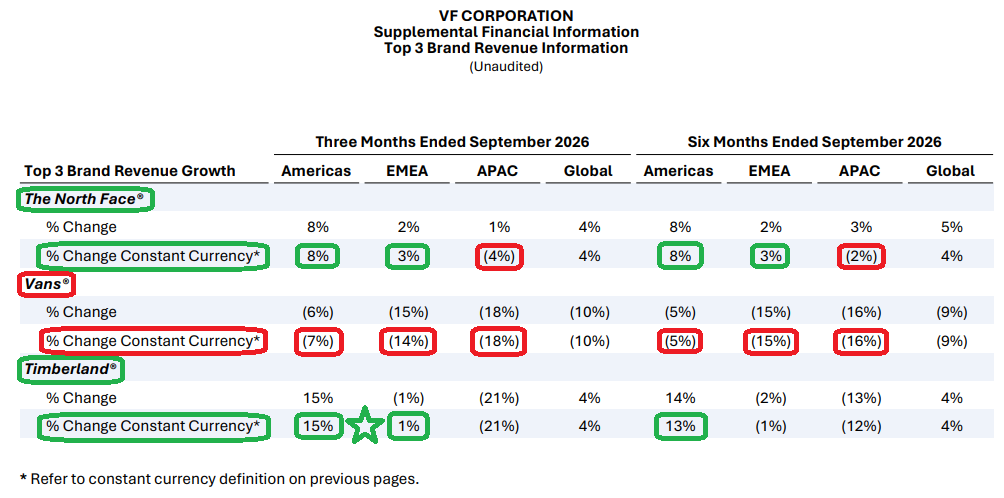
5) The North Face grew +4% C$ to $1.21B, its eighth straight quarter of growth and well ahead of management’s ~flat expectation. Part of the upside reflected wholesale demand landing in Q2 rather than Q3, with the balance coming from stronger execution in Americas DTC. By region, the Americas grew +8% C$ and EMEA grew +3% C$, while APAC declined (4%) C$. Growth was broad-based across categories, with apparel led by bottoms and transitional jackets such as the Quest and Yumiori Fleece, while footwear grew double digits across every region and bags posted another strong quarter. The brand was named a top 10 athletic clothing brand in Piper Sandler’s teen survey for the first time in three years, with the reversible Nuptse launching this season alongside the first U.S. Ski & Snowboard drop. Management guided Q3 to +4% or better while raising its full-year outlook to up mid-single digits, with Bracken reiterating that the brand can double over time.
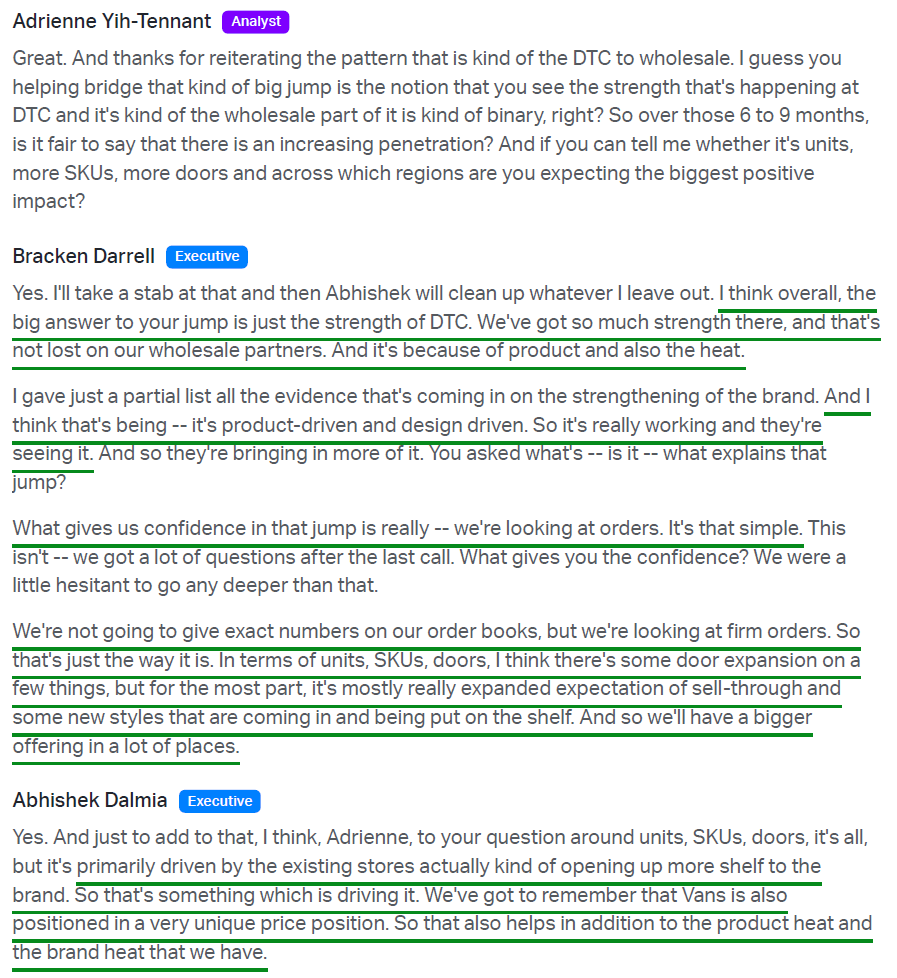
6) Vans declined (10%) C$ to $547.6M, ~$3-4M softer than guided as continued wholesale destocking weighed on the quarter, with the Americas at (7%) C$, EMEA at (14%) C$, and APAC at (18%) C$. Beneath the headline decline, global DTC returned to growth for the first time in almost five years, extending management’s progression from U.S. e-commerce to Americas DTC to global DTC. Product is driving the turn, as Old Skool led icon growth on new versions like Pearlized and Souvenir, Authentic delivered another strong double-digit quarter, and Slip-On returned to growth, while new styles such as the Super Lowpro, Mules, and Loafer are adding further heat. Wholesale continues to trail DTC by its typical 6-9 month lag, with new silhouettes tested in e-commerce and stores now flowing into Spring/Summer ’27 sell-in. Management guided Q3 to (4%) or better and H2 to (2%) or better, with the larger wholesale improvement expected in Q4 given Q3’s seasonally heavier DTC mix. Firm Fall/Winter ’26 and Spring/Summer ’27 orders, primarily from existing partners expanding shelf space and adopting new styles, keep the full year on track for a mid-single-digit decline versus (11%) in FY26.
7) Timberland grew +4% C$ to $525.9M, its eighth straight quarter of growth, led by the Americas at +15% C$. EMEA grew +1% C$, while APAC declined (21%) C$ (~$12M), in line with expectations as VF works through changes with its regional partner. The 6-inch boot continued to grow, though shoes and other boots grew faster as franchises like the Field Boot and Boat Shoe broaden growth beyond the core. Management sees sneakers and apparel as significant longer-term growth opportunities, while Timberland PRO offers another lever as core franchises resonate with consumers and a new multiyear NASCAR partnership expands the brand’s reach. VF opened five more full-price stores in the Americas, bringing the total to 19, with plans for selective expansion in key cities. Management guided Q3 to +4% or better while raising its full-year outlook to up mid-single digits.
8) Other Brands grew +6% C$ ex-Dickies to $414.3M, once again led by Altra, which grew 40%+ with gains in every region and channel to remain VF’s fastest-growing brand. Growth was strong across both Road and Trail, led by the Torin 9, which delivered the season’s biggest launch with strong sell-through. With Altra already leading in trail and road running representing a market ~10x larger, the brand has massive runway toward management’s $1B+ ambition.
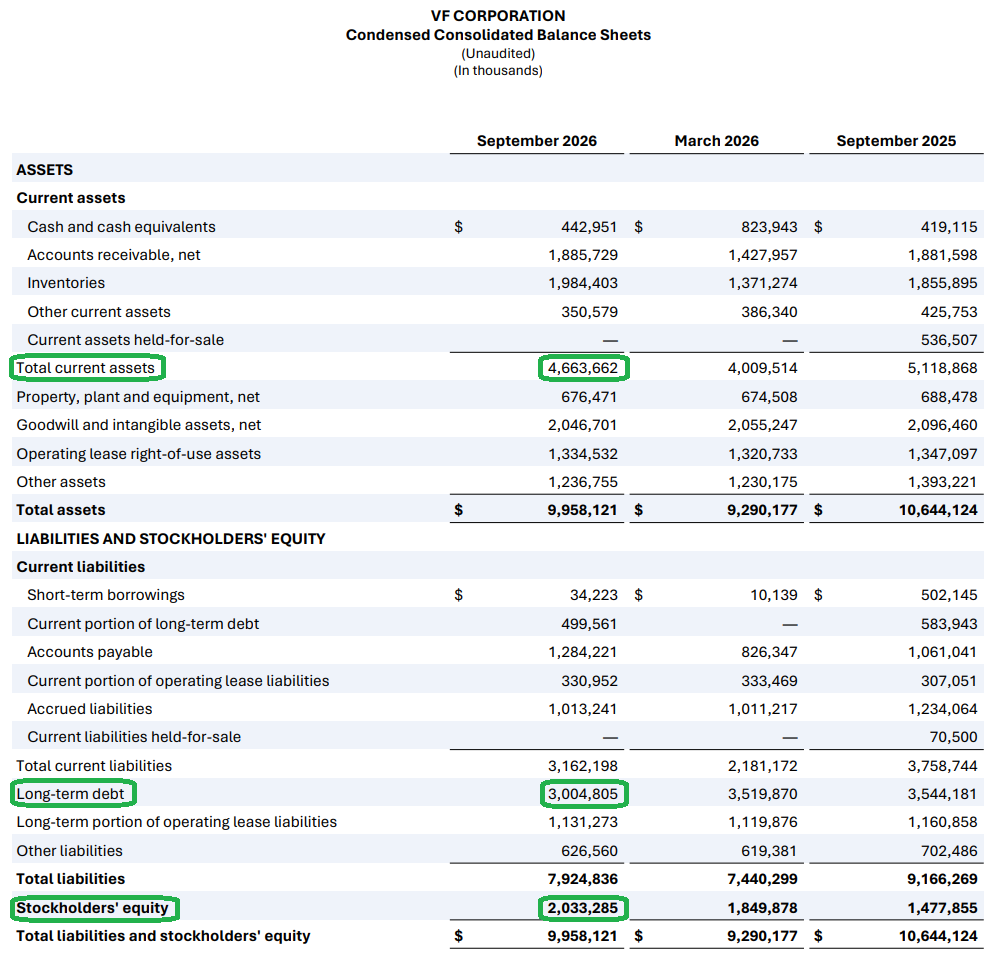
9) Free cash flow was an outflow of ~($207M) in Q2 versus ~($262M) LY, bringing H1 to ($322.7M), a $130.4M improvement Y/Y driven by tariff refunds collected YTD. Normalized H1 FCF was ~in line with LY and consistent with historical seasonality. Management reaffirmed FY27 FCF of flat to up versus the normalized $405M baseline, with actual FCF expected at ~$515M or better once ~$110M of net tariff refunds are included. On the balance sheet, net debt ended the quarter at $4.6B, down $1.1B or (20%) Y/Y, while net debt excluding lease liabilities fell to $3.1B, down $1.1B or (26%) Y/Y. Net inventories rose +7% Y/Y as a deliberate build to support H2 demand, with management flagging inventory management as a key priority for FY28 and beyond. Debt paydown remains the top capital allocation priority, with VF planning to prepay its April 2027 maturity in March as it works toward FYE27 leverage of 2.6x to 2.9x.
10) Management reaffirmed its FY27 revenue outlook of +2% or better C$ ex-Dickies, raising its full-year outlook for The North Face and Timberland to up mid-single digits each while maintaining its outlook for Vans at a mid-single-digit decline. Adjusted gross margin is expected to increase Y/Y, supporting an adjusted operating margin outlook of ~8%, while the full-year effective tax rate was lowered to the high 20s from the low 30s following the resolution of historical tax matters. For Q3, management guided revenue to +3% or better, an acceleration from H1’s +1% C$ pace, as The North Face and Timberland each grow +4% or better and the Vans decline narrows to (4%) or better. Medium-term targets were also reaffirmed, calling for leverage of 2.5x or better by FY28 and an adjusted operating margin of 10% or better for FY29, with Bracken stressing that VF is “absolutely not stopping at 10%.”
Earnings Call Highlights
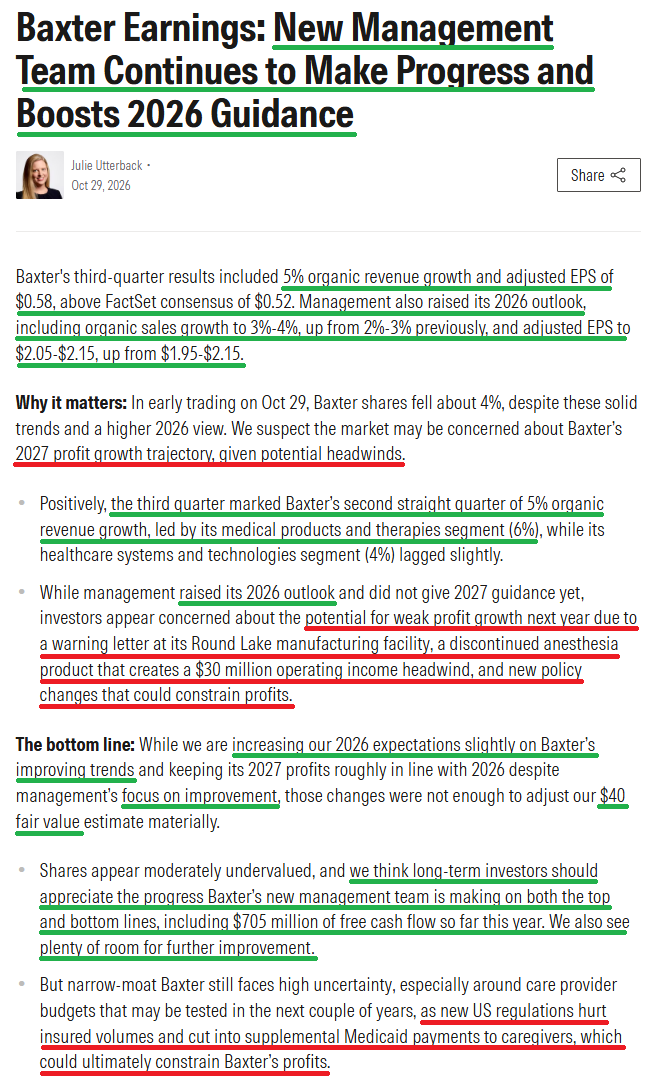
Morningstar Analyst Note
BAX Update
For newer readers, here’s a quick overview of the key drivers behind our thesis on Baxter (BAX), a century-old medtech leader where temporary headwinds and operational missteps have created an opportunity for a Danaher-trained CEO to reset execution and restore normalized earnings power:
Company Overview
Founded in 1931 in Chicago. The first commercial manufacturer of prepared IV solutions and a supplier of blood products to U.S. armed forces in WWII. An iconic ~100-year medtech brand.
Global leader in IV fluids/infusion systems, inhaled anesthetics, and hospital essentials (infusion pumps, smart beds, injectable drugs).
Two reportable segments as of Q2 2026: Medical Products & Therapies (~70% of sales, now including the former Pharmaceuticals business, folded into the new Infusion Therapies & Platforms division) and Healthcare Systems & Technologies (~27%), plus Other (~3%, Vantive/Kidney Care MSA revenue).
FY2025 revenue: $11.24B (+6% Y/Y).
U.S. ~55% of sales, international ~45%.
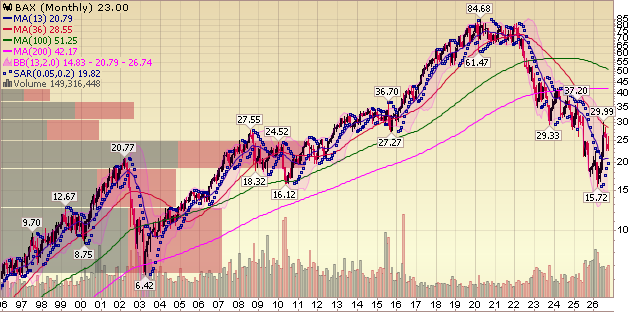
Shares down ~72% from the 2020 peak (~$83, market cap >$47B to ~$13B today).
Historically, rare 50%+ drawdowns in BAX have delivered multi-baggers on the recovery. Only four other instances in its operating history: ~59% in 1974, 61% in 1984, 68% in 2003, and most recently, 81% in March 2026.
Management — CEO Andrew Hider
Appointed July 2025, started September 3, 2025.
Previously CEO of ATS Corporation since 2017, where he delivered a ~5x bagger in six years (automation solutions; Baxter was a customer).
Spent 10+ years at Danaher mastering the “Danaher Way” — continuous improvement, operational excellence, and execution discipline.
New CFO John Rogers joined October 1, bringing a med tech background and a track record of leading complex organizations through transformation and performance improvement.
Already rolled out the Baxter Growth and Performance System (GPS) just months in.
Aimed at driving continuous improvement, enterprise-wide efficiency, and a growth mindset. 700+ continuous improvement initiatives completed YTD 2026, 200+ in flight, and ~350 more planned, following the 10 President’s Kaizen events that kicked off the year, with focus on cash flow, service reliability, and speed to market.
GPS is the new permanent operating system for the enterprise, with management layers removed, P&L responsibility pushed directly to segment leaders, and rigorous KPI frameworks embedded throughout the organization.
Hillrom + Deleveraging
Acquired Hillrom in December 2021 for $10.5B equity / $12.5B enterprise — the largest deal in Baxter’s history. Expanded into connected care (beds, patient monitoring, digital tools).
A $3.1B goodwill impairment in 2022 confirmed the overpay (~20x EBITDA for a $3B revenue company). Debt ballooned to $17B against $2.9B in cash, with leverage going from <1x to nearly 5x just as rates soared.
Responded with aggressive divestitures: sold BioPharma Solutions for $4.25B (2023) and Vantive (Kidney Care) for $3.8B to Carlyle (2024). The kidney segment was the slowest-growing (+1% FY2023) and lowest-margin (6.7% EBIT) — the divestiture removed a structural drag.
Net debt reduced from ~$15B (2023) to ~$6.6B as of Q3 2026, down from ~$7.5B at year-end 2025.
Net leverage on track for ~3x by end of 2026. Cash: $1.98B vs. $8.6B in total debt ($7.76B long-term plus $844M current maturities).
Potential for smaller divestitures/portfolio pruning in 2026 to support further deleveraging.
Completed a $600M cash tender offer in Q3 2026, retiring $864M of debt at ~69 cents on the dollar.
Dividend cut to $0.01/quarter (Q4 2025) frees >$300M in annual cash flow for debt paydown. Interest expense savings from $439M (2023) to $210-220M (2025) — a ~$0.44/share benefit.
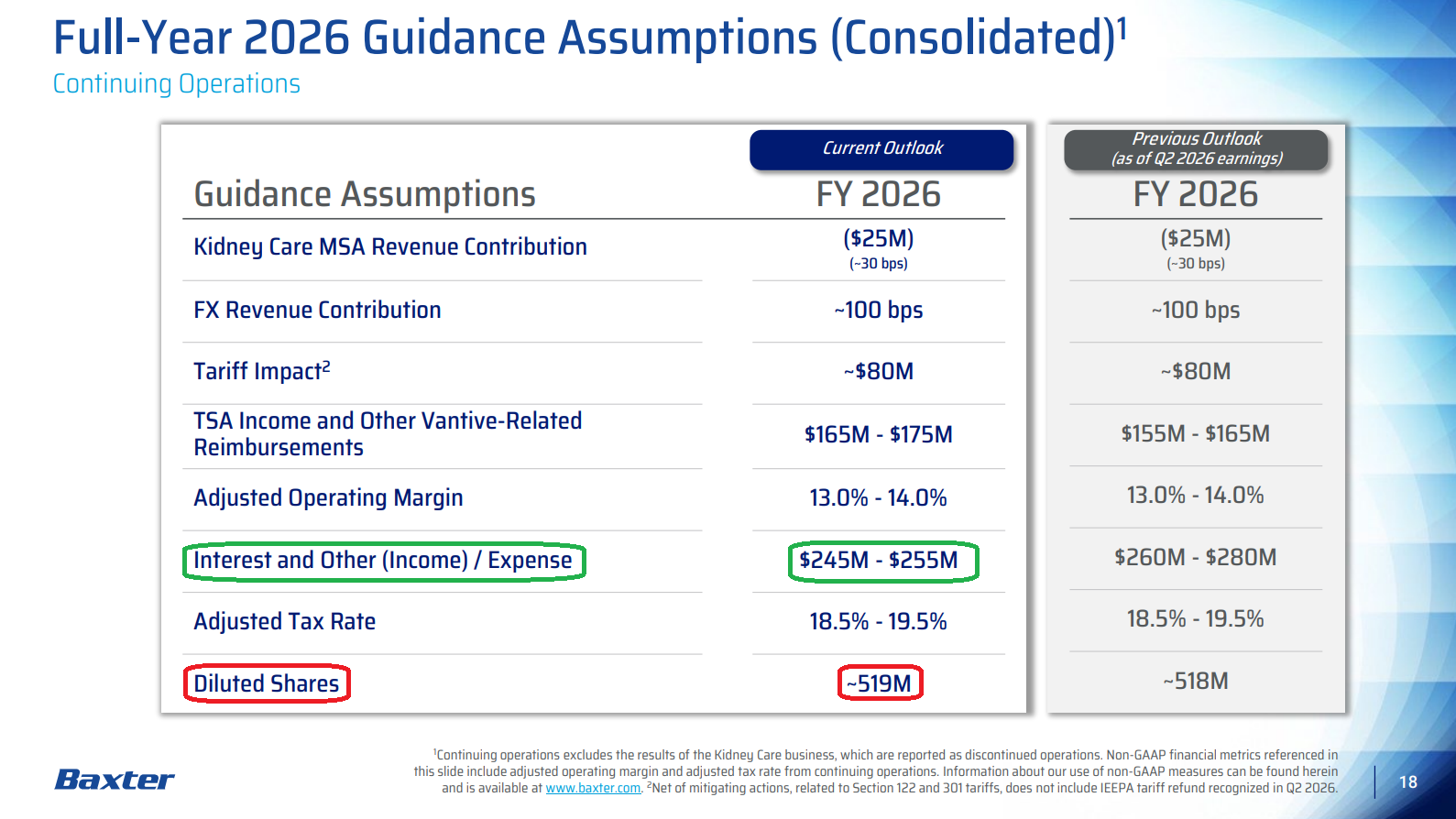
FY2026 net interest and other expense now guided to $245-255M, lowered from $260-280M following the tender.
Solvency risk is off the table. The balance sheet is positioned for future flexibility and eventual buybacks.
IV Fluids Disruption: Hurricane Helene
Hurricane Helene (September 2024) flooded the North Cove, NC plant, which supplied ~60% of U.S. IV fluids. Production halted, triggering a national shortage.
Full recovery reached by May 2025 — pre-hurricane production levels restored and allocations removed for nearly all IV codes.
Hospitals had conserved and rationed during the disruption, and volumes remain ~10-15% below the pre-hurricane baseline. Management is treating current demand as the new baseline and right-sizing the labor and support footprint accordingly. IV Solutions returned to growth in Q3 2026 off the new lower baseline.
This mirrors the Hurricane Maria playbook (~2-year normalization).
Novum IQ Pump
Novum IQ is the first new large-volume infusion pump in ~30 years. Had strong early momentum — drove 50% infusion growth in 2024, gained +200 bps of share, and converted major accounts.
Ship and installation hold expected to remain in place through full-year 2026. Field-action corrections have now been identified and are in early verification testing, a step forward from Q1, pending regulatory submissions. Management reported continued progress with regulators in Q3.
No material impact from customer returns in Q1 or Q2 2026.
Exposure is limited (~2% of revenue for the total pump portfolio including Spectrum). Spectrum demand remains strong in the meantime, with Infusion Systems growth in Q3 driven by Spectrum IQ.
Margin Recovery
Adjusted operating margin fell from 18.8% (FY2021) to a 13.9% trough (FY2024). The culprit: fixed-price GPO contracts with no price escalators got crushed by inflation, supply disruptions, and low volumes.
Recovery underway — 14.1% for FY2025. Q1 2026 adjusted operating margin came in at 11.0% (-390 bps Y/Y), weighed down by an expected unfavorable prior-year comp, tariffs, and elevated manufacturing costs including lower absorption.
Q2 2026 adjusted operating margin recovered to 14.2% (-90 bps Y/Y), with gross margin 38.6% (-210 bps), bringing 1H 2026 adjusted operating margin to 12.7%.
Q3 2026 adjusted operating margin of 14.5% (-40 bps Y/Y), with gross margin 38.3% (-110 bps) on mix and a lower pricing contribution, bringing YTD adjusted operating margin to 13.3%. HST segment margin expanded 140 bps to 17.2%.
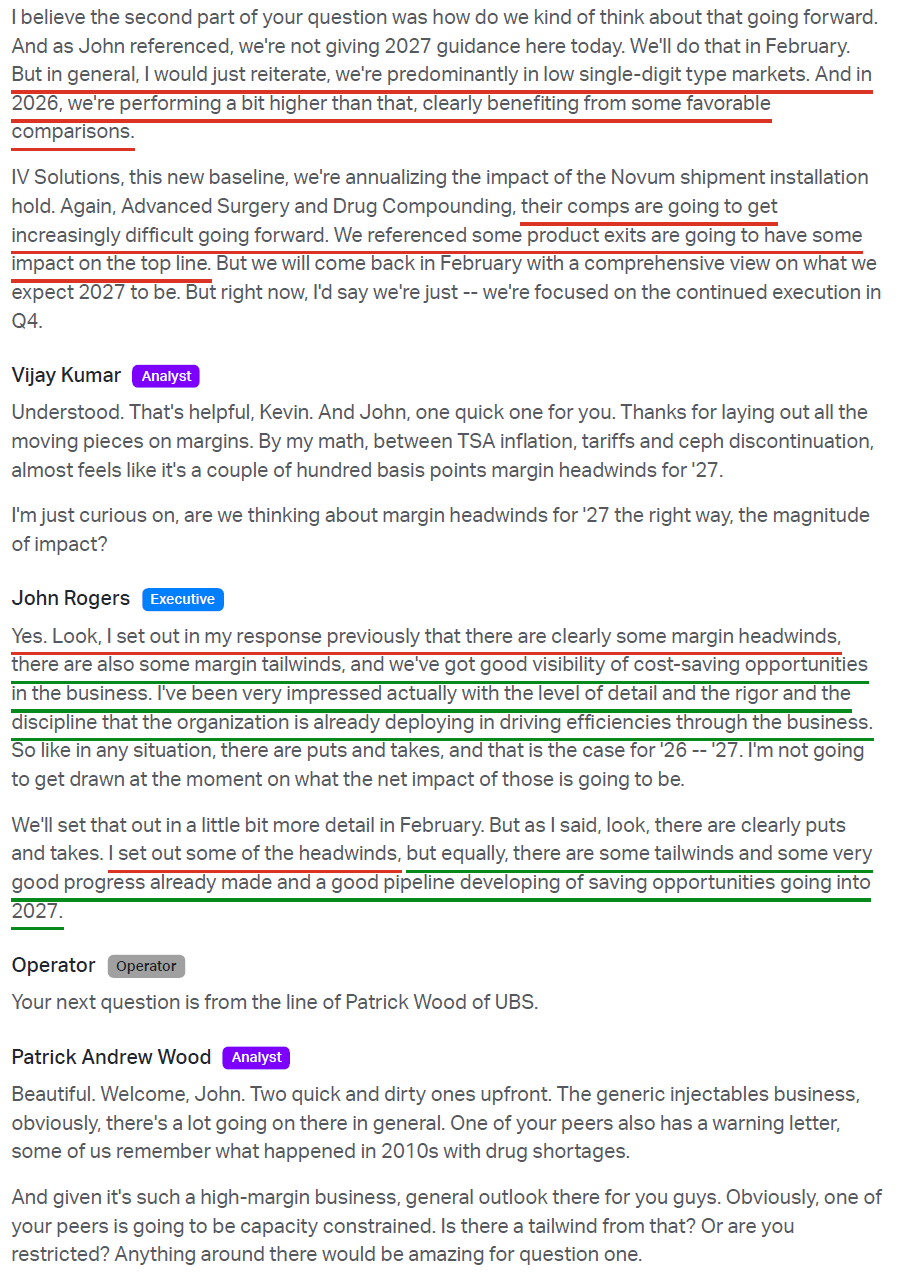
FY2026 guide reiterated at 13-14%, implying ~500 bps of expansion from the first half to the second half, with the bridge broken down as: volume-driven operating leverage (~250 bps), largely complete cost structure actions (~125 bps), and rolling through higher-cost inventory produced in the second half of 2025 (~125 bps). That higher-cost inventory has now fully cycled through, with Q3 delivering the expected step-up and Q4 expected at a similar level.
Two GPO contracts reset in early 2025 (+100 bps pricing benefit), with a third reset in 2026 that impacts 2027.
Upside drivers: stranded kidney-care costs rolling off (~250 bps uplift as production winds down through 2027), GPS-driven continuous improvement, and stabilized input costs.
Path to historical high-teens (18%+) over the forecast period; normalized mid-to-high teens by 2028-2029.
Potential for structurally higher margins over time without the drag of the low-margin kidney-care segment.
Return to Growth
Stabilizing post-transformation. FY2025 operational sales +3% (reported +6%).
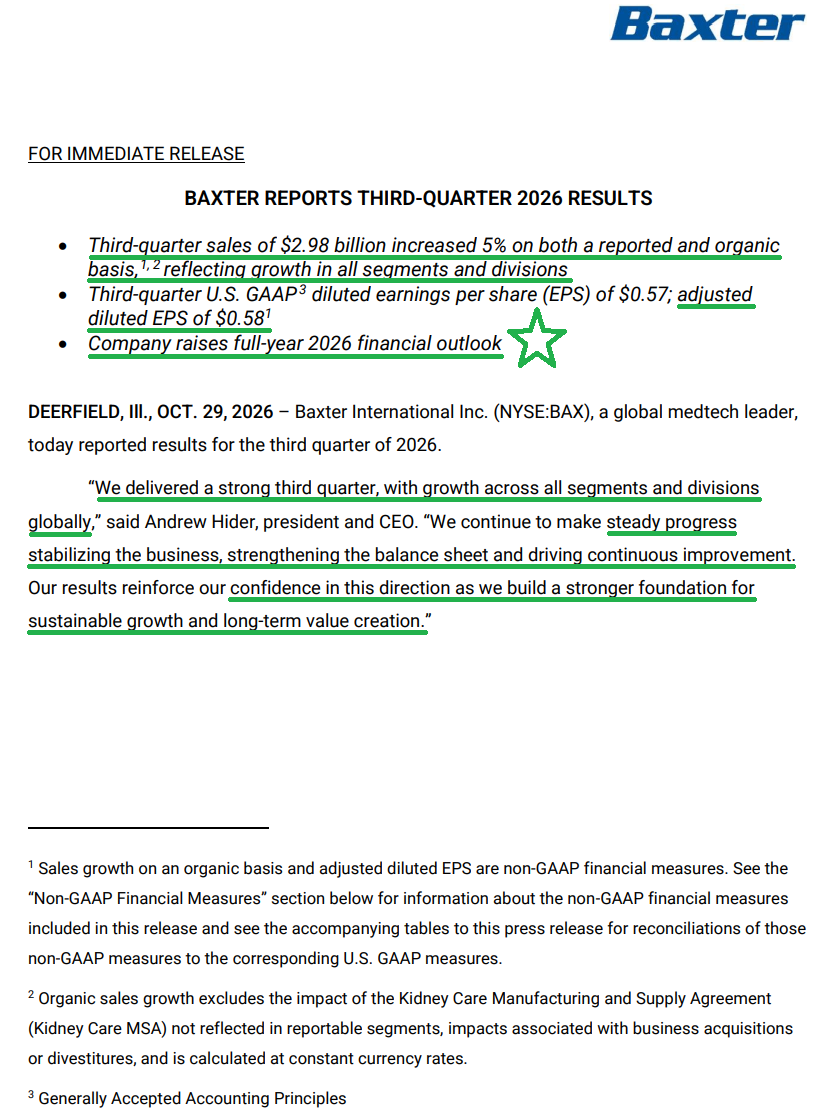
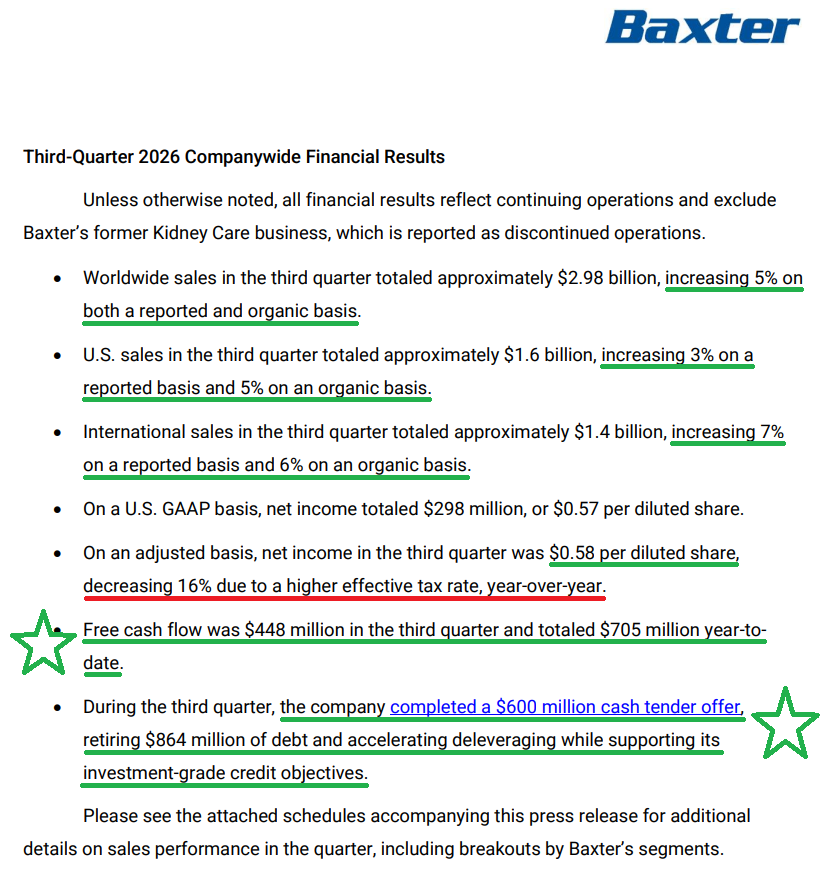
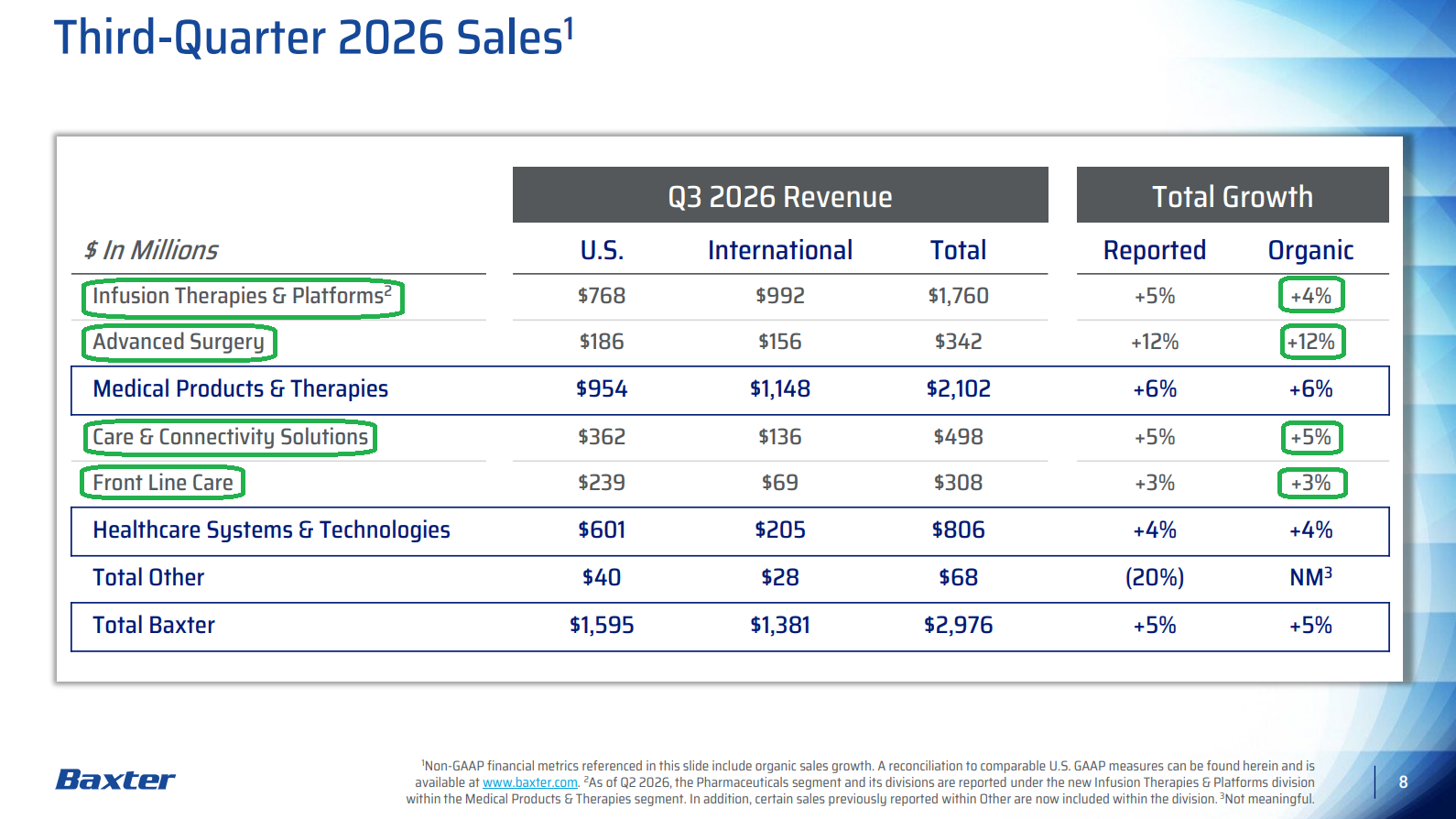
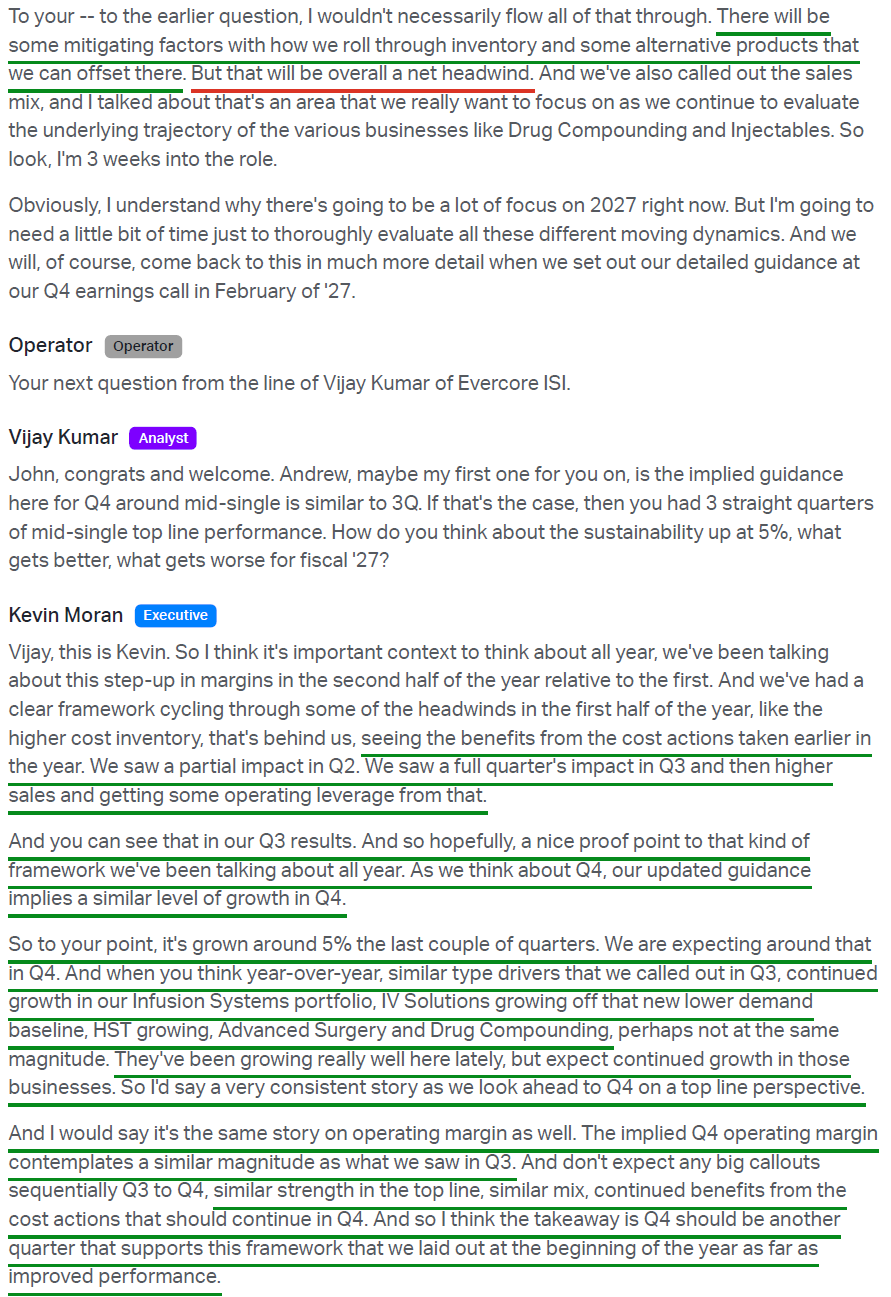
Q3 2026 revenue $2.98B (+5% reported and organic), beating consensus of $2.91B by ~$66M. U.S. sales ~$1.6B (+3% reported, +5% organic); international ~$1.4B (+7% reported, +6% organic). Growth across every segment and division, a second straight quarter of ~5% organic growth after Q1’s -1%, led by Advanced Surgery (+12%), Drug Compounding (+9%), and Infusion Systems.
End markets growing low single digits; goal is to outperform at mid-single digits long-term.
Innovation cadence building, with new product launches including Connex 360, the Dynamo smart stretcher, the IV Verify Line Labeling System, the XR spine surgical table, Purview infusion benchmarking (built into the IQX platform), and BEST APX Acute Care airway clearance, with Dynamo now launched internationally in Canada.
Hider has described the strategy as base hits rather than walk-off grand slams, with a consistent cadence of customer-driven products designed to expand value over time.
Next catalyst: 2027 guidance on the Q4 call in February, followed by the 2027 investor day, where management is expected to lay out a roadmap with long-term growth targets.
FDA warning letter (Oct. 20) on the Round Lake, IL plant, Baxter’s only U.S. pharma facility, citing four findings: antibiotic cross-contamination, sterility controls, particulate inspection, and investigations.
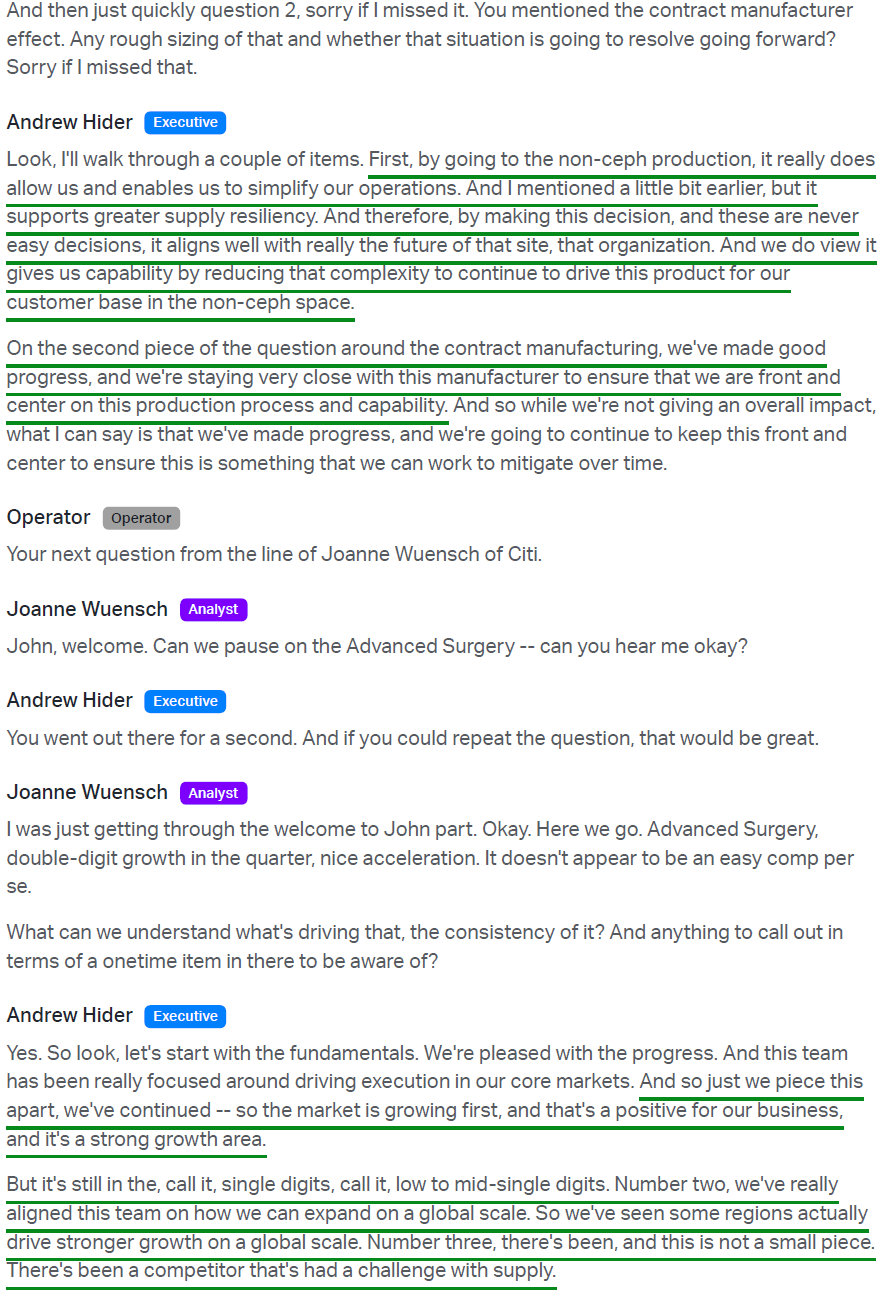
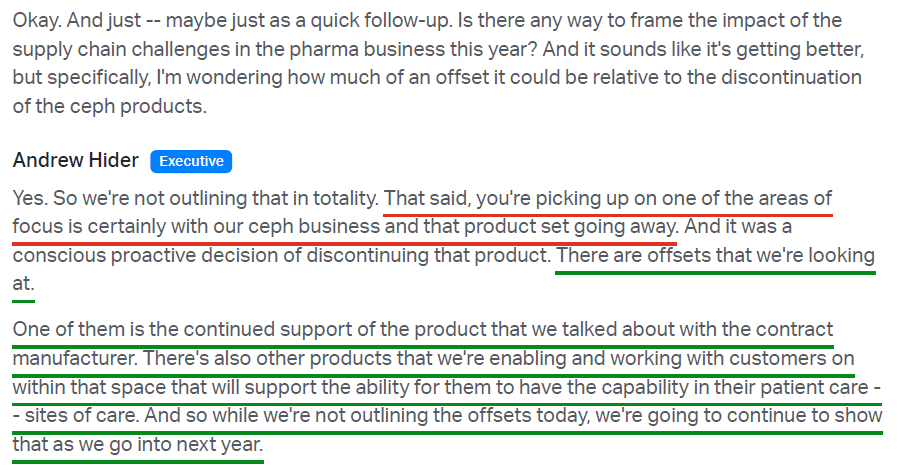
Announced it will discontinue cephalosporin production at Round Lake effective the end of October (supporting contracted customers into 2027), repositioning the site exclusively for non-ceph production and helping address complexities cited in the warning letter. Ceph products contribute ~$50M in sales and ~$30M in operating income in 2026.
Key Financials + Valuation
FY2025: revenue $11.24B (+6% reported, +3% operational). Adjusted EPS $2.27 (+20% Y/Y). Adjusted operating margin 14.1% (+20 bps). FCF $438M (+17% Y/Y).
Q3 2026 adjusted EPS $0.58 (-16% Y/Y on a higher tax rate vs. prior-year discrete tax benefits), beat consensus $0.52 by ~12%.
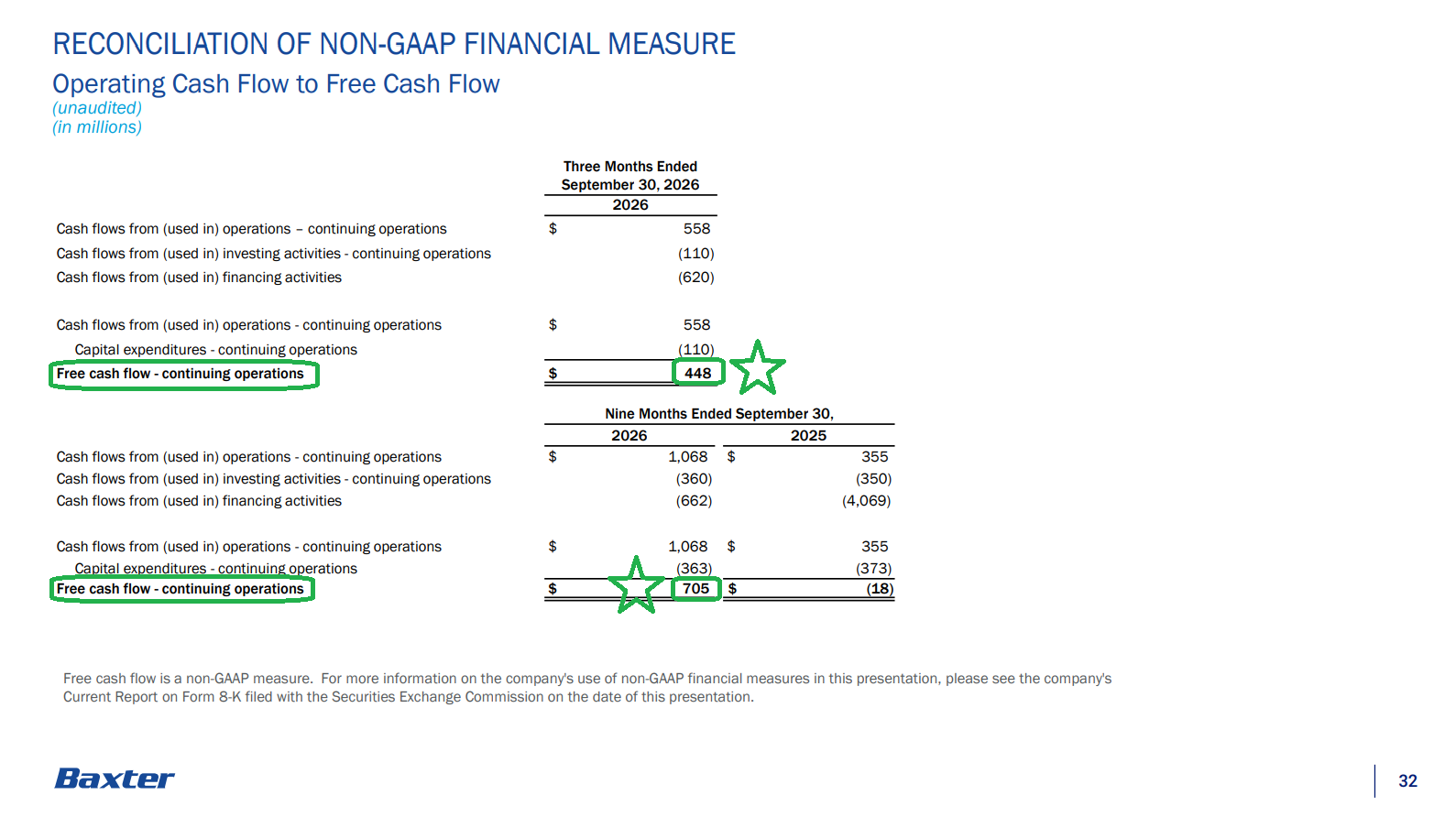
Q3 2026 FCF $448M on capex of $110M. YTD FCF $705M vs. an ($18M) outflow prior year, already ~61% above FY25’s $438M base, with Q4 seasonally the strongest cash quarter ($456M in Q4 2025).
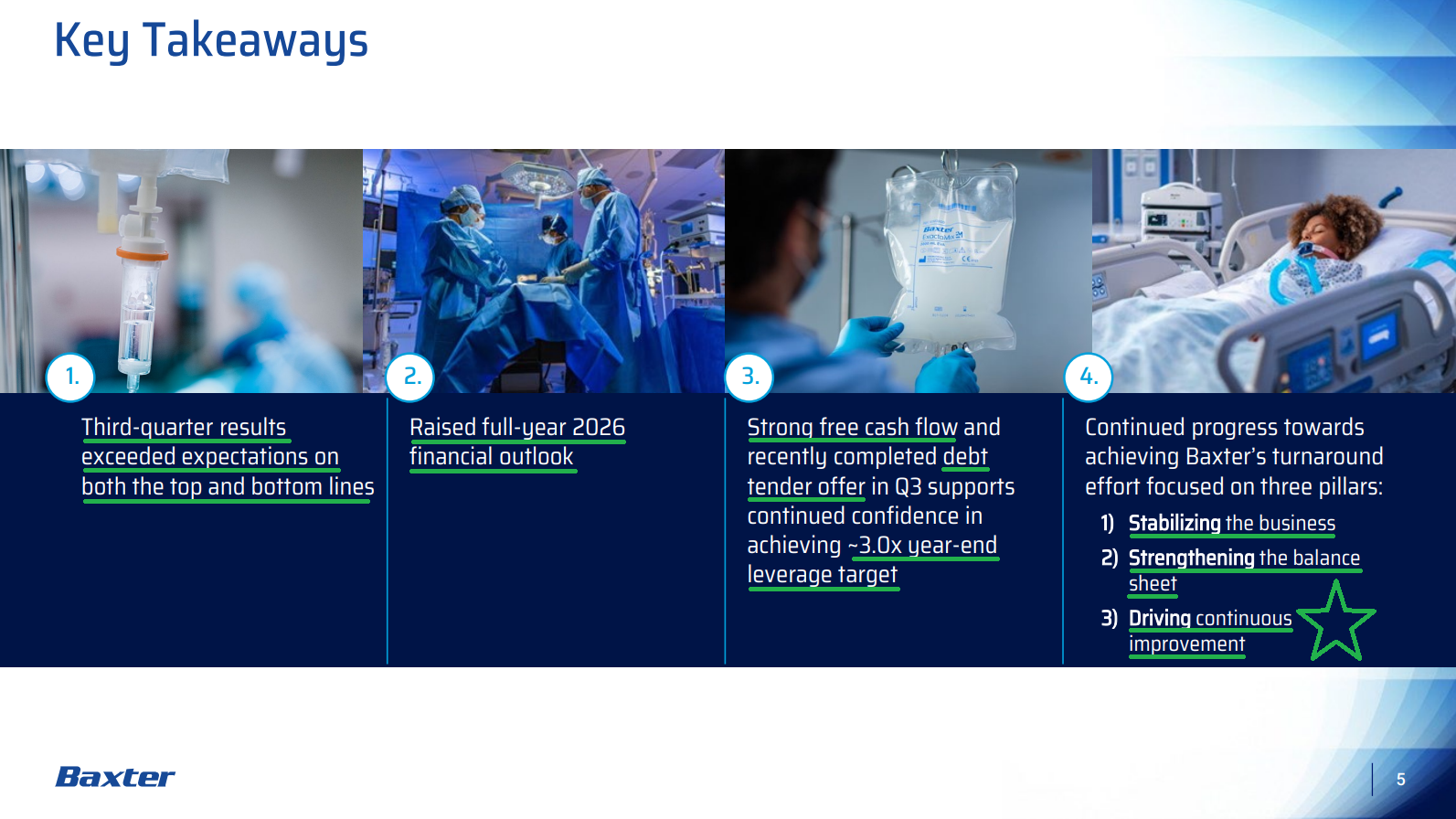
Deleveraging remains the primary use of cash, targeting ~3x net leverage by year-end 2026.
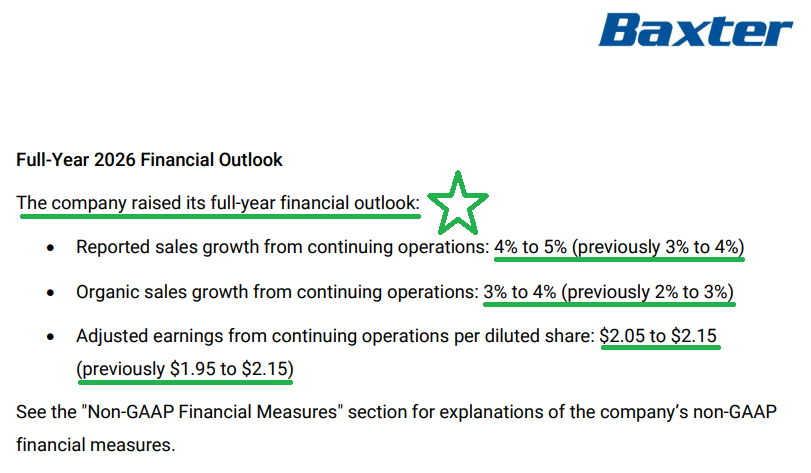
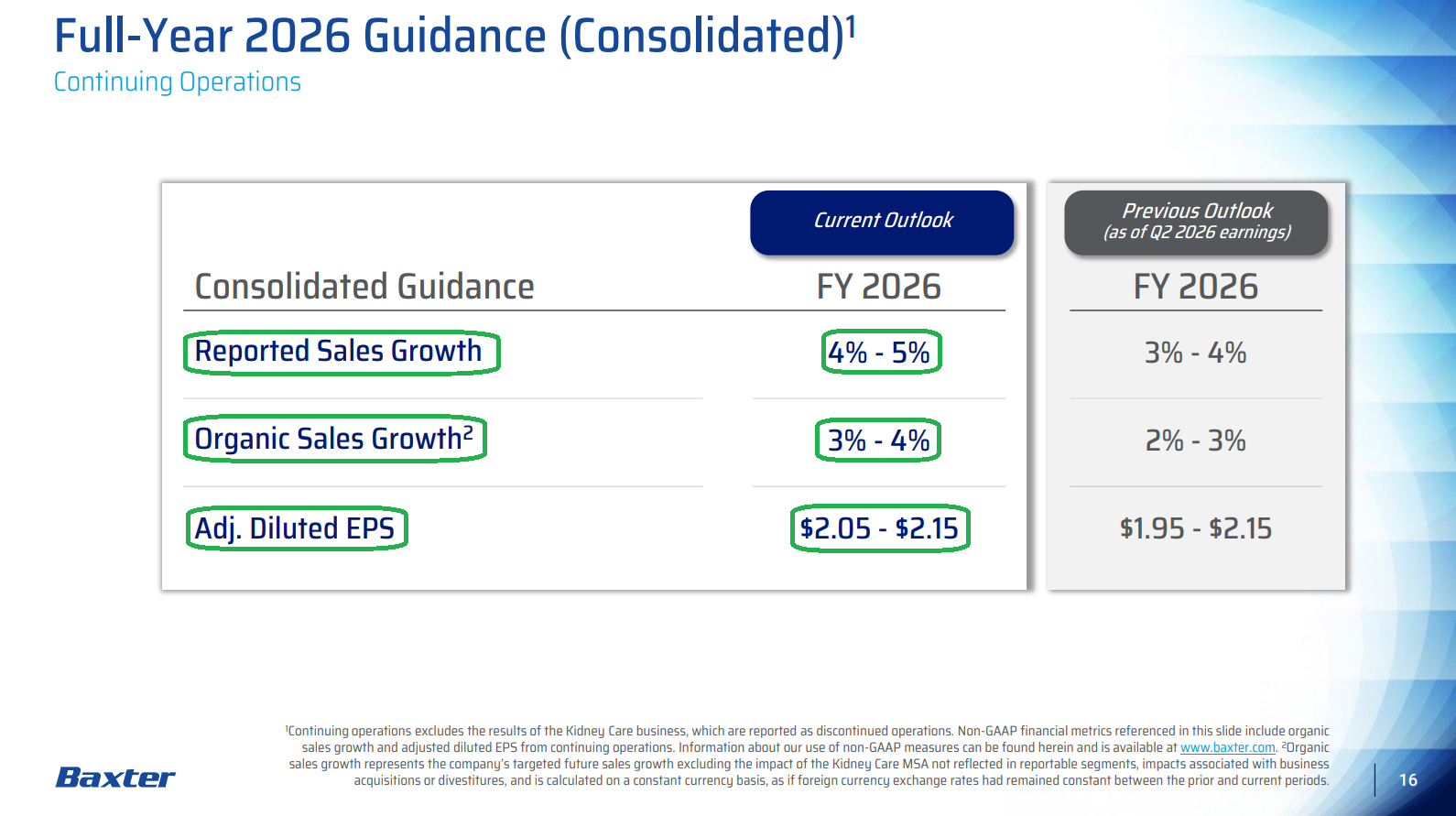
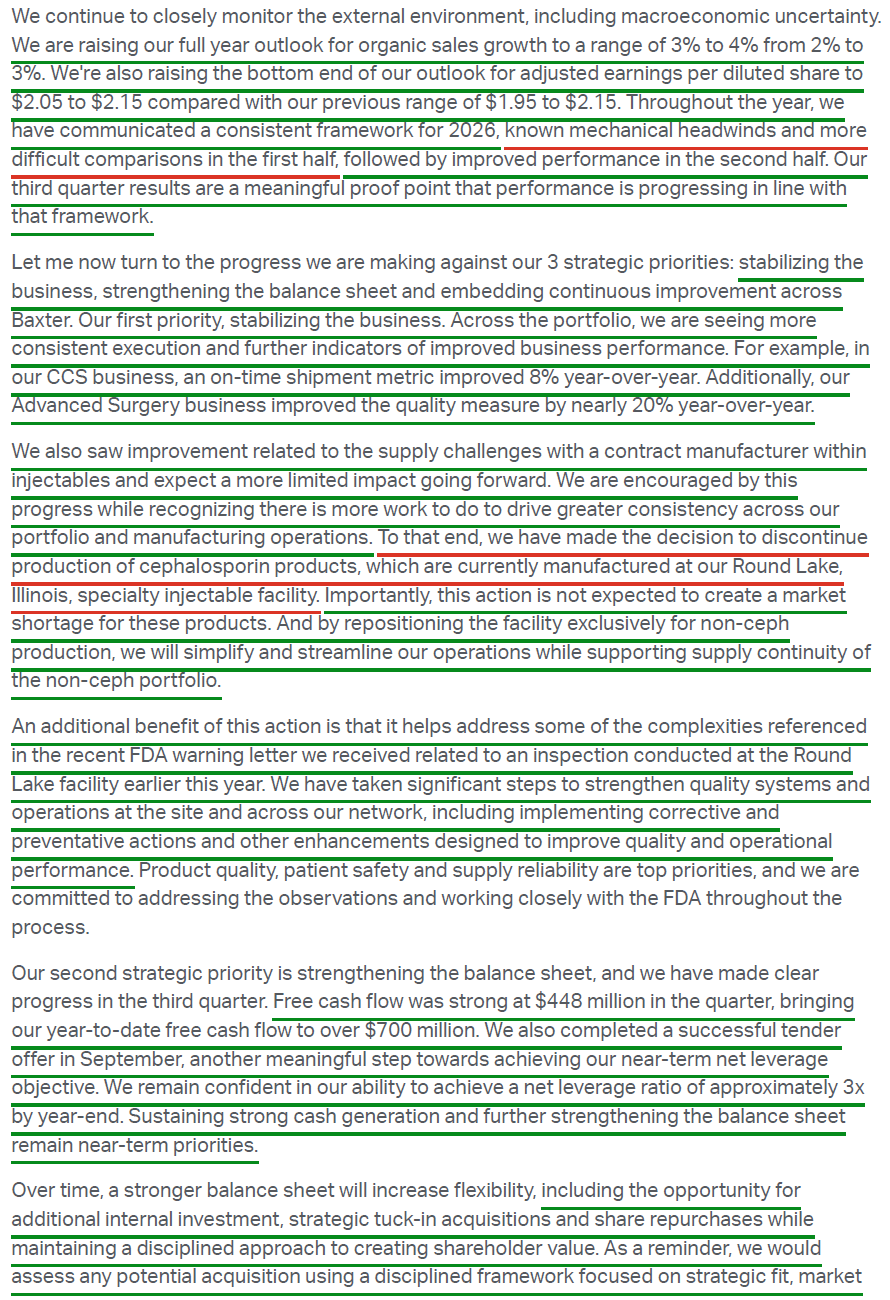
FY2026 guidance raised again: reported sales +4-5% (from +3-4%), organic +3-4% (from +2-3%). Adjusted EPS $2.05-$2.15 (from $1.95-$2.15; new midpoint $2.10). Adjusted operating margin held at 13-14%.
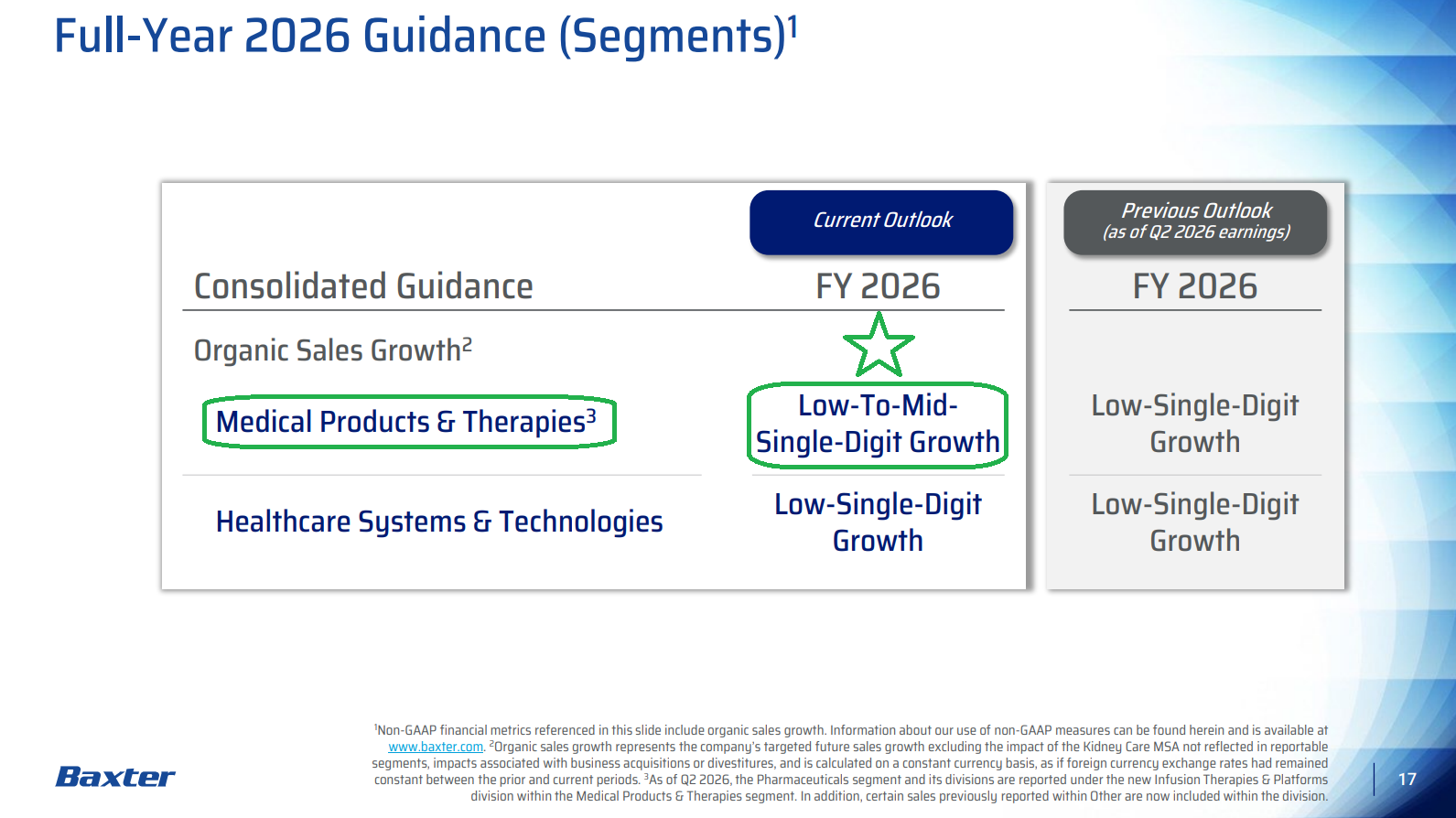
By segment: MPT low-to-mid-single-digit growth (raised from low single digits); HST low-single-digit growth. Pharma no longer broken out as a standalone segment.
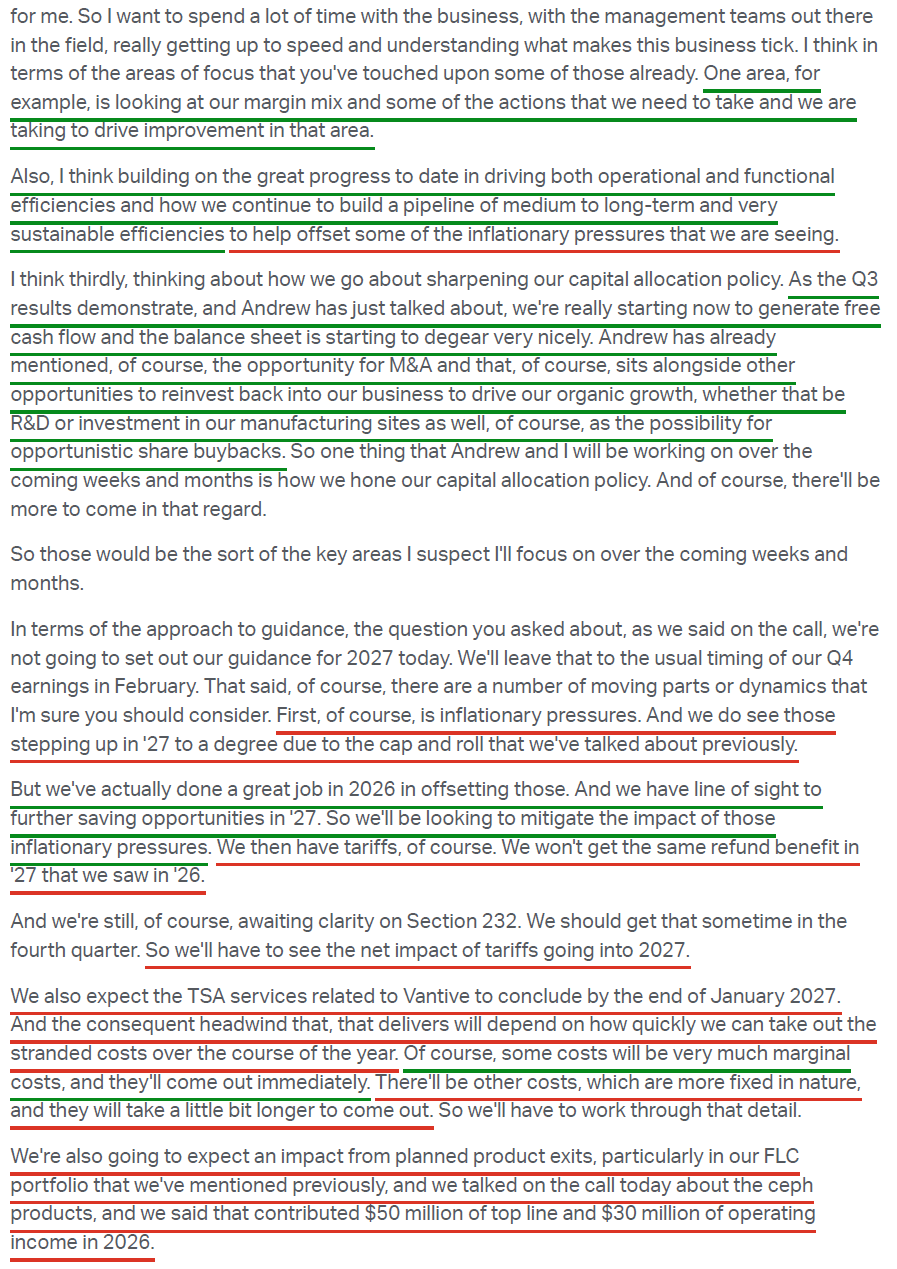
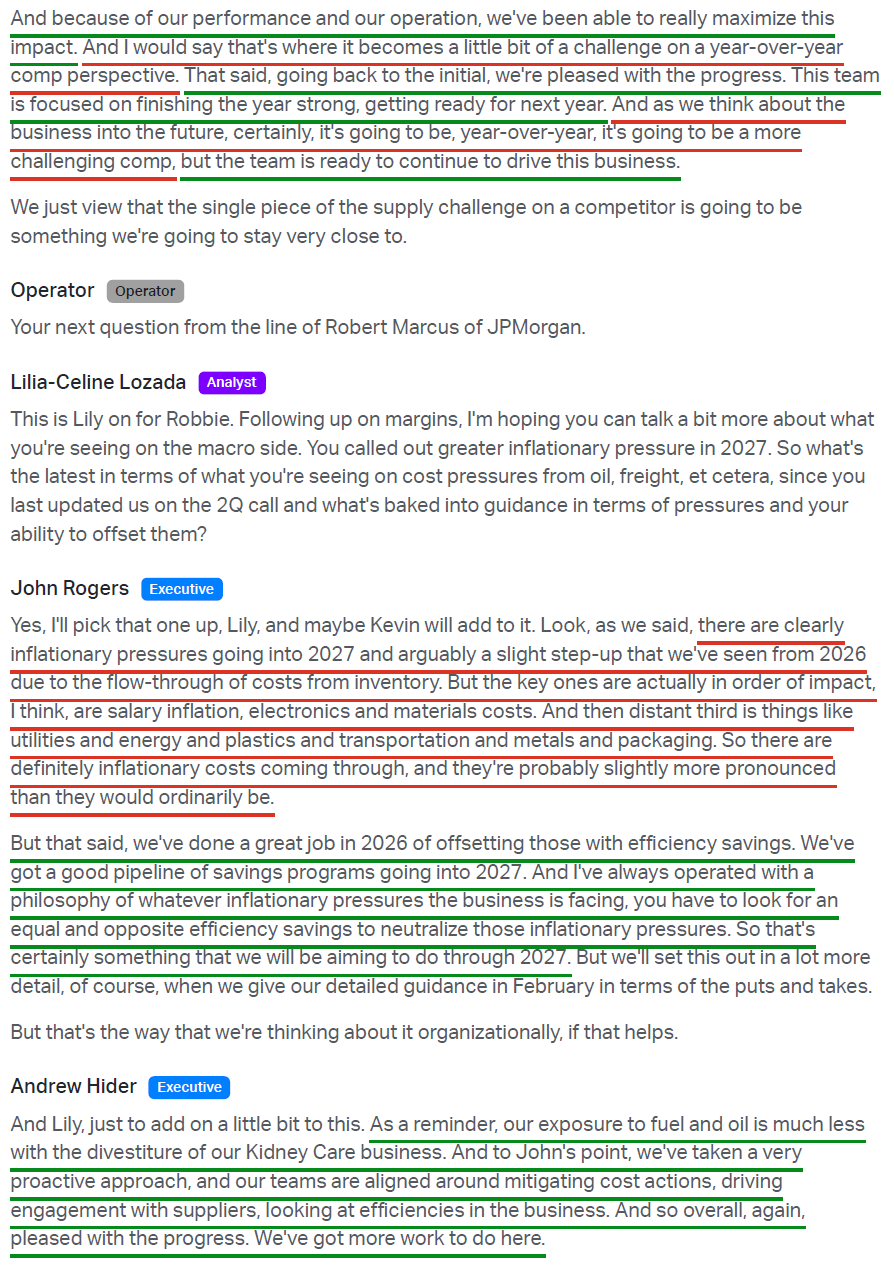
Initial 2027 read: headwinds from stepped-up inflation, no repeat of the 2026 tariff refund, stranded costs once the Vantive TSA concludes at the end of January, and the ceph and Front Line Care product exits, offset by a growing pipeline of efficiency savings.
Normalized earnings power: ~$3.50/share long-term.
Trading at ~11.5x forward earnings vs ~18x historical average.
Trades like it’s been taken out on a stretcher despite deleveraging progress, a new CEO, and a clear margin recovery path.
Q3 Earnings Breakdown
10 Key Points
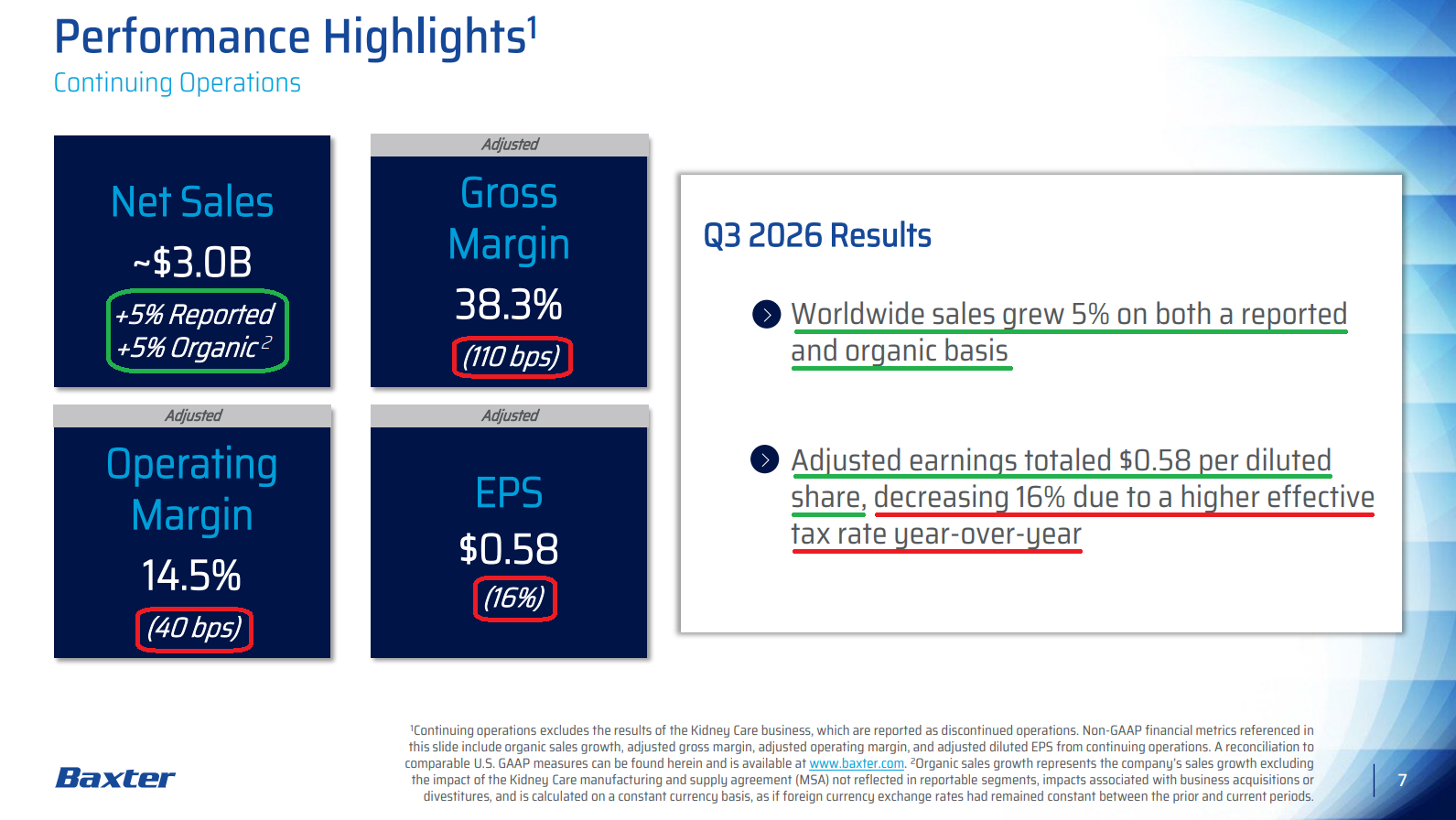
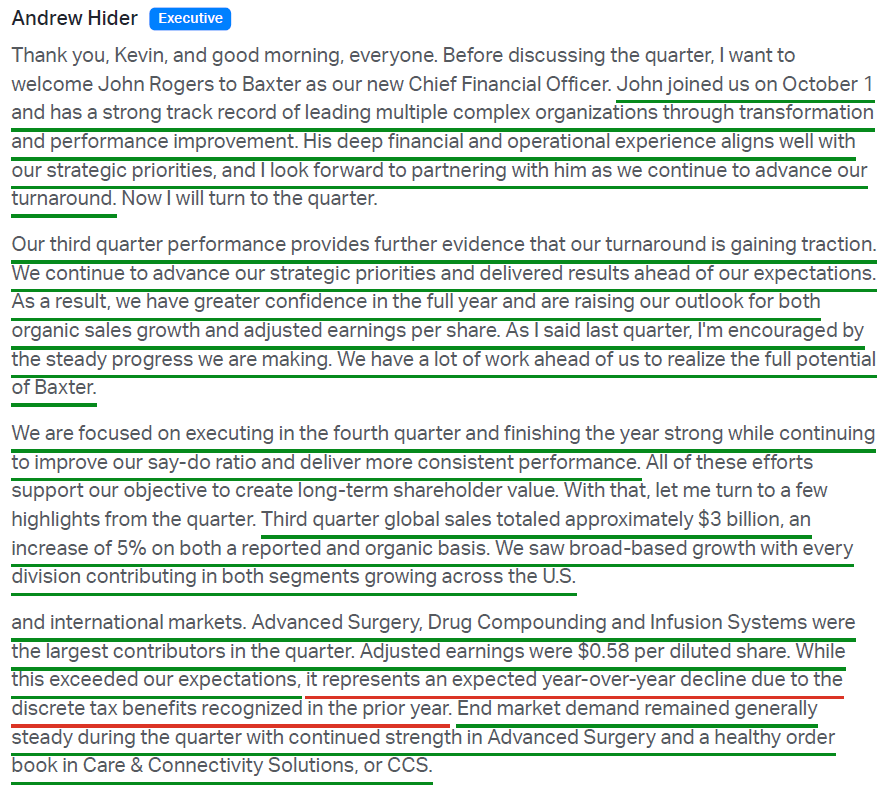
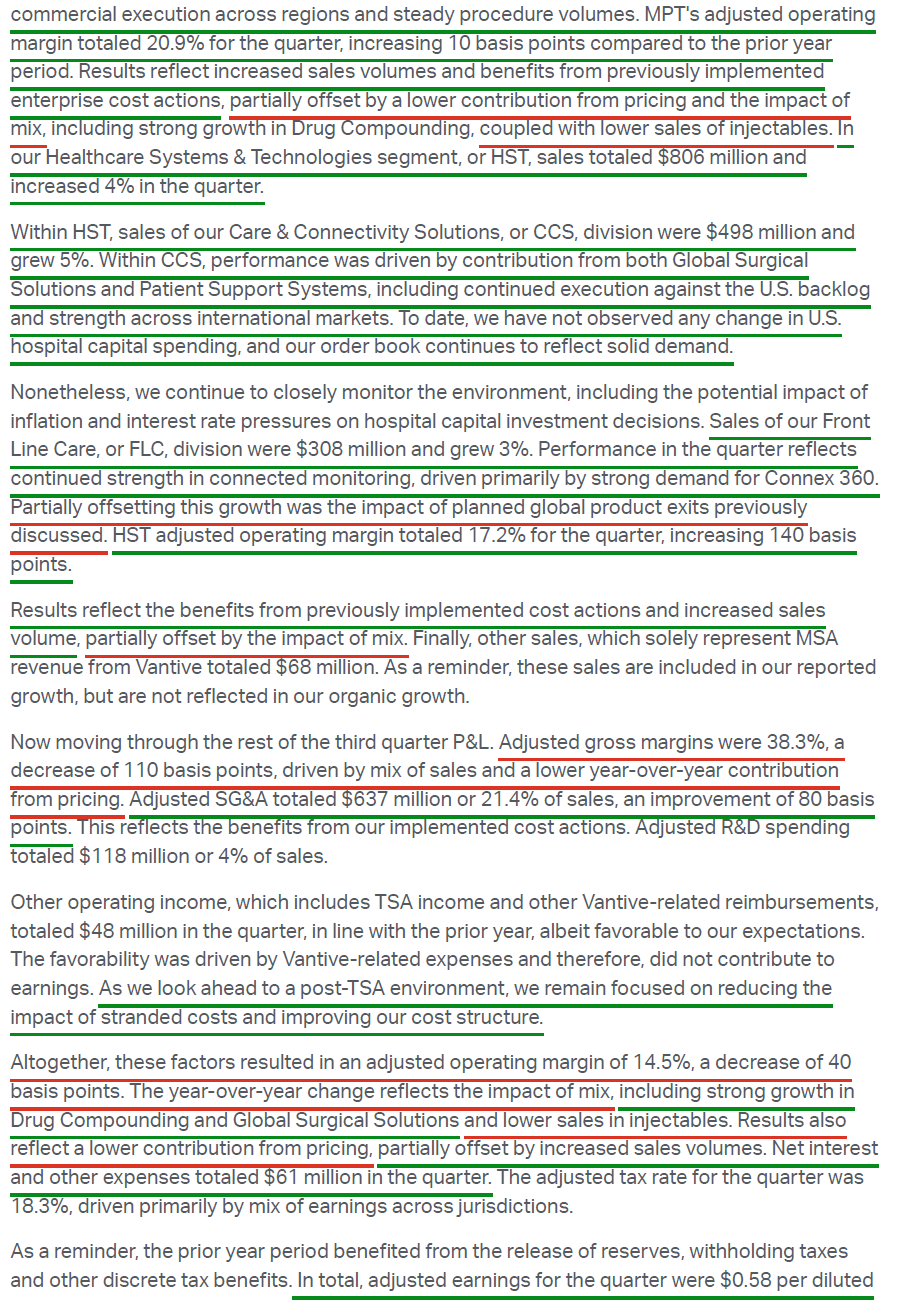
1) Revenue of $2.98B (+5% reported, +5% organic) came in ahead of consensus of $2.91B, with growth across every segment and division in both the U.S. and international markets. U.S. sales of $1.6B grew 3% reported and 5% organic, while international sales of $1.4B rose 7% reported and 6% organic. Advanced Surgery, Drug Compounding, and Infusion Systems were the largest contributors, with end-market demand holding steady. This was the second straight quarter of ~5% organic growth following Q1’s (1%) decline.
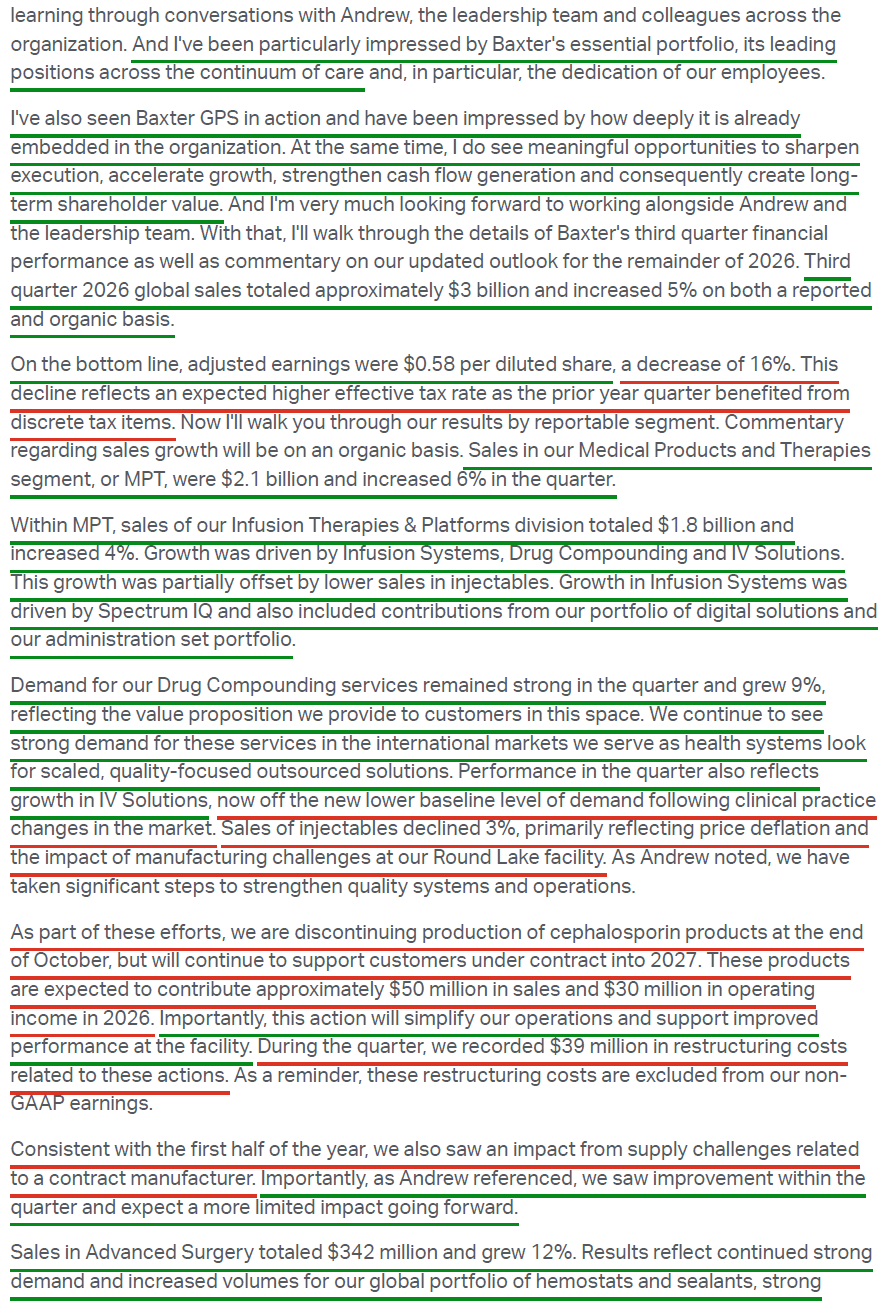
2) Adjusted EPS of $0.58 (-15.9% Y/Y) came in ahead of consensus of $0.52. The decline was expected and came entirely from taxes. The adjusted tax rate was 18.3% vs. 5.1% a year ago, when reserve releases, withholding taxes, and other discrete benefits lowered the prior-year rate.
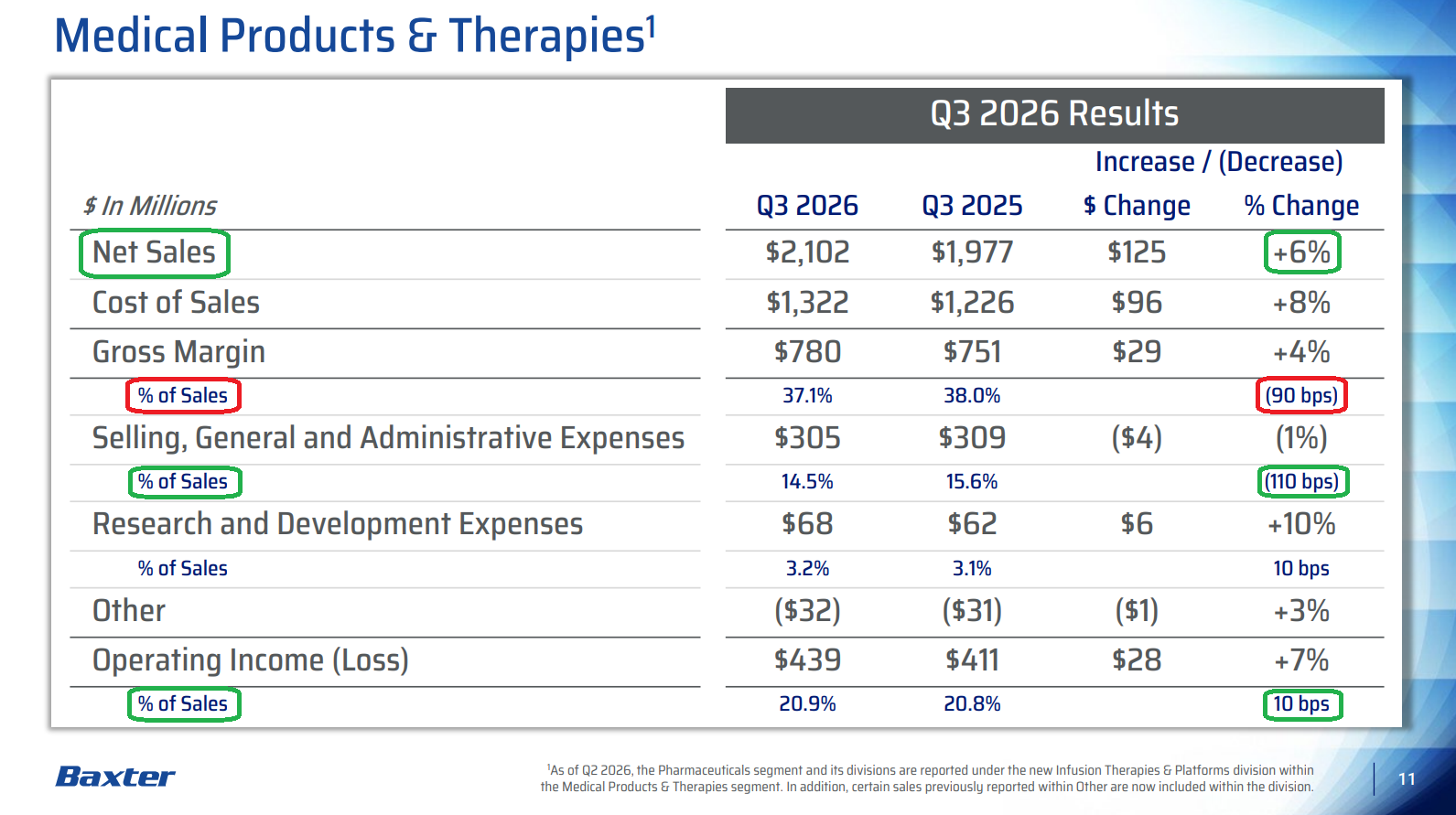
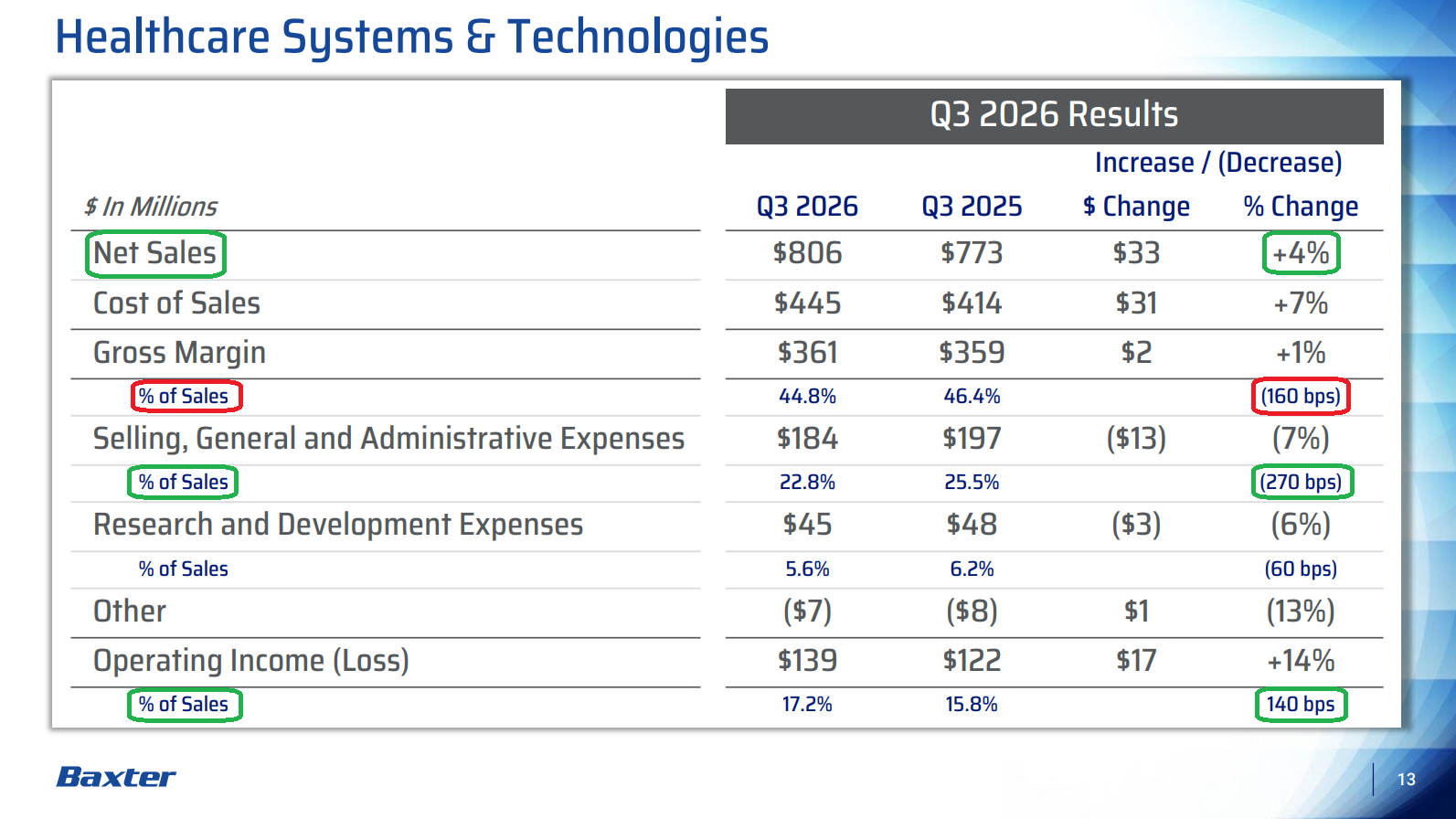
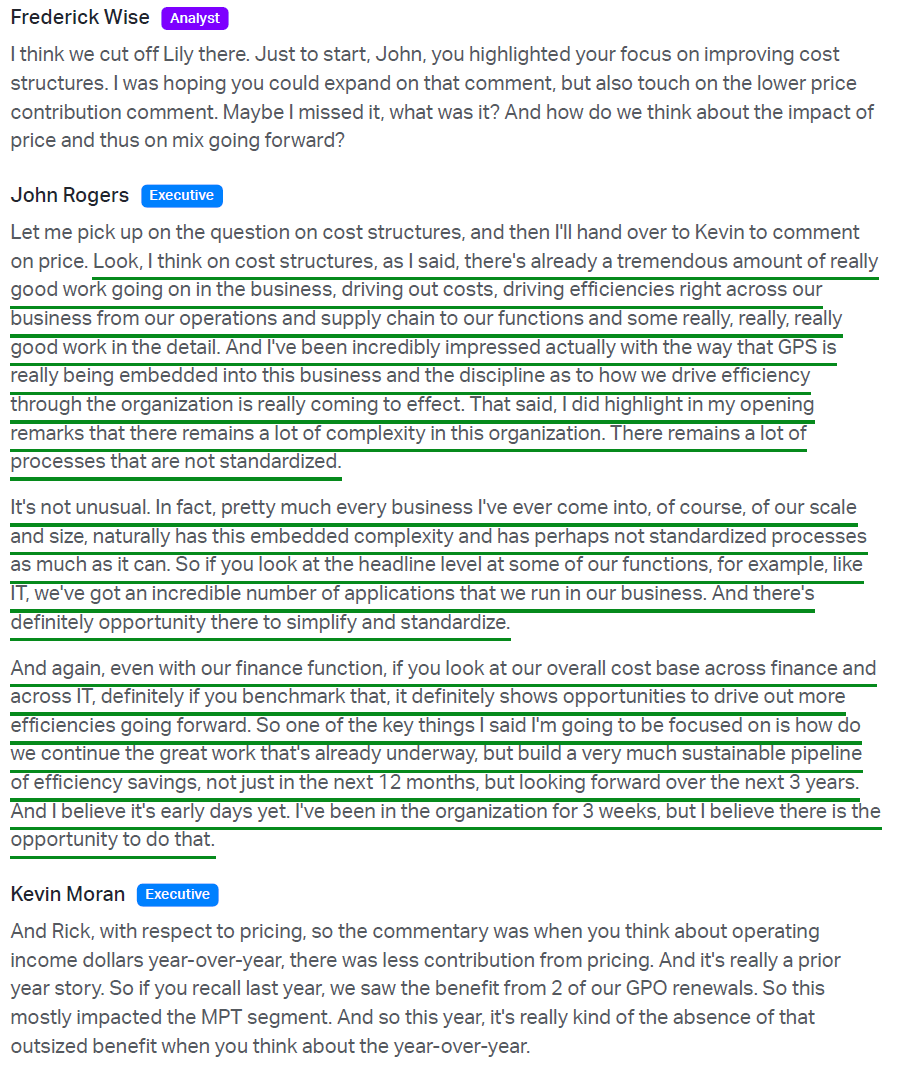
3) Adjusted gross margin of 38.3% (-110 bps) brought YTD gross margin to 37.9% (-270 bps), with Y/Y compression narrowing from Q2’s -210 bps. The pressure came from mix, with strong growth in lower-margin Drug Compounding and Global Surgical Solutions alongside lower sales of higher-margin injectables. A smaller pricing contribution also weighed as Baxter lapped two GPO renewals that benefited the prior-year period. By segment, MPT gross margin came in at 37.1% (-90 bps), with HST at 44.8% (-160 bps). The higher-cost inventory that weighed on the first half has now fully cycled through.
4) Adjusted operating margin of 14.5% (-40 bps) came on adjusted operating income of $432.0M (+2.1% Y/Y), ~$29M ahead of consensus of $402.9M. That brings YTD adjusted operating margin to 13.3% (-170 bps). Cost actions, now contributing for a full quarter, mostly offset gross margin pressure. Adjusted SG&A of $637M (21.4% of sales) improved 80 bps, with adjusted R&D steady at 4.0% of sales. The quarter delivered the expected second-half step-up from 11.0% in Q1 and 14.2% in Q2, with management expecting Q4 operating margin to be in line with Q3 and holding full-year guidance at 13% to 14%.
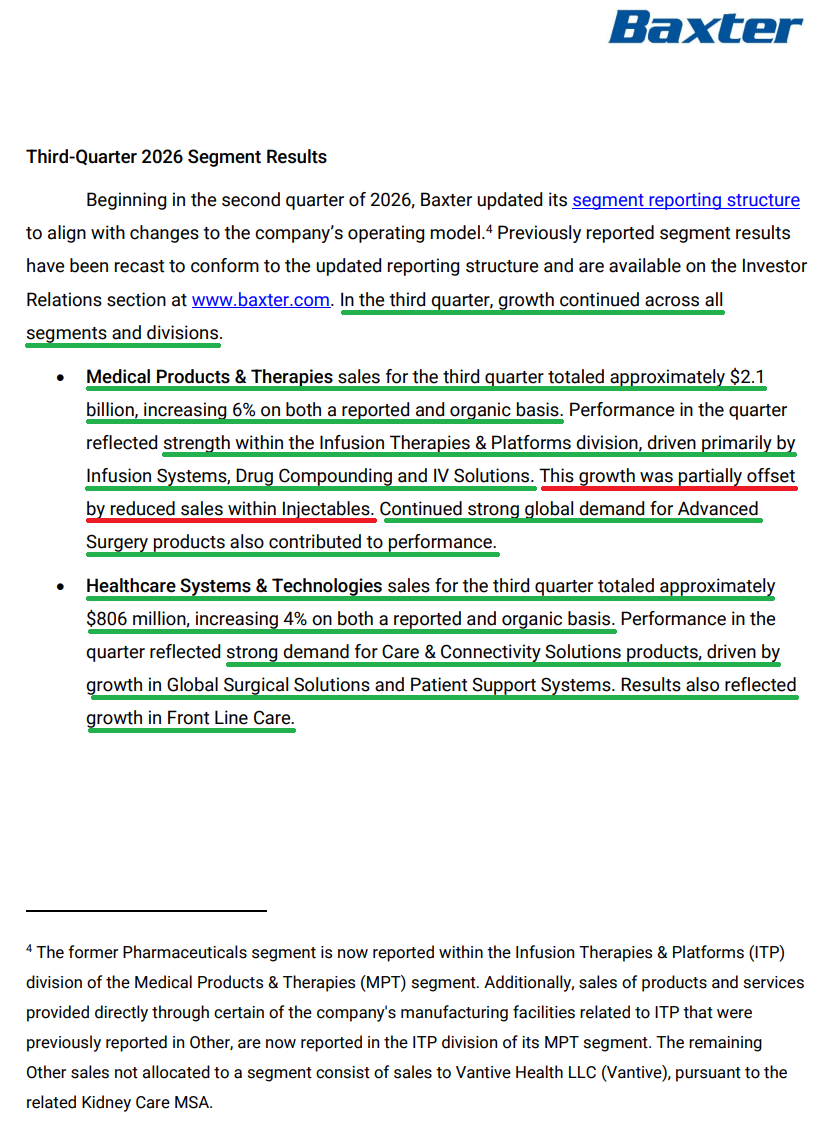
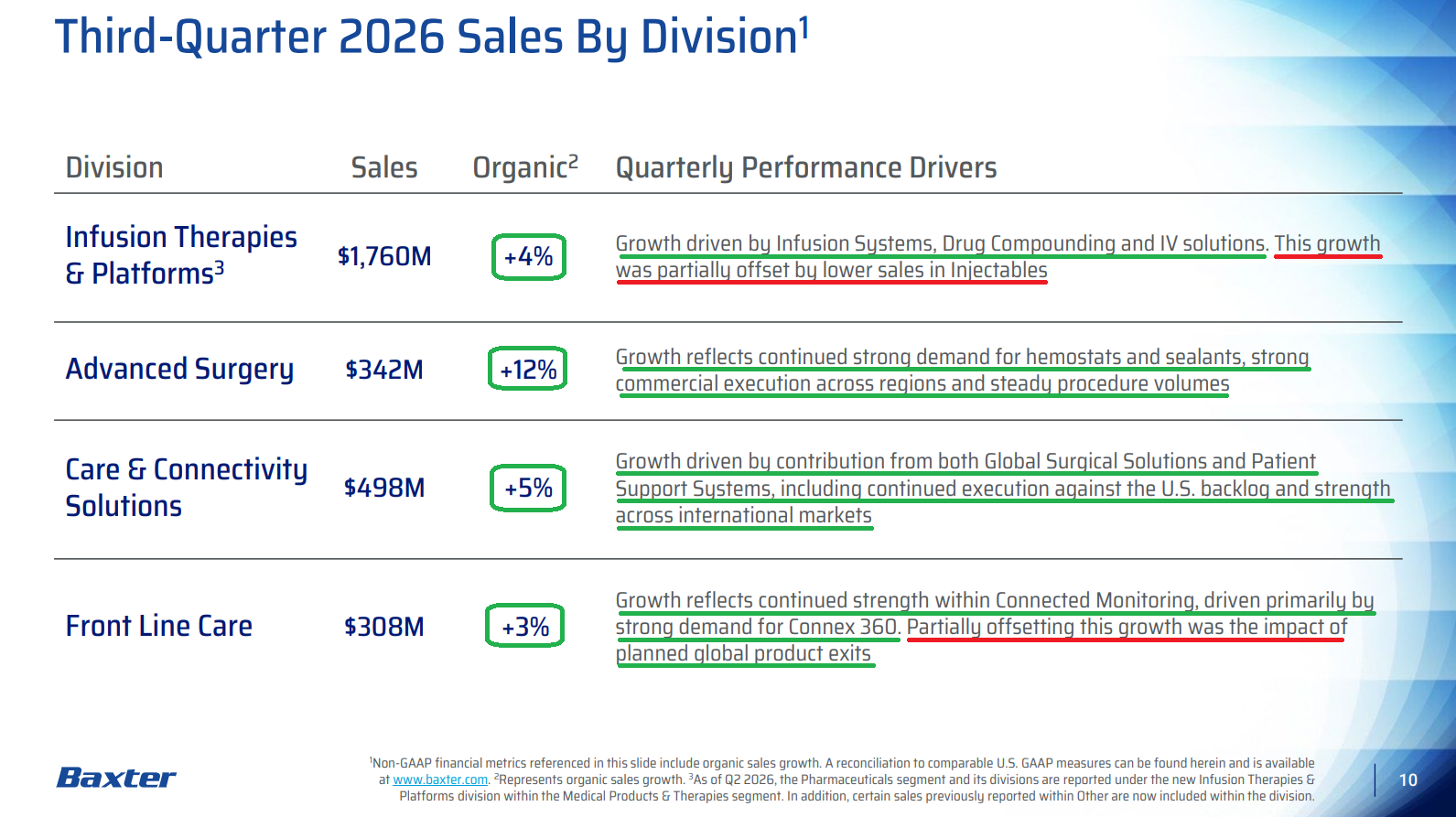
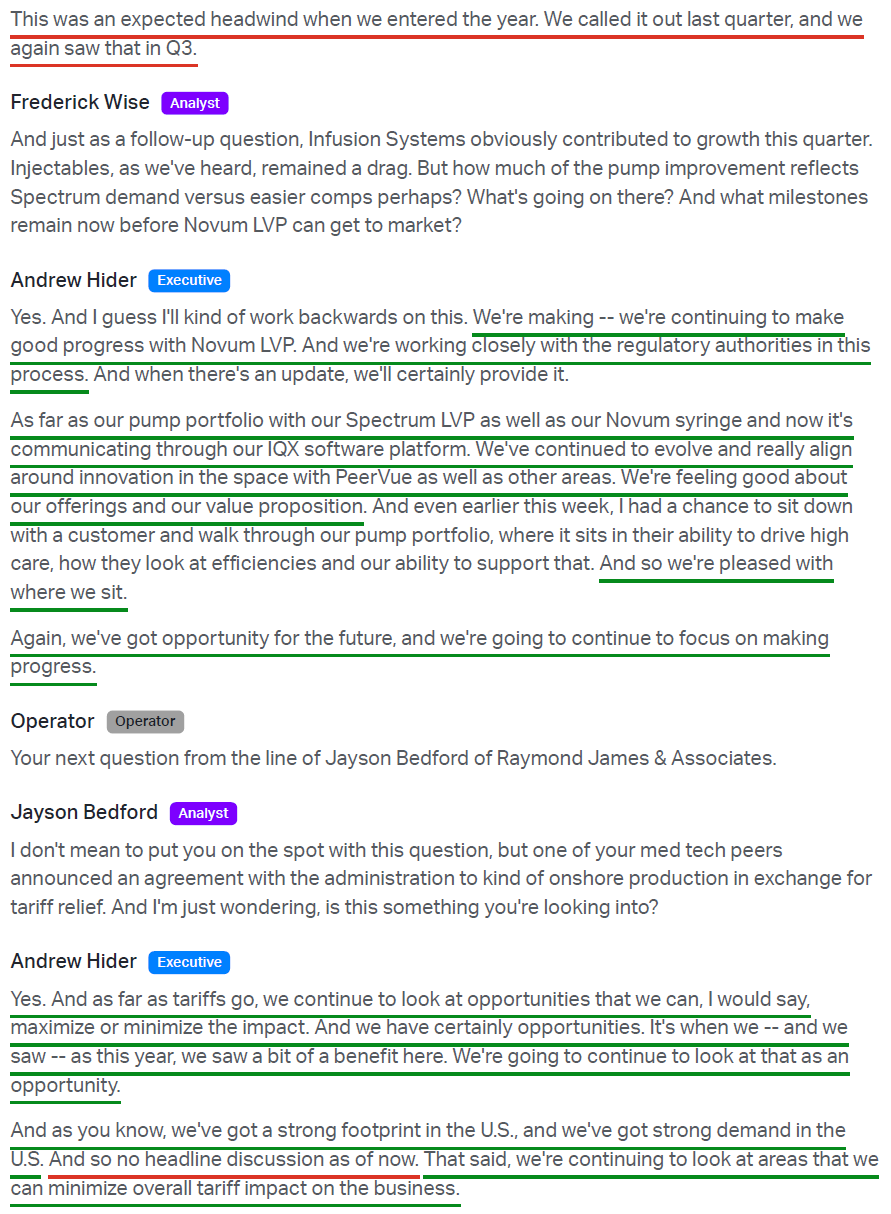
5) Medical Products & Therapies revenue of $2.10B grew 6% on both a reported and organic basis. Segment operating income was $439M (+7%), with adjusted operating margin of 20.9% (+10 bps). Infusion Therapies & Platforms posted $1.76B (+4% organic), driven by Infusion Systems, led by Spectrum IQ, Drug Compounding (+9%) on strong international demand, and IV Solutions, which grew off the new lower demand baseline. Injectables declined 3% due to price deflation and manufacturing challenges at Round Lake, partially offsetting that growth. Advanced Surgery grew 12% to $342M, driven by hemostat and sealant volumes and strong commercial execution. A competitor’s supply disruption also benefited Advanced Surgery, making comps tougher going forward. On Novum IQ, the LVP continues to make progress with regulators, with an update to come when available. In the meantime, the broader pump portfolio of Spectrum LVP, Novum syringe, and the IQX software platform is driving Infusion Systems growth.
6) Healthcare Systems & Technologies revenue of $806M grew 4% on both a reported and organic basis. Segment operating income was $139M (+14%), with adjusted operating margin of 17.2% (+140 bps) on cost actions and higher volumes, partially offset by mix. Care & Connectivity Solutions grew 5% to $498M on Global Surgical Solutions and Patient Support Systems, continued execution against the U.S. backlog, and international strength. Front Line Care grew 3% to $308M on connected monitoring led by Connex 360, partially offset by planned global product exits. Management has still not seen any change in U.S. hospital capital spending, with the order book reflecting solid demand.
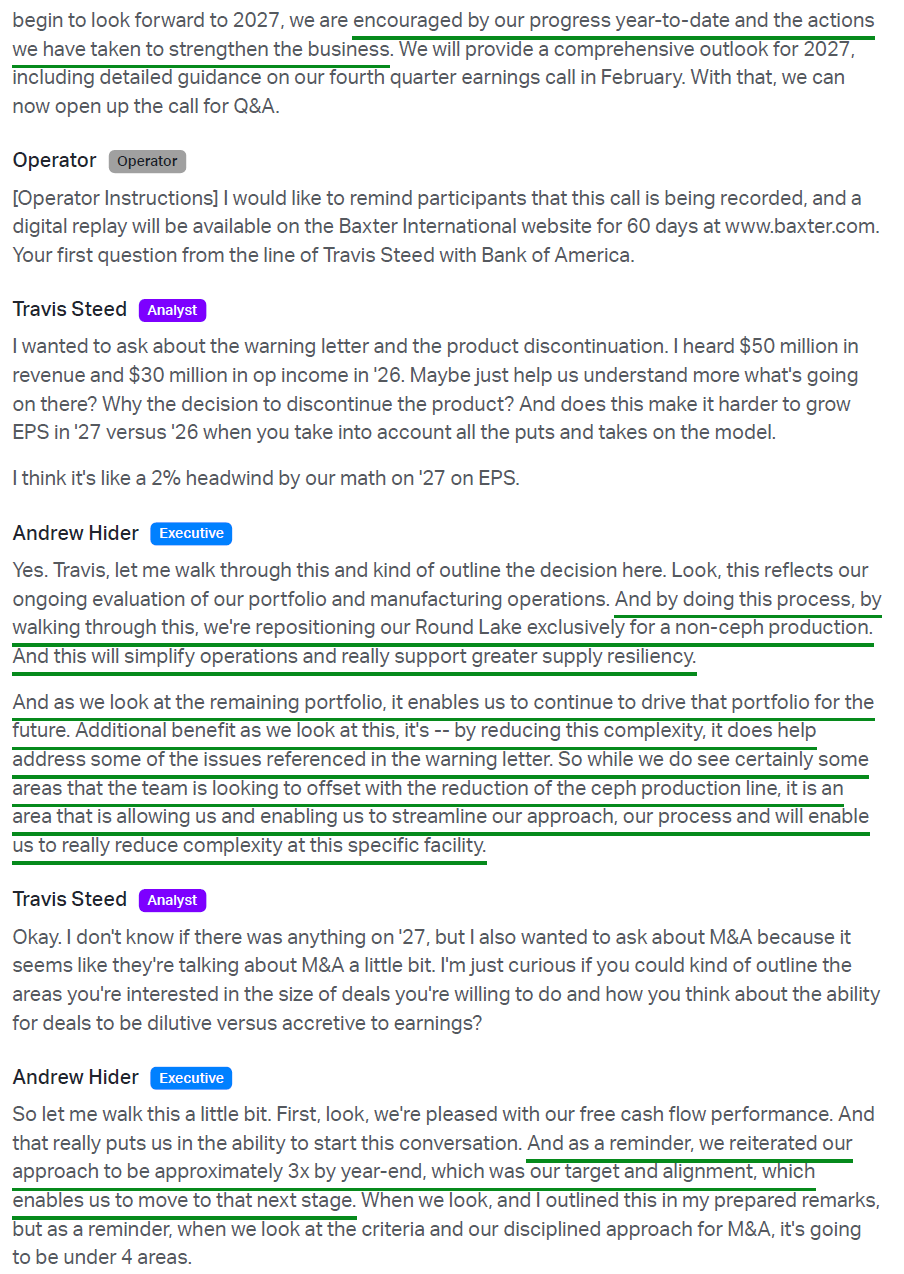
7) Following the FDA warning letter, Baxter announced it will discontinue cephalosporin production at its Round Lake specialty injectables facility effective the end of October, while continuing to support customers under contract into 2027. The move repositions the site exclusively for non-ceph production, simplifying operations, supporting supply continuity, and addressing some of the complexities cited in the letter. Corrective and preventive actions are already underway across the site and broader network. Ceph products are expected to contribute ~$50M in sales and ~$30M in operating income in 2026, which management called a net headwind for 2027, partially mitigated by inventory sell-through and alternative products. Baxter recorded $39M of related restructuring costs in the quarter, excluded from adjusted results.
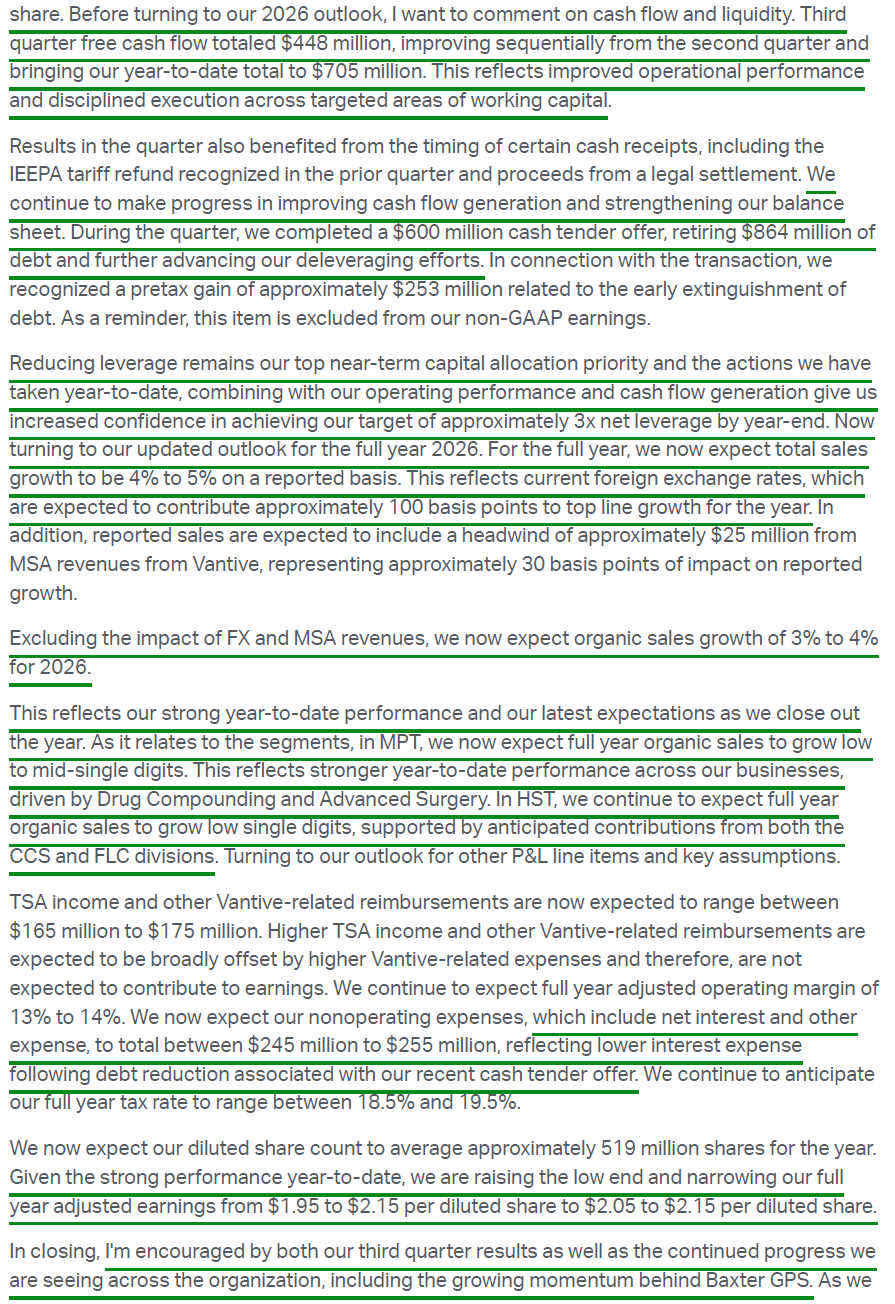
8) Free cash flow of $448M rose ~255.6% Y/Y from $126M, bringing YTD FCF to $705M from a ($18M) outflow in the prior-year period. That is already 61.0% above the $438M generated in all of FY25, with Q4 still ahead as the seasonally strongest cash quarter ($456M last year). The improvement came from better operational performance and working capital discipline, helped by the timing of cash receipts, including the IEEPA tariff refund recognized in Q2 and proceeds from a legal settlement. Baxter also completed a $600M cash tender offer in September, retiring $864M of debt and bringing net debt to ~$6.6B from ~$7.5B at year-end 2025, leaving management confident in reaching ~3.0x net leverage by year-end. Once that target is reached, capital allocation opens up to internal investment, tuck-in M&A, and opportunistic buybacks, with Hider naming cardiac monitoring and Advanced Surgery as areas of interest.
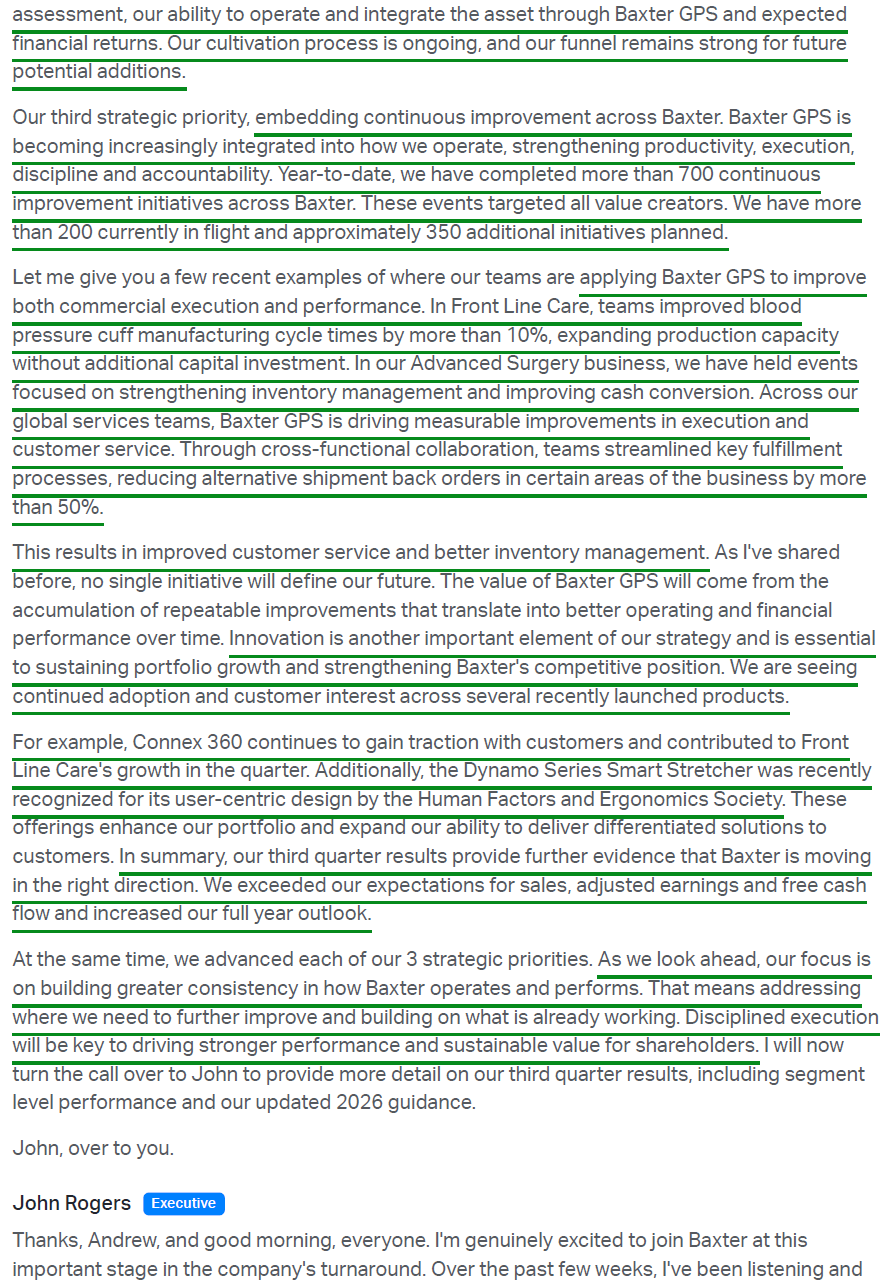
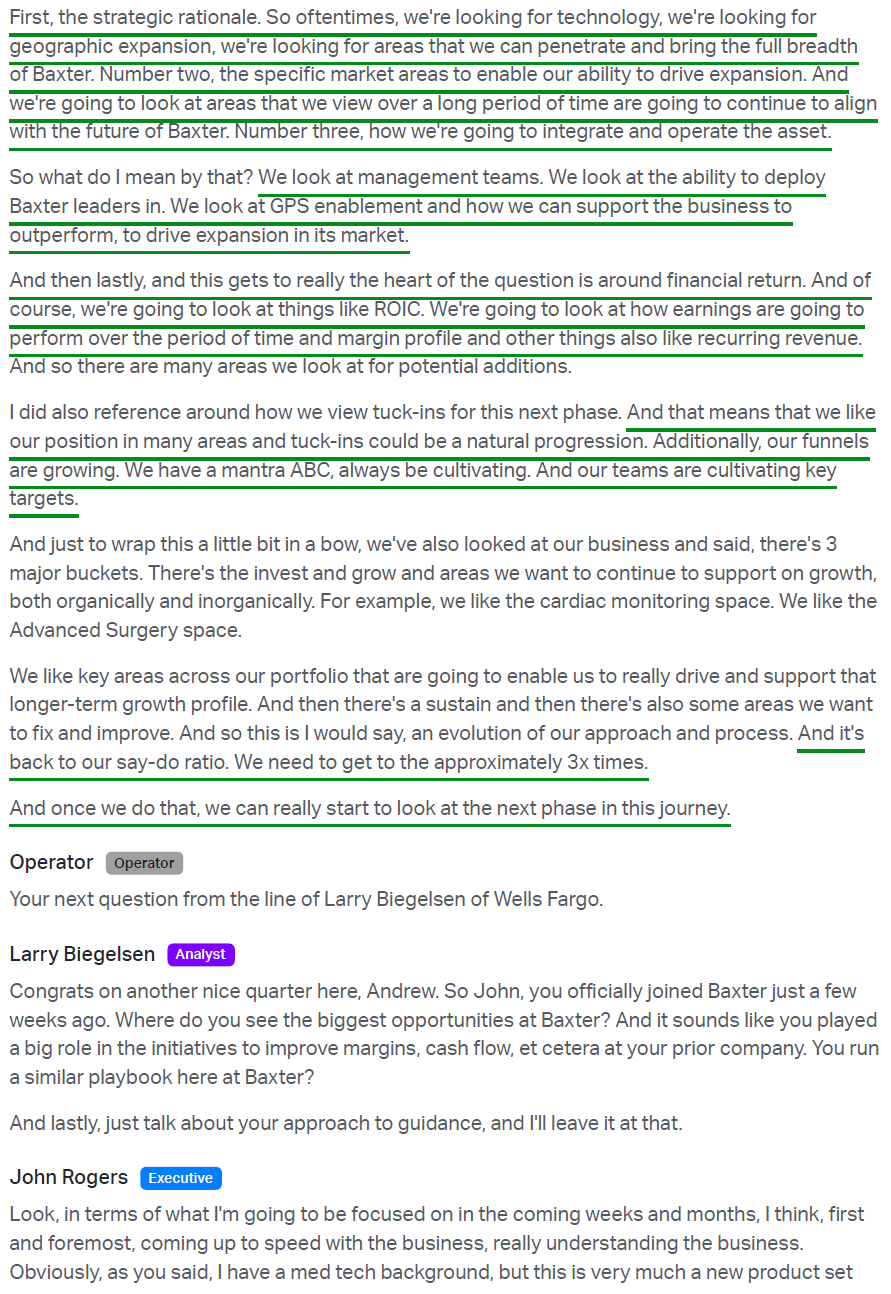
9) Baxter GPS continues to embed itself across the organization, with more than 700 continuous improvement initiatives completed YTD, 200+ in flight, and ~350 more planned. Front Line Care improved blood pressure cuff manufacturing cycle times by more than 10%, adding capacity without additional capital, while global services cut alternative shipment backorders by more than 50% in certain areas of the business. CCS on-time shipments also improved 8% Y/Y, with the Advanced Surgery quality measure up nearly 20%. New CFO John Rogers, who joined October 1, said GPS is already deeply embedded, though he sees remaining complexity in areas like IT and finance as the basis for a sustainable pipeline of efficiency savings over the next three years.
10) Management raised its full-year outlook for the second straight quarter, now expecting organic sales growth of 3% to 4% (from 2% to 3%) and reported growth of 4% to 5% (from 3% to 4%), implying ~5% organic growth in Q4. Adjusted EPS guidance moves to $2.05 to $2.15 (from $1.95 to $2.15), lifting the midpoint to $2.10, with MPT raised to low-to-mid-single-digit organic growth (from low single digits) and HST held at low single digits. Adjusted operating margin guidance was held at 13% to 14% and the tax rate at 18.5% to 19.5%, while interest and other expense guidance was lowered to $245M to $255M (from $260M to $280M) following the tender. Ahead of full guidance in February, management also gave an initial read on 2027, laying out several headwinds: stepped-up inflation led by salaries, electronics, and materials; no repeat of this year’s tariff refund, with Section 232 clarity expected in Q4; stranded costs once the Vantive TSA ends in January; and the ceph and Front Line Care product exits. New CFO John Rogers balanced that with a growing pipeline of savings and a goal of fully offsetting inflation through efficiency gains.
Earnings Call Highlights
Morningstar Analyst Note
General Market
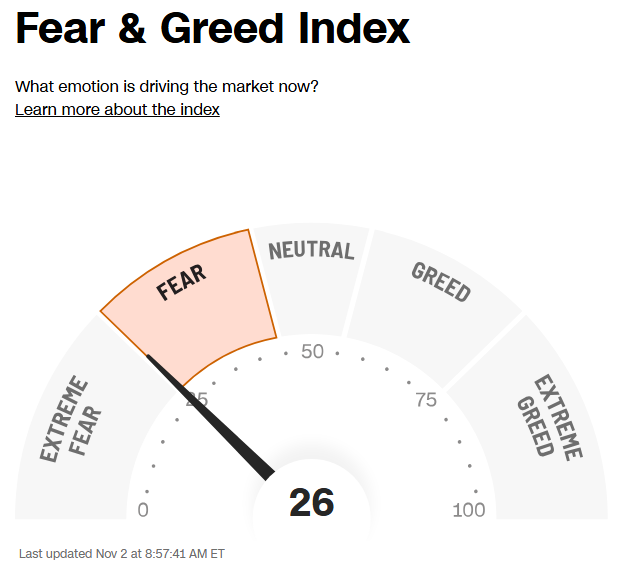
The CNN “Fear and Greed Index” ticked down to 26 this week from 35 last week. You can learn how this indicator is calculated and how it works here: (Video Explanation)
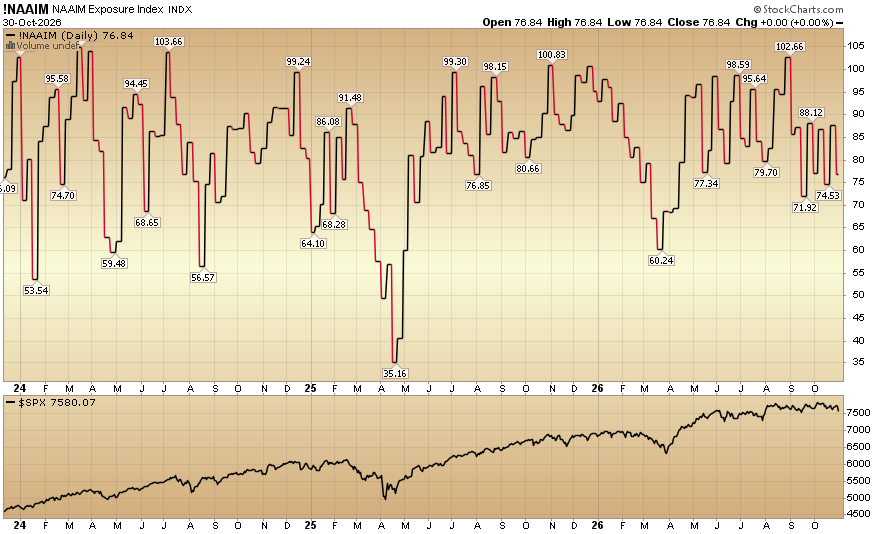
The NAAIM (National Association of Active Investment Managers Index) (Video Explanation) ticked down to 76.84% equity exposure this week from 87.69% last week.



Comments
Log in or sign up to join the conversation.