


Gold prices fell nearly 5% last week, and naturally there was some downside follow-through first thing this morning, especially as oil prices and the dollar extended their gains on fresh escalation in the Middle East conflict. Prices have since bounced back as Iran said it was ceasing strikes on Israel, causing oil to turn lower on the day. Recently, momentum has been turning bearish for gold, with prices now on their fourth monthly decline. Long-term, I think gold remains fundamentally supported but in the near-term the risks remain tilted lower, as I have been warning in the last few months.
As things stand, I think all the signals point towards spot gold prices returning to the $4000 level, with yields rising in recent months, the dollar going from strength to strength and central bank buying cooling a bit. That said, inflation hedging is something that could keep demand for gold high, while central banks will likely continue purchasing gold at lower levels as they seek to diversify their reserves. So, I think the downside is limited, but I can’t see prices reversing strongly in the near-term, with the dollar looking to rise further.
Dollar extends rally
The EUR/USD fell to the 1.15 handle this morning before bouncing back as Trump said that Israel and Iran were looking to do an immediate ceasefire. The US president said, “Final negotiations are proceeding, subject to stupidity getting in its way.” Oil prices pared earlier gains and then turned red as Iran said it would halt strikes on Israel. Last week, the greenback rallied after a much stronger-than-expected labour market report prompted investors to reassess the outlook for Federal Reserve policy, sending yields higher.
Looking ahead, we have US CPI and ECB rate decisions looming this week. Traders are also watching oil prices and the US-Iran-Israel situation. Hopes for a potential deal between the US and Iran to open the Strait of Hormuz faded after the latest escalation in the conflict. But with oil prices still holding in the existing ranges, markets are still betting that the strait will reopen soon.
US inflation data take centre stage
Attention now turns to US consumer price inflation on Wednesday. After surprising markets with a 3.8% annual reading in April, inflation is expected to accelerate further to 4.2% in May, reflecting the recent surge in energy prices. The release could prove pivotal for market sentiment. A reading above consensus would likely reinforce expectations that the Federal Reserve may need to keep policy restrictive for longer, potentially extending the dollar’s recent gains. Conversely, any downside surprise could prompt investors to scale back some of the hawkish pricing that emerged following the payrolls report.
Technical analysis: XAU/USD eyes $4,000 level
Last week saw gold lose its footing as it couldn’t hold above the $4,500 level amid the macro pressures discussed above. Then all attention was on the 200-day moving average around the $4,430 area and whether this would trigger another bounce as we saw on Friday. Although for a time it looked as though gold was holding its own quite well, Thursday’s bullish move was ultimately rejected, and then the metal collapsed on Friday, breaking below the 200-day.
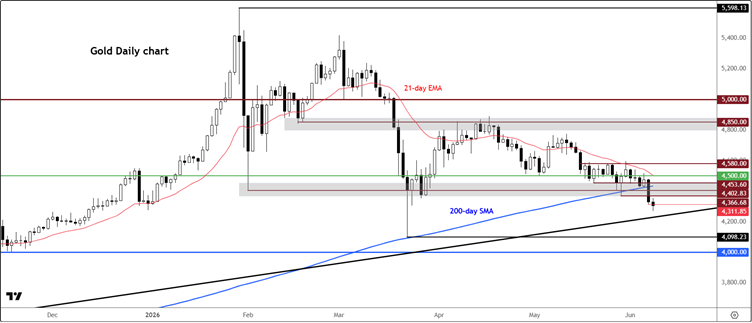
On the downside, there is a bullish trend line around $4,230 area to watch. Beyond that, there are few obvious support levels until the March low, just below the $4,100 area. That leaves considerable room for gold to decline, potentially even towards the $4,000 level.
Initial resistance is now sitting near $4,366, marking the low from the last rally attempt on 28th May. Above this, $4400, $4455 and finally $4500 are the next key levels to watch.
As things stand, the technical picture would only improve if gold were to reclaim those levels and break decisively above the former resistance area around $4,580.
However, breaching those levels would likely require at least a sharp decline in oil prices and a confirmed agreement between the United States and Iran that eases tensions and reopens key energy supply routes. Even then, the surprising strength of US data means the dollar wouldn’t go down without a fight. That, in turn, might mean limited upside for gold.


Comments
Log in or sign up to join the conversation.