

Here’s an interesting fact. Global gold mine output hit a record 3,672 tonnes last year. But that number has barely moved in years. It’s essentially flat with 2022, 2023, and 2024, and barely above the previous record of 3,663 tonnes set back in 2018, even though the price of gold has nearly tripled since then.
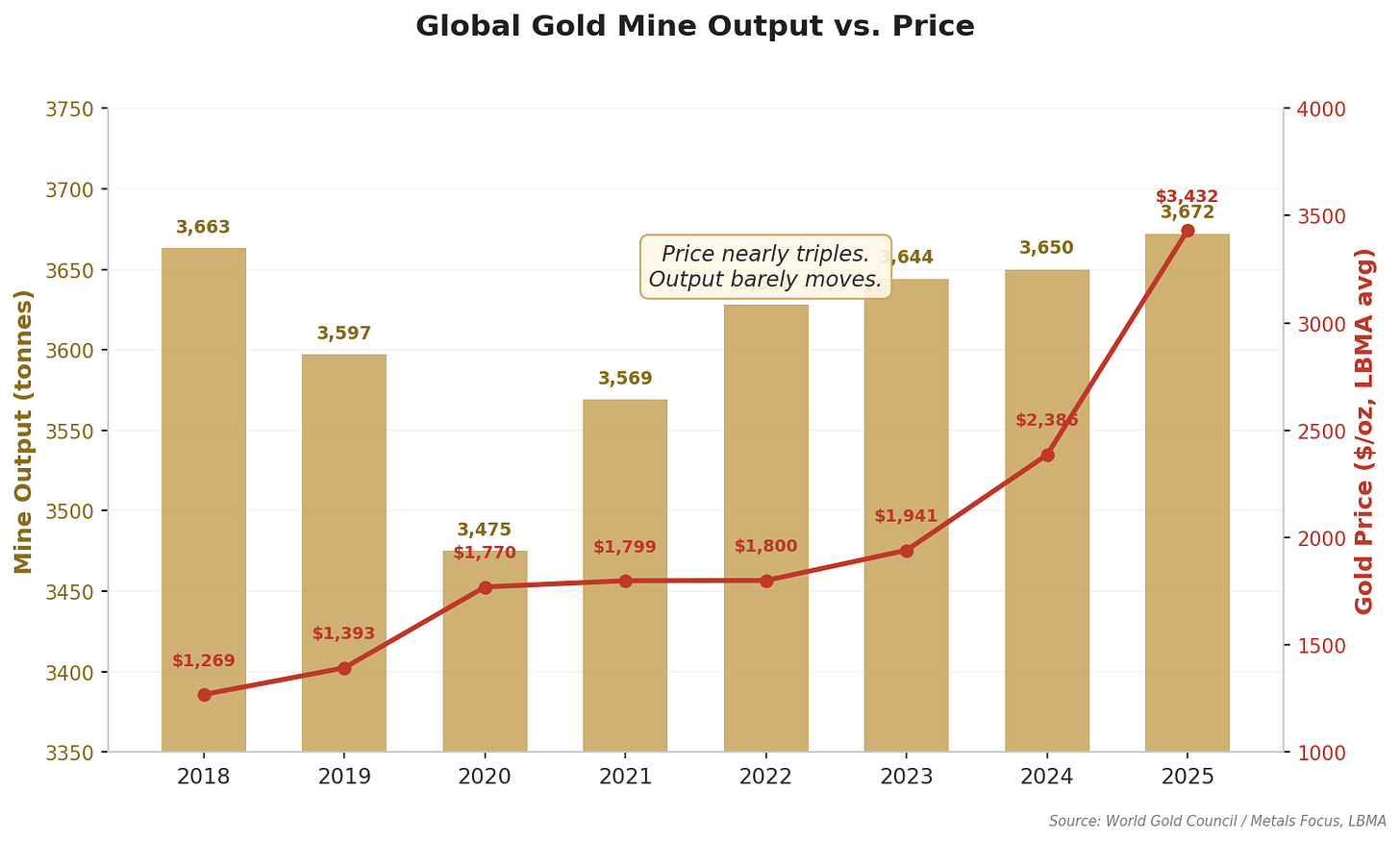
When the price of your product nearly triples and your output barely moves, something is broken. And in gold mining, what’s broken is the pipeline underneath.
The major gold producers have been depleting their reserves faster than they’ve been replacing them for over a decade. They’ve spent billions on exploration. They’ve scoured every prospective belt on every continent. And the result? The rate of major new gold discoveries has fallen to near zero.
S&P Global now puts the average time from discovering a new gold deposit to producing first metal at about 18 years. In the 1980s, that number was six. Let that sink in. Any deposit discovered today, even a world-class one, probably won’t produce its first ounce until the mid-2040s.
And the industry is not finding enough deposits to fill even that timeline.
The Reserve Clock Is Ticking
Now, to understand the opportunity, you have to understand what’s happening on the other side of the equation. And that’s demand.
Not just any demand. Investment demand.
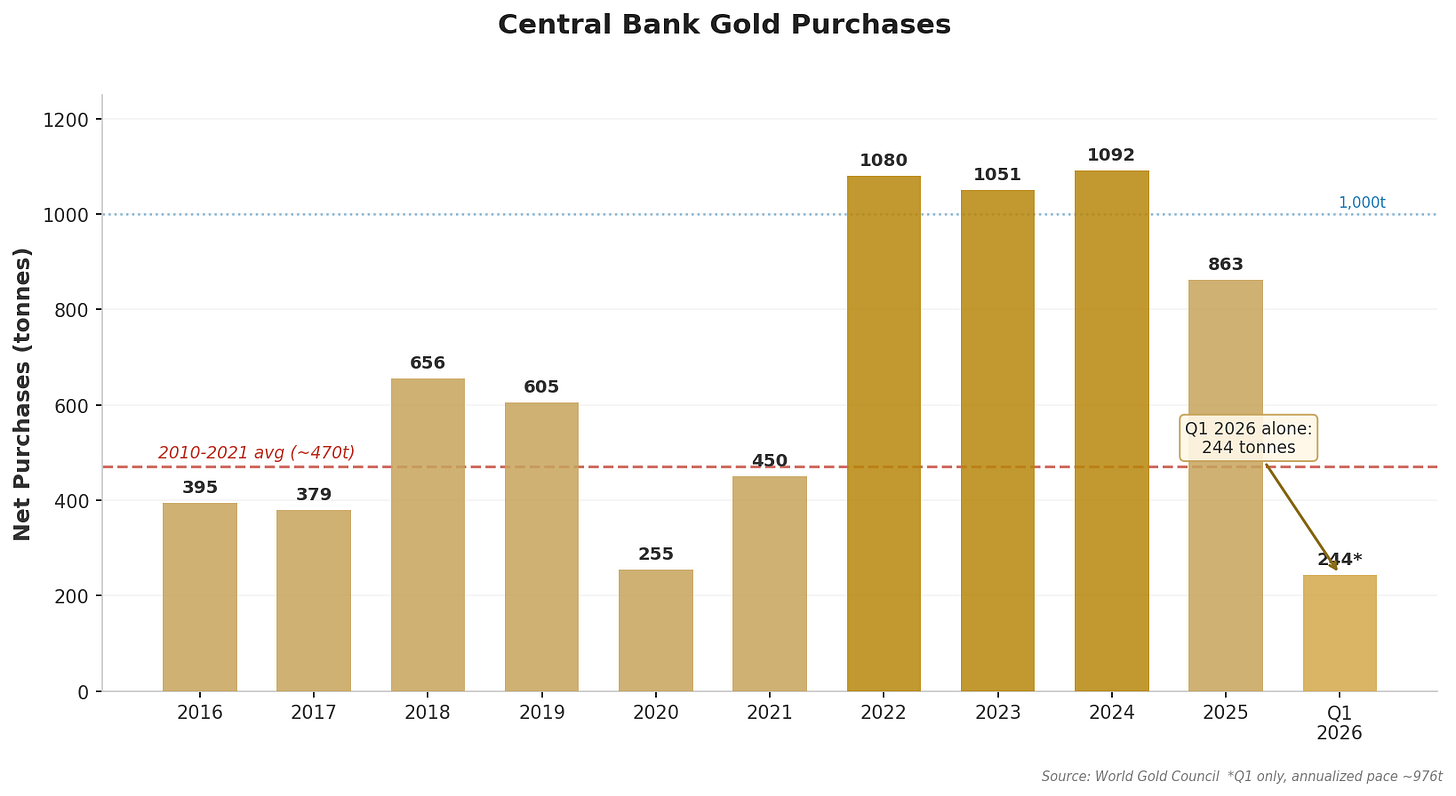
The biggest investors in gold are, of course, central banks. And they bought more than 1,000 tonnes of gold in each of 2022, 2023, and 2024. They added 863 tonnes last year and another 244 in the first quarter of 2026 alone.
And it’s not just central banks. Physical bar and coin buying hit a 12-year high near 1,374 tonnes. Pension funds, insurers, and sovereign wealth funds are moving into allocated gold they can actually hold. All told, total gold demand passed 5,000 tonnes for the first time ever in 2025.
Now, remember, all of this is happening at a time when supply is basically standing still. The miners are running faster just to stay in place, and the reserve base underneath them keeps shrinking.
As an aside, it’s interesting that this part of the gold story recently got lost in the daily price action. Gold had its worst quarter since 2013 in Q2. The headlines were all about Fed hike bets and dollar strength, and coming off a stellar year in 2025, some respite was probably in order.
But what the headlines aren’t reporting is that underneath that noise, the structural problem hasn’t changed: the world is consuming gold faster than it can find and develop new sources of it.
What the Majors Are Doing About It
When you can’t find it, you buy it. That’s exactly what’s been happening.
Since 2024, nine major gold takeovers have committed more than $24 billion, part of a broader mining deal wave near $139 billion, the busiest since 2011. The largest gold producers have been acquiring developers and explorers at progressively earlier stages. They’re no longer waiting for a project to reach production. They’re buying drill results, economic studies, and permitted deposits, because the alternative is watching their reserve base shrink while the gold price keeps rising.
The deals have gotten bigger, and the targets have gotten younger. Companies that haven’t poured a single ounce of gold are attracting multi-billion-dollar bids. The acquirers don’t care. They need the ounces.
And every deal that closes removes one more buildable project from the market, which lifts the scarcity value of whoever is left.
This means one thing: the companies that already control defined gold resources in stable, buildable jurisdictions are exactly what the majors need and can’t find on their own anymore.

Comments
Log in or sign up to join the conversation.