

As global financial instability grows, the United States is demonstrating its inability to control market trends. With communication taking precedence over all rationality, the risk of a major economic and financial crisis continues to accelerate. Gold is, once again, at the center of attention.
The disconnect between the real economy and the financial sector is becoming increasingly wide with each passing day. Debt-based currency imposes an exponential dynamic on the economy that the production of goods and services cannot keep up with without a clear imbalance. This imbalance stems from the constant loss of value of the currency and the separation of markets from all economic fundamentals. While the support provided by central banks since the subprime crisis has made it possible to postpone this underlying problem (and the associated risk) for the time being, this is no longer sufficient now that inflation is firmly entrenched in the real economy. Thus, in the United States — where monetary policy continues to influence the global financial system — communication now serves as a buffer to prevent the outbreak of a crisis, just as the use of highly artificial methods — such as including the latent (and thus unrealized) profits of major U.S. corporations in their financial results, or the assumption of a reduction in capital gains tax by indexing them to inflation before calculating the tax — is employed to maintain investor confidence.
But no imbalance lasts forever. Within the world’s leading economic power, all indicators are flashing red. Already, last year’s withdrawal by numerous American billionaires of all the liquidity from their funds should have served as a warning sign. Since information is key — both in the markets and elsewhere — and circulates all the more quickly among “insiders,” they are clearly preparing for the obvious: the risk of a debt crisis linked to the acceleration of the Fed’s inevitable dilemma. This scenario is all the more evident today, as the U.S. central bank was forced to keep interest rates unchanged in July, despite the return of inflation and the dollar’s decline.
Far from achieving a “soft landing,” the Fed — and its new chair, overwhelmed by long-term historical trends — is thus demonstrating its inability to control developments in the U.S. financial system. For the first time since 2021, it is reacting too slowly relative to market expectations. While its interest rates range from 3.5% to 3.75%, the yield on 2-year Treasury bonds exceeds 4.1%. This means the Fed should continue to raise rates (as it had to do under similar conditions in the aftermath of the health crisis). But such action is made impossible by the exponential increase in U.S. debt and the need to refinance nearly one-third of its total amount by next year.
Furthermore, its ability to control inflation remains limited: the expansion of its balance sheet primarily leads to asset price inflation, whereas rising prices (as measured by the Consumer Price Index) depend primarily on the liquidity injected into the real economy and the state of the productive sector — that is, on the distribution of credit by commercial banks and the law of supply and demand. As the money supply continues to rise (admittedly supported by an increase in the Federal Reserve’s balance sheet since last December — which is why the markets are reaching such high levels) and inflationary pressures persist, the Fed is consequently losing control not only over interest rates but also, gradually, over inflation.
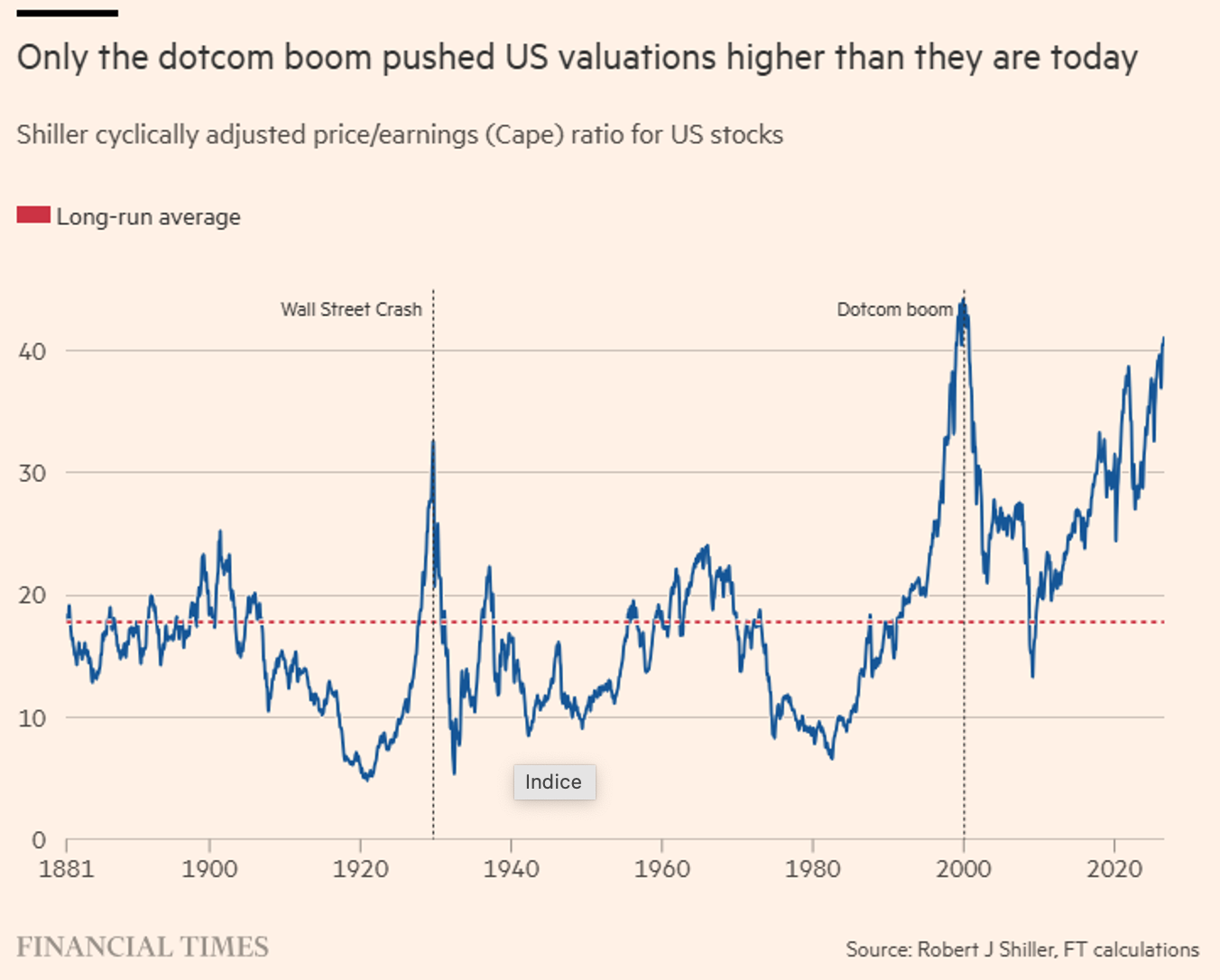
Beyond short-term rates, long-term rates are also rising to record levels. However, while the Fed controls short-term interest rates, it has no influence over long-term rates — particularly the 10-year and 30-year rates — which are determined by the market and used as benchmarks worldwide. This situation is all the more concerning given that the market capitalization of U.S. companies has reached an all-time high — surpassing the levels seen during the 1929 crisis and trailing only the bubble of the 2000s — and that financial instability is growing at every level: in addition to withdrawals by many billionaires, the number of bank executives stepping down is on the rise, as seen at BlackRock, where the private credit crisis has led to massive losses and the closure of numerous funds.
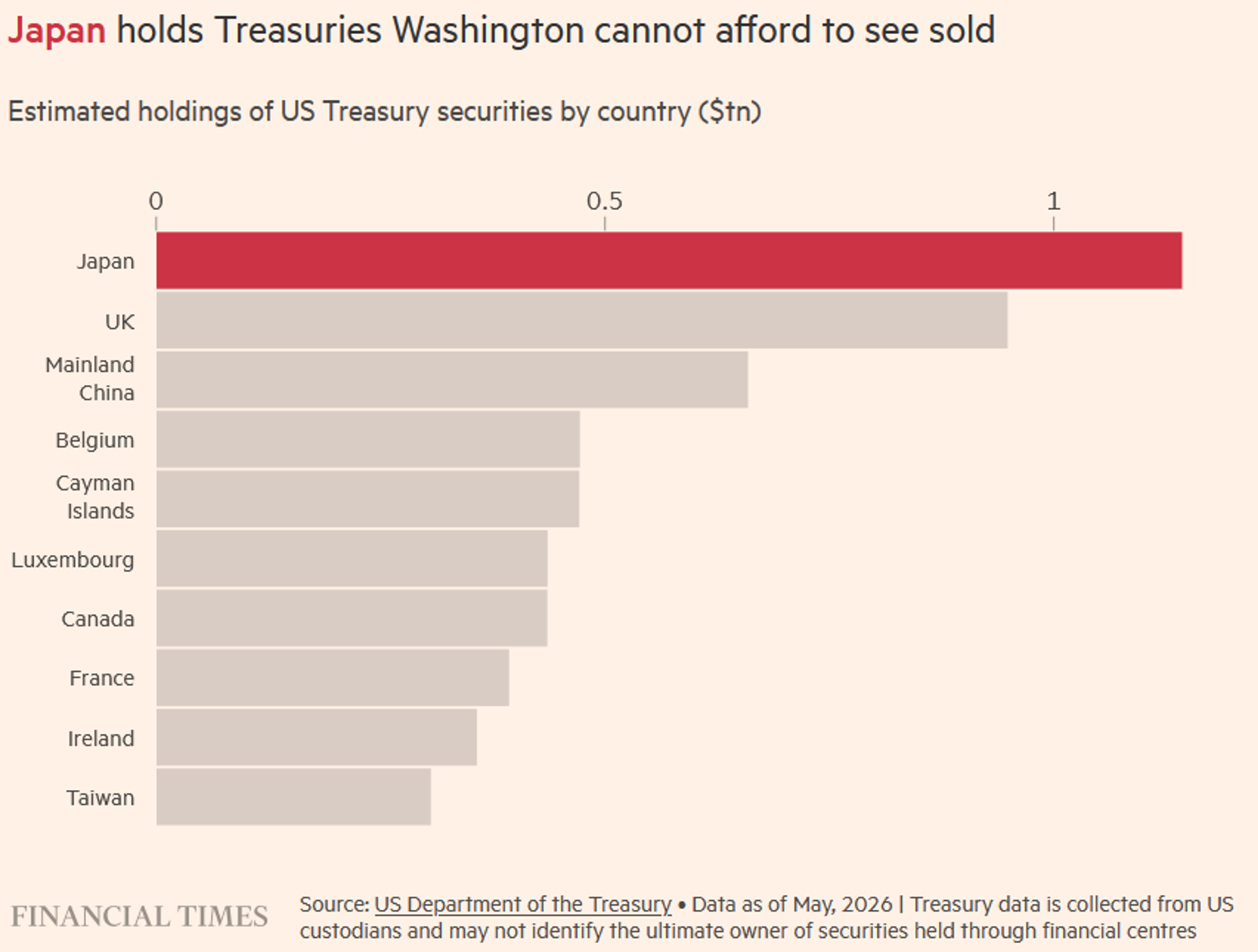
Faced with the imminent prospect of a major crisis, the contradictions are coming to light: the U.S. triggering a war in Iran to protect the dollar’s hegemony would also lead to a rise in inflation in Japan (given that Japan imports all of its energy, particularly from the Strait of Hormuz) and to a historic plunge in the yen, directly threatening the world’s leading power. Japan remains the largest holder of U.S. debt, with nearly 1.2 trillion dollars. In order to avoid a rush to sell U.S. bonds — which could precipitate the inevitable dollar crisis — the U.S. Treasury was therefore forced to intervene urgently (as it had done a few months earlier by establishing dollar swap lines for the Gulf monarchies) by purchasing yen. Rather than issuing new debt and avoiding massive bond sales, the United States bought yen by selling off all of its euros, which it holds in the Treasury’s emergency reserve fund. A winning bet — for now — for both the United States and Japan. And yet another illustration of Europe’s financial subservience to the United States, especially since the ECB was not notified in advance of such an intervention and since these sales are contributing to increased inflationary pressures on the Old Continent.
But this event, following the private credit crisis, only further highlights the vulnerability of the U.S. financial system. Moreover, if the United States shows itself willing to intervene and protect a foreign country that holds U.S. bonds, any country can then use those bonds as leverage — particularly in response to the asymmetric tariffs imposed by Washington. Thus, as confidence in the dollar continues to erode and the Fed gradually becomes the ultimate financier of U.S. debt, the words of the U.S. Treasury Secretary spoken in 1971 are ultimately turned on their head: the dollar has become, for the United States, its own problem.
All else being equal, gold is capitalizing on this situation — and on growing financial instability — to resume its upward trend. For, far from being dependent on temporary phenomena, gold is underpinned by long-term dynamics and continues to fulfill its role as a safe-haven asset during this period, particularly in the face of the increasing monetization of debt in advanced economies. As interest rates reach record highs since 2008 across the globe, this rise in gold prices also demonstrates that its relationship with bond yields is firmly established, as is its historical correlation with the dollar.
Central banks have therefore taken this opportunity to increase their reserves. This trend continues to be driven primarily by China, which remains true to its strategy; the Middle Kingdom stepped up its purchases following the recent decline in gold prices, recording its largest increase in July since 2023. The country intends to maintain its leadership position in the market, notably by allowing any business or individual to save a portion of their income in the form of gold. This trend is also spreading across the continent: in South Korea, in particular, the central bank has resumed its gold purchases after more than a decade, while diversifying the storage of its reserves. More broadly, in East Asia — where half the world’s population now lives — demographic shifts, the growth of the middle class, and massive wage increases in recent years continue to drive up demand for gold. Finally, as part of the ongoing global trend,the Chinese central bank has repatriated a significant portion of its reserves from London in order to establish Hong Kong as a major hub for the gold trade, while continuing to build dedicated infrastructure. Thus, China and other Asian countries are preparing, first and foremost, for the major economic and financial crisis to come, and for the rush of investors toward the primary safe-haven asset.



Comments
Log in or sign up to join the conversation.