

Something quite extraordinary has been happening in the financial markets over the past few days. Signs of fragility are multiplying in the artificial intelligence ecosystem, even as large-cap U.S. tech companies continue to enjoy nearly unshakable investor confidence.
The correction among semiconductor manufacturers, growing doubts about the profitability of investments in data centers, and—above all—the dramatic acceleration in the development capabilities offered by artificial intelligence are painting a picture of a much more unstable environment than the resilience of the major U.S. indices would suggest.
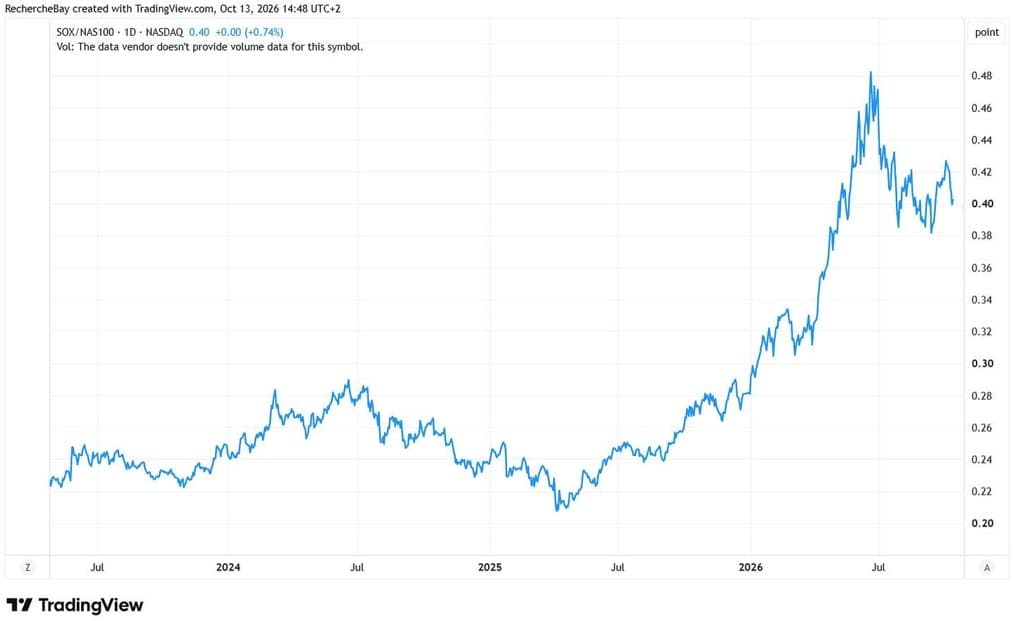
The SOX/NAS100 ratio measures the relative performance of the semiconductor sector compared to the large-cap technology stocks in the Nasdaq 100. Its trend clearly shows a period of underperformance that began in June and has been exacerbated by a new wave of corrections since September.
This divergence points to growing fragility in the semiconductor sector, while large-cap tech stocks, for their part, continue to demonstrate remarkable resilience.
What strikes me in particular is that we may be witnessing a situation in which the very success of a technology could lead to significant value destruction for the companies that develop, finance, and market it.
The paradox is all the more striking given that the markets continue to value these companies based on future profits, the visibility of which, however, seems to me to be diminishing at an astonishing rate.
A discrepancy that is becoming increasingly difficult to understand
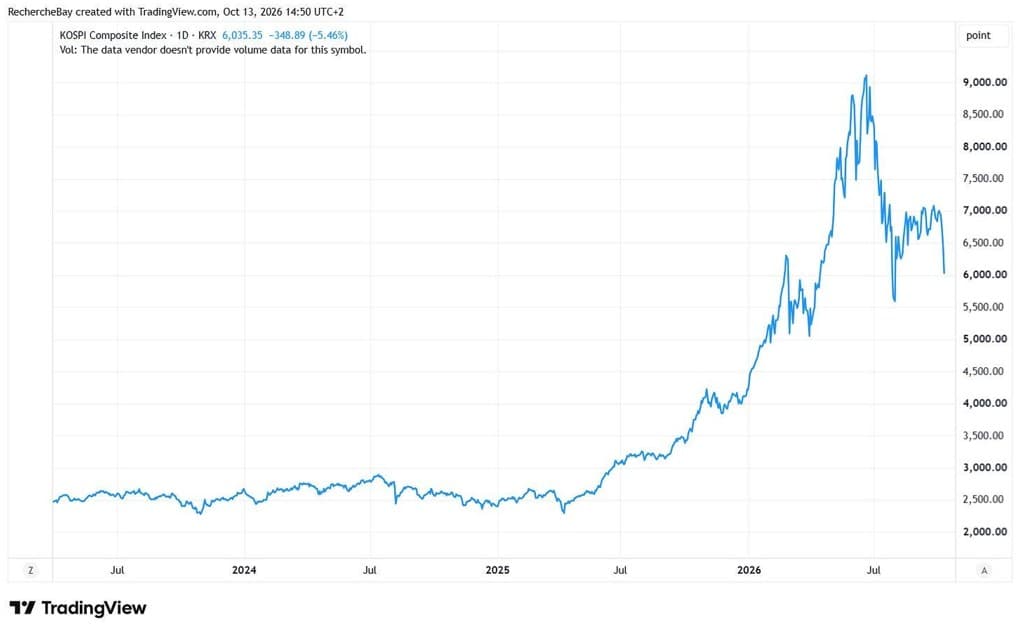
The recent correction in the South Korean market—which has been particularly pronounced in the semiconductor and memory sectors—stands in contrast to the resilience of major U.S. technology platforms, which investors appear to continue turning to as a safe haven.
This divergence seems to stem from the idea that component manufacturers would be the first to suffer from a slowdown in investment in artificial intelligence, while major platforms like Microsoft, Alphabet, or Amazon could, on the contrary, benefit from the falling cost of computing power.
The reasoning isn’t entirely absurd, since these companies are indeed very large buyers of processors, memory, and computing capacity. But it seems to me that this overlooks a crucial aspect of the issue: these same companies have already invested considerable sums in infrastructure whose profitability depends precisely on the future value of that computing power.
A drop in equipment prices may improve the profitability of future investments, but it may also reduce the profitability of previously purchased equipment—particularly when new generations of processors enable greater computing power to be produced at a lower energy and financial cost.
This distinction is fundamental, because infrastructure can continue to function perfectly well even as it rapidly loses its economic competitiveness.
Unlike the fiber-optic networks deployed during the dot-com bubble—much of which remained in service for several decades—graphics processing units (GPUs) are subject to much shorter innovation cycles. Their owners must therefore regularly replace part of their equipment to remain competitive.
The market thus appears to view the decline in computing costs as good news for hyperscalers, without always considering the potential impact this could have on the return on the capital they have already invested.
The precedent of the dot-com bubble
This situation is reminiscent of certain patterns observed during the dot-com bubble of 2000, when telecommunications operators had made massive investments in fiber-optic networks to prepare for an anticipated surge in traffic.
Their mistake was not in overestimating the adoption of the Internet—since it ultimately exceeded even the most optimistic forecasts—but in believing that this growth would allow them to sustain prices high enough to make their investments profitable in the long term.
The proliferation of networks, combined with technological advances that allowed ever-greater amounts of data to be transmitted over the same infrastructure, caused bandwidth prices to collapse. Many operators thus found themselves with assets that were extremely valuable to the economy but unable to generate the revenue needed to repay the capital invested.
Artificial intelligence could experience a similar phenomenon, in which token consumption would continue to grow exponentially, while their unit price would fall even more rapidly due to competition and productivity gains.
We must not confuse volume growth with profit growth, any more than we should confuse the operational profitability of a service with the return on the capital required to produce it.
Advances in models, new IT architectures, and software optimizations are already making it possible to significantly reduce the amount of computation required to perform certain tasks, while competition among research labs exerts constant pressure on prices.
For user companies, this trend represents a tremendous source of productivity. But for investors who finance the infrastructure, it raises a much more delicate question: how can they achieve a satisfactory return on equipment whose replacement cost and economic value can decline so rapidly?
Microsoft at the heart of this contradiction
Microsoft is likely the most interesting example of this situation, as the company is simultaneously exposed to multiple levels of the artificial intelligence value chain.
The company is investing heavily in its Azure infrastructure, maintains a major financial and commercial relationship with OpenAI, and continues to derive a large portion of its profitability from enterprise software sold on a subscription basis.
The market appears to view this diversification as a natural safeguard against the challenges facing AI labs, based on the assumption that the most vulnerable startups will eventually disappear and that the major platforms will capture their customers and market share.
The recent bankruptcy of Character.AI has further fueled this perception, as it demonstrates that a company can possess remarkable technology and attract a large number of users without managing to build a sustainable business model.
But there is a fundamental difference between the disappearance of a company and that of the technology it has developed. The story of Character.AI illustrates this precisely, since Google had acquired some of its talent and technology rights well before the company’s final difficulties.
The demise of startups does not, therefore, necessarily mean the end of competition. It can even accelerate the spread of certain innovations when technologies, teams, or models are taken over by other players.
For Microsoft, the issue is even more complex, since the company is not merely competing with artificial intelligence labs—it also funds part of their development and provides them with the infrastructure necessary for their operations.
If the profitability of these labs deteriorates due to falling computing costs, Microsoft could simultaneously face a decline in the value of certain investments, pressure on Azure’s future revenues, and a drop in the return on its own infrastructure.
It is therefore difficult to conclude that the potential bursting of an artificial intelligence bubble would automatically be good news for Microsoft, even though the company obviously has financial resources and a track record that are much stronger than those of most startups.
When a developer can challenge an entire industry
But perhaps the most spectacular development in recent days comes not from semiconductors or data centers, but from what is beginning to happen in the software industry.
An American developer, Brandon Thomas, recently used Claude to create several open source alternatives to Adobe software, before turning his attention to Word, Excel, and PowerPoint—with applications that are still imperfect but functional enough to generate considerable interest.

It would obviously be premature to view these software programs as competitors capable of immediately replacing Microsoft or Adobe products, since certain essential features are still missing and their compatibility with professional environments remains to be proven.
But that’s not at all what strikes me as important in this story.
What is extraordinary is that a developer working virtually alone can now produce, in just a few days, functional versions of software whose development previously required large teams, several years of work, and considerable investment.
We may be witnessing a dramatic reduction in the capital required to enter certain software markets, with potentially far-reaching consequences for companies whose valuations depend on the sustainability of their competitive advantages.
Even if the vast majority of these projects never resulted in a marketable product, it would only take a small fraction of them to reach a satisfactory level of quality to exert considerable pressure on the prices charged by established software publishers.
The question would then no longer be whether Microsoft Office or Photoshop remain the best software available, but why users would agree to continue paying high subscription fees for features that a growing number of competitors could replicate at low cost.
Artificial intelligence could destroy the revenue streams that fund its development
This is likely the risk that is most difficult for financial markets to assess, because artificial intelligence does more than just create new markets: it can also challenge the business models of the companies that fund it.
For several decades, major software publishers have benefited from a particularly favorable combination: high development costs, low marginal distribution costs, and barriers to entry high enough to maintain exceptional margins.
The gradual shift to subscription models has further reinforced this situation, transforming one-time software sales into recurring revenue—which is highly predictable and particularly appealing to investors.
However, as artificial intelligence models now make it possible to replicate a growing share of software functionality at very low cost, the technological scarcity that justified part of these margins could gradually disappear.
The threat does not necessarily lie in an immediate wave of cancellations, particularly in large enterprises where security, compliance, and integration constraints still pose significant barriers. Rather, it could take the form of an erosion of pricing power, well before any visible loss of market share.
Companies could retain their existing subscriptions while demanding more features for the same price, reducing their purchases of additional licenses, or shifting part of their budgets toward applications developed using open models.
The development of autonomous agents could further accelerate this trend, since certain tasks that currently require multiple software programs could be performed directly by artificial intelligence systems, without the user needing to interact with each of the traditional applications.
In such an environment, the per-user billing model—which is one of the cornerstones of large software vendors’ profitability—could itself gradually come under scrutiny.
There is something deeply paradoxical about seeing Microsoft, Google, and other major platforms investing considerable sums to develop technologies that could enable small teams to compete with some of their own long-standing business operations.
The real issue is the lack of visibility into future earnings
This technological acceleration poses a fundamental challenge for investors, since a stock’s value depends largely on the present value of the earnings and cash flows a company is expected to generate in the coming years.
When the market assigns high valuation multiples to a large technology company, it is valuing not only its current results but also its presumed ability to maintain its competitive advantages, margins, and growth over an extended period.
But how can one be so confident in a company’s earnings ten years from now when innovations capable of profoundly altering its competitive environment now emerge in a matter of weeks?
This obviously does not mean that the major tech companies will disappear, nor even that their profits will necessarily decline in the short term, but rather that the degree of certainty investors can reasonably attribute to them becomes much more questionable.
This distinction is crucial, because a company can continue to post excellent results while experiencing a significant contraction in its valuation multiple if investors begin to view its future margins as less secure than they previously thought.
This is precisely what makes the current concentration of U.S. markets on a few large-cap stocks particularly concerning. The resilience of these stocks sometimes gives the impression of overall strength, even as part of their industry environment becomes much more unstable.
The risk, therefore, is not necessarily that of an immediate collapse in earnings, but rather that of a sharp reassessment of how long those earnings can be sustained.
In the face of this instability, gold offers a radically different investment logic
It is in this context that gold’s resilience strikes me as particularly interesting, as demand for the yellow metal is driven by factors that are very different from those underpinning the valuations of major technology companies.
While equity investors must anticipate the future profitability of IT infrastructure, the sustainability of software margins, and the evolution of increasingly unpredictable competitive environments, central banks are pursuing a strategy of accumulating a physical asset whose monetary function does not depend on any of these factors.
Gold obviously generates neither dividends nor cash flow, and its price remains sensitive to real interest rates, the dollar, and liquidity shifts in financial markets. But it has one fundamental characteristic: its value does not depend on a company’s ability to maintain a technological or commercial advantage.
An ounce of gold does not become obsolete because a laboratory develops a more powerful artificial intelligence model, because a new processor reduces computing costs, or because a developer manages to replicate the functionality of subscription-based software in a matter of days.
This difference may seem obvious, but it takes on particular significance in an environment where the pace of innovation makes it increasingly difficult to predict the economic outlook for technology companies.
China Continues to Accumulate Physical Gold
The People’s Bank of China’s gold accumulation policy perfectly illustrates this difference in behavior between financial investors and monetary institutions.
For several years now, Beijing has been seeking to gradually diversify its reserves in an environment marked by rising geopolitical tensions, increasing U.S. debt, and questions about the dollar’s future role in the international monetary system.
Purchases of physical gold are driven by a desire to preserve and diversify reserves, rather than by a quest for profit growth or return on invested capital.
This strategy also offers a particular advantage for a central bank: gold held directly does not constitute debt owed by any foreign government, bank, or private company. It therefore does not expose its holder to the same counterparty risk as a traditional financial asset.
The contrast is thus becoming increasingly striking between a stock market that places a very high premium on future profits—the visibility of which diminishes as artificial intelligence advances—and a gold market supported by institutional physical purchases that depend neither on an economic model, nor on innovation, nor on the sustainability of a commercial income stream.
As technological certainties become more fragile, this fundamental difference between the two asset classes could become increasingly important in investors' decision-making.



Comments
Log in or sign up to join the conversation.