


Monday, 26 October 2026, may go down as an important date in the financial history of artificial intelligence. In a single day, nearly $200 billion in financing, potential issuance and financial commitments related to the sector was announced or detailed.
This mobilisation of capital comes as the credit market is beginning to show signs of strain. Spreads on the riskiest borrowers are widening, lenders are becoming more selective, and neocloud providers – which must continually finance their purchases of GPUs and data centres – are facing worsening funding conditions.
For several years, investors have been financing a promise: AI will transform the global economy and generate enough revenue to make investments in infrastructure on an unprecedented scale profitable.
But one question is becoming increasingly urgent: who will pay for all this infrastructure, and, above all, when? The spectacular growth in demand for computing power does not necessarily translate into equivalent growth in cash flow.
Four risks now warrant our attention :
1. Circular financing obscures the true level of demand
Relationships between chipmakers, hyperscalers, model developers and data-centre operators are becoming increasingly complex. These companies are simultaneously suppliers, customers and investors – and sometimes even guarantors of their partners’ financing.
The mechanism is simple: a GPU manufacturer invests in a neocloud provider, which then uses that capital to buy its equipment. The manufacturer records a sale, while its customer announces an increase in capacity.
These transactions can be entirely legitimate. But how much of the demand really comes from independent end customers, and how much depends on financing provided by the suppliers themselves?
We saw a similar mechanism during the telecoms bubble of 2000, when equipment manufacturers financed the operators buying their products. As long as capital keeps flowing, the system works. But when credit tightens, problems can quickly spread throughout the entire chain.
2. Computing commitments that have yet to show up in earnings
Anthropic’s IPO prospectus offers particularly useful insight into this issue.
As of 30 June 2026, the company reported $265.6 billion in minimum purchase commitments for computing capacity, compared with just $10.8 billion in contract revenue yet to be recognized.
These figures are not directly comparable: purchase commitments extend over several years, and not all future revenue is included in the reported contractual obligations. Even so, the asymmetry is revealing.
Anthropic has committed to purchasing substantial computing capacity, in some cases over very long periods, while the revenue needed to make those commitments profitable depends largely on future customer demand.
Because some of this infrastructure is not yet available, the associated costs have not yet been included in operating expenses. Anthropic can therefore report a spectacular improvement in current margins even as substantial expenses lie ahead.
This accounting treatment is not, in itself, irregular. But it makes extrapolating current profitability into the coming years particularly risky.
The problem could become even more serious if computing prices fall or customers switch to competing models.
3. Demand is exploding – but where is the cash-flow payoff?
This is probably the most underestimated risk.
Token consumption is growing at an extraordinary pace, driven in particular by developers, content creators and power users, who are making more requests and running several agents simultaneously.
But these customers are highly price-sensitive and relatively unloyal to any particular model. A developer may switch from Claude to DeepSeek or Qwen as soon as performance becomes comparable and pricing more attractive.
Yet the industry’s main anticipated growth driver remains the widespread adoption of AI by large enterprises.
And this is precisely where deployment appears to be taking much longer than expected.
One figure in Anthropic’s prospectus illustrates the situation. The company notes that more than half of Fortune 500 companies now spend at least $100,000 a year using its models – an average of less than 0.1% of total spending for the companies concerned.
This level of commercial penetration has generated considerable enthusiasm. But $100,000 a year is barely $8,300 a month. For a multinational, reaching that threshold is by no means proof that AI has been deployed at industrial scale.
It may simply reflect a few development teams, professional licences or pilot projects. Some companies undoubtedly spend much more, but the disclosed threshold does not reveal the actual scale of automation.
Using Copilot to write emails or summarise meetings is not the same as entrusting entire business processes to autonomous agents.
Integrating AI into IT systems, addressing security concerns, managing permissions and determining accountability for decisions make this transformation much more complex than expected.
Infrastructure is being financed today on the assumption of widespread enterprise adoption that has yet to materialise on anything like the anticipated scale.
And if this growth driver does not arrive for another three or four years, some operators could run into financial difficulties long before they benefit from it.
4. Technological competition poses a direct threat to margins
The fourth risk is that AI models become commoditised.
DeepSeek, Qwen and other open models are advancing rapidly, while software optimisation makes it possible to process ever more tokens with the same amount of hardware.
Hybrid architectures are also emerging, combining small models running locally with occasional access to large models hosted in the cloud.
I believe this shift could fundamentally change the economics of the sector.
Imagine personal computers equipped out of the box with an AI agent capable of handling most everyday tasks locally. Users would no longer necessarily need to pay for several subscriptions to US AI labs. They could use open models and call on a remote API only for more complex tasks.
Demand for AI could therefore continue to surge without a proportionate increase in demand for centralised computing power.
The most destabilising risk, then, is not AI’s technological failure. It is commercial success in an environment where computing prices fall much faster than volumes grow.
This brings us back to the telecoms paradox after 2000: internet traffic exploded, but the revenue it generated was not enough to make some of the infrastructure that had been built profitable.
Credit is starting to crack: the stock market comes to the rescue
These four risks take on a new dimension as the credit market deteriorates.
We have already discussed the widening of US credit spreads. Stress, initially concentrated in CCC-rated bonds, is now beginning to spread to B-rated issuers.
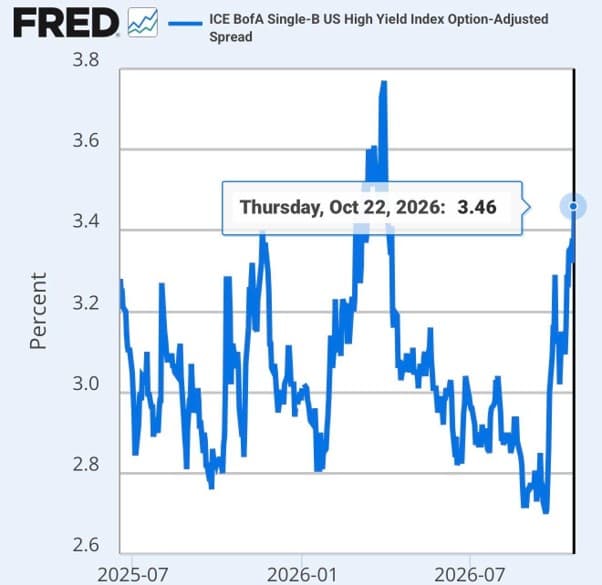
This development is particularly worrying for highly leveraged neocloud providers. When an operator has to pay 15% or more to finance its equipment, generating an adequate return on capital becomes much harder.
The bond market is not completely shut, but it is becoming more selective and demanding more collateral.
Under these conditions, equity markets are becoming an increasingly important source of funding for the AI industry.
And this is where the situation becomes particularly interesting.
The higher share-price valuations rise, the more capital companies can raise while limiting dilution for existing shareholders. That funding allows them to continue investing, which in turn sustains growth expectations.
We are entering a self-referential cycle: stock-market euphoria no longer merely reflects AI’s prospects; it is gradually becoming one of the conditions necessary to finance them.
Anthropic’s planned IPO must be viewed in this context. Its growth is spectacular, but its valuation will have to justify enormous infrastructure commitments and a sustained ability to defend its market share.
A significant correction in AI-related stocks could therefore have consequences far beyond losses for their shareholders: it could jeopardise the financing needed to sustain the sector’s expansion.
Monday, 26 October: $200 billion mobilised in a single day
The events of Monday, 26 October, perfectly illustrate the sector’s growing dependence on capital markets.
Three major transactions were announced or clarified at almost the same time:
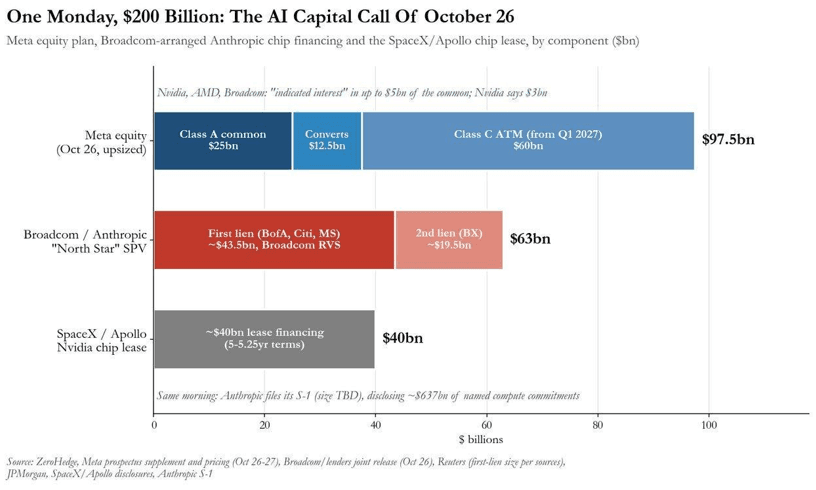
Meta outlined a financing programme of up to $97.5 billion, combining securities issuance and future transactions. Nvidia (NVDA), AMD (AMD) and Broadcom (AVGO), among others, expressed interest in participating to the tune of $5 billion in total, although no firm commitment had been made at this stage.
Anthropic and Broadcom announced a $63 billion financing structure to deploy new computing capacity. The transaction includes $43.5 billion in senior debt and $19.5 billion in subordinated debt, with Broadcom supporting the residual value of certain equipment.
Meanwhile, SpaceX (SPCX) and Apollo put in place an arrangement worth around $40 billion to finance the acquisition and leasing of Nvidia GPUs.
In total, around $200.5 billion in financing was announced or contemplated.
This does not mean that $200 billion in cash is being injected into the system immediately. The figures include potential securities issuance, financing commitments and transactions that could be carried out over several years.
But the fact that they are happening simultaneously is telling.
Chipmakers are becoming investors or guarantors. Private credit funds are financing equipment. Banks are structuring dedicated vehicles. And equity markets are being called upon to absorb ever-larger capital requirements.
The AI industry now has to mobilise extraordinary sums to keep financing growth whose ultimate profitability remains far from proven.
This is precisely what recalls the end of the telecoms bubble: a genuine technological revolution, but one involving investments that are becoming progressively more complex and expensive to finance.
The AI bubble feeds on stock-market euphoria, and gold pays the price
Ultimately, the market reaction is the most striking feature. Despite credit-market tensions and questions about the profitability of infrastructure, technology valuations remain extremely high.
And those valuations are themselves becoming a financing tool.
We are witnessing an exceptional concentration of capital in artificial intelligence, to the relative detriment of many other sectors. Small-cap stocks, industrial companies and mining stocks are struggling to attract investors on a sustained basis.
AI has become a gigantic capital vacuum.
This concentration of capital flows is also affecting precious metals.
Gold remains exposed to investors’ liquidity-driven portfolio reallocations, particularly when financial stress forces them to reduce leverage. In this environment, sustained central-bank purchases provide essential structural support, even though they are not the only factor underpinning the metal.
Silver’s underperformance relative to gold is particularly telling. Unlike gold, silver does not benefit from comparable demand from central banks. Its market is smaller, more volatile and more sensitive to the outlook for industrial activity.
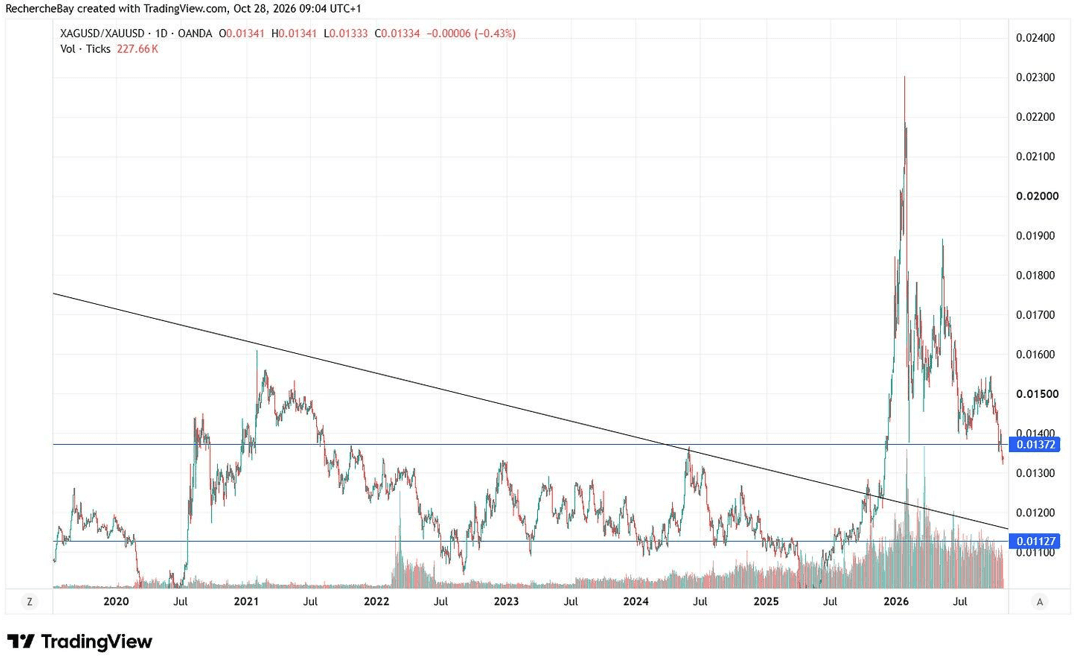
This divergence can therefore be interpreted as one symptom of investors’ current preference for liquidity and the most defensive assets.
Mining stocks are suffering even more from this environment. They combine exposure to metals with sensitivity to the cost of capital and investors’ aversion to sectors that are not directly participating in the AI euphoria.
We are left with a striking paradox: hundreds of billions continue to be mobilised to finance infrastructure whose future revenues remain uncertain, while companies with tangible assets and, in some cases, substantial cash flows struggle to attract capital.
This imbalance may persist for some time. But it raises a fundamental question about how global savings are currently being allocated.
We may have entered a phase in which the AI bubble needs ever-higher valuations to keep financing its own expansion.
And if this dynamic were to reverse, the consequences could extend far beyond the technology sector.
The question would then be where the capital that had been funding this expansion would flow instead.
Real assets, commodities and companies capable of generating substantial cash flows could regain a much more prominent place in investors’ portfolios.
For now, the capital vacuum is still operating. But the more AI financing depends on stock-market euphoria, the more vulnerable the system becomes to a simple loss of confidence.


Comments
Log in or sign up to join the conversation.