


The return of inflationary pressures in the United States is exposing a contradiction that is becoming increasingly difficult to ignore. While investors continue to price equities on the assumption of sustained growth, artificial intelligence’s ability to transform the economy over the long term, and a Federal Reserve still willing to step in whenever trouble arises, the bond market is beginning to send a markedly different message. Short-term US interest rates are rising again, hopes of rapid monetary easing are fading, and the cost of financing threatens to become a major problem for companies that rely heavily on credit.
At the same time, American consumers are feeling the effects of persistent inflation. Food prices remain high, essential expenses continue to weigh on household budgets, and wage growth no longer guarantees an improvement in purchasing power. Consumption may remain resilient for a while longer, but that resilience is becoming increasingly costly.
The paradox is that equity markets still seem relatively indifferent to this deterioration. Large-cap technology stocks continue to support the indices, while investors favour growth prospects without always accounting for the financing constraints involved in delivering them.
Gold, meanwhile, appears to be pricing in some of these tensions already. Its performance is not driven by inflation alone, but also by the growing fragility of a financial system whose stability increasingly depends on the availability of credit.
It is precisely this divergence between signals from the bond market, financing risks and the persistent optimism of equity markets that we will examine.
US inflation remains deeply entrenched
The release of October’s inflation figures served as a reminder that the US disinflation process remains far from assured. Consumer prices rose by a further 0.4% during the month, following September’s 0.6% increase. Core inflation, which excludes food and energy, also remained sticky, rising by 0.3% for the third consecutive month. Were this monthly pace to persist over a full year, it would translate into an annualised inflation rate of approximately 3.7%.
Food prices rose by 0.5% in October, as did restaurant prices, while housing costs continued their upward trajectory. Energy prices, which had contributed significantly to September’s acceleration, increased by a further 0.7%. The persistence of price increases across these everyday spending categories suggests that inflationary pressures extend beyond a temporary oil-price shock.
The 3.7% figure here is an annualised rate, not the official year-on-year inflation rate for October. The underlying picture is nonetheless concerning: core inflation remains too high for the Federal Reserve to consider its job done.
For American households, this persistent inflation comes on top of several years of cumulative price increases. Even when inflation slows, prices do not return to their previous levels. Wages therefore need not only to rise to preserve current purchasing power, but also to make up for some of the erosion that has already occurred.
This pressure is particularly acute for essential expenses. Food, housing, insurance and energy absorb a substantial share of household budgets. Lower-income households have little room to manoeuvre, while wealthier households can sustain their consumption for longer by drawing on their financial assets. But this latter source of resilience depends, in turn, on markets continuing to perform well.
This is where the first contradiction emerges: US consumption continues to benefit from the wealth effect generated by financial markets, even as the monetary conditions needed to sustain that effect are becoming less favourable.
The US two-year yield is beginning to challenge the equity-market narrative
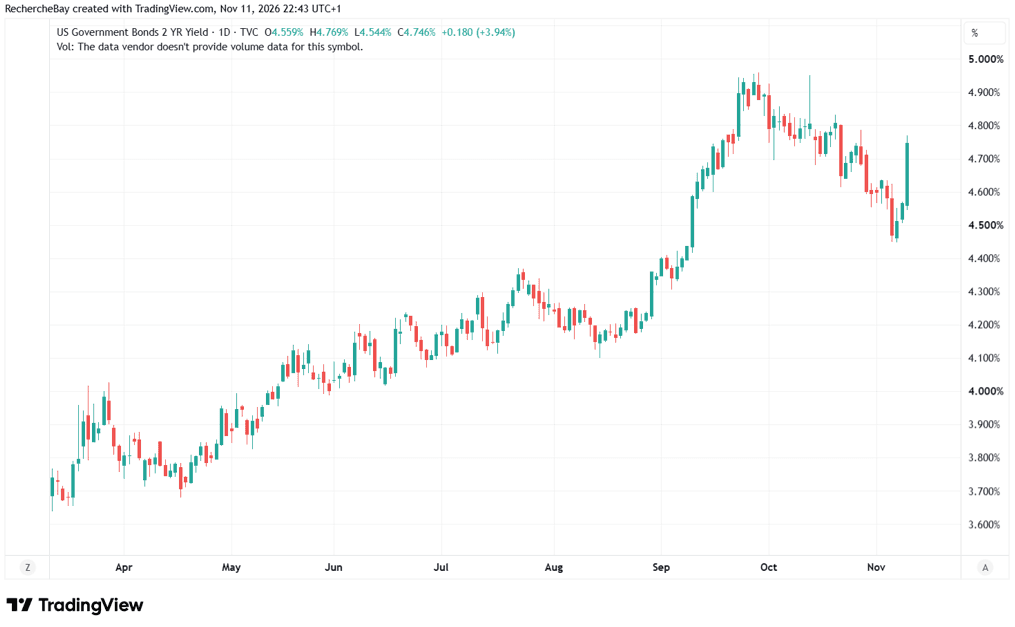
The most revealing move is taking place in two-year US Treasury yields.
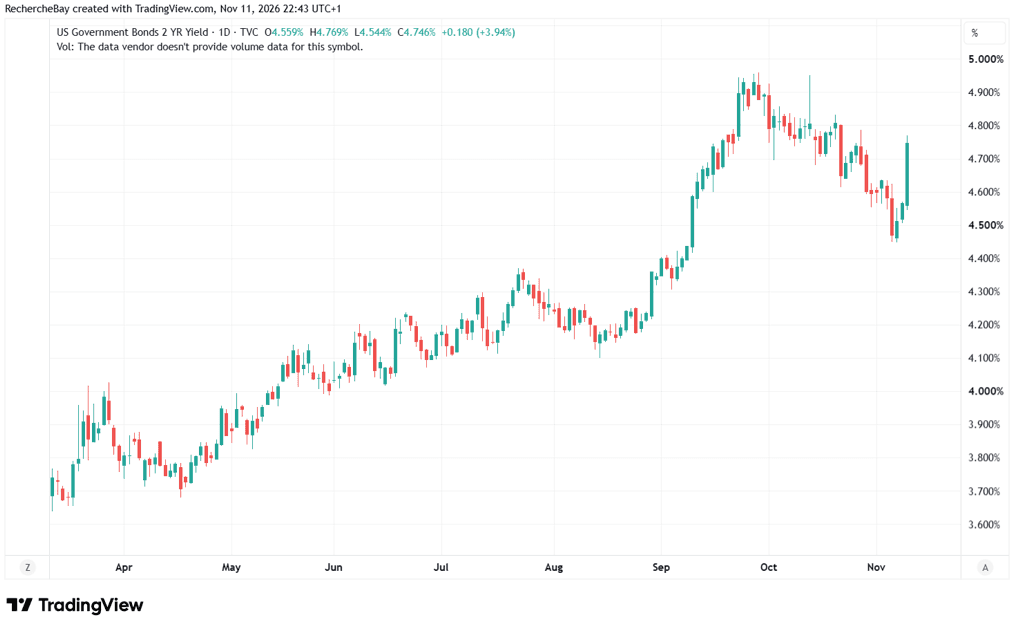
Particularly sensitive to expectations for monetary policy, the yield rose to around 4.76% on 10 November, after trading near 4.55% the previous day. An increase of more than 20 basis points over such a short period reflects a significant adjustment in investors’ expectations.
Why does this matter? The two-year yield primarily reflects market expectations for Federal Reserve policy over the coming quarters. When it rises, it generally means investors expect policy rates to be higher, or to remain restrictive for longer than previously anticipated.
For months, markets have built part of their optimism on the assumption that the Fed would eventually cut rates significantly. That prospect helped justify high valuations, particularly in the technology sector, while also supporting companies whose expansion depends on external financing.
Persistent inflation is now gradually calling that assumption into question.
If the Fed has to keep rates high to prevent prices from accelerating again, the cost of money will not fall as quickly as investors had hoped. Companies that expected to refinance their debt on more favourable terms will have to reassess their calculations, while new investment projects will become more expensive.
This is all the more concerning because the US economy has accumulated substantial financial commitments in recent years, particularly in infrastructure related to artificial intelligence.
The bond market is therefore beginning to challenge one of the main assumptions still underpinning equity markets: that a return to cheaper money is just around the corner.
Credit could become the real problem
To understand the consequences of rising interest rates, it is important to recall a key distinction. The rate at which a company borrows depends both on the general level of interest rates and on the confidence investors have in its ability to repay its debt.
A financially sound company with substantial cash reserves and steady earnings can generally borrow on relatively favourable terms. A more vulnerable business, by contrast, has to offer lenders additional compensation to persuade them to take the risk of lending it money.
This additional compensation is what markets call the credit spread.
When US interest rates rise, companies’ financing costs are already increasing. But if investors simultaneously begin to doubt their ability to repay their debts, they also demand a higher risk premium.
The two effects can therefore compound one another.
A company that previously borrowed at 8%, for example, could find its financing costs rising to 11% or 12% simply because benchmark rates have increased and lenders have become more cautious.
For an established company, such an increase can put significant pressure on earnings. For a business that relies on continuous borrowing to fund its expansion, however, it can call the viability of its business model into question.
For now, risk premiums on the debt of the highest-rated US companies remain relatively contained. Investment-grade spreads, at around 83 basis points in recent observations, continue to suggest that investors retain confidence in major corporate borrowers.
Yet this apparent calm masks a far more uneven picture. While the strongest companies continue to benefit from privileged access to financing on favourable terms, some heavily indebted businesses are already facing worrying debt costs.
The risk, then, is not necessarily an immediate, across-the-board credit crisis, but rather a gradual fragmentation of the market, in which the most vulnerable companies are denied the financing terms they need to grow.
This is precisely what makes the current situation in the artificial intelligence sector particularly interesting.
Artificial intelligence: spectacular growth that depends on credit
The build-out of artificial intelligence infrastructure represents one of the largest investment cycles in recent history. Major technology platforms, data-centre operators and computing-power providers have committed enormous sums to building the capacity required to train and run AI models.
But not all the companies involved in this expansion have the same financial resources.
Large technology groups such as Microsoft, Alphabet, Amazon and Meta can fund a substantial share of their investment through the cash flows generated by their existing businesses. They have relatively strong balance sheets and privileged access to the bond markets.
Companies specialising in renting out computing power, often known as neoclouds, have a very different profile.
Their business is to acquire graphics processing units, or GPUs, build or lease facilities capable of hosting them, and then sell that computing capacity to customers who generally sign multi-year contracts.
The problem is that the investment has to be made immediately, while the corresponding revenue is collected gradually.
To finance this growth, these companies therefore need to raise substantial amounts of capital, often in the form of debt.
As long as credit remains readily available, the model can work remarkably well. New financing allows companies to buy more GPUs, increase available capacity and sign new contracts. A growing order book reassures lenders, who are then willing to finance another phase of expansion.
But this mechanism can also work in reverse.
When the cost of credit rises, the returns on new facilities deteriorate. Lenders become more demanding, ask for additional collateral or reduce the amounts they are willing to provide. Projects may then be delayed, pushing back expected revenue while certain financial obligations remain payable.
The danger is particularly acute in an industry where equipment becomes obsolete quickly. GPUs purchased today must generate enough revenue to cover their financing costs and depreciation, and eventually to fund their replacement with more powerful generations.
Spectacular revenue growth therefore offers absolutely no guarantee that the investments made will prove profitable.
And this is precisely what CoreWeave’s latest results are beginning to illustrate.
CoreWeave: the credit market is telling a different story from the stock market
CoreWeave’s third-quarter 2026 results offer a particularly revealing example of this contradiction.
Revenue reached $3.66 billion, compared with $1.37 billion a year earlier, an increase of 168%. The company also has a $132.5 billion backlog, reflecting the scale of contracted demand for its infrastructure.
Behind this impressive growth, however, the financial position looks considerably more fragile.
Net losses rose from $110 million in the third quarter of 2025 to $709 million in the third quarter of 2026. They therefore increased more than sixfold in a year.
Net interest expense, meanwhile, reached $846 million for the quarter, compared with $310 million a year earlier. It now amounts to more than four times operating income, which stood at just $207 million.
In other words, CoreWeave is improving the operating profitability of its business, but its financing costs more than offset the profits generated by its operations.
And the situation could become even more strained.
The company expects to invest between $37 billion and $39 billion over the whole of 2026, while interest expense is forecast to reach between $1.05 billion and $1.15 billion in the fourth quarter alone.
These figures perfectly illustrate the nature of the problem. The more CoreWeave expands its capacity, the more it has to finance new equipment, and the higher its financing costs become.
The group can, of course, rely on future revenue growth to absorb some of these costs. But that assumption requires demand to remain strong enough, GPU rental prices to hold up, and new facilities to be brought online on schedule.
Above all, it assumes that financial markets will continue to be willing to fund this expansion.
Yet the first signs of strain are already visible.
In early November, the yield on a CoreWeave bond maturing in 2032 exceeded 16%. At that level, investors are demanding particularly high compensation to hold the company’s debt on the secondary market.
This does not mean that all of CoreWeave’s financing costs 16%. The company also benefits from loans secured against its equipment and customer contracts, whose terms can be significantly different. Nevertheless, the message from the bond market remains worrying.
At these yields, issuing new unsecured bonds becomes particularly expensive. The company has also indicated that it does not intend to raise financing in this segment of the market at the terms currently being demanded.
The contrast with the performance of its shares is striking.
After its results were published, CoreWeave’s stock rose sharply, driven by revenue guidance above expectations and probably amplified by short covering.
The shares can therefore rise by nearly 25% while creditors continue to demand extremely high yields to finance the company.
This divergence is particularly revealing.
Shareholders can continue to bet on CoreWeave’s future growth and its ability to become an indispensable player in AI infrastructure. Creditors, by contrast, are primarily trying to determine whether future revenue will be sufficient to repay the financial commitments already made.
The equity market is valuing a promise of growth. The credit market is beginning to question how much it will cost to deliver on that promise.
And in an industry so dependent on external capital, it is probably the constraints imposed by the latter that will ultimately prevail.
The risk could spread across the entire AI supply chain
The problem extends far beyond CoreWeave alone.
The entire AI investment chain depends, directly or indirectly, on the availability of financing. Data-centre operators have to fund buildings, electricity connections and cooling equipment. GPU suppliers depend on their customers’ ability to finance orders. Power producers invest on the basis of consumption forecasts that sometimes stretch several years into the future.
A substantial proportion of these projects therefore rests on the assumption that capital will remain available until they become operational.
If credit conditions tighten, major hyperscalers may choose to slow certain investments, renegotiate contracts or prioritise their most profitable projects.
The companies building the infrastructure have far less flexibility.
Equipment has often already been ordered, electricity capacity reserved and financing committed. A slowdown in demand or even a simple postponement of delivery can therefore have considerable financial consequences.
It is important to remember, however, that hyperscalers’ contractual commitments cannot all be cancelled freely. Some include guarantees, penalties or firm obligations. Nevertheless, major platforms generally have a greater capacity to absorb shocks than their specialised suppliers.
This is why the market is gradually beginning to distinguish between companies that will benefit from artificial intelligence over the long term and those that bear the financial cost of developing it.
An industry can experience exceptional growth while destroying value for some of its investors if the return on invested capital falls below its cost.
This distinction, long obscured by enthusiasm surrounding artificial intelligence, could become central over the coming months.
Gold is beginning to price in a risk that equity markets continue to underestimate
In this environment, gold’s behaviour deserves particular attention.
Traditionally, a rise in short-term US interest rates is a headwind for the yellow metal. Higher real interest rates increase the opportunity cost of holding an asset that pays no interest, while a stronger dollar can also weigh on its price.
But this relationship becomes less straightforward when rising rates begin to threaten credit stability.
Gold is then no longer responding solely to the level of interest rates. It may also be pricing in the financial consequences of a monetary policy that remains restrictive for too long.
If the Fed keeps rates high to fight persistent inflation, it risks intensifying the pressure on the most vulnerable borrowers. But if it intervenes quickly to support credit, it could fuel inflation expectations and undermine confidence in monetary stability.
This contradiction could gradually become a favourable factor for gold.
Equity markets, for their part, continue to focus on growth prospects and the ability of major technology companies to generate future profits. Financing difficulties are still largely viewed as problems specific to certain companies, rather than as early symptoms of broader fragility.
It seems that gold is starting to price in this credit risk, while equity markets remain elevated despite mounting signs of financial strain.
This does not mean that the yellow metal would be immune to a market correction. During a sharp deleveraging episode, investors may be forced to sell liquid assets, including gold, to meet margin calls or rebuild their cash reserves.
But such short-term liquidation pressure would not necessarily undermine the factors supporting gold over the longer term.
The prospect of an economy facing persistent inflation, high debt and growing dependence on monetary intervention at the same time creates an environment in which gold’s role as a store of value once again becomes especially important.
For mining companies, the picture remains more mixed. They may benefit from a high gold price, but they remain exposed to the availability of capital, stock-market liquidity and changes in risk appetite. Small-cap miners in particular may continue to struggle as long as investors favour companies that can finance their development without constantly turning to the markets.
There may therefore be a disconnect between the strength of the metal itself and the performance of mining stocks, particularly in the early stages of a tightening in credit conditions.



Comments
Log in or sign up to join the conversation.