


In my October 30 article, titled “The AI bubble is draining capital from other markets, including gold”, I explained how the artificial intelligence industry had become an enormous magnet for capital. Hundreds of billions of dollars were being mobilized to finance infrastructure whose future profitability remained largely unproven, while small-cap companies, industrial businesses and mining stocks were struggling to attract investors.
I focused on an especially dangerous mechanism: the market valuations of AI-related companies no longer simply reflected their growth prospects; they were gradually becoming an essential condition for financing that growth. The higher share prices climbed, the more capital these companies could raise to fund new data centers, thereby sustaining stock-market euphoria.
But this mechanism also works in reverse.
When valuations begin to fall, financing capacity deteriorates, lenders reassess the collateral available to them, and companies that depend most heavily on capital markets are forced to rethink their ambitions. This is precisely the risk we had identified.
The governance crisis currently engulfing Nvidia adds a new dimension to this vulnerability. Jensen Huang’s resignation, followed by statements hinting at a possible return, prompted an unusual show of activity in Silicon Valley. However, US Treasury Secretary Scott Bessent publicly argued in favor of appointing a successor from outside the company, amid questions about technological ties with China.
Beyond the circumstances of this departure, which still require clarification, the situation highlights just how strategically important Nvidia has become to the United States. Jensen Huang was not simply running a semiconductor manufacturer: he embodied an ecosystem in which suppliers, customers and investors have increasingly close financial ties.
The market correction now gives us a sense of the risks involved. Since its October 6 peak, Nvidia has lost around $2 trillion in market capitalization, with its valuation falling from approximately $5.8 trillion to $3.8 trillion.
Of course, this does not mean that $2 trillion in cash has actually left the markets. But this destruction of financial wealth can reduce the value of assets used as collateral, limit investors’ borrowing capacity and trigger forced selling across other asset classes.
This is how a stock-market correction concentrated in a handful of major technology companies can gradually turn into a broad-based contraction in liquidity.
The Fed cannot offset the destruction of financial wealth
Some investors are now counting on the Federal Reserve to stabilize the markets. Yet the amounts involved illustrate the limits of monetary intervention.
The Fed plans to reinvest around $14 billion in Treasury securities between November 16 and December 11, a negligible amount compared with the $2 trillion wiped off Nvidia’s market capitalization. These figures are not directly comparable, of course, since the Fed’s reinvestments are not intended to offset stock-market losses. However, they give an idea of the gap between the monetary operations currently planned and the scale of the ongoing repricing of financial assets.
More importantly, providing reserves to banks does not necessarily restore their appetite for risk. A bank may have ample liquidity and still refuse to finance a data-center operator whose collateral is losing value.
The problem is particularly concerning for neocloud providers, whose business models depend on continuously securing new financing. CoreWeave bonds are reportedly now yielding close to 15%, while certain Nebius convertible bonds are trading at around 70% of their face value.
With borrowing costs rising so sharply, profitability prospects could deteriorate quickly. The major hyperscalers still have balance sheets strong enough to absorb some of this pressure, but the most heavily indebted operators could find themselves in a much more difficult position.
Here we see the same mechanisms that emerged during the telecom bubble: a genuine technological revolution, but infrastructure financed on the basis of growth and profitability assumptions that the markets eventually begin to question.
The question is no longer simply how many GPUs Nvidia will be able to sell, but who will still be able to borrow the money to buy them, and at what cost.
Gold is correcting under liquidity pressure, but demand remains resilient
The recent correction in precious metals needs to be understood in this context.
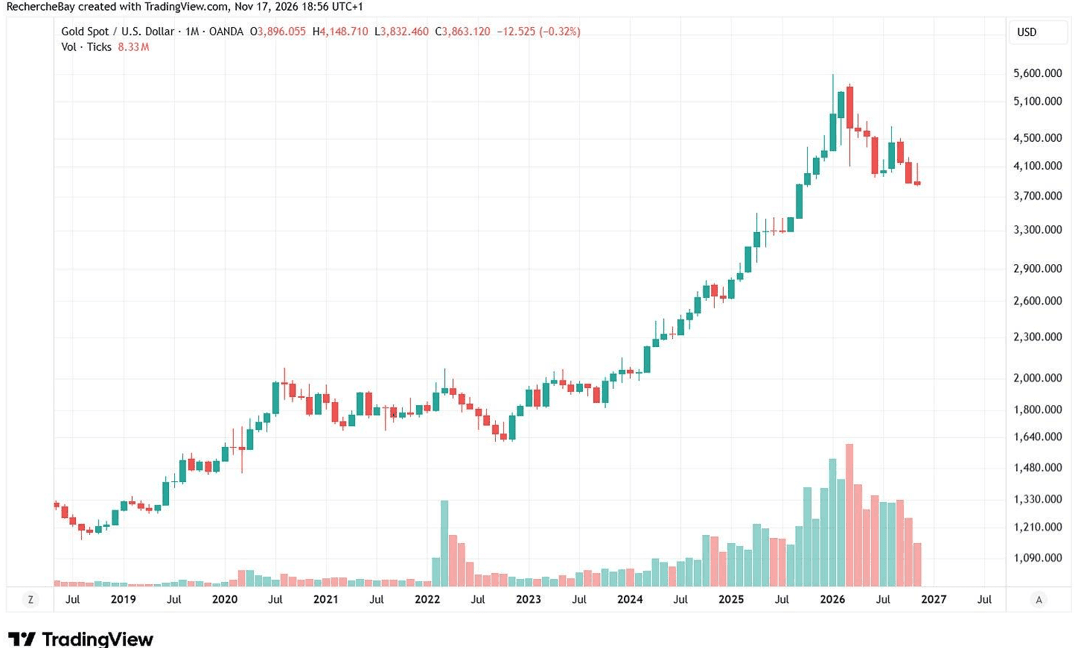
In October, gold fell 6.8%, ending the month at around $3,875 an ounce, while silver lost 18.7% and the leading gold-mining stocks declined by nearly 12%.
At first glance, this may seem paradoxical. Concerns about financing the AI industry, deteriorating credit conditions and mounting sovereign-debt tensions should, in theory, make gold more attractive.
But when a stock-market correction triggers deleveraging, investors do not sell only the losing positions. They also dump their most liquid assets to rebuild cash reserves and meet margin calls.
Gold then becomes a source of liquidity to cover losses incurred elsewhere.
We saw this phenomenon in 2008 and again in March 2020. In both cases, gold initially corrected during the broad liquidation phase before regaining its role as a safe haven when central banks were forced to intervene.
But one feature sets the current correction apart: falling prices have not been accompanied by a collapse in investment demand.
At the end of October, gold-backed ETF holdings stood at around 100.97 million ounces, even surpassing their February levels. Silver-backed ETFs also recorded an increase in their physical holdings, adding nearly 4.9 million ounces over the month.
In other words, prices fell sharply while the quantities of metal held by these investment vehicles remained resilient.
This divergence suggests that the correction has been driven more by position adjustments in derivatives markets, systematic strategies and short-term liquidity needs than by a broad withdrawal of long-term investors.
Quantitative funds and trend-following strategies, in particular, reduced their exposure to gold as certain technical thresholds were breached. According to some estimates, these market participants’ short positions were already approaching their usual limits by mid-October.
This development matters. Once excessive speculative positioning has been largely unwound, the market may become more sensitive to an improvement in financial conditions, although this does not necessarily mean that a bottom has already been reached.
China is absorbing some of the selling from Western markets
Another revealing factor is the behavior of Chinese buyers.
While Western investors were reducing their exposure to gold, premiums in Shanghai remained high, pointing to physical demand capable of absorbing some of the metal being sold internationally.
The divergence between the two markets has become striking. Over a rolling ten-week period, the correlation between an indicator combining Western gold positioning and Shanghai premiums is said to have fallen to around −0.97.
This figure does not mean that China mechanically absorbs every ounce sold in the West. Nevertheless, it shows that the two indicators have recently moved in almost opposite directions: while Western financial investors were reducing their positions, premiums in the Chinese market pointed to sustained physical demand.
This distinction between the financial market and the physical market is becoming essential.
On Western markets, prices are heavily influenced in the short term by futures contracts, options, quantitative strategies and portfolio arbitrage. In China, physical demand is driven more by concerns relating to wealth preservation, monetary considerations and savings diversification.
The persistent weakness of China’s property market, difficulties in domestic credit markets and uncertainty surrounding economic growth are prompting some savers to seek assets whose value does not depend directly on the solvency of a financial intermediary.
Gold also benefits from central banks’ desire to diversify their reserves in an increasingly fragmented geopolitical environment.
We are therefore seeing a revealing trend: Western investors might sell gold to obtain dollars, but other market participants buy gold precisely to reduce their dependence on those same dollars.
This divergence could become one of the market’s main sources of support once liquidation pressures begin to ease.
Sovereign debt is gradually reinforcing gold’s monetary role
The recent correction should not obscure the broader transformation in the macroeconomic environment.
In October, gold faced a particularly unfavorable combination of factors: rising US real interest rates, a stronger dollar, energy-related inflationary pressures and a tightening of global financial conditions.
The US 10-year real yield briefly approached 3%, while the nominal yield exceeded 5.3%. In such an environment, the higher opportunity cost of holding an asset that generates no income makes gold less attractive to some investors.
But this rise in interest rates also reveals a much deeper vulnerability.
Developed countries must finance substantial structural deficits even as the cost of their debt rises. France is a particularly worrying example: its 10-year sovereign yield exceeded 5%, while the yield spread over German bonds reached around 174 basis points at the end of October.
The problem extends well beyond France. The United States, the United Kingdom and Japan are facing, to varying degrees, higher financing needs and increased sensitivity of their public finances to interest rates.
For investors, this raises a fundamental question: can sovereign bonds continue to serve simultaneously as reserve assets, financial collateral and protection against crises?
When the sustainability of public debt itself becomes a source of concern, physical gold once again demonstrates the full relevance of one of its fundamental characteristics: it is not the liability of any government and does not depend on any issuer’s ability to repay its debt.
Silver and mining stocks: an even sharper correction
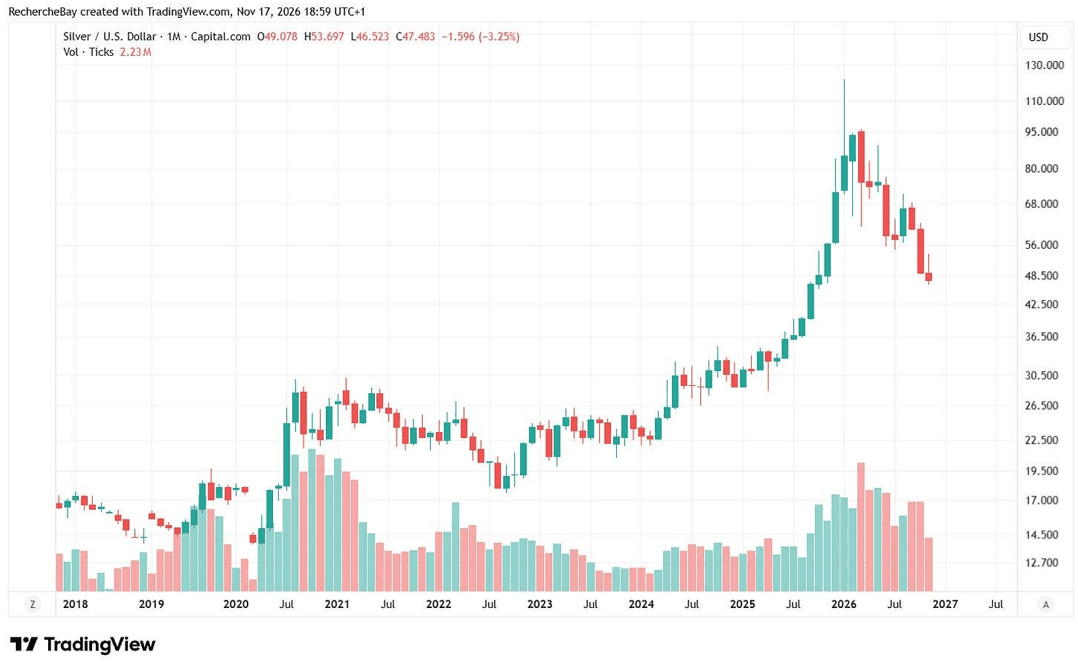
Silver suffered a much steeper correction than gold in October, falling by nearly 19%. This underperformance can be explained by a combination of contracting liquidity, the metal’s inherently higher volatility and its sensitivity to the outlook for industrial activity.
As a result, the gold-to-silver ratio has risen to around 79, well above its long-term historical average, generally estimated at 60:
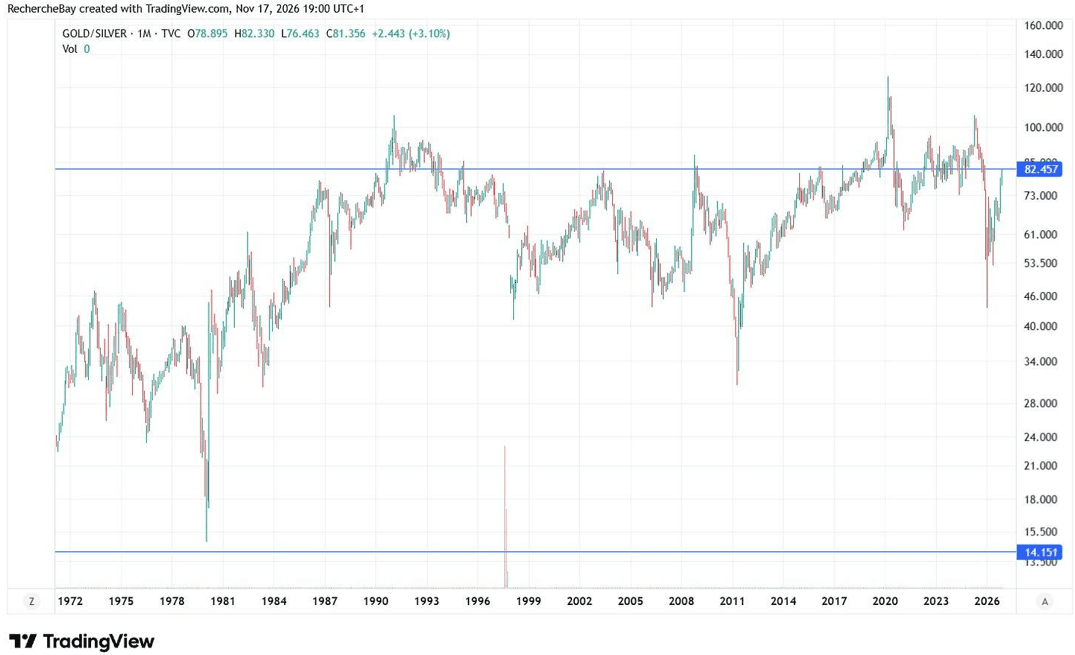
This level is not in itself a buy signal, but it highlights the extent of silver’s relative underperformance.
The situation is all the more interesting because silver-backed ETF holdings increased during the correction. From their July lows, these investment vehicles are said to have accumulated nearly 19.5 million additional ounces by the end of October.
Some investors appear to be taking advantage of lower prices to increase their exposure to the metal, while derivatives markets continue to exert downward pressure on prices.
Mining stocks, for their part, remain particularly vulnerable during episodes of deleveraging. They combine exposure to metal prices with sensitivity to equity markets and, in the case of small-cap companies, often limited liquidity.
But this correction is also widening valuation gaps between companies with tangible assets, identified reserves and sometimes substantial cash flows, and technology companies whose valuations are still largely based on expectations of future revenue.
This divergence is likely to persist as long as investors continue to reduce their overall exposure to risk.
Nevertheless, it could pave the way for a much more favorable phase of capital reallocation toward real assets once financing pressures begin to ease.
The immediate risk for gold remains another wave of forced liquidations. But its main source of support over the medium term could lie precisely in the financial consequences of the AI bubble bursting.
The real question, then, is not simply how far technology stocks may fall, but when the contraction in liquidity will stop weighing on the gold price and begin to strengthen its role as a benchmark monetary asset.



Comments
Log in or sign up to join the conversation.