


Lower energy prices are providing a supportive environment for European markets, with the DAX extending its gains and the euro holding largely in a holding pattern. The decline in oil prices has also helped longer-dated US Treasuries, pushing yields lower as concerns over inflation have eased somewhat. But the question, of course, is how much further oil prices and bond yields can fall. For now, the combination is supportive of risk assets and is helping to sustain a relatively benign decline in the dollar. The focus today will be on US core PCE inflation, due for release shortly, while Nvidia’s second-quarter earnings will provide another test for risk appetite after the US markets close. Attention then turns to Fed Chair Kevin Warsh and the Jackson Hole symposium on Friday.
Softer energy supports risk appetite
It has now been a week after US Treasury Secretary Scott Bessent’s intervention in the Treasury market, longer-dated US yields are now around 10 basis points lower. The sharp decline in oil prices since last week has clearly played a role, helping to ease some of the market’s concerns about the inflation outlook.
Investors are also taking encouragement from the latest peace talks, brokered by Pakistan. Whether these discussions ultimately produce anything concrete remains to be seen, but for now they have helped to reduce some of the geopolitical risk premium embedded in the oil markets.
The next tests for the long end of the Treasury curve come in quick succession: today’s US PCE inflation report, tomorrow’s $44bn seven-year note auction and Friday’s Jackson Hole speech from Fed Chair Kevin Warsh.
Lower yields have already helped to keep the US dollar debasement trade relatively quiet so far this week. We haven’t seen any major upside follow through in gold, bitcoin or the euro yet.
What to expect from the PCE data?
Coming up next on the economic calendar is the Fed’s favourite inflation measure: the core PCE price index. For the dollar, a core PCE reading around 0.2% month-on-month would probably leave the currency relatively steady. But with the broader risk backdrop looking benign, the balance of risks may still favour modest dollar losses. That would certainly be the case, I think, if the PCE numbers come out weaker than expected.
It is also worth keeping an eye on the release of preliminary GDP, which is expected to have remained unchanged at 1.5% y/y from the Advance estimate.
EUR/USD supported by lower energy prices and stronger eurozone data
Eurozone data continue to surprise on the upside, which is particularly surprising given the sharp rise in energy prices seen since the start of the year. The resilience of the European economy has been more impressive than many had expected. Some ECB policymakers such as Isabel Schnabel have acknowledged the improvement. For that reason, markets are still expecting to see a 25bp rate hike to 2.50% in September, while keeping alive the prospect of another 25bp increase early next year.
Key levels to watch on EUR/USD
Assuming today’s US core PCE data do not deliver an upside surprise, or Warsh is not super hawkish on Friday, I continue to favour the EUR/USD holding the breakout we saw last week.
For now, the pair has eased back a tad after reaching its first major target around 1.1700, where the 50% retracement of the January-to-June decline comes into play. A modest pullback ahead of the Jackson Hole is hardly surprising.
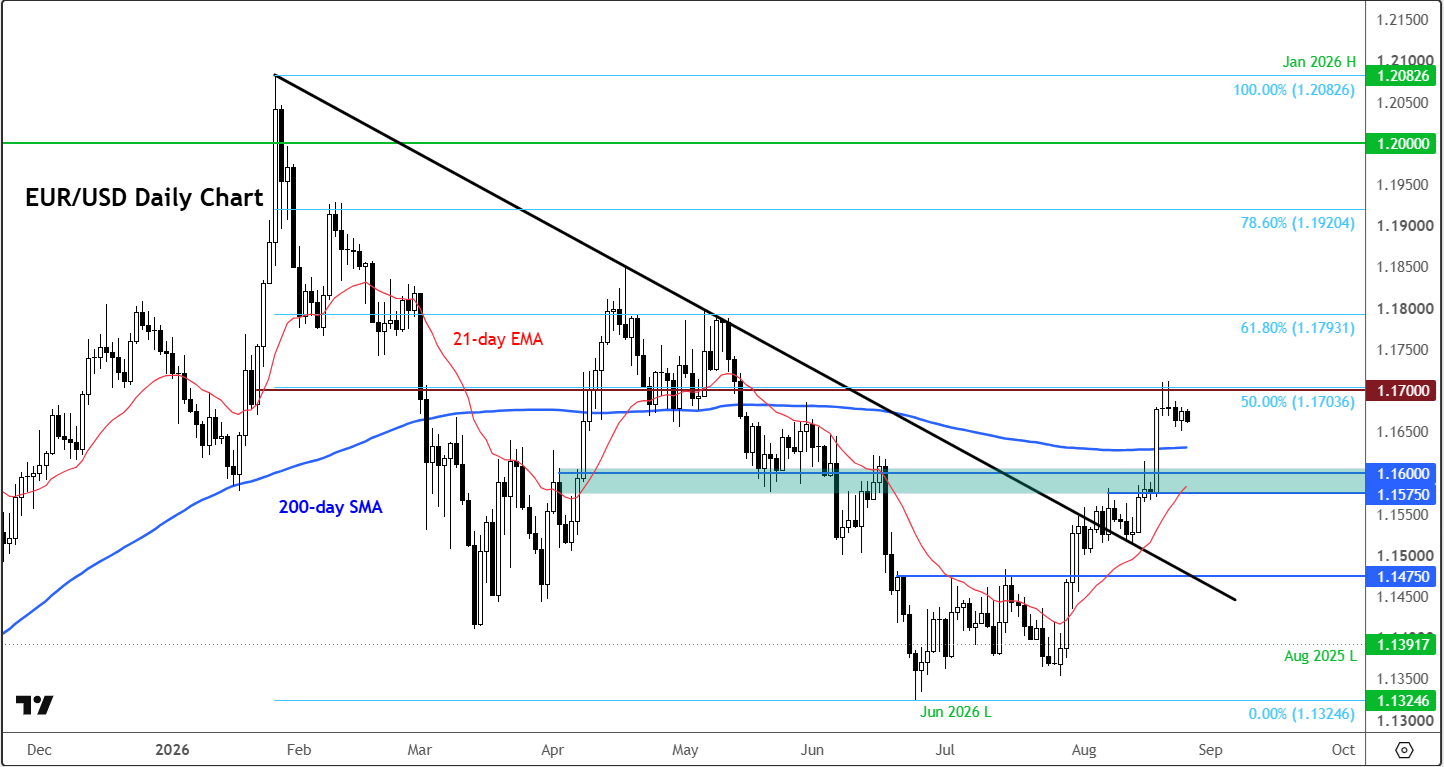
On the downside, the 1.1575–1.1625 area is the most important support zone to watch in my view. The upper end of this range is where the 200-day moving average comes into play, while the lower end marks the origin of the recent breakout.
As long as EUR/USD holds above 1.1575/70 area, the technical bias remains bullish. A sustained move back below this level, however, would weaken the current bullish structure and raise the prospect that the breakout was ultimately a false one.
In terms of upside targets beyond 1.1700, the next level of resistance is seen 1.1800, where the 61.8% Fibonacci retracement of the January-to-June decline also sits.



Comments
Log in or sign up to join the conversation.