

In ordinary times, investors debate earnings revisions, Federal Reserve nuance, and the subtle choreography of inflation and growth. In wartime—particularly when that war encircles the world’s most important energy chokepoint—those concerns are demoted to second-tier considerations. For now, spreadsheets have yielded to shipping lanes. What was once a steady flow of over 100 ships per day through the Strait of Hormuz has collapsed to a near standstill.
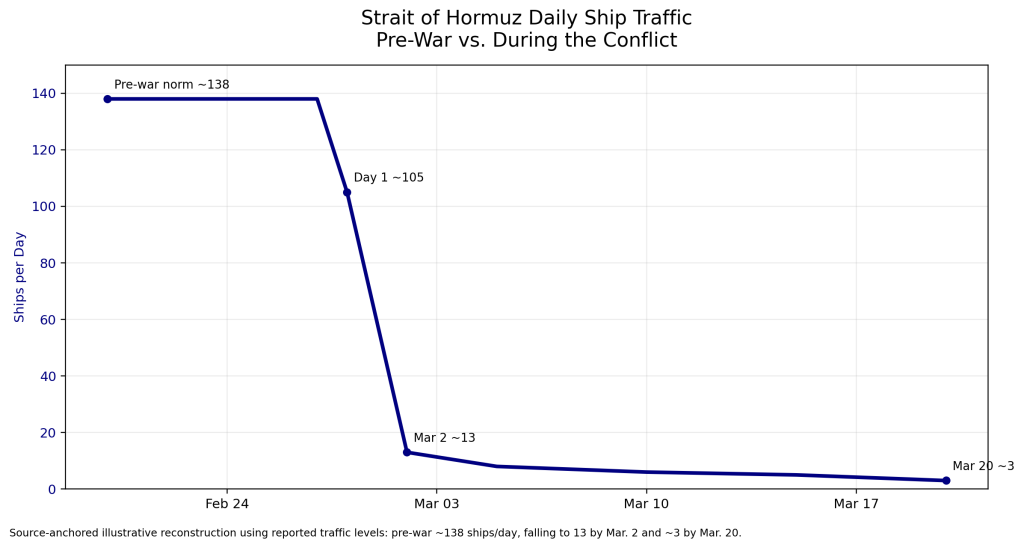
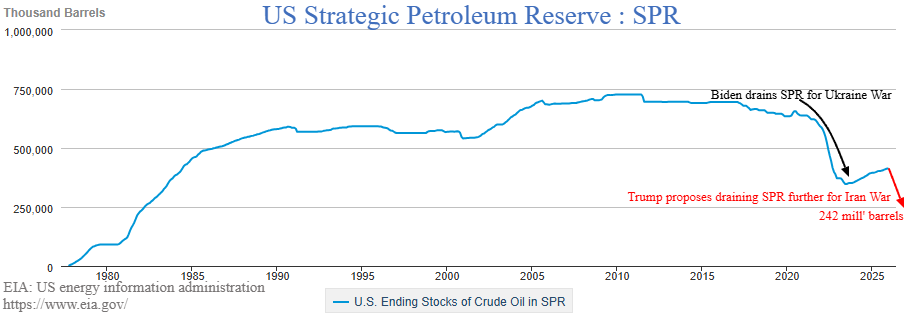
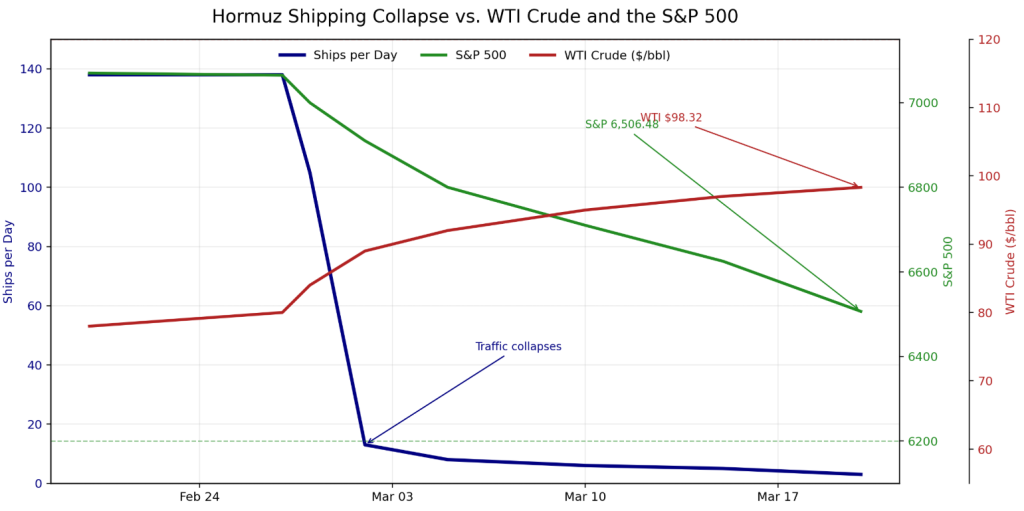
The world’s financial gaze is fixed upon the Strait of Hormuz with the vigilance of the watchmen of Gondor. Until oil, natural gas —and even fertilizers that sustain global agriculture—flow freely once more, markets will remain captive to the progress of military operations rather than the cadence of economic data. The arithmetic is unforgiving: the duration of Iran’s effective shipping disruption is directly correlated with the price of oil and inversely correlated with equity valuations. Markets may be complex in their construction, but in moments like this, their logic is simple.
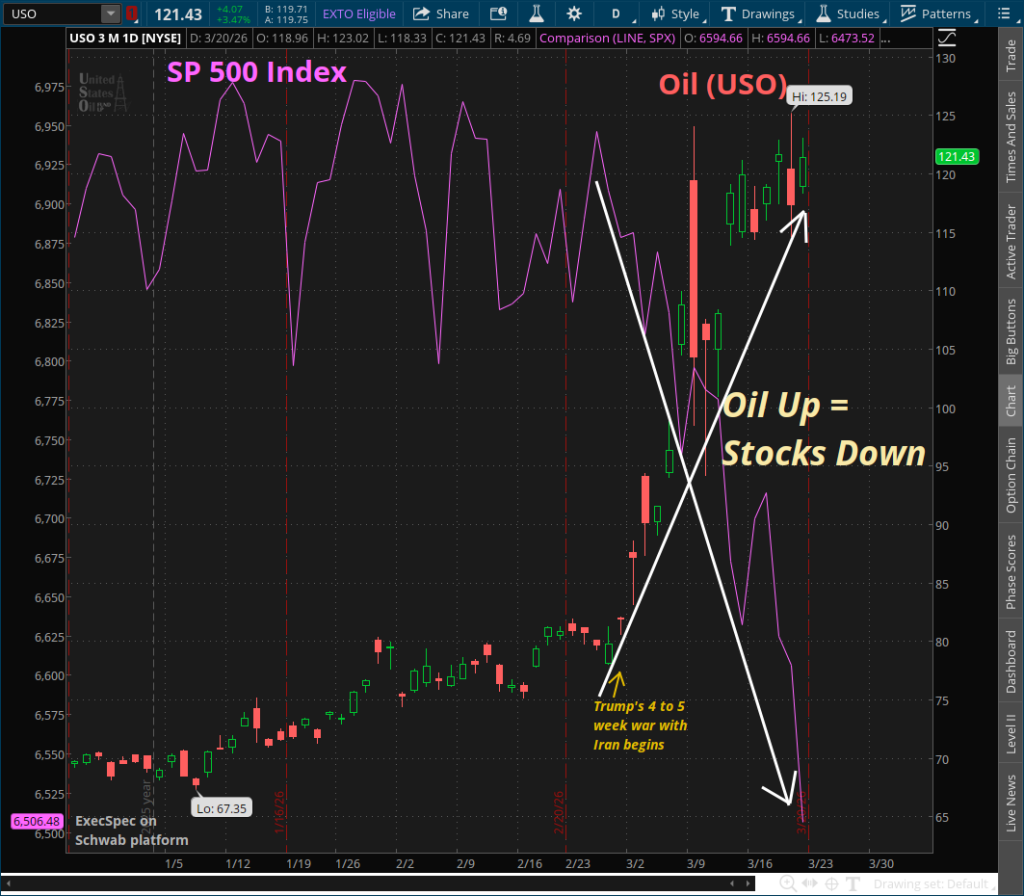
Releasing Strategic Petroleum Reserves: A Bridge to Nowhere, Not a Solution
The United States and its allies have responded to energy scarcity fears with a record 400 million barrel release from strategic reserves—an intervention that, in quieter times, would command markets’ attention. Today, it ‘s just a forgotten footnote.
This is because the reserves are irrelevant to the core problem. They add barrels for a few weeks, but they do not restore confidence. Markets are asking: Who controls the Strait—and for how long? Until that answer is resolved, reserve releases and suspending the Jones shipping Act are best understood as a flimsy temporary bridge over troubled water that remains closed.
The Paradox of Power
By conventional military standards, the United States and its allies have inflicted severe damage on Iran’s military infrastructure—across land, sea, and air. Command networks have been degraded, installations struck, and visible capabilities diminished. Yet markets are not grading the war on battlefield metrics. They are grading it on shipping risk. In that domain, Iran retains asymmetric leverage through RPGs, drones, mines, and missiles. The US is winning the war in a traditional sense—but Iran, for now, is dictating the terms for peace. Today, to appease voters, the President stated that the US is close to beginning a withdrawal from the war zone with Iran, listing all the objectives that have been achieved. On this news, Oil will fall and stocks will rise when the markets open. However, investors are likely to fade this alleged good news quickly since the US can’t withdraw until Iran allows it, which will require a further military escalation.
The 800-Pound Gorilla and the Calendar
The United States remains the preeminent military force—the proverbial 800-pound gorilla—and it will almost certainly reassert control over the Strait. But to secure Hormuz requires more than dominance; it requires exhaustive control:
Suppression of drone and missile launch sites
Neutralization of mine threats
Persistent surveillance and rapid-response coverage
Physical control of key shoreline positions
Finding all of the hidden Uranium that Iran threatened to use against the US and Israel.
The forces required for much of this undertaking—naval, aerial, and ground—are assembling and are likely to be in position by late March, suggesting that meaningful attempts at restoring secure passage may not occur until at least early April. Every day of delay without stopping Iran’s offensive capacity adds a premium to the price of Oil.
The Difficulty of Total Victory
Markets prefer decisive endings. This conflict offers none easily. For the United States, success is not merely degrading Iran’s capabilities—it is achieving near-total elimination of its ability to disrupt shipping. Anything less risks recurrence. Iran retains the capacity to rapidly reconstitute asymmetric threats, even after significant losses. Without internal regime fracture or surrender, any declared end to the conflict risks being temporary.
And yet, time is politically scarce. Both markets and voters are impatient. This war must be resolved in weeks, not months, or its economic and political costs compound.
A Market Losing Its Patience
On this first day of spring, the markets have not blossomed—they have retreated. The S&P 500 and Nasdaq have fallen to six-month lows, revisiting the minor panic levels of November. The S&P 500 now sits:
Down ~7% from its February peak
Down ~5% year-to-date
Trends, once resilient, have turned lower. And with that turn comes doubt—doubt that any near-term rally will possess durability, until the fog of war reveals a clear path to victory. For much of March, investors displayed admirable patience. The prevailing doctrine was familiar: buy the dip, trust the cycle, assume resolution. But markets, like voters, have a tolerance threshold. As April approaches, that patience is eroding. The assumption that the conflict would resolve quickly in 4 to 5 weeks as Trump originally estimated—restoring energy flows by late March—now appears increasingly optimistic. The war is about 3 weeks old and the market is beginning to reprice risk and earnings.
Oil, Earnings, and the Edge of Stagflation
As long as tanker traffic remains constrained, WTI crude oil anchored in the $90s represents a manageable, if uncomfortable, condition. But extend that disruption into April—and especially if more than 10% of global energy flows remain offline—the consequences compound:
Corporate earnings forecasts decline
Input costs rise across industries
Consumer purchasing power erodes as travel becomes too expensive
Stagflation risks increase
Irreparable damage to mideast production mounts
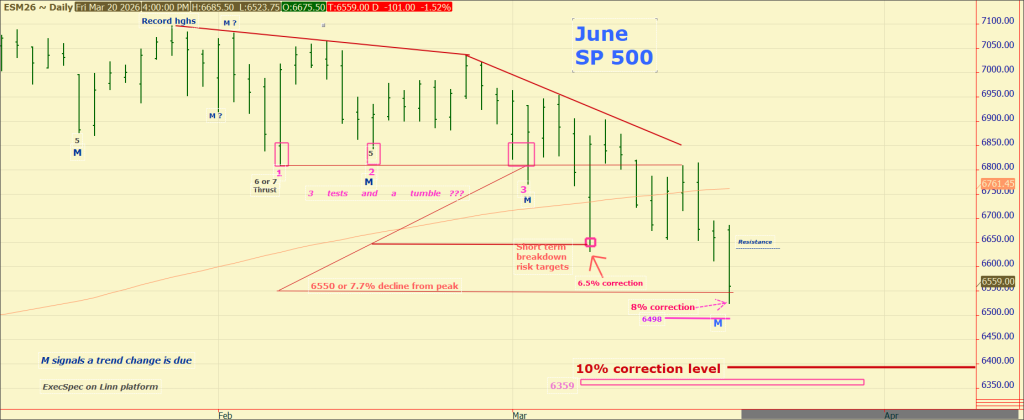
Markets are forward-looking. They will not wait for the data—they will anticipate the damage. Our longstanding base case—a 8% to 12% correction—was formulated before the war began. It’s now being tested today as the June S&P touched the 8% correction level. But if the United States cannot achieve near-total control of the Strait and effectively shield Middle Eastern energy production, downside risks extend beyond prior expectations, potentially breaking below the 6160 – 6440 support range on the S&P. While the timing and resolution of the Iran War is opaque, our math and optimism does not currently assume a more dire outcome, yet a failure to reopen tanker traffic and Oil production in the region during April could elicit a deeper dive into the upper 5,000s S&P.
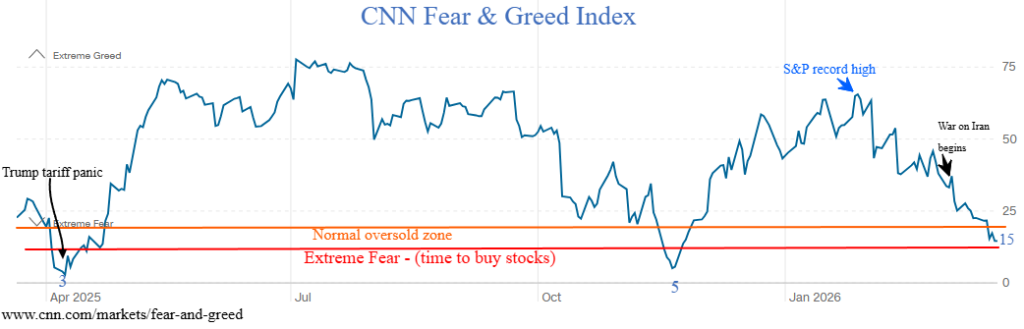
The good news is that sentiment is beginning to signal some investor capitulation that will soon present an attractive use of the large amount of sideline cash we have been building.
April: The Decisive Month
Time, in this conflict, is asymmetric. It favors Iran. Iran’s strategy is not to defeat the United States outright, but to extend the conflict, impose costs, and erode patience—a familiar doctrine drawn from Vietnam and Afghanistan. The United States, by contrast, faces political and economic urgency. President Trump is acutely aware that prolonged disruption—rising gasoline prices, weakening markets, and economic uncertainty—carries consequences not only for the economy, but for November’s electoral calculus. Retreat is not an option.
Thus, rapid escalation becomes increasingly likely while he watches carefully for an off ramp. By late March – early April, as additional forces come into position, the conflict is likely to enter a more aggressive and risk-laden phase—one aimed at asserting physical control over the coastline and eliminating drone and missile threats with greater finality. Markets will interpret that phase as decisive—one way or another – once the military escort of ships begins.
The Market’s Singular Question
Strip away the commentary, the oil reserve releases, and the battlefield assessments, and the market reduces the conflict to a single inquiry:
How long until energy flows freely again?
Everything else—earnings, rates, valuations—waits in line behind that question. Actually, earnings and interest rates will become material again if oil shipments remain closed into early April, but with a negative calculus as stagflation worries would begin to spread like a virus through the most profitable market sectors.
Time, Not Victory, Is the Price
In markets, as in war, victory is often declared long before it is secured. The Strait of Hormuz offers no such luxury. It demands not proclamations, but proof—proof measured in tankers moving safely through contested waters. The modern economy, for all its AI sophistication, remains tethered to physical realities. Oil must move. Ships must sail. And until they do, valuations will bend to the will of geography.
Markets do not bottom when uncertainty begins—they bottom when it exhausts itself. Until then, patience remains a position, cash remains an asset, and time—more than firepower—remains the most consequential variable in both war and markets.


Comments
Log in or sign up to join the conversation.