

What’s the most memorable crowd you’ve ever been a part of?
For me, it was the first time I ran the Peachtree Road Race… The largest 10k in the world for nearly 50 years.
I first ran it in 1987, when I was 10 years old. This year will be my 39th running of the race, with an expected 60,000 runners on the course.
When I was 10, I was a skinny, lanky kid with awkward big feet. Midway through the race, someone stepped on the back of my heel and my shoe came clean off. I made the mistake of trying to run back upstream to grab it, and nearly got trampled by tens of thousands of my new friends.
If it weren’t for our family friend Paul Ryczek scooping me (and my shoe) up and carrying me to the side of the road, I might have ended up a smudge on Peachtree Road.
That was my first lesson in not fighting a crowd. Almost 40 years later, it’s a lesson that’s stuck with me, and one that applies just as much to the stock market as it does to a 10k road race.
When a crowd is moving in one direction, you don’t plant your feet and push back against it. You either move with it, or you get out of the way.
Right now, there’s a crowd turning on one of Wall Street’s former favorites. And I think it’s worth your attention.
A Quick Word on Yesterday’s Fed Meeting
Before we get to that stock, a brief recap on what we learned from Kevin Warsh yesterday.
The policy statement was unusually short. No fluff, and notably, no forward guidance.
That kind of silence makes markets nervous. Wall Street hates uncertainty, and an absence of guidance is its own kind of signal.
The tone leaned hawkish, with more emphasis on fighting inflation than supporting the job market.
Warsh also announced an institutional overhaul: five new independent task forces covering communications, balance sheet policy, data collection, productivity, and inflation frameworks. That’s not just a policy adjustment, that’s a sign he’s reshaping how the Fed itself operates.
Markets sold off initially following the statement, though they’ve clawed back some ground this morning.
Now, let’s talk about where I see opportunity because of it.
The Stock: Palantir Technologies (PLTR)
Palantir was, for a long time, one of the most loved stocks on Wall Street. The enterprise software company has deep ties to government contracts in defense and intelligence, real growth ahead of it, and a story that captured investors’ imagination.
And that’s exactly the problem.
As is often the case with beloved growth stocks, investors got too excited. They bought shares hand over fist at any price, simply wanting a piece of the company, and drove the stock to a level that stopped reflecting the underlying business.
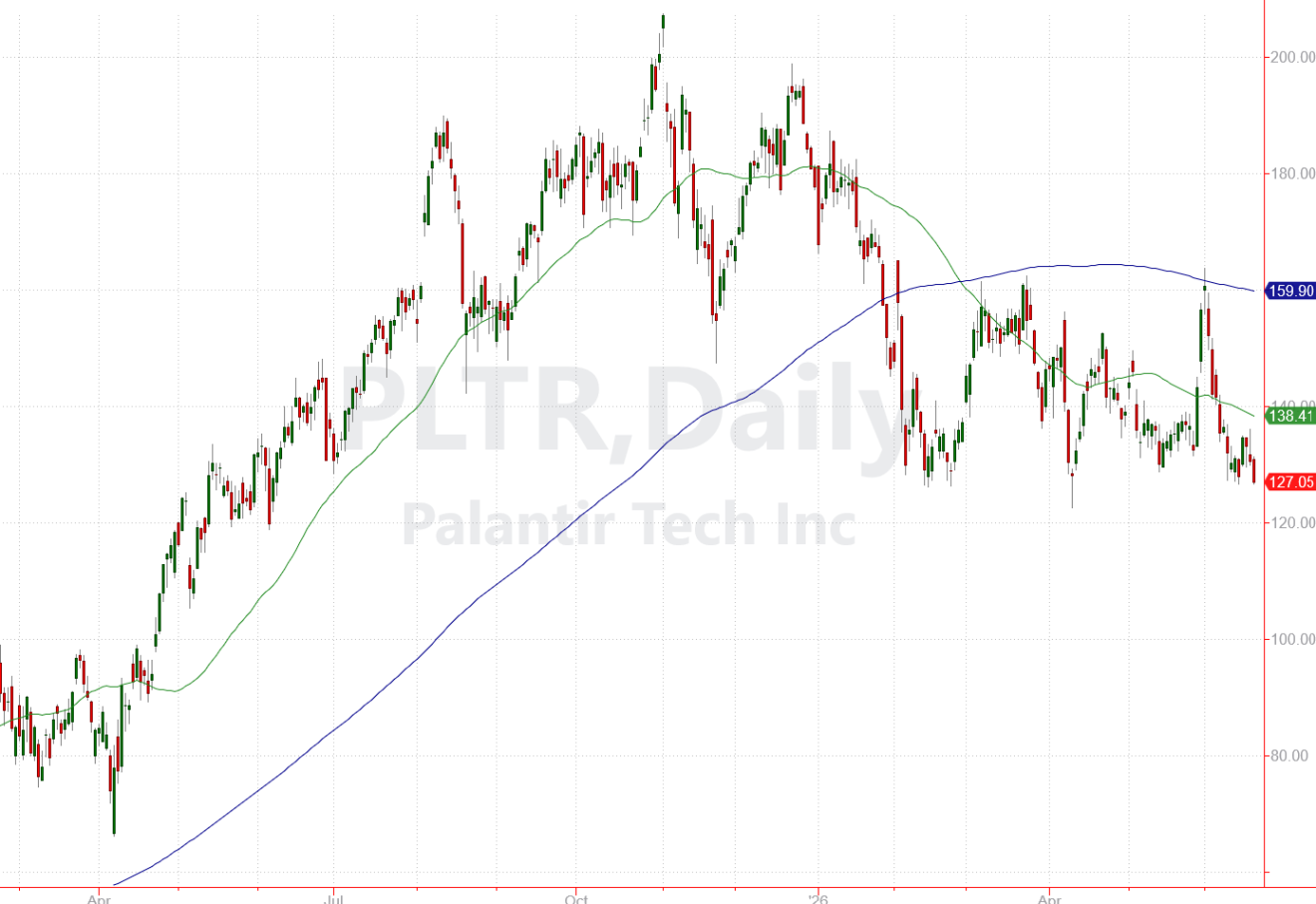
Now PLTR is in the process of drifting back toward a more reasonable price, which means the trend, for now, is lower.
Here’s the crowd dynamic I mentioned earlier: A lot of retail investors own this name.
When stocks that are this widely owned and widely loved fall out of favor, they tend to fall hard, because once the selling starts, everyone heads for the exits at the same time.
We haven’t seen that kind of panic in PLTR yet. But when it hits, it tends to move fast. (And that’s exactly the kind of move we want to be positioned ahead of.)
The technical picture backs this up. PLTR is underperforming a market that’s been making new highs. The stock is trading below both its 50-day and 200-day moving averages, two of the most closely watched trend indicators on Wall Street.
Ask yourself: if a stock can’t hold up when the broader market is strong, what happens to it if the market gets more nervous because of a more hawkish Fed?
The valuation math matters too. When interest rates rise, Wall Street places less value on profits that are still years away, because money you receive in the future is worth less today when rates are higher.
That hurts expensive growth stocks more than almost anything else, since investors in those stocks are paying today for profits that are still mostly out in the future.
And PLTR is expensive. Wall Street expects the company to earn $1.48 per share this year, growing to $2.09 per share in 2027.
At current prices, that puts the stock near 62 times next year’s expected profits. That’s a steep price tag, especially in an environment where investors are starting to pay closer attention to fundamentals again.
What that means in practice: There’s a lot of room for PLTR to trade lower, and not much room left for that valuation to expand further. That’s an asymmetric setup, exactly the kind of risk/reward profile I look for on the bearish side of my trading.


Comments
Log in or sign up to join the conversation.