


Photo by Joshua Mayo on Unsplash
Growth is not a four-letter word, but large growth stocks are bad so far in 2026. I am a big fan of Vanguard, and they run a very large growth stock fund that has Vanguard Growth Index Fund ETF Shares (VUG) as part of the overall approach. VUG, down 3.4% so far this year, is a low-cost fund run by a strong company with massive size and popularity, but I don't think investors should buy this dip.
The VUG ETF
This ETF is quite large at $200 billion. Launched in 2004, VUG is part of a strategy, including mutual funds, that totals $350 billion. Vanguard profiles the ETF on its website. The ETF charges just a 0.03% management fee, which is extremely low and probably boosts its popularity with investors.
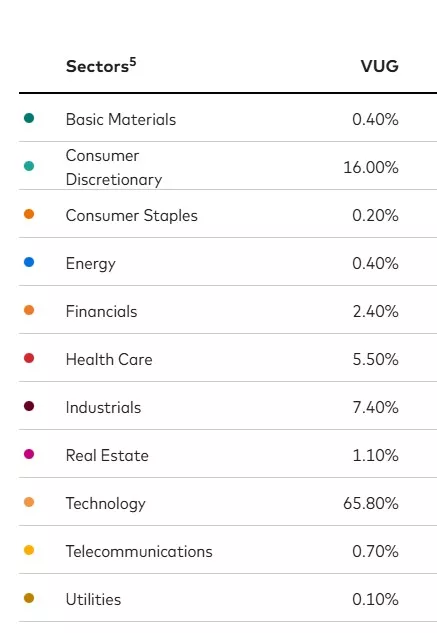
VUG holds 151 stocks with a median market cap at year-end of $1.7 trillion. At year-end, its top 10 stocks made up 64.3% of the fund, with the Magnificent 7 all included. Three of these top 10 exceeded 10%. Looking at the sector breakdown at year-end, Technology was a massive 65.8%:
So, VUG is very large, very liquid, run by a strong operator and very inexpensive on a management-fee basis.
The Price Action
The low fee and the strength of Vanguard certainly have helped boost VUG in size, but the growth of this ETF has been aided by the very strong performance of the fund. VUG gained 19.4% in 2025, and it gained 32.6% in 2024 and 46.9% in 2023. People like Vanguard, they love low fees, and they like strong performance!
About nine weeks ago, I published an article about VUG that was negative, suggesting that investors search for an alternative to VUG. Since then, VUG has dropped 4.6%, while the ETF that I recommended in the title has gained 10.2% with dividends included.
Over the past year, VUG has increased in price by 11.4% and has returned 12.0% with dividends:
(Click on image to enlarge)
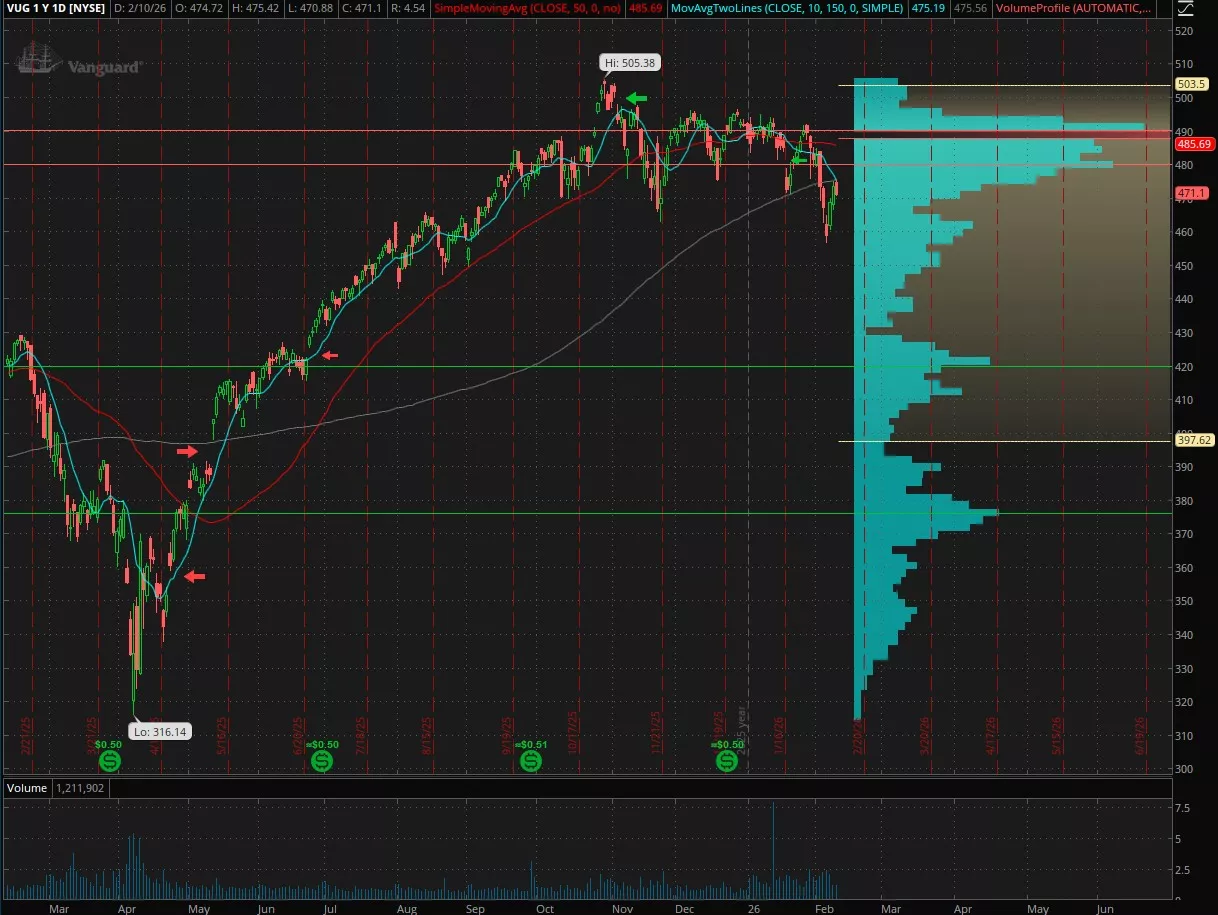
At $471.10, VUG has dropped 6.8% from its all-time high set in November, but it is 49% above the 52-week low set last April. I see resistance at $480 and $490, and support well above the April lows. A drop to $420 would fill a gap in trading left behind as it rallied in June, and this would represent a decline of 10.9%. A drop to $376 would fill a gap from May but still leave one open from April and would represent a decline of 20.2%.
The April 2025 low was quite low and represented a drop of 26.3% from the old all-time high of $429.11. Big moves can happen very quickly! That April low, though, was 55% above the $224 low from October 2022. Applying a 50% Fibonacci retracement to the move from $203.64 in October 2022 to the all-time high in 2025 of $505.38 would leave VUG at $354.51, which would be a decline of 24.8%. It might not fall that much, but it might fall more.
Better Ideas than VUG
In that December piece about VUG, I suggested an ETF that is on my ETF Watch List: Schwab Fundamental U.S. Small Company ETF (FNDA). I don't especially like FNDA (I rated it Hold then), but I think going into mid-caps like ProShares S&P MidCap 400 Dividend Aristocrats (REGL) or small-caps like Vanguard Small-Cap Value Index Fund ETF (VBR), which are both Holds right now, or ProShares Russell 2000 Dividend Growers (SMDV), which is one of my favorites that I still like, makes a lot of sense. I do understand, though, that many investors want to stay with large-caps. For them, I continue to recommend Invesco S&P 500 Equal Weight ETF (RSP).
All of these ETFs that I suggest have less exposure or no exposure to the Magnificent 7, and they all have much lower exposure to large-cap Technology than VUG. Here is a chart since the end of 2022 with VUG and these other ETFs:
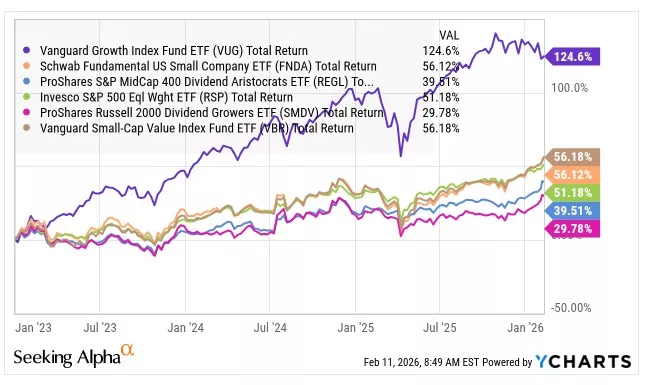
This may seem like just a technical analysis argument, but I believe that all of these alternatives to VUG have better valuations.
Conclusion
2026 has started with investors stepping away from large-cap Technology, and VUG, with its massive exposure, has suffered a bit. Nobody knows the future, but I think that it could get worse for VUG and have suggested some alternatives. My balanced ETF model portfolio, launched at the end of 2025, currently has equity exposure of 41.2%, which is substantially lower than my index, which is 60% the S&P 500. The exposure is in three ETFs: Invesco High Yield Equity Dividend Achievers (PEY), RSP and SMDV. I exited VBR and have reduced PEY and SMDV, but I do like them all a lot more than VUG and also better than some other large-cap focused ETFs.
More By This Author:
Sharp S&P Sector Swings Suggest Shifts
Why Investors Should Pay For PEY
Be Careful With The Stock Of Curaleaf



Comments
Log in or sign up to join the conversation.