


US equity futures recovered after the Federal Reserve delivered its first rate hike since 2023, with investors taking some comfort from Chair Kevin Warsh’s clear commitment to bringing inflation back under control without unleashing a disorderly bond-market reaction. S&P 500 futures rose 0.6% after the cash index touched its lowest level since July, while Nasdaq 100 futures advanced 0.7%. European markets were set for a firmer open, while Asian equities added 0.3%, helped by a modest stabilisation in global duration and signs that oil supply concerns may be starting to ease.
Treasuries trimmed their losses following the Fed decision. The two-year yield fell 2 bps to 4.71% after hitting its highest level since 2024 in the previous session, while 10-year and 30-year yields also declined by around 2 bps. Asian bonds reversed earlier weakness, suggesting that while the Fed delivered a hawkish message, it was not hawkish enough to trigger another disorderly repricing across global fixed income. The recent flattening bias remains intact, however, as markets continue to absorb a central bank that is now openly re-engaged in fighting inflation.
The Fed hiked rates as expected to a 3.75% to 4.00% target range, with no dissents. The statement said the move would “support a timelier return to the Committee's 2 per cent goal” but stopped short of offering explicit forward guidance. That restraint mattered. The Committee signalled vigilance without locking itself into a rigid path, an important distinction given the uncertainty around energy markets, geopolitics and fiscal supply. Warsh’s press conference linked the decision to both domestic inflation and labour-market resilience, as well as to external price pressures from the Middle East.
The refreshed dot plot delivered a firmly hawkish signal. The median projection showed two hikes in 2026, meaning one more move after yesterday’s increase, no change in 2027, and one cut in each of 2028 and 2029. Both the modal and median dots for 2026 were at 4.00% to 4.25%, while the modal projection for 2027 implied one further hike, showing that a solid core of the FOMC sees a risk of two additional increases on top of yesterday’s move. The breadth of support for two hikes this year, alongside eight projections for a 4.25% to 4.50% rate in 2027, underlines that inflation-fighting credibility is now at the centre of the reaction function.
The economic projections were also quietly important. The Committee upgraded 2026 and 2027 GDP forecasts by 0.1 percentage points despite a tighter rate path, suggesting confidence in the economy’s resilience. The unemployment rate projection was lowered by 0.2 percentage points and now stands at 4.1% through the horizon. Core PCE was projected at 3.4% by year-end, a forecast that appears consistent with only limited assumed impact from recent PCE methodological changes. Taken together, the Fed is effectively saying the economy can withstand tighter policy and that inflation risks justify action.
Relative to baseline expectations, the meeting was hawkish. Relative to market pricing, the meeting was closer to what was anticipated. That distinction explains the more constructive risk reaction. The Fed validated much of what investors had already priced but did not deliver the type of distribution-opening hawkishness seen from the ECB last week. The result is a message strong enough to preserve curve flattening and maintain upward pressure on front-end rates, but not so aggressive that it forces another immediate volatility spike.
Oil also helped risk sentiment. Brent crude hovered near $105.75/bbl after falling as much as 5% on Wednesday, as signs emerged that Middle East supply disruptions may be easing. Saudi Arabia is reportedly working to restore about half of its East-West pipeline capacity following drone strikes, while Trump’s comment that the Iran conflict will end “very soon” added to speculation that supply risks could moderate. Even after the pullback, crude remains elevated, but the easing of immediate disruption fears reduced pressure on breakevens, long-end yields and inflation-sensitive assets.
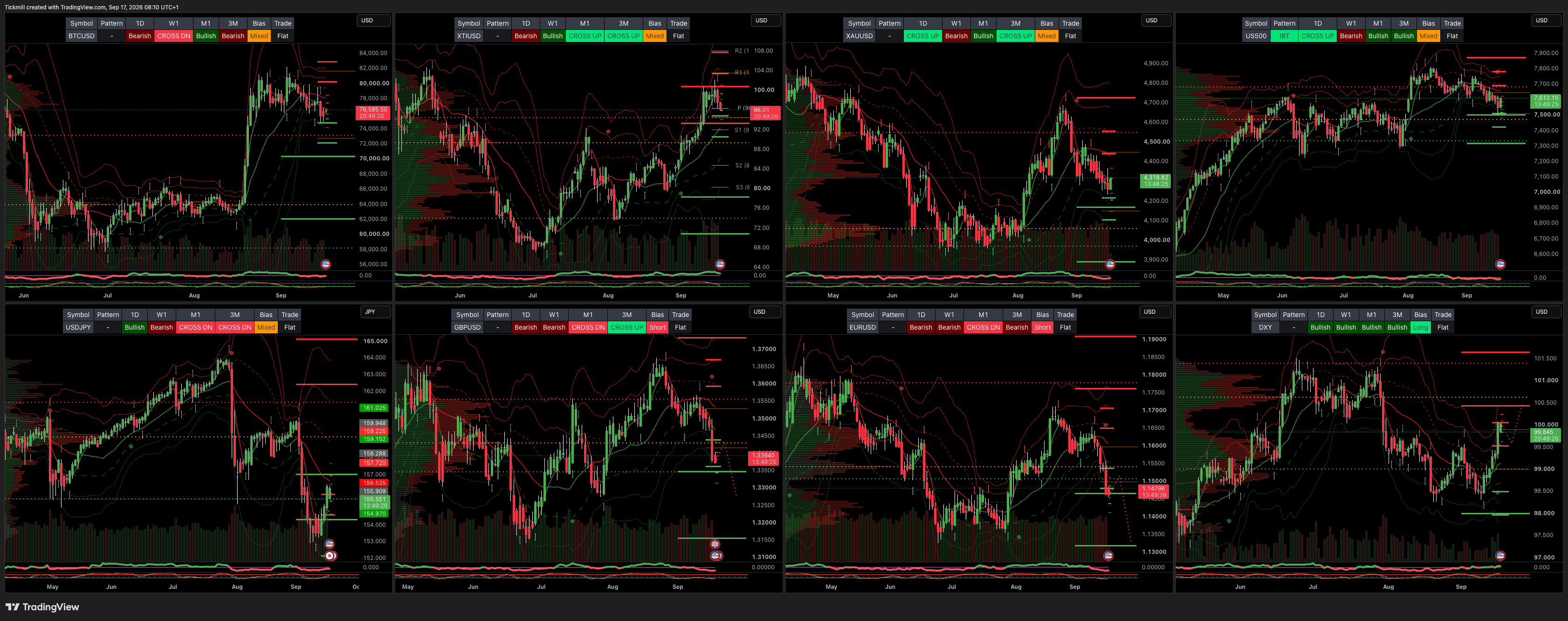
Gold rebounded after three days of losses, trading around $4,290/oz. The move suggests investors are still hedging against policy and geopolitical uncertainty, even as real yields remain restrictive. Bitcoin remained under pressure in the broader environment of tighter financial conditions and regulatory disappointment, while the Dollar’s next move will be closely watched as a barometer of whether markets see the Fed as sufficiently hawkish or merely catching up with inflation risks.
Attention now shifts to the Bank of England today and the Bank of Japan on Friday. For the BoE, yesterday’s UK CPI report confirmed an absence of clear indirect inflationary impacts from the energy shock, reducing the already low probability of a rate hike at this MPC meeting. The central expectation is for Bank Rate to remain at 3.75%, with a likely 6-3 vote split in favour of no change. However, as with the Fed, the immediate rate decision may not be the key focus.
The more important UK focus is the annual decision on the pace and structure of quantitative tightening. Survey consensus points to a £50bn reduction in the BoE’s gilt holdings over the year ahead, which remains the central case. However, press reports suggesting that the roughly £20bn active QT component could be concentrated entirely in short- and medium-maturity gilts, excluding long-dated bonds, introduce an important curve-management dimension. At current elevated yields, preserving the existing share of long gilts in active QT would have involved only around £1.5bn in market-value terms over the year, so any decision to exclude long gilts would be seen as a deliberate attempt to avoid adding pressure to the long end.
There is also the possibility of a process change in which BoE gilts would be transferred to the Debt Management Office rather than sold directly to end-investors. If adopted, such a change would require careful communication to ensure the boundary between monetary and fiscal policy does not become blurred. In a market already sensitive to government borrowing needs and term premia, any perception that QT is being reshaped to accommodate fiscal conditions could generate unintended consequences.
For the BoE, whatever individual MPC members say in their paragraphs, developments in energy prices between meetings are likely to dominate expectations for November. Domestic core and services inflation have not yet shown a decisive second-round impulse from higher energy prices, but the pipeline remains vulnerable. A renewed rise in oil would quickly revive questions about whether the Bank can remain on hold until year-end.
Macro to Micro, the Fed has delivered a hawkish hike, but the bond market has not rejected it. That is the key takeaway. Warsh managed to signal inflation-fighting resolve while avoiding a fresh surge in long-end yields, helped by some easing in oil prices and the absence of explicit forward guidance. Still, the test is not over. The Fed controls the front end, but the 10-year yield will be set by inflation risk, oil, fiscal supply and whether investors believe policy is restrictive enough. If crude stabilises and the long end remains contained, equities can extend the relief rally, while the Dollar may consolidate. If oil turns higher again or term premia rebuild, the 10-year can quickly retest the highs, putting pressure back on growth stocks, credit and risk appetite. Watch the Dollar, Gold and equities closely: together they will show whether markets see the move as a credible Fed reset or just the first step in a longer fight against inflation.
Overnight Headlines
BoE Set To Resist The Urge To Hike But Pressure Is Mounting
Energy Shock Pushes UK Inflation Higher Ahead Of BoE Rate Decision
Saudis Pound Yemen, Houthis Fire At Saudi, As Middle East War Spreads
Trump To Hold Iran Talks With Gulf Leaders Next Week
US Diplomats Meet With Houthis As Red Sea Crisis Intensifies
Rate Hike Puts Trump, Fed On A Collision Course
Global Bonds Recover As Warsh’s Inflation Fight Calms Market
Foreign Holdings Of US Treasuries Fell To Nine-Month Low In July
BoJ Faces Higher Bar To Support Yen After Fed’s Hawkish Hike
New Zealand Economic Growth Exceeded Estimates In Second Quarter
Trump Floats EU Tariffs If Canada Invite Deemed A Hostile Act
EU's Von Der Leyen Wants Canada To Become Bloc's First Associate Member
House Passes Bill Allowing Trump Tariffs On Russian Oil Buyers
Banks Line Up $22B Chip Loan Tied To Blackstone, Alphabet
Exxon Is Nearing A Preliminary Deal To Invest In Venezuela’s Oil Fields
FX Options Expiries For 10am New York Cut
(1BLN+ represents larger expiries and is more magnetic when trading within the daily ATR.)
EUR/USD: 1.1400 (EU3.13b), 1.1500 (EU2.21b), 1.1600 (EU2.07b)
USD/JPY: 153.00 ($2.8b), 156.00 ($2.55b), 155.00 ($1.67b)
AUD/USD: 0.7200 (AUD910.1m), 0.6990 (AUD798.1m), 0.7050 (AUD394.5m)
USD/BRL: 5.1825 ($345m)
USD/CAD: 1.3850 ($765.9m), 1.3960 ($659.9m), 1.3955 ($486.7m)
USD/CNY: 6.7305 ($1.01b), 6.7500 ($452m), 6.8760 ($360m)
USD/MXN: 17.09 ($713.9m)
NZD/USD: 0.5855 (NZD757.2m)
EUR/GBP: 0.8880 (EU324.2m)
CFTC Positions as of 11/9/26
Equity fund speculators increase S&P 500 CME net short position by 29,085 contracts to 336,643
Equity fund managers cut S&P 500 CME net long position by 19,683 contracts to 907,770
Speculators trim CBOT US 5-year Treasury futures net short position by 113,020 contracts to 1,267,493
Speculators trim CBOT US 10-year Treasury futures net short position by 74,492 contracts to 834,783
Speculators increase CBOT US 2-year Treasury futures net short position by 46,589 contracts to 929,107
Speculators trim CBOT US UltraBond Treasury futures net short position by 24,171 contracts to 345,140
Speculators increase CBOT US Treasury bonds futures net short position by 1,016 contracts to 200,517
Bitcoin net long position is 1,524 contracts
Swiss franc posts net short position of -29,985 contracts
British pound net short position is -58,836 contracts
Euro net short position is -42,616 contracts
Japanese yen net long position is 10,796 contracts
Technical & Trade Views

Comments
Log in or sign up to join the conversation.