


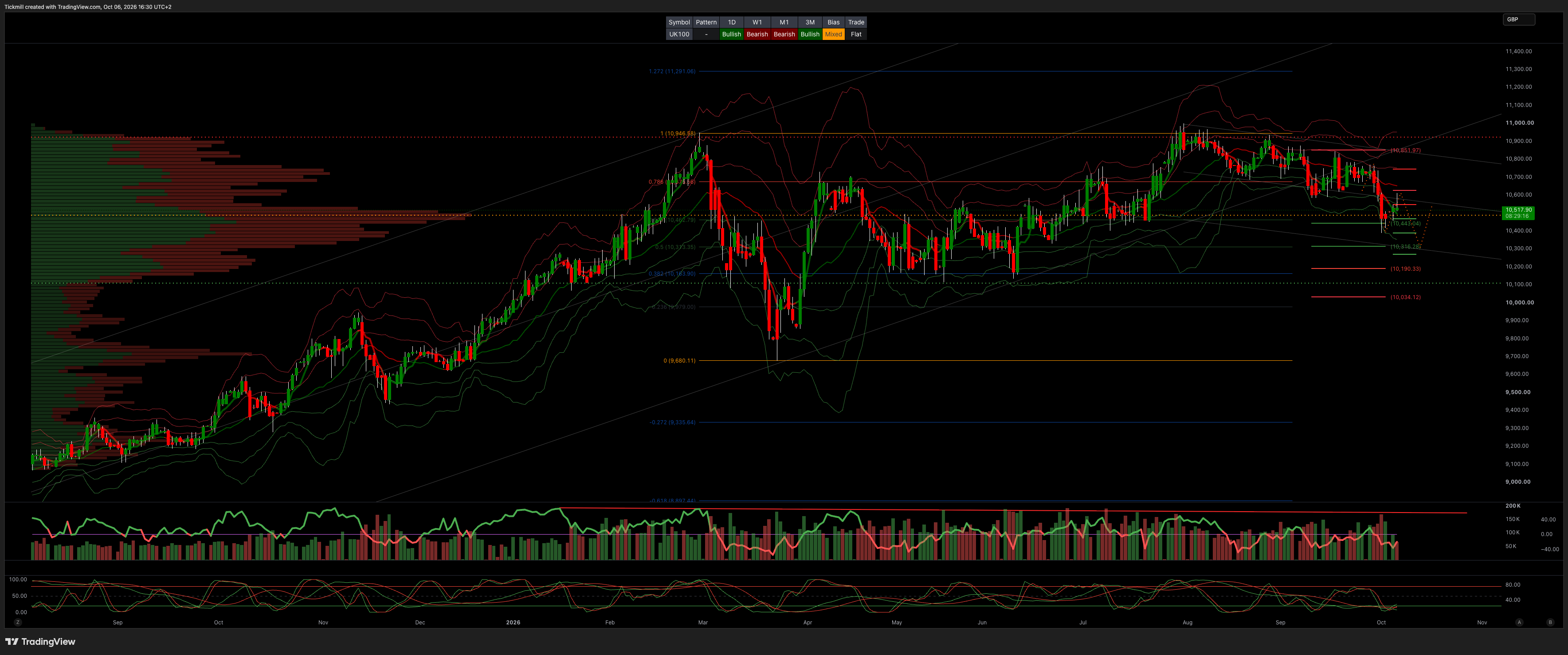
London's FTSE 100 surrendered its initial advance on Tuesday to close modestly lower, down 12.40 points or 0.12% at 10,517.80. An early bounce—driven by a pull-back in Gilt yields and softer crude oil prices—faded late in the session after warning statements from Beijing over potential U.K. electric vehicle (EV) tariffs spooked broader market risk sentiment, while hawkish commentary from the Bank of England added further pressure.
Events and publishing group Informa topped blue-chip gainers, rising 2.8% after announcing a £2.24 billion ($3 billion) deal to acquire events organiser Clarion alongside plans to spin off its Taylor & Francis academic publishing unit. Healthcare heavyweights also provided firm support: AstraZeneca (AZN) rose 2.2% following news it will invest over $1 billion in Massachusetts as part of a broader $50 billion U.S. capital deployment strategy. Outside the main index, shipping services provider Clarkson climbed 6% on the FTSE 250 after forecasting underlying pre-tax profit above expectations, while titanium miner Kenmare Resources surged 28% after receiving a non-binding takeover proposal from International Resources Holdings. Heavyweight financials and consumer staples also posted early gains.
Conversely, defense contractors faced sharp selling pressure following a Times report indicating the government may delay plans to set out a binding path toward lifting defense spending to 3% of GDP. BAE Systems, Babcock International, and Rolls-Royce Holdings dropped between 1.1% and 3.0%. Late-session market jitters intensified after headlines confirmed Beijing is expressing concerns over reported U.K. EV tariff proposals and warning it will monitor developments and respond accordingly.
On the fixed income and monetary policy fronts, government borrowing costs eased as benchmark 10- and 30-year Gilt yields backed away from multi-decade highs. However, hawkish remarks from BoE External MPC member Catherine Mann at the TS Lombard Summit reinforced tight policy expectations. Mann warned that inflation has become "embedded" and projected inflation running "notably" above 4% in Q1 during crucial wage negotiations. Arguing that "tightening policy too early in the face of inflation risk is less risky than tightening too late," she characterised the labour market as "low hire, low fire" and noted that corporate investment in energy conservation shows firms adapting to supply-side shocks. Money markets continue to price in a 90% probability of a 25-basis-point interest rate hike at the Bank of England's upcoming November policy meeting.
Finish Line: A promising relief rally across healthcare, publishing, and financial heavyweights unravelled into the close as trade frictions with Beijing and persistent hawkish messaging from the BoE weighed on investor confidence. With defense spending delays hitting industrial names and central bank officials warning of embedded inflation above 4%, U.K. equities remain pinned in a cautious posture.
TECHNICAL & TRADE VIEW
Comments
Log in or sign up to join the conversation.