


Markets are starting the week with crude as the macro driver. Brent’s break above $90/bbl has turned the US-Iran escalation from a geopolitical tail risk into the dominant macro input again, pressuring bonds, reviving inflation concerns and limiting the comfort investors can take from last week’s softer US CPI and PPI prints. Equities are trying to stabilise after Friday’s tech-led rout, but the message from rates and oil is less forgiving: the disinflation trade now has to survive a fresh energy shock.
Brent crude rose as much as 3.8% to $91.42/bbl, its highest level since June, as US strikes continued and reportedly extended beyond purely military targets. Iran said the MoU deal is suspended, while traffic through the Strait of Hormuz continues to dry up. That keeps the supply-risk premium embedded, even before any full closure scenario is priced. The scale of the move matters. Brent is now roughly 28.5% above its July low, but still short of the near-$100/bbl midpoint between the immediate pre-crisis level and the late-April peak around $126/bbl. In other words, oil has moved far enough to trouble central banks, but not far enough for markets to treat the shock as fully priced. That is an uncomfortable middle ground. Bonds are reacting accordingly. 10-year Treasury futures fell 7/32, while Australian and New Zealand bonds also sold off as investors marked up inflation risk. Japan was closed for a holiday, limiting price discovery in JGBs and the Yen, but the direction of travel in global duration is clear enough. Higher oil is forcing markets to rethink how much of last week’s inflation relief can be extrapolated. The Fed pricing adjustment is telling. Last week’s weaker US CPI and PPI reports reduced near-term tightening fears, but markets still price roughly 32bps of hikes by the December FOMC. That is lower than before the inflation data, but still consistent with further oil upside based on how expectations behaved earlier in the crisis. The curve is not saying the Fed is done. It is saying the Fed has less certainty about how much more it needs to do. That distinction matters because June’s CPI relief was backward-looking. Headline CPI fell for the first time in six years, and core inflation remained comparatively contained, but the current oil move is a forward-looking shock. If fuel prices feed into expectations, shipping costs and firm pricing behaviour, the Fed will struggle to dismiss it as noise. With policymakers entering the pre-meeting quiet period, markets will have fewer official comments to lean on and more room to price the data and the oil tape directly.
Equities are steadier, but not broadly confident. Nasdaq 100 futures rose 0.5%, clawing back some of Friday’s losses after the tech sector was hit by concerns that Moonshot AI’s new model could challenge assumptions around US dominance in artificial intelligence. The rebound looks tactical rather than emphatic. Investors are still asking whether AI capex can keep validating the valuations built into the sector. Asia was mixed. The Kospi fell 3.7% as South Korean traders returned from holiday, extending the region’s role as the highest-beta expression of AI anxiety. Broader Asian equities were little changed, suggesting markets are no longer in full liquidation mode, but the stabilisation is fragile. The semiconductor trade has shifted from “buy the theme” to “prove the earnings”. That is the key equity tension for the week. Oil is tightening financial conditions from the macro side, while AI is facing a valuation and competitive challenge from the micro side. Either one would be manageable alone. Together, they create a more difficult backdrop for duration-sensitive growth stocks.
The ECB is likely to take comfort from the oil move in one specific way: it strengthens the case for keeping September hike expectations alive. This week’s meeting should still result in an unchanged decision, as lower June CPI and generally soft activity data make an immediate hike difficult to justify. But the renewed energy shock gives hawks more ammunition to argue that second-round effects cannot be ignored.Markets now price roughly a 95% chance of a 25bp ECB hike at the September meeting. Lagarde is likely to preserve optionality, framing the current environment as close to baseline rather than adverse, while avoiding any language that closes the door on September. The policy message should be steady today, but not soft.
In the UK, the political transition takes centre stage. The transfer of power from Starmer to Burnham is scheduled for around lunchtime, with cabinet appointments expected during the afternoon. A Shabana Mahmood Chancellorship is already priced after last week’s press reports, so the immediate market reaction may depend more on confirmation, tone and any signals around fiscal discipline than on the appointment itself. The gilt market will be watching for early hints about the cost and funding implications of greater public control in selected industries, including water. The initial communications are likely to focus on broad themes rather than detailed policy, but markets will still listen closely for any language that suggests a larger borrowing requirement or a looser fiscal stance.
The UK data calendar is heavy. Public borrowing and labour-market reports arrive Tuesday. Fiscal slippage last month was partly linked to volatile inflation-indexed borrowing costs, but expenditure has also crept higher while revenue growth has softened. That makes the borrowing data relevant under a new administration, especially if investors are already questioning the price tag attached to structural reform or public-control commitments. The labour-market report may be more reassuring for the BoE. Employment has started to look a little better, while wage pressures are cooling. That is close to the monetary-policy sweet spot: resilient enough to avoid growth panic, but not hot enough to force an aggressive inflation response. Wednesday’s UK inflation report carries slightly less weight after two consecutive downside surprises and softer inflation prints in the US and euro area. Falling energy prices in June should help both headline and core CPI ease from May’s 2.8% and 2.6% y/y rates. A small upside surprise would probably be forgivable, provided wage and services inflation are not re-accelerating. The UK week rounds out with the CBI trends survey on Thursday, then retail sales and the BoE Decision Maker Panel on Friday. UK consumers, like their US counterparts, appear to have dipped into savings to smooth the upfront costs of the Iran war. That behaviour can sustain the improving retail trend for now, though it also means household balance sheets are doing some of the shock absorption.
Outside the UK, European releases are limited to ZEW on Tuesday and flash PMIs on Friday. The same PMI cycle will matter for the UK and US too, particularly because markets need to know whether oil is primarily lifting inflation expectations or starting to damage activity. The US calendar is otherwise light, with Chicago and Kansas City Fed surveys on Thursday, followed by new home sales and building permits on Friday. With no Fed speakers due in the quiet period, even second-tier data may get more attention than usual. Globally, Canada CPI today, Japan CPI Tuesday and Australia labour-market data Thursday are worth keeping on the radar. Japan CPI will be especially important once Tokyo reopens, given the Yen’s recent weakness and the government’s efforts to encourage domestic investment in Japanese financial assets.
Monday’s market message: crude has reclaimed the macro narrative. Last week’s softer US inflation data gave markets a disinflationary reprieve, but Brent above $90/bbl makes that reprieve look conditional. Bonds are already marking the risk, equities are only stabilising after a tech shock, and central banks have less room to sound relaxed. The AI story still needs earnings to defend its valuation, while the inflation story now needs oil to stop rising. Until then, the market is trading relief with one eye on Hormuz.
Overnight Headlines
US-Iran Attacks Escalate As Strikes Kill Two American Troops
Tehran Declares Peace Deal Abandoned
Kuwait Energy Infrastructure Hit During Intense Iran Attacks
Washington Pushes EU To Announce Import Rules Rollback
Merz Floats Government Reshuffle After Top Conservative’s Resignation
Burnham Plots Policy Blitz For First Day As PM
Burnham Plots Miliband Foreign Office Shake-Up
Burnham To Maintain Ban On North Sea Exploration Licences
Hungary’s President Ends His Own Term In Bow To New Premier
Turkey Aims To Offload Russian Air-Defense System Seeks To Buy F-35s
China Holds Loan Prime Rates Steady As Growth Slows And Yuan Firm
Brent Oil Tops $90 As Middle East Attacks Threaten Hormuz Flows
Oracle Data Centers Face Multibillion-Dollar Cost Surprises
Boeing Says It Will Be Ready To Fund New Plane Programme By 2030
American Airlines CEO Lays Out Vision To Close More Than $3B Profit Gap
Samsung Cuts US Jobs, Offers Relocations Ahead Of HQ Move
Alibaba’s Qwen Unveils Preview Of Flagship AI Model
Russia Hits Kyiv With Largest Ballistic Missile Barrage
Zelenskyy Considers Sacking Commander-In-Chief As Protests Swell
FX Options Expiries For 10am New York Cut
(1BLN+ represents larger expiries and is more magnetic when trading within the daily ATR.)
EUR/USD: 1.1265 (EU2.47b), 1.1650 (EU1.84b), 1.1425 (EU1.6b)
USD/JPY: 162.00 ($2.95b), 159.00 ($575m), 162.50 ($560.5m)
AUD/USD: 0.6900 (AUD326.2m)
USD/BRL: 4.9750 ($430.3m), 5.3700 ($325.1m), 5.6730 ($320.8m)
GBP/USD: 1.3520 (GBP568.1m), 1.3395 (GBP472.8m), 1.3300 (GBP379.7m)
USD/CAD: 1.4200 ($337.3m), 1.3590 ($326m)
NZD/USD: 0.5750 (NZD319.6m)
USD/MXN: 17.39 ($438m), 17.44 ($408.7m), 17.55 ($362.2m)
EUR/GBP: 0.8680 (EU751.1m), 0.8665 (EU452.4m)
USD/KRW: 1500.00 ($405.4m)
CFTC Positions as of 17/7/26
Equity fund speculators have ramped up their net short positions on the S&P 500 CME, adding 6,873 contracts to reach a total of 359,456. Meanwhile, equity fund managers have reduced their net long positions in the S&P 500 CME by 30,209 contracts, bringing their total down to 941,123.
Treasury futures market, speculators have made some notable adjustments. They've trimmed their net short position in CBOT US 5-year Treasury futures by 64,833 contracts, leaving them with a total of 1,294,283. Conversely, they have increased their net short position in CBOT US 10-year Treasury futures by 17,413 contracts, now totaling 831,675. In the CBOT US 2-year Treasury futures market, there's been a significant reduction in net short positions by 103,531 contracts, bringing the total to 1,157,477.Additionally, speculators have upped their net short position in CBOT US UltraBond Treasury futures by 16,588 contracts to a total of 324,407 and have increased their net short position in CBOT US Treasury bonds futures by 35,465 contracts, reaching 179,056.
Bitcoin's net long position stands at 3,091 contracts. In the foreign exchange arena, the Swiss franc is showing a net short position of -36,956 contracts, while the British pound sits at -71,253 contracts. The euro has a net short position of -12,605 contracts and the Japanese yen is notably more bearish with a net short position of -122,663 contracts.
Technical & Trade Views
The AI/momentum unwind has now reached a potential capitulation zone. The SOX just posted its worst week since April 2025, Info Tech was the most net-sold sector, and U.S. long/short leverage has fallen into the bottom decile. That is the kind of cleaner positioning backdrop that often precedes a bounce. But positioning alone is not enough. The market now needs a fundamental catalyst, and it has one on the calendar. Wednesday’s GOOG earnings print, along with the broader hyperscaler capex updates, will be the key fulcrum for the AI trade. If capex guidance and AI infrastructure demand remain intact, the washed-out AI complex can re-underwrite higher. If not, the unwind likely has further to run. Importantly, the damage beneath the surface has not yet broken the broader market. The broadening trade continues to work, helping keep the index resilient despite pressure in tech leadership. With roughly 18% of S&P 500 market cap reporting this week and the Fed entering blackout, the stance is straightforward: stay invested, but express exposure through the broadening trade; keep clean hedges in place against further tech downside; and be ready to add to the washed-out AI complex if the hyperscalers validate the capex cycle. In short, positioning is clean enough for a bounce, but the next move depends on whether fundamentals confirm the AI spending story..
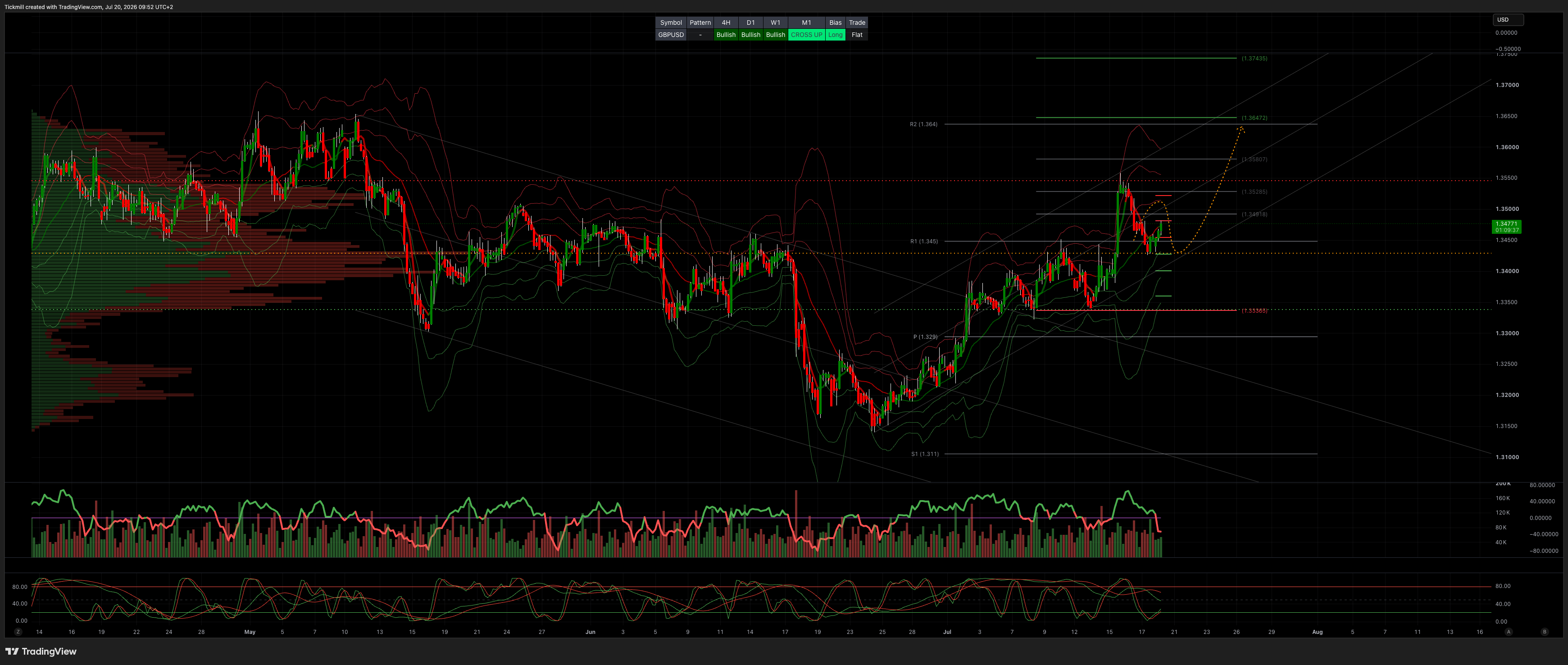
SP500 - 7390 weekly bull/bear level
Daily VWAP Bearish
Weekly VWAP Bearish>Bullish
Above 7500 Target 7619
Below 7390 Target 7560
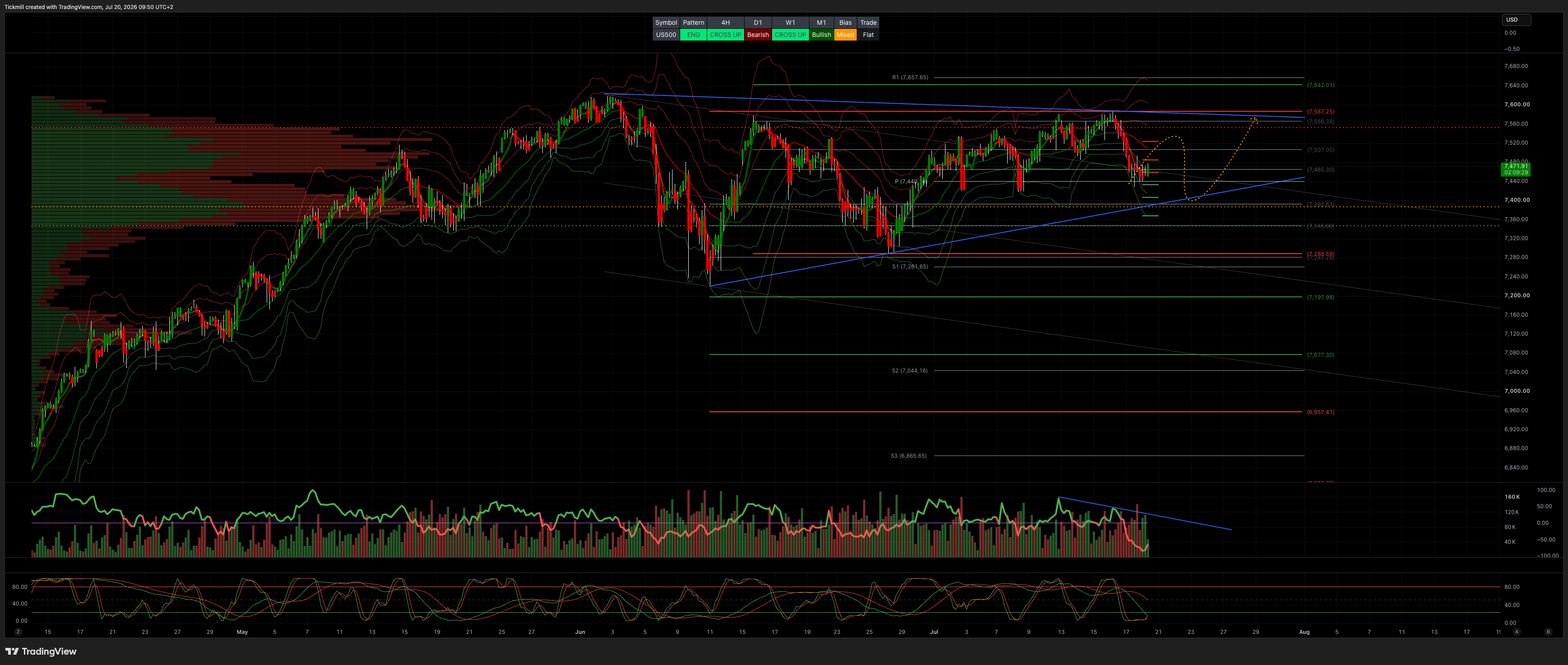
DXY - 99.75 weekly bull/bear level
Daily VWAP Bullish
Weekly VWAP Bearish
Above 99.75 Target 102.50
Below 99.40 Target 98.40
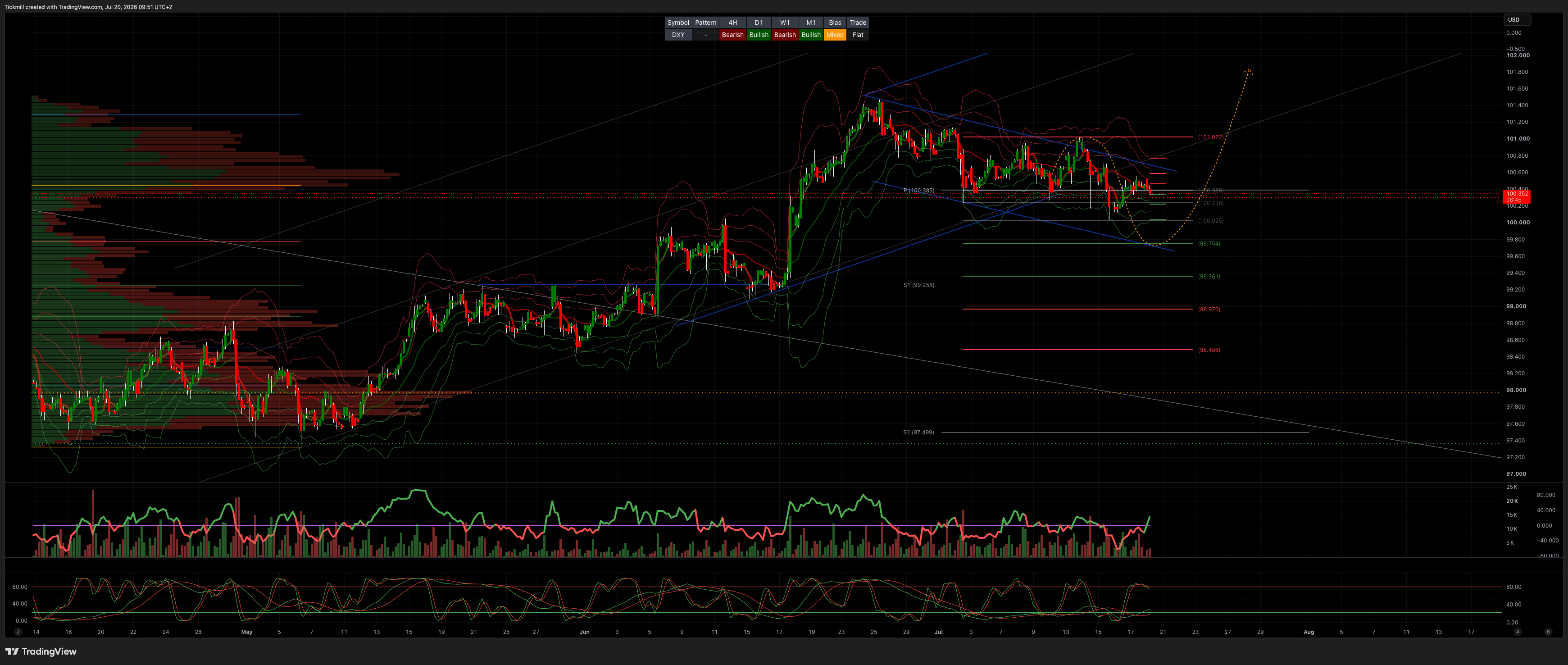
EURUSD - 1.1525 weekly bull/bear level
Daily VWAP Bullish
Weekly VWAP Bullish
Above 1.1550 Target 1.1780
Below 1.1525 Target 1.1370
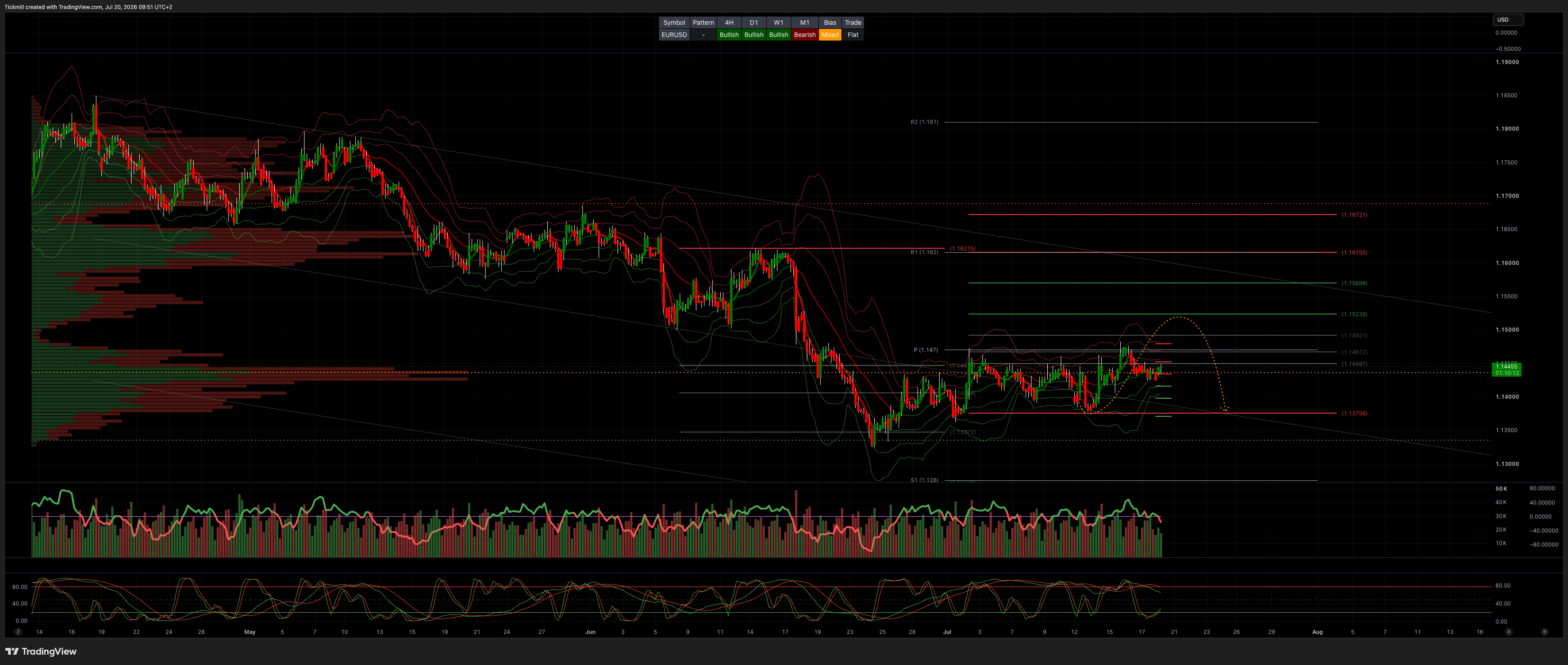
GBPUSD - 1.3450 weekly bull/bear level
Daily VWAP Bullish
Weekly VWAP Bullish
Above 1.3450 Target 1.3640
Below 1.33 Target 1.3050
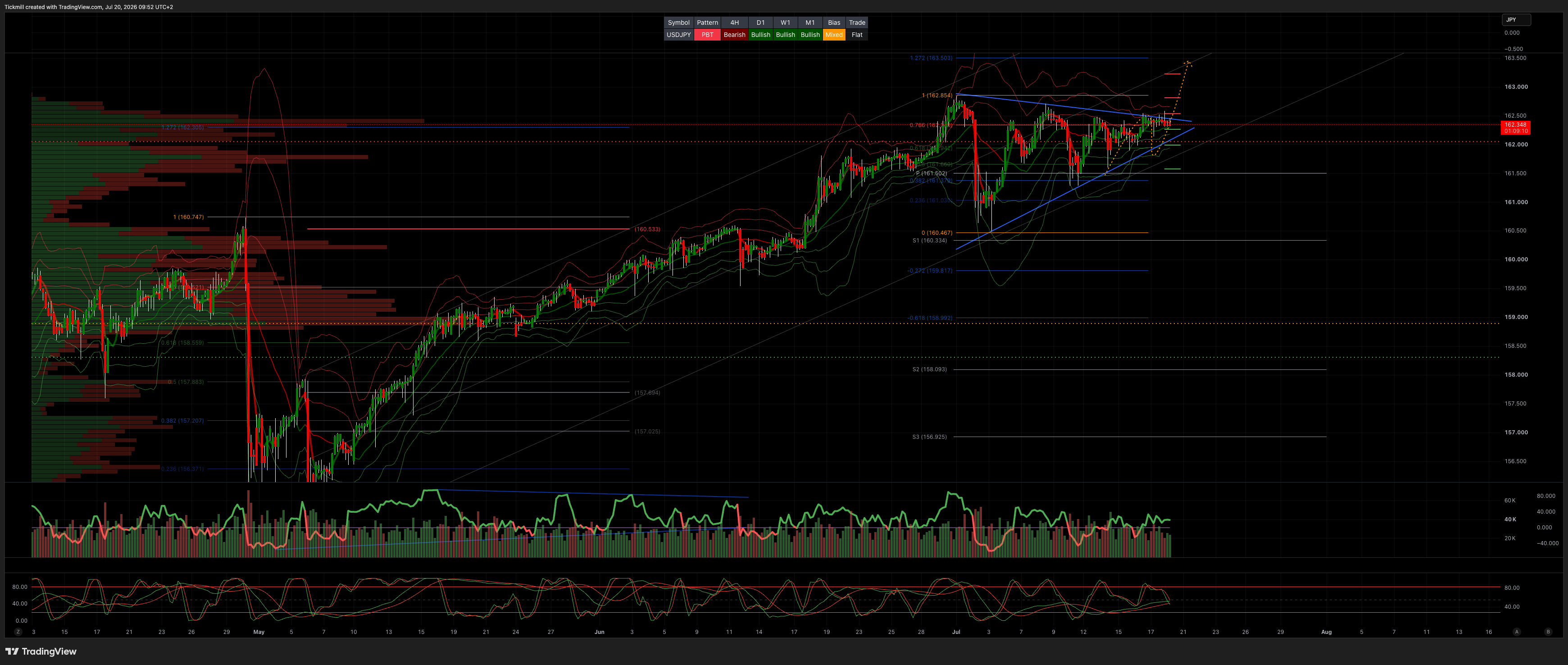
USDJPY - 161.50 weekly bull bear level
Daily VWAP Bullish
Weekly VWAP Bullish
Above 162 Target 163.75
Below 161 Target 160.50
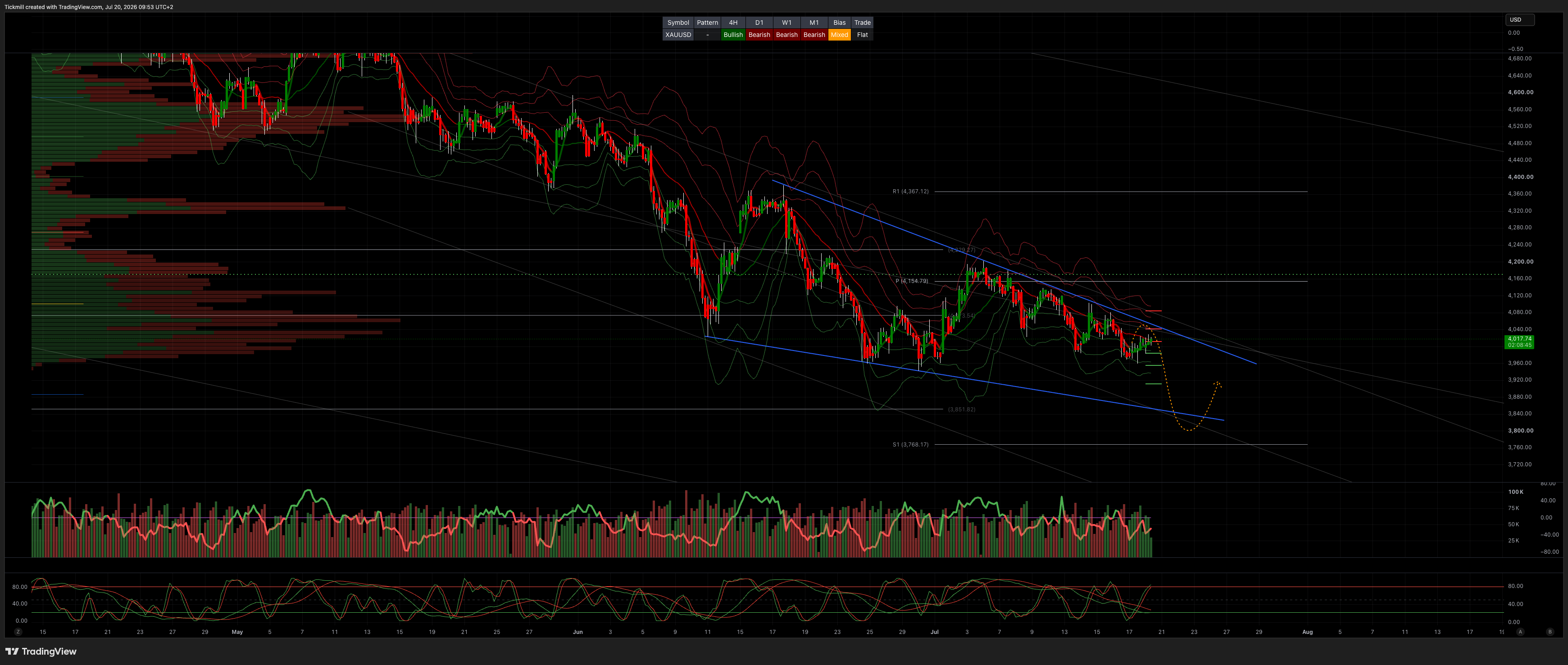
XAUUSD - 4100 weekly bull bear level
Daily VWAP Bearish
Weekly VWAP Bearish
Above 4200 Target 4500
Below 4100 Target 3569
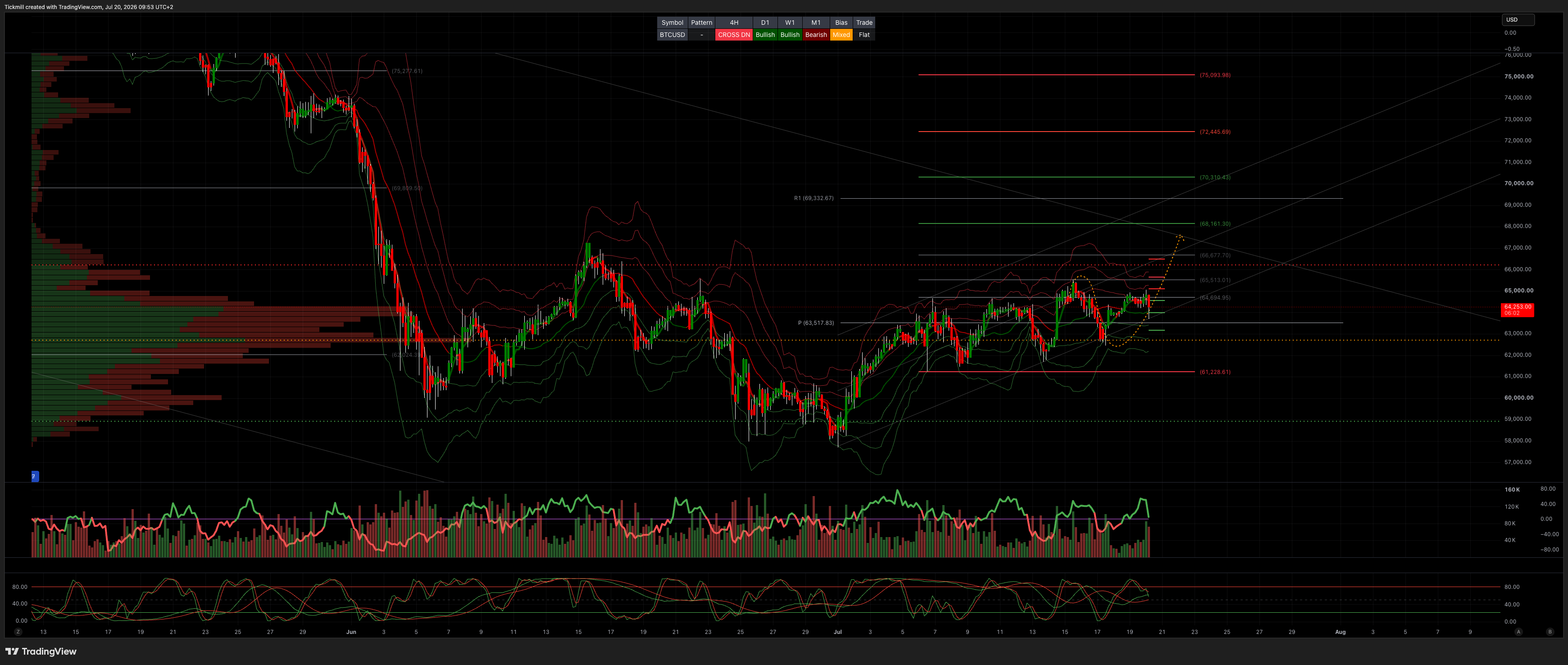
BTCUSD - 61k weekly bull bear level
Daily VWAP Bearish
Weekly VWAP Bullish
Above 62.5k Target 68.1k
Below 61k Target 52.2k

Comments
Log in or sign up to join the conversation.