

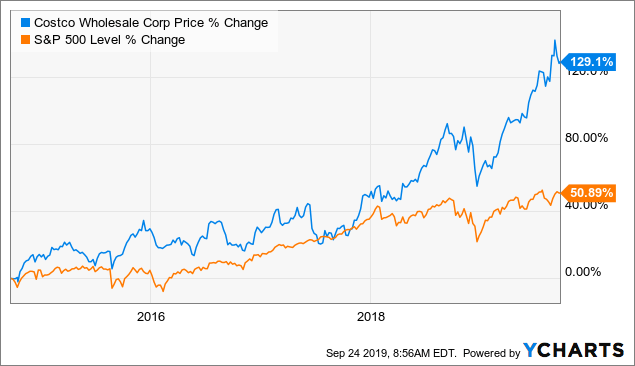
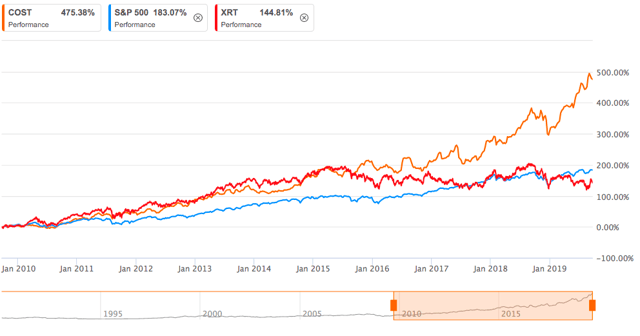
Costco (COST) has created a lot of value for shareholders over time. The stock has downright obliterated the S&P 500 in the past five years, which is no small achievement at all, especially considering that the index has performed quite well over this period.
Data by YCharts
This attractive return from Costco stock is well justified by the company's financial performance, which has been impressive over the long term. However, past performance does not guarantee future returns, and Costco stock is priced at a considerable valuation premium versus other companies in the sector.
With this in mind, let's take a look at Costco stock from a quantitative perspective, considering factors such as financial quality, valuation, fundamental momentum, and relative strength.
Outstanding Quality
Costco makes most of its profits from membership fees, not margins on product sales. This means that the company can sell its products at cost, or sometimes even at a loss, which provides a key advantage in the discount retail sector, where price competitiveness is a crucial source of competitive strength.
As Costco grows in size, it gains purchasing power with suppliers, which allows the company to negotiate better prices and more convenient financial conditions for its products. Besides, economies of scale and supply-chain efficiencies reduce fixed costs per unit, generating additional cost savings as sales volume expands.
The more successful Costco is on the commercial side of the business, the larger the savings it can pass on to customers. This produces a self-sustaining virtuous cycle by which the service provided by Costco becomes more valuable as the company becomes bigger over time.
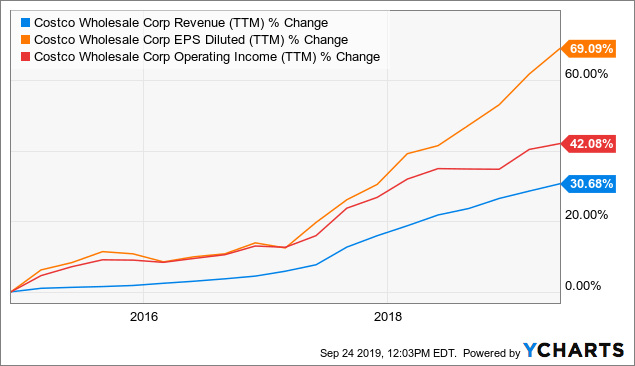
Most brick and mortar retailers are under heavy pressure due to competition from online retailers, but Costco is still producing an outstanding financial performance in a challenging environment. The key variables such as sales, operating income, and earnings per share are clearly reflecting financial soundness.
Data by YCharts
Because the company is focused on low pricing, profit margins on sales are rather low. However, Costco is a remarkably efficient operator. The company has an asset turnover ratio of 3.59 versus a sector median of 1.04. Profitability on capital is also far superior. Costco has a return on capital ratio of 14.66% versus a sector median value of 6.44%.
Demanding Valuation
The table below compares Costco versus the median stock in the sector in terms of different valuation ratios: price to earnings, enterprise value to EBITDA, price to sales, and price to cash flow. Except for the price to sales ratio, the stock is priced at a valuation premium versus the median values for the sector.
| Costco | Sector Median | |
| P/E Non-GAAP | 36.54 | 22.54 |
| EV/EBITDA | 20.28 | 12.67 |
| Price/Sales | 0.84 | 1.34 |
| Price/Cash Flow (TTM) | 22.52 | 13.46 |
Source: Seeking Alpha Essential
This does not mean that Costco is necessarily overvalued, since superior quality deserves a higher valuation, and Costco is clearly superior to the average company in the sector. Like Warren Buffett said, "price is what you pay and value is what you get", and top-quality businesses such as Costco rarely trade at discounted valuations.
Nevertheless, current valuation levels don't leave much room for error, and Costco will need to continue delivering superior performance in order to justify the price tag for the stock.
Solid Fundamental Momentum
Current stock prices reflect a particular set of expectations about the future of the business. If the company can consistently deliver earnings numbers above expectations, then earnings estimates will tend to increase, and the stock price will need to increase too for the valuation to remain stable.
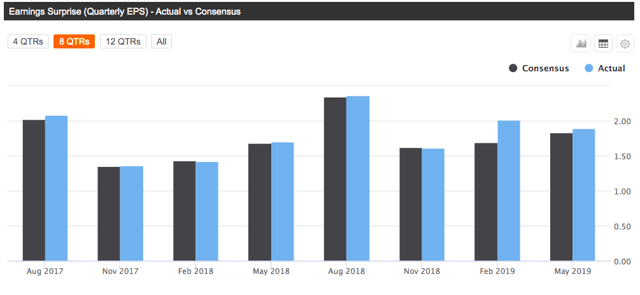
The chart below shows how Costco has a solid track record in terms of outperforming expectations, as the company has delivered earnings numbers above Wall Street estimates in 6 of the past 8 quarters.
Source: Seeking Alpha Essential
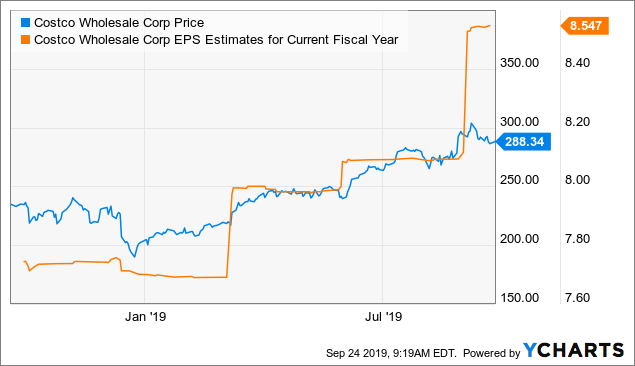
More importantly, Wall Street analysts have consistently increased their earnings estimates for Costco over the past year. We can see in the chart below how earnings estimates and the stock price tend to move in the same direction over time. Interestingly, earnings expectations seem to be outpacing the stock price in recent weeks, which could be providing an attractive entry price for investors in Costco over the middle term.
Data by YCharts
Superior Relative Strength
Winners tend to keep on winning in the stock market, since rising stock prices create a positive narrative, attracting more buyers for the stock and creating a self-sustaining cycle.
Besides, money has an opportunity cost. When you buy an investment with subpar returns, that money is not available to be invested in companies with superior performance. For this reason, we don't just want to buy stocks that are doing well. We want to buy the names that are performing materially better than others.
The chart below shows how Costco has significantly outperformed both the S&P 500 index and the SPDR S&P Retail ETF (XRT) over the past five years.
Source: Seeking Alpha Essential
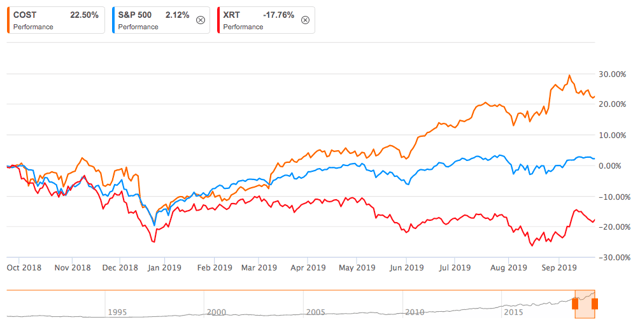
Zooming in into the past year, the company is also outperforming both the market in general and the sector in particular by a considerable margin.
Source: Seeking Alpha Essential
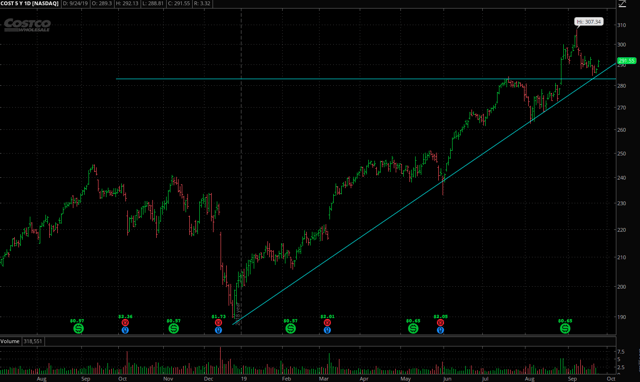
The U.S. stock market remains in a sideways range over the past months, and most retail stocks are under heavy selling pressure. Costco, on the other hand, is delivering impressive relative strength. The stock is in a well-defined uptrend, and the price action should be considered bullish as long as the stock is trading above $280 per share.
Source: Think or Swin
Putting It All Together
The PowerFactors system is a quantitative system that ranks companies in a particular universe according to a combination of quantitative drivers, including financial quality, valuation, fundamental momentum, and relative strength.
Here is a quick explanation of the factors considered in the algorithm:
- Financial quality includes profitability metrics such as return on assets, return on investment, return on equity, gross profit margin, operating profit margin, and free cash flow margin. The more profitable the business, the higher its ability to create profits for shareholders over the long term.
- Valuation covers typical valuation ratios such as price to earnings, price to earnings growth, price to free cash flow, and enterprise value to EBITDA. The cheaper the better, so stocks with lower valuation levels receive a higher ranking in the algorithm.
- Fundamental Momentum: This factor looks for companies that are performing better than expected and producing rising expectations, so it measures the change in earnings and sales forecasts. The bigger the increase in forecasts, the higher the score for the company in fundamental momentum.
- Relative Strength: When a stock is outperforming the market, it tends to continue doing so more often than not. For this reason, the PowerFactors system looks for stocks delivering above-average returns over different time frames.
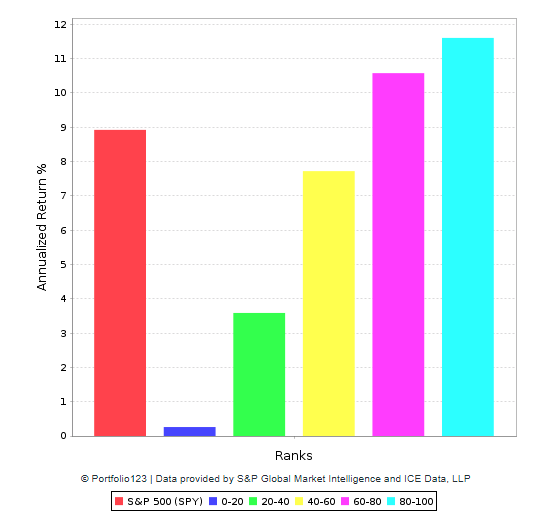
The backtested performance numbers show that companies with high PowerFactors rankings tend to deliver superior returns in the long term. The higher the PowerFactors ranking, the higher the expected returns, indicating that the system is consistent and robust.
Data from S&P Global via Portfolio123
Costco has a PowerFactors ranking of 90 as of the time of this writing, meaning that the stock is in the top 10% of companies in the US stock market when considering financial quality, valuation, fundamental momentum, and relative strength together.
The chart shows how Costco ranks across the four dimensions in the PowerFactors algorithm. The company is below-average in terms of value alone, but it more than compensates for such weakness with strong rankings in quality, fundamental momentum, and relative strength.
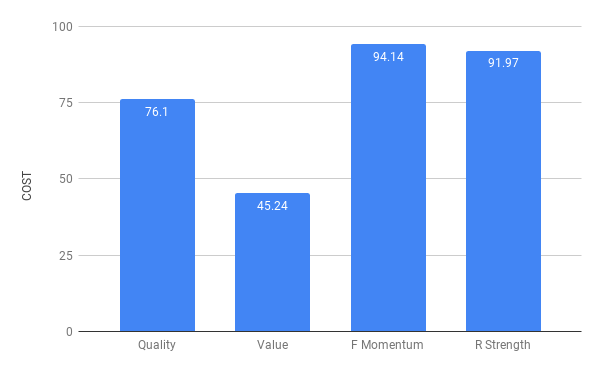
Data from S&P Global via Portfolio123
The Bottom Line
Looking at the main risk factors, rising competitive pressure from online retailers, and especially Amazon (AMZN), is a key factor to watch. Costco's unique business model has allowed the company to continue thriving while keeping the competition at bay, but it's important to monitor the competitive landscape closely in order to make sure that Costco's armor remains intact.
As the business matures in the United States, Costco will need to increasingly focus on international expansion for sustained growth in its store base. This could open the door to exciting new opportunities, but international expansion can also be expensive and risky.
Over the short term, investors are getting concerned about the impact that international trade tariffs could have on profit margins. This is mostly a sector-wide phenomenon, and rather temporary as opposed to a long-term concern. However, it makes sense to expect the trade war negotiations to have an impact on investor sentiment towards Costco stock in the command months.
Those risks being acknowledged, Costco is a high-quality business with strong fundamentals. Valuation is not particularly attractive, but Costco does not need to trade at bargain-low valuation levels in order to produce solid returns.
Chances are that the stock will continue doing well for investors going forward, and any pullback down the road should be considered an opportunity to buy a world-class business for a more attractive valuation.



Comments
Log in or sign up to join the conversation.