

Cisco's (CSCO) stock has been on fire lately, gaining almost 30% in the past 12 months on the back of solid financial performance from the business. But past performance does not guarantee future returns, and investors have reasons to wonder if the stock still offers upside potential or if the best is already in the past for Cisco. With this in mind, let's take a look at Cisco's stock and the risk versus potential reward going forward.
Solid Quality
Cisco is the largest player in networking, and the company is increasingly expanding into software and services over recent years. Cisco operates in a dynamic industry prone to technological disruption, but customers tend to be quite loyal to a market leader like Cisco because changing vendors can be complicated and risky.
Growth rates are not particularly impressive for a tech stock, but segments such as applications and security look quite promising going forward. As these segments continue outgrowing the rest of the company's businesses, they will account for a larger share of total revenue, which should have positive implications in terms of overall revenue growth.
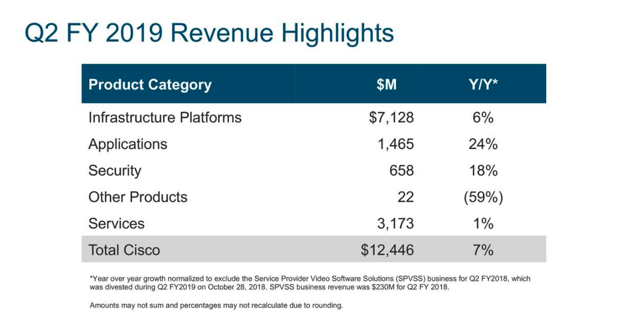
Source: Cisco
Due to pricing power and the cost advantages generated by scale, the business model is remarkably profitable. Gross profit margin stands at 62% of revenue, and operating profit margin represents nearly 26% of sales.
Looking at key financial metrics such as free cash flow, cash from operations, and EBITDA, the main financial indicators are clearly moving in the right direction over the long term.
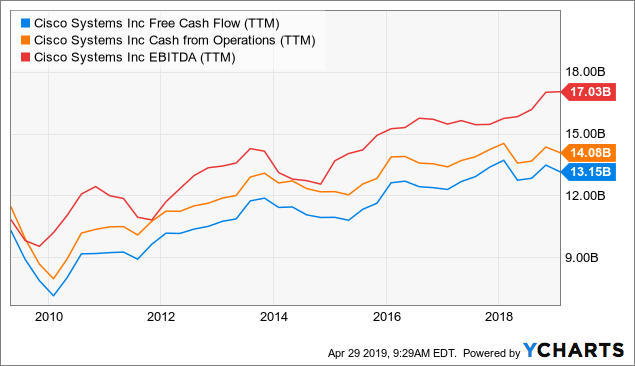
Data by
Big Cash Distributions
Cisco has a strong track record of capital distributions over the long term. The company started paying dividends in 2011, and it has significantly raised payments over the past decade. What started as a dividend payment of 6 cents a share in 2011 has now turned into a much larger amount of 35 cents per share and growing.
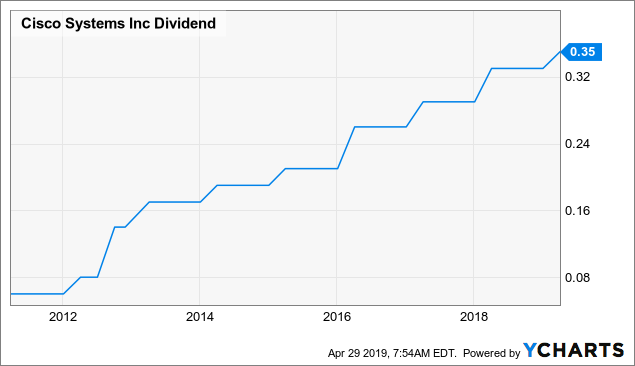
Data by YCharts
As important, the company is increasingly prioritizing buybacks as a venue for cash distribution. During the quarter ended in January of 2019, Cisco allocated $1.5 billion to dividends and nearly $5 billion to share buybacks. The company has reduced the number of shares outstanding by more than 23% in the past decade.
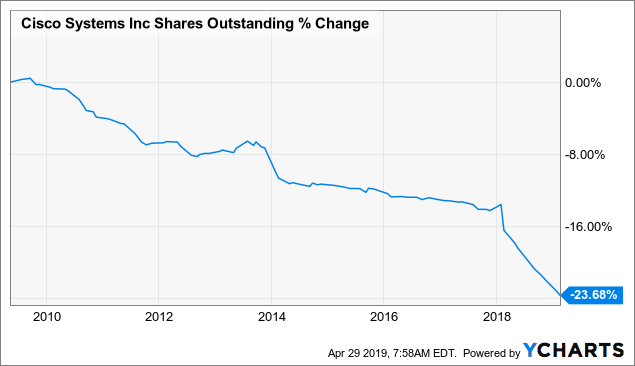
Data by YCharts
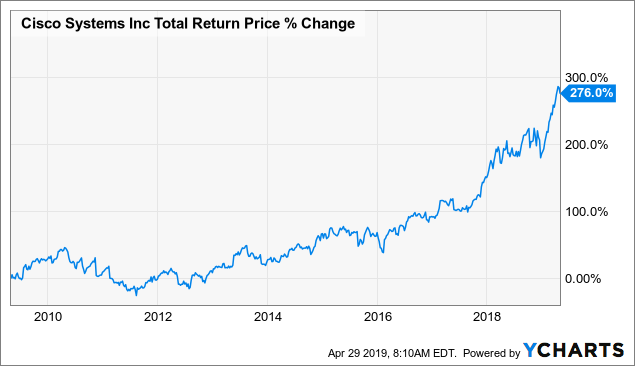
When a company repurchases stock, it's basically allocating shareholder capital to its own stock. The stock has appreciated substantially in recent years, so these investments have been quite profitable, and buybacks have turned out to be a smart use of shareholder capital.
Data by YCharts
Strong Fundamental Momentum
A stock is essentially a share in the ownership of a business. If the business is doing well, then the stock should do well over the long term too. However, it's of utmost importance to understand that current stock prices are reflecting a particular set of expectations about the future of a business, and this has massive implications on returns.
Even if the company is doing well, if the numbers are below market expectations then the stock price will probably remain under selling pressure. Conversely, when financial performance is better than expected and expectations about the future of the business are improving, this can be a powerful upside fuel for the stock price.
Cisco has an outstanding track record of consistently delivering earnings numbers above Wall Street expectations. The table below shows the expected earnings numbers and the actual reported figures over the past four quarters.
| 4/29/2018 | 7/30/2018 | 10/30/2018 | 1/30/2019 | |
| EPS Estimate | 0.65 | 0.69 | 0.72 | 0.72 |
| EPS Actual | 0.66 | 0.7 | 0.75 | 0.73 |
| Difference | 0.01 | 0.01 | 0.03 | 0.01 |
| Surprise % | 1.50% | 1.40% | 4.20% | 1.40% |
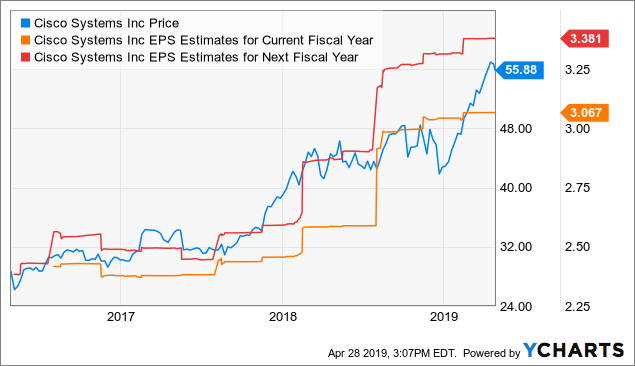
The chart shows earnings estimates for Cisco in both the current fiscal year and next fiscal year have significantly increased over time. Like usually happens, the stock price and earnings estimates tend to move in the same direction. In this particular case, fundamental momentum is driving the stock price higher in the past several years.
Data by YCharts
Reasonable Valuation
Wall Street analysts are, on average, expecting Cisco to make $3.38 in earnings per share. Under this assumption, the stock is trading at a forward price to earnings ratio around 16.5. The valuation is broadly in line with the average valuation level for companies in the S&P 500, which is more than reasonable since Cisco is a business with strong fundamentals and solid profitability levels.
It's also important to keep in mind that valuation is a dynamic as opposed to a static concept. Cisco has a solid track record in terms of delivering better-than-expected earnings over time, and earnings expectations for the company are increasing.
If Cisco can sustain its fundamental momentum going forward, the current earnings expectations are underestimating the company's true earnings power, and the stock would ultimately be much cheaper than what current valuation ratios are indicating.
In simple terms, a company with superior financial performance and strong fundamental momentum obviously deserve higher valuation levels than a business with mediocre financial quality and declining momentum. There is not much discussion about this fact, but it can sometimes be difficult to incorporate the different quantitative metrics in a single tool.
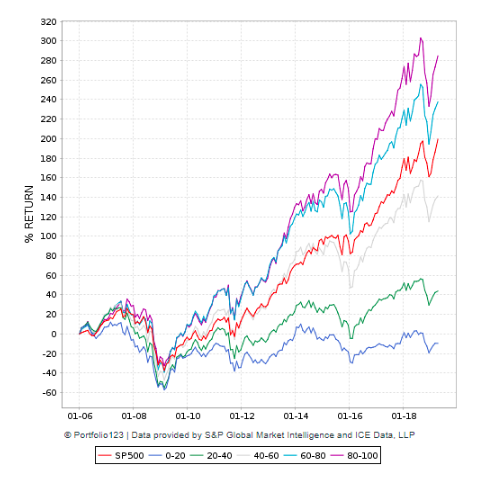
The PowerFactors system is a quantitative algorithm available to members in "The Data Driven Investor." This system basically ranks companies in a particular universe according to quantitative return drivers such as financial quality, valuation, fundamental momentum, and relative strength.
Data from S&P Global via Portfolio123
Cisco is the top quintile, with a PowerFactors ranking of 98.26. According to the backtested performance data, companies with the strongest quantitative rankings tend to generate superior performance in the long term.
The numbers alone don't tell the whole story. The algorithm shows that a group of companies with strong numerical attributes tend to outperform the market over the years. However, this does not really tell us much about what kind of performance a particular company such as Cisco will deliver in a specific year.
That being fully acknowledged, it's good to know that Cisco still has room for further upside potential if management plays its cards well from current valuation levels.
The Bottom Line
Cisco is far more stable and mature than other companies in technology, and the stock is not the best name for investors who are looking for a business with explosive potential for growth in the short term. On the other hand, strong cash flows and reasonable valuation levels also put a limit to downside risk in Cisco's stock.
With Cisco's stock trading close to all-time highs, there is no reason to rush into building a position in the stock at current prices. However, Cisco is a high-quality business trading at a very reasonable valuation, and the big picture in terms of risk and potential returns looks clearly solid over the long term.
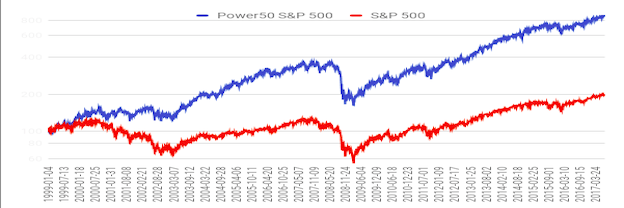
Statistical research has proven that stocks and ETFs showing certain quantitative attributes tend to outperform the market over the long term. A subscription to The Data Driven Investor provides you access to profitable screeners and live portfolios based on these effective and time-proven return drivers. Forget about opinions and speculation, investing decisions based on cold hard quantitative data can provide you superior returns with lower risk. Click here to get your free trial now.



Comments
Log in or sign up to join the conversation.