

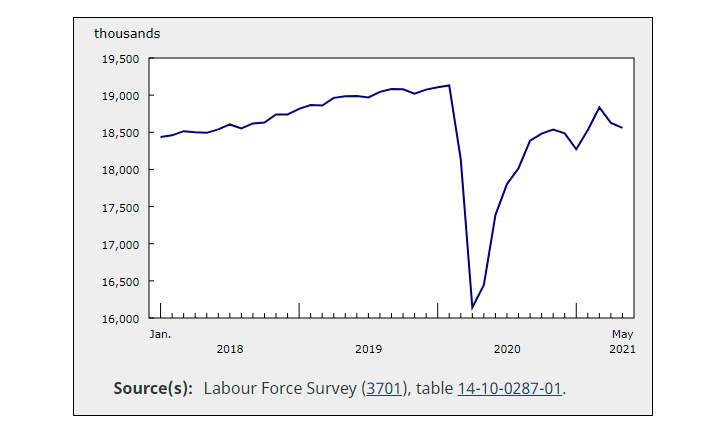
The May employment numbers in Canada serve as a perfect example of how damaging the pandemic has been to the Canadian economy. A smaller labour market, a further decline in the participation rate and an increase in the underutilization rate are very worrisome signs that the Canadian labour market is under considerable stress. Considering that public health restrictions and lockdowns remained in force, the loss of just 68,000 jobs and no change in the unemployment rate of 8.2% suggests that the Canadian economy continues to muddle through the pandemic. With the stay-at-home restrictions and closures of non-essential businesses continuing partway through June, we can expect another month of weakness in the job market. Many observers are looking beyond June, however, and are anticipating a much-improved labour market for the balance of the year. This remains to be seen, though.
Meanwhile looking under the hood of the Canadian labour market, there are several disquieting developments, to wit:
- The labour force participation rate continues to drop by another 0.3%; most of the decline can be traced to the drop off in the participation of core-age women (aged 25-54); many women have been directly affected by the third wave of lockdowns;
- The underutilization rate remains elevated. This rate captures those people who are able to work but are prevented from working more than half their usual hours; the underutilization rate is an indication of lost hours and loss income, indicating that we remain a long way from pre-pandemic employment levels;
Employment Decline in Canada
- Far too many workers are discouraged job seekers. Discouraged workers are those who want a job, but do not search because they have faced too many disappointments in the recent past or believe that there is no suitable work to be found; this is especially the case in recessions; Statistics Canada estimates that including the discouraged workers, the unemployment rate in May would have been 10.7%.
- Employment dropped in the goods-producing sectors. One of the anomalies of the pandemic has been the surge in demand for goods for both households and businesses; however, for the first time since April 2020, the manufacturing and construction industries suffered job losses; the only bright spot was a significant increase in natural resources which saw employment grow by 9%, on the back of a surge in international demand for commodities;
- Rise in Involuntary part-time work. An increasing number of workers must settle for part-time work because of their inability to land full-time employment; the rate of involuntary part-time work was 26% for men and 20% of women; and,
- Compared to February 2020, private sector employment is down 564,000; the number of self-employed workers is 5% below pre-pandemic levels and has shown relatively little growth over the past 15 months.
Unlike the Federal Reserve, the Bank of Canada does not have a dual mandate of price stability and full employment--- it is principally charged with maintaining price stability. At the same, it sets monetary policy with a framework of potential economic growth and that means it must bear in mind developments in the labour market. The May employment report suggests that Canada is a long way from full recovery and still further from any change in monetary policy.


Comments
Log in or sign up to join the conversation.