


In the long colorful history of American enterprise, few spectacles rival the resilience of the equity markets in the age of AI. Since the post-COVID bull market took hold in earnest in 2022, the tech-heavy S&P 500 (SPY) has climbed some 117 percent, while the even more concentrated Nasdaq (QQQ) easily outpaced, advancing almost 167 percent. By contrast, the patient steward of a tried-and-true diversified portfolio has had to content himself with roughly 66 percent—rather like bringing a sensible sedan to a Formula One race and wondering why the hypercars keep lapping him. Financials have offered little better, and large-cap healthcare—ostensibly ripe for artificial intelligence’s transformative touch – quelled every stock market scare. Two more companies joined the market’s 8 trillion-dollar valuation companies this year, with three more guaranteed a fast pass when they go public later this year.
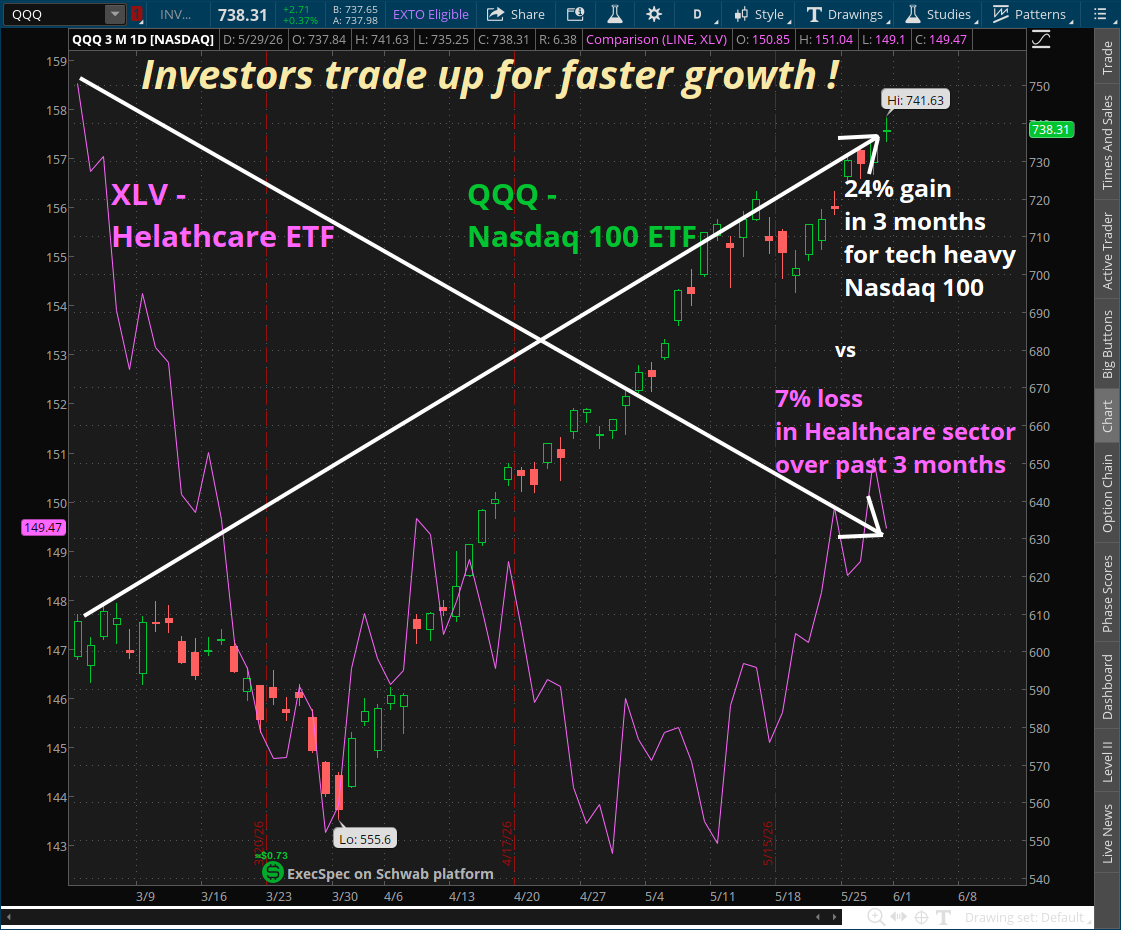
The AI concentration has grown even more pronounced of late. In May, seven of the eleven S&P 500 sectors finished in the red, yet the overall market was propelled sharply higher on the ever-rising weighting of the AI-related technology behemoths.
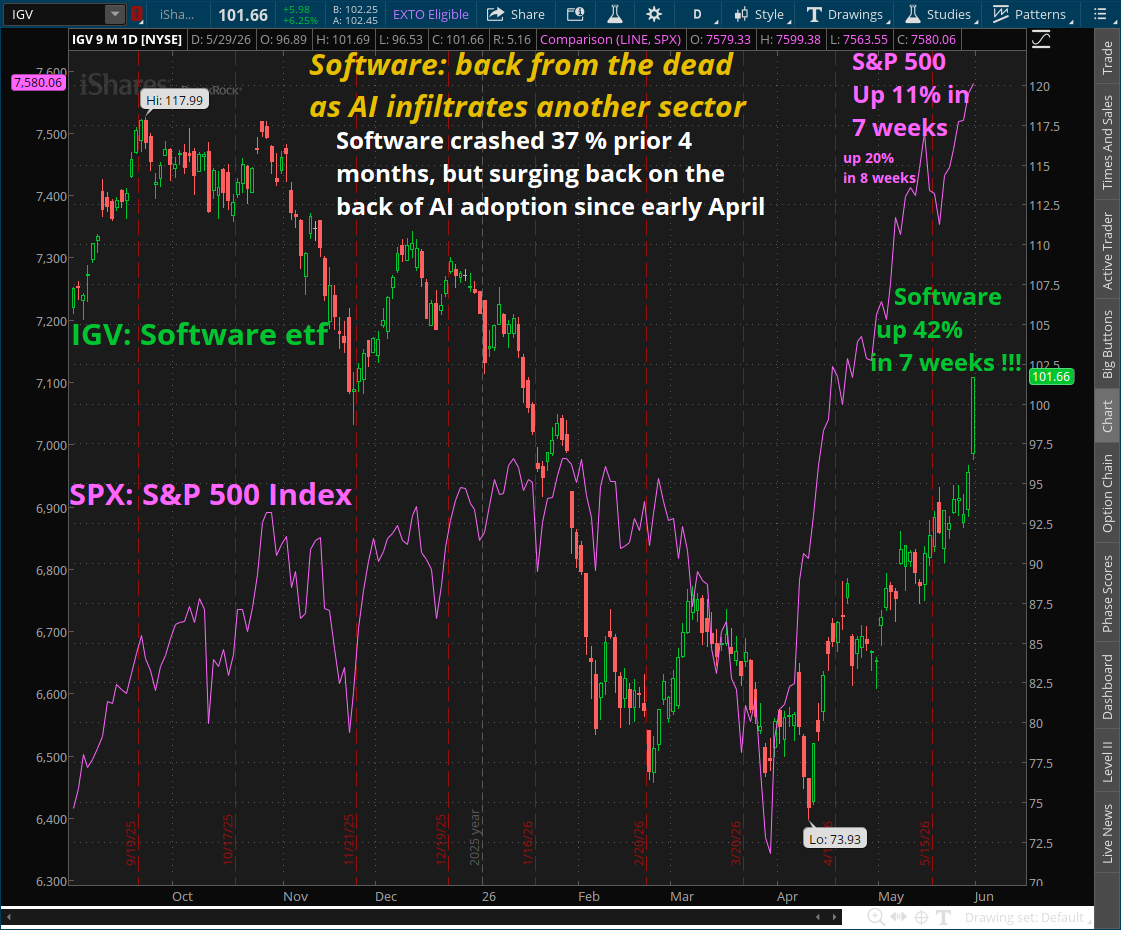
The few mega cap tech singers in this market are hitting notes so high that investors don’t hear that the rest of the choir sections have laryngitis. This narrow leadership underscores both the market’s vigor and its vulnerability. The long-awaited broadening of the rally appeared to gather momentum in the first two months of 2026, only to be interrupted by geopolitical tempests in the Middle East. The outbreak of hostilities involving Iran sent energy prices spiking, rekindling inflation fears and reminding investors that distant straits can still roil domestic ledgers. Yet through it all, one sector has remained serenely immune: the AI-related technology complex, propelled by hyperscalers whose capital expenditures continue to set new records and, in the process, lift the broader economy. Hardware, not software; durable goods for the data center rather than ephemeral code—these have been the engines of outperformance. The good news is that the SaaS apocalypse shows credible signs of abating. (SaaS = Software as a Service)
Quality names are seeing guidance and estimates revised upward, and the IGV software index has surged a remarkable 32 percent in just seven weeks. Leading the charge have been Oracle (ORCL), Microsoft (MSFT), and ServiceNow (NOW), with cybersecurity leaders—Palo Alto Networks (PANW), CrowdStrike (CRWD), and Fortinet (FTNT)—particularly distinguished. While the AI adoption game has barely begun in the majority of economic sectors, it is encouraging to see artificial intelligence now lifting the quality portion of software to join the technology hardware rocket ship—proof that even the software laggards are finally catching the tailwind of the new industrial revolution. Investors should expect that growth will remain with AI, but that AI will increasingly infect all sectors, extending the AI expansion wave.
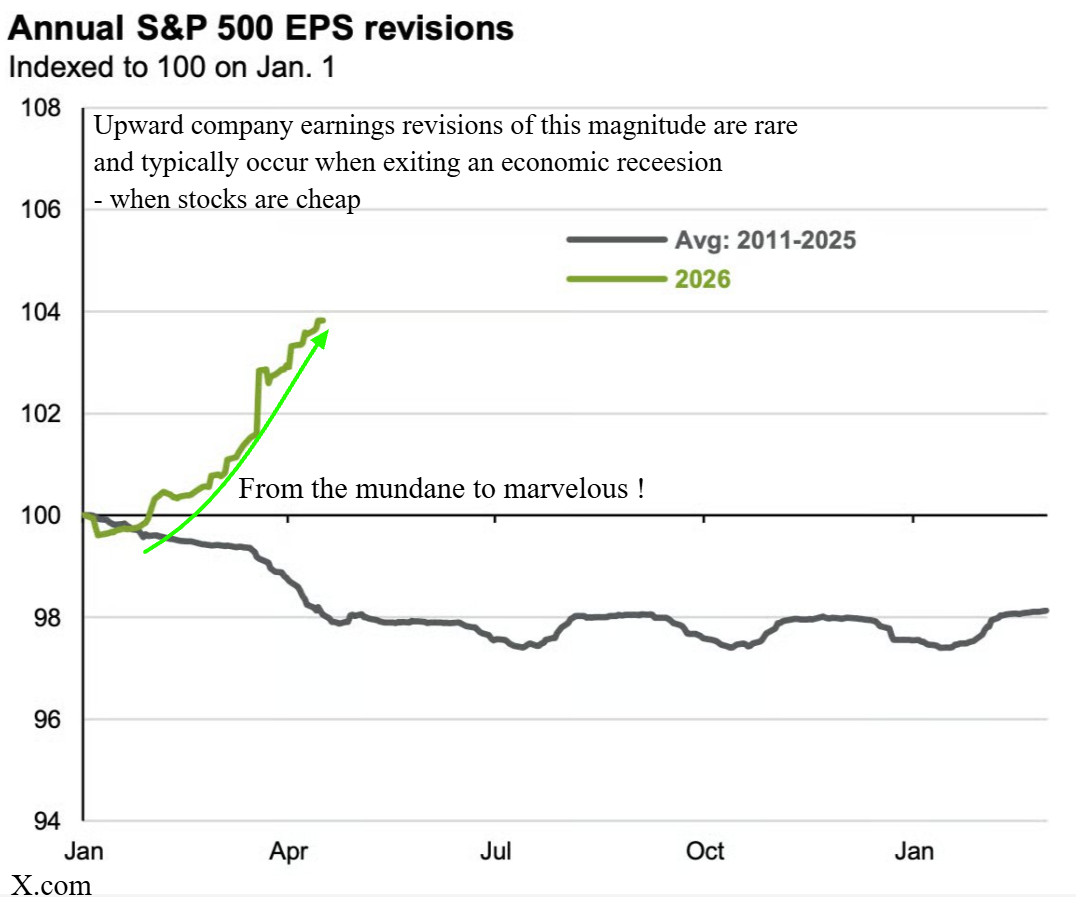
It is tempting to dismiss the stellar gains in the benchmark indices as narrowly led by the data-center buildout tsunami. Tempting, but incomplete. Corporate earnings provide sturdy justification for current valuations and underwrite aggressive forecasts for the year ahead. FactSet (FDS) data show first-quarter 2026 earnings growth of approximately 28 percent—the strongest since the artificial government-spending-fueled surge of 32 percent in late 2021. Fully 84 percent of reporting companies exceeded estimates, well above historical norms. This behavior usually correlates with new economic expansion cycles. Goldman Sachs (GS) and the reliably accurate Ed Yardeni project S&P 500 earnings of $385 and $375 respectively for 2027. At prevailing forward price-earnings multiples, that arithmetic points to 10 to 20 percent further upside in the index over the next year. The low 8,000s on the S&P 500 stands as a reasonable expectation, absent some fresh crisis, with the upper 8,000’s projected in 2027.
This week the S&P technology sector stands on the cusp of a second consecutive month of roughly 10 percent gains. The last such occurrence was in March-April 2009, at the dawn of the long post-Global Financial Crisis bull market. The time before that was October-November 2002—another launching pad for extended advances. Overall earnings growth today evokes the resurgence typical after recessions and bear markets: precisely the moment when consensus upgrades accelerate and history records the least risky entry points for equities. Those who buy at the point of maximum skepticism are often rewarded with the longest and most profitable journeys.
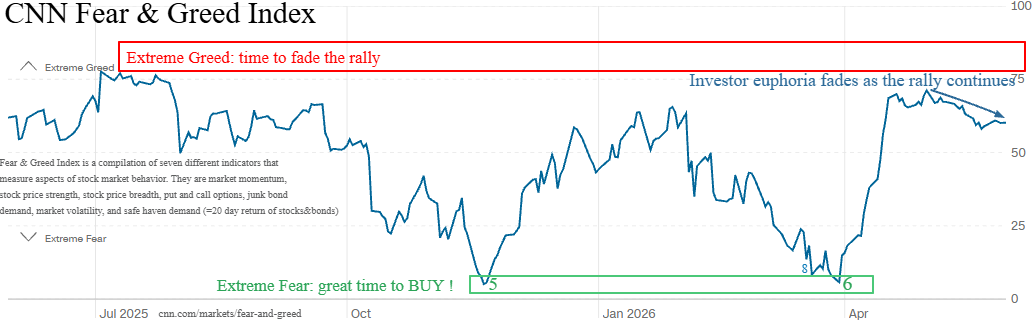
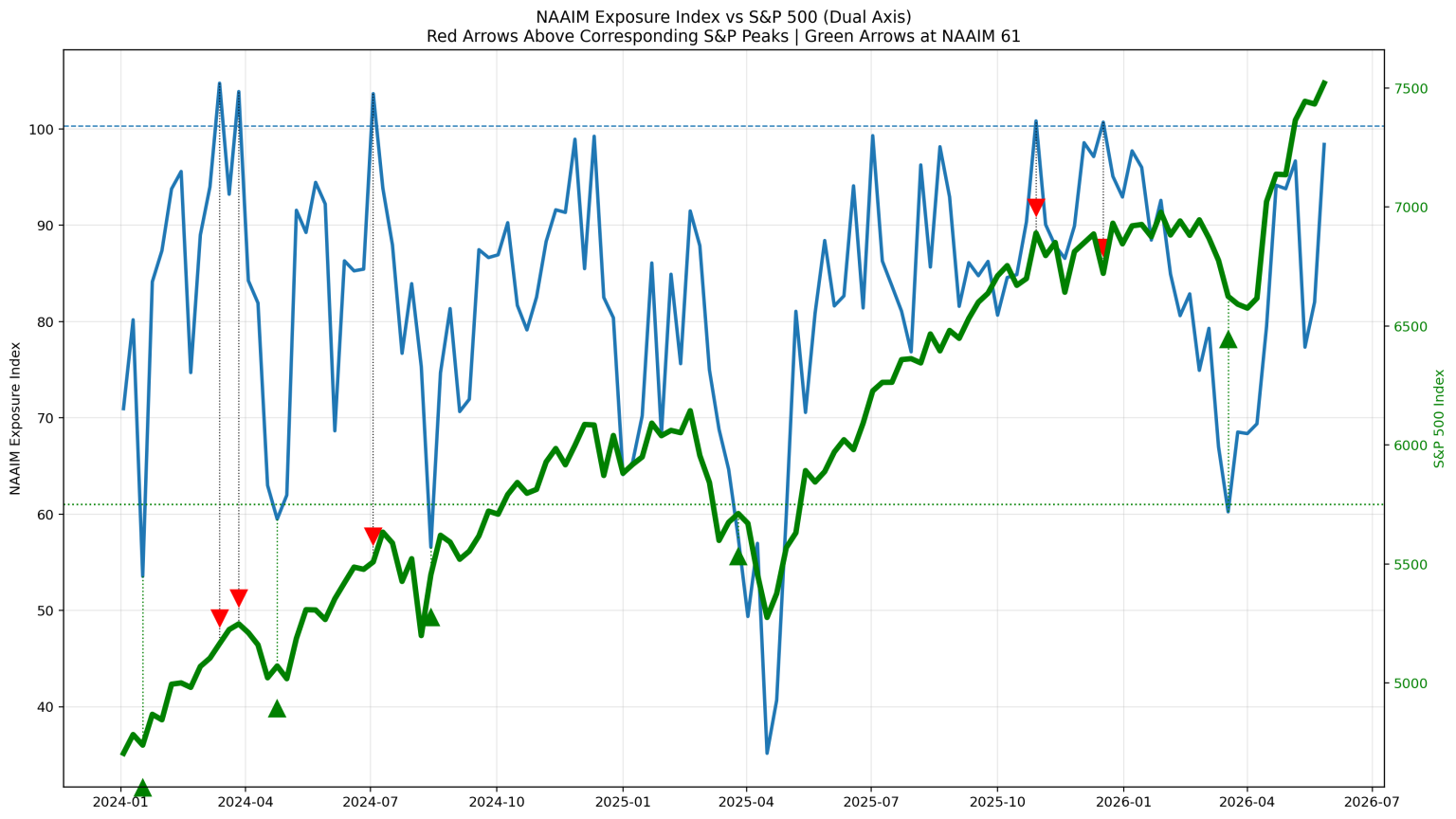
Memory and semiconductor indices have posted eye-watering two-month gains—125 percent and 65 percent, respectively—prompting understandable murmurs of froth. Yet revenues, earnings, and order backlogs among these firms are soaring in tandem, keeping valuations from the red zone. In truth, this is not longer term froth but the sound of genuine economic creation: the clanging of digital hammers building the bits and bytes of cathedrals in the AI age. Indeed, sentiment has turned notably more skeptical precisely as prices have rocketed higher; investors sit on their remaining cash and in sub-par performers rather than chase. The CNN Fear & Greed Index and the AAII small-investor bull sentiment gauge remain well short of extreme greed territory. Meanwhile, the NAAIM Exposure Index—measuring leveraged equity exposure among active money managers—has risen to elevated levels, yet it has not crossed the correction warning threshold above 100 where “temporary setbacks become more likely. In other words, the professionals are leaning in, but not yet leaping off the ledge. Patient, diversified investing was always the lesson throughout financial history for long term gains. This Bull market, almost 4 years and counting – has been prudent to be impatiently narrowing the focus to AI related, data center supplied concentration.
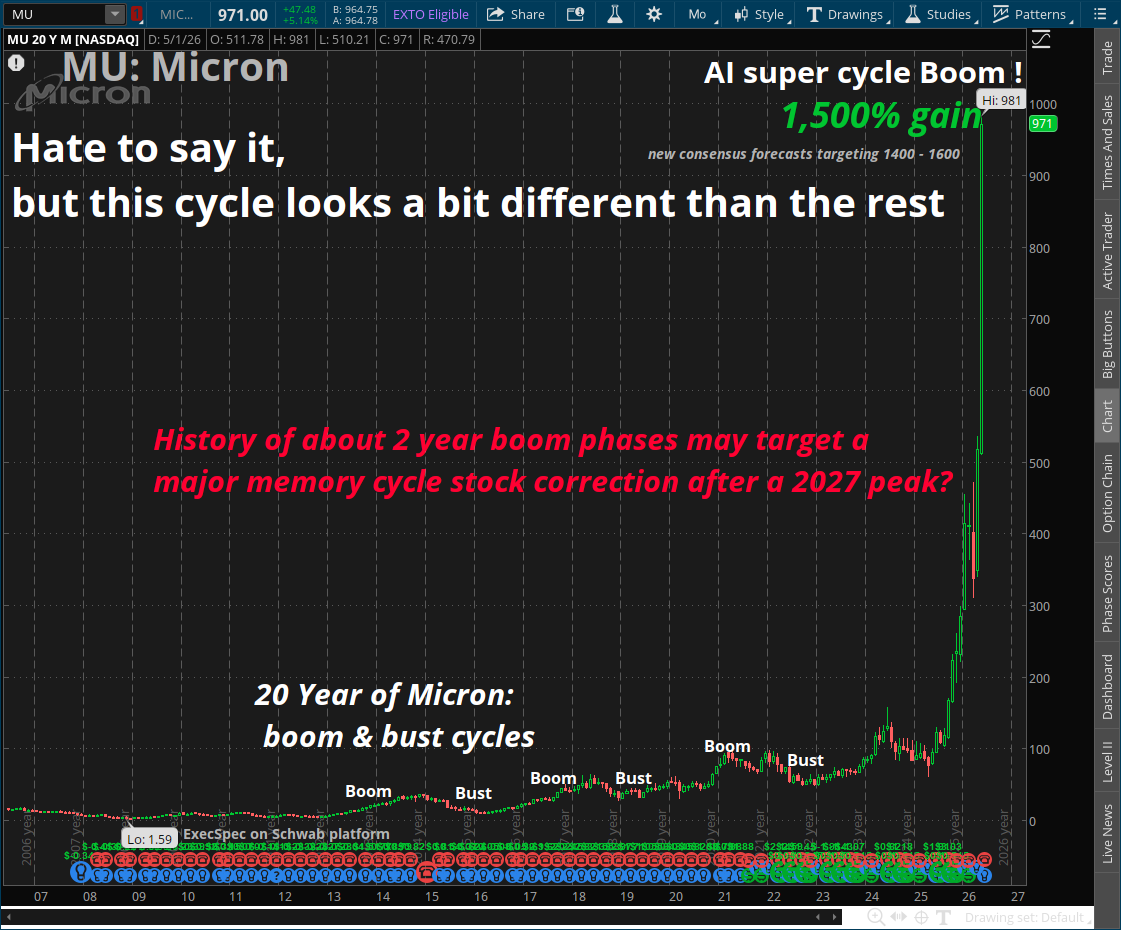
AI was conceived about 70 years ago, but it was only in the present decade that computational hardware could support this explosive deep learning revolution. At each stage, from Inference (the AI computational processing power) to Generative (applies that compute to create answers), insatiable increases in energy, memory and material are required. As the more aspirational Agentic phase of AI takes hold, the demand on resources may rise so rapidly as to reach a growth slowdown so that hardware and labor capacity can catch up. We are far from the oversupply stage of a maturing expansion cycle. Quantum computing efficiency in a couple years may adjust this prognosis, but sailing toward the current visible horizon, the trillion dollar tech giants appear destined to witness an ever larger club of participants. The first act of AI—generative—catapulted Nvidia (NVDA) into the exclusive $5 trillion club. The second, agentic reasoning, is accelerating demand beyond GPUs to embrace CPUs, TPUs, and especially memory while moving into widespread adoption by the end of the decade. Memory chips were once a cyclical commodity subject to regular boom-and-bust rhythms and now carries a secular tailwind, at least until the great AI infrastructure buildout reaches a plateau and quantum leaps in efficiencies reduce the energy and hardware growth requirements currently required. There will be deep corrections – often after a ~2 year run that we may be in the middle of now. Yet, slowing from hypersonic speed to supersonic will feel like a slowdown, but it’s still quite fast.
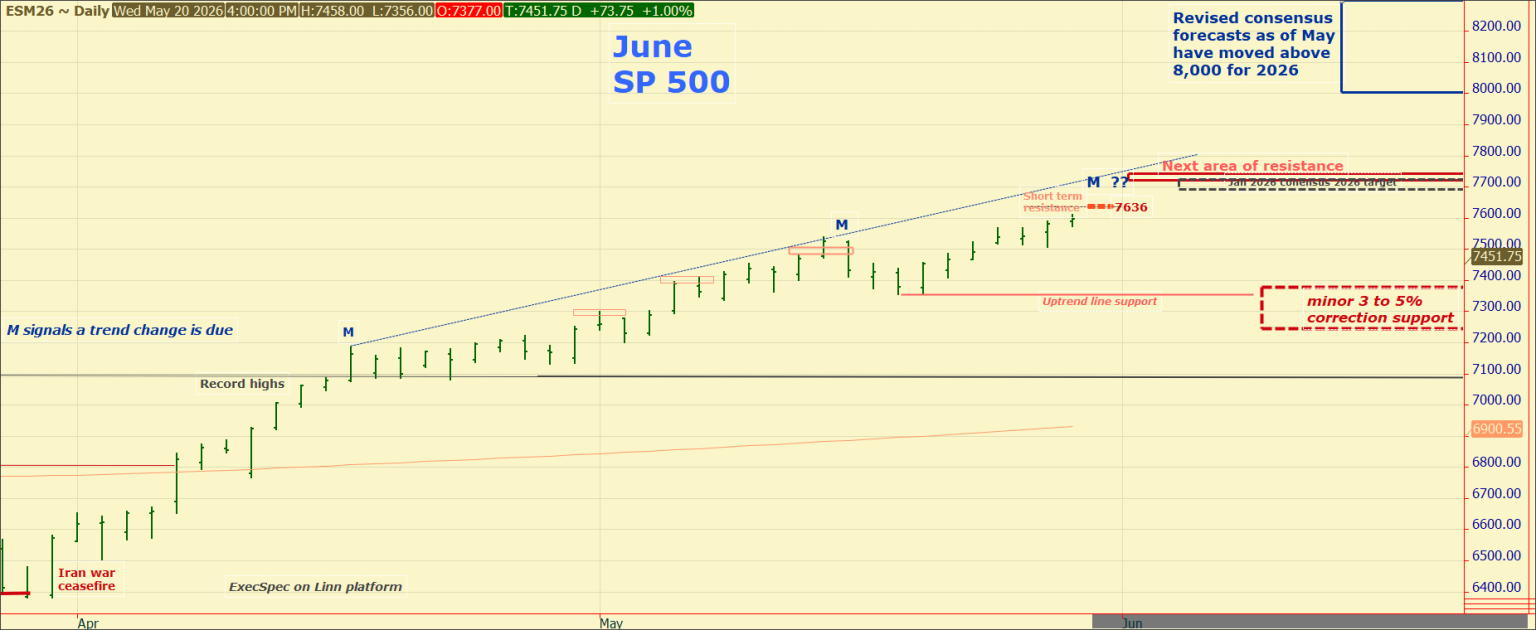
Short-term caution is not misplaced. SpaceX’s prospective public offering, with its modest $80-plus billion share float vs $1.8 trillion valuation, may coincide with a June peak as investors hoard liquidity for the Musk rocket. A further corrective wave seems probable in the month or so preceding November’s elections, particularly once OpenAI completes its own trillion dollar IPO. Yet the underlying bull market and the American consumer display robust health: record capital spending, business and consumer debt defaults and unemployment remain low, checking accounts are growing, retailers expect 5% sales increase and travel of every variety sets fresh records. The fiscal tax refunds and trade deficit improvement will boost Q2 GDP, despite the increased budgetary stress triggered by the spike in gasoline. Inflation and interest rates pose risks if they prove persistent. But should the current pause or prospective peace hold and energy flows resume – as investors surprisingly continue to expect, then markets will look past temporary tightness. When investors and bond traders can peer beyond the Strait of Hormuz, broadening into the long-beleaguered healthcare and financial sectors becomes probable. When any sector embraces AI, that will be the catalyst for further gains.
Should this market rally continue launching into the SpaceX IPO June 12th and into the forced institutional index accumulation prior to its Nasdaq lisiting, prudent traders may raise cash modestly ahead of potential June/July and OpenAI September peaks. Serious investors, however, should remain constructively bullish despite likely increased volatility after a summer peak that fades into the November elections. In markets, concentration carries hazards, but so does missing the durable advance driven by genuine technological and earnings momentum. The gate may be narrow, yet the road beyond remains open to more AI adopters —and history suggests those who walk it with disciplined optimism are often rewarded.
Comments
Log in or sign up to join the conversation.