

Key Market Outlook(s) and Pick(s)
On Tuesday, I joined Stuart Varney on Fox Business’ Varney & Co. to discuss Iran, markets, the economy, outlook, earnings, banks, and a lot more. Thanks to Stuart and Maggie Edwards for having me on:
On Tuesday, I joined Joel Elconin on the Stock Trader Network’s “PreMarket Prep” show to discuss markets, the economy, outlook, and the latest developments. Thanks to Joel and Zoltan Suranyi for having me on:
Bank of America Fund Manager Survey Update
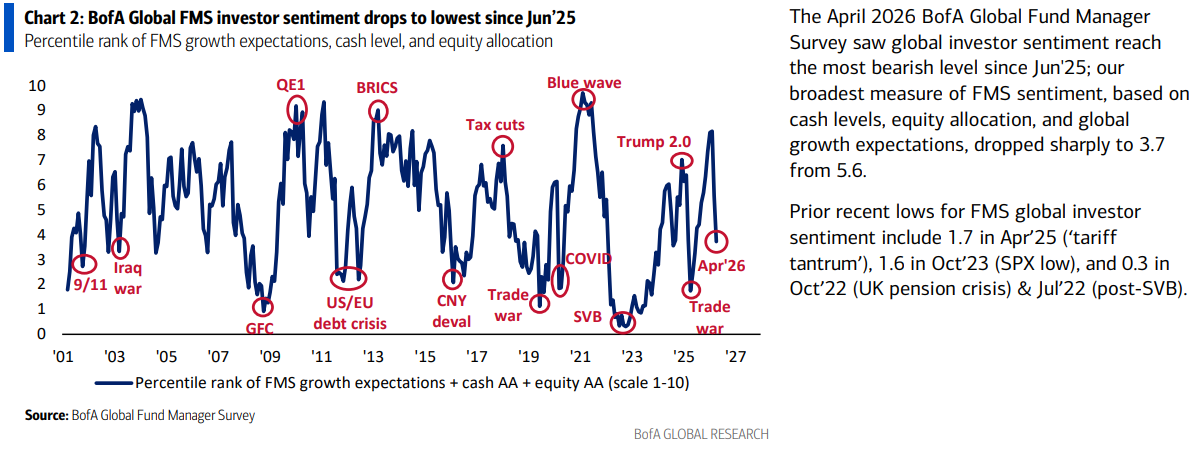
On Tuesday, we put out a summary of the monthly Bank of America “Global Fund Manager Survey.” This month they surveyed 193 institutional managers with ~$563B AUM:
Here were the 5 key points:
1) Fund manager sentiment, based on cash levels, equity allocations, and global growth expectations, fell from 5.6 last month to 3.7 in April, the most bearish reading since June 2025 (keep in mind, three-quarters of managers responded before the ceasefire announcement on April 8th). While that’s still a long way from the true capitulation levels seen in recent washouts (April 2025 “tariff tantrum” at 1.7, October 2023 SPX low at 1.6, July 2022 post-SVB at 0.3), zoom out and the playbook hasn’t changed: these “elevator down” collapses in sentiment have consistently proven to be buying opportunities served on a silver platter, a chance to add exposure to GOOD companies at EVEN BETTER prices. This time has once again proven to be no different.
2) Global equity allocation dropped from a net 37% overweight to just 13% overweight in April, the least overweight positioning since July 2025. While managers are certainly lightening up, they haven’t thrown in the towel yet. For context, prior recent lows saw managers go outright underweight, hitting a net 17% underweight in April 2025 and a net 52% underweight in September 2022.

3) The share of fund managers saying US equities are overvalued dropped to a net 64% in April, the lowest reading since February 2019. Something we continue to fall back on, and the reason we remain so constructive, is the earnings engine that keeps accelerating and powering equities higher. Full-year S&P 500 earnings growth estimates have been revised HIGHER since the beginning of the Iran War, now at 17.6% versus the prior 14.7%. The recent pullback has been driven entirely by multiple contraction (-18%), a rare setup alongside accelerating earnings growth and one that sets the table for the next leg higher.

4) Fund managers’ average cash levels held steady at 4.3% in April, the highest since May 2025 after the biggest single-month jump since COVID during the March survey. As we said from the beginning, this “event” started with a tweet and will end with a tweet, with the positive news and progress over the past few days catching positioning way offside and powering the V-shaped recovery seen since.

5) Global growth expectations have rolled over meaningfully, dropping from 7% last month to -36% in April, the lowest reading since August 2025. Once again, macro expectations and sentiment have diverged from US equity prices, with S&P 500 Y/Y performance still well in positive territory. Historically, these kinds of disconnects tend to be short-lived and consistently resolve higher, with markets proving far more resilient than the fear suggests.

Diageo (DEO) Update

For newer readers, here’s a brief overview of the key drivers behind our thesis on Diageo, the world’s largest premium spirits company priced as if nobody will ever sip alcohol again as the market mistakes a cyclical hangover for permanent impairment:


Diageo’s 1H FY2026 earnings report was a textbook kitchen sink quarter, the kind you tend to see whenever a brand new CEO steps into a turnaround situation. The idea is simple: take all your medicine at once by releasing every piece of bad news, cutting the dividend, and lowering expectations to the floor so that everything moving forward becomes GOOD NEWS.
That’s exactly what Dave Lewis delivered in his first earnings call as CEO of the world’s largest spirits company. He cut the dividend to a floor of $0.50 per share (vs. $1.03 in FY2025) and reduced the payout ratio to just 30-50% going forward. Full-year guidance was lowered, with organic sales now projected to decline -2% to -3% (previously flat to slightly down) and operating profit growth revised to flat to low single digits (previously low to mid single digits).
Most importantly, Lewis laid out every pain point prior management had failed to properly address with zero sugar coating: persistent capacity constraints at Guinness that continue to leave demand unmet, customer service levels he described as “very poor” following years of underinvestment, and a neglected mass-market segment after more than a decade of pushing the premiumization angle at the expense of everything else.
The good news is that Lewis didn’t just lay out the problems. Just seven weeks into the role, he laid out three immediate priorities to tackle them head on: portfolio repositioning, rebuilding customer relationships, and redesigning the operating framework.


On portfolio repositioning, this is the same playbook Lewis ran at Tesco: cut prices selectively to reposition brands, claw back share, and offset any margin dilution with volume gains. It’s no secret that Diageo’s portfolio skews heavily toward the premium end, especially in tequila where 70% of units sell north of $45 compared to just 35% for the broader market. That strategy has left flagship brands like Casamigos and Don Julio essentially competing with each other at the very top while the mass market goes unserved. Lewis sees selective repositioning as not only an opportunity to build a more resilient portfolio less dependent on the economic cycle, but to add incremental business rather than cannibalize what is already there. For those concerned about near-term margin dilution as a result, as Lewis put it: “you don’t take percentages to the bank, you take cash to the bank.”
On customer relationships, Lewis was very clear: on-trade capability dismantled during COVID has been slow and patchy in its rebuild, and off-trade systems are not fit for purpose, with Diageo still entering 65% of its customer orders manually. In his eyes, that is an opportunity to shift from growing through customers to growing with customers by helping them build their categories and gaining disproportionately from that growth.
On the operating framework, this is an area where we suspected there’s plenty of low-hanging fruit. Lewis, who earned the nickname “Drastic Dave” for his cost cuts during his Unilever (UL) days, came to the same conclusion. Perhaps the most telling example is the fact that Diageo is paying 10x more to run payroll for ~30,000 employees than Tesco did despite having 15x the headcount. So while the Accelerate cost savings program is already running ahead of schedule, with ~50% of the $625M in total savings now expected in FY2026 and ~40% of that already delivered in the first half, expect Lewis to kick that into an even higher gear.
Complementing these near-term priorities, the first domino of the long-rumored executive overhaul has fallen, with John O’Keeffe named as the new North America President and CEO, stepping into the company’s biggest geographical pain point.

Lewis is clearly wasting no time ripping off the band-aid and making significant changes before he’s even found the coffee machine, with the full turnaround plan expected to be laid out at a capital markets day in calendar Q3.
Kitchen sink quarter aside, it’s also worth putting this “disaster” into context. Revenues are down 2.8% organically (fundamentals). The stock is down 60% from its 2022 highs (price). This is a perfect example of the short-term voting machine versus the long-term weighing machine playing out in real time.

Right now, the voting machine has given up on the entire sector, pricing Diageo and its peers as if nobody will ever sip alcohol again. That dislocation has left the highest-quality name in global spirits trading at ~12x forward earnings, the cheapest level going back to the GFC and well below its 20-year average of ~20x. The market continues to mistake a cyclical hangover for permanent impairment, and that’s an opportunity we are more than comfortable leaning into.
The first half under Lewis was never going to be the major inflection point for Diageo. But give a proven turnaround operator a few years to reset the foundation and clean up operations, and what you will find on the other side is the same high-quality compounder Diageo has always been, not the terminal patient the stock price currently suggests. In the meantime, free cash flow continues to recover and remains on track for ~$3B this year (+9% Y/Y), giving management the flexibility and a long runway to get there.
Q2 Earnings Breakdown


10 Key Points
1) Diageo reported 1H net sales of $10.46B (-4% Y/Y), with organic net sales down -2.8%, missing consensus of -2.0%. The organic decline was driven by volume down -0.9% and negative price/mix of -1.9%. Three of five regions grew organically, with Europe +2.7%, Africa +10.9%, and Latin America & Caribbean +4.5%, but that was more than offset by North America at -6.8% (Diageo’s #1 market at 36% of sales) and Asia Pacific at -11.1%. The U.S. was the primary drag, with organic spirits down -9.3% as tequila sales fell -23.1% on continued category softness and down-trading, while Greater China fell -42.3% on government-driven Chinese white spirits headwinds.
2) Organic operating profit declined -2.8%, with margins broadly flat (+1 bps) at 31.1%, as adverse market mix and tariff costs were offset by lower marketing spend driven by Accelerate efficiencies. Looking ahead, management warned of some near-term margin pressure as the focus shifts toward the neglected mass-market portfolio with selective price repositioning on a brand-by-brand basis. This is the same playbook Lewis ran at Tesco: narrow price gaps to win back share, with the volume response and quantum of gross profit dollars more than offsetting the short-term dilution to percentage profitability.
3) The Accelerate cost savings program continues to deliver, with ~50% of the $625M total savings now expected in FY26, up from the ~40% assumption last quarter, and ~40% of that already realized in 1H alone. The majority of savings came from supply chain agility, cost efficiencies, and A&P optimization, with marketing spend down ~10% Y/Y, providing a $178M benefit to operating profit. Management continues to find low-hanging fruit across the organization, with new CEO Dave Lewis highlighting the fact that Diageo is paying 10x more to run payroll for ~30,000 employees than Tesco did despite having 15x the headcount, and that ~65% of customer orders are still being entered manually.
4) Guinness remains the standout across the portfolio, posting +10.9% organic sales growth in 1H and gaining share every single week of the half in North America. The Diageo Beer Company USA division saw net sales +7.3%, driven by double-digit Guinness growth, with the brand now +15% in North America and the fastest-growing beer brand in the region. Despite strong double-digit growth over the last five years and high historical ROIC, the business remains highly geographically constrained, with eight markets representing 85%+ of sales. Management is committed to increasing investment in capacity expansion to unlock new markets and scale Guinness 0.0, noting that current capacity will not be sufficient for the next 2-3 years given the growth trajectory and significant untapped opportunity ahead.
5) The board made the decision to cut the FY26 dividend to a floor of $0.50 per share, compared to $1.03 in FY25, with an interim dividend of $0.20 declared. Going forward, Diageo is moving to a 30-50% payout policy and remains committed to growing shareholder distributions over time. The savings will be used to fund reinvestment in restoring competitiveness in North America and expanding Guinness capacity. Given the need for deleveraging and reinvestment required to fund the turnaround, the cut doesn’t come as a major surprise and is exactly the type of decision we want to see from a new CEO focused on long-term value creation.
6) 1H operating cash flow decreased $202M to $2.14B, while free cash flow came in at $1.53B, down $164M Y/Y due to adverse working capital movements. Management reiterated FY26 FCF guidance of ~$3.0B (+9% Y/Y from $2.75B in FY25), and their commitment to strong cash generation remains unchanged.
7) While only seven weeks into the job, new CEO Dave Lewis laid out three clear near-term priorities during his inaugural earnings call: competitive category strategies with relevant brands, reinvigorating customer relationships, and redesigning Diageo’s operating framework. He called out Diageo’s customer service as “very poor,” noted the company is significantly underrepresented in the mass market, and indicated he would explore price repositioning, new proposition spaces, and RTDs to broaden the portfolio beyond the prior premiumization-only focus. Management expects to provide the board with a full updated strategy proposal in calendar Q2, with a capital markets day planned for mid-Q3.
8) Net debt stood at $21.7B at the end of 1H, down $182M, with leverage flat Y/Y at 3.4x. Management reiterated a commitment to deleveraging and reaching the target range of 2.5x-3.0x by fiscal 2028, but remains more focused on operational improvement than asset disposals to reach the target. Management was clear they are unwilling to sell brands below fair value despite recent market speculation. That said, with a portfolio of 200+ brands, disposals remain possible where appropriate, as evidenced by the recent $2.3B EABL sale and $1.8B sale of the Indian cricket franchise Royal Challengers Bengaluru.
9) 1H capex came in at ~$590M, down ~$40M Y/Y, driven by continued discipline around project-level investments. Management continues to expect full-year capex to reach the low end of the $1.2-1.3B range, down from ~$1.5B in FY25, with spend largely focused on Guinness production and capacity expansion, supply agility, and digital infrastructure, all areas that directly support the turnaround thesis and long-term competitive positioning.
10) Management lowered FY26 guidance, now expecting organic sales of -2% to -3% (prior: flat to slightly down) and operating profit growth of flat to low single digits (prior: low to mid single digits). The revision reflects further weakness in the U.S., which was previously expected to remain in line with FY25 market conditions, the ongoing impact of Chinese white spirits headwinds, and tariff-related pressure.
Earnings Call Highlights


Morningstar Analyst Note

Hormel (HRL) Update

For newer readers, here’s a brief overview of the key drivers behind our thesis on Hormel, an out-of-favor staples compounder and dividend aristocrat with a margin inflection ahead and the secular protein megatrend behind it:


Q1 Earnings Breakdown


10 Key Points
1) Hormel delivered its fifth consecutive quarter of organic net sales growth at +2% Y/Y, though reported net sales of $3.03B (+1.3% Y/Y) came in slightly below consensus of $3.07B. Organic growth remains broad based, with Foodservice at +7%, International at +8%, and Retail the weak spot at -2%. Adjusted EPS of $0.34 came in $0.02 ahead of consensus expectations.
2) Adjusted operating income came in at $247M, with an adjusted operating margin of 8.2%, down from 8.5% last year, as commodity and freight capacity headwinds continued to pressure profitability. Beef remained a significant inflationary headwind across the industry, pork trim increased +12% Y/Y, and nut costs stayed elevated, though some relief was seen on pork bellies. In response to the sharp increase in input costs, Hormel implemented two rounds of pricing actions that are now fully in effect as of the start of Q2, with benefits expected to build throughout the year. Management expects commodity costs to ease somewhat in the back half of FY2026, which, alongside Transform and Modernize efficiency and productivity gains, is expected to help drive gross margin expansion for the full year.
3) The Retail segment (~61% of total sales) remained under pressure, posting a -2% decline in organic net sales to $1.85B driven by a -6% drop in volumes and pricing actions not yet fully implemented. Segment profit fell -19% Y/Y to $96.2M, bringing segment profit margins down to just 5.21%. The decline was driven by the strategic exit from non-core private-label snack nut items, higher raw material costs, and unexpected increases in logistics expenses. That said, Hormel’s total dollar consumption was +2% in the latest 13-week Circana data, with priority brands +3%, led by Jennie-O ground turkey (dollar consumption +15%), Planters, Applegate, Hormel Gatherings, and Mexican brands.
4) Foodservice continues to be the engine, posting its 10th consecutive quarter of organic net sales growth at +7% to $998.2M, with segment profit +13% Y/Y to $156.5M and segment profit margins of 15.68%. Growth was broad-based across channels, driven by premium prepared proteins and branded pepperoni, with brands like Austin Blues smoked meats, Hormel Fire Braised, and Hormel Natural Choice all delivering strong volume and net sales growth. Management views the differentiated Foodservice model as a key competitive advantage in what remains a challenging environment with traffic still under pressure.
5) The International segment delivered +8% organic net sales growth to $181.3M, with segment profit +10% Y/Y to $22.9M and segment profit margins of 12.64%. Growth was driven by Hormel’s multinational businesses and branded exports, led once again by SPAM luncheon meat, with profit strength supported by lower SG&A spend and continued growth in China.
6) Hormel’s dividend aristocrat status continues, with the company paying its 390th consecutive quarterly dividend and returning ~$160M to stockholders during the quarter (5.61% current annual yield). The dividend is supported by a strong balance sheet with $868M of cash on hand (+$197M sequentially) against $2.85B in long-term debt.
7) Hormel announced a definitive agreement to sell its whole-bird turkey business to Life-Science Innovations, a strategic move aimed at reducing exposure to volatile, commodity-driven businesses and sharpening the focus on its value-added protein portfolio. The business typically generates $200-275M in annual net sales with high volatility and low margins that are significantly dilutive to Retail segment profitability. The transaction is expected to close by the end of fiscal Q2 with a ~$50M net sales impact in FY2026 and a larger impact reflected in FY2027. Importantly, the sale does not affect value-added turkey products, and Hormel will continue to own and use the Jennie-O brand name.
8) Capital expenditures came in at $69M in the quarter (vs. $72M last year), with the largest projects in China and continued investments in data and technology. Full year FY2026 capex guidance remains at $260–290M, compared to $311M in the prior year.
9) Cash flow from operations came in at $349M, up +$26M from the prior quarter, as Hormel continues to deliver strong and consistent cash generation.
10) Management reiterated full year FY2026 guidance across the board: net sales of $12.2–12.5B, organic net sales growth of +1% to +4%, adjusted operating income of $1.06–1.12B (+4% to +10%), and adjusted diluted EPS of $1.43–1.51 (+4% to +10%). Management expects sequential improvement throughout the year, with Hormel well positioned to deliver against its long term targets of 2–3% annual organic sales growth and 5–7% operating income growth.
Earnings Call Highlights


Morningstar Analyst Note

General Market
The CNN “Fear and Greed Index” ticked up to 47 this week from 28 last week. You can learn how this indicator is calculated and how it works here: (Video Explanation)

The NAAIM (National Association of Active Investment Managers Index) (Video Explanation) rose to 69.38% equity exposure this week from last week’s 68.36%.

Our podcast|videocast will be out sometime today. We have a lot of great data to cover this week. Each week, we have a segment called “Ask Me Anything (AMA)” where we answer questions sent in by our audience. If you have a question for this week’s episode, please send it in at the contact form here.
Congratulations to all of the new clients that came in intra-quarter (Q1) with larger sized accounts, and to those existing clients who upsized their contributions to their accounts.
Our Q1 opening is officially closed. Congratulations to all the new clients who joined during the opening.
Larger accounts $5-10M+ can access bespoke service anytime here.
Not a solicitation.
*Opinion, Not Advice. See Terms


Comments
Log in or sign up to join the conversation.