


The yield on France’s 10-year OAT has just crossed an important technical threshold, breaking out of the handle of the cup-and-handle pattern that had formed over the past few months:
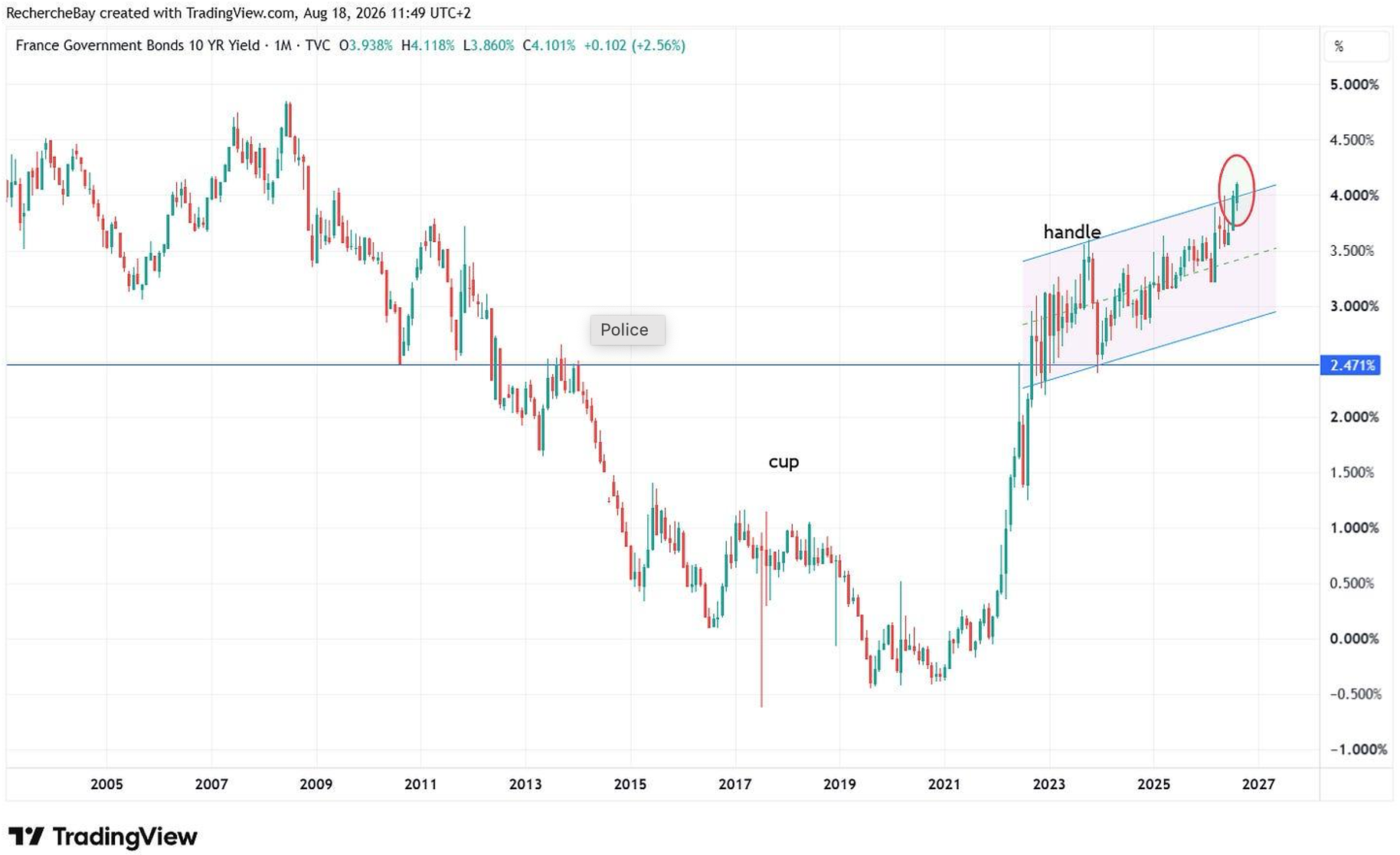
For technical analysts, this type of setup is generally interpreted as a signal that the upward trend is resuming. In the bond market, however, rising yields mechanically mean falling bond prices and higher borrowing costs for the government.
This breakout comes against a backdrop of fundamentals that continue to deteriorate.
France’s unemployment rate has risen to 8.3%, corporate bankruptcies remain close to 70,000 over a 12-month period, public debt has now reached 117.5% of GDP, and interest payments have become one of the government’s largest expenditure items. None of these indicators, taken individually, constitutes a crisis. But their accumulation is gradually reducing the country’s fiscal room for maneuver.
The key point, however, lies elsewhere.
French yields are not rising solely because of the deterioration in France’s domestic situation. They are part of a much broader move that is now affecting the entire global sovereign debt market.
For several weeks, U.S. yields have also been moving higher again:
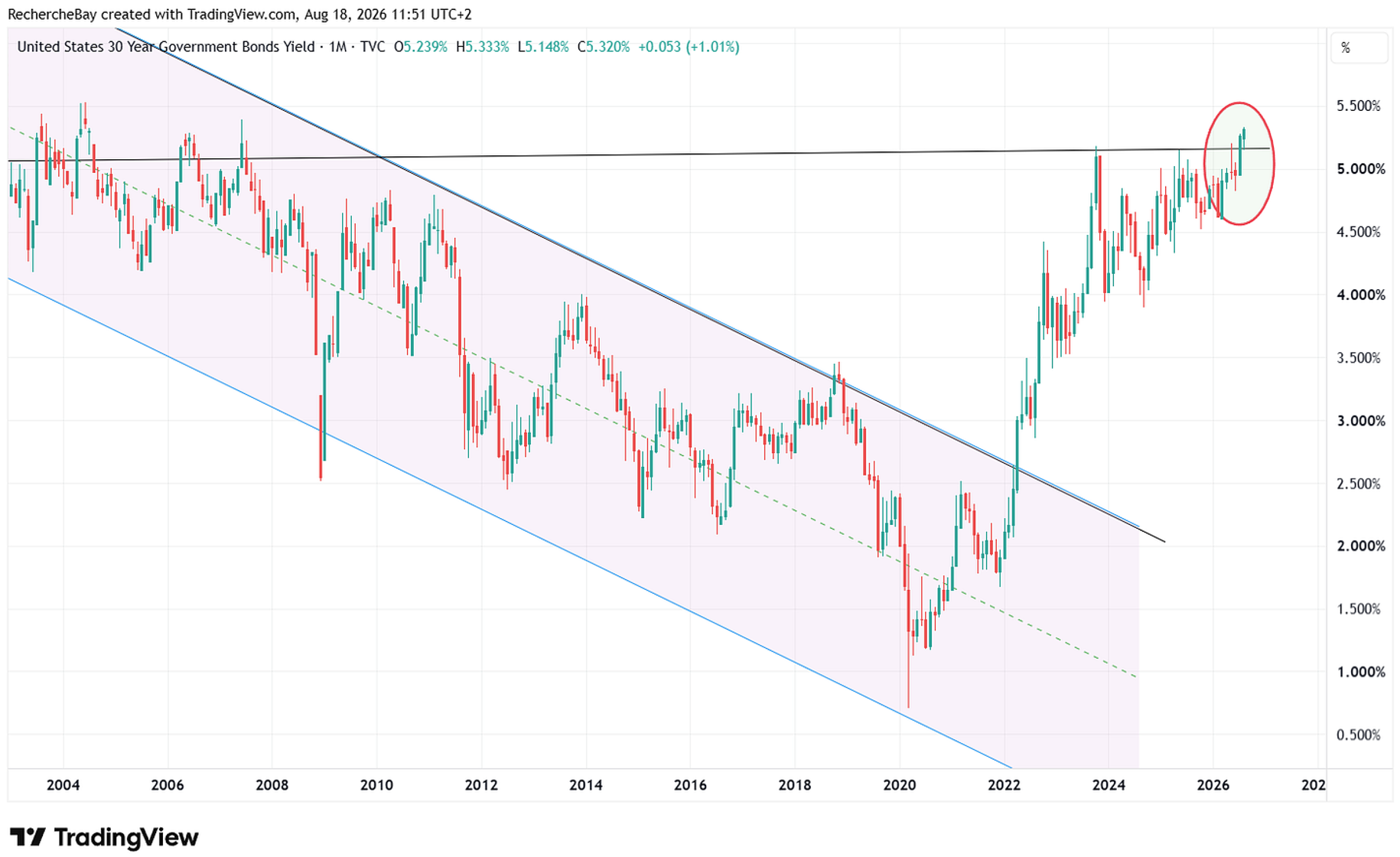
Investors are demanding increasingly higher returns to finance deficits that continue to widen. Banks are gradually reducing their exposure to Treasuries, several foreign central banks are slowing their purchases, and Treasury auctions are becoming increasingly difficult for the market to absorb naturally.
This trend was amplified by an episode that went largely unnoticed: the U.S. Treasury’s intervention regarding the yen.
By encouraging Japan to use the FIMA Repo Facility rather than sell its Treasuries directly to defend its currency, Washington implicitly acknowledged that further sales of U.S. government bonds could destabilize the market. The aim was to buy time and avoid a disorderly unwinding of the yen carry trade.
But this intervention has also altered perceptions of sovereign risk.
For decades, Treasuries have been regarded as the most liquid asset in the world. The Japanese episode is now a reminder that, when financial tensions rise, authorities may seek to influence how these bonds are used or sold. For some international investors, this development could change perceptions of liquidity in the U.S. sovereign debt market.
Bond markets, however, are deeply interconnected.
When U.S. yields rise, investors generally demand higher returns on other developed-market sovereign debt as well, including French government bonds. France does not finance its debt in isolation: it is in constant competition with the United States, Germany, Japan and other major sovereign issuers for international capital.
Japan is another major warning signal.
The yield on two-year Japanese government bonds has just reached its highest level in more than 30 years:
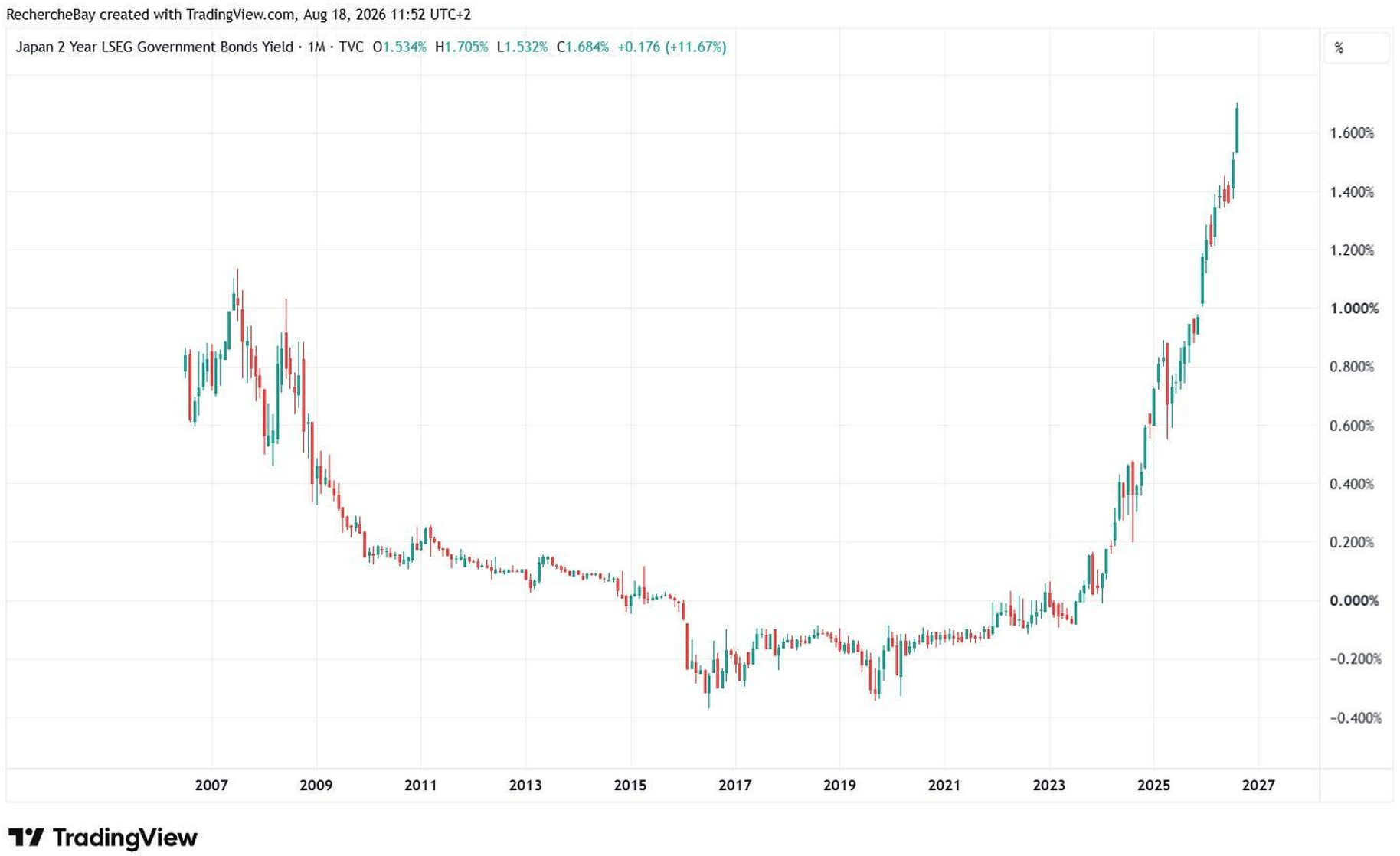
This rise is gradually weakening one of the main engines of global liquidity: the yen carry trade. For more than 20 years, investors borrowed yen at near-zero interest rates to buy higher-yielding assets elsewhere in the world. Today, this source of funding is becoming much more expensive, gradually putting pressure on bond markets around the world.
In other words, France is facing a double constraint.
On the one hand, its own public finances are gradually deteriorating. On the other, global markets are now demanding higher yields to finance governments. This combination explains why the French 10-year bond is currently moving in a much less favorable environment than during the previous decade.
Does this mean we should be talking about another Greek crisis? Probably not.
Greece in 2010 faced a sudden crisis of confidence. Investors stopped refinancing the government, bond yields soared, the country lost normal access to financial markets and had to be supported by its European partners and the IMF. In return, Athens implemented several years of fiscal austerity, restructuring and far-reaching reforms. The Greek crisis was ultimately resolved through a combination of external assistance, debt restructuring and extremely costly economic adjustments.
France’s situation is very different.
France retains normal access to financial markets, benefits from a much more diversified economy and belongs to a monetary union capable of intervening in the event of extreme market stress. It is not, however, immune to financing constraints. The more debt rises in a high-interest-rate environment, the more interest payments gradually erode the government’s fiscal room for maneuver.
It is precisely in this type of environment that holding part of one’s wealth in real assets, particularly physical gold, becomes especially relevant.
Gold is not a bet against France. It is insurance against an environment in which highly indebted governments have fewer and fewer painless options available to them. History shows that when the debt burden becomes difficult to finance, the response generally involves some combination of inflation, financial repression, higher taxation or persistently low real returns on savings. The methods vary from one country to another, but the objective is often the same: to gradually reduce the real burden of debt.
The technical breakout in the French 10-year yield therefore does not mean that a crisis is imminent. It does, however, serve as a reminder that the era of persistently low interest rates is probably behind us. For French savers, this means monitoring not only the decisions of the European Central Bank, but also developments in the global sovereign debt market.
Because it is increasingly in this market that the financial stability of governments — and, ultimately, the real return on people’s savings — will be determined.



Comments
Log in or sign up to join the conversation.