Biogen Needs An Easier Injection

Biogen aims to accelerate Leqembi adoption with a new at-home autoinjector designed to bypass clinic bottlenecks.

A new drug delivery format usually just extends a product lifecycle. But for the latest class of Alzheimer therapies, regular infusions have become a major commercial bottleneck. Biogen and Eisai are entering the launch window for the starting dose of Leqembi Iqlik, which lets patients begin treatment at home instead of waiting 18 months to switch from infusions. If the bull case is right, moving new patients out of infusion centers could unlock real volume and support the growth expectations tied to the stock. A closer look at the ongoing treatment and monitoring requirements suggests the convenience narrative might still be overstated.

Main Note

Testing the at home thesis for Leqembi

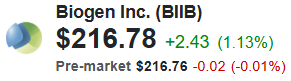
Biogen (BIIB) Quote

Verdict: The transition to an autoinjector solves the clinic bottleneck, but it does not eliminate the heavy monitoring burden placed on patients.

What happened

Monday was supposed to be the FDA’s extended action date for the weekly starting dose of Leqembi Iqlik. The original deadline was May 24, but the agency pushed it to August 24 before approving the dose ahead of schedule on July 13. The approved starting regimen is two 250 milligram injections once a week, and Eisai has said it should become available through specialty pharmacies in late August. That means the story has already moved from regulatory risk to commercial execution.

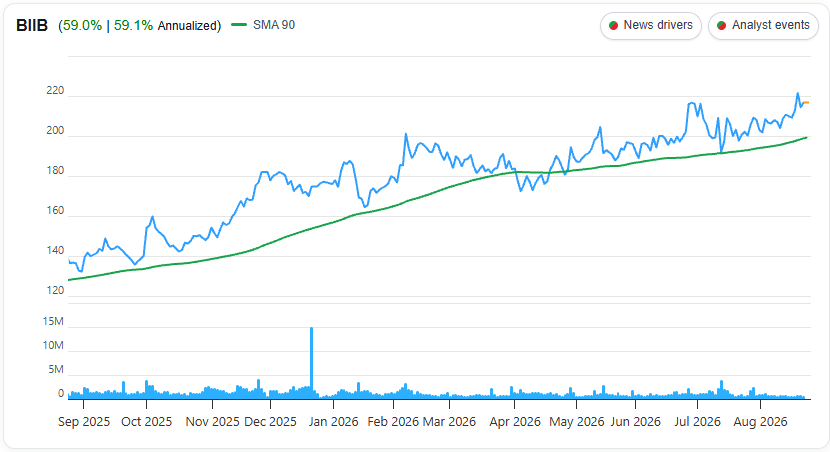
Biogen (BIIB) 1 Year Chart

Biogen (BIIB) 1 Year Chart

Why it matters

The intravenous version requires a trip to an infusion center every two weeks, which can limit how many patients a health system can handle. Moving new starts to an at home autoinjector removes the infusion chair from the treatment routine, though patients trade that visit for two injections at home each week and still face the diagnostic and monitoring work around the drug. Biogen recognizes its 50% share of Leqembi net revenue after cost of sales and royalties, while also absorbing half of the related research, sales and marketing costs. Higher volume still matters as the company tries to offset declining revenue from legacy multiple sclerosis products, but it does not flow straight to the bottom line.

What changed in the thesis

Investors now have to believe the delivery format was the primary hurdle to adoption. The market priced in a steep revenue curve based on the idea that an easier injection will keep patients on the drug longer and attract new users who previously avoided the clinical hassle.

What the market may be missing

The convenience narrative downplays the reality of ongoing medical surveillance and safety risk. Patients using the subcutaneous format still face a baseline MRI and periodic MRI monitoring to watch for amyloid related imaging abnormalities, which can involve brain swelling or bleeding. Extra attention is recommended during the first 14 weeks of treatment, so patients cannot simply take the drug at home and forget about the clinic entirely. Leqembi’s approved treatment model also includes ongoing maintenance after the first 18 months. Its main rival, Kisunla, allows prescribers to consider stopping therapy once a PET scan shows amyloid plaques have fallen to minimal levels.

Valuation and expectations

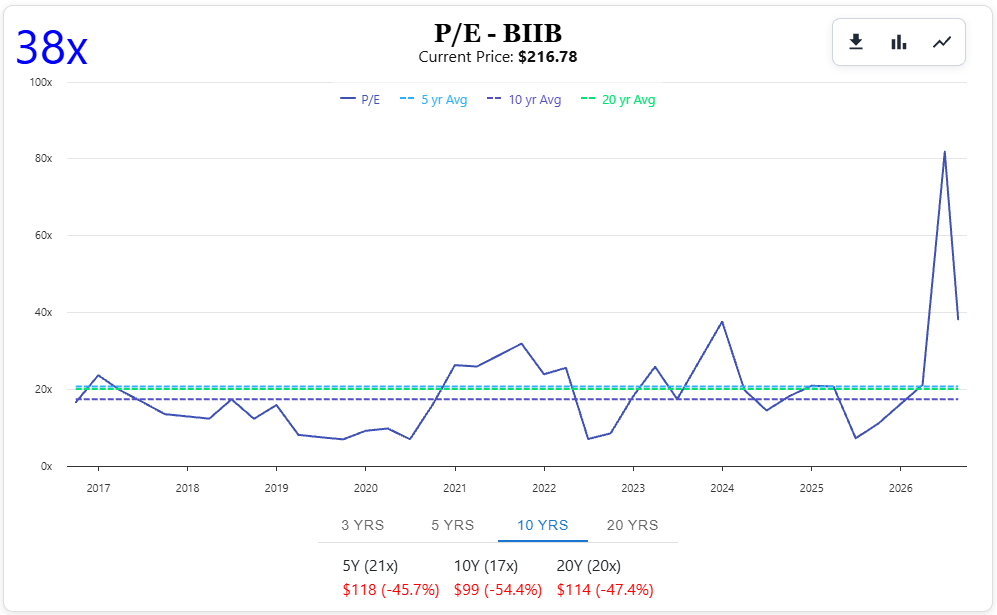
Biogen trades near 38 times trailing GAAP earnings, but that number is elevated by acquisition related and in process research and development charges. At roughly $217, the shares trade closer to 17 to 18 times Biogen’s current 2026 non GAAP earnings guidance of $12 to $13 a share. That is not cheap enough to ignore execution risk, but it is a very different setup from a clean 38 times multiple. If early specialty pharmacy data shows the autoinjector fails to accelerate patient adoption, analysts could still cut peak sales estimates and pressure the stock.

Biogen (BIIB) PE Ratio

Biogen (BIIB) PE Ratio

Bottom line

An easier injection is a necessary step for Biogen, but it might not be a sufficient one. Until there is proof that patients are willing to accept long term maintenance, MRI monitoring and the rest of the treatment workup, the commercial ceiling for Leqembi remains a major open question.

Pre Market Pulse

  • Biogen shares were slightly positive early Monday, trading near $217.

  • The broader healthcare sector continues to show defensive strength. The Health Care Select Sector SPDR Fund (XLV) moved higher over the past month to reach recent 52 week highs.

Why it matters this morning

Healthcare stocks are catching bids as investors rotate into defensive names. That gives Biogen a favorable sector backdrop right as its most important product hits a critical commercial phase.

Peer Read Through

Eli Lilly (LLY)

The primary competitor in the Alzheimer space commands a massive market capitalization of roughly $1.12 trillion. Its Kisunla therapy requires a monthly intravenous infusion but offers a finite treatment duration once plaques are cleared. That presents a direct contrast to the indefinite treatment model of Leqembi.

Eisai (ESALY)

The development and commercialization partner for Leqembi carries a market capitalization of roughly $8.6 billion. Eisai leads global regulatory submissions and books all sales. The two companies share the economics equally, making this launch just as vital for the Japanese drugmaker.

BioArctic (BIOA B)

The original discoverer of the Leqembi antibody maintains commercial rights in the Nordic region and collects royalties on global sales. It currently holds a market capitalization of roughly $3 billion, meaning its valuation is highly sensitive to the autoinjector adoption curve.

Group takeaway

The Alzheimer drug space is splitting into two distinct commercial bets. Biogen and Eisai are betting on an easier at home delivery method. Eli Lilly is betting that patients will accept a clinical infusion if it means the treatment eventually ends.

What to Watch

  • Confirmation that the Leqembi Iqlik starting dose is actually available through specialty pharmacies in late August, followed by any early prescription data.

  • The mix of new patients beginning with the at home format versus existing patients switching from intravenous treatment.

  • Biogen’s timing and trial design for a planned Phase three program for diranersen. The Phase two CELIA study missed its dose response primary endpoint, even though several cognition measures and tau biomarkers favored the drug.

  • Any change in treatment starts, interruptions or discontinuations tied to MRI monitoring, safety concerns or specialty pharmacy access.

Bottom line

The real test arrives with the next set of prescription data. Investors need to see hard numbers proving the new delivery format is actually expanding the total addressable market, rather than just cannibalizing the existing infusion patient base.

STOCKS IN THIS ARTICLE

Also Mentions:

Comments