

In Real Estate, Confidence Is King!
Ask any builder their view of the real estate investment landscape, and they will typically say it’s a great time to invest and build. That’s because the vast majority of real estate investors are a pretty optimistic bunch. They have to be, in order to be willing to commit both time and money to begin a project.
Over time, that optimism has paid off, with a few memorable exceptions, including 1987, 1994, and of course, the Great Financial Crisis that began around 2007.
Unfortunately, I was caught in two of those, building houses on Long Island in 1987, and as the owner of a commercial mortgage company in 2008. As the saying goes, ‘timing is everything!’
On a positive note, however, I bought my house in 1994, a very favorable market for buyers. But how about now?
Uncertainty And Making Major Financial Decisions…Or, There’s No Such Thing As a Sure Thing!
The war with Iran has been a source of economic uncertainty as oil prices have been extremely volatile, while interest rates and mortgage rates have generally moved higher.
This isn’t our first rodeo with Iran, as that country has played a significant historical role in the U.S., with an example being the 1979 revolution there that triggered an energy crisis and caused crude prices to surge.
At the time, inflation soared to 14.5%, and the Fed Chair at the time, Paul Volcker, pushed interest rates to over 20% in order to fight back, triggering a recession at the same time.
As a newly minted college graduate with a degree in economics looking to start my career, I can attest to the fact of a very weak economy!
As a general rule, inflation plus recession is the definition of stagflation, the worst possible state of the economy, devastating for consumer confidence.
Using real estate as an example of the impact stagflation can have, because at the time home prices were falling, there was no urgency for buyers to jump in.
Stagflation is the worst of all economic scenarios because it takes away that urgency to make expenditures, under the assumption that prices will come down, or at the very least not rise.
In normal economic environments not ensconced in stagflation, uncertainty will come from typical business cycles, employment trends, and/or Federal Reserve policy.
Those forces tend to move slowly and somewhat predictably. What we are dealing with today is much different. The U.S.-Iran war has introduced a new and uniquely destabilizing form of uncertainty, one that arrives at unpredictable intervals, in the form of a presidential announcement on Truth Social, and reverses everything the market thought it knew about inflation, oil prices, interest rates, and mortgage costs, within minutes or hours.
We have had five or so ceasefires announced. We have had five or so reversals. Each ceasefire has produced market repricing and each reversal has unwound it. The cumulative effect on consumer and business psychology is severe.
What Whipsaw Uncertainty Does to Consumer Psychology
Whipsaw typically serves to create decision paralysis (somewhat similar to paralysis by analysis). I saw that happen many times a day as an equity trader, where being whipsawed on one trade can create an opportunity, but often traders would become indecisive and miss the chance to reverse.
Every major consumer purchase, whether a home, a commercial building, a long-term lease, or business expenditure, requires a stable set of assumptions about the future cost of money.
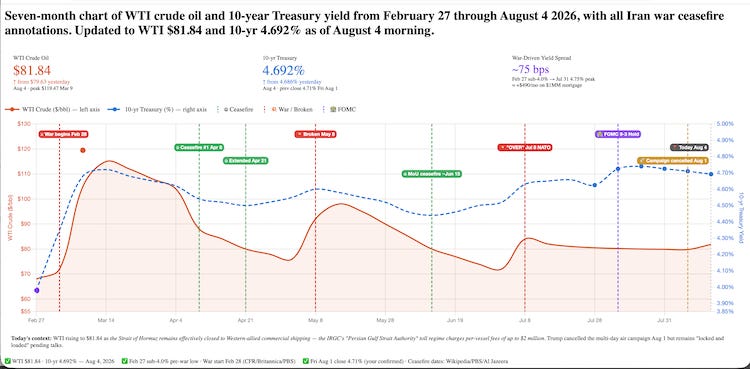
A buyer evaluating a $900,000 Nassau County home needs to know, with reasonable confidence, what their monthly payment will be. When geopolitics move the 10-year Treasury yield from sub-4.0% on February 27 to 4.75% by late July, a spread that adds nearly $490 per month to a $1 million mortgage, no rational buyer can plan. So they don’t.
Each time a ceasefire is announced, and yields dip along with crude oil prices, buyers who have been sitting on the sidelines begin to move. They call their agent. They get pre-approved. They make offers. And then the ceasefire collapses, yields and crude oil spike, their pre-approval no longer covers the payment, and they are forced to withdraw.
Consumer confidence is a measure of how people feel about their future economic circumstances. When conditions swing violently based on factors entirely outside someone’s control, like a Trump tweet about a ceasefire, an Iranian missile strike, a news alert about renewed talks, the psychological feedback is that the future is not navigable. Every category of discretionary spending that depends on a stable view of the future softens when that future becomes unreadable.
The Impact on Residential Real Estate:
1. The Mortgage Rate Whipsaw Kills Affordability Planning
2. The Lock-In Effect Has Intensified
3. Builder Confidence Is at Cycle Lows And Is Not Yet Recovering
4. The Appraisal Problem
Volatile rate environments create appraisal complications that most buyers and sellers never anticipate. Comparable sales used to appraise a property were completed in a different rate environment than the one the current transaction is being financed in.
5. The Psychology of Home Prices
Sellers who watched rates briefly dip to the low 6% range in June have set their price expectations accordingly. Buyers who are now facing rates back near 6.80% are unable to meet those expectations.
The Impact on Commercial Real Estate: Three Structural Challenges
1. The Cap Rate / Treasury Yield Squeeze
2. The Lease Decision Paralysis
Businesses signing commercial leases are making 5, 7, and 10-year commitments. Those commitments require a view not just on current business conditions but on the trajectory of the economy.
3. The Refinancing Wall Meets Maximum Uncertainty
Billions in commercial mortgages originated at 3% to 4% during 2019-2022 are maturing right now. In a stable rate environment, owners of those properties would negotiate refinancing terms, adjust their business plans, and move forward. In a whipsawing rate environment, the decision is much more difficult. Do you lock in a 7% rate today and accept the pain or wait for a ceasefire that might bring rates down, knowing that the ceasefire might collapse and push rates even higher?
What About Us?
There is a second-order effect of this whipsaw environment that is seldom discussed in financial media, but that is deeply relevant to real estate specifically.
Uncertainty affects not just buyers and sellers but also the entire real estate ecosystem that supports real estate transactions, including agents, attorneys, title companies, mortgage brokers, appraisers, inspectors, contractors, and the local businesses that serve newly moved-in families.
When transaction volume falls due to decision paralysis, every participant in that ecosystem sees their income decline. Reduced income reduces their own consumer spending. Reduced consumer spending weakens the local economy. A weaker local economy makes the employment outlook less certain. It all feeds back into reduced consumer confidence.
How Do The Markets Move Forward
Simply, the buyers, sellers, tenants, and investors who make up the real estate market need confidence and clarity, that the market is heading in one direction or the other.
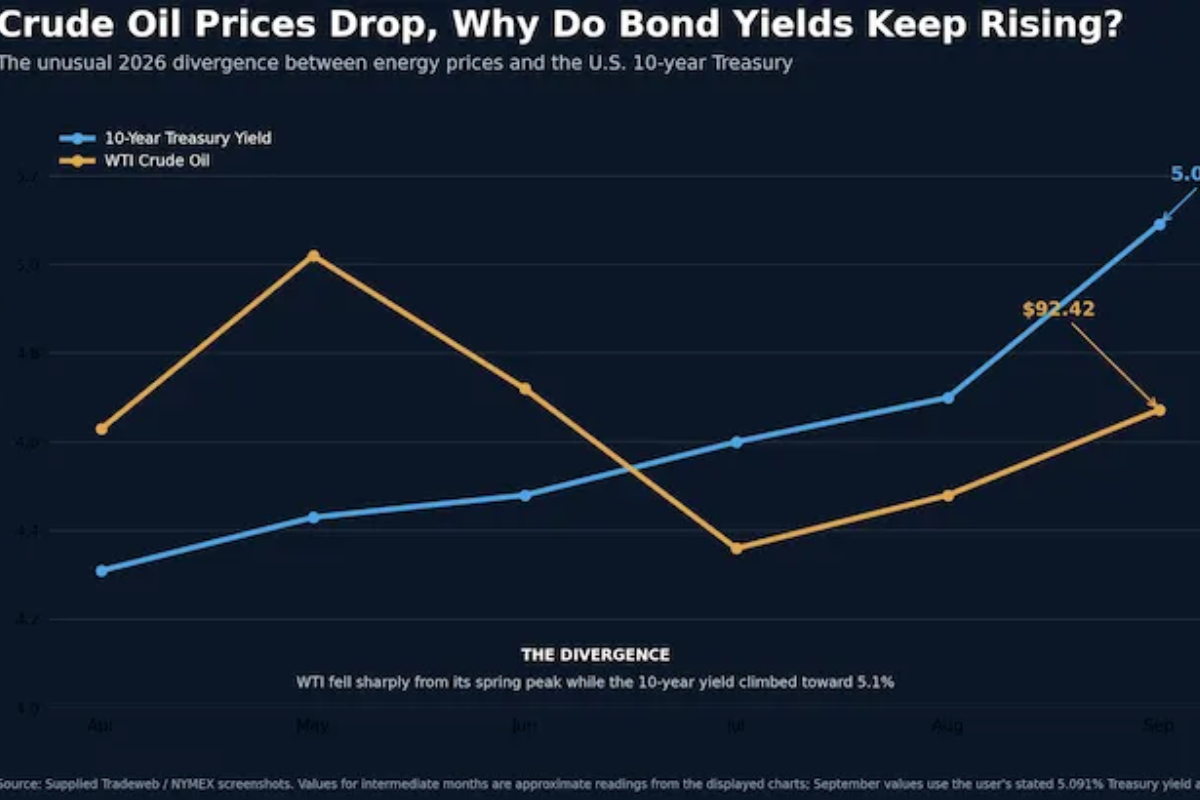
Looking at the roller coaster ride of interest rates and crude oil prices makes the current problem fairly clear.
Markets can handle bad news and high rates. But what markets have trouble handling, most recently delivered through the conflict with Iran, is uncertainty without end.
Comments
Log in or sign up to join the conversation.