

Let me take you to the poker table for a minute.
If you've ever played serious poker, you know about the rake. Here's how it works:
Every hand, before the dealer slides the pot to the winner, they quietly pull a few chips off the top. They drop those chips through a little slot in the table.
That's the rake. The house's cut.
I've spent a lot of hours at the table over the years.
I've had nights where the cards ran hot and I couldn't lose. And I've had nights where I couldn't catch a break to save my life.
But after enough time at the table, you start to notice... There's one seat that never has a losing night.
It isn't the best player in the room. It's the house.
Because the house isn't betting on the hand.
The house gets paid on the action. Win, lose, bluff, or fold. The rake comes out of every single pot.
And here's the thing most investors miss: The stock market has a house too. And right now, it's raking in chips hand over fist.
Meet the House
The big financial firms are the house of the stock market.
While everyone else argues over which stocks go up and which go down, these firms sit in the dealer's seat and take a cut of all the action.
They don't need to be right about the market.
They just need the table to be busy. And the table is VERY busy right now.
Let me show you the three different ways the house rakes its chips.
Rake #1: Taking Companies Public
Every time a company sells stock to investors, a bank runs the deal and collects a fee.
New companies going public (IPOs). Existing companies selling more shares (secondary offerings).
There's been a record $251 billion of new stock issued so far in 2026 (data through June 21).
And two really big deals are still coming! The giant AI names like Anthropic and OpenAI haven't even hit the market yet.
Wall Streets investment banks get paid to bring each deal to the table.
Where the stock trades afterward? Not the bank's problem. The fee is already in the drawer.
Rake #2: Putting Deals Together
When two companies combine, these mega-cap banks advise on the deal and collect fees on the transaction. This business is heating up fast!
Goldman Sachs advised on Martin Marietta (MLM) combining with Lhoist. Goldman also worked the deal for CRH (CRH) buying Arcosa (ACA).
And just this past weekend, Rocket Lab (RKLB) agreed to buy Iridium (IRDM). One more sign that dealmaking is picking up steam.
Now think about what's really happening here.
The buyer in each of these deals is making a massive bet. Billions of dollars on the line. That bet might pay off. It might not.
But the advisor's fee doesn't care either way.
Somebody else takes the risk. The house takes its cut.
That's the rake in its purest form.
Rake #3: Watching the Money
This is the quiet one. And it might be the best one.
The first two rakes only pay when something happens. A company goes public. A deal gets done.
But wealth management pays just for holding the money.
Wealth management firms manage trillions of dollars for affluent clients. And they skim a small percentage off those assets every single year.
Now remember where the market is right now. Sitting near all-time highs.
When account balances are swollen, so are the fees.
It's an annuity hiding inside the bank. The money sits there, grows, and quietly pays the house a cut year after year.
Activity AND Assets
Here's the pattern that ties it all together.
The first two rakes get paid on activity. Deals happening.
The third rake gets paid on assets. Money parked and growing.
So the house wins whether the market is busy OR just sitting near its highs.
Banks aren't betting on a hand here. They're owning the table. And the table collects three different ways.
This is exactly the kind of opportunity I pointed to yesterday. One of those corners of the market that's quietly working while everyone stares at the Mag-7.
Yesterday I promised you the one corner that gets paid no matter who wins.
This is it!
The Purest Way to Own the Table
If you want one name that captures all three rakes, look at Goldman Sachs (GS).
Goldman underwrites the stock offerings. (Rake #1.)
Goldman advised on those big deals we just talked about. (Rake #2.)
And Goldman runs a growing wealth and asset management arm. (Rake #3.)
One stock. All three rakes. The purest way to own the table.
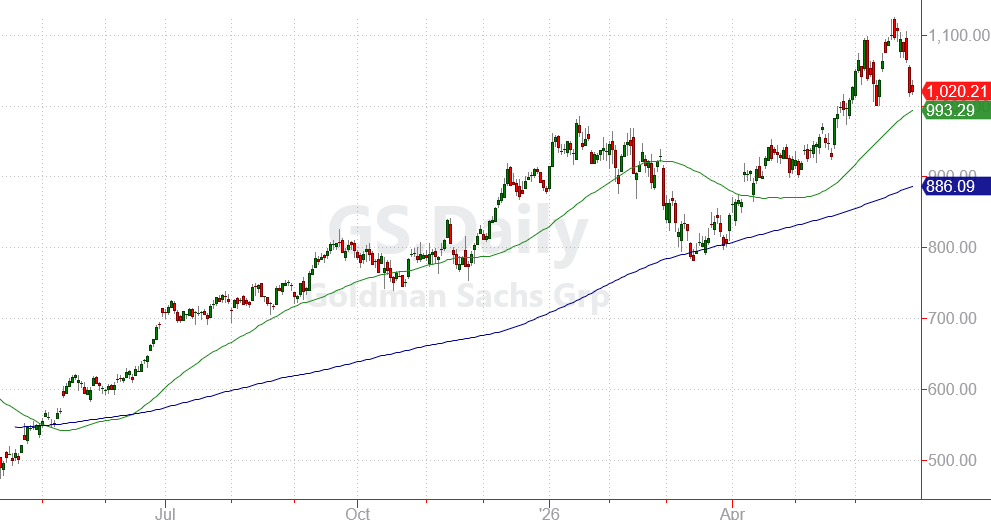
Of course, Goldman isn't the only bank in the dealer's seat.
JPMorgan (JPM) is the diversified giant that touches all of it at massive scale.
Morgan Stanley (MS) leans heavily on the dealmaking and wealth-management legs, so it rakes from two of the three.
And Robinhood (HOOD) plays the retail side, collecting on all the trading activity from everyday investors.
A quick word on how I like to buy these. I'm not chasing them higher here. I'd rather wait for a pullback and step in when the rest of the market gets nervous.
Full Disclosure
Before we go any further, I need to tell you that I personally own a bullish options position in Robinhood (HOOD).
Notice I said options.
There's a reason I often reach for options instead of just buying shares outright. Used the right way, options let you put down a small amount of money to control a much larger position. More upside potential, with a defined amount of risk going in.
It's one of my favorite tools for getting paid on what the market is actually doing, instead of just guessing which way a stock will go next.
And it's a big part of what I want to share with you next Monday. More on that in a second.
One Last Thought
The players spend all their energy fighting over who wins the next hand.
But the house just rakes its chips and stacks them higher.
This week, give some thought to which seat you'd rather be in.
Here's to building and protecting your wealth!

Comments
Log in or sign up to join the conversation.