


The Strategic Petroleum Reserve, or SPR, is at Multi-Decade Lows: Its Original Purpose and Potential Depletion Ramifications!
You will often hear the acronym SPR, or the full term Strategic Petroleum Reserve, mentioned in the news or in a speech by a President facing high gas prices, used as a tool to reduce the pain at the pump by releasing oil into the marketplace.
This lower price achieved from any release is typically a temporary band-aid that some might cynically consider to have been made with politics in mind, and not why the SPR was created in the first place.
Of course, the release is understandable from a PR perspective, as voters dislike the impact that filling their cars and trucks at high prices has on their budgets.
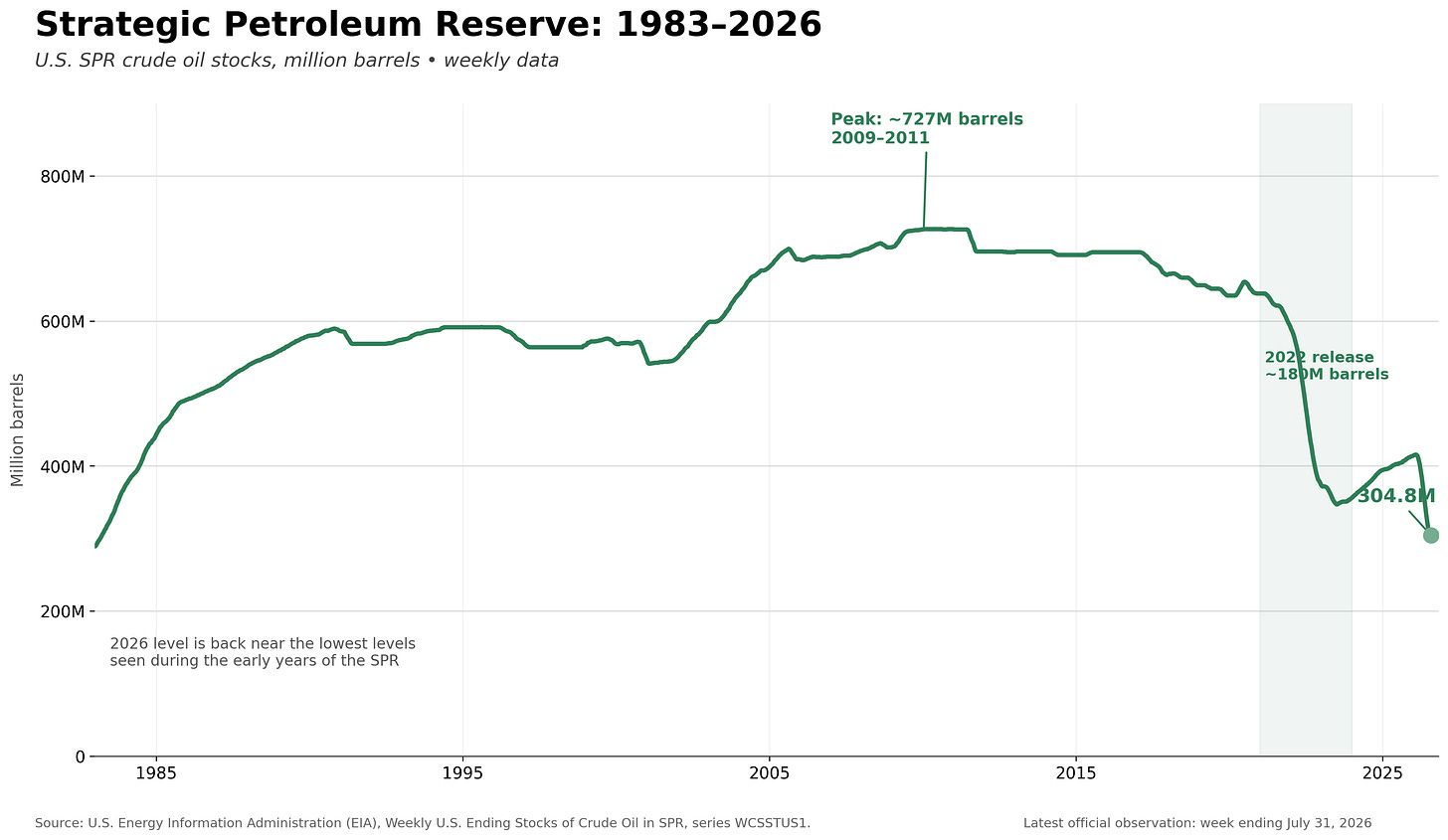
Whatever the reason a release is done or not done, the SPR is big, with an authorized capacity of 714 million barrels, currently sitting at 305 million barrels. The average number of barrels in the SPR over 30 years is 625 million.
So what exactly is the SPR and why was it created?
The Original Purpose of the Strategic Petroleum Reserve (SPR)
Genesis and Legislative Mandate: Established by President Gerald Ford through the Energy Policy and Conservation Act (EPCA) of 1975, the SPR was created in direct response to the 1973–1974 Arab oil embargo, which caused severe fuel shortages and economic disruption across the United States. I remember driving by gas stations on the high school bus, where lines would often be around the block, with people only being able to get gas on odd or even days.
National Security and Supply Protection: The core objective was to establish an underground stockpile of up to 1 billion barrels of crude oil to protect the U.S. economy, defense readiness, and foreign policy independence against international supply interruptions.
Treaty Obligations: The SPR fulfills U.S. commitments as a founding member of the International Energy Agency (IEA), which requires member nations to maintain emergency oil stocks equal to at least 90 days of net imports.
Emergency Stabilization Tool: The reserve was designed to serve strictly as a shock absorber during major crises such as foreign wars, severe natural disasters (e.g., Hurricane Katrina), or physical import blockades, and not as a tool for trying to push prices lower.
Now That The SPR Is At Four-Decade-Low Levels, How could It Impact Our Economy?
Loss of Shock Absorption Capacity: With reserves sitting near 40-year lows, the U.S. government loses its primary mechanism to offset sudden global supply shocks, leaving domestic energy markets directly exposed to geopolitical escalations and production cuts.
Inflation Risk: Energy serves as an input cost across almost all sectors. Oil price spikes rapidly pass through to gasoline, diesel, aviation fuel, petrochemicals, freight, and consumer products, driving up the Consumer Price Index (CPI) and the Producer Price Index (PPI).
Higher-for-Longer Interest Rates: Energy-driven inflation shocks complicate central bank policy. Persistent inflation pressures compel the Federal Reserve to maintain higher benchmark interest rates for longer, elevating yields on 10-year and 30-year U.S. Treasuries.
Suppressing Economic Growth: High fuel costs act as a tax on both businesses and households. Increased corporate operating costs combined with reduced discretionary consumer spending slow economic growth.
Erosion of Consumer Confidence: Retail fuel prices are one of the most visible daily economic indicators for consumers. We drive by gas stations and see it every day. Higher-for-longer gas prices negatively impact consumer sentiment and curtail spending across retail, entertainment, and travel.
Residential Real Estate Stagnation: An extended high-interest-rate environment keeps mortgage rates elevated, maintaining the “lock-in effect” for existing homeowners, keeps housing turnover low, and already hurting homebuyer affordability will worsen.
Commercial Real Estate (CRE) Underwriting Pressure:
Operating Expenses: Higher energy costs directly inflate utility bills for commercial properties, compressing Net Operating Income (NOI). This has been increasingly obvious in New York City rent-stabilized apartment buildings, where small allowable rent increases, and now 0% rent increases, are bumping up against a spike in utility costs along with an increase in other expenses like insurance and taxes.
Cap Rates & Valuations: Sustained mortgage costs keep capitalization rates high, resulting in lower property valuations and slowing transaction activity across office, retail, and industrial sectors.
Construction & Renovation: Petroleum-based materials (asphalt, insulation, roofing, PVC) and transportation fees increase, squeezing margins on ground-up developments and property renovations.
Fiscal Burden of Rebuilding the SPR: Bringing the SPR to its average fill rate would require a significant federal capital outlay if done at today’s prices. So what would it cost?
Target Fill Level - Current Fill Level = Barrels Needed
625,000,000 barrels} - 298,700,000 barrels} = 326,300,000
Total Refill Cost
326,300,000 barrels X $83.50\barrel = $27,246,050,000
So What Does A Depleted SPR Mean?
The drawdown of the Strategic Petroleum Reserve to multi-decade lows creates a significant amount of vulnerability. Originally built as a shield against global supply shocks has instead been drawn down to manage domestic cost pressures. This alters the risk profile for investors, consumers, and real estate professionals alike.
A Structural Shift in Macro Risk: With the national cushion depleted, any future geopolitical shock, Middle East supply disruption, or major Gulf Coast hurricane will transmit directly into domestic pump prices without a government buffer to absorb the initial blow. Of course, we are now producing much of our own oil, but oil is a global commodity with a price that’s global as well.
Sustained Headwinds for Interest Rates: As long as energy markets remain exposed to sudden price shocks, the Federal Reserve will face persistent inflationary pressure. This “higher-for-longer” monetary reality keeps long-term borrowing costs elevated across the board.
Real Estate Market Implications: High interest rates will continue to freeze residential inventory through the lock-in effect, while commercial real estate valuations, particularly across capital-sensitive assets, will remain under pressure from elevated cap rates and higher property operating expenses.
The Long-Term Capital Drag: Refilling the SPR will not be quick or cheap. The eventual fiscal capital needed to repurchase millions of barrels will create an ongoing structural demand floor under oil prices, ensuring energy policy remains a central focal point for economic growth through the late 2020s.
Ultimately, navigating an era of depleted energy reserves requires active risk management. Investors, developers, and business owners can no longer assume cheap energy or rapid central bank rate cuts, making balance sheet conservatism and operational efficiency the primary defenses against future macroeconomic volatility.

Comments
Log in or sign up to join the conversation.